







Abstract
Background
Physical education (PE) teachers work in highly interactive settings where regulating emotions is a routine yet resource-intensive requirement, potentially increasing occupational strain.
Objective
Grounded in Conservation of Resources theory and the Job Demands–Resources model, this study examined how three emotional labor strategies—surface acting, deep acting, and genuine expression—relate to emotional exhaustion among Chinese primary and secondary school PE teachers, and whether social support moderates these associations.
Methods
Using convenience sampling, questionnaire data were collected from 1483 PE teachers. After controlling for gender, age, teaching experience, marital status, and education level, moderated regression analyses were conducted to test direct and interaction effects.
Results
Surface acting and deep acting were positively associated with emotional exhaustion, whereas genuine expression was negatively associated with emotional exhaustion. Social support significantly buffered the positive associations of surface acting and deep acting with emotional exhaustion, but did not significantly moderate the association between genuine expression and emotional exhaustion.
Conclusions
Emotional labor strategies show differentiated links with emotional exhaustion among PE teachers in China. Strengthening social support may help mitigate the adverse effects of resource-draining regulation strategies, offering context-specific implications for burnout prevention and occupational well-being in school settings.
Keywords
Introduction
In contemporary educational settings, teaching entails not only instructional delivery but also continuous emotional regulation to meet professional norms. As classroom interactions grow more complex, emotional labor has become an integral component of teachers’ daily work. 1 According to Grandey's 2 framework, emotional labor strategies can be classified into surface acting (SA), deep acting (DA), and genuine expression (GE). SA involves suppressing or faking emotions, DA entails modifying internal feelings to align with required displays, and GE reflects authentic emotional expression when internal states and external displays are congruent. Prior research has consistently linked SA to greater resource depletion and burnout risk. By contrast, findings on DA are more mixed: although DA may reduce emotional dissonance and support more adaptive functioning than SA, it still requires sustained psychological effort and may become resource-depleting under high-demand, low-resource conditions. GE, in contrast, is typically linked to better occupational well-being.3,4 Among the various outcomes of emotional labor, emotional exhaustion has been most consistently identified as its primary psychological consequence in teaching professions.
Emotional exhaustion is the core dimension of burnout and a central indicator of teachers’ occupational strain.5,6 It reflects a state of emotional and psychological depletion caused by prolonged exposure to work-related stress and often precedes depersonalization and reduced personal accomplishment.7,8 In teaching contexts, emotional exhaustion has been consistently associated with diminished well-being, increased turnover intentions, impaired instructional quality, and negative student outcomes.9,10 Consequently, emotional exhaustion provides a focused and theoretically meaningful outcome for examining the occupational consequences of emotional labor.
In the Chinese educational context, physical education (PE) teachers face particularly distinctive emotional labor demands. On one hand, their work involves a wide range of responsibilities, including large-class outdoor instruction, management of student safety, training for athletic performance, and organization of extracurricular competitions—tasks that are both complex and resource-intensive. On the other hand, PE as a discipline has long been marginalized within the curriculum, leaving teachers with heavy workloads, limited resources, and constrained career advancement opportunities.11–13 From an institutional perspective, although the officially stipulated teaching load for PE teachers is typically 16–18 class hours per week, empirical reports indicate that many PE teachers undertake more than 20 class hours per week in practice, often without formal workload recognition for additional duties such as organizing morning exercises, recess activities, extracurricular training, school sports competitions, and the implementation of the National Student Physical Fitness Standards. These unrewarded and uncounted responsibilities substantially increase teachers’ actual workload and work intensity. 14 These high-demand yet resource-scarce conditions are likely to intensify emotional labor costs and elevate exhaustion risk. 15 Despite this, empirical research specifically examining emotional labor and emotional exhaustion among PE teachers remains limited, especially at a large scale.
The Conservation of Resources (COR) theory offers a useful framework for understanding these dynamics. COR theory posits that individuals strive to acquire and protect valued resources, and that resource loss has more profound psychological consequences than resource gain. 16 From this perspective, SA can be conceptualized as a prototypical resource-depleting job demand, whereas GE represents a low-cost or potentially resource-generating strategy. DA, by contrast, occupies a more ambivalent position: although it may reduce emotional dissonance and support emotional congruence, it still requires sustained psychological effort and may become resource-depleting under high-demand, low-resource conditions.17,18 Social support constitutes a critical contextual resource that may offset resource depletion and promote recovery. 19 Complementing COR, the Job Demands–Resources (JD–R) model further highlights job resources as important conditions associated with lower emotional exhaustion and, in some contexts, with weaker links between job demands and strain. 20 Within this framework, social support—through emotional, informational, and instrumental assistance—may weaken the adverse associations between emotional labor strategies and emotional exhaustion, particularly under high-demand conditions.21,22
Although existing studies have examined emotional labor and teacher well-being, social support has often been treated as an antecedent rather than a contextual moderator. 23 Empirical evidence testing its buffering role, especially among PE teachers, remains scarce. Addressing this gap, the present study investigates the relationships between three emotional labor strategies (SA, DA, and GE) and emotional exhaustion among Chinese primary and secondary school PE teachers, while examining the moderating role of social support. By doing so, this study seeks to advance the contextualized application of emotional labor theory and to provide occupational health–relevant insights for reducing emotional exhaustion and promoting sustainable professional functioning in PE education.
Theoretical background and literature review
Conservation of resources theory and job demands–resources model
COR theory, proposed by Hobfoll, 24 posits that individuals strive to obtain, protect, and restore valued resources, and that resource loss exerts a stronger and more enduring impact on psychological well-being than resource gain. Resources broadly include material assets, social support, personal characteristics, and emotional energy. When individuals are exposed to sustained high demands without adequate resource replenishment, they are likely to experience a resource loss spiral, characterized by escalating stress, impaired mental health, and reduced work performance.
Within the professional context of primary and secondary school PE teachers, emotional labor represents a salient source of resource consumption. Beyond instructional tasks, PE teachers are required to manage classroom order, ensure student safety, respond to students’ emotional and motivational needs, and organize extracurricular activities and competitions. These multifaceted responsibilities demand continuous emotional investment, placing teachers at heightened risk of emotional strain and resource depletion.25,26
In China, these challenges are further amplified by the marginalized status of PE within the school curriculum. PE teachers frequently encounter limited resource allocation, insufficient social recognition, and constrained career advancement opportunities.27,28 Under such high-demand, low-resource conditions, emotional labor strategies differ markedly in their resource implications. SA can be viewed as a prototypical resource-depleting strategy because it relies on suppression or fabrication of emotions. DA, in contrast, occupies a more ambivalent position. It may reduce emotional dissonance by fostering congruence between felt and displayed emotions, yet it still requires sustained cognitive and emotional effort. As a result, DA may function as either a relatively adaptive strategy or a resource-depleting demand, depending on contextual demands and available resources.2,4 In contrast, GE, characterized by congruence between internal experience and external display, entails minimal regulatory effort and may facilitate resource gains through authentic interaction and positive emotional experiences. From a COR perspective, SA functions as a resource-depleting job demand, whereas GE operates as a low-cost or potentially resource-generating strategy. DA, however, should be understood as a context-dependent strategy whose resource implications vary with job demands and available support.
Complementing COR, the JD–R model conceptualizes work environments in terms of job demands and job resources. Job demands primarily contribute to burnout through a health-impairment pathway, whereas job resources enhance motivation and well-being via a motivational pathway. 29 Crucially, job resources can buffer the detrimental effects of high demands. 30
For PE teachers, social support represents both a key external resource in COR and a central job resource in the JD–R model. By providing emotional, informational, and instrumental assistance, social support can mitigate resource depletion and facilitate psychological recovery, thereby weakening the adverse effects of high-resource-consuming emotional labor strategies on emotional exhaustion. 31
Together, COR and JD–R offer an integrated theoretical framework for understanding how different emotional labor strategies contribute to resource depletion or replenishment, and why social support may function as a critical moderator in the emotional labor–exhaustion relationship among PE teachers.
Emotional labor and emotional exhaustion
Emotional exhaustion is widely regarded as the core dimension of burnout and the most stable outcome examined in emotional labor research. 32 It refers to a state of emotional and psychological depletion resulting from prolonged exposure to work-related stress, typically manifested as chronic fatigue, diminished energy, and reduced work engagement. 17 Prior research suggests that different emotional labor strategies are associated with distinct pathways to emotional exhaustion, shaped by both emotion regulation mechanisms and contextual job conditions.8,33
A central mechanism linking emotional labor to exhaustion is emotional dissonance, which arises when individuals’ displayed emotions remain inconsistent with their inner feelings over time. Sustained emotional dissonance requires continuous monitoring and regulation of emotional expression, leading to cumulative depletion of cognitive and emotional resources.34–36 In teaching, this risk is amplified by high interaction intensity and multitasking demands. PE teachers, in particular, must simultaneously manage classroom order, motivate students, organize activities, and ensure safety, all of which require continuous emotional involvement. When available resources are insufficient, such sustained regulation is more likely to translate into emotional exhaustion.25,26
At the strategy level, SA involves suppressing or faking emotions to meet external display rules and is directly associated with emotional dissonance. Prolonged reliance on SA requires persistent emotional suppression and self-monitoring, which consumes substantial psychological resources and is consistently linked to elevated exhaustion.4,37 From the perspective of COR, SA represents a high-cost strategy that gradually erodes emotional reserves, especially in demanding teaching contexts such as PE. 16
DA, which seeks to align internal feelings with external expressions through cognitive reappraisal, occupies a more ambivalent position than SA. On the one hand, DA may reduce emotional dissonance and enhance emotional congruence, and is therefore sometimes regarded as a relatively adaptive strategy. On the other hand, DA still requires sustained cognitive and emotional effort, making it a potentially resource-intensive form of regulation. Under conditions of high job demands and limited support, the repeated use of DA may gradually become resource-depleting and has been associated with higher levels of emotional exhaustion.4,20 At the same time, when DA is closely aligned with teachers’ professional values and enacted in more supportive environments, it may partially offset exhaustion by strengthening work meaning and emotional authenticity. This suggests that DA should be understood as a context-dependent strategy with both adaptive and depleting potential.
In contrast, GE reflects authentic emotional display and involves minimal regulatory effort. As a low-cost or resource-enhancing strategy, GE reduces emotional dissonance, facilitates positive teacher–student interactions, and supports the accumulation of emotional resources. Empirical studies consistently associate GE with lower emotional exhaustion and higher occupational well-being. 38
Overall, the relationship between emotional labor and emotional exhaustion reflects the combined influence of regulatory processes and work context. SA is typically linked to higher exhaustion, DA shows both adaptive and depleting features, and GE functions as a stable protective factor. Integrating COR and the JD–R framework provides a useful lens for understanding these differentiated pathways and for identifying psychosocial risk patterns in teaching.
Social support as a moderator
Social support is commonly defined as the emotional, informational, and instrumental assistance individuals receive from significant others within their social environment, including colleagues, supervisors, family members, friends, and broader social networks. 31 Conceptually, social support can be differentiated along two complementary dimensions: the sources of support (e.g., students, parents, colleagues, school administrators, family, and friends) and the functional types of support, primarily encompassing emotional support and instrumental support. 39 Emotional support involves care, understanding, and respect, whereas instrumental support refers to tangible assistance, guidance, and institutional protection. 40 For teachers, such support provides immediate psychological comfort in emotionally demanding contexts and facilitates more effective emotion regulation. 19
From the perspective of COR, social support represents a critical external resource that can compensate for resource depletion caused by emotional labor and, under favorable conditions, initiate a resource gain process that enhances psychological well-being. 16 Similarly, the JD–R model conceptualizes social support as a key job resource that not only reduces burnout directly but also buffers the adverse effects of high job demands by mitigating energy depletion. In emotionally intensive occupations such as teaching, social support is therefore widely regarded as a core protective factor in the emotional labor–burnout relationship.
Empirical evidence suggests that the buffering role of social support varies across emotional labor strategies. For SA, which involves suppressing or faking emotions and is closely associated with emotional dissonance and rapid resource loss, 36 support from colleagues, supervisors, or family members can significantly reduce the strain associated with sustained emotional suppression and weaken its link to emotional exhaustion.41,42 For DA, although this strategy may reduce emotional dissonance by aligning internal feelings with external expression, it still requires substantial cognitive and emotional investment. In this context, organizational and collegial support—such as constructive feedback, collaborative climates, and psychological support programs—can alleviate cumulative resource depletion and attenuate the positive association between DA and exhaustion. 23
By contrast, GE is generally regarded as a low-cost or even resource-enhancing strategy. When teachers express emotions authentically, they are more likely to receive immediate positive feedback from students and colleagues, which may function as an internal resource similar to social support. 43 As a result, additional external support may provide limited incremental buffering effects, which may explain the inconsistent moderation findings reported in prior studies. 23
In sum, social support appears to play a strategy-dependent moderating role in the relationship between emotional labor and emotional exhaustion. It primarily buffers the negative effects of high-resource-consuming strategies (SA and DA), while its moderating influence may be weaker for low-consumption strategies such as GE. Based on COR and JD–R frameworks, the following hypotheses are proposed.
Based on the above research hypotheses, the proposed research framework is presented in Figure 1.
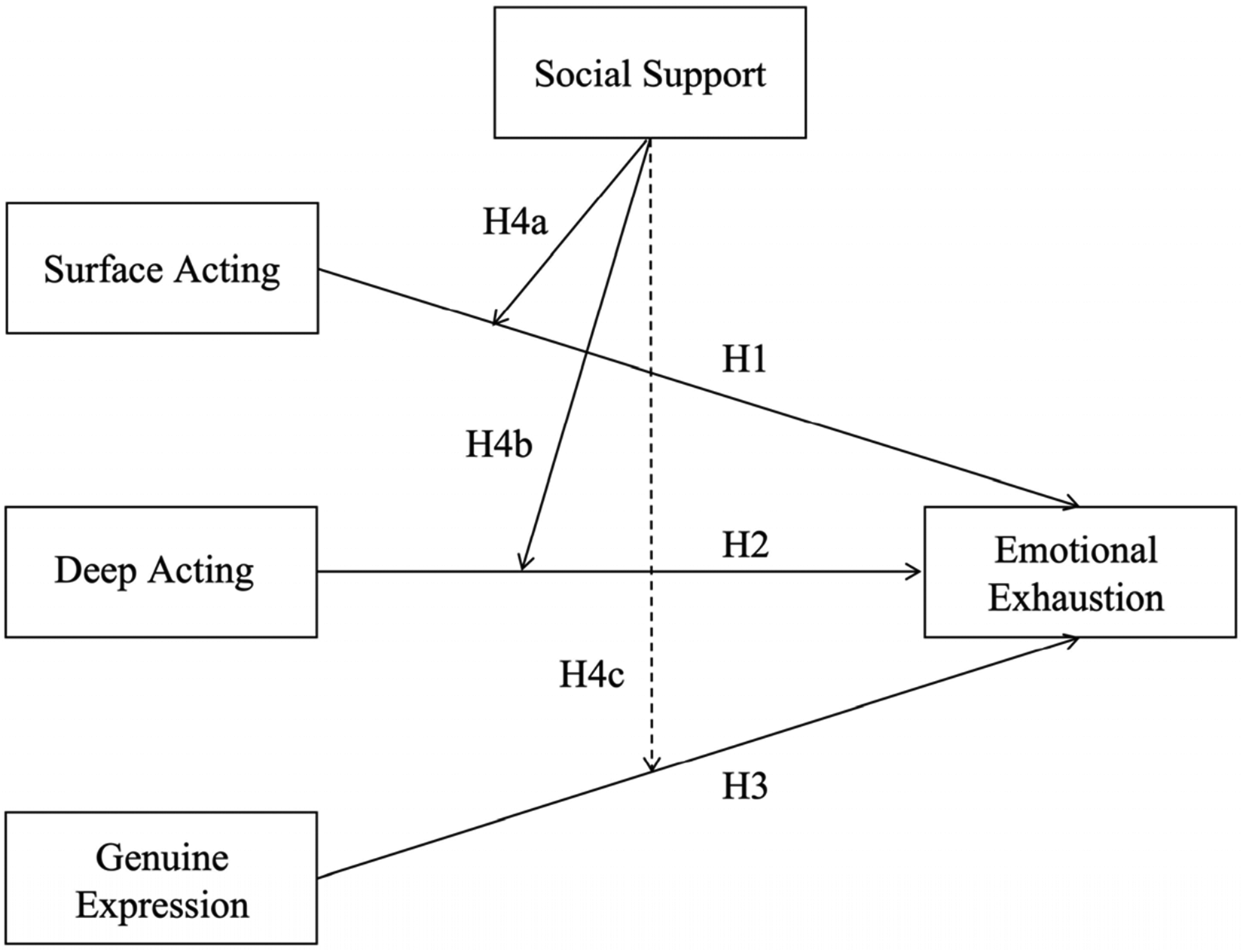
Research model.
Methods
Participants
The study employed a convenience sampling approach and recruited primary and secondary school PE teachers in Beijing, China. Data were collected via the online survey platform Wenjuanxing. The research team, in collaboration with district-level teaching researchers and school administrators, distributed the questionnaire link directly to teachers, accompanied by an informed consent statement outlining the study's purpose, anonymity, and voluntary participation. Because participants were recruited through convenience sampling and institutional contacts, the sample may overrepresent teachers from schools that were more accessible or more willing to cooperate with the survey. In addition, teachers who chose to participate may differ systematically from those who did not, introducing the possibility of self-selection bias. As such, the sample may not fully capture the diversity of PE teachers working in different school settings or under different resource conditions.
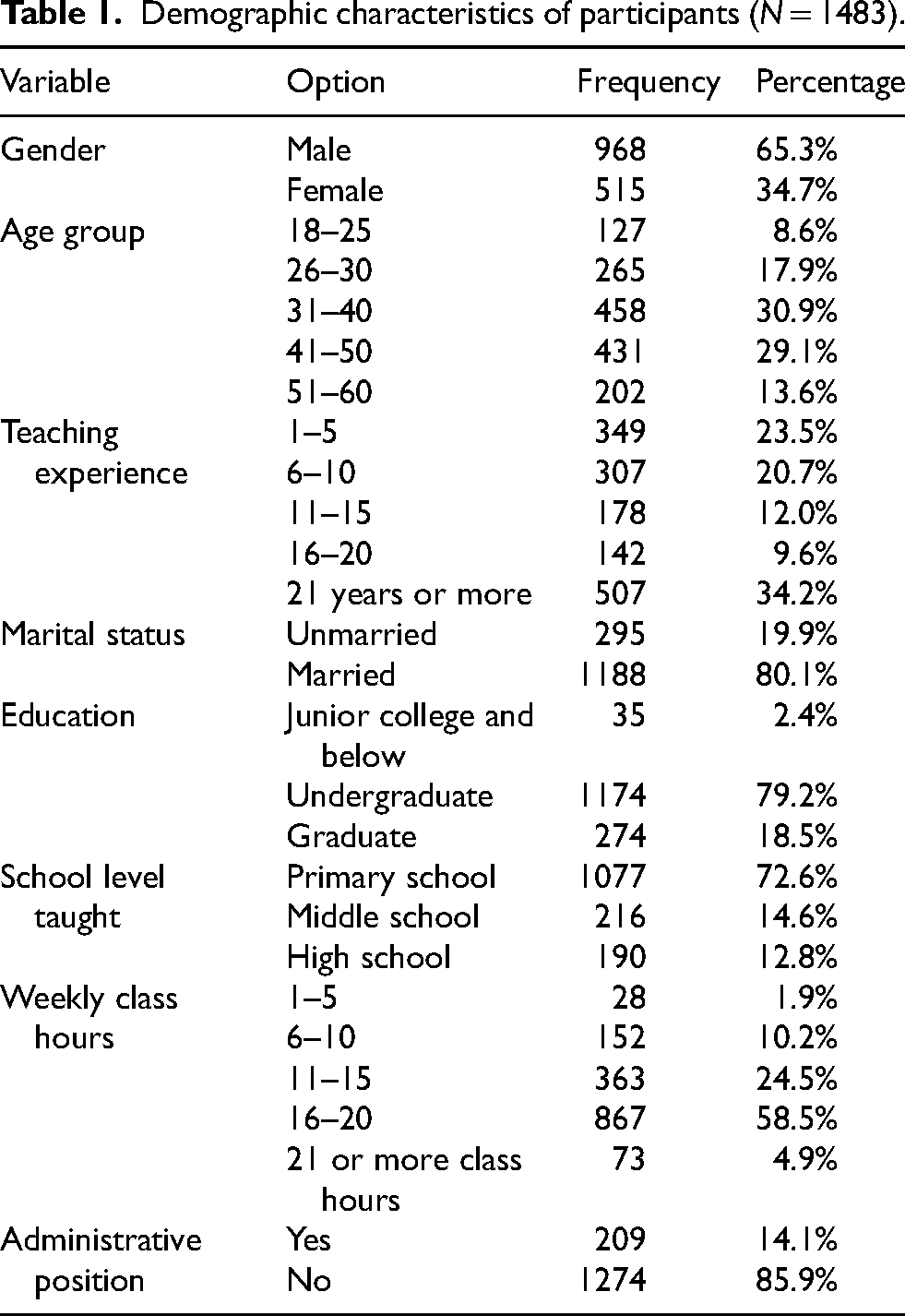
To ensure data authenticity and validity, invalid questionnaires were excluded based on the following criteria: (1) completion time significantly below the minimum threshold for valid responses (less than 150 s); (2) uniform or highly patterned responses across items, indicating invalid answering behavior. In total, 1601 questionnaires were distributed, and 1483 valid responses were retained, yielding an effective response rate of 92.63%. Among valid respondents, 968 were male (65.3%) and 515 were female (34.7%). Demographic information included age, teaching experience, educational background, weekly teaching hours, and administrative responsibilities (see Table 1).
Demographic characteristics of participants (N = 1483).
Measures
Teacher emotional labor strategy scale
This scale, originally developed by Diefendorff et al. 44 and later adapted to the Chinese context by Yin, 45 was used to assess the emotional labor levels of primary and secondary school PE teachers. The scale consists of three dimensions: surface acting (six items, e.g., “I need to put on a facade to appropriately interact with students or their parents”), deep acting (four items, e.g., “I try to genuinely feel the emotions I must express to students or their parents”), and genuine expression (three items, e.g., “The emotions I display toward students or their parents naturally reflect my inner feelings”). Responses were rated on a 5-point Likert scale (1 = “strongly disagree,” 5 = “strongly agree”), with higher scores indicating higher levels of emotional labor. In this study, the overall scale had a Cronbach's α of 0.78, with reliability coefficients for the subscales being 0.89 (surface acting), 0.73 (deep acting), and 0.74 (genuine expression), demonstrating acceptable internal consistency.
Teacher emotional exhaustion
Emotional exhaustion was measured using the emotional exhaustion subscale of the Teacher Burnout Inventory developed by Maslach et al. 46 and adapted for the Chinese context by Wu et al. 47 The subscale consists of eight items (e.g., “I feel that being a teacher is emotionally draining”) and assesses the extent to which teachers feel emotionally depleted in their work. Responses were rated on a 5-point Likert scale (1 = “strongly disagree,” 5 = “strongly agree”), with higher scores indicating higher levels of emotional exhaustion. Scores below 3 were classified as mild exhaustion, scores between 3 and 4 as moderate exhaustion, and scores above 4 as severe exhaustion. In the present study, the Cronbach's α coefficient for the subscale was 0.94, demonstrating excellent internal consistency reliability.
Teachers’ social support questionnaire
The Teachers’ Social Support Questionnaire was developed by van Dick and Wagner 48 and adapted for the Chinese context by Xu and Wang. 39 This instrument captures social support along two conceptual dimensions: (a) sources of support, including students, parents, colleagues, school administrators, family members, and friends; and (b) types of support, encompassing both instrumental (practical) support and emotional support. It consists of 12 items measuring social support in the teaching environment, such as: “School administrators and supervisors frequently provide valuable advice and guidance for my work.” Responses were rated on a 5-point Likert scale (1 = “strongly disagree,” 5 = “strongly agree”), with higher scores indicating greater perceived social support. In this study, the Cronbach's α for the overall scale was 0.93, demonstrating high internal consistency.
Quality control
The survey was administered through the “Wenjuanxing” platform, which generated both a QR code and an online access link for participants. Prior to formal data collection, the research team conducted a pilot test of the questionnaire to evaluate item clarity, logical flow, and interface design. Based on pilot feedback, wording and sequencing were revised to enhance comprehensibility and ease of completion. During the distribution phase, the research team communicated extensively with PE department heads and school administrators, explaining the study purpose, participation requirements, and confidentiality principles. These contacts assisted in distributing the survey link to eligible primary and secondary school PE teachers.
After data collection, the research team conducted two rounds of screening to remove invalid responses, including cases with missing information, abnormally short completion times, or highly repetitive response patterns. To further ensure data accuracy and reliability, a double-entry procedure was employed: two independent researchers entered the valid responses into the statistical software, and consistency checks were performed to resolve discrepancies.
Statistical analysis
Data were managed and analyzed using SPSS 29.0 and AMOS 26.0. First, common method bias was assessed using both Harman's single-factor test and a single-factor confirmatory factor analysis (CFA), following recommendations that procedural remedies and multiple statistical checks be used in combination when self-report data are collected from a single source.49,50 Descriptive statistics and partial correlation analyses were then performed in SPSS 29.0. Next, moderation effects of emotional labor strategies on emotional exhaustion were tested using the PROCESS macro for SPSS (Model 1), with gender, age, teaching experience, marital status, and educational background included as covariates. A bootstrap resampling procedure with 5000 iterations was applied, and statistical significance was set at α = 0.05. The overall analysis pipeline is summarized in Figure 2.
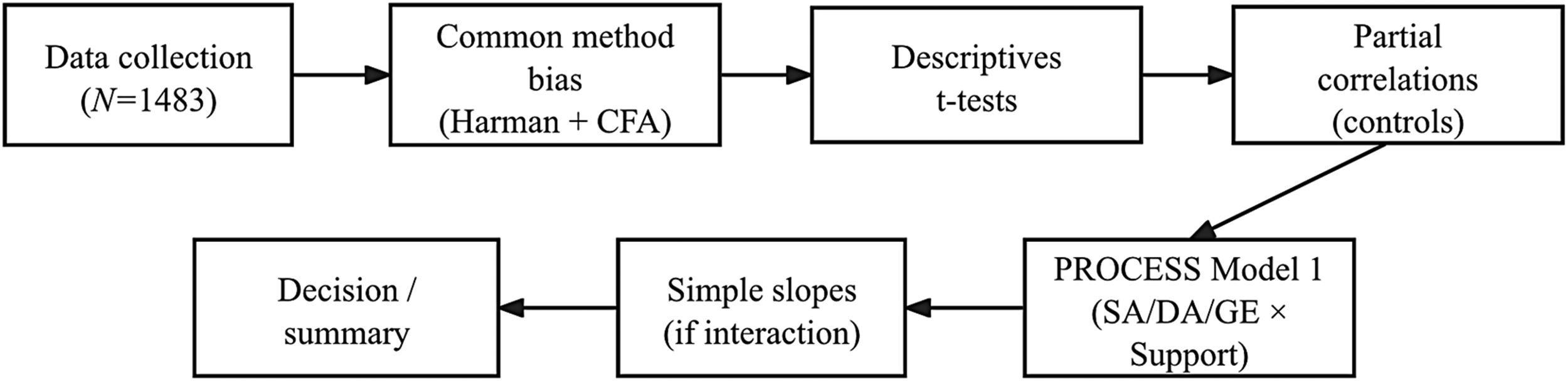
Flowchart of the study's analytical pipeline.
Results
Common method bias test
Since all variables in this study were measured through self-reports, both procedural and statistical remedies were employed to control for common method bias. Procedurally, anonymity was assured, ambiguous wording was revised, and potentially confusing items were clarified. Statistically, Harman's single-factor test was conducted. The results indicated that five factors had eigenvalues greater than 1, with the first factor explaining 28.84% of the variance, which is below the 40% threshold. In addition, a single-factor confirmatory factor analysis was performed on all self-reported items. The model fit was poor, χ2/df = 41.129, CFI = 0.572, GFI = 0.540, AGFI = 0.443, NFI = 0.566, RMSEA = 0.165, suggesting that common method bias was not a serious concern in this study.
Descriptive features of emotional labor and emotional exhaustion in physical education teachers
The results showed that the overall mean score of emotional exhaustion was 3.25 (on a 5-point scale), falling between 3 and 4, which corresponds to a moderate level of exhaustion and is close to the threshold for severe exhaustion. Notably, 18.2% of teachers scored at or above 4, indicating a high risk of emotional exhaustion.
Independent-samples t-tests were conducted to examine gender differences across study variables. Gender differences were observed across the three emotional labor strategies, although only some reached conventional levels of statistical significance. Specifically, female PE teachers reported significantly higher scores on surface acting than male teachers (t = 3.055, p = 0.002), while gender differences in deep acting approached significance (t = 1.815, p = 0.070), with females scoring slightly higher. In contrast, male teachers reported significantly higher scores on genuine expression compared to female teachers (t = −3.333, p < 0.001). No significant gender differences were found for social support (t = −1.383, p = 0.167) or emotional exhaustion (t = 0.574, p = 0.566).
Correlation analysis
After controlling for gender, age, teaching experience, marital status, and educational background, the partial correlation results (see Table 2) revealed significant differences in the associations between the three emotional labor strategies and emotional exhaustion. Specifically, surface acting was positively correlated with emotional exhaustion (r = 0.424, p < 0.001), and deep acting also showed a significant positive correlation with emotional exhaustion (r = 0.180, p < 0.001). In contrast, genuine expression was negatively correlated with emotional exhaustion (r = −0.164, p < 0.001).
Correlations among the study variables (N = 1483
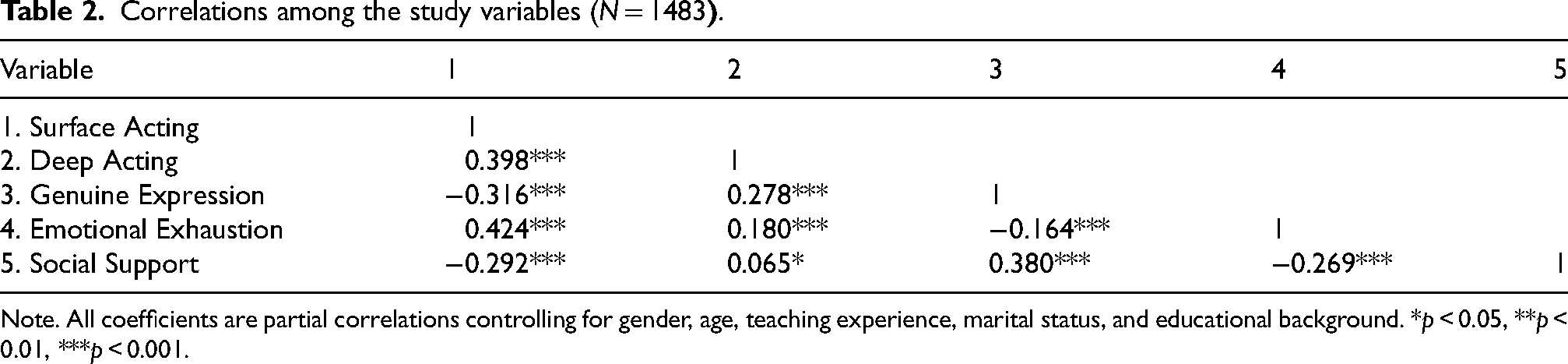
Note. All coefficients are partial correlations controlling for gender, age, teaching experience, marital status, and educational background. *p < 0.05, **p < 0.01, ***p < 0.001.
Regarding the relationships among emotional labor strategies, surface acting was positively correlated with deep acting (r = 0.398, p < 0.001) but negatively correlated with genuine expression (r = −0.316, p < 0.001). Deep acting was also positively correlated with genuine expression (r = 0.278, p < 0.001). In addition, social support was negatively correlated with surface acting (r = −0.292, p < 0.001), positively correlated with genuine expression (r = 0.380, p < 0.001), weakly correlated with deep acting (r = 0.065, p = 0.012), and negatively correlated with emotional exhaustion (r = −0.269, p < 0.001).
Moderation analysis
Social support was tested as a moderator of the associations between emotional labor strategies and emotional exhaustion using the PROCESS macro for SPSS (Model 1). Emotional exhaustion (Y) was specified as the outcome. Each emotional labor strategy was entered as the focal predictor (X) in separate models: surface acting (SA), deep acting (DA), and genuine expression (GE). Social support (W) was specified as the moderator. Gender, age, teaching experience, marital status, and educational background were included as covariates. Predictors (X) and the moderator (W) were mean-centered within PROCESS prior to generating the interaction term (X × W). For each model, unstandardized coefficients (B), standard errors (SE), t values, p values, 95% confidence intervals (CI), model R2, and the incremental variance explained by the interaction (ΔR2) were reported. Where interactions were significant, conditional effects of X on Y were probed at low (M−1 SD), mean (M), and high (M + 1 SD) levels of social support as implemented in PROCESS.
For each emotional labor strategy, the moderation model was estimated as:
Y = β0 + β1X + β2 W + β3(X × W) + ΣγjCj + ɛ.
The conditional effect of X on Y at a given level of W is: ∂Y/∂X = β1 + β3 W.
The overall model was significant (R = 0.491, R2 = 0.241, F(8,1474) = 58.520, p < 0.001). Controlling for covariates, SA positively predicted emotional exhaustion (B = 0.601, SE = 0.038, t = 15.765, p < 0.001, 95% CI [0.5266, 0.6762]), whereas social support was negatively associated with emotional exhaustion (B = −0.176, SE = 0.027, t = −6.508, p < 0.001, 95% CI [−0.2293, −0.1231]). The SA × social support interaction was significant and negative (B = −0.010, SE = 0.004, t = −2.370, p = 0.018, 95% CI [−0.0190, −0.0018]), accounting for additional variance (ΔR2 = 0.003; Fchange(1,1474) = 5.617, p = 0.018). Simple slopes indicated that the SA–exhaustion association was strongest at low support (M−1 SD: B = 0.676, SE = 0.053, p < 0.001, 95% CI [0.5713, 0.7808]), moderate at mean support (M: B = 0.601, SE = 0.038, p < 0.001, 95% CI [0.5266, 0.6762]), and weakest at high support (M + 1 SD: B = 0.527, SE = 0.045, p < 0.001, 95% CI [0.4380, 0.6155]), consistent with a buffering effect.
2.
The model was significant (R = 0.397, R2 = 0.158, F(8,1474) = 34.547, p < 0.001). DA positively predicted emotional exhaustion (B = 0.629, SE = 0.072, t = 8.756, p < 0.001, 95% CI [0.4884, 0.7704]), and social support was negatively associated with emotional exhaustion (B = −0.323, SE = 0.028, t = −11.776, p < 0.001, 95% CI [−0.3771, −0.2694]). The DA × social support interaction was significant and negative (B = −0.030, SE = 0.008, t = −3.589, p = 0.0003, 95% CI [−0.0466, −0.0137]), explaining additional variance (ΔR2 = 0.007; Fchange(1,1474) = 12.878, p < 0.001). Conditional effects showed that the DA–exhaustion association decreased as support increased (M−1 SD: B = 0.845, SE = 0.105, p < 0.001, 95% CI [0.6392, 1.0516]; M: B = 0.629, SE = 0.072, p < 0.001, 95% CI [0.4884, 0.7704]; M + 1 SD: B = 0.413, SE = 0.081, p < 0.001, 95% CI [0.2548, 0.5719]).
3.
The model was significant (R = 0.343, R2 = 0.117, F(8,1474) = 24.520, p < 0.001). GE was negatively associated with emotional exhaustion (B = −0.263, SE = 0.097, t = −2.706, p = 0.007, 95% CI [−0.4532, −0.0723]), and social support was also negatively associated with exhaustion (B = −0.268, SE = 0.030, t = −8.831, p < 0.001, 95% CI [−0.3272, −0.2082]). However, the GE × social support interaction was not significant (B = 0.004, SE = 0.010, t = 0.400, p = 0.689, 95% CI [−0.0163, 0.0246]) and explained negligible additional variance (ΔR2 = 0.0001; Fchange(1,1474) = 0.160, p = 0.689).
Across models, social support moderated the associations between the effortful emotional labor strategies (surface acting and deep acting) and emotional exhaustion, such that higher support attenuated the positive slopes. In contrast, the interaction was nonsignificant for genuine expression, indicating that its negative association with exhaustion did not vary by social support.
Discussion
The present findings indicate that emotional labor strategies are differentially associated with emotional exhaustion among primary and secondary school PE teachers, with clear implications for occupational health and psychosocial risk management. Overall, teachers reported moderately high levels of emotional exhaustion, suggesting a non-negligible occupational health risk. Both SA and DA were positively associated with emotional exhaustion, with SA emerging as the most stable risk strategy. In contrast, GE showed a protective association. Gender differences were observed in strategy use, and social support significantly buffered the adverse effects of high resource-consuming strategies. Together, these findings highlight the heterogeneous pathways through which emotional labor, resources, and individual characteristics jointly shape teachers’ occupational well-being.
Surface acting and emotional exhaustion
The results indicate a significant positive association between SA and emotional exhaustion, consistent with previous findings in teacher populations.34,51 SA requires individuals to display emotions that align with professional norms while suppressing or even faking genuine feelings. 17 Sustained reliance on this strategy is commonly accompanied by emotional dissonance and continuous psychological strain, and is therefore closely linked to higher levels of emotional exhaustion. 36 From the perspective of COR theory, SA can be conceptualized as a prototypical high resource-consuming strategy. When frequently enacted, it is associated with ongoing resource depletion and an elevated vulnerability to exhaustion, particularly in contexts characterized by limited external resource support. 16
This association appears especially salient in the occupational context of PE teachers. Within the Chinese education system, PE teachers often occupy a marginalized position, with disadvantages in curriculum allocation, teaching resources, and career advancement opportunities. 28 Moreover, PE classes are characterized by high-intensity, real-time management demands: teachers must maintain order through vocal commands, organize diverse activities, and respond immediately to students’ complex emotional and behavioral needs. 52 Importantly, this classroom intensity is compounded by a broader workload structure in which a substantial proportion of PE-related duties—such as extracurricular training, school-wide sports events, and physical fitness monitoring—are often excluded from formal workload calculations, resulting in sustained high teaching intensity across the workweek. In such an environment, SA does little to alleviate emotional dissonance; rather, it tends to compound classroom management stress and professional helplessness, thereby intensifying the experience of exhaustion. 7
The JD–R model further contextualizes this pattern. In environments characterized by high job demands and constrained job resources, SA is linked to accelerated depletion of emotional and psychological energy, increasing susceptibility to burnout-related outcomes. 20 In addition, structural constraints—such as limited career advancement opportunities, difficulties in quantifying teaching achievements, and low societal recognition—further restrict resource replenishment, depleting teachers’ psychological reserves and exacerbating exhaustion. 53
Taken together, the strong association between SA and emotional exhaustion reflects not only the inherent costs of emotional labor but also broader structural and organizational conditions in education. From an occupational health perspective, SA should be understood as a psychosocial risk pattern rather than an individual shortcoming. 54 Accordingly, risk mitigation should prioritize organizational-level interventions, such as reducing excessive emotional display demands, optimizing workload design, enhancing professional recognition of PE, and strengthening institutional mental health support, thereby limiting reliance on surface acting and its adverse occupational health consequences.
Deep acting and emotional exhaustion
This study identified a significant positive association between DA and emotional exhaustion among primary and secondary school PE teachers. Although this finding appears to diverge from research portraying DA as a relatively adaptive strategy, growing theoretical and empirical evidence indicates that its effects are highly context-dependent and shaped by the balance between job demands and available resources.34,36 From the perspective of COR, DA involves deliberate cognitive reappraisal and emotional regulation to align internal feelings with external displays. While this process may reduce emotional dissonance in the short term, it requires sustained psychological and emotional investment. When enacted repeatedly in high-demand environments without adequate recovery or resource replenishment, the cumulative resource costs of DA may outweigh its adaptive benefits, resulting in elevated emotional exhaustion.16,55 Consistent with the JD–R model, prior research has shown that under conditions of high job demands and limited job resources, DA is more likely to function as a resource-depleting demand rather than a protective strategy. 4
This interpretation is particularly salient in the context of PE teaching. PE teachers operate in settings characterized by intensive organizational demands, continuous interaction, and immediate emotional feedback, while simultaneously managing instruction, student safety, and classroom climate. In addition, the marginalized status of PE within school systems often necessitates reliance on DA to sustain classroom order and teacher–student relationships.56,57 Although DA may support short-term role performance, its prolonged use in resource-constrained environments is associated with sustained emotional effort and heightened exhaustion risk.
Overall, these findings underscore the dual and context-sensitive nature of DA. From an occupational health perspective, this “adaptation–risk paradox” suggests that DA should neither be uncritically promoted nor uniformly discouraged. Instead, effective risk management should prioritize strengthening contextual resources—such as teaching support, recovery opportunities, and organizational climate—to prevent DA from becoming a source of cumulative psychological strain while preserving its potential adaptive value.
Genuine expression and emotional exhaustion
The results of this study revealed a significant negative association between GE and emotional exhaustion, which is highly consistent with previous findings.4,38,58 GE is characterized by congruence between internal emotional states and external emotional displays, which is typically associated with reduced demands for emotional regulation. 17 As such, this form of emotional labor is linked to lower levels of psychological strain and energy consumption, and is less frequently accompanied by emotional dissonance.
From the COR perspective, GE reduces emotional dissonance and additional psychological load, enabling teachers to preserve resources for instructional tasks. From the JD–R perspective, GE not only weakens the depletion pathway of emotional labor but also fosters resource generation through the authentic transmission of emotions. 20 When teachers express genuine emotions, they are more likely to build strong affective bonds with students and receive immediate positive feedback. Such interactions create a gain spiral of emotional resources that helps alleviate exhaustion. 16
This pattern is particularly relevant in the occupational context of PE teachers. PE classes are highly interactive and physically engaging, and teachers’ emotional states are closely intertwined with classroom climate and student participation. Under these conditions, GE is associated with enhanced trust, engagement, and relational quality in teacher–student interactions. 43 At the same time, ongoing affective feedback during instruction may support the replenishment of psychological resources, thereby limiting cumulative emotional depletion.
Collectively, these findings highlight GE as a comparatively low-risk and potentially health-protective emotional labor strategy. From an occupational health perspective, GE may be viewed as a resource-supportive pattern rather than a psychosocial risk factor. Accordingly, organizational practices that legitimize appropriate genuine emotional expression—while maintaining professional boundaries—may contribute to reducing emotional exhaustion and promoting sustainable occupational well-being. Such practices include fostering open communication climates, strengthening positive feedback mechanisms, and supporting professional development focused on constructive teacher–student relationships.
The moderating role of social support
This study further confirmed the moderating role of social support in the relationship between emotional labor and emotional exhaustion, but the effect varied across different strategies. Specifically, social support exerted a significant buffering effect in the contexts of SA and DA, whereas no significant moderation was observed for GE. These findings are consistent with the core assumptions of COR and the JD–R model, which posit that external resources can offset the depletion caused by high job demands, thereby reducing the risk of exhaustion. It is worth noting that social support in this study is understood as a multidimensional construct encompassing both diverse sources (e.g., colleagues, school leadership, family members) and functional types (e.g., emotional and instrumental support), which together shape teachers’ capacity to cope with emotional demands.
In the context of SA, teachers are required to suppress or disguise genuine emotions to comply with professional display rules. 59 Such sustained suppression is typically accompanied by emotional dissonance and elevated energy expenditure, both of which are closely linked to emotional exhaustion.1,36 When teachers have access to high levels of social support—from colleagues, family members, or school leadership—emotional support (e.g., understanding, empathy, and validation) and instrumental support (e.g., guidance, assistance, and organizational backing) jointly provide channels for emotional recovery, validation, and psychological adjustment. As a result, the strength of the association between SA and emotional exhaustion is substantially attenuated, aligning with evidence that social support plays a protective role in occupational well-being. 7
A similar buffering pattern was observed for DA. Although DA may reduce emotional dissonance relative to SA, it remains a cognitively and emotionally demanding strategy. In PE teaching contexts characterized by intensive interaction and immediate feedback, DA requires sustained regulatory effort. 60 Under conditions of sufficient social support, the psychological costs associated with DA are buffered, recovery opportunities are enhanced, and its association with emotional exhaustion is weakened. 55 In such contexts, the adaptive aspects of DA—such as maintaining classroom harmony and strengthening teacher–student relationships—are more likely to be sustained without excessive psychological cost.
In contrast, social support did not significantly moderate the relationship between GE and emotional exhaustion. One plausible explanation is that GE is inherently a low-resource or resource-generating strategy. When teachers express emotions authentically, emotional dissonance and cognitive demands are minimal, resulting in a relatively low baseline level of resource depletion. Moreover, GE often elicits immediate positive feedback and affective resonance from students, generating internal emotional resources through classroom interactions. 43 These internally generated emotional resources, emerging directly from classroom interactions, may function in ways similar to emotional support, thereby statistically masking the incremental benefits of external social support.
In summary, these findings suggest that the protective role of social support is contingent on the resource demands of specific emotional labor strategies. From an occupational health perspective, social support primarily functions as a psychosocial risk buffer for high-resource-consuming strategies such as SA and DA. Accordingly, teacher support policies should adopt a differentiated approach: strengthening multi-level support systems for high-resource-consuming strategies, while fostering open and trust-based organizational climates that sustain authentic emotional expression.
Implications and limitations
This study extends existing research on emotional labor by integrating COR and the JD–R model to clarify how different emotional labor strategies are differentially associated with emotional exhaustion among PE teachers. The findings highlight that surface acting and deep acting, as high-resource-consuming strategies, are more strongly linked to emotional exhaustion, whereas genuine expression functions as a protective factor. Moreover, social support plays a critical buffering role for high-resource-consuming strategies but shows limited additional benefits for genuine expression. These results underscore the importance of adopting contextualized and differentiated perspectives when examining emotional labor processes within occupational health psychology.
From a practical perspective, the findings suggest that school administrators and policymakers should adopt strategy-specific and prevention-oriented support measures. Organizational efforts should aim to reduce excessive reliance on surface acting by optimizing workload design, clarifying role expectations, and enhancing professional recognition of PE teachers. At the same time, the adaptive use of deep acting can be supported through emotion regulation training, peer consultation, and recovery-oriented work arrangements. Strengthening multi-level social support systems—including collegial support, leadership recognition, and family understanding—may offer a sustainable approach to mitigating burnout. Given the inherent protective role of genuine expression, schools should also foster open and inclusive climates that facilitate authentic teacher–student interactions, thereby promoting teachers’ occupational well-being.
Despite these contributions, several limitations should be acknowledged. First, this study employed convenience sampling, and participants were drawn exclusively from Chinese primary and secondary school PE teachers in Beijing. Although the sample size was relatively large, this non-random recruitment strategy may have introduced sampling bias. Specifically, the sample may overrepresent teachers from schools that were more accessible, more supportive of participation, or more closely connected to local administrative and teaching networks, while teachers working in less well-resourced or more demanding settings may have been underrepresented. As a result, the findings should be generalized with caution to PE teachers in other regions, school systems, or resource contexts. Future studies could adopt probability sampling methods or broader multi-site recruitment strategies, and could also conduct cross-regional or cross-cultural comparisons to strengthen external validity.
Second, the cross-sectional design of this study precludes any causal inference and does not allow the temporal ordering of emotional labor strategies, social support, and emotional exhaustion to be established. Accordingly, the observed associations should be interpreted with caution as correlational rather than directional. Although the present model was theoretically grounded, it reflects a theoretically interpretable pattern of relationships rather than a verified causal process. Given that emotional labor processes are inherently dynamic, future research would benefit from longitudinal, diary, or experience-sampling designs to capture temporal fluctuations and test the directionality of these associations more rigorously.
Third, all variables were measured using self-report questionnaires, which may introduce common method bias due to shared measurement sources. Although the theoretical model and differentiated interaction effects reduce the likelihood of severe bias, future research could further strengthen methodological rigor by incorporating multi-source data (e.g., peer or supervisor ratings), behavioral observations, or objective indicators to triangulate findings.
Conclusions
From an occupational health and safety perspective, this study suggests that emotional labor strategies constitute salient psychosocial risk factors for emotional exhaustion among primary and secondary school PE teachers. SA showed a strong and consistent positive association with emotional exhaustion, indicating that prolonged suppression of genuine emotions represents a high-risk occupational coping pattern. DA was also positively associated with emotional exhaustion, suggesting that even seemingly adaptive emotion regulation strategies may become risk factors when sustained under high job demands and limited resource conditions. In contrast, GE was negatively related to emotional exhaustion, underscoring its protective role in reducing emotional dissonance and preserving psychological resources. Social support emerged as a critical occupational resource for psychosocial risk mitigation. High levels of social support significantly buffered the adverse effects of SA and DA on emotional exhaustion, whereas its moderating role was not significant for genuine expression, likely due to the latter's low resource demands and intrinsic resource-generating properties.
Overall, emotional exhaustion among PE teachers should be understood as a preventable psychosocial occupational hazard rather than an individual coping failure. Accordingly, occupational health interventions should adopt a differentiated and prevention-oriented approach: reducing structural conditions that encourage excessive reliance on SA, supporting the adaptive use of DA through training and recovery-oriented work design, and fostering supportive organizational climates that legitimize appropriate genuine emotional expression. Integrating emotional labor management into OHS frameworks may help reduce psychosocial risks, enhance teachers’ occupational well-being, and promote sustainable professional functioning in educational settings.
Footnotes
Acknowledgements
We sincerely thank all the teachers who participated in this study for their time and cooperation. We also appreciate the support from the faculty and administrative staff who assisted in the recruitment process.
Ethical approval
All methods were conducted in accordance with the 1964 Declaration of Helsinki and its later amendments. The study was reviewed and approved for exemption by the Office of Science and Technology, Capital University of Physical Education and Sports (Approval No. 2024A033), on March 13, 2024.
Informed consent
Informed consent was obtained from all participants prior to their participation in the study.
Funding
The authors disclosed receipt of the following financial support for the research, authorship, and/or publication of this article: This work was supported by the Beijing Municipal Social Science Foundation (Grant No. 25BJ03126).
Declaration of conflicting interests
The authors declared no potential conflicts of interest with respect to the research, authorship, and/or publication of this article.