







Abstract
Background
Non-regular workers in South Korea account for approximately 37% of the workforce and face elevated risks of occupational injury, yet empirical research on their return-to-work (RTW) outcomes remains limited.
Objective
This study aims to (1) compare RTW outcomes between regular and non-regular workers over a four-year observation period, and (2) identify group-specific predictors of RTW using a multidimensional framework encompassing individual, psychological, health-related, social, and workplace factors.
Methods
Data from 2643 occupationally injured workers were drawn from the Panel Study of Workers’ Compensation Insurance, a nationally representative dataset spanning four annual waves (2018 to 2021). Random-effects panel multinomial logistic regression models were estimated separately for each employment type, supplemented by a pooled interaction model to test between-group differences.
Results
Non-regular workers were more likely to remain unemployed or be reemployed at a different workplace, whereas regular workers were more likely to return to their original jobs. Self-efficacy and social interaction were associated with RTW in both groups, though their effects operated through different pathways. Labor union presence was significantly associated with RTW only among regular workers.
Conclusions
Non-regular workers experience structurally distinct RTW patterns following occupational injury. The findings highlight the need for targeted interventions that strengthen psychological and social resources for non-regular workers, alongside institutional reforms to support their sustainable reintegration.
Keywords
Introduction
In the South Korean labor market, non-regular workers account for approximately 37% of the total workforce, and this proportion has continued to grow in recent years. 1 The rapid transformation of industrial structures and expansion of the platform economy have produced a wide range of employment forms. Emerging types of nonstandard employment, such as zero-hour contracts (ZHCs), platform work, and part-time jobs, are becoming increasingly prevalent but often remain outside the boundaries of legal and institutional protection.2,3 These changes do not merely represent a diversification of employment arrangements, but are also linked to declining job quality and heightened social vulnerability. 4
Non-regular workers often face disadvantages compared with their regular counterparts. These include lower wages, less job security, limited access to employee benefits, and poorer working conditions. 5 These disparities are particularly evident in the context of occupational safety.3,4 Non-regular workers in South Korea are frequently assigned to “3D” jobs that are dirty, dangerous, and difficult, and involve physically demanding and hazardous tasks that place them at higher risk of occupational injury. Moreover, non-regular workers’ limited access to workplace safety training and accommodations further increases their exposure to hazardous conditions, while the absence of employment protections leaves them with few options to report or refuse unsafe work.3,6 Nevertheless, despite this increased exposure, they often receive less institutional support for recovery and reintegration into the labor market after an injury.
South Korea has one of the highest occupational injury rates among OECD member countries, and the proportion of severe or fatal cases is notable as well.7,8 Although the Korean government has introduced several policy measures, including the Non-regular Worker Protection Act of 2007, many non-regular workers continue to face significant challenges in recovering from occupational injuries. These include unstable employment arrangements, restricted access to welfare and rehabilitation services, and limited workplace protections.
Return to work (RTW) after any occupational injury is a crucial step in the process of recovery. It not only restores income and work capacity but also contributes to self-esteem, social identity, and overall quality of life. At the societal level, RTW reduces long-term unemployment and alleviates social and economic burdens. Nonetheless, previous research has largely concentrated on regular workers or treated employment type as a secondary factor rather than a central focus of the analysis. Furthermore, existing studies have tended to emphasize medical recovery, often overlooking the non-medical aspects of rehabilitation, such as employment reintegration. 9
This study addresses these gaps with two specific objectives: (1) to compare RTW outcomes and their temporal patterns between regular and non-regular workers over a four-year period; and (2) to identify group-specific predictors of RTW by estimating separate models for each employment type, thereby revealing how individual, psychological, social, and workplace factors operate differently across employment groups. Drawing on nationally representative panel data that tracked 2643 occupationally injured workers over four years, we applied random-effects panel multinomial logistic regression models stratified by employment type.
Literature review
Definition and typology of non-regular workers
Although no universally accepted international definition of non-regular employment exists, the Korean labor market is distinctly segmented into regular and non-regular forms of employment. In Korea, regular workers are typically defined as those who are directly employed by an employer, work full time, and have no contractual period. 10 They generally benefit from stable job security and a comprehensive range of employment benefits, including health insurance, pensions, and paid leave. By contrast, non-regular workers encompass all employment types that diverge from this standard arrangement. They are often employed under nonpermanent, part-time, or atypical contracts that are frequently renewed for short periods.3,5,6,10 This category also includes workers who have working conditions similar to those of regular workers but have different contract conditions, as well as a new class of workers, such as platform workers, part-time employees, and those under ZHCs.
Similar classifications exist internationally. For example, in Japan, such workers are referred to as “non-regular workers”, 11 while in the United States, they are commonly described as “contingent workers” or “precarious workers”.12,13 In academic discourse, related terms such as “vulnerable workers” and “marginalized workers” are frequently used to highlight the social and economic disadvantages faced by specific groups of workers, especially in research contexts that examine inequality, precarity, or labor rights. 14 Restubog, Deen 15 define vulnerable workers as individuals who are at risk of being abused, exploited, or harmed physically, psychologically, or socially in the workplace. Similarly, marginalized workers are excluded from full participation in the labor market because of their social identities, such as race, disability, or sexual orientation. While these groups may overlap in some cases – for instance, when non-regular workers also experience social or economic marginalization – these concepts are not interchangeable because they are based on fundamentally different classification criteria. Accordingly, this study operationally defines non-regular workers as individuals who do not simultaneously satisfy the three conditions of regular employment in Korea: being employed by a single employer, working standard full-time hours, and having no fixed terms of employment.
Risks of non-regular workers
In the global economy, the labor market is changing rapidly owing to technological advancements and shifts in employment practices, such as ZHCs and platform work.2,16,17 This economic situation in which companies hire people as needed is known as a gig economy. 18 These types of employment, characterized by flexibility and a lack of guaranteed hours, are altering traditional work concepts. However, this shift has led to serious occupational safety and health (OSH) issues. ZHCs, which do not guarantee minimum working hours, fail to provide job security or a stable income. 17 Platform work facilitated through digital apps offers flexibility and additional income opportunities. 18 However, for low-skilled platform workers, particularly those in the delivery industry, these advantages are often outweighed by job insecurity, lack of social protections, and limited bargaining power. 19 Because they are not in a traditional employer-employee position, their employment status is often unclear. These workers face increased job insecurity and are forced to take responsibility for their safety. 20
ZHCs do not obligate employers to provide a minimum number of working hours; moreover, workers must accept work when offered. While this arrangement can offer various job opportunities and support work-life balance, workers with unpredictable hours often experience increased stress, mental health problems, and job insecurity. 21 Both types of non-regular contracts often attract socially disadvantaged groups such as women, elderly people, and immigrants. 22 These workers frequently have limited access to legal protection, social security, and worker compensation, leading to long-term social welfare gaps.
As precarious forms of employment have expanded globally, governments have adopted diverse regulatory approaches to address the social and occupational risks faced by non-regular workers. In several European countries, policy responses have focused on improving employment protection without prohibiting flexible contracts. For example, the United Kingdom introduced regulatory reforms in 2018 to strengthen wage transparency and holiday entitlements for workers on ZHCs, while preserving contractual flexibility. 2 Similarly, other European countries (e.g., Germany and Netherlands) have relied on collective bargaining institutions and works councils to mitigate employment insecurity among temporary and agency workers.
In South Korea, policy efforts have taken a somewhat different trajectory. The Non-Regular Worker Protection Act of 2007 sought to reduce discrimination and promote conversion to regular status after a fixed employment period. However, despite these legislative initiatives, the proportion of non-regular workers has remained substantial, accounting for approximately 37% of wage workers in 2023, compared to 32.5% in 2013. 1 By OECD measures, Korea had one of the highest rates of temporary employment among member countries at 27.3% of employees (i.e., wage workers excluding the self-employed) in 2023, far exceeding the OECD average of 11.3%. 23 This persistent prevalence suggests that institutional reforms have not fundamentally altered the structural segmentation of the labor market.
Non-regular workers continue to report lower job satisfaction than regular workers and experience worse outcomes across multiple dimensions, including higher mortality rates, greater prevalence of obesity and chronic diseases, and poorer physical and mental health indicators such as depression and insomnia. 10 As of 2022, South Korea's fatality rate from industrial accidents stood at 0.43 deaths per 10,000 workers, 7 ranking fifth highest among the OECD countries, exceeding the OECD average of 0.29 deaths per 10,000 workers. 8 South Korea's fatality rate from industrial accidents is alarming and even higher for non-regular workers. 24 These disparities in health and safety outcomes underscore the need to examine how employment type shapes the RTW process following occupational injury.
RTW of non-regular workers
Despite best efforts, it is impossible to completely prevent occupational accidents. Therefore, considerable attention must be paid to the recovery process following such events, particularly during the RTW phase. RTW is not merely a resumption of economic activity, but also holds multidimensional significance at the individual, organizational, and societal levels. On a personal level, RTW helps secure a means of livelihood, restores self-efficacy and social identity, and improves the overall quality of life, as supported by numerous studies.25–27 At the societal level, it contributes to preventing long-term unemployment, reducing social expenditure, and mitigating productivity losses. 28 The recovery process after an occupational accident can be broadly divided into medical and non-medical recovery. 28 However, most policies and academic literature have focused primarily on the medical phase. The nonmedical recovery phase also plays a critical role in determining long-term well-being and social reintegration. Among these key indicators, RTW is widely regarded as one of the most important.
For regular workers, the RTW process typically benefits from established institutional supports, including employment protection legislation, employer obligations to accommodate returning workers, and access to workplace-based rehabilitation programs.9,28 Regular workers are more likely to maintain their employment relationship during medical treatment and return to the same workplace, often with the support of labor unions and structured reintegration procedures. These institutional advantages provide a relatively stable foundation for recovery.
The importance of RTW is even more pronounced for non-regular workers. Due to structural vulnerabilities such as high job replaceability, low employment security, and limited institutional protection, non-regular workers face greater barriers to returning to work.3–5 In countries such as South Korea, these workers are more likely to experience hazardous working conditions and have less autonomy and control over their jobs, which increases their risk of occupational injury. Nevertheless, support systems to facilitate RTW and access to welfare and rehabilitation services remain underdeveloped for this group. As a result, non-regular workers are more vulnerable to challenges such as reemployment difficulties, income loss, and declining health outcomes, which may ultimately contribute to socioeconomic inequality. Despite these challenges, empirical studies on non-regular workers remain scarce. Given these structural disparities in access to support systems and rehabilitation services, there is a pressing need for more in-depth analyses that specifically target this group.
Theories explaining RTW have emerged from biomedical approaches. 29 These approaches view disability as being caused by an observable medical condition identified by the medical norms of function or structure. From this perspective, disability is regarded as an individual problem requiring medical treatment. On the other hand, psychosocial perspectives emphasize the individual's health and rehabilitation, particularly focusing on psychological characteristics such as expectations, perceptions, and beliefs about RTW. 30 By contrast, the social construction perspective views disability as a complex combination of activities, relationships, personal attributes, and conditions that occur primarily in an individual's social environment. While the biomedical and psychosocial perspectives focus on individuals, the social construction perspective takes a systemic view of RTW.
The biopsychosocial approach was developed by combining the biomedical, psychological, and social paradigms.29,31 These three dimensions play crucial roles in the rehabilitation and reintegration of individuals in the workplace. Biological factors include physical and physiological aspects directly related to an individual's medical condition. Psychological factors refer to the mental health status and cognitive aspects of an individual, including their attitudes, beliefs, and perceptions of illness and capabilities. These include motivation, self-efficacy, stress level, and psychological resilience. Social factors encompass the support systems available to individuals, both in the personal and professional spheres. These include family support, workplace culture, relationships with colleagues, and support from supervisors.
The holistic approach of the biopsychosocial model is crucial for understanding and facilitating the RTW process.31,32 Successful RTW after illness or injury depends on many interrelated factors, and not solely on the medical condition. Rehabilitation programs that integrate medical treatment (biological), counseling or psychological support (psychological), and vocational rehabilitation or workplace modifications (social) are more likely to succeed. This model provides a comprehensive framework for identifying and effectively addressing barriers to RTW across different domains.
These theoretical perspectives highlight that RTW is not determined by a single factor, but rather emerges from the complex interplay of biological, psychological, and social processes embedded in broader institutional contexts. However, the biopsychosocial model focuses primarily on identifying factors that facilitate or hinder recovery, with less attention to how the same resources may operate differently depending on structural employment conditions. The concept of resilience in occupational health addresses this gap by emphasizing that sustainable RTW depends not only on individual resources but also on the institutional environment that determines how those resources can be mobilized.33,34 Based on this understanding, this study has adopted a multidimensional approach to analyze RTW outcomes, classifying influencing factors into five conceptual domains: individual attributes, psychological characteristics, health-related conditions, social support factors, and workplace-related characteristics. This categorization provides a theoretically grounded framework for exploring how diverse factors shape RTW experiences among non-regular workers.
Methods
Data collection
This study used secondary data from the Panel Study of Worker's Compensation Insurance (PSWCI), provided by the Korea Worker's Compensation and Welfare Service. The PSWCI is a nationally representative longitudinal survey that tracks occupationally injured workers for five years following the termination of medical treatment, collecting data on economic activity, health, rehabilitation, and socioeconomic characteristics. The PSWCI has been conducted in two successive cohorts: the first cohort (2013–2017) followed workers who completed medical treatment in 2012, and the second cohort (2018–2022) followed workers who completed medical treatment in 2017. The target population for the second cohort consisted of 75,392 workers who completed medical treatment for occupational injuries between January and December 2017, excluding those with unverified addresses and foreign nationals. The PSWCI was administered through tablet-assisted in-person interviews. From this population, 3294 participants were selected through proportional stratified random sampling based on disability grade (six categories), sex (two categories), and age group (four categories), with area of residence (six categories) and rehabilitation service usage (two categories) used as implicit stratification variables. The dataset covers workers enrolled in the Korean Workers’ Compensation Insurance (KWCI), a mandatory social insurance program that applies to nearly all workplaces regardless of industry. The male dominant composition of the sample (82.0%) reflects the concentration of occupational injuries in physically demanding sectors such as construction and manufacturing.
The data spanned four annual waves from 2018 to 2021. We analyzed data from 2643 participants who provided complete responses across all four waves, excluding those with missing data. A panel data approach was adopted because RTW is not a single event at a fixed point in time but a dynamic process in which workers may transition between unemployment, reemployment, and return to original workplace across successive years. A cross-sectional observation at any single point of time would fail to capture this instability, which is particularly relevant for non-regular workers who may cycle between employment states more frequently. All data cleaning and analyses were performed using Stata 18.0.
Table 1 presents the demographic characteristics of the participants. First, the sex distribution showed that 2168 (82.0%) participants were male, whereas 475 (18.0%) participants were female. In terms of age group distribution, 410 participants (15.5%) were 30s and under, 525 (19.9%) were in their 40s, 934 (35.3%) were in their 50s, and 774 (29.3%) were 60 years old or older. Regarding marital status, 1775 participants (67.2%) were married, while 868 (32.8%) were unmarried (including single, divorced, or widowed individuals). Regarding employment status, 1521 participants (57.5%) were in regular employment, and 1122 participants (42.5%) were in non-regular employment. This shows a relatively balanced distribution of employment types among participants.
Demographic characteristics of the study participants.
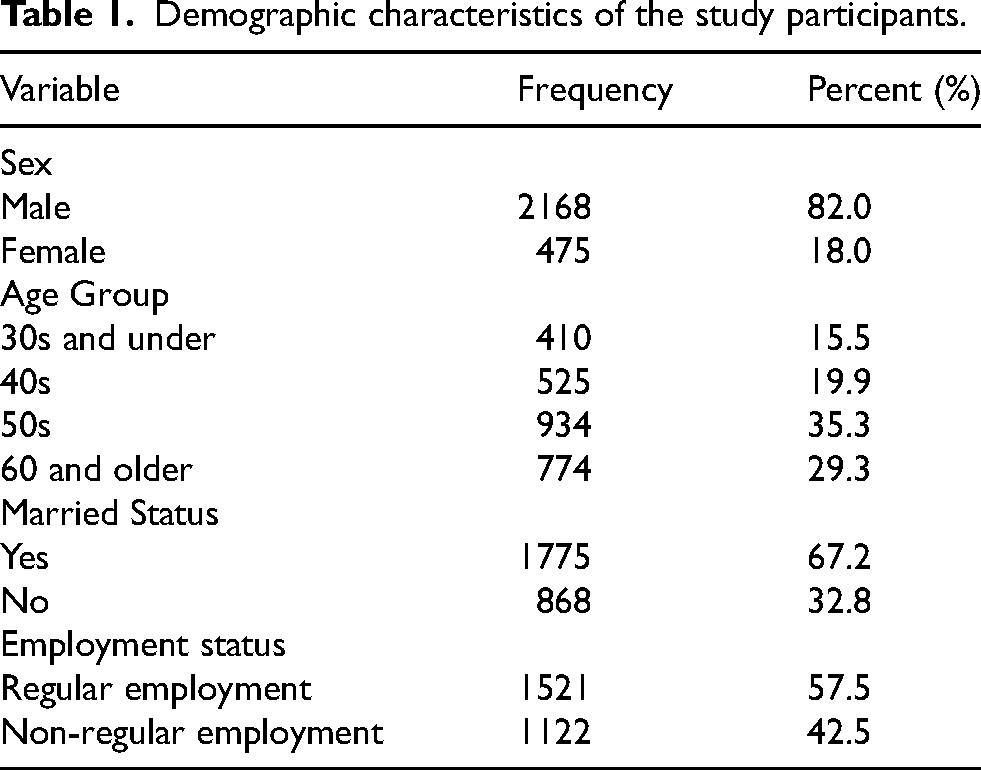
Demographic characteristics of the study participants.
To investigate the factors associated with RTW among workers with occupational injuries, the independent variables were organized into five conceptual domains: individual attributes, psychological factors, health-related factors, social support, and workplace characteristics. This classification enables a multidimensional understanding of how personal, psychological, social, and occupational factors jointly shape RTW outcomes in longitudinal settings.
Individual attributes included demographic and human-capital-related characteristics. Specifically, sex was coded as 1 for male and 0 for female. Age was divided into four categories: 1 = 30s and under, 2 = 40s (40–49), 3 = 50s (50–59), and 4 = 60 years and older. Educational attainment was categorized into four levels: 0 = elementary school or below, 1 = middle school, 2 = high school, and 3 = college or above. Certification is measured as a continuous variable representing the number of professional licenses acquired. Work duration was categorized as 0 for less than 6 months, 1 for 6 months to less than 2 years, and 2 for 2 years or more.
Psychological factors include personal beliefs and perceptions of work and injury. Self-efficacy was assessed using the Korean version of Self-Efficacy Scale (SES), 35 which consists of 23 items measuring two dimensions: general self-efficacy (17 items; e.g., “I can carry out my plans,” “When I make plans, I am certain I can make them work”) and social self-efficacy (6 items; e.g., “If I see someone I would like to meet, I go to that person instead of waiting for them to come to me,” “I do not handle myself well in social gatherings”). Items were rated on a 5-point Likert scale, and individual scores were averaged into a single continuous variable, with higher values indicating stronger self-efficacy. The scale captures generalized confidence in performing tasks and managing interpersonal situations, rather than RTW-specific self-efficacy. The internal consistency of the scale was high across waves (Cronbach's α = .910–.992). In addition, injury perception was included to represent an individual's subjective assessment of the severity of their condition and its impact on daily and work lives. This variable ranges from 1 to 4, with higher values indicating greater recovery (4 = fully recovered, 1 = not recovered at all).
Health-related factors were represented by disability status measured after the end of medical treatment. This was coded as a binary variable, where 1 indicated the presence of a recognized disability and 0 indicated no disability.
Social support includes structural and functional aspects. Social interaction was measured as the average of the three items assessing changes in interactions with family, relatives, and friends, with higher values indicating increased interaction. The utilization of vocational and social rehabilitation services was coded as 1 if used and 0 otherwise.
Workplace characteristics capture the aspects of the work environment during an industrial accident. Labor union presence was coded as 1 if a union was available and 0 otherwise. The workplace scale was categorized based on the number of employees as follows: 0 for fewer than 5, 1 for 5–19, 2 for 20–99, 3 for 100–299, and 4 for 300 or more. Although not a grouping variable in the regression itself, employment type (regular or non-regular) served as the primary stratification variable in this study.
We employed a random-effects panel multinomial logistic regression model to estimate associations between individual factors, social support, workplace factors, and job return outcomes. This method is particularly appropriate for handling repeated observations from the same individual over time while accommodating both time-varying predictors and time-invariant characteristics.
The model was specified as follows:
The subscript j refers to the outcome categories of the dependent variable: 2 for returning to the original workplace, 1 for reemployment at a different company, and 0 for remaining unemployed. Independent variables were classified as either time-varying (TV) or time-invariant (TI), as indicated in Table 4.
We chose random-effects over fixed-effects models for three primary reasons. First, our research focus requires estimating associations with time-invariant characteristics (sex, education, baseline employment type), which are central to understanding employment-type disparities but would be eliminated in fixed-effects specifications. Second, by stratifying our analysis by employment type (regular and non-regular), we substantially reduce within-group heterogeneity, strengthening the plausibility of random-effects assumptions. Third, preliminary analysis revealed that approximately 60-85% of individuals showed no temporal variation in RTW outcomes across the four waves, meaning fixed-effects models would exclude the majority of our sample and severely limit statistical power.
To assess the appropriateness of our random-effects specification, we conducted diagnostic comparisons with fixed-effects models for time-varying predictors. For reemployment outcomes, coefficient estimates showed reasonable consistency between specifications (maximum differences: 0.38 for regular workers, 0.33 for non-regular workers). For return to original workplace outcomes, estimates were similar for regular workers (maximum difference: 0.39), but diverged more substantially for non-regular workers (maximum difference: 1.07). This divergence suggests potential random-effects assumption violation for this specific outcome among non-regular workers. However, fixed-effects estimation for return to original workplace outcomes would exclude 85-90% of individuals due to lack of temporal variation, precluding meaningful analysis. Given our substantive focus on between-group employment type differences and the general consistency of estimates for reemployment outcomes, we retained the random-effects specification while acknowledging this limitation.
To enhance interpretability, we presented the results as marginal effects rather than log odds. Marginal effects illustrate the change in predicted probabilities for each outcome category in response to a one-unit increase in the independent variable. Therefore, this approach provides intuitive and policy-relevant insights into factors associated with RTW outcomes.
Results
RTW pathways according to employment type
Figures 1 and 2 illustrate the annual transitions in RTW pathways following the end of treatment separately for regular and non-regular workers. These figures are organized based on the panel structure of the data. The arrows depict transitions between employment types from Year 1 (2018) to Year 4 (2021), allowing for a visual comparison of temporal dynamics across employment types.
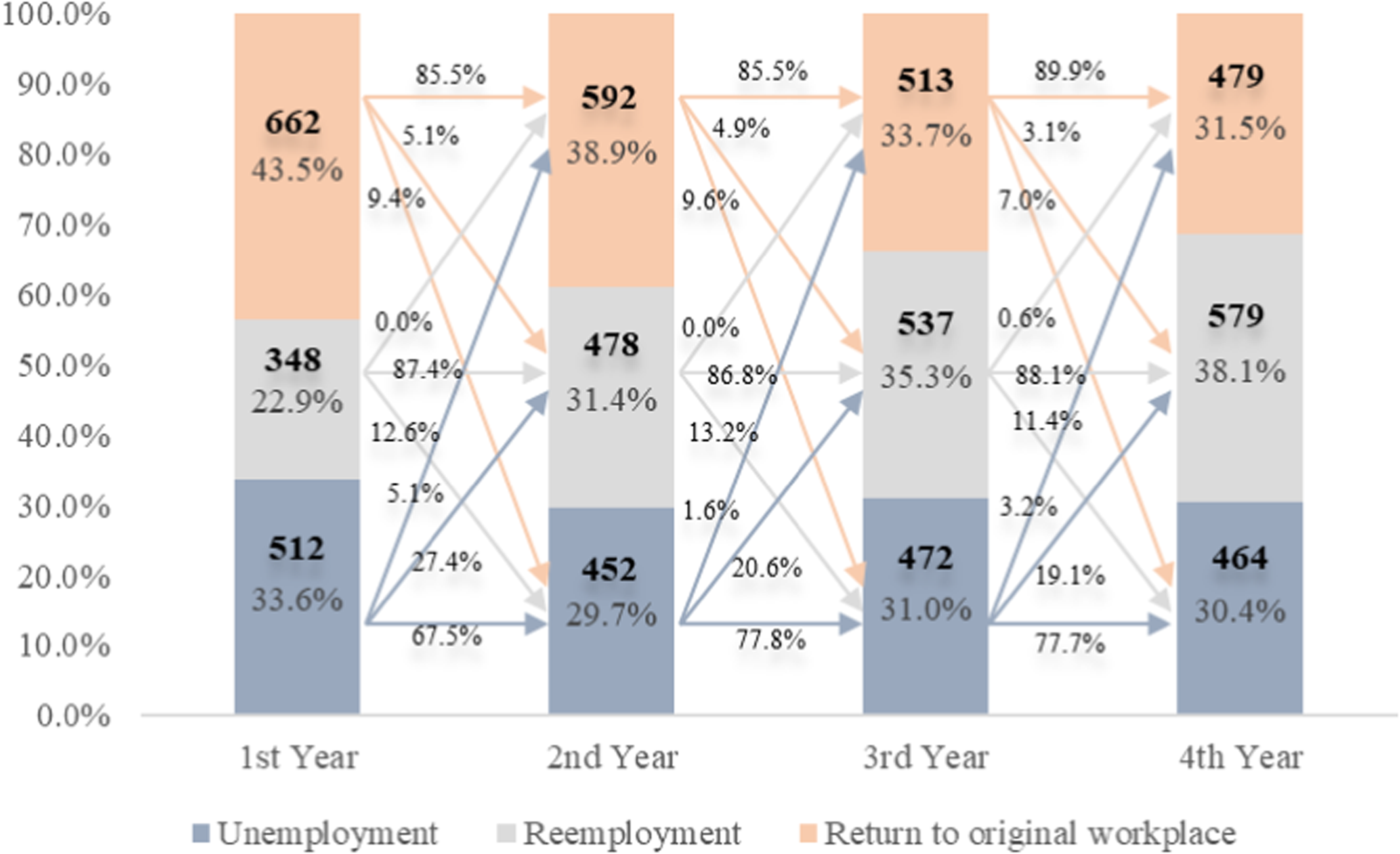
RTW pathways for regular workers across four waves (2018-2021).
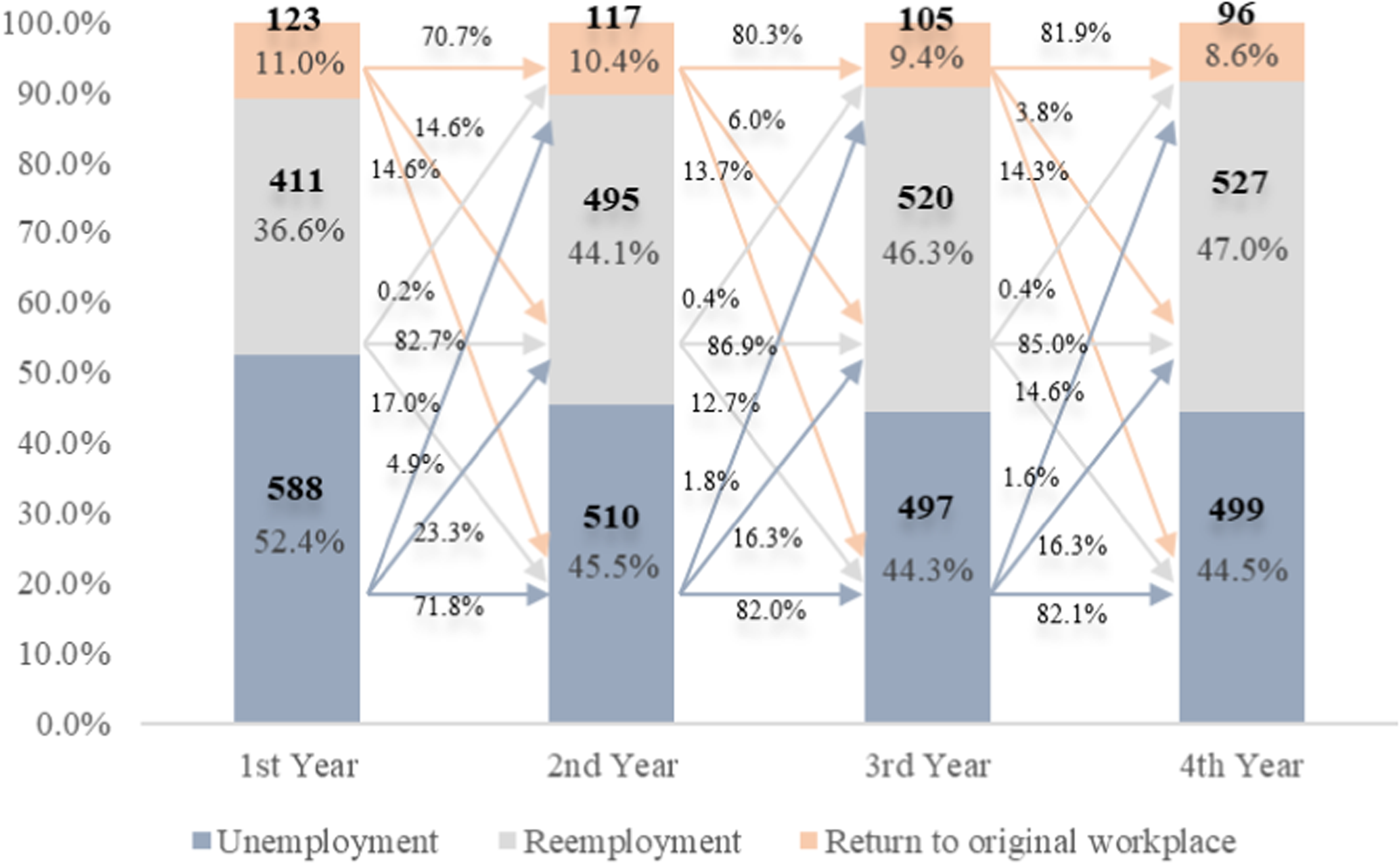
RTW pathways for non-regular workers across four waves (2018-2021). Note: Percentages show the proportion of workers in each RTW status at each wave. Arrows indicate transition patterns between waves.
Figure 1 shows that regular workers are more likely to return to their original jobs or find reemployment than non-regular workers, as shown in Figure 2. Specifically, in Year 1 (2018), 33.6% of regular workers remained unemployed, 22.9% were reemployed, and 43.5% returned to their original workplace. This pattern continued over subsequent years, with some fluctuations in percentage points but consistently higher RTW rates among regular workers. In contrast, Figure 2 shows that in Year 1 (2018), 52.4% of non-regular workers remained unemployed, 36.6% were reemployed, and only 11% returned to their original jobs. This trend of higher unemployment and lower return to original job rates persisted across all four years, indicating less stable RTW patterns for non-regular workers after the end of injury treatment.
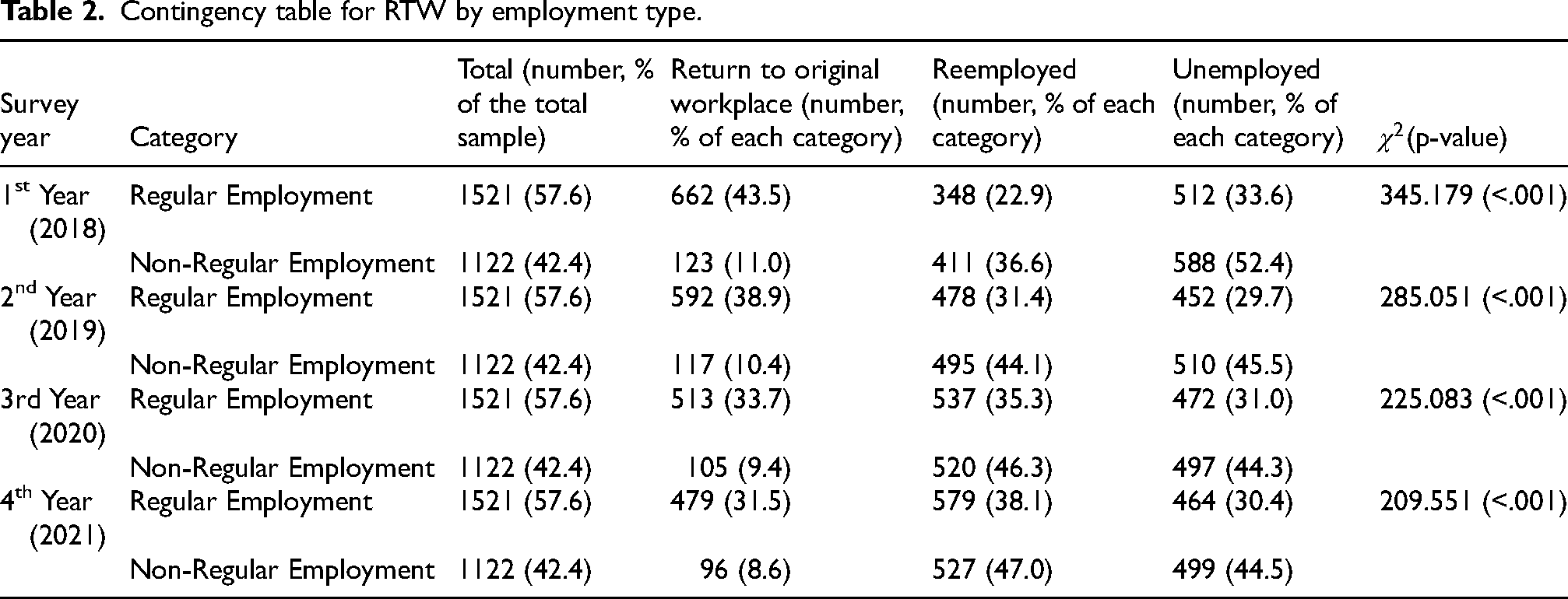
These descriptive results suggest that regular workers have a higher likelihood of returning to their original jobs or being reemployed, whereas non-regular workers are more likely to remain unemployed or find reemployment rather than returning to their previous positions. To statistically verify these observations, a chi-square test of independence was conducted to examine the association between employment type (regular or non-regular) and RTW outcomes (return to the original workplace, reemployment, and unemployment) over the four survey years. Table 2 summarizes the results for each year. Similar patterns were observed in the second (2019), third (2020) and fourth (2021) years. Among non-regular workers, reemployment was consistently the most common outcome (44.1% in Year 2, 46.3% in Year 3, and 47.0% in Year 4), while returning to the original workplace remained relatively rare. By contrast, regular workers consistently exhibited higher rates of return to their original workplaces. Overall, the results demonstrate a clear and persistent disparity in RTW outcomes based on employment status, with regular workers experiencing more stable and favorable outcomes than non-regular workers.
Contingency table for RTW by employment type.
Given that access to psychological and social resources may vary by employment status, self-efficacy and social interaction were included as key predictors in our panel regression models as they represent critical psychological resources that influence RTW outcomes. Table 3 presents the means and standard deviations (SD) of self-efficacy and social interaction across the four survey waves (2018-2021), comparing the regular and non-regular employment groups. In terms of self-efficacy, regular workers consistently reported higher scores than their non-regular counterparts. Specifically, self-efficacy scores among regular workers ranged from 3.41 to 3.44, showing overall stability with minimal variation. By contrast, non-regular workers displayed consistently lower scores, ranging from 3.29 to 3.32. For social interaction, both groups exhibited relatively stable levels across the four waves (2018-2021). However, regular workers again reported slightly higher values, with scores ranging from 2.89 to 2.91, compared to 2.83 to 2.86 among non-regular workers.
Self-efficacy and social interaction by employment type.
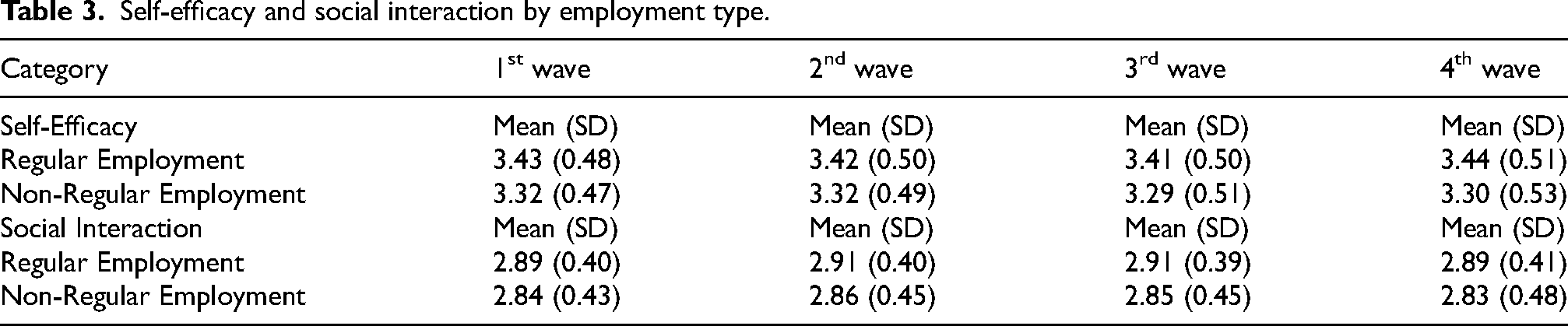
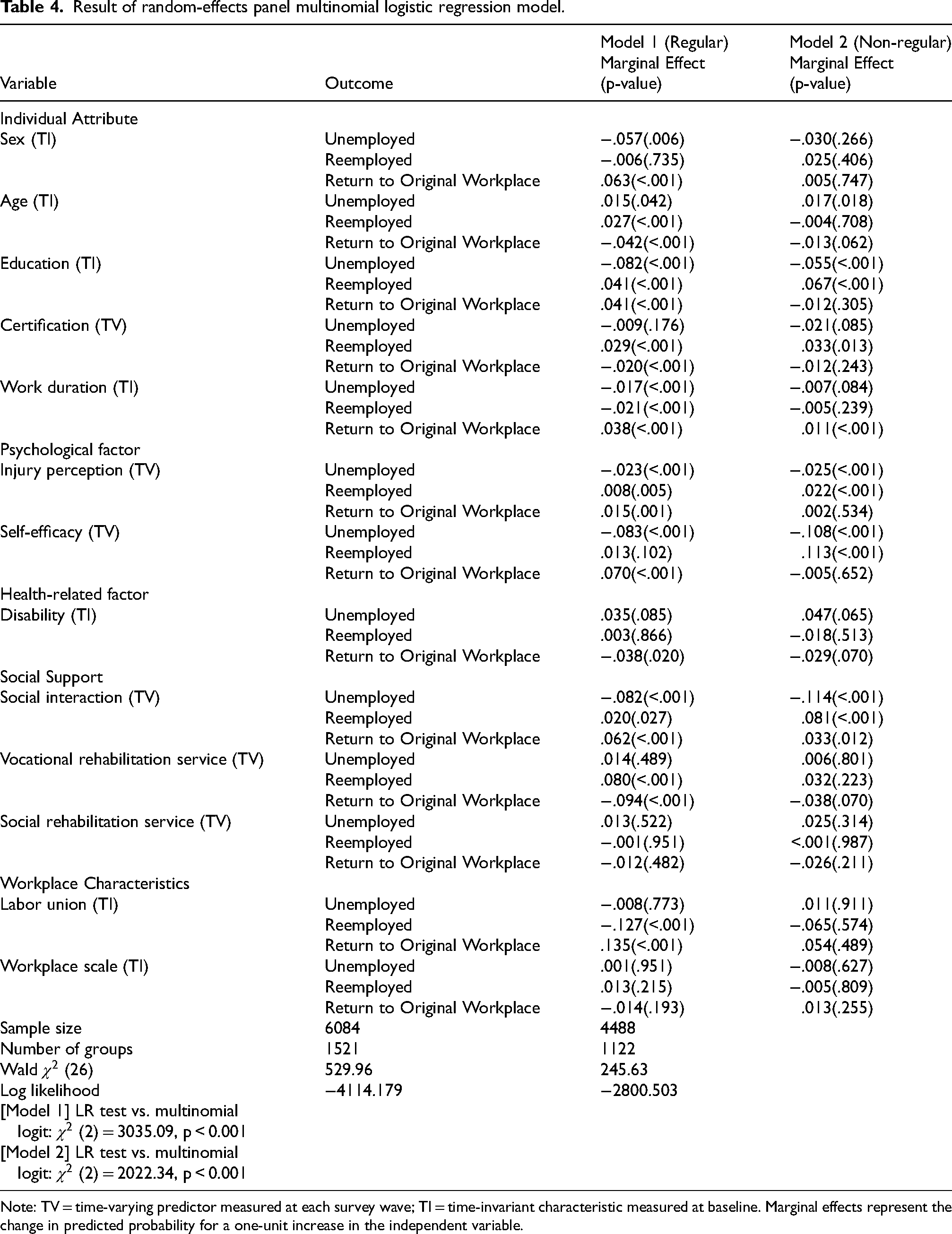
Table 4 presents the marginal effects from the panel random-effects multinomial logistic regression models for both regular and non-regular workers, allowing a comparison of RTW predictors across employment types. The RTW outcomes were categorized into three groups: unemployment, reemployment, and return to the original workplace. The independent variables were organized into five conceptual domains: individual attributes, psychological factors, health-related factors, social support factors, and workplace characteristics.
Result of random-effects panel multinomial logistic regression model.
Result of random-effects panel multinomial logistic regression model.
Note: TV = time-varying predictor measured at each survey wave; TI = time-invariant characteristic measured at baseline. Marginal effects represent the change in predicted probability for a one-unit increase in the independent variable.
To validate the appropriateness of the random effects specification, likelihood-ratio (LR) tests were conducted for both models. In Model 1 (regular workers), the LR test comparing the random-effects specification against a standard multinomial logit model yielded a chi-square statistic of 3035.09 (p < .001). In Model 2 (non-regular workers), the corresponding chi-square statistic was 2022.34 (p < .001). These highly significant results indicate that incorporating unobserved individual-level heterogeneity through random intercepts substantially improves model fit. Therefore, the random-effects panel logistic regression model is statistically more appropriate than the standard multinomial logit model for analyzing panel RTW data with repeated observations.
Among the individual attributes, sex showed statistically significant associations only for regular workers. Among regular workers, being male was associated with a 6.3 percentage point higher probability of returning to the original workplace (p < .001) and a 5.7 percentage point lower probability of remaining unemployed (p = .006) compared to female workers. Age was also notably associated with RTW outcomes. Older individuals were more likely to remain unemployed and less likely to return to their original workplaces. For regular workers, each additional age category was associated with a 4.2 percentage points decrease in the probability of returning to the original workplace (p < .001), whereas for non-regular workers, the decrease was 1.3 percentage points (p = .062). Education showed consistently strong associations in both groups. For regular workers, higher educational attainment was associated with 8.2 percentage points lower unemployment probability (p < .001) and higher probabilities of both reemployment and return to original workplace. Similar patterns were observed for non-regular workers. Holding certifications was significantly associated with higher likelihood of reemployment in both groups, with stronger effects among non-regular workers (+2.9 percentage points, p < .001 for regulars; +3.3 percentage points, p = .013 for non-regulars). Work duration was also positively related to RTW outcomes. Among regular workers, longer work history was associated with lower unemployment probability (−1.7 percentage points, p < .001) and higher return to original workplace probability (+3.8 percentage points, p < .001). For non-regular workers, the positive effect on returning to the original workplace was present but was smaller (+1.1 percentage points, p < .001).
Psychological factors showed significant associations with RTW pathways. The perception of injury showed consistent and significant associations across both groups. More positive injury perception was associated with lower unemployment probability (−2.3 percentage points, p < .001) and higher probability of reemployment (+0.8 percentage points, p = .005; +2.2 percentage points, p < .001, respectively). Self-efficacy showed one of the strongest associations with RTW outcomes. In the non-regular group, higher self-efficacy was associated with 10.8 percentage points lower unemployment probability (p < .001) and 11.3 percentage points higher reemployment probability (p < .001). For regular workers, these associations were smaller but still significant (−8.3 percentage points for unemployment, +7.0 percentage points for return to original workplace, both p < .001), suggesting that self-efficacy is particularly strongly associated with RTW outcomes among non-regular workers.
Health-related factors showed weaker and less consistent associations. Having a disability after treatment was associated with a decreased probability of returning to the original workplace in both groups. Among regular workers, individuals with a disability were 3.8 percentage points less likely to return to their original workplace (p = .020), while among non-regular workers, the effect was −2.9 percentage points and marginally significant (p = .070). However, it did not show any significant effect on unemployment or reemployment.
Social support factors, particularly social interaction, were significantly related to RTW outcomes. Among regular workers, greater social interaction was associated with lower unemployment probability (−8.2 percentage points, p < .001) and higher reemployment probability (+2.0 percentage points, p = .027). These effects were even stronger for non-regular workers, with a reduction in unemployment by 11.4 percentage points (p < .001), increases in reemployment (+8.1 percentage points, p < .001), and return to the original workplace (+3.3 percentage points, p = .012). Use of vocational rehabilitation services was associated with higher reemployment probability among regular workers (+8.0 percentage points, p < .001), but negatively associated with return to original workplace (−9.4 percentage points, p < .001). This suggests that individuals who accessed these services were already at a disadvantage in returning to their previous work, possibly reflecting a self-selection bias. No significant effects are observed for non-regular workers. Social rehabilitation services did not show any significant association with either group.
Workplace characteristics had limited but notable effects. Among regular workers, labor union presence was associated with 13.5 percentage points higher probability of returning to the original workplace (p < .001) and reducing reemployment probability (−12.7 percentage points, p < .001). Among non-regular workers, labor union status did not exhibit significant effects, possibly reflecting lower union coverage or effectiveness. Workplace scale was not significantly related to any of the three outcomes in either group.
As a supplementary analysis, we estimated a pooled model including interaction terms between employment type and three key predictors (self-efficacy, social interaction, and labor union presence) to formally test whether the observed group differences are statistically significant. Most interaction terms were non-significant, with the exception of the interaction between employment type and social interaction for returning to the original workplace, which approached marginal significance (p = .056). These results suggest that while the stratified models reveal meaningful pattern differences, the formal statistical evidence for group differences is limited. Full results are reported in Supplementary Table S1.
This study provides longitudinal evidence of systematic differences in the RTW processes between regular and non-regular workers following occupational injury. The chi-square test results indicated that regular workers had consistently higher RTW success rates than non-regular workers, particularly in terms of returning to their original workplaces. In contrast, non-regular workers were more likely to remain unemployed or, when they did RTW, were typically reemployed at a different workplace rather than returning to their original jobs. This pattern persisted consistently over the four-year observation period. In general, non-regular workers, who are often employed under fixed-term contracts, tend to seek reemployment in different workplaces after completing medical treatment. Nevertheless, approximately 44.5% of non-regular workers remained unemployed even three years after treatment completion. These findings clearly demonstrate employment type disparities in the RTW process in Korea. These patterns are consistent with international evidence. In Spain, temporary workers showed nearly three times the rate of occupational injury compared with permanent workers, 36 and in the United States, temporary workers who were injured at work experienced significantly greater employment reductions and more severe earnings losses than comparable direct-hire workers, with these disparities persisting for at least three years despite similar injury severity. 37 Together, these findings suggest that non-regular workers face compounded disadvantages: not only are they more likely to be injured, but their post-injury recovery pathways are also structurally constrained, a pattern that transcends national contexts.
To examine factors associated with these disparities, we applied a random-effects panel multinomial logistic regression model, which was found to be statistically more appropriate than a standard multinomial logit model for handling panel data. First, educational attainment and certification were consistently associated with higher probability of reemployment. Notably, certification was more strongly associated with securing new employment than with returning to the original workplace. This suggests that human capital factors, such as education and certification, play a critical role in post-injury labor market reintegration and career transitions, highlighting the need for government policies targeting skill development and vocational retraining.
Regarding psychological and social factors, self-efficacy and social interaction showed strong associations with RTW outcomes across all workers, with particularly strong patterns observed among non-regular workers. Given their employment insecurity and lack of institutional protection, non-regular workers may rely more heavily on psychological resources and social networks to navigate the RTW process. This finding provides both theoretical and policy-relevant insights, illustrating the underexplored dependence of non-regular workers on psychological and social resources in their recovery pathways.
Labor union presence showed significant associations with RTW outcomes only among regular workers, with substantially higher probability of returning to the original workplace. No such association was observed for non-regular workers, reflecting the institutional protection gap they experienced. This gap is observed internationally; the OECD Employment Outlook 2019 reported that non-regular (non-standard) workers are approximately 50% less likely to be unionized than regular workers across OECD countries. 38 However, this gap may be particularly pronounced in Korea's dualized labor market, where institutional protections are strongly tied to regular employment status. One possible explanation is that labor unions may have played a key role in the RTW process by informing workers of their rights and providing essential information regarding workplace reintegration.39,40 International evidence further suggests that institutional and regional contexts shape RTW beyond individual resources. In Germany, works councils and labor unions play active roles in supporting injured workers’ reintegration through tailored retraining programs, and RTW rates are notably higher in regions with lower unemployment rates, indicating that structural and community-level factors significantly influence recovery outcomes. 41 Furthermore, the use of vocational rehabilitation services was associated with a higher probability of reemployment but a lower probability of returning to the original workplace. This may reflect a selection effect wherein these services are more likely to be accessed by workers facing greater barriers to returning to their pre-injury jobs. These results suggest the need to reconsider not only the accessibility of such services, but also the criteria for selecting service recipients and strategies for facilitating reintegration into the original workplace.
Work duration was positively associated with RTW across both groups, suggesting that longer tenure is associated with advantages in returning to work. Conversely, having a disability was associated with a decreased likelihood of returning to the original workplace, and this effect was more pronounced among non-regular workers. These results suggest that RTW inequalities are cumulative and are reproduced within the labor market.
Taken together, our findings show that non-regular workers occupy a structurally disadvantaged position in terms of employment security, institutional protection, and access to welfare services, and that these structural vulnerabilities persist throughout the RTW process. This study demonstrated that the recovery pathways of non-regular workers are not simply slower or more difficult but are fundamentally structured in different ways. Building on these findings, it is also important to consider the concept of resilience in occupational health and rehabilitation research.33,34 Rather than focusing solely on the moment of RTW, strengthening resilience at the individual, workplace, and broader community levels is increasingly recognized as a comprehensive framework for preventing reinjury and promoting sustainable recovery. Adopting a resilience-based approach may therefore offer a complementary framework for rehabilitation, one that addresses not only individual recovery but also the institutional and environmental conditions that shape RTW outcomes.
This study has several limitations. First, because this study used national-level public data, researchers were unable to change or modify the survey design. Therefore, commonly used resilience measurement variables, such as the Connor-Davidson Resilience Index or organizational measures, were not included. Future research should incorporate these questions into empirical studies. Second, this dataset does not fully include newly emerging non-regular workers, such as platform workers. Since the non-regular workers in this dataset were enrolled in the Korean Workers’ Compensation Insurance before 2018, most non-regular workers share similar working conditions with regular workers but have different contracts. Starting in 2023, several types of non-regular workers, including designated drivers and delivery laborers, are gradually being covered by workers’ compensation insurance. Third, the observed differences in employment status transition between regular and non-regular workers may partially reflect pre-existing labor market inequalities rather than being solely attributable to the RTW process itself. Non-regular workers generally face higher job instability regardless of occupational injury, and without a comparison group of uninjured workers, this study cannot fully disentangle injury-specific RTW effects from baseline employment disparities. Future research employing matched control designs or difference-in-differences approaches could help isolate the distinct impact of occupational injury on RTW outcomes across employment types. Finally, while the stratified regression models provide valuable insights into group-specific predictor patterns, direct comparison of effect sizes across separately estimated models has inherent statistical limitations. Although a supplementary pooled model with interaction terms was conducted to address this issue (Supplementary Table S1), most interaction terms did not reach conventional significance levels, suggesting that observed cross-group differences in effect magnitudes should be interpreted with caution. Fifth, self-efficacy and social interaction were measured concurrently with RTW status at each wave, raising the possibility of reverse causality. This concern is partially mitigated because the PSWCI uses a generalized self-efficacy measure rather than an RTW-specific instrument, which would more directly overlap with the outcome. Nonetheless, the reported associations should be interpreted as bidirectional, and future research employing pre-injury baselines, lagged predictors, or domain-specific RTW self-efficacy measures would help clarify temporal direction.
Conclusion
This study empirically examined the differences in the RTW process by employment type among workers who completed medical treatment for occupational injuries in 2017. The findings revealed that non-regular workers experienced greater difficulties in returning to work and, more importantly, followed distinctly different recovery pathways than regular workers. Human capital factors, such as education and certification, played a key role in facilitating reemployment, while psychological and social resources, particularly self-efficacy and social interaction, were found to be more critical for non-regular workers. These results demonstrate that structural vulnerabilities associated with employment type actively influence the RTW process. Notably, labor union presence was associated with a 13.5 percentage point increase in the probability of returning to the original workplace among regular workers, while no such association was observed for non-regular workers, underscoring the institutional protection gap as a central mechanism driving RTW disparities.
RTW, or returning to the original workplace, cannot always be regarded as the optimal outcome. In some cases, reemployment in a different workplace or career transition may serve as a more appropriate path for injured workers. However, distinguishing between returning to original work and reemployment remains important, as most injured workers in South Korea tend to perceive returning to their original workplace as offering greater stability and hope. 42 Moreover, RTW itself serves as a core outcome indicator for evaluating the success of the rehabilitation and recovery processes. From this perspective, this study highlights that non-regular workers do not merely experience delayed or difficult RTW, but encounter structurally constrained recovery processes.
By analyzing the RTW process of occupationally injured non-regular workers as an independent analytical focus and using nationally representative panel data, this study makes both academic and policy contributions through its multidimensional analysis of employment-type differences in recovery pathways. Future rehabilitation policies should expand their focus beyond medical recovery and address nonmedical aspects, including long-term employment stability after RTW. In particular, there is an urgent need to develop tailored interventions to strengthen the psychological resources and social networks of non-regular workers, along with institutional protection measures to support their sustainable reintegration. Specifically, expanding occupational rehabilitation services beyond the initial medical treatment period for non-regular workers, developing portable social protection systems that are not tied to a specific employer, and creating targeted RTW programs that account for the structural constraints of non-regular employment would directly address the disparities identified in this study. Future research should further develop the concept of resilience in occupational rehabilitation, examining how multi-level resilience can promote sustainable recovery and prevent reinjury, particularly for workers in structurally vulnerable employment positions.33,34
Supplemental Material
sj-docx-1-wor-10.1177_10519815261458766 - Supplemental material for Return-to-Work challenges faced by non-regular workers: Insights from a four-year panel study in South Korea
Supplemental material, sj-docx-1-wor-10.1177_10519815261458766 for Return-to-Work challenges faced by non-regular workers: Insights from a four-year panel study in South Korea by Min-Kyu Kim and Ji-Bum Chung in WORK
Footnotes
Acknowledgements
We thank the Korea Workers’ Compensation & Welfare Service (Labor Welfare Research Institute) for offering raw data on PSWCI (Panel Study of Workers’ Compensation Insurance).

Ethical approval
Not applicable.
Informed consent
Not applicable.
Funding
The authors disclosed receipt of the following financial support for the research, authorship, and/or publication of this article: This work was supported by the National Research Foundation of Korea, (Grant No. RS-2025-00517091).
Declaration of conflicting interests
The authors declared no potential conflicts of interest with respect to the research, authorship, and/or publication of this article.
Supplemental material
Supplemental material for this article is available online.
References
Supplementary Material
Please find the following supplemental material available below.
For Open Access articles published under a Creative Commons License, all supplemental material carries the same license as the article it is associated with.
For non-Open Access articles published, all supplemental material carries a non-exclusive license, and permission requests for re-use of supplemental material or any part of supplemental material shall be sent directly to the copyright owner as specified in the copyright notice associated with the article.
