






Abstract
Background
Workplace ostracism is a negative social stressor that is associated with psychological distress, work stress, and poor employee well-being. Leadership behavior is an important determinant of social inclusion in the workplace; yet there is a lack of evidence on how and under what conditions spiritual leadership can counteract ostracism, especially in a highly regulated work context.
Objective
This study examines the association between spiritual leadership and workplace ostracism, with justice orientation explored as a moderating variable in this association. Additionally, job social support, meaningful work, and harmonious passion are investigated as psychological mechanisms mediating this association.
Methods
A cross-sectional survey was conducted among 378 banking employees in Punjab, Pakistan. Standardized scales were used to measure all variables. Hierarchical regression analysis was employed to test direct and moderating effects, while mediation analyses were conducted using regression-based procedures to examine the proposed parallel mediating mechanisms.
Results
The results indicate a negative association between spiritual leadership and workplace ostracism. Justice orientation moderates this relationship, such that a more negative relationship is found for employees with higher justice orientation. Job social support, meaningful work, and harmonious passion each partially mediate the association between spiritual leadership and workplace ostracism.
Conclusion
The findings of this study indicate that spiritual leadership is related to reduced workplace ostracism through unique interpersonal, cognitive, and motivational mechanisms. By identifying three distinct psychological mechanisms and a critical boundary condition, this study places spiritual leadership on the organizational map as a valuable work resource for promoting social inclusion and employee well-being in a regulated work context.
Keywords
Introduction
Spiritual leadership is rooted in intrinsic motivation, altruistic love, and vision. This form of leadership is widely known to build positive work cultures. By promoting meaning and belonging, leaders create workplaces with increased job satisfaction, better employee engagement, and improved performance. 1
However, workplace ostracism can undermine these benefits. Ostracism occurs when employees feel ignored or excluded by their colleagues. 2 This experience severely impacts psychological well-being, causing increased anxiety, depression, and lower self-esteem.3,4 These psychological impacts appear as severe occupational health outcomes, including high stress biomarkers, sleep problems, cardiovascular problems, and increased susceptibility to professionally diagnosed mental health issues. 5 Occupational stress due to social exclusion can be a factor in burnout, work-related illnesses, and absenteeism. 6 These consequences are not limited to individual suffering, as ostracized employees tend to be less satisfied with their jobs and less committed to the organization. They also exhibit more counterproductive behaviors, such as having intentions to leave the organization and engaging in workplace deviance.7,8 The social pain from ostracism hurts a sense of belonging among employees and may be a poison to organizational culture. 9 The effects of these eventually have a negative impact on organizational performance and employee engagement. 10
Ostracism in the workplace is affected by leadership styles. A recent meta-analysis reveals that leadership factors are more important than individual personality and contextual factors. 4 Building on this insight, researchers have examined how different leadership approaches may affect ostracism. Studies show that leader-member exchange, 11 ethical leadership, 12 and transformational leadership 13 can reduce employees’ feelings of ostracism.
Initial evidence suggests spiritual leadership has similar effects in hospitality settings. 14 Spiritual leadership's emphasis on altruistic love directly addresses ostracism by fostering inclusive behaviors, while its focus on shared vision cultivates a collective identity that counters exclusionary practices. 15 The intrinsic motivation aspect promotes genuine relationships that reduce feelings of ostracism among employees. However, there are three key gaps in knowledge. First, we don’t understand much about how spiritual leadership works to reduce ostracism. Existing research demonstrates a direct link, but does not explain how or why this association exists. 14 Second, boundary conditions have been overlooked, and little is known for whom spiritual leadership is effective in reducing ostracism. Third, existing research has been confined to a narrow range of industries and often focuses on the hospitality sector. This limited focus neglects how spiritual leadership may play out in different industry contexts, especially those with high regulatory pressures.
This study presents a comprehensive model of the link between spiritual leadership and ostracism in the workplace. Our study has three main objectives: First, we test the direct link between spiritual leadership and workplace ostracism among the employees in the banking industry of Pakistan. Second, we examine the role of justice orientation (sensitivity to fairness and ethical treatment) as a moderator in the spiritual leadership-ostracism relationship. Finally, we wonder how spiritual leadership is associated with lower ostracism in employees by examining job social support (assistance and care from colleagues), meaningful work (experiencing work as purposeful and significant), and harmonious passion (intrinsic motivation aligned with personal values) as potential mediators.
To test these claims, this research uses a survey research design and employs a sample of 378 banking employees in the province of Punjab, Pakistan. Banks operate in the rigid regulatory frameworks that may not only constrain managerial flexibility but also feature hierarchical cultures that may suppress genuine human connection.16,17 Our results indicate that spiritual leadership is negatively and significantly related to workplace ostracism, and this relationship is more pronounced for employees who are more highly oriented towards justice. In addition, we determine three important psychological processes by which spiritual leadership functions: job social support, meaningful work, and harmonious passion, all of which partially mediate the spiritual leadership and workplace ostracism relationship.
This paper contributes to the literature in three ways. First, it explains how spiritual leadership is linked with lower workplace ostracism. It has been demonstrated in previous studies that spiritual leadership can be linked to reduced ostracism, 14 but the mechanisms behind this relationship are not well understood. We identify three psychological processes, including job social support, meaningful work, and harmonious passion, where each one can explain the negative relationship between spiritual leadership and workplace ostracism. This extends the theory by specifying conditions that strengthen spiritual leadership's negative association with workplace ostracism.
Second, this study identifies when spiritual leadership works best. Prior research ignored boundary conditions for spiritual leadership effectiveness. 4 We show that justice orientation moderates the spiritual leadership-ostracism relationship, implying that employees who value fairness benefit more from spiritual leadership practices in resisting workplace ostracism.
Third, this study extends the theory of spiritual leadership to regulated industries. Most studies put spiritual leadership to the test in relatively flexible organizational contexts. 18 We demonstrate the applicability of this theory in the banking industry, where employees operate in an environment of strict regulations and hierarchical structures. In this sense, this work expands the theoretical conceptualization of spiritual leadership by showing how the principles of spiritual leadership can be effective in both constrained and unconstrained organizational situations.
The following section concerns relevant literature and develops the hypotheses of this research. Next, we describe the research design and data gathering procedures and present the empirical analyses and findings. The final part is a review of the theoretical and practical implications of the study.
Hypothesis development
Spiritual leadership and workplace ostracism
Organizations with spiritual leaders often tend to have a workplace culture that focuses on the collective values, purpose, and a sense of community for employees. 18 By aligning organizational goals with the intrinsic values of employees, spiritual leaders foster a sense of belonging among the team members.1,19 This is linked to improved individual motivation and facilitates collaboration and teamwork. A sense of community can counter feelings of isolation and ostracism. 20 Spiritual leaders encourage inclusivity by recognizing and valuing diversity. 21 When employees find the opportunity to express their thoughts and opinions in a safe environment, spiritual leadership promotes a sense of belonging and self-identity.8,22
In addition, spiritual leadership creates a positive work environment that prioritizes well-being and intrinsic motivation.23,24 This leadership style encourages employees to engage in prosocial behaviors, such as helping colleagues and collaborating on tasks.21,25,26 By demonstrating trust and compassion, spiritual leaders inspire similar behaviors in their employees, thereby enhancing workplace harmony.19,27 This emphasis on empathy and understanding reduces the likelihood of ostracism, as employees become more attuned to the perspectives and needs of others. 28 This emphasis on empathy and understanding is associated with a lower likelihood of ostracism, as employees become more attuned to the perspectives and needs of others.
Additionally, spiritual leadership fosters psychological empowerment by cultivating a work environment that emphasizes meaning, competence, self-determination, and impact.29,30 By aligning employees’ work with a greater purpose and recognizing their skills, spiritual leaders enhance employees’ sense of meaning and competence.1,21 Encouraging autonomy and highlighting the positive impact of their contributions further nurtures self-determination and significance.29–31 These elements of psychological empowerment enhance employees’ self-esteem and resilience, enabling them to better navigate the adverse social dynamics of ostracism and maintain their well-being. Thus, we propose the following hypothesis:
H1: Spiritual leadership is negatively associated with workplace ostracism.
Justice orientation as moderator
While spiritual leadership is generally associated with lower workplace ostracism, the reactions of employees to this form of leadership may not be consistent.4,30 One of the important individual differences that can influence these reactions is justice orientation. Justice orientation is the extent to which employees value fairness, ethics, and consistency in workplace interactions. 32 Existing literature suggests that justice orientation influences individuals’ attention, interpretation, and internalization of leadership behaviors32–34 and thus represents an important boundary condition for the effectiveness of leadership.
Employees with high justice orientation are more likely to scrutinize leaders’ values and intentions.35,36 Since spiritual leadership emphasizes altruistic love, shared vision, and moral purposes, the relational cues of spiritual leadership are of particular importance to these employees. When these relational cues are perceived as genuine, justice-oriented employees are more likely to identify with spiritual leadership, 33 which is associated with higher feelings of workplace belonging, interpersonal trust, and workplace connectedness. These social experiences are remarkably similar to the inclusionary conditions under which workplace ostracism is less likely to occur.37,38
On the other hand, employees with low justice orientation are less responsive to cues of fairness and ethics. While they may still react favorably to spiritual leadership, they are less likely to identify with its relational and value-based aspects. As a result, the negative relationship between spiritual leadership and workplace ostracism may be weaker for them.
Justice orientation is therefore hypothesized to influence the strength of the association between spiritual leadership and workplace ostracism.
H2: Justice orientation strengthens the negative relationship between spiritual leadership and workplace ostracism.
Theoretical framework for multiple mediators
Having established the direct relationship (H1), this study turns to the processes through which spiritual leadership is associated with lower workplace ostracism. We focus on three mediators: job social support, meaningful work, and harmonious passion. These mediators are not arbitrarily chosen. They are grounded in the Job Demands-Resources model, which holds that job resources activate distinct psychological processes depending on the specific needs they address.39,40 Spiritual leadership is a job resource that simultaneously provides three distinct psychological resources to employees: job social support at the relational level, meaningful work at the cognitive level, and harmonious passion at the motivational level. These resources serve to meet different psychological needs and thus provide different mechanisms through which spiritual leadership is related to workplace ostracism.
The choice of these three mediators is theory-based. These three mediators correspond to the three key components of the spiritual leadership mode. The altruistic love component creates a caring and supportive environment among employees, which is reflected in job social support.18,21 The vision component shapes how employees interpret the significance of their work, reflected in meaningful work.18,19 The intrinsic motivation component encourages employees to engage with their work in ways that align with their personal values, reflected in harmonious passion.18,21 In this way, the three mediators are not only theoretically distinct but also exhaustive of the core mechanisms through which spiritual leadership is theoretically linked to employee outcomes.
These processes are considered in parallel rather than in sequence. Spiritual leadership is associated with multiple aspects of employee experience simultaneously, and these pathways may operate with varying strength across individuals. Examining these mediators together, therefore, provides a more complete yet parsimonious account of how spiritual leadership is associated with lower workplace ostracism. There is empirical evidence that these constructs are unique and each explains a unique amount of variance in outcomes. 4 Together, these parallel processes provide a more comprehensive understanding of how spiritual leadership is associated with inclusive workplaces.
Job social support as mediator
Based on social exchange theory (SET), spiritual leadership forms positive exchange relationships by offering social and emotional benefits to employees.41,42 These leadership behaviors establish an environment where reciprocal exchange of support is expected and valued, fostering a culture of mutual care and consideration.15,21 Spiritual leadership's emphasis on genuine care, support, and concern for ethical standards leads to improved supportive interpersonal relationships with colleagues and increased job social support.43,44
Enhanced job social support subsequently establishes a network of reciprocal obligations and positive exchanges among employees. Research suggests that when employees receive support from colleagues, they experience a psychological obligation to reciprocate with inclusive behaviors, which is associated with a lower likelihood of workplace ostracism. 3 This exchange relationship develops a norm of mutual support and inclusion in the workplace, thereby decreasing the probability of employees engaging in ostracism.30,45
Job social support functions as a crucial mediating mechanism by channeling spiritual leadership's initial resource provision into sustained patterns of positive social exchange.46,47 These patterns of exchange create a duty of ongoing support and incorporation, which reduces the likelihood of employees acting in ostracizing ways. Job social support through this social exchange process can explain the relationship between spiritual leadership and workplace ostracism. 48
The mediating role of job social support is key to social exchange settings as it is the outcome of leadership-initiated exchanges and the antecedent of future exchange actions of employees.49,50 When spiritual leaders establish high-quality exchange relationships characterized by trust and mutual respect, they foster conditions conducive to flourishing job social support. This, in turn, generates ongoing cycles of positive reciprocity that are associated with lower levels of ostracism behaviors.5,51
H3: Job social support mediates the negative relationship between spiritual leadership and workplace ostracism.
Meaningful work as mediator
While SET provides the relational context for the leadership outcome, the experience of meaningful work is more immediately rooted in identity-based and meaning-making theories. Meaningful work is the employees’ cognitive interpretation of work as meaningful, significant, and consistent with their self-concept.52,53 In this regard, spiritual leadership is associated with meaningful work because it provides a vision, value alignment, and sense of calling that shape employees’ cognitive interpretation of the significance of their work roles.21,54,55
From the social exchange perspective, these meaning-enhancing leadership behaviors also convey care, moral intention, and investment in employees, which supply a relational context in which positive reciprocity becomes more likely. 56 Employees who experience their work as meaningful have a stronger psychological bond and shared sense of purpose with other employees, which reinforces inclusive social interactions and discourages withdrawal and exclusionary social interactions.52,53 Consequently, meaningful work is negatively related to workplace ostracism because employees are more motivated to maintain positive social interactions, which can contribute to a cooperative social environment. 57
In this regard, meaningful work serves as a cognitive mediating variable that connects spiritual leadership to workplace ostracism. Spiritual leadership is associated with employees’ cognitive interpretation of work meaning, while social exchange processes explain why these cognitive interpretations are linked to inclusive social interactions and reduced workplace ostracism. 58 Therefore, we propose the following hypothesis:
H4: Meaningful work mediates the negative relationship between spiritual leadership and workplace ostracism.
Harmonious passion as mediator
Harmonious passion is a type of motivational involvement where people voluntarily invest effort in work activities because these activities are congruent with their identity, values, and sense of purpose. 29 Harmonious passion is best explained by self-determination theory, which emphasizes the importance of autonomous internalization and intrinsic motivation in value-congruent and autonomy-supportive contexts.59,60
Spiritual leadership is related to harmonious passion because it helps to create an organizational environment that is characterized by transcendental purpose, altruistic love, and significant interpersonal relationships. 21 These conditions are conducive to employees’ autonomous motivation and internalization of values.18,23,61
Although self-determination theory can explain the internalization of harmonious passion, SET is a complementary theory that is able to explain the social manifestation of this type of motivation in the workplace. Through spiritual leadership, employees perceive cues of care, morality, and long-term investment, which, in turn, are associated with reciprocal engagement in positive social interactions. 41
Employees with harmonious passion are likely to display high levels of empathy, cooperation, and prosocial behavior. These behaviors directly offset the tendencies of social withdrawal or exclusion.62,63 As such, individuals with harmonious passion are less likely to engage in exclusionary behavior and are more motivated to maintain inclusive workplace relationships.61,63
In this manner, harmonious passion is a motivational mediating factor that links spiritual leadership to workplace ostracism. Spiritual leadership is associated with the autonomous internalization of work values, while reciprocal social processes help to explain the social manifestation of this motivation in inclusive social behavior. Therefore, the following hypothesis is proposed (Figure 1).
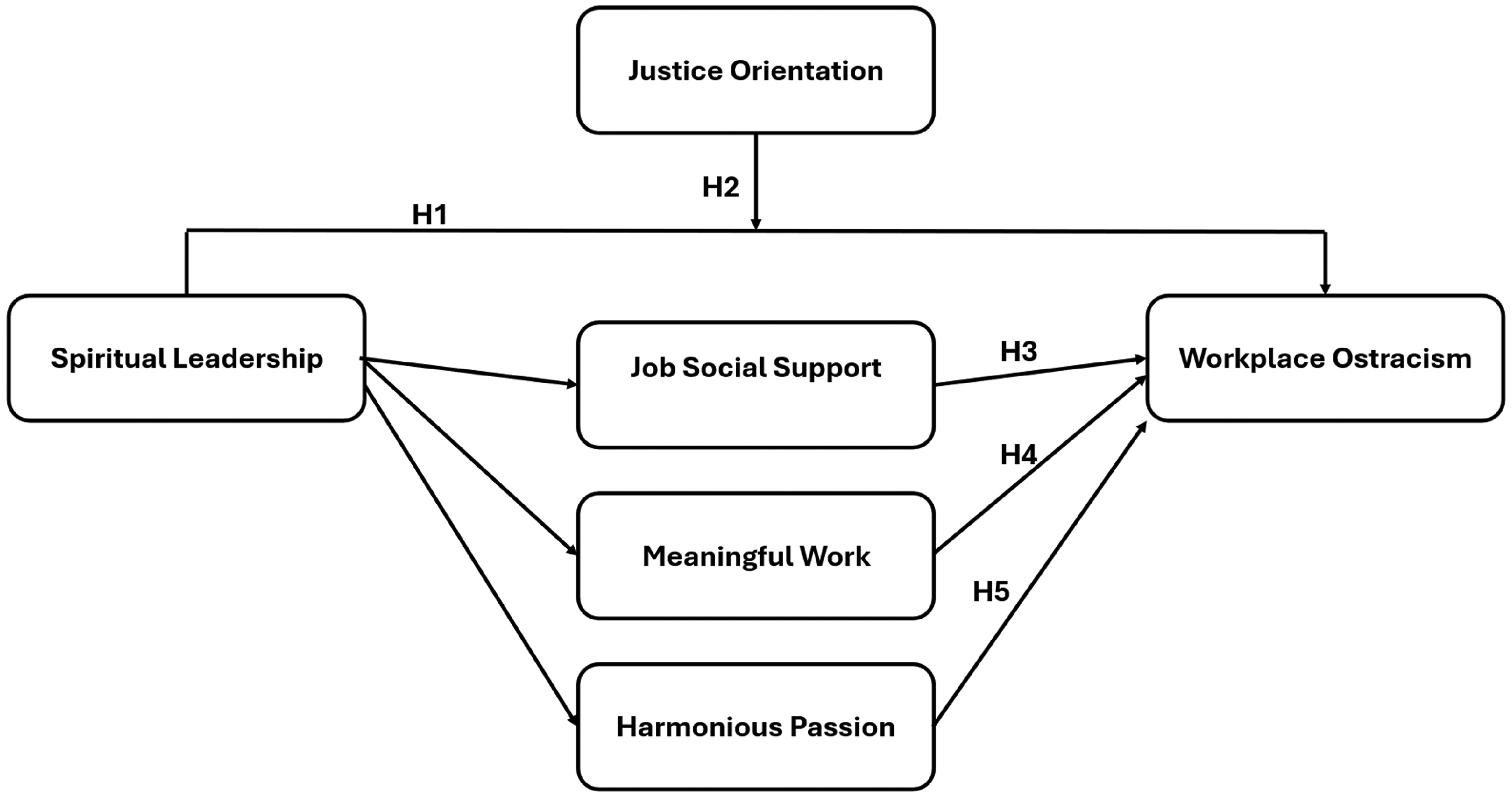
Theoretical model.
H5: Harmonious passion mediates the negative relationship between spiritual leadership and workplace ostracism.
Methodology
Participants and procedure
This study used a quantitative approach to explore how spiritual leadership relates to workplace ostracism. The study population consisted of employees working in the banking sector. Data were collected from banking professionals in Lahore, which serves as a major financial hub in Punjab, the most populous province of Pakistan. A non-probability sampling technique was chosen, i.e., convenience sampling method, due to its practical advantages in accessing participants within financial institutions. While convenience sampling may limit generalizability, it allowed for efficient data collection and ensured we could investigate all key study variables within resource constraints.
The study sample is determined using item response theory, i.e., ten responses per item; hence, we administered 490 structured paper questionnaires to employees in the selected banks in Punjab, to ensure uniformity and reliability. The study participants were recruited via professional and organizational networks with institutional permission and were invited to take part on a voluntary basis. To have a sufficient exposure to workplace interaction, sample participants were only considered those with a tenure of at least six months. The confidentiality and anonymity of the participants were guaranteed. Of the 408 responses obtained, 30 were excluded for being incomplete, yielding 378 usable responses. This represented a usable response rate of 77.14 percent.
The sample was predominantly male (55.8%) and composed largely of young professionals aged 21–30 years (54.8%). The 31–40 years age group was the second most common (37.6%), with relatively few older workers (41–50 years, 7.1%; over 50 years, 0.5%). The sample was relatively early in tenure, with 55.0% having 2–4 years of experience and 22.0% having 5–7 years; the remainder had 8–10 years (14.0%) or more than 10 years (9.0%), so that employees with eight or more years of tenure represented about 23% of the sample. The sample was highly educated: the most common qualification was a graduate degree (54.8%), followed by a postgraduate degree (25.7%) and an undergraduate degree (19.6%). This is consistent with the qualifications required for the banking sector in Pakistan. A detailed description of the respondents is provided in Table 1.
Frequency analysis of respondents’ characteristics.
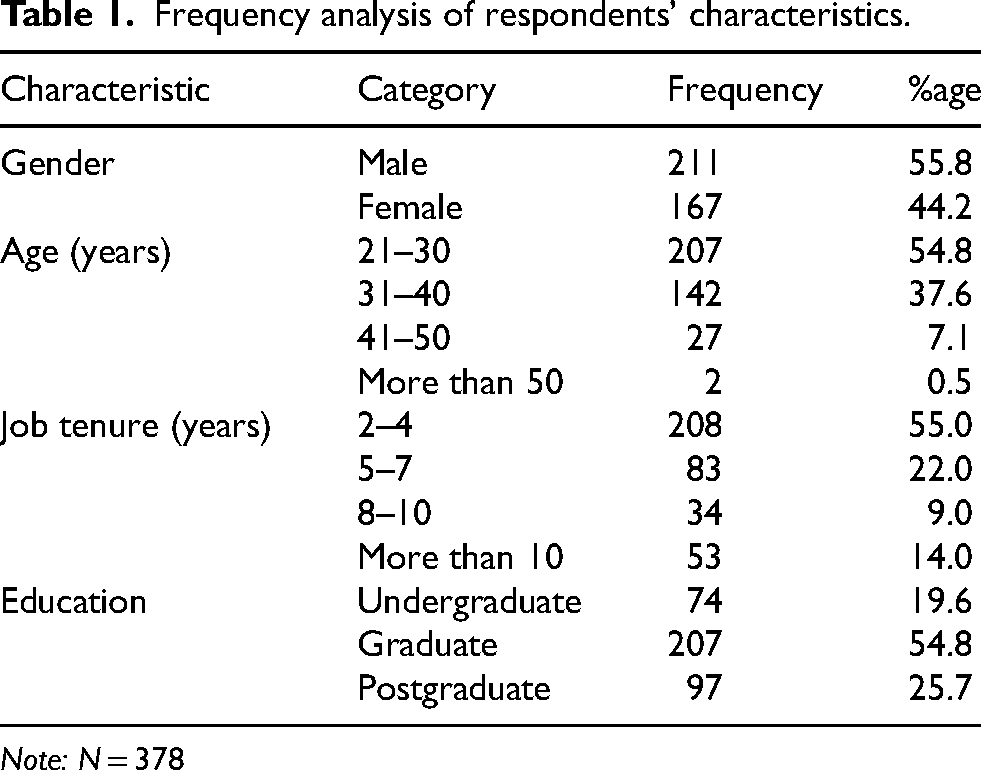
Note: N = 378
Measurement instruments
This research utilized established psychometric instruments to assess six theoretical constructs. The measurement strategy involved spiritual leadership as the independent variable, workplace ostracism as the dependent variable, justice orientation as a moderator, and three mediating variables: job social support, meaningful work, and harmonious passion.
Spiritual Leadership was measured using Fry's 21 validated 17-item Spiritual Leadership Scale, which captures three theoretical dimensions: vision, hope/faith, and altruistic love. This measure evaluates leadership practices needed to intrinsically motivate followers by providing spiritual survival, calling, and membership in the workplace.
Workplace Ostracism was assessed using Ferris et al.'s 3 10-item Workplace Ostracism Scale, a widely-validated instrument measuring the extent to which individuals perceive being ignored or excluded by organizational members. The scale demonstrates robust psychometric properties and unidimensional factor structure across diverse organizational settings.
Job Social Support was evaluated using Karasek et al.'s 64 8-item scale, which measures perceived instrumental and emotional support from colleagues and supervisors within the workplace environment.
Meaningful Work was assessed using Steger, Dik, & Duffy's 65 10-item scale, capturing employees’ sense of purpose, significance, and transcendence in their organizational roles.
Justice Orientation (moderator) was measured using Hülle, Liebig, & May's 33 4-item scale, evaluating individual differences in sensitivity to fairness and justice concerns within organizational contexts.
Harmonious Passion was assessed using Vallerand et al.'s 59 6-item scale from the Passion Scale, measuring the autonomous internalization of activities that individuals find important and meaningful to their identity.
Reliability analysis
Each of the measurement scales used a five-point Likert response format from “strongly disagree” (1) through to “strongly agree” (5), ensuring that the scales were comparable and that subsequent statistical analyses could be performed. The reliability analysis showed that all measures were of high internal consistency. The Cronbach's alpha values ranged from 0.781 to 0.873, all above the generally accepted value of 0.70 for the social sciences. 66 Specifically, the reliability coefficients were job social support (α = 0.840), meaningful work (α = 0.783), spiritual leadership (α = 0.827), justice orientation (α = 0.781), workplace ostracism (α = 0.873), and harmonious passion (α = 0.829). These reliability values demonstrate the internal consistency and measurement quality of the instruments used in this study. 67 Table 2 describes the detailed description of reliability testing.
Reliability analysis of variables.
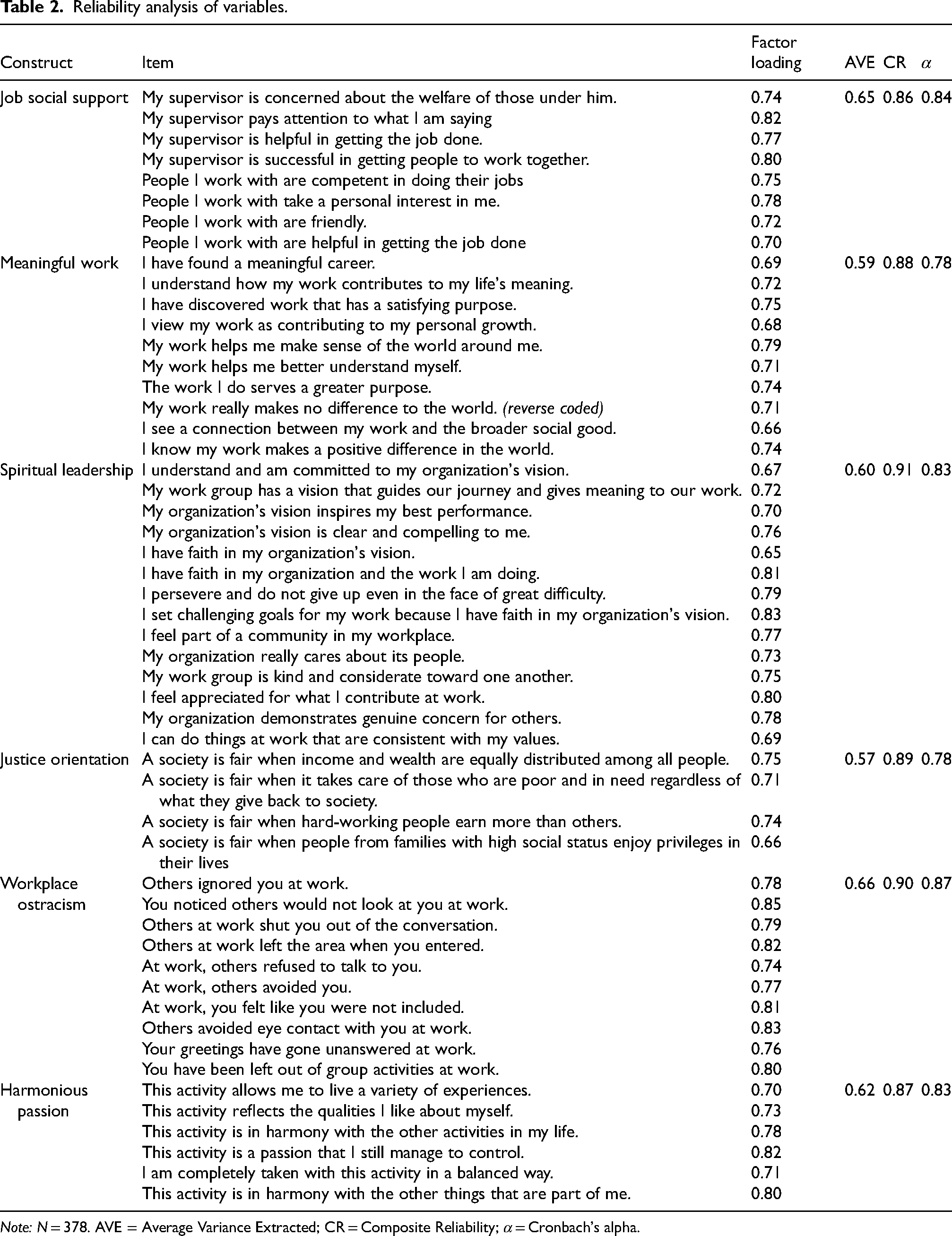
Note: N = 378. AVE = Average Variance Extracted; CR = Composite Reliability; α = Cronbach's alpha.
Results and discussion
Preliminary results
Prior to testing the hypotheses of the study, we examined the collected data for missing values, outliers, and multicollinearity as these could compromise the results. 30 responses were identified with missing data; after exclusion of these, 378 responses are the valid responses to be used for further analysis. To check the normality of the data, we assessed the skewness and kurtosis values, which fell well within the threshold range, i.e., (±1) and (±3), respectively. Multicollinearity diagnostics revealed no significant concerns, as Pearson's correlations (see Table 3) for all the variables fell below 0.85. 68 These assumptions confirm the suitability of the data for further analysis.
Correlation analysis of variables.
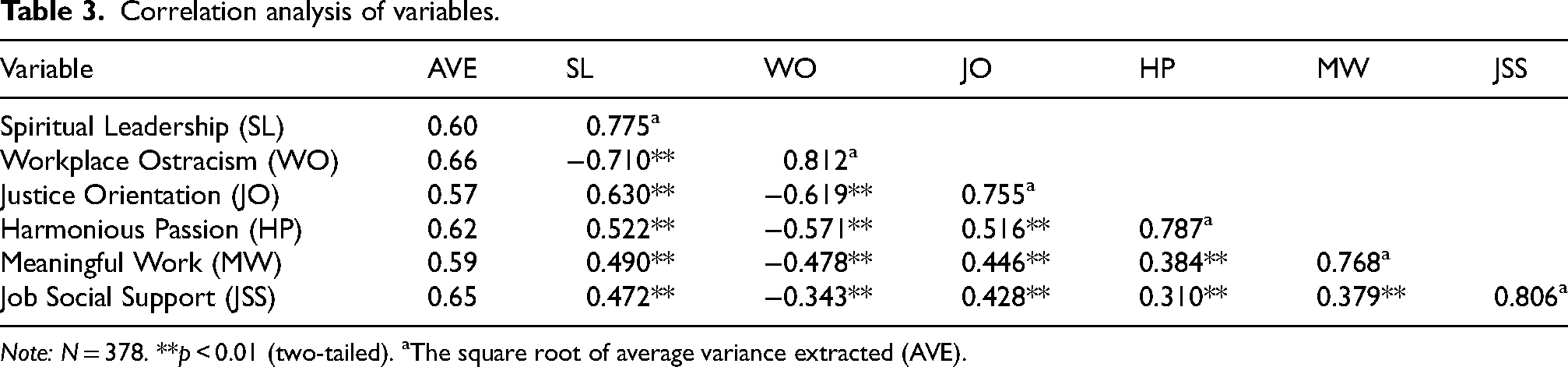
Note: N = 378. **p < 0.01 (two-tailed). aThe square root of average variance extracted (AVE).
Common method variance
Several measures were implemented to minimize common method variance (CMV) concerns. First, questionnaire items were randomized across different sections to reduce response patterns. 69 Second, we used different response scales for predictor and outcome variables where possible. Third, participants were assured of anonymity and encouraged to respond honestly, reducing social desirability bias. 70 Fourth, temporal separation was created by collecting the predictor variables (spiritual leadership and justice orientation) in the first part and the outcome variable (workplace ostracism) in the later sections. 69 Finally, Harman's single-factor test was conducted post-hoc, which revealed that no single factor accounted for the majority of variance (the largest factor explained 23.4% of variance). Furthermore, a common latent factor (CLF) analysis was performed, and after comparing the regression weights of baseline and CLF models, i.e., minimal difference between the two (< 0.02), it suggests CMV was not a significant concern. 71
Correlation analysis
Table 3 shows correlation coefficients. Workplace ostracism was negatively correlated with spiritual leadership (r = -0.710, p < 0.01), justice orientation (r = -0.619, p < 0.01), harmonious passion (r = -0.571, p < 0.01), meaningful work (r = -0.478, p < 0.01), and job social support (r = -0.343, p < 0.01). The significant negative association between spiritual leadership and workplace ostracism (r = -0.710) is in line with meta-analytic findings that leadership is the most powerful predictor of ostracism that explains a greater variance than personality traits or contextual influences. 4 This value does not suggest that there is construct overlap; the two constructs are theoretically different, and each has a different loading in the confirmatory factor analysis (CFA). Spiritual leadership was significantly and positively correlated with justice orientation (r = 0.630, p < 0.01), harmonious passion (r = 0.522, p < 0.01), meaningful work (r = 0.490, p < 0.01), and job social support (r = 0.472, p < 0.01). Also, the other study variables had significant positive intercorrelations ranging from r = 0.310 to 0.516 (all p < 0.01). Additionally, the data did not have multicollinearity since the correlation values are lower than 0.85. 72
Confirmatory factor analysis (CFA)
At the first stage, CFA was applied to assess the measurement model because the scales for the constructs were from the literature. Factor loadings (see Table 2) of all the constructs were significant, and the standardized loading ranged from 0.65 to 0.85. We further noted that the values of composite reliability are greater than 0.60 and AVE is more than 0.50, which is well above the threshold level. 67 For discriminant validity, the Fornell-Larcker criterion was followed, and it was noted that the square root of AVE is more than the correlation values (see Table 3). 67 Furthermore, the model demonstrated a good overall fit as indices show χ2/df = 2.13 (acceptable, ≤ 3.00), RMSEA = 0.056 (good, ≤ 0.08), SRMR = 0.043 (good, ≤ 0.05), and CFI = 0.957 (excellent, ≥ 0.95). 67 The results confirm the discriminant validity, convergent validity, and support model adequacy.
Hypothesis testing
At the second stage, the hypotheses were tested using the PROCESS macro, Model 1 for moderation analysis, and Model 4 for mediation with 5000 bootstrap resamples.
Direct effects
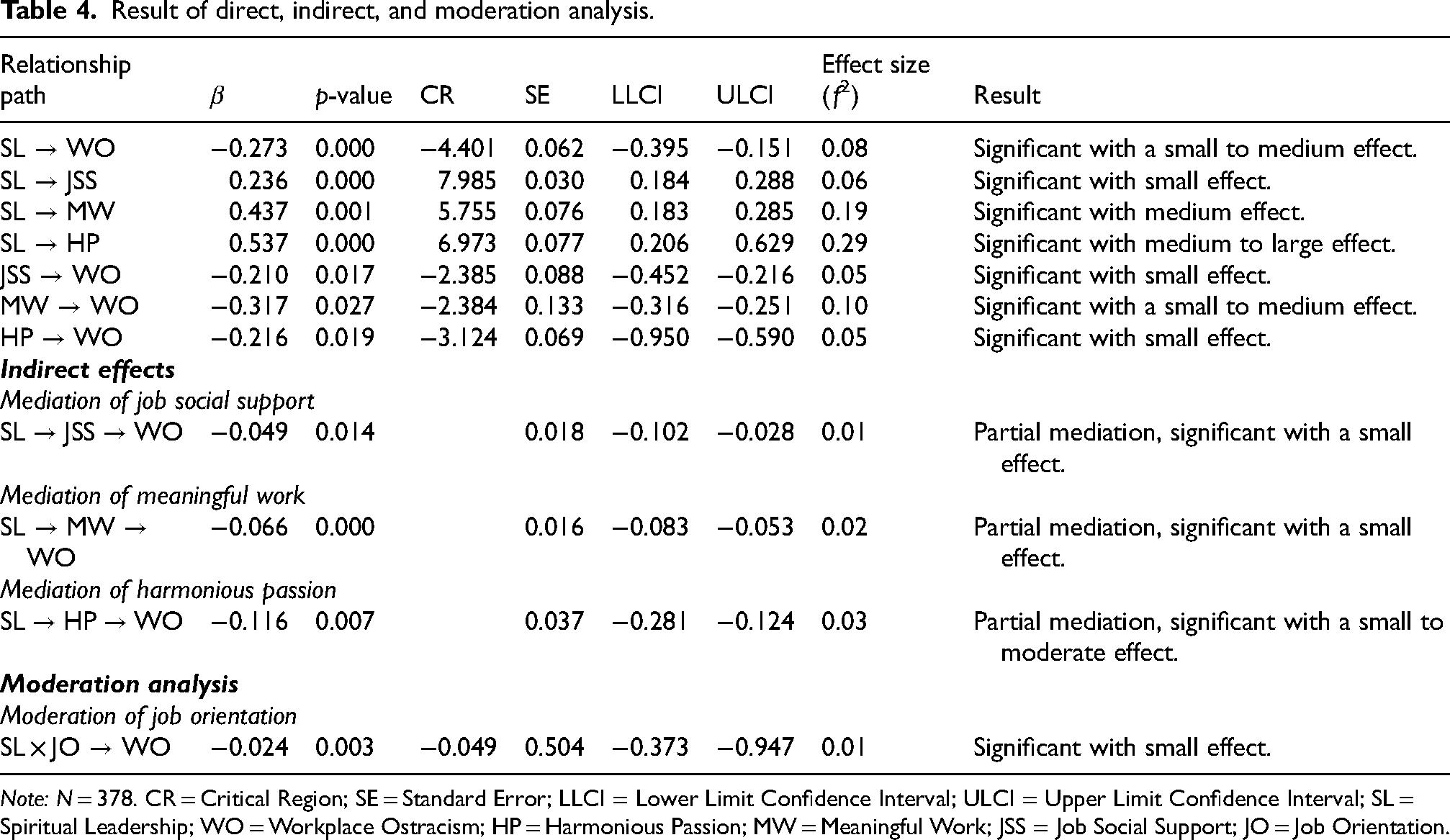
Regression analysis was conducted to test the hypotheses. Table 4 shows the direct association between spiritual leadership and workplace ostracism. Results indicate a significant negative association between spiritual leadership and workplace ostracism (β = -0.273, R = -0.710, R2 = 0.54, t = -4.401, df = 376, p < 0.001, f2 = 0.08), supporting H1. Higher spiritual leadership levels are associated with lower workplace ostracism. The model explains 54% of the variance in workplace ostracism, indicating that spiritual leadership is associated with more inclusive workplace environments.
Result of direct, indirect, and moderation analysis.
Note: N = 378. CR = Critical Region; SE = Standard Error; LLCI = Lower Limit Confidence Interval; ULCI = Upper Limit Confidence Interval; SL = Spiritual Leadership; WO = Workplace Ostracism; HP = Harmonious Passion; MW = Meaningful Work; JSS = Job Social Support; JO = Job Orientation.
Moderation analysis
Table 4 presents the moderation analysis examining the role of justice orientation in the spiritual leadership-workplace ostracism relationship. The interaction term shows a significant negative association (β = -0.025, t = -3.03, p = 0.003, CI: −0.041 to −0.009, f2 = 0.01), confirming significant moderation. Although the effect size is small (f2 = 0.01), this is typical in field studies with individual moderators in limited work settings. 73 This association is statistically significant, given the value of the interaction term and non-overlapping confidence interval (CI: −0.041 to −0.009).
The results indicate that justice orientation is associated with strengthening the negative relationship between spiritual leadership and ostracism. This suggests that justice-oriented workers are more strongly linked to spiritual leadership's inclusion practices, as they are likely to value true ethical practices. These findings support H2 and demonstrate that justice orientation is a positive moderator of the association between spiritual leadership and workplace ostracism. Figure 2 visually describes the moderation, which is shown as a graph.
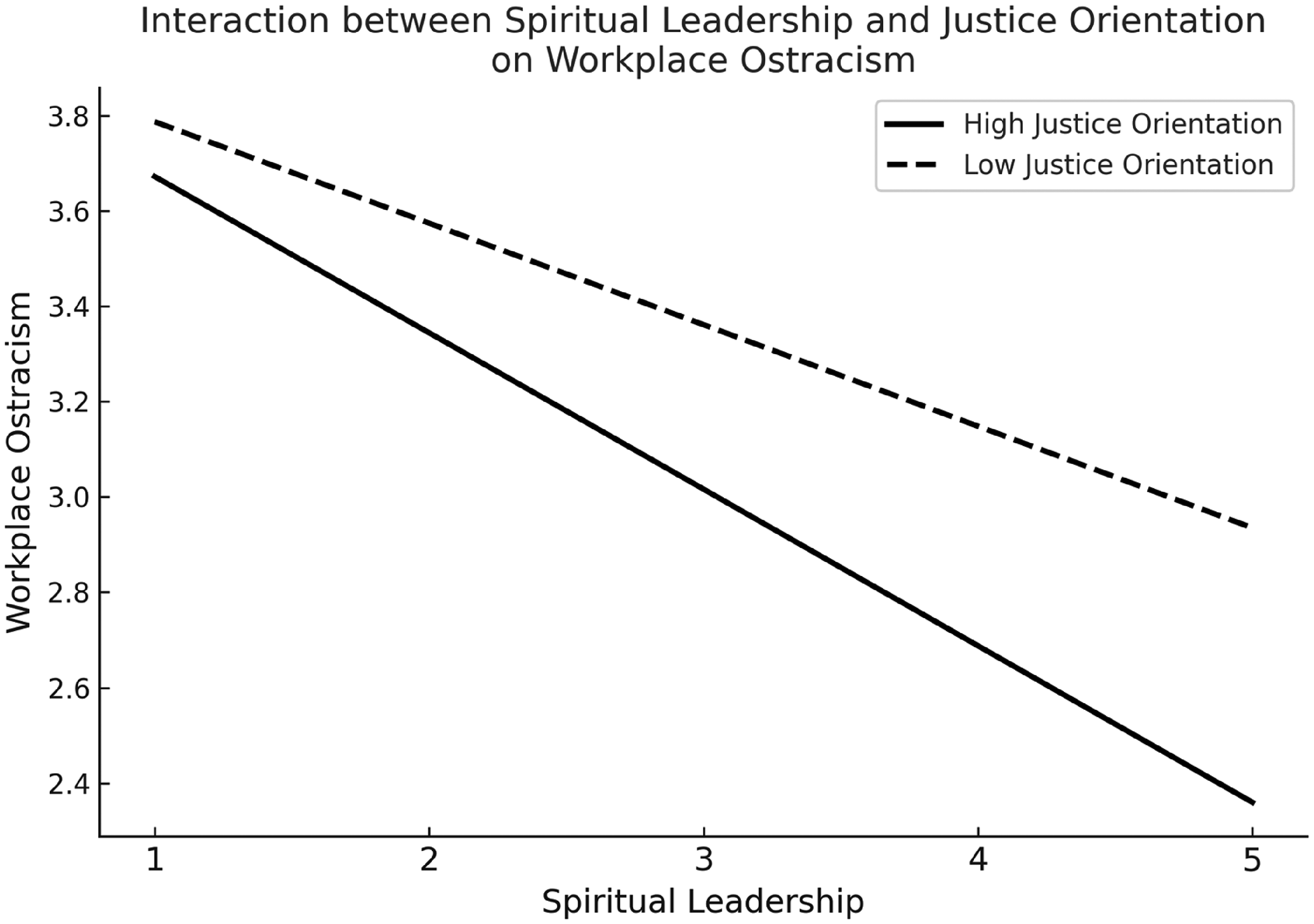
Interaction plot.
Mediation analysis
Job Social Support as Mediator
Table 4 presents the mediation analysis results examining the relationship between spiritual leadership and workplace ostracism and the role of job social support. Spiritual leadership is significantly associated with job social support (β = 0.236, t = 7.984, p < 0.001, f2 = 0.06), accounting for 28.7% of its variance (R2 = 0.287). Job social support, in turn, is negatively associated with workplace ostracism (β = -0.211, t = -2.385, p < 0.05, R2 = 0.063, f2 = 0.05). Spiritual leadership has a significant indirect association with workplace ostracism through job social support (β = -0.063), with a 95% bootstrap confidence interval (LLCI = −0.174, ULCI = −0.023), suggesting partial mediation. These findings support H3, indicating the relevance of social support in buffering ostracism at work.
Meaningful Work as Mediator
The findings of the mediation analysis examining the role of meaningful work in the association between spiritual leadership and workplace ostracism are presented in Table 4. The results indicate that spiritual leadership is significantly and positively associated with meaningful work (β = 0.437, t = 5.755, p < 0.001, f2 = 0.19), accounting for 18.7% of the variance (R2 = 0.187). Meaningful work, in turn, is significantly and negatively associated with workplace ostracism (β = -0.317, t = -2.385, p < 0.05, R2 = 0.061, f2 = 0.10). The mediation analysis results indicate that the indirect association is significant, as the 95% bootstrap confidence interval (LLCI = −0.1257, ULCI = −0.07) does not include zero, suggesting partial mediation. These results provide empirical support for H4.
Harmonious Passion as Mediator
Table 4 depicts the mediation analysis, which looks at the role of harmonious passion in the association between spiritual leadership and workplace ostracism. The findings indicate that spiritual leadership is significantly and positively associated with harmonious passion (β= 0.537, t = 6.973, p = 0.001, f2= 0.29), which accounts for 28.7% of its variance (R2 = 0.287). In turn, harmonious passion is significantly and negatively associated with workplace ostracism (β = -0.216, t = -3.124, p < 0.05, f2 = 0.05), accounting for 15.29% of the variance (R2 = 0.1529). Table 4, which is the result of mediation, indicates that there is a significant indirect association (β = -0.0974) and the 95% bootstrap confidence interval (LLCI = −0.297, ULCI = −0.149) does not include zero, suggesting partial mediation. These results give empirical evidence to H5.
Conclusion
This research proposes a theoretical framework to explore the association between spiritual leadership and workplace ostracism. More broadly, this framework capitalizes on the role of justice orientation as a moderating variable and job social support, meaningful work, and harmonious passion as intervening variables in our proposed framework. We test this framework among banking employees in Pakistan, and the findings of this study are as follows. Our findings indicate that spiritual leadership is associated with reducing workplace ostracism behaviors, and this association is more pronounced for employees who are more highly oriented towards justice. Our findings also provide that spiritual leadership has a negative association with workplace ostracism via three different psychological mechanisms: job social support, meaningful work, and harmonious passion.
Our findings have three major contributions to the literature. First, it clarifies various interpersonal, cognitive, and motivational mechanisms underlying the link between spiritual leadership and reduced workplace ostracism. Second, it demonstrates that justice orientation is an important moderator, identifying when spiritual leadership will be more effective in restricting workplace ostracism. Third, it extends the generalizability of spiritual leadership to more highly regulated financial institutions, increasing its theoretical generalizability to more formalized settings.
These findings have implications for workplaces and occupational health practitioners. The standardized measures of job social support, meaningful work, and harmonious passion used in this study are short and can easily be administered. Occupational health professionals and vocational specialists can include them in their regular workplace assessments at the individual and departmental level to pinpoint units where a collective sense of social disengagement is occurring so that interventions can take place before ostracism leads to burnout or other occupational health problems. Low levels of social support, meaningful work, and harmonious passion in departments may reflect structural problems with work environments, enabling organizations to focus leadership and job redesign interventions at the department level before things get worse. In terms of rehabilitation, leaders can be trained in supportive and values-based leadership skills, especially in the context of dealing with returning employees after illness and stress. Such training may address the social, cognitive, and motivational processes identified in this study as key elements in reducing workplace ostracism.
There are a few limitations in this study. The study is cross-sectional in design, and this design does not allow for causal inference. Further, the use of self-reported measures can result in common method bias, although various remedial steps were taken to address this issue. Our research is conducted in a sample of banking employees in the Punjab province of Pakistan, restricting the generalizability of the findings of this study to other sectors and cultures. Moreover, the research investigates individual-level variables and does not consider team and organizational-level variables, which may also influence workplace ostracism. Although the findings are consistent with the proposed model, other explanations should be taken into consideration. For instance, people with a positive attitude might more frequently consider leadership as spiritual and might experience greater levels of social support, meaningful work, harmonious passion, and lesser levels of ostracism. Similarly, a good work environment (e.g., fairness or psychological safety) can influence perceptions of leadership and may impact ostracism outside the hypothesized pathways identified in this study.
Longitudinal and multi-source designs would strengthen causal inference and help distinguish leadership effects from dispositional and contextual influences. Future studies may extend the findings of this research in various other industries and cultures. Future studies may also explore additional mediators, such as psychological safety, and evaluate the effectiveness of spiritual leadership training interventions. Additional sources of data, such as ratings from peers and supervisors, would also enhance measurement reliability and limit social desirability effects.
Footnotes
Acknowledgements
The authors sincerely thank all participants for their valuable contributions to this study. The authors also appreciate the constructive comments and suggestions provided by the Editor-in-Chief, Dr Karen Jacobs, and the anonymous reviewers, which helped improve the quality of the manuscript.

Ethical approval
Ethical approval for this study was obtained from the Institute of Business & Management, University of Engineering and Technology, Lahore (Ref. No. 18/Uni/IBM/Dir/2025).
Informed consent
Written and verbal informed consent was obtained from all participants prior to their participation in the study.
Funding
The authors received no financial support for the research, authorship, and/or publication of this article.
Declaration of conflicting interests
The authors declared no potential conflicts of interest with respect to the research, authorship, and/or publication of this article.