






Abstract
Background
Scholarly calls have also been made for more studies with a transgender and gender diverse health promotion in the workplace policy focus.
Objective
This co-designed study aims to: a) investigate and report on mental health barriers and enablers for transgender and gender diverse employees with psychosocial disability; and b) model and critically discuss the issues and measures which respectively constrain and advance the mental health of transgender and gender diverse employees with psychosocial disability.
Methods
Thematic analysis was applied to data collected from interviews involving 12 participants identifying as transgender or gender diverse.
Results
Micro system issues included gender-related stigma and discrimination. Micro system enablers included more contact with transgender and gender diverse employees. Meso system issues encompassed a lack of mental health supports. Meso system enablers included transgender and gender diversity workplace education. Macro system issues and enablers were discriminatory national policies and kindness as a universal guide respectively.
Conclusions
We conclude by recognising a need for co-developed national health and wellbeing policies to support the mental health of transgender and gender diverse employees with psychosocial disability.
Keywords
Introduction
Categories of gender have become increasingly fluid over recent times. 1 Approximately one percent of the Australian population aged sixteen years and older consists of people who are transgender and gender diverse. 2 The term transgender can be unclear for persons who are not familiar with it. 3 Transgender is defined as, “an umbrella term for people whose gender identity, gender expression, or behaviour deviates from that associated with the sex they were assigned at birth”,4, p.792,5 Gender diverse is defined as, “having a gender identity or gender expression that differs from a given society's dominant gender roles”. 6 Cisgender is a term referring to persons who are non-transgender. 7 Recognising variances in gender expression and identity, Müller 8 warned of a paucity of service availability which is gender-affirming. Transgender and gender diverse individuals can also experience difficulties in accessing gender-affirming healthcare services with stigma reported as a systemic barrier.9,10 Yet another fundamental barrier to gender-affirming healthcare services is that of medical labelling. Until recent times, the Diagnostic and Statistical Manual of Mental Disorder (DSM) classified transgender as a form of mental illness. 11 This original classification was revised to the present label of gender dysphoria. 12 However, this reclassification of transgender and gender diverse identity has not only antagonised relationships with medical professionals but also dissuaded access to health services.13–15 Ongoing barriers to accessing gender-affirming healthcare services represent a pressing policy issue. Research conducted at a population level reported that transgender people experience worsened mental health results than cisgender people.16–18 Zhu, Gao, Gillespie, Xin, Qi, Ou, Zhong, Peng, Tan and Wang 19 too reported of high levels of mental ill health across the transgender and gender diverse population. Experiences of healthcare accessibility challenges following applications of medical labelling therefore hold significant consequences for the mental wellbeing of transgender and gender diverse individuals.
Discrimination is yet another often-shared reality among transgender and gender diverse people. In a healthcare related example, transgender people attempting to access HIV services have been criticised for attaining the virus on the basis of their gender identity.20,21 The transgender and gender diverse population continues to experience hostility in many areas of life including that of employment.22,23 Research indicates that approximately 70 percent of transgender employees report experiencing workplace discrimination and harassment. 24 This population is also highly represented among the targets of workplace violence.23,25,26 Discrimination, together with expectancies and experiences of rejection, represents a significant mental health issue for transgender and gender diverse employees.27,28,29,30 Discrimination is an especially notable mental health concern given the considerable periods of time spent in the workplace by an existing and vulnerable population. 31 The discrimination experienced by transgender and gender diverse individuals can become exaggerated when intersections occur with other dynamics including that of disability.11,32 Complicated realities therefore exist at the intersection of disability and transgender identities. 33
Following societal stigma and discrimination, transgender and gender diverse individuals experience elevated rates of mental health conditions.34–37 These conditions include anxiety, depression as well as suicidality.37–39 In efforts to grasp mental health related complexities, researchers purported a need to investigate emotions and experiences across individuals’ daily lives.40–42 Most research to date, however, has investigated topics of gender and vulnerability in ways that are confined to binary understandings of gender and which overlook a transgender and non-binary population.16,43 Mellifont and Smith-Merry 44 cautioned of a lack of extant scholarly literature examining the employment experiences of gender diverse people with psychosocial disability. Psychosocial disability is described as disability that is mental health related in nature and which impairs quality of life.45,46 Scholarly calls have also been made for more studies with a transgender and gender diverse health promotion policy focus.47–49 Addressing this pressing research gap from an advancing mental health in the workplace policy perspective, this current co-designed study aims to: (a) investigate and report on mental health barriers and enablers for transgender and gender diverse employees with psychosocial disability; and (b) model and critically discuss the issues and measures which respectively constrain and advance the mental health of transgender and gender diverse employees with psychosocial disability.
Method
Following human research ethics approval [2024/HE000427] from The University of Sydney, potential study subjects were invited to participate in the research through a study flyer that was placed by the first author on the University's website. The flyer invited prospective study participants who met the inclusion criteria to gain more details about the study by accessing a REDCap weblink to an online Participant Information Statement and consent form. Included among the study participant inclusion criteria was the need to: (1) identify as transgender or gender diverse with psychosocial disability; (2) be 18 years or older; (3) be an Australian citizen; (4) have current or previous employment experience; and (5) not be at risk of experiencing an elevated level of stress from participating in the study. After providing online consent, respondents were provided with the option of doing a Zoom interview or providing written responses in a separate REDCap Survey. The second author conducted and recorded the interviews and utilised the Zoom transcription function to produce text file transcripts. Reflecting a structured interviewing technique, study participants were first asked if they primarily identified as transgender or gender diverse. Respondents then received a series of open questions in which they are asked to describe: any workplace issues that can negatively impact on the mental health of employees who are transgender and gender diverse with psychosocial disability; and any things that can help workplaces to be mentally healthy for employees who are transgender and gender diverse with psychosocial disability. Next, the second author de-identified transcript and completed survey response content and saved the respective files in a secure SharePoint storage location at the [INSERT UNIVERSITY NAME] ready for data analysis. The first author then uploaded the interview transcript and survey response files into NVivo14 software in readiness for thematic analysis.
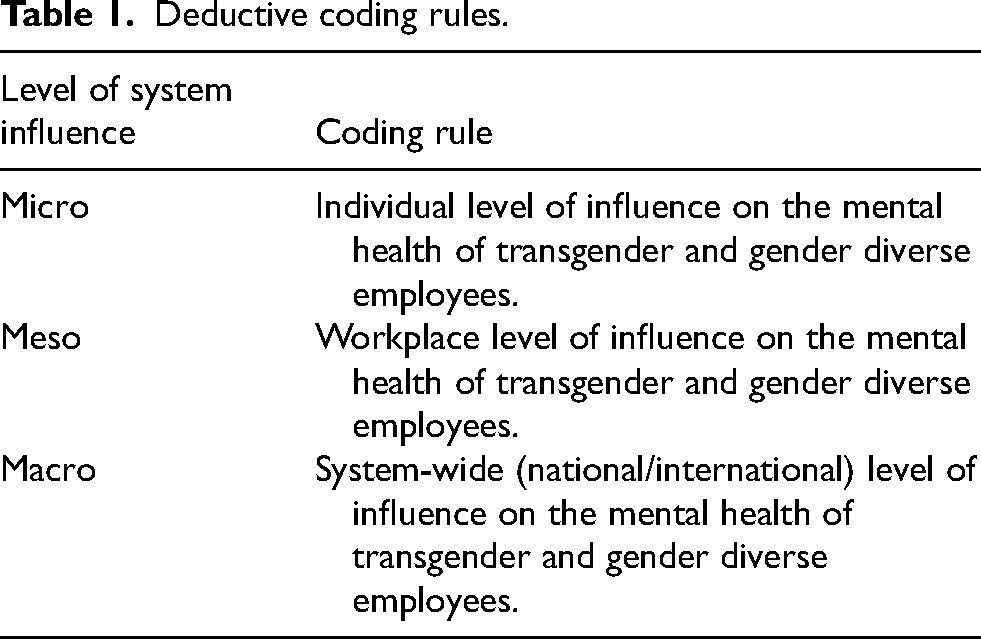
Analysis undertaken by this study involved a hybrid process meaning that inductive and deductive thematic analysis was applied. 50 Guided by the Braun and Clarke 51 approach to performing inductive thematic analysis and as pragmatically applied within NVivo14, the first author iteratively applied five phases to identify the themes and sub-themes which respectively reflected mental health barriers and enablers for transgender and gender diverse employees with psychosocial disability. These phases consisted of: (1) reading transcripts to gain familiarity with the data; (2) identifying a set of preliminary codes, (3) grouping initial codes into possible themes, (4) naming themes, and (5) reviewing themes. The inductively derived coding results were discussed in a collaborative manner at regular meetings with the second author and agreement on the coding was reached. Bronfenbrenner's Ecological Systems Theory is described as fundamental to the studying of workplace health and wellbeing. 52 Following on, the first author adapted a deductive coding approach from Bronfenbrenner's theoretical framework to organise the inductively derived themes and sub-themes across micro, meso, and macro system levels. These three system levels were purposefully selected as they have been previously applied in scholarly efforts to attain an ecological systems perspective within workplace health related studies.53–55 The first author then conducted deductive thematic analysis utilising NVivo14 to organise the themes and sub-themes into micro, meso and macro system levels by applying the coding rules as co-developed between the two authors (see Table 1). The organisation of themes and sub-themes into these three levels of system influence was collaboratively discussed with the second author with consensus achieved between the two authors.
Deductive coding rules.
This exploratory study was purposefully co-designed and co-developed with the second author of this paper who is a member of the priority community. This author was genuinely involved and made valuable contributions to the setting of research direction and design, collection of data, analysis of data, and review of writing content.
Results
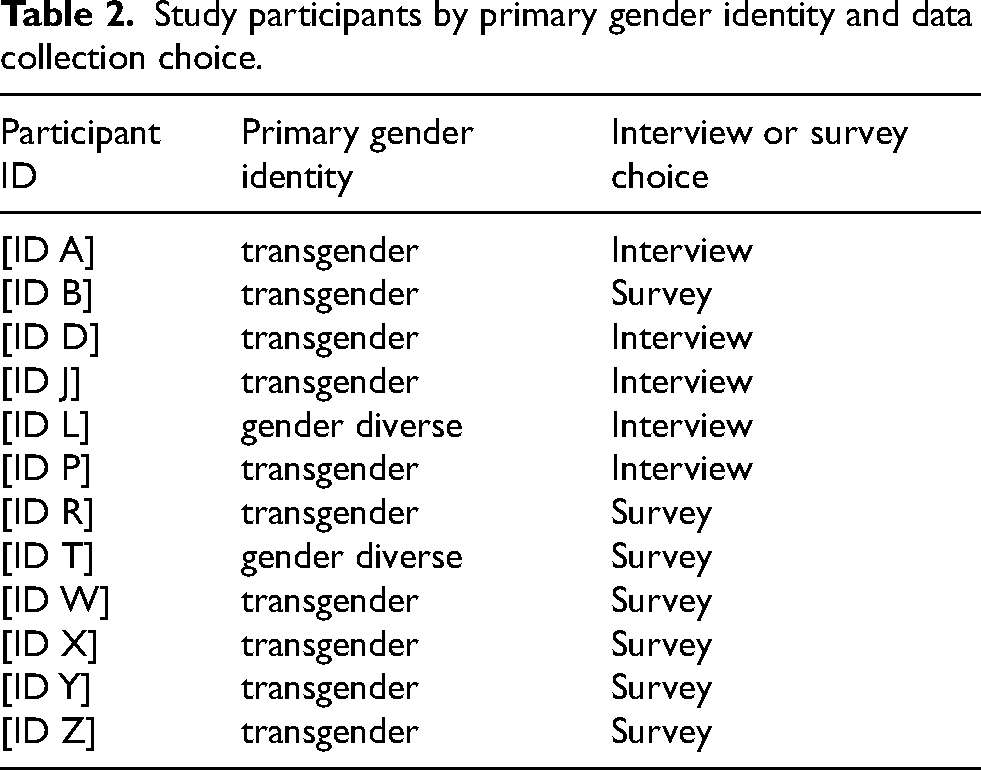
A total of 12 study respondents signed the online consent form and participated in this research. Ten of these respondents identified as transgender and two identified as gender diverse. Seven respondents chose to complete the online survey and five elected to attend the online Zoom interviews. The participant IDs, primary gender identity and data collection choice (i.e., interview or survey) as advised by each study participant are shown in Table 2.
Study participants by primary gender identity and data collection choice.
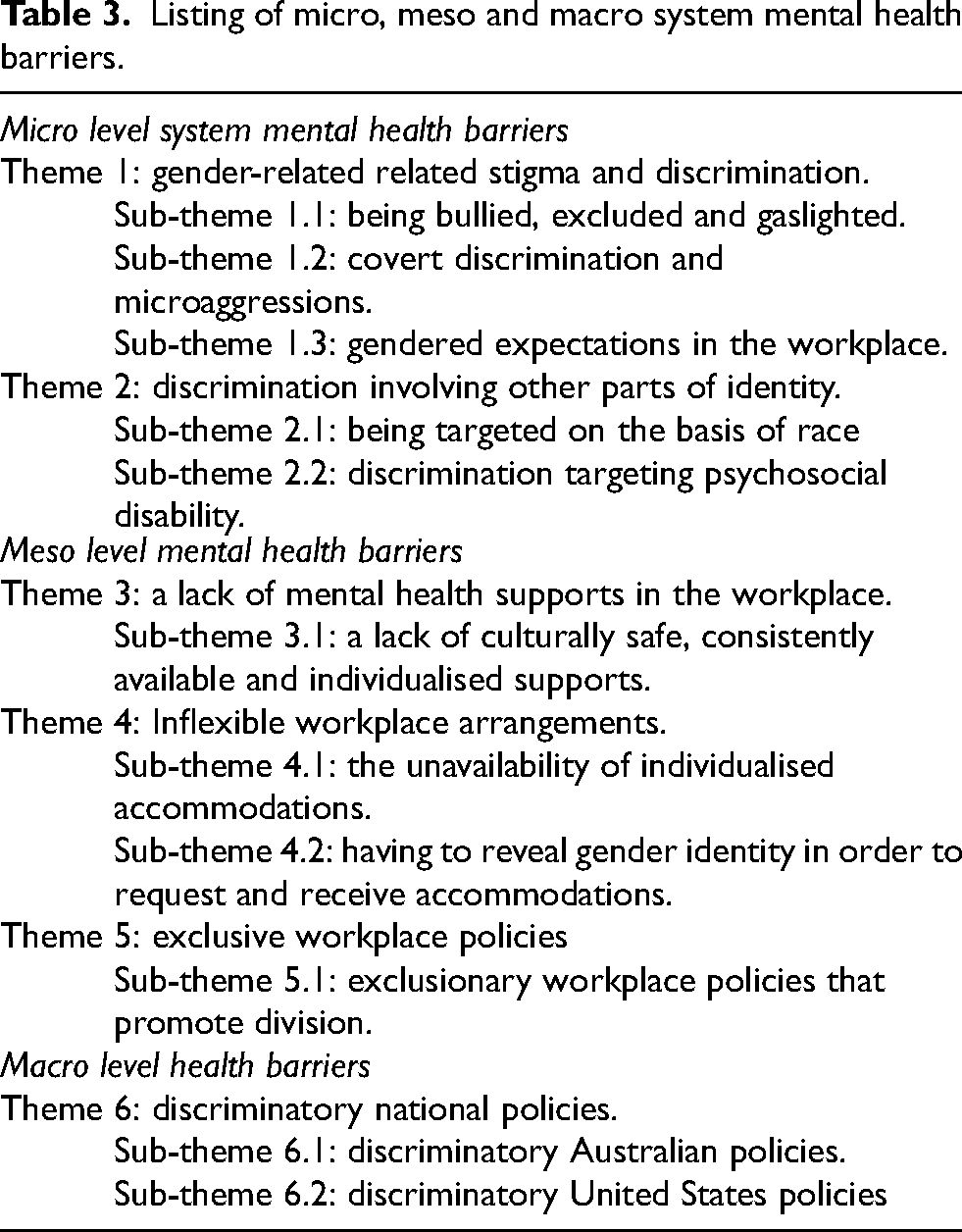
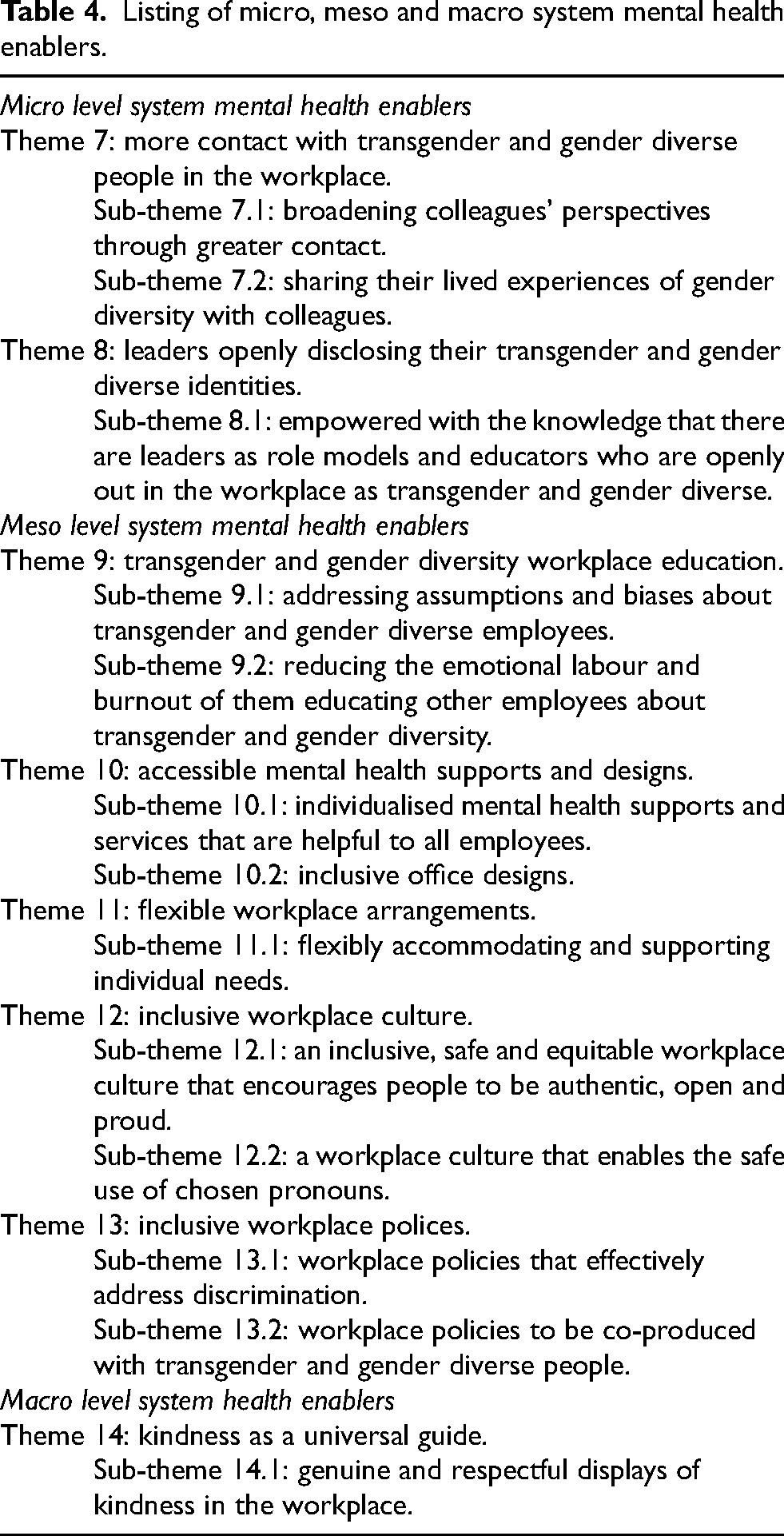
Addressing the first of our research aims about informing mental health barriers and enablers for transgender and gender diverse employees with psychosocial disability, the themes and sub-themes as organised according to micro, meso and macro system levels are respectively listed in Tables 3 and 4 below and are described as follows.
Listing of micro, meso and macro system mental health barriers.
Listing of micro, meso and macro system mental health enablers.
Micro level mental health barriers
Theme 1: Study participants shared their personal experiences of gender-related related stigma and discrimination that reduced their mental health.
Sub-theme 1.1: These workplace experiences included being bullied, excluded and gaslighted: “Being overlooked, being bullied.” [ID X] “Negative impacts on mental health come from being excluded from the working and social groups and teams that form in the workplace.” [ID R] “It makes you feel unsafe, excluded, and disregarded. It also triggers dysphoria, which can lead to heightened anxiety, depression, and suicidal ideation/self-harm.” [ID Y] “Being gas lit or victim blamed from lack of education and cultural awareness.” [ID X]
Sub-theme 1.2: Study participants reported experiencing reduced mental health through covert discrimination and microaggressions: “Transphobia is more pervasive than the cis community realises - the microaggressions we experience on an ongoing basis even from coworkers who we have positive relationships with. As a trans person - you’re expected to fit in and soften yourself for the collective comfort of those around you. We learn to shrink ourselves out of safety, to make others more receptive to us and our experiences, to avoid conflict” [ID X] “Small things that like wear you down and you’re just like, oh, do I actually belong here.” [ID D] “It's also…it just can be very kind of progressively exhausting to have to deal with really polarized gender stereotypes.” [ID A]
Sub-theme 1.3: Study respondents described experiencing the negative mental health implications of gendered expectations in the workplace: “Within a workplace - gendered expectations around behaviour, resilience and coping mechanisms may mean that TGD people's needs are overlooked or misunderstood within the workplace.” [ID X] “…within that workplace, I’m regularly being reminded that I do not fit within the stereotyped role expectations, so I’m regularly being made to feel other within that workplace.” [ID Z] “I guess when you’re working in something that's such either a male or female dominated industry… when you’re in something like a staff room and you have, I don’t know for example theoretically a bunch of men kind of insulting women about doing their jobs.” [ID D]
Comments across these sub-themes reveal the serious negative impacts on mental health which can accompany various forms of gender-based discrimination in the workplace including those of overt discrimination, covert discrimination, as well as gender-oriented pressures about how employees are unfairly expected to look and behave.
Theme 2. Study respondents advised of experiences of reduced mental health through discrimination involving other parts of identity.
Sub-theme 2.1. Study participants described being targeted on the basis of race: “…against them being Aboriginal or them being transgender - they’re not going to be very supported and they’re probably going to feel a bit like crap.” [ID D] “The different aspects that make self, i.e., race, disability, gender, and orientation, are inextricably linked together- hurting one can hurt them all.” [ID Y]
Sub-theme 2.2. Study participants reported reduced mental health through experiences of discrimination targeting psychosocial disability: “…discriminating against people with disabilities, or with social neurotype differences can be exhausting to navigate…neurotypical norms of indirect and assumed ‘communication’…I can suck a huge amount of energy because people with psychosocial disabilities have to put so much extra energy and capacity into bridging those gaps in covert vs overt communication.” [ID Z] “Having a psychosocial disability already impacts your self-confidence and sense of self; you’re more susceptible to other peoples’ negative comments and destructive behaviour.” [ID Y]
Comments across these sub-themes reveal the serious negative impacts on mental health following gender-based discrimination in the workplace that can undermine confidence levels while also damaging a sense of identify and which occur at the intersections of race and psychosocial disability.
Meso level mental health barriers
Theme 3. Study participants advised of a lack of mental health supports in the workplace.
Sub-theme 3.1. Respondents described experiencing reduced mental health through a lack of culturally safe, consistently available and individualised supports: “So, it's not just about having any old mental health support, it's having it specific to that cohort.” [ID P] “Someone who experiences ill mental health and doesn’t receive appropriate support may stop coming to their job, isolate themselves and more. These can have an impact on their ability to pay rent, eat and socialise.” [ID W] “Layering on workplace stress and lack of support on top of wider experiences of isolation, lack of community connection and culturally safe mental health support makes the community more vulnerable to poor mental health, time off work, lower financial security etc.” [ID X]
This theme highlights the importance from a social and economic inclusion perspective of providing workplace mental health supports which are culturally safe and sensitive to individual needs of transgender and gender diverse employees with psychosocial disability.
Theme 4. Study respondents reported of inflexible workplace arrangements.
Sub-theme 4.1. Participants described reduced mental health through the unavailability of individualised accommodations: “Flexible work arrangements need to be the norm. For many people, myself included, a 40-hour work week is impossible and directly linked to suicidal ideation.” [ID Z] “I think other people who are prone to panic attacks or depressive episodes would suffer more if they aren’t able to receive flexible workdays or sick leave…having gender-affirming surgical leave was incredibly important for me. If I had to recover from work for a month without it, I wouldn’t have been able to support myself financially. I think anything medically necessary should be covered by work.” [ID Y]
Sub-theme 4.2. Study participants advised of a loss of mental health by having to reveal gender identity in order to request and receive accommodations: “So, flexibility is good, but not when there's got to be too much information shared because then it doesn’t feel helpful…and especially if you’re, I don’t know, if you’re going for bosom surgery or something you don’t really want to discuss.” [ID D] “However, and unfortunately, there is a double-edged sword with trans visibility as those who want to be stealth may get clocked. This could be unsafe for some trans people.” [ID Y]
Comments across these sub-themes reveal significant negative mental detriments which follow the unavailability of gender-related personalised accommodations together with undue pressure to disclose gender-identity in the workplace.
Theme 5. Study participants cautioned of experiencing mental health detriments following exclusive workplace policies.
Sub-theme 5.1. Respondents described reduced mental health through exclusionary workplace policies that promote division: “Like if…you’ve got a very strict male only males only wear shorts women only wear skirts policy.” [ID D] “policy decision making, for example, like if you have a psychosocial disability, it can just be incredibly stressful to engage with those sorts of processes” [ID A]
This theme cautions of the high levels of stress and frustration that can be experienced by transgender employees as a consequence of exclusionary and gender divisive workplace polices.
Macro level mental health barriers
Theme 6. Study participants cautioned of discriminatory national policies impacting on mental health.
Sub-theme 6.1. Respondents expressed concerns about discriminatory Australian policies: “So, it's a little bit of uncertainty but I think a lot of this stuff is decided federally…so like, you know, changing names, all that stuff is federal.” [ID D] “We can’t control so much what politicians do in the policies they make.” [ID P] “I can’t in good conscience think of any reason why someone would vote…what's his face?…Peter Dutton…we just got to kind of keep an eye on the LNP.” [ID D]
Sub-theme 6.2. Respondents expressed concerns around discriminatory United States policies: “I’m not sure if it's going to be, you know, like what's happening over in the USA.” [ID D] “We certainly can’t control what happens in other countries…So, you know, which may impact you know…media people feel in Australia.” [ID P] “Like some people are saying they’re going to ban changing your gender.” [ID D]
This theme reveals the stress as experienced by transgender employees following an uprising of conservative Unites States politicians and policies that risk encouraging media-promoted division around gender-related topics in Australia.
Micro level mental health enablers
Theme 7. Study participants raised improved mental health through more contact with transgender and gender diverse people in the workplace.
Sub-theme 7.1. Respondents raised improved mental health by broadening colleagues’ perspectives through greater contact: “If the people who make up a workplace have more contact with trans and gender diverse people, it will help them (along with education) to understand the barriers to entry and discrimination experienced by trans and gender diverse people.” [ID R] “Personal connection as an enabler to better understanding/acceptance of minorities.” [ID J] “People getting to know diverse people broaden these people's perspectives.” [ID B] “It assures us that we are not alone…that we are in community and also that we have more in common with each other and common goals.” [ID Z]
Sub-theme 7.2. Respondents described opportunities for improved mental health by sharing their lived experiences of gender diversity with colleagues: “Humanising an experience, people sharing their lived experience and non TGD having a chance to understand what it might be like living within a cis-het-white normative society in terms of discrimination, violence, access etc” [ID X] “Yes, by having an understanding on a range of different queer experiences, workplaces are able to understand how their employees may be impacted by a negative workplace culture.” [ID W]
This theme reveals the mental health benefits as gained through casual conversations among transgender and gender diverse employees and cisgender employees where lived experiences are freely shared.
Theme 8. Study participants described the mental health benefits of leaders openly disclosing their transgender and gender diverse identities.
Sub-theme 8.1. Respondents raised being empowered with the knowledge that there are leaders as role models and educators who are openly out in the workplace as transgender and gender diverse: “Yes, as it provides visibility for trans people, and it allows for social education about trans people and their needs.” [ID Y] “By openly being trans as a leader, if it is safe to do so, can encourage others to feel empowered and seen within the workplace. It may also start a conversation around being respectful towards TGD coworkers and give diverse employees someone they know they can talk to.” [ID W] “…there isn’t a glass ceiling on what you can achieve because of the way you identify”. [ID P] “This is critical. Trans and gender diverse people need to see themselves reflected in the workplaces around them through policies and leadership. Leaders who openly share their lived experience support trans and gender diverse people and contribute to the breaking down of negative attitudes held by other people in the workplace.” [ID R] “It's providing that hope to people starting out their career that it's not a limitation, it's not a barrier to success.” [ID P]
This theme reveals the mental health benefits for transgender and gender diverse employees who hold leadership aspirations of having more leaders in the workplace who choose to openly disclose their gender diversity.
Meso level mental health enablers
Theme 9. Study participants described improved mental health through transgender and gender diversity workplace education.
Sub-theme 9.1. Respondents spoke about addressing assumptions and biases about transgender and gender diverse employees: “Proper, in-depth training that address conscious and unconscious bias towards Trans and Gender Diverse people and conveys their increased vulnerability from being excluded or ‘othered’ in the workplace.” [ID R] “Transgender diversity education can help open up people's perspective to people and understanding.” [ID L] “Workplaces that have ZERO trans and gender diversity education are obviously worse.” [ID A]
Sub-theme 9.2. Study respondents described improved mental health by reducing the emotional labour and burnout of them educating other employees about transgender and gender diversity: “So much emotional labour falls on the shoulders of trans people to educate the community around them, or conversely we become isolated because it becomes exhausting to raise awareness for your own rights all the time.” [ID X] “I hope that transgender diverse education will support trans people in the workplace to be able to get on with their job instead of needing to justify their reality to the people around them.” [ID Z]
This theme reveals the importance of workplace education as a means of increasing respect for gender diversity and reducing pressure on transgender and gender diverse employees to educate their colleagues.
Theme 10. Study participants raised improved mental health through accessible mental health supports and designs.
Sub-theme 10.1. Respondents reported on individualised mental health supports and services that are helpful to all employees: “They can help all workplaces and all employees! Not just MH community and/or TGD community.” [ID X] “They definitely can particularly if the workers trust the confidentiality of the mental health service”. [ID Z] “Mental health supports in the workplace assist people to feel valued and supported and like repair can happen after rupture.” [ID Z] “It's been very practical knowing that if you’re being discriminated against or not supported work, that you’ve got someone you can contact, whether it's a manager or an actual service.” [ID L]
Sub-theme 10.2. Study participants described advancing mental health through inclusive office designs: “Workplaces that offer connection to nature with plants with time spent outdoors or places that offer mindfulness that offer connective experiences like places that offer gender neutral agenda inclusive bathrooms.” [ID Z] “Choice of open or closed workspaces or workplaces designs that provide sensory stimulation or sensory respite.” [ID R] “Soft warm 3-point lighting. Get rid of fluorescent overhead lighting!” [ID Z]
This theme reveals the mental health benefits of providing safe and accessible workplace services and supports for all employees as well as workplace designs that are sensory-friendly and inclusive of transgender and gender diverse employees with psychosocial disability.
Theme 11. Study participants recalled the mental health benefits of flexible workplace arrangements.
Sub-theme 11.1. Diverse employees by flexibly accommodating and supporting individual needs: “Yeah, flexible workplace arrangements definitely but even this job…I did have flexible work arrangements, it was really good I worked from home a lot and I wouldn’t have last as long as I did, I don’t think.” [ID J] “Work hours that fit into people's lives and support them to also exercise and eat well and socialise to nourish themselves outside of work and also within their work environment.” [ID Z] “Yes. If someone knows that they are supported at work, they may enjoy coming to work more, socialise with colleagues and feel safe coming to work.” [ID W]
This theme reveals the mental and social benefits to follow an offering of flexible working arrangements to transgender and gender diverse employees with psychosocial disability.
Theme 12. Study respondents raised mental health improvements through an inclusive workplace culture.
Sub-theme 12.1. Participants reported on the importance of an inclusive, safe and equitable workplace culture that encourages people to be authentic, open and proud: “Having a supportive workplace culture boosts esteem. It makes you feel comfortable and safe, and that you have a voice to be heard. It can allow people to reach out or to set boundaries with coworkers. It definitely aids in reducing workplace anxiety and depression.” [ID Y] “A good workplace culture that values the presence and contribution of trans and gender diverse people and remains aware of the ways in which trans and gender diverse people can be excluded in the workplace and takes action on behalf of us when they are excluded, can help to create a mentally healthy workplace.” [ID R] “…it allows us to show up as our full selves.” [ID T]
Sub-theme 12.2. Study participants raised improved mental health through a workplace culture that enables the safe use of chosen pronouns: “Workplace culture of things like using pronouns in introductions means I feel safe to do so too.” [ID T] “People who are cisgender take it for granted that they have their pronoun uses and referred to in the correct way.” [ID P]
This theme reveals the positive feelings aligned with workplace cultures that encourage the inclusion of transgender and gender diverse employees and respect for their choice of pronouns.
Theme 13. Study participants described better mental health through inclusive workplace policies.
Sub-theme 13.1. Respondents highlighted the importance of workplace policies that effectively address discrimination: “Inclusive workplace policies should guide the behaviour of all staff and hold staff accountable when they do not comply with workplace policy on inclusion.” [ID R] “Of course, basic policies such as anti-hate-speech and anti-discrimination should always be in place for everyone. Policies like these make us feel protected, at the very least.” [ID Y]
Sub-theme 13.2. Study participants noted a need for workplace policies to be co-produced with transgender and gender diverse people: “This is a BIG question… but anything done FOR a community should be led BY that community. So, if you want inclusive policies, you first need to have diverse representation within the workplace or seek consultation with communities as to how to develop policies that might support higher engagement of TGD people.” [ID X] “…these need to be co-produced with LGBT people.” [ID T] “These workplace policies can show diverse employees that they are seen, heard and understood.” [ID W]
This theme reveals the mental health value of co-developing and implementing anti-discrimination policies that protect transgender and gender diverse employees with psychosocial disability.
Macro level mental health enablers
Theme 14. Study participants raised improved mental health in line with kindness as a universal guide.
Sub-theme 14.1. Respondents described the broad mental health benefits of genuine and respectful displays of kindness in the workplace: “Kindness is part of the backbone of the contract of humanity that helps everyone.” [ID Z] “Kindness boosts morale. It makes people feel respected and heard. It reduces hostility. It makes workers want to ‘pay it forward’. It can make you feel included.” [ID Y] “By practicing kindness and giving everyone space to exist as themselves within the workplace may keep the workplace feeling safe.” [ID W] “Mentally healthy workplaces begin and end with kindness.” [ID R]
This theme reveals the mental health benefits for transgender and gender diverse employees which include increased feelings of safety, respect and motivation following displays of kindness in the workplace.
Discussion
Reflecting the valuable scholarly contribution of our co-designed study, we introduce an evidence-based mental health systems model for transgender and gender diverse employees with psychosocial disability. Figure 1 illustrates the overarching themes representing the issues and enablers which respectively constrict and advance the mental health of transgender and gender diverse employees with psychosocial disability across micro, meso and macro system levels.
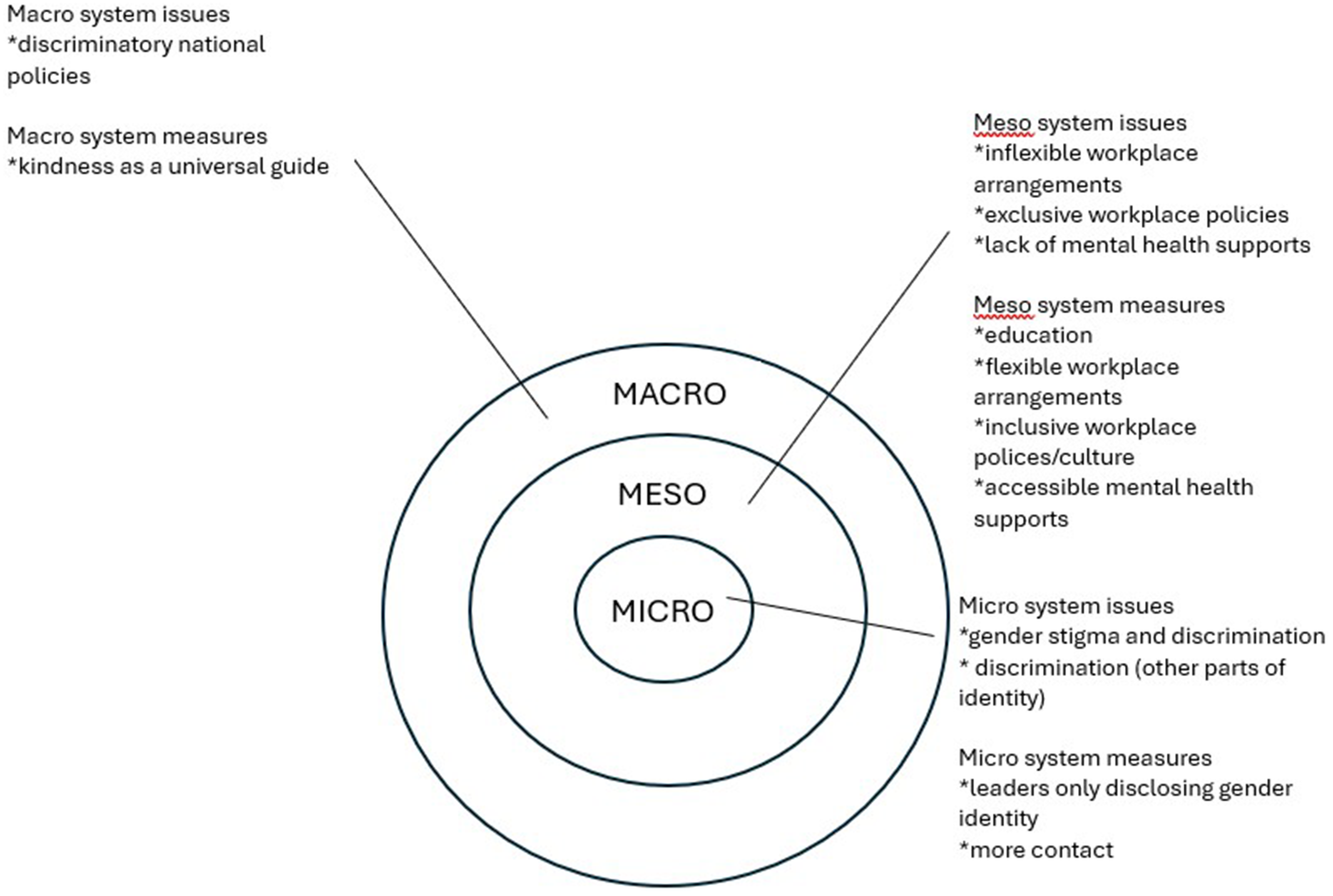
Mental health systems model for transgender and gender diverse employees with psychosocial disability.
Micro system level issues and enablers
Gender-based discrimination begins at a very early age. Children can be encouraged to behave in gendered and stereotypical ways and are reprimanded for not doing so. 56 Our investigative research reveals covert and overt forms of gender related discrimination travelling into adulthood so as to infiltrate the working lives and to lessen the mental wellbeing of study participants. Our findings align with previous research about the types of discrimination experienced by transgender employees.22,57,58 Specifically, we identified reported instances of exclusion (e.g., being othered), unfair critiques (e.g., clothing choices), and harassment (e.g., bullying). Transgender and gender diverse employees with psychosocial disability should not feel a need to hide their true selves in attempts to avoid discrimination in its various forms. Previous research argued that in a majority of cases, concealment of true identity ultimately holds negative impacts on mental health.59,60 From the evidence revealed in this investigative study, we too caution that the act of ‘shrinking oneself’ in the workplace originates out of fear and as such is accompanied with its own significant mental health challenges.
Brennan, Halpenny and Pakula 61 purported that an increased representation of transgender and gender diverse employees advances workplaces which are relation-focused, progressive and inclusive. Our study raises the prospect of greater contact between cisgender employees and transgender and gender diverse employees with psychosocial disability as helping to reduce discrimination and to subsequently increase mental health through improved understandings of lived experiences, challenges and lives. Investment in future workplace mental health research is needed to conduct a detailed examination and statistical assessment of this interesting possibility.
Prior studies stressed a need for workplaces to advance representativeness by hiring people of differing gender identities including transgender people.24,62 Moving beyond recruitment, our investigative research adds to the scholarly literature by recognising a need for promotional opportunities so that more transgender and gender diverse employees with psychosocial disability are empowered to hold leadership roles. These open and proud representations of gender diversity in positions of power might encourage other employees to fully embrace and publicly celebrate their diverse gender identities across organisational levels. Nonetheless, the point is stressed that no workplace leader or prospective leader should feel forced or pressured in any way to be open about their gender identity. Respecting personal choice, it is nonetheless a decision that should not be unfairly taken away by bigoted individuals who contribute to unsafe and mentally unhealthy workplace environments through their applications of gender targeted discrimination.
Meso system level issues and enablers
Gender transition can be a difficult journey requiring short and long-term absences from the workplace.63–65 Our research builds on previous studies which underline the importance of an organisational culture which supports transgender and gender diverse employees through availability of flexible workplace arrangements.63,66 We further report these arrangements as having a key role to play in advancing the mental health of employees with psychosocial disability who choose to undergo medical surgeries or therapies as part of their gender transitioning. The offering of gender affirming surgical leave reportedly holds capacity to lower the anxiety and depression as experienced by employees who are receiving these medical procedures. However, our research also warns of possibilities for reduced mental health as a consequence of prying managers who demand details be provided about gender related medical procedures as a proviso to their approval of flexible workplace arrangements. This highlights a need for workplace managers to consistently respect gender identity as well as the medical privacy of transgender and gender diverse employees.
Conservative norms in the community are associated with undesirable outcomes for transgender and gender diverse employees that include unsupportive and transphobic work environments.47,67 Discriminatory workplace policies involving the use of gendered bathrooms can worsen the mental health of transgender and gender diverse employees, which can in turn lessen their capacity to seek mental health supports. 68 In contrast, inclusive workplace policies offer protections by banning discrimination on the basis of gender identity. 69 Recognising that transgender employees are seldomly included within policymaking activities,70,71 Tobin, Candelario, Winiker, Crayton, Volpi, Pollock, Takahashi and Davey-Rothwell 72 noted the capacity for specialised transgender working groups to advance trans-affirming workplace policies. We highlight the importance of an inclusive workplace culture as reflected in various practical ways including the genuine involvement of transgender and gender diverse employees with psychosocial disability in the co-development of workplace health and wellbeing policies. However, we add that a greater inclusion of stakeholders from the priority community in health policy co-development needs to be done with reasonable accommodations in place wherever required so as to remove or reduce the potential negative impacts on mental wellbeing.
While employees should participate in gender-specific education, many workplaces continue to fail to provide these much needed educational programs.3,72 The benefits of workplace gender-related educational programs as reported in our study are twofold. First, workplace education was said to assist in redressing the bias as directed towards transgender and gender diverse employees while also resisting ‘othering’ in the workplace. Second, workplace education advances mental health and wellbeing by removing the emotional burden and burnout as reportedly experienced by transgender and gender diverse employees with psychosocial disability who feel obligated to educate their cisgender colleagues on gender related matters on a regular basis. This is not to suggest that gender-affirming workplace education should not be led by people with lived experience of transgender and gender diversity and psychosocial disability. In the interests of advancing mental health, however, this involvement of the priority community needs to be willingly made rather than coming from a place of unwanted obligation.
Macro system level issues and enablers
There is much political action occurring in the United States which is raising anxiety for transgender and gender diverse people in that country and beyond. The recent Trump election campaign paid in excess of $200 million USD on anti-transgender advertisements that while not generally reflecting American attitudes, served to increase discriminatory attacks on transgender citizens of the United States. 73 Negatively impacting upon American workplaces, the Trump Administration endorsed alterations to the Civil Rights Act that lessened protections against discrimination for non-binary and transgender employees. 74 Our study recognises the anxiety and subsequent loss of mental wellbeing as expressed among the priority community following the prospect of discriminatory messages as politically expressed in the United States becoming loudly echoed across conservative Australian politics and media. These fears are not unfounded. Australia has experienced a recent increase in anti-transgender national political and media discourse as well as anti-transgender public rallies with reports of police violence against transgender citizens.75,76 Investment in co-designed research is therefore needed to investigate the possible extent to which discriminatory political and media discourse in Australia and abroad, combined with abuses of policing, might collectively serve to embolden discriminatory expectations of heteronormativity across Australian public and private workplaces.
Workplaces can be environments where transgender and gender diverse employees endure discrimination, but they can also be places where examples of kindness and support towards this population exist.77–79 Mulqueen 80 highlighted the likelihood of the priority community readily generating rapport with people who are willing to show them respect and kindness. With kindness positioned as a universal guide to engaging with transgender and gender diverse employees, our exploratory study reveals wide-ranging mental health benefits for this priority population including those of increased morale and psychological safety. A need thus exists for co-produced national health and wellbeing related policies and frameworks whose inclusive rhetoric and evidence-based policy measures encourage kindness towards as opposed to discrimination against transgender and gender diverse employees with psychosocial disability.
Limitations
We readily acknowledge the exploratory nature of this qualitative study together with the inherent limitations of our proposed mental health systems model for transgender and gender diverse employees with psychosocial disability. These limitations include the research being informed by a small sample with respondents primarily identifying as transgender meaning that our findings are not generalisable. We also note that our findings are based on the self-reporting of study participants. Investments in future studies with larger study populations and beyond Australia are therefore needed to assist in validating and building upon the findings from our preliminary co-designed and co-developed research.
Conclusions
In this exploratory study we introduced an evidence-based mental health systems model for transgender and gender diverse employees with psychosocial disability. This explorative research should be of interest to health policymakers and policy stakeholders who are seeking evidence-based and practical ways to increase the mental wellbeing of this priority community. Importantly, we identified mental health system-related issues and enablers for the priority population across micro (i.e., individual), meso (i.e., workplace) and macro (i.e., national and international) levels. Our research is timely as it warns of recent increases in discriminatory discourse and actions against transgender Australian citizens as fuelled by conservative political parties and media. We conclude our study by arguing for investment in further research that can inform about ways to improve the mental health of transgender and gender diverse employees with psychosocial disability, along with movement towards the co-development of kinder national health and wellbeing related policies..
Footnotes
Acknowledgements
The authors acknowledge Mr Aaron Ford (He/him/his) for his contributions to the research proposal. We would also like to thank Anastasia Le (She/her/hers) for promoting the study to prospective study participants. Finally, we thank the study participants for their time and enthusiasm.
Ethics approval
The ethics approval number from the University of Sydney Human Research Ethics Committee is 2024/HE000427.
Informed consent
All participants provided informed consent prior to their participation in the study.
Funding
The authors disclosed receipt of the following financial support for the research, authorship, and/or publication of this article: Funding was received for this study by Candella LTD.
Declaration of conflicting interests
The authors declared no potential conflicts of interest with respect to the research, authorship, and/or publication of this article.