






Abstract
Background
Overtime serves as an indicator of bureaucrats’ efficiency. If excessive, it may undermine the country's long-term capacity to fulfill its responsibilities. The global ascent of digital government transformation presents new opportunities to alleviate the burden on government employees.
Objective
This study aims to investigate the impact of digital government on the work burden of government employees.
Methods
Utilizing daily satellite nighttime light data and a long-term nationwide survey dataset, we constructed a new government overtime indicator for China. In terms of analytical methods, this study employs the Difference-in-Differences (DID) model and the Double Machine Learning (DML) model to identify causal effects.
Results
The study found that digital government significantly reduced overtime, with each government employee working 2.5 fewer overtime hours per week. Further analysis revealed a U-shaped relationship between the level of digital government intelligence and the overtime. Digital government has been demonstrated to be more clearly correlated with reduced overtime in areas with a strong overtime culture, among men, in the 45-65 age group, among the group with no higher education, and among the group with high promotion expectations and high income satisfaction. The monetary valuation analysis indicates that digital government has resulted in a total savings of USD 14.76 billion in labor costs for 2022.
Conclusions
Digital government platforms are crucial for reducing government employees’ overtime. These findings provide decision-making references for saving labor costs and enhancing government efficiency. In addition, the study provides empirical evidence on how to alleviate the work burden of government employees and prevent excessive overtime from eroding the long-term effectiveness of the public sector in the context of global digital government transformation.
Keywords
Introduction
Overtime leads to approximately 750,000 deaths annually worldwide. 1 However, a significant proportion of the global workforce, estimated at more than 1/3, engages in work that exceeds 48 h per week. There is an urgent need for countries to adopt public policies that will reduce working hours in order to promote work-life balance for workers. 2
However, governments that enforce laws and policies restricting overtime are also plagued by overtime. On the one hand, the proliferation of public issues has led to mounting pressure on governments to exercise effective governance. 3 The increased number of environmental policies exemplifies this phenomenon and the lingering effects of COVID-19 and the economic recession. Consequently, government employees are subjected to an augmented workload, resulting in extended working hours. On the other hand, inflexibility in the workplace, mechanical and repetitive tasks, and strict procedural requirements have also been identified as contributing factors to an increase in the working hours of government employees. 4 The issue of government employees working overtime has become increasingly critical due to a combination of internal and external factors. For instance, data disclosed by the Government of Japan in 2020 revealed that 30% of civil servants in their twenties in the central government sector worked overtime hours that exceeded the “death by overwork” line. In South Korea, “deaths of public officials due to overwork” is the most common theme in related news. 5 Governments play an instrumental role in promoting economic growth, providing public goods, and reducing inequality. 6 Nonetheless, extended overtime periods among government personnel have been shown to have adverse consequences for government employees’ health. 7 Consequently, the prevalence of overtime among government employees indicates the government's operational efficiency and its impact on its long-term capacity to fulfill its responsibilities.4,8
China is one of the countries with the largest number of public officials in the world, with over 7 million. According to the “Green Paper on the Health of China's Civil Servants (2019),” 53.3% of civil servants have cervical vertebral abnormalities, which is due to their long hours of sitting and desk-bound work. We compared overtime across occupational groups using China Family Panel Studies (CFPS) data. Figure 1 shows that in 2022, government employees averaged 5.39 h of overtime per week, with a growth trend exceeding that of the other two occupational groups.
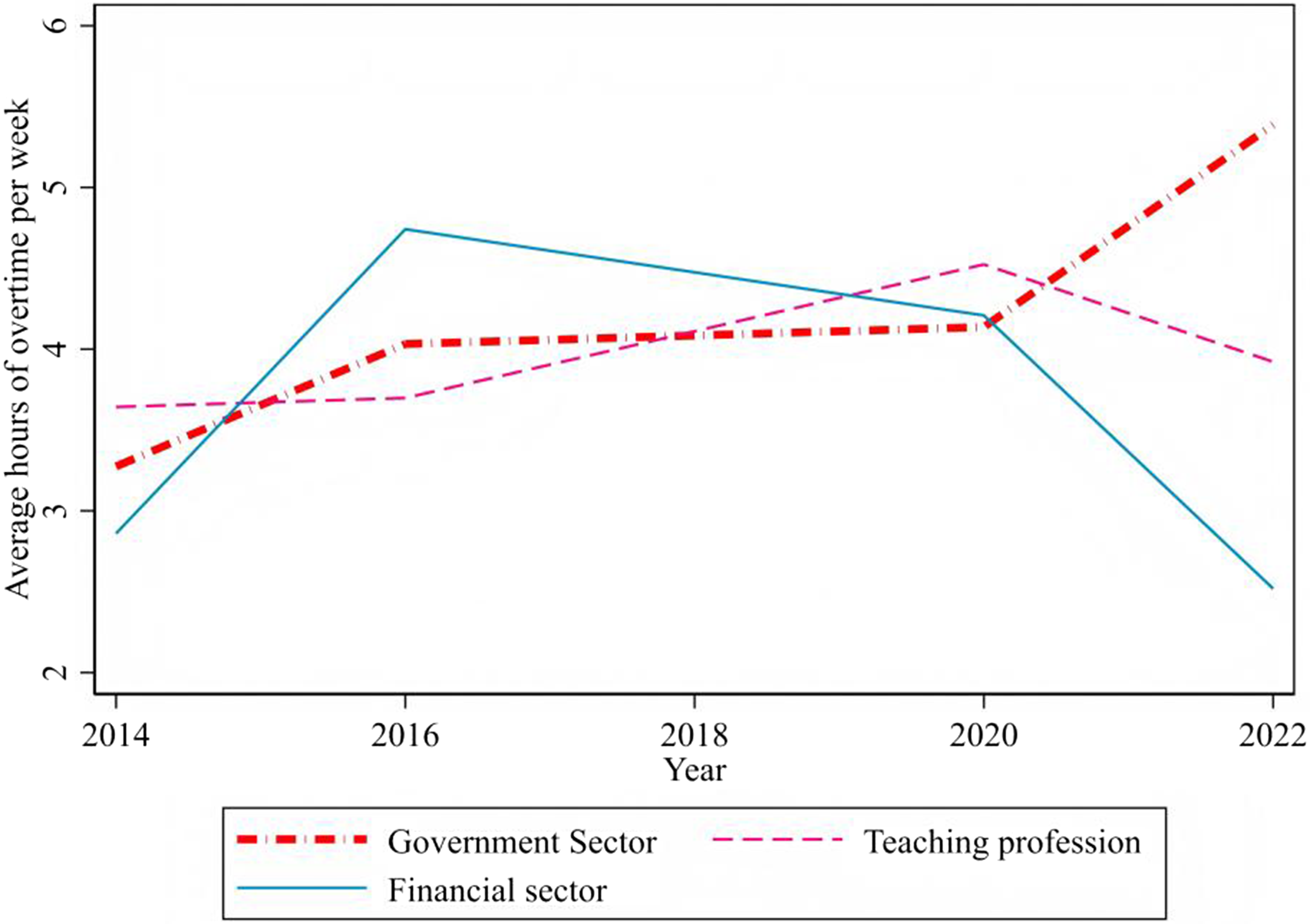
Average overtime hours across different industries in China.
Fortunately, the global proliferation of digital government initiatives provides a viable solution for large-scale overtime reduction. These initiatives aim to transform governmental internal processes and external interactions by integrating digital technologies and enhancing government efficiency and productivity. 9 Consequently, implementing digital government can substantially reduce repetitive tasks and streamline processes, thereby reducing the workload of government employees. Dunleavy posits that the future government will be more innovative and more efficient with the integration of technology. 10 In China, the implementation of digital government initiatives has progressed significantly. The number of provinces achieving a digital government level of 90 points at the provincial level increased from 2 in 2015 to 16 by 2021. 11
However, current research on digital government and government employee overtime is scarce and exhibits three limitations. First, most extant studies examining bureaucratic overtime have employed cross-sectional data, a methodological approach that has been shown to compromise the estimated model's performance and the results’ reliability.7,8 This limits the ability of existing research to provide causal evidence. Second, existing research has focused on the impact of digital government on corruption, 12 the environment, 13 and technological innovation, 14 among other areas. However, limited attention has been paid to its effects on the productivity of public officials. Third, existing literature on the economic benefits of digital transformation in government remains limited. 15 This undermines the accumulation of knowledge about the cost-benefit of digital government.
This study bridges the above gap through three approaches. Firstly, we used Satellite Nighttime Light (SNL) data to successfully identify government overtime, making up for the lack of data. Additionally, it can serve as a valuable source of inspiration for subsequent studies that establish links between geographic information data and government activities. Secondly, our study contributes to the extant body of knowledge by expanding on digital government's economic and social impacts. To our knowledge, this study is the first to systematically examine the impact of digital government on officials’ overtime practices. Thirdly, we estimate the monetary value of the reduction in overtime that results from digital government. We employ the Jorgenson-Fraumeni (J-F) lifetime income method to quantify the labor cost savings achieved through digital government, providing a more comprehensive assessment of its benefits.
Literature and hypotheses
The evolution of digital government in China
Since the early 2000s, China has engaged in the large-scale construction of a digital government. This development can be broadly categorized into two phases: Digital Government 1.0 and Digital Government 2.0. The period from 2000 to 2012 marked the Digital Government 1.0 phase. During this time, the Chinese government launched a comprehensive e-government initiative, which included the development of a government intranet and extranet, one government portal, four fundamental databases, and twelve business systems. The primary goal of this initiative was to strengthen the government's informatization infrastructure. After 2013, the era of Digital Government 2.0 commenced. The lack of unified standards during the 1.0 phase resulted in significant fragmentation of digital government initiatives, with administrative processes remaining inadequately integrated. Consequently, the primary objective of phase 2.0 is to enhance the integration of government services, focusing on establishing a comprehensive government service integration platform that encompasses the “province-city-county” level. In 2019, the Digital Government Services Integration Platform (DGSIP) was implemented in China's 31 provincial-level administrative regions (see Figure 2). Appendix A provides a chronology of the implementation of the provincial DGSIP. Since 2014, provincial governments have been implementing DGSIP. In 2018, the number of DGSIP additions reached its peak. Concurrently, China's digital government level advanced to the first tier of the global rankings.
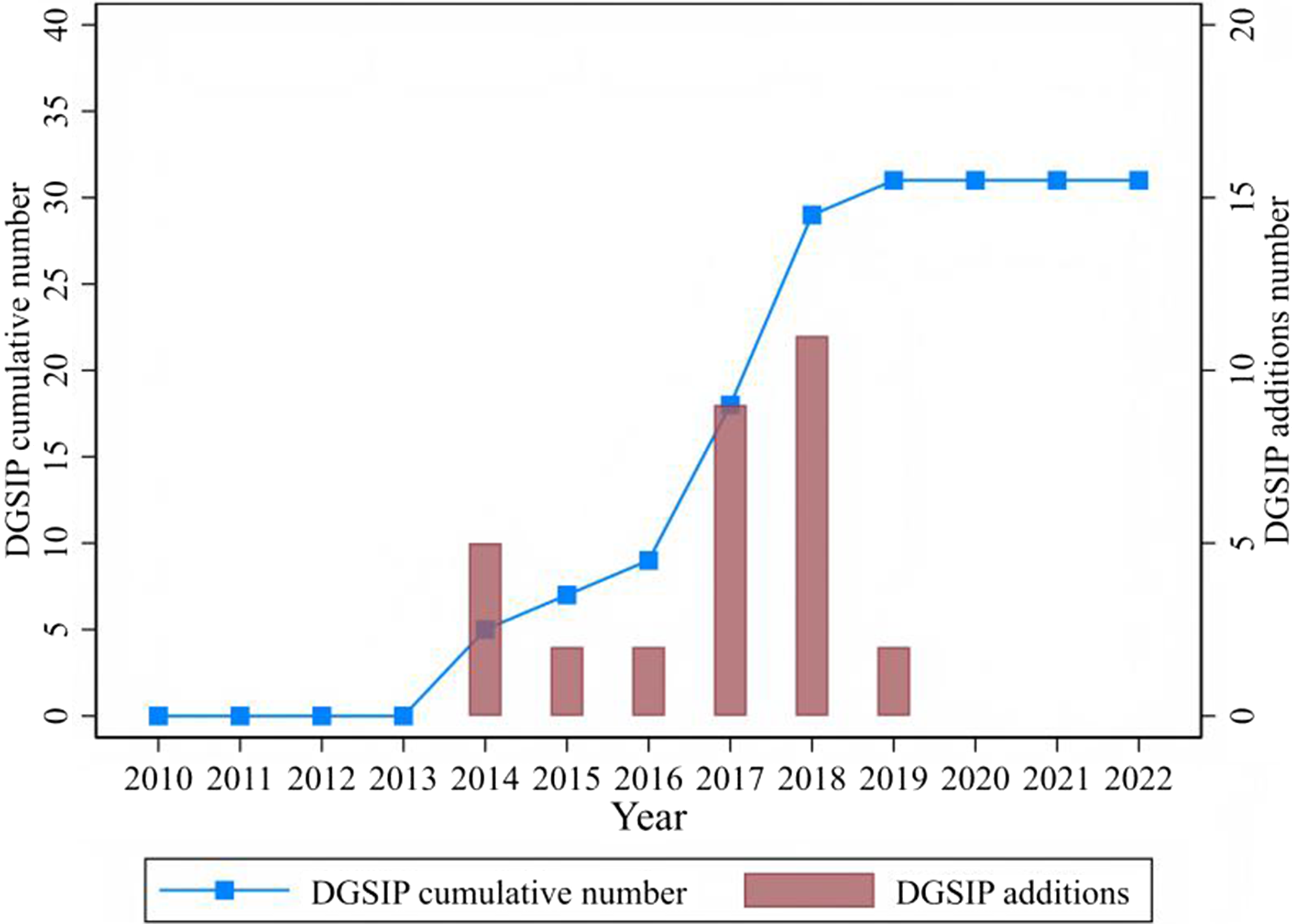
Establishment of DGSIP.
Digital government, work efficiency, and overtime
Since Frederick Winslow Taylor's Scientific Management was published, working hours have become the focus of organizational management. Given the proliferation of government tasks, “governance in the digital age” is emerging as the new paradigm.
16
Digital government has been shown to improve efficiency in at least four ways, thereby reducing overtime. Firstly, AI technology can efficiently process large amounts of standardized operations. This capability could replace manual labor and reduce the workload of government employees.
10
Secondly, digital technologies have transformed the structure and agility of government organizations, enabling governments to operate flatter and reduce time consumption in cumbersome processes.
17
Thirdly, the advent of big data technologies has been demonstrated to have the capacity to dismantle data barriers and curtail data collection efforts, particularly those of a repetitive nature.
18
This phenomenon often engenders a considerable reduction in government employees’ time allocated to data-related tasks. Fourthly, the advent of digital government has enabled the provision of public services on a 24/7 basis, thereby reducing the necessity for night shifts.
19
Research has also demonstrated that digital government has improved efficiency.
20
Based on this, we propose the following hypothesis.
Heterogeneous impacts across different contexts
Firstly, a nonlinear relationship may exist between intelligent technologies and the enhancement of government efficiency. The “Automation-New Tasks Model” posits that while technological shocks can initially reduce working hours, subsequent new tasks emerge that tend to extend working hours. 21 Due to the complexity of organizational contexts, implementing digital government does not necessarily result in reduced work hours at lower levels of intelligence. 22 Instead, as levels of intelligence and adaptability increase, government labor costs will decrease. For instance, the tax bureaus and motor vehicle administration authorities have adopted advanced innovative technologies, resulting in substantial increases in employee productivity.23,24 Of course, the impact of intelligence levels on reducing overtime may also begin to diminish with the incorporation of novel tasks and heightened competition.
Secondly, overtime is also influenced by culture. In Asia, overtime is more common. “996” has even become a culture in the workplace. Some studies suggest that the phenomenon of overtime work in Asia stems from Confucian culture. The four cultural orientations of Confucianism can all lead individuals to work overtime. 25 A survey also found that Japanese civil servants work approximately one hour more daily than their Egyptian counterparts. 26 Therefore, the effect of digital government on overtime work may also be influenced by cultural contexts.
Finally, factors at the individual and organizational levels also affect overtime. At the individual level, gender, age, and education can influence working hours. At the organizational level, some literature indicates that income expectations and promotion expectations can affect the investment of time in work.27,28 Consequently, these individual and organizational conditions may also influence the effect of digital government.
In summary, we again propose hypothesis H2.
Data, variables, and methods
Data presentation
Government overtime
The National Aeronautics and Space Administration (NASA) recently provided a corrected VNP46A2 data product. 29 This product removes noise interference from clouds, atmosphere, vegetation, snow, etc., from the raw National Oceanic and Atmospheric Administration (NOAA) Nighttime Color Visible Infrared Imagery Radiometer Suite (NPP/VIIRS) data, resulting in daily Satellite Nighttime Light data with a grid size of 500 m × 500 m. Due to its high frequency and high resolution, this satellite data product has gradually emerged as a novel data source for measuring human micro-activities. It is particularly suitable for capturing short-term human events characterized by rapid changes in light intensity. 30 Therefore, drawing inspiration from existing research, 31 we identify government overtime based on Satellite Nighttime Light (SNL). The specific steps are as follows:
Step 1: Obtain the relevant VNP46A2 data from the official NASA website. Subsequently, Python software was employed to extract the grid corresponding to the city government office address and the eight grids surrounding it. These additional grids encompass the four fundamental directions (i.e., south, east, northwest, and north) and the four intermediate directions (i.e., southeast, northeast, southwest, and northwest). The nine grids’ daily SNL intensities were summarized to form the basic dataset.
Step 2: It is acknowledged that the inherent brightness of lights and light spillover will result in significant errors when measuring the intensity of lights on the government's grid directly over time. The basic dataset is corrected using two criteria constructed in the spatial and temporal dimensions to address this challenge. Primarily, based on the temporal dimension, the issue of excessively bright lights in the grid where the government is located is addressed using “Criterion 1” (see equation 1).

In equation (1),
However, the municipal government is predominantly situated within the primary business district. Consequently, there is a spillover effect of lights in the surrounding areas, which results in the government grid's illumination being excessively bright. In consideration of the spatial dimension, “criterion 2” is introduced to eliminate the effect of light overflow by leveraging the information of eight surrounding grids (see equation 2).

In equation (2),
Step 3: Combine the data set and the two guidelines to calculate government overtime data. First, we calculated the proportion of overtime days worked on workdays relative to the total number of workdays (
To enhance the reliability of the conclusions and for monetary valuation, we also used the 7 rounds of China Family Panel Studies (CFPS) data from 2010 to 2022 for additional validation. For this study, it possesses two distinctive advantages. For one thing, the CFPS data includes information on individuals’ job nature and weekly working hours. This allows us to extract overtime data for government employees from it. Another thing is that the CFPS data are nationally tracked panel data, resulting in a panel data set that more accurately reflects individual changes over time and aligns more closely with the Difference-in-Differences model than cross-sectional data. The samples of government employees were obtained through the respondents’ job affiliations and employer attributes. Overtime was calculated from the “Working hours per week (hours)” questionnaire. Although the Law of the People's Republic of China on Civil Servants does not stipulate the working hours of Chinese civil servants, the Labor Law of the People's Republic of China provides a reference value (the working hours per week cannot exceed 44 h). Our study employed this value as a reference point to calculate the number of overtime hours, with any hours not exceeded recorded as 0. This method formed a micro-level indicator of overtime for government employees (
We conducted a series of analytical procedures, including workload tests, policy noise analysis, and microdata validation (see Appendix B). The results of these analyses indicate that our indicator, based on the SNL construct, is a reliable measure of overtime.
Digital government
If the provincial area where city
Control variables and data
The control variables at the city level take into account three distinct aspects. First, economic and social factors include economic level (
In the microdata section, control variables encompass three aspects.
Individual level, including gender, age, marital status, education level, and job satisfaction.
Household level, including household income, urban/rural location, and number of elderly in need of care.
Regional level, including economic level, the proportion of the industrial sector, and the added value of the tertiary industry.
Data sources and descriptive statistics
We formed an urban dataset (296 cities) for 2012-2023 and a microdata dataset for 2010-2022. SNL data are from the VNP46A2 data product. City-level data is from the China Urban Statistical Yearbook. Microdata are from CFPS. DGSIP opening information and government work reports are collated from official government documents, government websites, etc. Appendix C presents the measurement method of main variables and sample information.
Model setting
There are numerous factors influencing government overtime. In this situation, the traditional DID (Difference-in-Differences) model may encounter problems such as model misspecification and the curse of dimensionality.
32
Double machine learning (DML) methods capitalize on the strengths of models and algorithms to attain unbiased estimation in large-sample scenarios. It provides an effective method for accurately identifying the causal effect between digital government and overtime work in this study. Therefore, with reference to relevant research,
33
we have constructed an extended DID model based on DML to enhance robustness. The DML model is set up as follows:

In order to expedite the convergence process and ensure unbiased estimation, we construct the following auxiliary regression model:

Empirical analysis
Baseline regression results and core tests
Baseline regression results
In the baseline regression, we employ a gradient boosting algorithm for estimation, with the sample split set to 1: 4. Table 1 shows the results of the baseline regression. Columns (1) through (4) sequentially incorporate control variables and fixed effects. The findings indicate that the estimated coefficient for digital government is negative, and the result is statistically significant at the 5% or 1% level. According to the estimation results from Column (4), after establishing a digital government represented by the DGSIP, the proportion of overtime days worked on government workdays decreased by an average of 11.42%. Hypothesis H1 is verified.
Results of the baseline regression.
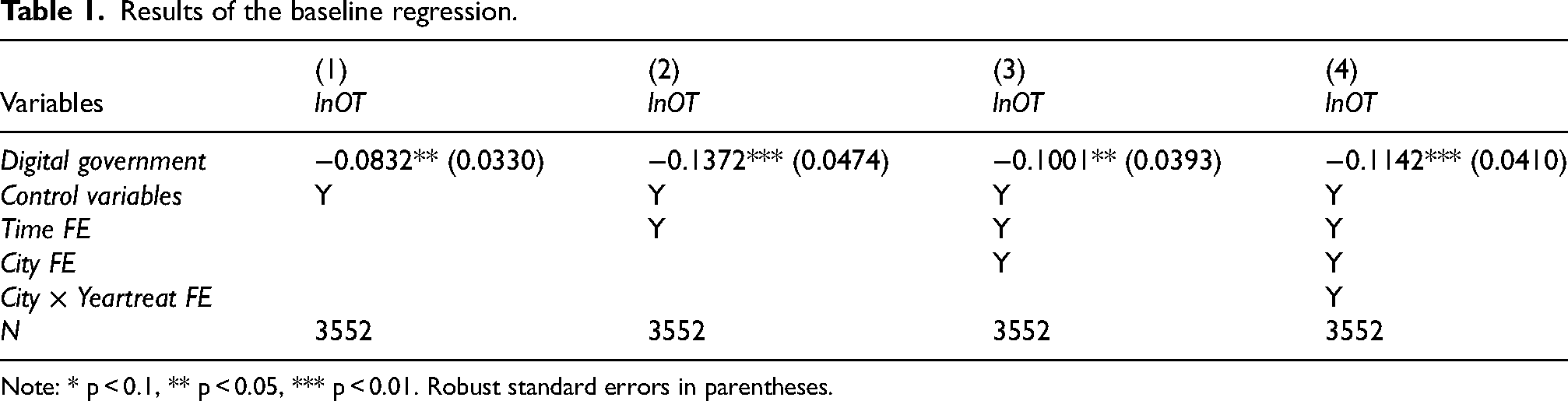
Note: * p < 0.1, ** p < 0.05, *** p < 0.01. Robust standard errors in parentheses.
Parallel trend tests and placebo tests
The DID model needs to satisfy the assumption of parallel trends. Based on relevant research,
32
we set up the following model to test it:
The findings in Figure 3(a) suggest no substantial discrepancy in government overtime work between the control group and the experimental group before the implementation of DGSIP. However, a substantial decrease in government overtime work was observed subsequent to the implementation of DGSIP, which demonstrated a degree of persistence. This outcome serves to validate the assumption of parallel trends.
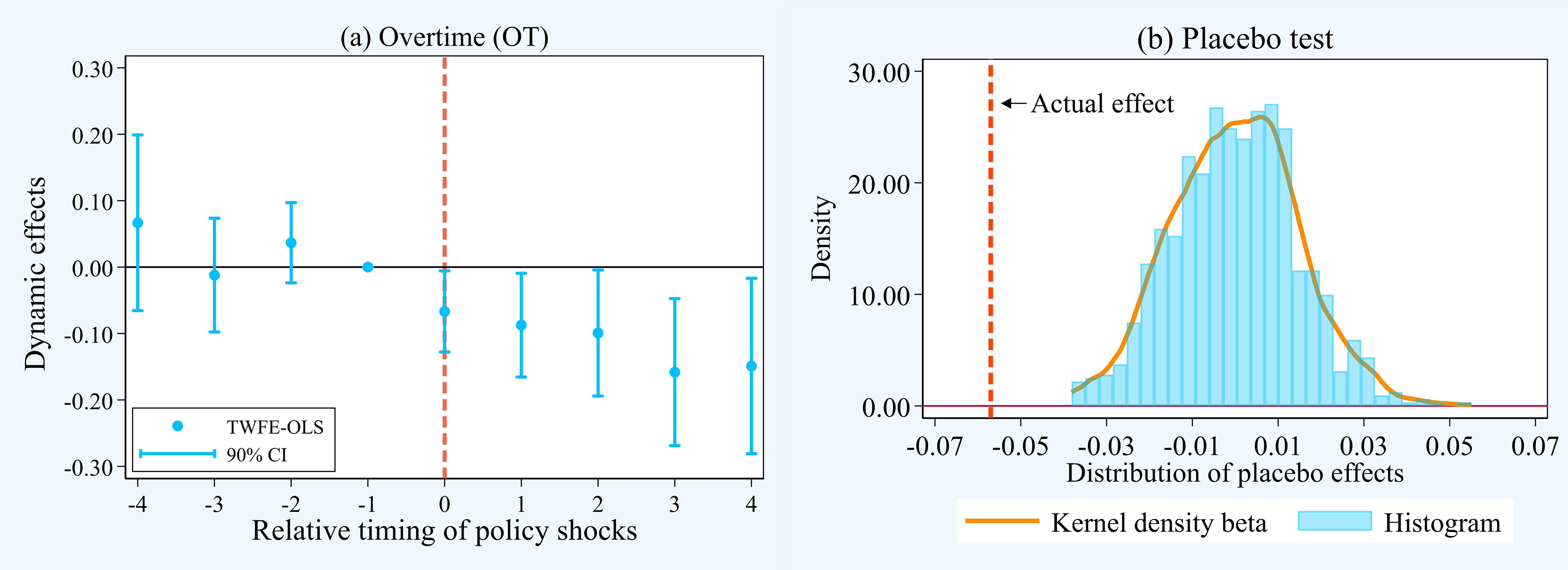
Results of parallel trend test and placebo test.
Furthermore, to examine whether the reduction in overtime work was due to chance factors, we conducted a placebo test by randomly generating 1000 virtual events for the opening of the DGSIP. The empirical data presented in Figure 3(b) demonstrate that the estimates of the virtual events are near the value of 0 and adhere to the normal distribution. A significant disparity is observed between the real and virtual estimated coefficients (p-value less than 0.01 on the left side). This finding suggests that the reduction in government overtime is influenced by the DGSIP coming online and not by random factors.
Robustness test
To guarantee the reliability of our conclusions, we additionally carry out supplementary analyses in three aspects: reducing measurement errors, tackling endogeneity, and conducting other robustness checks. In terms of measurement errors, we mitigate the impacts of unexpected incidents, infrastructure, and features of government buildings. Concerning endogeneity problems, we use geographic distance as an instrumental variable to bolster the causal link of the variables. Additionally, we performed a series of other robustness tests. The detailed test process and results are listed in Appendix D. All results continue to support the conclusions of the benchmark regression.
Heterogeneity analysis
Individuals and organizations may respond differently to the impact of digital government in different contexts. We report the heterogeneity estimation results in Figure 4.
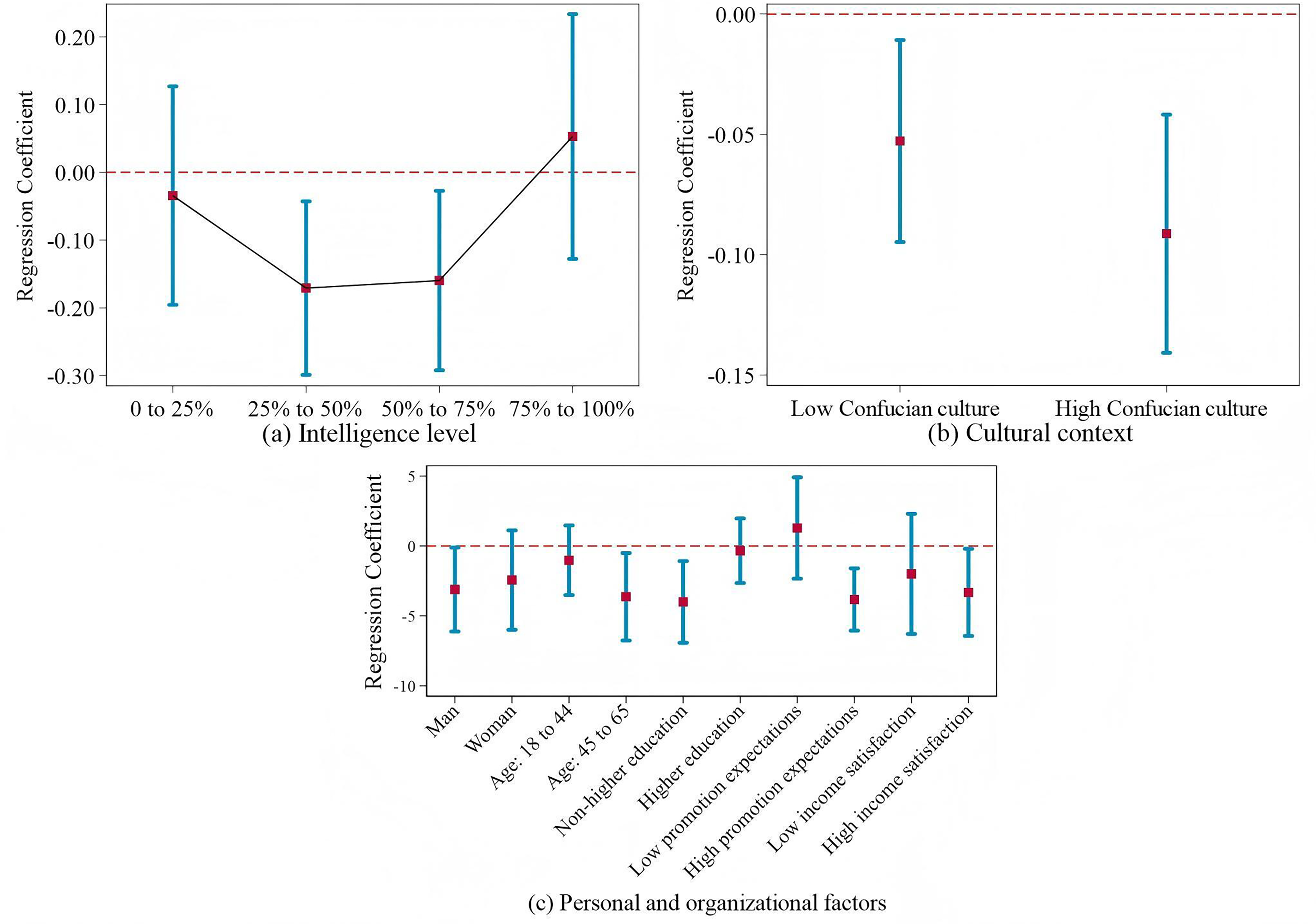
Results of heterogeneity analysis.
We obtained data on intelligence levels from the “Development Report on the Internet Service Capability of Chinese Local Governments” spanning from 2019 to 2023. The report has evaluated the online government service capabilities of over 330 cities in China for consecutive years, covering indicators in three aspects: supply capability, response capability, and intelligence capability. The results in Figure 4(a) reveal that when the intelligence level is within the 0th to 25th percentile range (based on percentile rankings), digital government initiatives positively influence overtime work, albeit not significantly. However, within the 25th to 50th percentile range, digital government initiatives significantly reduce overtime work, exhibiting the most substantial effect. As the intelligence level continues to increase, the negative effect diminishes. This suggests that intelligent technologies in digital government can reduce overtime work, but there is a diminishing marginal effect. This finding aligns with the U-shaped curve describing the impact of technological shocks on working hours. China is experiencing compressed development, 34 where digital governments with different levels of intelligence exist during the same period. As a result, digital governments show reduced working hours in areas in the early stages of intelligence. However, in regions with deeper maturity and diffusion of innovative technologies, it can lead to the beginning of longer working hours due to increased competition and new tasks. 21
The phenomenon of overtime in East Asia is closely related to Confucian culture. 25 Referring to related studies, 35 we utilized the density of Confucius's temples (number of Confucius's temples/area of administrative region) to proxy the intensity of Confucian culture. Data on Confucius's temples were obtained by consulting various local records and documents about Confucius's temples. Figure 4(b) shows that in regions with higher Confucian cultural intensity, digital government has a stronger effect on reducing overtime work. A possible explanation for this phenomenon is that government employees typically invest more time in their work in areas deeply influenced by Confucian culture. This is because Confucian culture is a form of collectivist culture, where individuals prioritize work over family, thereby making it more likely to foster an environment conducive to long working hours. 36 Digital government initiatives can enhance work efficiency, resulting in a more significant reduction in overtime work in these regions. This indirectly proves that digital government is an effective solution for reducing overtime, especially in areas where overtime is serious.
Figure 4(c) shows the analysis based on the CFPS data, where we provide the results of the heterogeneity analysis at the individual and organizational levels. The results indicate that:
Digital government initiatives have significantly reduced overtime for government employees, particularly men, more than for women (at the 10% significance level). Male government employees tend to invest more time in their work and are often engaged in complex and high-intensity executive tasks.
26
The remote technology and automation capabilities of digital government can greatly improve the efficiency of these tasks, thereby having a stronger impact on reducing overtime among male government employees. Regarding age and education, digital government initiatives have significantly reduced overtime among civil servants aged 45 to 65 and those without a higher education. The impact on younger civil servants and those with a higher education is less pronounced. The phenomenon can be explained by skill-biased technical change (SBTC). Due to their comparatively limited digital skills, these groups spend more time processing documents and reports. Implementing digital government can reduce these tasks, significantly alleviating their workload. At the organizational level, government employees with higher expectations for promotion and greater satisfaction with their income tend to benefit more from digital government initiatives (by experiencing a reduction in overtime hours). This is because they are often more diligent in their work and invest more time, consequently deriving more significant benefits from the enhanced efficiency of digital government.
Pricing for reduction of overtime
We estimate the labor cost savings of digital government based on the J-F Lifetime Income Method. The J-F Lifetime Earnings Method, proposed by Jorgenson and Fraumeni, is a method for calculating human capital based on the monetary price of labor. 37 This method has gained significant traction on an international scale, having been adopted by prominent international organizations such as the OECD and the World Bank. The fundamental premise underlying this method is recognizing that an individual's intrinsic knowledge, skills, health, and other attributes are inherently challenging to quantify. The approach posits that labor market wages can serve as a reflection of human capital. Consequently, we can estimate the monetary value of digital government by using labor market prices (i.e., wages) as a proxy.
Firstly, the overtime effect of digital government can be determined from the results in column (3) of Table 7 in Appendix D. The average overtime per week for government employees has decreased by 2.5 h, which equates to a reduction of 130 h per year. Secondly, due to the lack of statistics on the wages of Chinese government employees, we primarily use the average annual wages of employees in public administration, social security, and social organizations as an approximate proxy. We converted the average annual wage into an hourly wage based on 250 working days per year and 8 h per day. Finally, we measure the scale of government employment by the number of civil servants.
The monetary valuation results in Table 2 demonstrate that the economic value generated by digital government in reducing overtime climbs annually, from USD 5.997 billion in 2012 to USD 14.76 billion in 2022. For individuals, in 2022, digital government increased the unit wage income of each government employee by reducing overtime, creating a monetary value of USD 2014.18 per person. This is approximately equivalent to 2 months’ salary for an ordinary civil servant in China. In addition, we obtained investment data for China's digital government from International Data Corporation (IDC). After analysis, we found that in 2022, the value created by digital government solely through improving work efficiency (i.e., reducing overtime) accounted for 40.77% (14.760/36.201) of the total investment. This indicates that digital government has a high return on investment.
Monetary value of digital government.
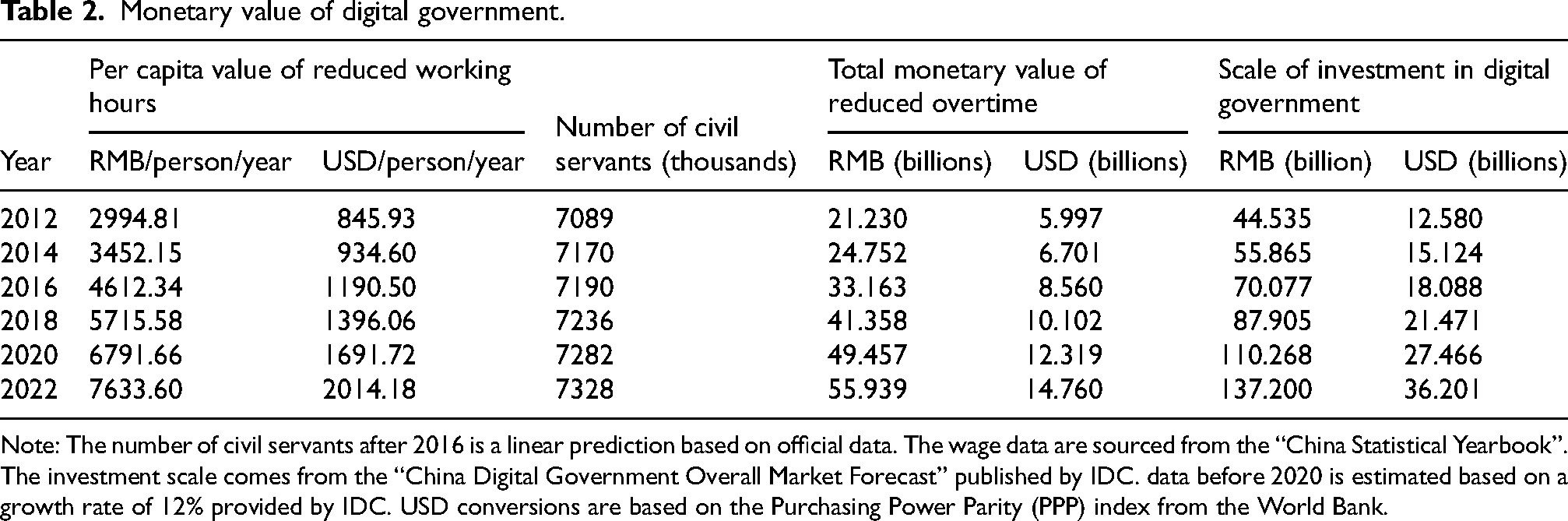
Note: The number of civil servants after 2016 is a linear prediction based on official data. The wage data are sourced from the “China Statistical Yearbook”. The investment scale comes from the “China Digital Government Overall Market Forecast” published by IDC. data before 2020 is estimated based on a growth rate of 12% provided by IDC. USD conversions are based on the Purchasing Power Parity (PPP) index from the World Bank.
Our results are consistent with related studies showing higher return rates for digital governments. For example, the Danish public sector provides a wide range of information and services, with electronic invoicing resulting in taxpayer savings of EUR 150 million per year. 38 In China, the digital government platform can save RMB 112.83 for citizens when they go to the municipal government to conduct business. 39 However, compared to applying artificial intelligence (AI) technology in unpaid work, the reduction in government overtime achieved through digital government initiatives is still relatively small. Research by Hertog et al. found that AI technology can save a Japanese woman 3.5 h during a workday. 40 This may be because government work's digital transformation is more complex than household labor. This also suggests that digital government initiatives still need further refinement and improvement.
Notably, our estimates are relatively conservative. First, the benefits are likely understated because we considered only formal civil servants, excluding the many government workers without formal civil servant status. Second, digital government investment may be overestimated, as DGSIP is only part of the larger digital government market. Thus, the actual benefits of the DGSIP are likely higher.
Conclusions and policy implications
Conclusions
This study utilizes SNL data to construct a novel overtime indicator system. This indicator is verified to serve as a reliable proxy for overtime. Subsequently, we utilized the quasi-natural experiment created by the phased deployment of DGSIP to investigate the impact of digital government on overtime among government employees. Research reveals that the implementation of digital government has significantly reduced overtime among government employees. Following the activation of DGSIP, the average number of overtime days, as measured by SNL, decreased by 11.42%. Based on survey data estimates, each government employee could reduce their weekly working hours by 2.5 h. Heterogeneity analysis indicates that the impact of digital government on overtime varies significantly with the level of technological sophistication, cultural context, and individual and organizational characteristics. As the level of intelligence within the digital government systems increases, the negative influence over time begins to diminish, exhibiting a U-shaped curve. The correlation between digital government initiatives and the reduction of overtime is more pronounced in regions with a strong culture of overtime, among male employees, within the age cohort of 45 to 65 years, among individuals without higher education, and among those with high expectations for career advancement and high levels of income satisfaction. The economic valuation indicates that the labor cost savings of digital government increase annually, from USD 5.997 billion in 2012 to USD 14.76 billion in 2022. For each government employee, the estimated benefit is approximately USD 2014.
Discussion
We constructed a novel government overtime indicator using SNL. Following a series of tests, this study finds that it can serve as a reliable proxy indicator for government overtime work. Compared to previous cross-sectional data,7,8 this metric enhances causal identification in research. Particularly for research centered on long-term impacts, it presents advantages that survey data are unable to substitute.
This study finds that digital government significantly reduces overtime among government employees. This expands the relevant literature and knowledge base on government digital transformation.12–14 In particular, we focused on analyzing how digital technologies within government improve the work environment and consequently impact overtime. This fills a crucial research gap concerning the impact of work-related digital technology on public sector employees. 41 The U-shaped curve revealed in this paper also provides an explanation for the inconsistent findings in existing research. Owing to differing intelligent levels, cross-sectional and small-scale surveys might merely capture a particular stage of the U-shaped curve.
We quantified the benefits of digital government in reducing the burden on employees. Many public sectors invest heavily in developing digital governments only to encounter failure. 42 One reason is the lack of cost-benefit analysis, 15 which results in insufficient knowledge for decision-making. Research reveals that in 2022, the benefits derived from digital government in reducing overtime made up 40.77% of the investment. This estimate of the benefits is conservative. The digital government platform is a one-time investment that will generate ongoing benefits. Certainly, when compared to other straightforward tasks (e.g., household labor), 40 the decrease in working hours resulting from digital government is still relatively limited.
Policy implications
First, it is imperative to advocate for the phased implementation of digital government initiatives. Regional authorities should expedite the development of digital government to mitigate overtime work among government employees and improve administrative efficiency. However, it is crucial to emphasize the dynamic adaptation of technological sophistication levels during implementation. During the initial phase of low technological sophistication, priority should be accorded to deploying fundamental automation tools to maximize the reduction of overtime among low-skilled employees. As the system transitions to a medium-high level of technological sophistication, it is essential to intensify training programs and optimize algorithms to circumvent a resurgence in overtime due to increased technical complexity. We should acknowledge that digital government initiatives represent not just an initial impact but an ongoing management endeavor. Employing a dynamically adaptive strategy can more effectively prevent overtime rebound. Promoting a “human-machine collaborative governance” model is advocated upon reaching a high level of technological sophistication. This approach should redirect the conserved human resources towards enhancing public services, thereby preempting the emergence of new burdens stemming from technological dependency. For instance, the advancement of digital government initiatives may result in redundant government staff. If idle human resources are not effectively harnessed, it is likely to induce service involution, consequently resulting in declining marginal returns. Such involution and excessive competition add unnecessary procedures, introducing new burdens.
Second, acknowledging cultural diversity and reinforcing the design of culturally sensitive policies is crucial. In regions with a pronounced overtime culture, emphasis should be placed on how digital government initiatives can enhance efficiency to achieve “valuable working hours.” Conversely, the synergy between digital government and policies such as the “Right to Disconnect” should be highlighted in areas that prioritize work-life balance.
Third, it is imperative to establish an inclusive digital transformation support system. This involves enhancing educational compensation, age-appropriate adaptations, and gender balance to empower vulnerable groups. This will prevent technological empowerment from exacerbating existing inequalities. Furthermore, it is crucial to recalibrate government performance metrics by replacing the “absolute working hours” metric with the “effective working hours” metric as a criterion for promotion evaluations. This adjustment would incentivize behaviors that leverage technology to enhance productivity.
Fourth, it is essential to transform digital government from a mere technological upgrade project into a systemic reform of global labor governance. This entails continuously enhancing digital government initiatives’ diversity, inclusivity, and sustainability. Ultimately, the goal is to leverage digital government to drive the global public sector towards a new paradigm characterized by “efficiency, equity, and human-centricity.”
Limitations
Despite our considerable efforts, there are still some shortcomings. First, we have only focused on the impact of digital government on overtime from a technical perspective, which can be further extended to ChatGPT technology, work rotation programs, and load shedding programs in government in the future.
Second, we only constructed overtime indicators for workplaces and did not explore invisible overtime enough, which needs to be continued. Owing to the rapid advancement of digital technology, invisible overtime outside the workplace is becoming more and more prevalent. The 11.42% reduction in overtime derived from SNL data carries a risk of overestimation. This is primarily because invisible overtime outside the workplace cannot be captured by SNL data. Thus, the above findings should be interpreted cautiously and not simply extrapolated to civil servants or other occupational groups in other regions. Meanwhile, we recommend fully accounting for job characteristics when using SNL data to measure overtime. For a more precise economic valuation, analysis should be conducted with actual employee survey data.
Third, the government overtime metric established on the basis of SNL still exhibits certain limitations. When applying such data in other countries and regions, due attention should be given to the following issues. Researchers are required to pinpoint suitable solutions to tackle urban lighting problems not associated with overtime work. For example, this study eliminates samples with high-floored government buildings and a large quantity of streetlights on government sites. This can mitigate measurement errors to a certain extent. For government departments with much non-workplace office work, building overtime metrics via SNL can bring in large deviations. For example, this approach should be applied with caution in departments such as public security and supervisory agencies. Although the approach presented in this paper can be applied to cross-national comparisons. However, during cross-national comparisons, due attention should be given to the time satellites remain in the sky, and the influence of such temporal variations should be minimized.
Supplemental Material
sj-pdf-1-wor-10.1177_10519815261464603 - Supplemental material for An easier government? The impact of digital government platform on government employee overtime
Supplemental material, sj-pdf-1-wor-10.1177_10519815261464603 for An easier government? The impact of digital government platform on government employee overtime by Yongzhou Chen and Qiuzhi Ye in WORK
Footnotes
Acknowledgements
We would like to thank the reviewers and editors for their valuable feedback on this paper. We would also like to express our gratitude to those who provided data support and funding for this study.

Ethical approval
The CFPS data used in this study adhere to strict ethical standards. This project has been approved by the Peking University Biomedical Ethics Committee, approval number: IRB00001052-14010.
Informed consent
Informed consent was collected from the participants.
Consent to publish
All authors have approved the final version for publication.
Author contributions
Literature review: Y.Z Chen; Data collection: Q.Z Ye; Data analysis and interpretation: Q.Z Ye; Statistical analyses: Y.Z Chen; Writing of the manuscript: Q.Z Ye, Y.Z Chen; Reviewing or editing a draft of the manuscript Q.Z Ye, Y.Z Chen. All authors have approved the final version for publication.
Funding
The authors disclosed receipt of the following financial support for the research, authorship, and/or publication of this article: This study was supported by the Guangxi University Outstanding Doctoral Candidate Cultivation Program Funded Project (grant number: GXUODC2026014).
Declaration of conflicting interests
The authors declared no potential conflicts of interest with respect to the research, authorship, and/or publication of this article.
Data availability statement
The datasets generated during and/or analyzed during the current study are available from the corresponding author on reasonable request.
Supplemental material
Supplemental material for this article is available online.