






Abstract
Background
Opportunity-enhancing HR practices have been linked to positive employee outcomes, yet less is known about how these practices motivate employees to take charge at work. Understanding how and under what conditions opportunity-enhancing HR practices influence employees taking charge remains an important gap.
Objective
This study investigates how opportunity-enhancing HR practices foster employees taking charge through the sequential roles of signature strengths use and harmonious passion. In addition, this study examines how calling orientation acts as a strengthening mechanism.
Methods
Data were collected from 324 matched supervisor–employee dyads. The proposed model was tested using structural equation modeling (SEM) in Mplus.
Results
Results demonstrate that opportunity-enhancing HR practices positively enhance employees’ taking charge behavior through the sequential mediation of signature strengths use and harmonious passion. Furthermore, an employee's calling orientation significantly strengthens the indirect serial moderated mediated relationship.
Conclusions
This study extends the “work” literature by identifying the specific psychological mechanisms—signature strengths use, and harmonious passion—through which opportunity-enhancing HR practices encourage employees to take charge at work. In addition, calling orientation enhances the indirect effects, showing that employees high in calling respond more positively. This helps organizations design HR practices that better activate employees’ strengths and motivation, encouraging them to take charge.
Keywords
Introduction
The heightened instability and rapid shifts characterizing modern organizations underscore the importance of employee proactivity—actions that are self-started, oriented toward change, and focused on improving future conditions.1,2 Taking charge at work, defined as employees’ self-initiated and constructive actions aimed at improving work methods or procedures, represents one of the most impactful forms of proactive behavior for advancing organizational outcomes. 3 Previous studies have highlighted several antecedents of employees taking charge at work, such as leader-member exchange quality and psychological empowerment, 4 inclusive leadership, 5 authentic leadership, 6 servant leadership, 7 ambition, career satisfaction, 8 and perceived investment in employee development. 3
Despite growing research on how to encourage employees to take charge, limited attention has been given to the role of opportunity-enhancing human resource (HR) practices—HR practices that empower employees by providing the platform, resources, and supportive environment needed to apply their skills and motivation—in recognizing and supporting such behavior. This omission is significant because integrating practices such as skill-development programs, mentorship, and advancement pathways is crucial to acknowledging and empowering employees, thereby reinforcing pro-organizational behaviors. 9 When organizations align HR practices with proactive behaviors, such as taking initiative, they foster a culture of innovation while signaling to employees that their efforts are valued. 10 By prioritizing opportunity-enhancing HR practices, organizations can create a virtuous cycle in which proactive employees receive the tools, visibility, and growth opportunities needed to amplify their impact, ultimately promoting resilience and adaptability in a constantly changing workplace. 11 In response to recent research calls (e.g.,12,13), this study draws on Social Cognitive Theory (SCT 14 ;) to propose that opportunity-enhancing HR practices promote employees’ taking charge. SCT highlights how environmental factors—like opportunity-enhancing HR—affect individuals’ cognitive assessments and subsequent behavior. Although SCT emphasizes reciprocal interactions among environmental factors, individual factors, and behavior, the present study focuses on one theoretically relevant direction of this process. Specifically, we examine how opportunity-enhancing HR practices, as an environmental factor, shape employees’ motivational states through signature strengths use and harmonious passion, which subsequently encourage taking charge at work. This focus is consistent with our research objective, which is to explain how HR practices activate employees’ internal motivational resources and translate them into proactive workplace behavior. 9
To further explain how opportunity-enhancing HR practices lead to employees’ taking charge at work, we propose employees’ signature strengths use and harmonious passion as a sequential mediating mechanism. Signature strengths use reflects “an individual's inherent and authentic patterns of behaving, thinking, or feeling that provide energy and support high functioning and performance”. 15 Merritt, Huber 16 defined strength as the ability to consistently deliver high-level execution on a task. Based on prior studies, we argue that leveraging signature strengths is crucial for fostering harmonious passion at work. 17 Harmonious passion arises when employees form a deep connection with their work, seeing it as a valuable and meaningful part of their lives, rather than just a job. It is characterized by intrinsic motivation and a genuine joy in the work itself, which contributes to greater psychological well-being and positive outcomes. 18 By using signature strengths, employees can express their authentic selves, fostering a sense of satisfaction and fulfillment. 16 We argue that aligning tasks with individual strengths improves employees’ identification with their work, leading to greater initiative and responsibility. This alignment cultivates confidence and psychological empowerment, prompting employees to take charge at work.
We argue that the impact of opportunity-enhancing HR practices on taking charge is contingent on employees’ calling orientation. Calling orientation—also referred to as a calling or vocation—is a strong internal drive or sense of purpose related to one's work. 19 It reflects a deep sense of meaning, personal fulfillment, and the belief that work is central to one's identity. 20 Employees with a strong calling orientation are intrinsically motivated, passionate, and committed to their roles. A calling orientation has been linked to positive organizational outcomes, including stronger organizational attachment, 21 career engagement, 22 meaningful engagement, 23 and performance outcomes. 24 We propose that employees with a strong calling orientation are more likely to go beyond formal job requirements. When opportunity-enhancing HR practices are in place—offering autonomy, voice, and participative structures— these individuals are empowered to apply their unique strengths. This fosters the development of a harmonious passion, in which work is pursued for its own sake rather than out of obligation. In turn, employees become more proactive in their roles, engaging in behaviors that reflect taking charge at work.
This study contributes to the literature by examining how opportunity-enhancing HR practices foster employee taking charge at work. While prior research has examined various antecedents to taking charge at work, 6 this study highlights the role of opportunity-enhancing HR practices in promoting this behavior. Based on SCT, the study identifies signature strength use and harmonious passion as sequential mediators. We argue that opportunity-enhancing HR practices activate employees’ internal motivational systems—particularly through signature strengths and harmonious passion—which foster taking charge at work. Furthermore, by incorporating calling orientation as a moderator, the study demonstrates that a strong sense of purpose and work-related identity strengthen the relationship between opportunity-enhancing HR practices and taking-charge behavior. Employees with a high calling orientation are more likely to perceive their work as meaningful and aligned with their values, which intensifies their intrinsic motivation to contribute beyond formal job expectations. Our proposed model is illustrated in Figure 1.
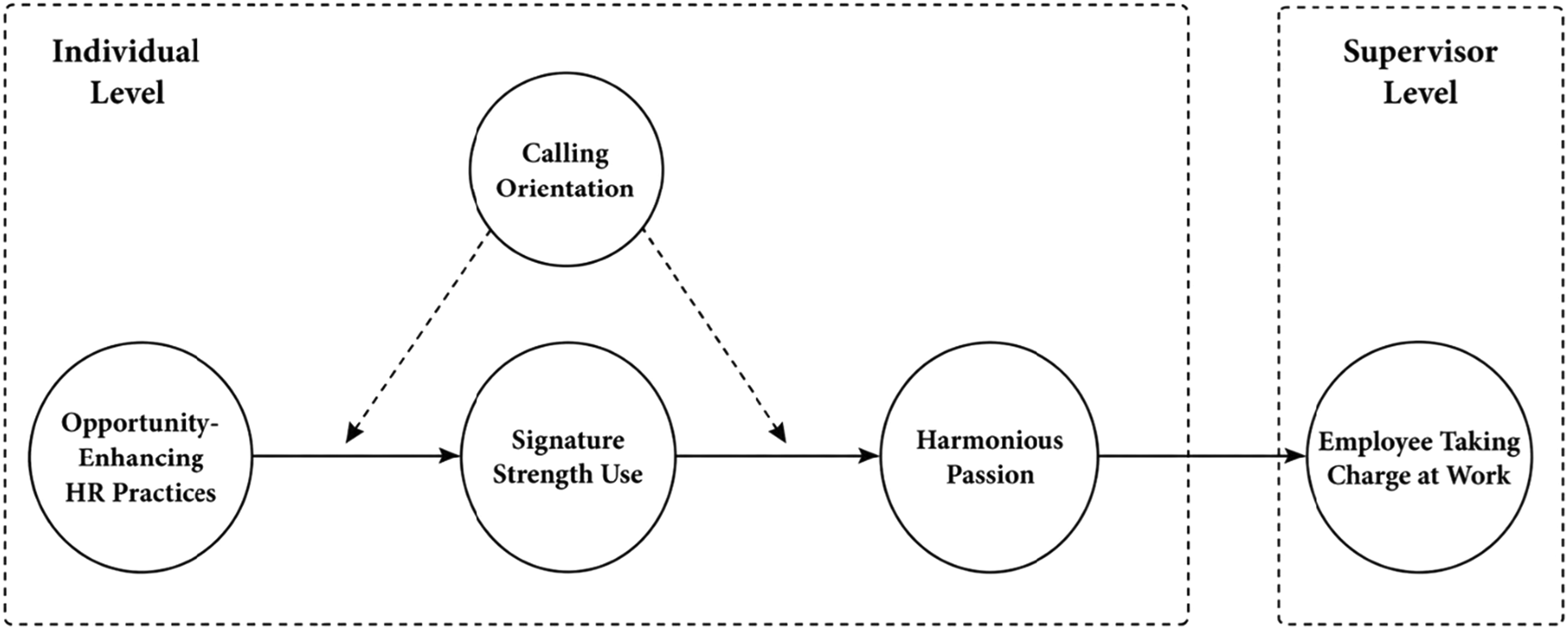
Conceptual model.
Literature review and hypotheses development
Opportunity-enhancing HR practices and employee taking charge at work
Although taking charge is typically viewed as a bottom-up, self-initiated behavior, 25 research has shown that organizational contexts can shape and support such behaviors. Previous studies highlight that flexible HR practices (i.e., resource and coordination flexibility 26 ; or high-commitment HR practices 27 foster employee proactivity. Extending this line of research, we propose that opportunity-enhancing HR practices serve as a key driver of employees’ engagement in taking-charge behaviors at work.
Opportunity-enhancing HR practices—such as autonomy, teamwork, job rotation, broad job design, flexible assignments, decentralized decision-making, participative structures, suggestion systems, and transparent information sharing. We examine opportunity-enhancing HR practices 28 that are designed to foster direct employee involvement in work processes. Such HR practices empower employees to take initiative by involving them in goal setting, problem-solving, and decision-making, thereby fostering proactive behavior. Within the Ability-Motivation-Opportunity (AMO) model, 29 opportunity-enhancing practices correspond to the “opportunity” component and complement ability- and motivation-focused HR practices. Taking charge may be indirectly supported through practices that build skills and reward target behaviors. 29 In contrast, opportunity-enhancing HR practices more directly foster it by providing employees with autonomy, discretion, and voice. 30 Accordingly, these HR practices shape employee behavior by signaling that they have the autonomy and responsibility to leverage their knowledge, skills, abilities, and motivation to engage meaningfully in task execution, goal formulation, and decision-making activities (e.g.,9,10).
Drawing on social cognitive theory (SCT
14
;), we argue that opportunity-enhancing HR practices shape employees’ beliefs about their capacity to influence outcomes. By signaling organizational trust and support, these practices enhance employees’ psychological empowerment, thereby fostering proactive action. Prior research confirms that opportunity-enhancing practices positively impact outcomes such as performance, innovation, and engagement.
10
Employees who perceive these opportunities are more likely to view themselves as valued contributors, which motivates them to initiate change, simplify tasks, seek variety, and assume greater responsibility.
31
Accordingly, we hypothesize that opportunity-enhancing HR practices play a central role in encouraging employees to take charge by creating an enabling environment that supports initiative and ownership. Hypothesis 1. Opportunity-enhancing HR practices are positively related to employee taking charge at work.
Signature strengths use as a mediator
Signature strengths are individuals’ core traits that energize them and contribute to optimal functioning, growth, and performance. 32 Their use fosters emotional fulfillment and intrinsic motivation through experiences such as excitement, discovery, and personal alignment. 33 Drawing on social cognitive theory, 14 we suggest that signature strengths use serves as a mediator between opportunity-enhancing HR practices and employee taking charge behavior. Opportunity-enhancing HR practices—such as granting autonomy, assigning challenging tasks, and involving employees in decision-making—serve as signals of organizational support and a commitment to employee development. 34 When employees perceive these practices positively, they are more likely to apply their authentic, high-performing qualities at work. 35 These practices are regarded as effective strategies for strengthening employees’ capability and motivation to leverage their signature strengths at work. These practices not only foster capability but also create a psychologically safe environment where employees feel empowered to express their strengths. 16
Specifically, employees who perceive opportunity-enhancing HR practices tend to view these practices as organizational support for their development, which motivates them to apply their distinctive strengths more actively at work.
36
Forest, Mageau
17
found that autonomy and opportunities for creative problem-solving enhance the application of signature strengths. Similarly, redesigning tasks around employees’ innate qualities fosters self-awareness and initiative.
37
Positive psychology research confirms that using signature strengths drives proactive and constructive behavior, including initiating workplace change.
38
Using their signature strengths makes employees more likely to take initiative, show leadership, and support key organizational goals.
39
This alignment enhances engagement, a sense of purpose, and willingness to go beyond formal roles.
40
Utilizing signature strengths promotes a sense of purpose and engagement, which, in turn, facilitates greater involvement and leadership in work-related tasks.
41
Hypothesis 2. Employee signature strengths use mediates the association between opportunity-enhancing HR practices and employee taking charge at work.
Harmonious passion as a mediator
Harmonious passion reflects engaging in work out of personal choice and meaning, leading to sustained and balanced involvement. 42 Unlike obsessive passion, it stems from autonomous internalisation—when work is freely chosen, aligned with one's values, and integrated into identity without external pressure (e.g., 43 ). This form of passion is associated with positive outcomes such as well-being, motivation, and performance. 44 Employees tend to view opportunity-enhancing HR practices, such as involvement in decisions and challenging assignments, as evidence that the organization is genuinely committed to fostering their development. 10 These practices—such as flexible assignments, developmental feedback, and skill-building opportunities—meet psychological needs for autonomy and competence, encouraging employees to pursue work with greater passion. 45
Following social cognitive theory,
14
we suggest that opportunity-enhancing HR practices foster a sense of obligation and empowerment, which employees reciprocate through greater harmonious passion toward their work. Vallerand, Robichaud
46
stated that employee's feel valued when organizations invest in their development through training, constructive feedback, and other growth-oriented practices, motivating them to respond with deeper commitment and enjoyment in their work. This harmonious passion, in turn, directly fosters employees’ initiative by driving them to take charge at work, as evidenced by proactive behaviors such as improving processes, solving problems, and embracing responsibility beyond their core duties. Harmonious passion, in turn, increases focus, initiative, and engagement.
44
Hypothesis 3. Opportunity-enhancing HR practices are positively associated with employee taking charge at work via harmonious passion.
Serial mediation
Taken together, the hypotheses above posit that the use of signature strengths and harmonious passion sequentially mediate the association between opportunity-enhancing HR practices and taking-charge behavior. By providing autonomy and developmental opportunities, these HR practices enable employees to apply their signature strengths, fostering a sense of authenticity and psychological energy. This, in turn, cultivates harmonious passion, which drives employees to engage in proactive behavior at work. Hypothesis 4. Opportunity-enhancing HR practices indirectly influence employee taking charge at work via signature strengths use and harmonious passion.
Calling orientation as a moderator between opportunity-enhancing HR practices and signature strengths use
Social cognitive theory suggests that employees’ responses to contextual cues are shaped by their cognitive appraisals, self-regulatory processes, and motivational orientations. 47 Opportunity-enhancing HR practices provide discretion, opportunities for participation, information sharing, and developmental support, thereby creating conditions for employees to apply their capabilities at work. 28 However, employees vary in the extent to which they convert these opportunities into the use of their signature strengths. Those with a strong calling orientation are more likely to view work as meaningful and aligned with their identity, values, and long-term goals. 48 As a result, they are more receptive to HR practices that support growth, contribution, and self-expression, and are more likely to recognize, activate, and apply their distinctive strengths in their work roles.49,50
Employees with a strong calling orientation are more likely to view work as a meaningful context for expressing their abilities and contributing to valued goals. 51 Therefore, when they experience opportunity-enhancing HR practices, they are more likely to recognize these practices as opportunities to apply their core strengths in meaningful ways. Such employees may interpret participation in decision-making, flexible job design, and information sharing as signals that the organization supports their growth and enables them to use their talents more fully. 19 These practices allow employees with a strong calling orientation to align their work roles with their deeply held values and to apply their unique strengths in ways that support both personal fulfillment and work-related contribution. 52
Drawing on social cognitive theory,
47
individuals’ behavior is shaped by personal agency, self-efficacy, and environmental reinforcement. Opportunity-enhancing HR practices can serve as environmental cues that strengthen employees’ confidence and perceived ability to use their signature strengths at work.
11
Employees with a calling orientation, because of their strong sense of purpose and desire to contribute, are more likely to respond to these cues by actively applying their strengths, skills, and capabilities in their daily work.
21
These individuals are more inclined to take initiative and leverage their strengths when HR systems support autonomy, learning, and participation.
53
In contrast, employees with lower calling orientation may perceive the same HR practices as general organizational support but may be less motivated to translate them into active strengths use. Thus, calling orientation strengthens the effect of opportunity-enhancing HR practices on signature strengths use. Hypothesis 5a. Employee calling orientation positively moderates the association between opportunity-enhancing HR practices and signature strengths use, such that the association is stronger when calling orientation is high. Hypothesis 5b. Employee calling orientation moderates the indirect link between opportunity-enhancing HR practices and employees taking charge at work through signature strength use, such that the relationship is stronger when employee calling orientation is high.
Moderating role of calling orientation between opportunity-enhancing HR practices and harmonious passion
We propose that calling orientation moderates the association between opportunity-enhancing HR practices and harmonious passion. Employees with a strong calling orientation view their work as a vital part of their identity and a means of contributing meaningfully. 54 Harmonious passion represents an emotion-driven mechanism through which employees develop enthusiasm, enjoyment, and internalized motivation toward their work. 55 Opportunity-enhancing HR practices can foster an enabling work environment that supports employees’ capability development, personal growth, and pursuit of meaningful career-related goals. 56 These practices signal organizational support for employee development, which can strengthen employees’ sense of purpose and fulfillment (e.g.,2,57).
Drawing on social cognitive theory,
14
employees with a strong calling orientation are especially receptive to growth-oriented HR practices because they interpret such practices as emotionally meaningful opportunities for personal fulfillment and purposeful work engagement.
58
When opportunity-enhancing HR practices provide autonomy, participation, development, and support, employees with a high calling orientation are more likely to feel emotionally connected to their work, experience enthusiasm, and internalize their work as personally meaningful.
28
This alignment strengthens emotional and cognitive engagement, motivating employees to invest themselves in tasks they find meaningful and rewarding.
59
Thus, calling orientation helps employees transform organizational opportunities into harmonious passion by deepening their emotional attachment, intrinsic motivation, and sense of meaningful contribution. Employees who perceive their work as closely aligned with their core values are more likely to experience harmonious passion, a form of engagement driven by genuine enjoyment and internalized motivation.
56
Hypothesis 6a. Opportunity-enhancing HR practices are more strongly associated with harmonious passion when employees report higher calling orientation. Hypothesis 6b. Calling orientation moderates the indirect association between opportunity-enhancing HR practices and employee taking charge at work via harmonious passion, such that the indirect effect is stronger when calling orientation is high.
Moderated serial mediation
We propose that calling orientation strengthens the relationship between opportunity-enhancing HR practices and employees’ taking-charge behavior by promoting the use of signature strengths and fostering harmonious passion. Employees with a strong sense of calling view work as meaningful and value-driven, making them more responsive to supportive HR practices. Practices such as development opportunities, feedback, and autonomy help employees identify and apply their unique strengths. When work aligns with their calling, employees use these strengths more effectively and meaningfully. These practices also support autonomy and growth, cultivating harmonious passion, deepening engagement, and intrinsic motivation. As a result, employees are more likely to take initiative and exceed formal role expectations. Thus, calling orientation moderates the indirect effect of opportunity-enhancing HR practices on taking charge via strengths use and harmonious passion. Hypothesis 7. Calling orientation positively moderates the indirect effect of opportunity-enhancing HR practices on employee taking charge at work through signature strengths use and harmonious passion.
Methods
Sample and procedure
Data were collected from employees and their supervisors working in service firms in Guangdong Province, China. These firms operate in fast-paced, client-oriented environments where project-based work, high performance expectations, and continuous skill utilization are common. The cultural context is also important, as Chinese workplaces typically reflect collectivist values, greater power distance, and strong respect for authority. These cultural and industry-specific characteristics may shape how employees perceive HR practices and respond to opportunities for taking charge. Although this context is appropriate for examining the study's research questions, it may also limit the generalizability of the findings beyond similar cultural and industry settings. Participation in the study was voluntary, and informed consent was obtained from all respondents.
To reduce common method bias, 60 data were collected across three waves and from multiple sources. At Time 1, employees completed measures of opportunity-enhancing HR practices, calling orientation, and demographic variables. Two months later, at Time 2, the same employees reported their use of signature strengths and harmonious passion. At Time 3, supervisors rated their corresponding employees’ taking-charge behavior. To avoid rating inflation and clustering effects, each supervisor evaluated only one employee, ensuring clean one-to-one dyadic matching.
A total of 637 questionnaires were distributed at Time 1, and 517 usable responses were returned, representing an 81.16% response rate. After removing incomplete responses, 513 valid responses were retained. At Time 2, 427 participants responded, representing 83.24% of the retained Time 1 sample, and after excluding incomplete surveys, 424 valid responses remained. At Time 3, supervisors of these 424 employees were contacted, yielding 326 responses (76.89% response rate). After data cleaning and matching using unique identifiers, the final dataset comprised 324 supervisor–employee dyads, representing 50.86% of the questionnaires initially distributed. The final employee sample was 57.1% male and 42.9% female, with an average age of 36.13 years and an average of 3.08 years of work experience. Educational levels were relatively high, with 39.5% holding a bachelor's degree and 27.8% holding a master's degree or higher. With respect to supervisor demographics, 62.4% were male and 37.6% were female. The supervisor group consisted of 62.4% males and 37.6% females. Their mean age was 41.17 years, and their average organizational tenure was 6.54 years. In addition, the average dyadic tenure between supervisors and employees was 1.44 years.
Common method bias
Several procedural and statistical steps were taken to assess the possibility of common method bias. Procedurally, the use of a time-lagged research design helped reduce respondents’ tendency to provide artificially consistent answers across constructs. Statistically, Harman's single-factor test was first performed by specifying all study items to load onto one factor. The resulting factor explained 32.35% of the total variance, below the commonly used 50% benchmark, indicating that a single-source factor did not account for most of the covariance among the measures. 61 In addition, we estimated a Common Latent Factor (CLF) to further examine common method bias. Specifically, we compared an unconstrained model, a fully constrained model with the CLF variance fixed to zero, and an equally constrained model. The non-significant chi-square difference between the unconstrained and fully constrained models (Δχ2 = 24.14, df = 12, p = 0.16) further indicates that common method bias did not substantially threaten the validity of the findings.
Measures
All English-language measures were translated into Chinese using Brislin's 62 translation and back-translation procedure. Minor contextual refinements were made to ensure the items were clear, culturally appropriate, and suitable for the Chinese research setting.
Opportunity-enhancing human resource practices
Opportunity-enhancing HR practices were measured using ten items adopted from Prieto and Pilar Pérez Santana. 63 Sample items include “Our organization emphasizes employees’ job rotation and flexible work assignments in different work areas,” “Employees are provided the opportunity to suggest improvements in the way things are done.”
Calling orientation
To measure calling orientation, we used a seven-item scale developed by Wrzesniewski, McCauley. 64 Sample items include: “My work is one of the most important things in my life,” and “I enjoy talking about my work to others.”
Signature strengths use
Employee signature strengths use was measured using the 14-item scale developed by Govindji and Linley. 65 The sample item is “I am able to use my strengths in lots of different ways.”
Harmonious passion
Harmonious passion was assessed using the seven-item scale developed by Vallerand et al.. 66 A sample item is “The new things that I discover with this activity allow me to appreciate it even more.”
Employee taking charge at work
Employees’ taking charge at work was assessed using the ten-item scale developed by Morrison and Phelps. 67 A sample item was “This employee often tries to adopt improved procedures for doing his or her job.”
Control variables
Following prior research on proactive workplace behaviors, including taking charge, we included employee age, gender, education, and supervisor–employee dyadic tenure as control variables.25,68
Results
Means and correlations
As shown in Table 1, the descriptive statistics and correlation results indicate that the key variables were significantly associated in the expected directions. In addition, as shown in Table 1, the CR values ranged from .87 to .96, exceeding the recommended threshold of .70. The AVE values ranged from .51 to .68, exceeding the recommended threshold of .50. These results indicate satisfactory construct reliability and convergent validity.
Means and correlations.
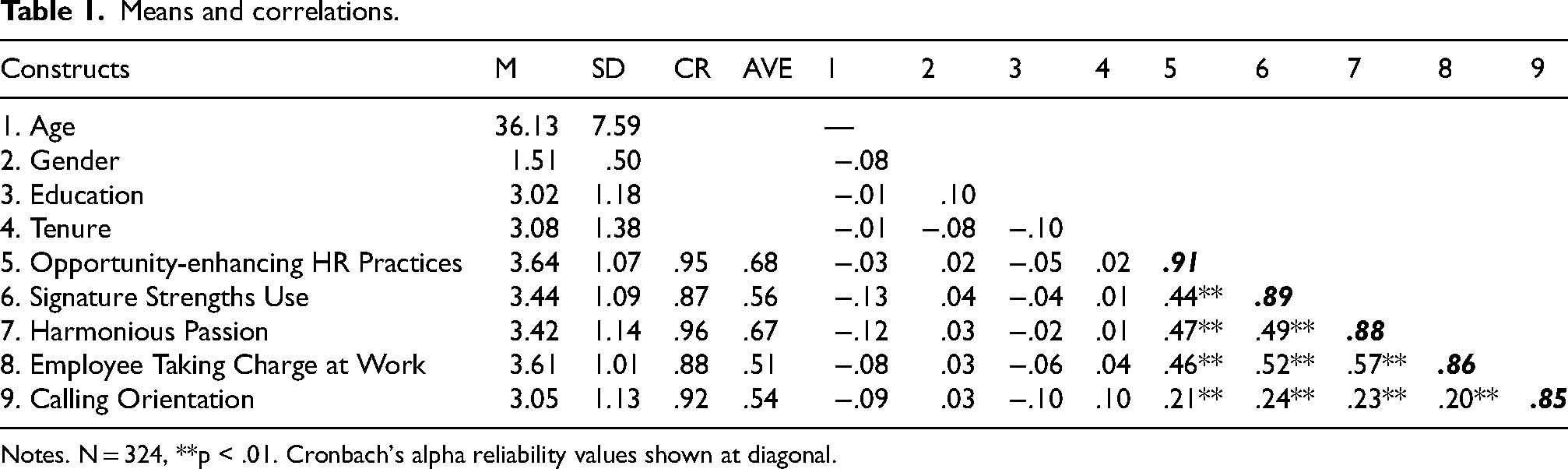
Notes. N = 324, **p < .01. Cronbach's alpha reliability values shown at diagonal.
Measurement model
Table 2 shows the results of the confirmatory factor analysis (CFA) assessing discriminant validity across three models. The five-factor model (M1)—opportunity-enhancing HR practices, calling orientation, signature strength use, harmonious passion, and taking charge at work—demonstrated a good fit: χ2/df = 1.20, RMSEA = .03, SRMR = .02, CFI = .95, and TLI = .93. Furthermore, as shown in Table 3, discriminant validity was further assessed using the HTMT criterion. The HTMT values ranged from .19 to .57, all below the recommended threshold of .85, indicating adequate discriminant validity.
HTMT results.

Confirmatory factor analysis of discriminant validitya.

Notes: aM = Model, OHRP = opportunity-enhancing HR practices; CO = calling orientation; SSU = signature strengths use; HP = harmonious passion; ETC = employee taking charge at work.
Hypotheses testing
We employed SEM in Mplus to test the proposed hypotheses. As reported in Table 4, opportunity-enhancing HR practices had a significant positive effect on employee taking charge at work (B = .16**, SE = .05, 95% CI [.07, .25]). Thus, Hypothesis 1 was supported. The indirect effect of opportunity-enhancing HR practices on employee taking charge at work through signature strengths use was significant (B = .12**, SE = .03, 95% CI [.06, .17]), supporting Hypothesis 2. The indirect effect through harmonious passion was also significant (B = .11**, SE = .02, 95% CI [.05, .15]), supporting Hypothesis 3. In addition, the serial indirect effect through signature strengths use and harmonious passion was significant (B = .05**, SE = .01, 95% CI [.03, .08]), supporting Hypothesis 4.
Hypotheses testing.
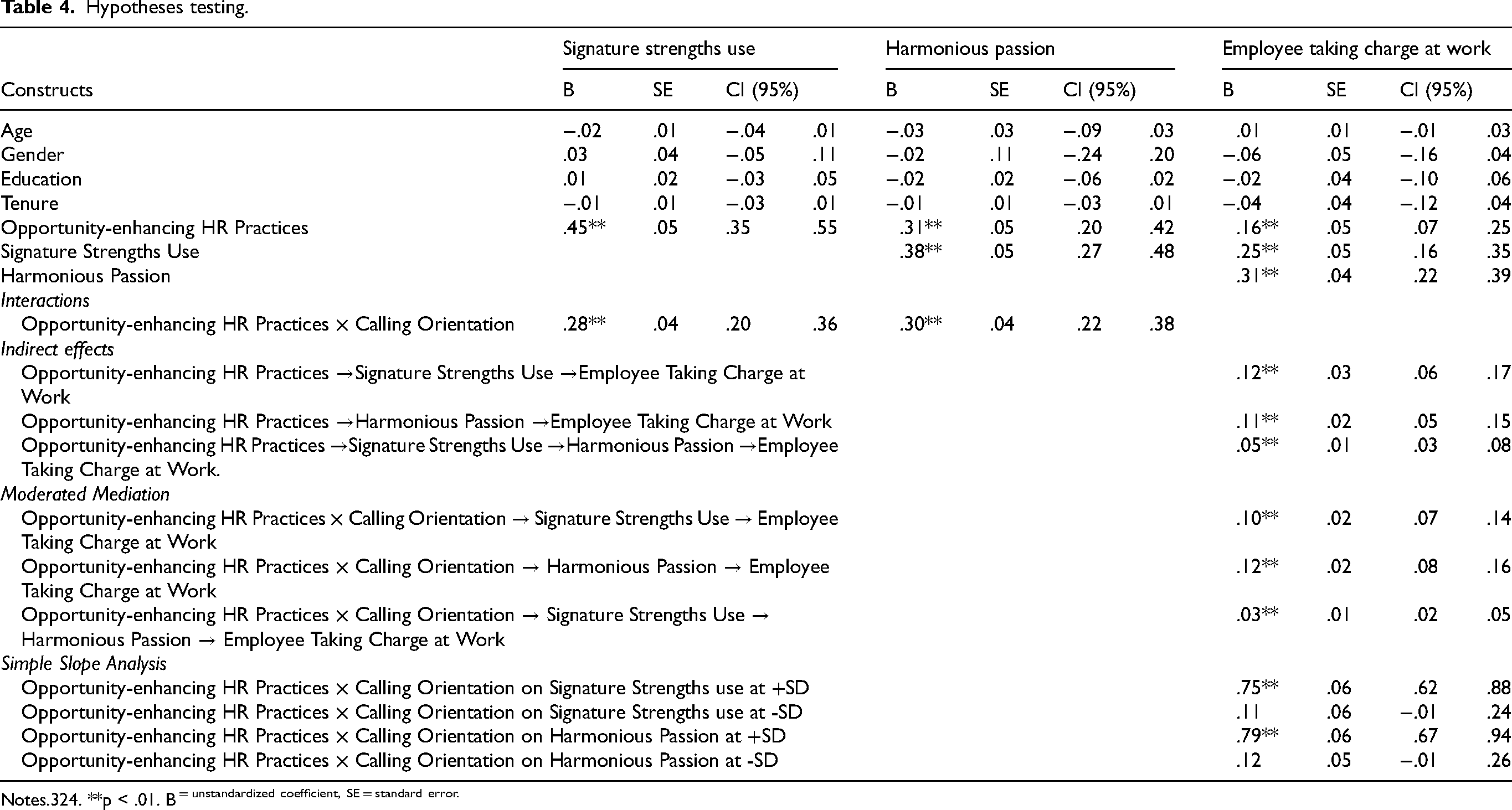
= unstandardized coefficient, SE = standard error.
Calling orientation significantly moderates the association between opportunity-enhancing HR practices and signature strengths use (B = .28**, SE = .04, 95% CI [.20, .36]). Simple slope analysis showed that the effect of opportunity-enhancing HR practices on signature strengths use was stronger when calling orientation was high (+1 SD: B = .75**, SE = .06, 95% CI [.62, .88]) than when calling orientation was low (−1 SD: B = .11, SE = .06, 95% CI [−.01, .24]) (see Figure 2). Thus, Hypothesis 5a was supported. The moderated indirect effect through signature strengths use was also significant (B = .10**, SE = .02, 95% CI [.07, .14]), supporting Hypothesis 5b.
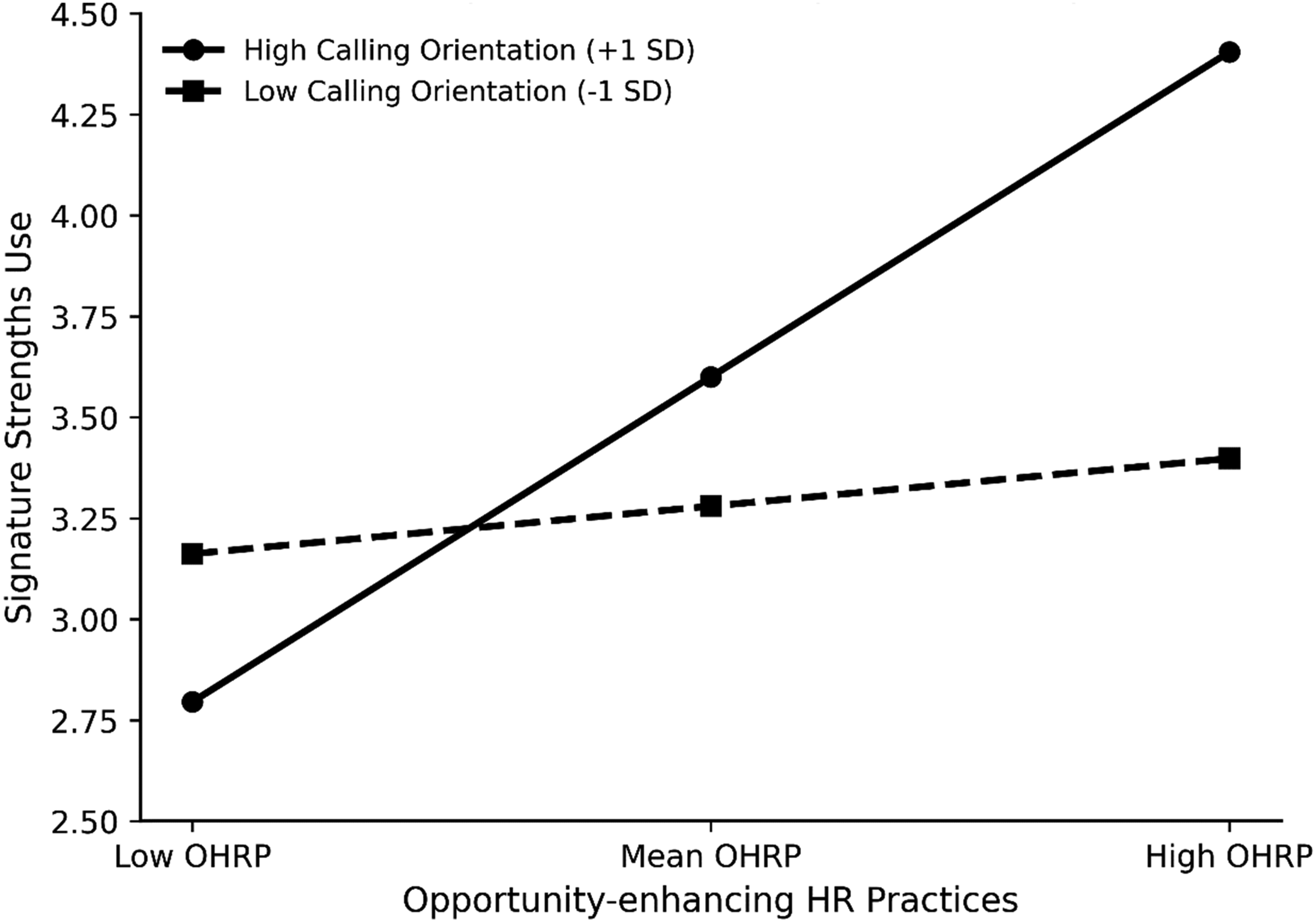
Moderating effect of calling orientation on opportunity-enhancing HR practices and signature strengths use.
Calling orientation also significantly moderates the association between opportunity-enhancing HR practices and harmonious passion (B = .30**, SE = .04, 95% CI [.22, .38]). Simple slope analysis indicated that the effect of opportunity-enhancing HR practices on harmonious passion was stronger when calling orientation was high (+1 SD: B = .79**, SE = .06, 95% CI [.67, .94]) than when calling orientation was low (−1 SD: B = .12, SE = .05, 95% CI [−.01, .26]) (see Figure 3). Therefore, Hypothesis 6a was supported. The moderated indirect effect through harmonious passion was significant (B = .12**, SE = .02, 95% CI [.08, .16]), supporting Hypothesis 6b. Finally, calling orientation significantly moderates the serial indirect effect of opportunity-enhancing HR practices on employee taking charge at work through signature strengths use and harmonious passion (B = .03**, SE = .01, 95% CI [.02, .05]). Thus, Hypothesis 7 was supported.
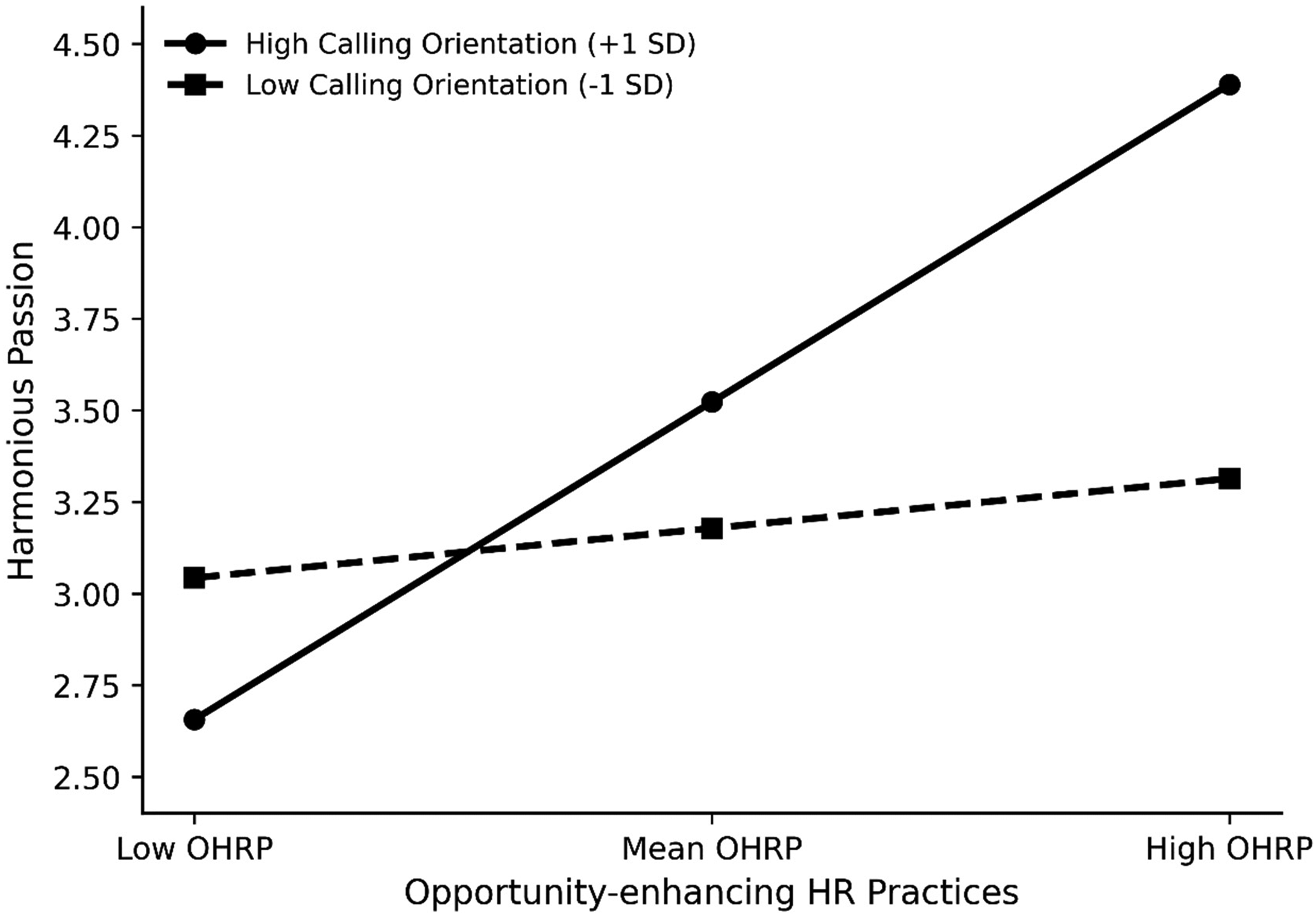
Moderating effect of calling orientation on opportunity-enhancing HR practices and harmonious passion.
Discussion
Prior research consistently shows that HR systems that expand employee discretion, autonomy, and developmental opportunities encourage greater engagement and initiative.28,69 Our study aligns with this evidence by highlighting the importance of employees’ strengths use, which previous studies have linked to higher authenticity, vitality, and proactive efforts at work.40,70,71 Similarly, the role of harmonious passion resonates with earlier findings suggesting that employees who experience deep interest and enjoyment in their work are more likely to persist, adapt, and contribute constructively. 66 The influence of calling orientation is also supported by the literature, which shows that employees with a strong sense of calling tend to respond more favorably to supportive work environments and display greater commitment and proactive engagement.72,73
Theoretical implications
This study significantly contributes to the literature on employee proactivity by exploring how opportunity-enhancing HR practices encourage employees to take charge at work. While previous research has examined leadership styles, 6 personal traits, 68 and organizational factors, 74 as drivers of proactive behavior, limited attention has been paid to how actionable HR initiatives—such as skill development, mentorship, and career advancement pathways—support such behavior. This study shifts the focus from traditional organizational factors and personality traits to actionable HR practices, providing new insights into how these practices can be strategically implemented to foster a proactive workforce.
Unlike earlier studies that treat HR practices in isolation or as undifferentiated bundles, 75 this study emphasizes how these opportunity-enhancing practices can work together to drive proactivity. These practices not only provide employees with essential tools and resources but also motivate them to exceed their formal responsibilities. Moreover, the study introduces the concepts of “signature strength use” and “harmonious passion” as sequential mediators between opportunity-enhancing HR practices and employee taking charge at work. Signature strengths are often aligned with personal values and contribute to optimal functioning, development, and performance. 37 This study argues that when employees are encouraged to use their signature strengths through opportunity-enhancing HR practices, they experience greater intrinsic motivation and a stronger connection to their work. This sense of authenticity and alignment with personal strengths fosters a deeper sense of fulfillment and joy in the work itself, known as harmonious passion. The study extends previous literature by demonstrating that using signature strengths leads to harmonious passion, fostering a more proactive approach to work in which employees are motivated to go beyond standard job expectations to drive positive change.
Additionally, the study introduces the concept of “calling orientation”—a profound sense of purpose and meaning that employees experience in their work. 21 This study suggests that employees with a strong calling orientation are more likely to feel personally fulfilled and deeply connected to their work. When aligned with opportunity-enhancing HR practices, such as those that provide resources for growth and development, this intrinsic fulfillment is further amplified. Opportunity-enhancing HR practices empower employees with the tools and support they need to thrive, driving them to take charge at work and demonstrating higher levels of initiative and responsibility in their roles. This contribution deepens our understanding of how an individual's sense of calling can interact with opportunity-enhancing HR practices to promote proactive behaviors. Calling orientation shapes how employees perceive and engage with their work environment, influencing their willingness to take charge and contribute beyond their prescribed roles.
Practical implications
This study provides important insights for organizations seeking to encourage employees’ taking charge at work. Implementing opportunity-enhancing HR practices—such as skill development programes, structured mentoring, developmental feedback, participation opportunities, and transparent career progression pathways—can provide employees with the resources, confidence, and motivation needed to initiate constructive workplace improvements. HR managers should ensure that these practices are clearly communicated and consistently implemented so that employees understand the opportunities available to them and feel encouraged to use them.
Importantly, the moderation results show that calling orientation strengthens the effect of opportunity-enhancing HR practices. This means that employees with a strong calling orientation are more likely to convert HR-related opportunities into taking charge at work. For these employees, managers should provide enriched assignments, autonomy, involvement in problem-solving activities, and opportunities to contribute beyond formal job requirements. Such employees may respond especially well when managers connect developmental opportunities with meaningful work, personal values, and organizational contribution. However, managers should not assume that all employees respond to opportunity-enhancing HR practices in the same way. Employees with lower calling orientation may require additional motivational support before they translate available opportunities into taking charge at work. For these employees, managers can provide coaching, mentoring, strengths-based feedback, and career conversations that clarify how HR opportunities relate to personal development, career growth, and work meaning. By doing so, organizations can help employees with weaker calling orientation recognize the value of available opportunities and gradually build stronger motivation to engage in constructive change-oriented behavior.
Encouraging employees to use their signature strengths in daily tasks is also important. Supervisors can incorporate strengths discussions into performance reviews, assign tasks that align with employees’ demonstrated strengths, and recognize strengths-based contributions during team meetings. When employees are able to apply their strengths in meaningful ways, they are more likely to experience harmonious passion, which can motivate them to take charge at work. HR strategies should therefore prioritize intrinsic rewards, such as growth, learning, fulfillment, and meaningful contribution, alongside appropriate extrinsic incentives. Developmental job rotations, stretch assignments, and personalized learning plans can further strengthen employees’ motivation to initiate workplace improvements. Overall, the findings suggest that organizations should adopt a more differentiated approach: employees with high calling orientation may benefit most from autonomy and meaningful contribution opportunities, whereas employees with lower calling orientation may benefit from clearer guidance, developmental support, and stronger connections between HR opportunities and personal career goals.
Limitations and future research avenues
While this study offers valuable insights into how opportunity-enhancing HR practices encourage employees to take charge at work, several limitations should be acknowledged. First, the study was conducted in professional service firms in Guangdong, China, which may limit the external validity of the findings. Professional service employees often work in client-oriented, knowledge-intensive, and performance-driven environments where initiative, problem-solving, and responsiveness to work demands are strongly expected. As a result, employees in this context may be more receptive to opportunity-enhancing HR practices and more likely to engage in taking charge at work than employees in more routine or less initiative-oriented industries. In addition, China's collectivist and relatively high-power-distance cultural context may shape how employees interpret HR opportunities, supervisor expectations, and change-oriented behavior. Employees may be more cautious when taking charge, especially when such behavior challenges existing practices or hierarchical authority. Therefore, the findings may not fully generalize to other industries, regions, or cultural settings. Future research should examine the proposed model in sectors such as manufacturing, education, healthcare, and technology-based firms, as well as in more individualistic and low-power-distance cultural contexts, to assess the broader generalisability of the findings.
Second, although this study draws on SCT, it examines only one direction of the reciprocal process: from opportunity-enhancing HR practices to employees’ taking charge at work. SCT also suggests that behavior can influence the work environment. Thus, employees who take charge may subsequently receive greater supervisor recognition, more challenging assignments, and additional developmental opportunities. Future research could examine this reciprocal process more directly by testing whether employees’ taking charge behavior later increases their access to opportunity-enhancing HR practices or other work-related resources. Such work would provide a more complete understanding of the reciprocal logic proposed by SCT.
Third, this study examined calling orientation as a boundary condition. However, other factors may also influence how employees respond to opportunity-enhancing HR practices. Future studies could consider factors such as proactive personality, emotional intelligence, career aspirations, or person–job fit to provide a more complete understanding of when these HR practices are most effective. Finally, this study identified signature strengths use and harmonious passion as key psychological underlying mechanisms. Future research could extend this model by examining additional psychological processes, such as self-efficacy, psychological empowerment, or emotional well-being. Exploring these factors would offer a broader understanding of how opportunity-enhancing HR practices stimulate employees’ motivation to take charge at work.
Conclusion
Drawing on SCT to explain how opportunity-enhancing HR practices drive employees to take charge at work. We found that using employee signature strength and harmonious passion to drive opportunity-enhancing HR practices leads employees to take charge at work. Furthermore, we found that calling orientation strengthens the serially moderated relationship. Based on these findings, we encourage organizations and supervisors to foster employee initiative at work by leveraging HR practices that enhance opportunities.
Footnotes

Ethical approval
All procedures performed in studies involving human participants were in accordance with the ethical standards of the institutional research committee of Shenzhen University (SZU/E/20251241) and with the 1964 Declaration of Helsinki and its later amendments, or comparable ethical standards.
Informed consent
Informed consent was obtained from all individual participants included in the study
Funding
This research was supported by the Key Project of the National Social Science Foundation of China (21AGL014) and the General Project for Humanities and Social Sciences Research of Ministry of Education of China (20YJA630098).
Declaration of conflicting interests
The authors declared no potential conflicts of interest with respect to the research, authorship, and/or publication of this article.