






Abstract
Background:
Disaster response personnel are routinely exposed to extreme psychological and operational stressors that challenge their emotional stability, decision-making, and performance under pressure. Effective psychosocial risk management is therefore vital to sustaining their safety and efficiency. Previous research highlights the roles of psychological resilience, coping strategies, and personality traits as key determinants of individual adaptation in high-stress environments.
Objective:
This study investigated how resilience, coping styles, and personality characteristics influence psychosocial risk management effectiveness among disaster workers.
Methods:
A total of 295 professionals and volunteers from national and regional disaster response organizations participated in the study. Participants completed the Institutional Psychosocial Risk Management Scale (IPSRMS), the Resilience Scale for Adults (RSA), the Coping Styles Scale (CSS), and the Eysenck Personality Questionnaire–Revised Short Form (EPQ-RS). Data were analyzed using correlational and multiple regression techniques to identify predictive relationships.
Results:
Higher IPSRMS scores were positively associated with extraversion and the lie scale, and negatively associated with neuroticism. Active coping strategies—particularly self-confidence, optimism, and seeking social support—were linked to more effective psychosocial risk management, while passive strategies such as helplessness and submissiveness were inversely related. All dimensions of resilience, including personal competence, structured style, and social competence, were significantly correlated with effective psychosocial risk management.
Conclusions:
The findings underscore the critical role of resilience, adaptive coping, and positive personality traits in managing psychosocial risks within disaster settings. Integrating resilience-building and coping skills training into disaster preparedness programs could enhance workforce well-being and organizational effectiveness.
Introduction
Recent disasters have clearly demonstrated the inadequacy of response-oriented approaches and underscored the critical importance of risk-based preparedness in building resilient societies. Disaster risk refers to the potential for loss of life, injury, destruction, or damage within a specific time frame, encompassing the interacting components of hazard, exposure, and vulnerability that shape these outcomes.
1
Accordingly, contemporary disaster management approaches increasingly emphasize proactive and preventive strategies rather than reactive responses. A comprehensive disaster risk management strategy should consider not only physical, geographical, and economic factors, but also the biological, psychological, sociological, and emotional characteristics of individuals involved in the process
Although the literature includes numerous studies examining the psychological states of professionals involved in post-disaster interventions, research on psychological preparedness in the pre-disaster phase remains limited
To better contextualize this perspective, it is important to clarify the key concepts underlying disaster risk. The transformation of an event into a disaster is shaped by several key concepts, including hazard, risk, vulnerability, and capacity. According to the Hyogo Framework for Action, a hazard is defined as a natural, technological, or human-induced event or phenomenon that occurs at a specific time and place, disrupts daily life, and causes damage to the social, economic, psychological, and physical well-being of the affected community, as well as to the environment, cultural heritage, and historical assets.4,5 Risk refers to the probability of an adverse event occurring under certain conditions, along with the likelihood of being affected, which is further influenced by social factors. 6 Disaster risk often involves complex and difficult-to-measure potential losses and is shaped by the socioeconomic, political, cultural, and environmental conditions of the affected region. These conditions also influence the extent to which such risks are perceived as acceptable or tolerable. From this perspective, disaster risk should be understood not only as a technical construct but also as a socially and psychologically embedded phenomenon. In this sense, the presence of risk reflects not only a technical issue but also the ongoing need to develop and strengthen capacities in areas such as socioeconomic policy, emergency response, preparedness, intervention, and recovery. 7 Disaster risk management is a multidimensional process that involves eliminating, or where elimination is not possible, mitigating the impact of hazards that threaten the integrity and continuity of communities at local, regional, national, and global levels. Its primary aim is to minimize community vulnerability through effective preparedness and risk reduction strategies. 8 Accordingly, disaster management must incorporate both structural measures and psychosocial dimensions to ensure comprehensive preparedness.
Within this framework, disaster management should address not only physical and structural components but also psychosocial dynamics. In a study conducted in the L’Aquila region of Italy, the impact of the COVID-19 emergency on mental health (including general well-being, levels of depression, and post-traumatic distress), coping strategies, and training needs was assessed. Findings revealed that younger volunteers, despite having less experience, were more motivated and more effective in managing stress compared to their more experienced counterparts. 9 This finding suggests that psychological factors may, in some cases, play a more decisive role than experience alone in disaster contexts. Accordingly, it underscores the need to integrate psychological resilience assessments alongside physical readiness evaluations in disaster risk management.
Disasters represent crisis situations that can lead to severe physical, social, and psychological consequences for both individuals and communities. Professionals and volunteers who intervene in such situations operate under intense stress, uncertainty, and a high level of responsibility. Therefore, it is essential that those involved in disaster response are equipped not only with technical knowledge and skills but also with psychological resilience, effective stress management strategies, and strong personality traits that enable them to perform under pressure.10,11 The effectiveness of disaster risk management depends not only on professional competence but also on the psychological well-being of these individuals. Psychological resilience refers to the capacity to adapt and recover in the face of stressful life events, while coping styles encompass the cognitive and behavioral responses developed to manage stress.12–14 Personality traits serve as key individual factors influencing these psychological processes; for instance, higher levels of extraversion and lower levels of neuroticism have been associated with more adaptive coping abilities in disaster contexts. 15 Furthermore, well-structured and effectively managed institutional frameworks can enhance individuals’ sense of control and self-efficacy, thereby strengthening their psychological resilience. Thus, both individual-level and organizational-level factors’ interaction should be considered when shaping effective disaster response.
The success of disaster response processes is not solely dependent on technical preparedness and operational capacity, but also is closely linked to the psychosocial competencies of the human resources involved in these processes. While scientific studies have predominantly focused on the psychological impacts of disasters on survivors, recent years have witnessed a growing interest in the psychological well-being and professional competence of disaster workers. 16 However, the existing literature remains limited in its ability to address, in an integrated manner, the interplay between disaster workers’ perceptions of risk management and their individual characteristics, such as personality traits, psychological resilience, and stress coping strategies. To address this gap, the present study adopts an integrative perspective that brings together institutional risk management processes and individual worker psychological characteristics. Specifically, it examines how these psychological attributes interact with risk management processes. In doing so, the study aims to contribute both to the psychological well-being of disaster personnel and to the development of strategies that enhance institutional response and management capacity. Within this framework, the primary objective is to evaluate disaster workers’ effectiveness in risk management during the disaster risk reduction process and to assess their competencies in relation to psychological resilience, coping styles, and personality traits. In addition, the study seeks to identify potential factors underlying negative outcomes and to provide practical and theoretical contributions to the disaster risk reduction literature. By explicitly linking individual-level psychological factors with institutional-level processes, this study offers a more comprehensive understanding of disaster risk management effectiveness.
Method
Study design and setting
This study was conducted between September and December 2023 with participants residing in İzmir, who had served professionally or voluntarily in disasters occurring both domestically and internationally. The target population comprised members of AFAD (Disaster and Emergency Management Authority), UMKE (National Medical Rescue Team), AKUT (Search and Rescue Association), and GEA (Mother Earth Search and Rescue). The study employed quantitative data collection tools, including a demographic information form and four standardized psychological assessment scales, administered through Word documents and Google Forms. The total population of the study consisted of 930 individuals: AFAD İzmir staff (n = 185), UMKE İzmir personnel (n = 550), AKUT İzmir and Yarımada Team members (n = 110), and GEA İzmir volunteers (n = 85). 10 Using the known population sample size formula with a 95% confidence interval, the minimum required sample size was calculated as 295. A total of 299 individuals participated in the study; however, four participants were excluded due to incomplete responses, resulting in a final sample of 295 individuals.
Data collection
The study was conducted using a relational screening model within the framework of a quantitative observational research design. Data were collected through face-to-face interviews conducted by the researcher with participants who voluntarily provided informed consent. The sample consisted of disaster professionals of both genders, aged between 20 and 70 years. Participants completed a structured questionnaire comprising demographic items and standardized instruments drawn from four validated psychological scales. For individuals who could not be reached in person, an identical digital version of the questionnaire was made available to ensure methodological consistency. On average, survey completion required approximately 15 to 20 min per participant. Individuals who declined to participate or submitted incomplete responses were excluded from the study. Additionally, responses with missing data on any of the psychological scales were omitted from the statistical analyses and not included in the final dataset.
Data collection tools
Personal information form
The Personal Information Form was developed to collect demographic data related to disaster professionals. This structured form consists of 10 items and includes questions regarding participants’ age, gender, marital status, level of education, years of experience in the workplace, current institutional role, affiliated organization, and disaster-related experiences. In addition, the form captures data on the number of disasters in which participants were actively involved, the types of disasters experienced, and the geographical regions where these events occurred.
Institutional psychosocial risk management scale (IPSRMS)
The Institutional Psychosocial Risk Management Scale (IPSRMS), developed by Çilingirtürk et al., 17 is designed to assess organizational-level psychosocial dynamics. The scale consists of four subscales—performance, problem-solving, motivation, and well-being—and includes a total of 61 items, each rated on a five-point Likert scale. Scores are evaluated based on subscale dimensions, allowing participants to be categorized into “low,” “normal,” and “high” functioning levels. The scale has been validated for effectively measuring high-performance outcomes and allows for nuanced interpretation of individual and organizational psychosocial capacities. Each subscale reflects a distinct conceptual domain: performance assesses work efficiency and task completion under stress; problem-solving measures adaptive strategies when encountering challenges; motivation evaluates goal-directed persistence and engagement; and well-being captures psychological strain or stress responses within institutional settings. Higher scores on the performance, motivation, and problem-solving subscales indicate positive individual and organizational outcomes, while higher scores on the well-being subscale reflect increased psychological strain or negative psychological states; this inverse scoring captures psychological burden within institutional contexts. The IPSRMS has demonstrated high reliability in previous studies, with Cronbach's alpha values of performance α = 0.92, problem-solving α = 0.89, motivation α = 0.87, and well-being α = 0.90, indicating that the scale provides a comprehensive and reliable assessment of psychosocial risk management capacities in high-stress occupational populations, including disaster professionals.
Eysenck personality questionnaire – revised short form (EPQ-RS)
The Revised Eysenck Personality Questionnaire Short Form (EPQ-RS) was developed by Francis et al. 18 following a re-examination of the original Eysenck Personality Inventory and its 48-item short version. In Turkey, validity and reliability studies of the EPQ-RS were conducted by Karancı and colleagues. 19 The EPQ-RS consists of 24 dichotomous (Yes=1, No = 0) items designed to assess three core personality dimensions: extraversion, neuroticism, and psychoticism. To ensure response validity, the scale also includes a lie subscale. Each dimension is evaluated based on six items, yielding scores ranging from 0 to 6. Higher scores indicate stronger expression of the respective personality traits, with interpretations varying according to the subscale in question.
Resilience scale for adults (RSA)
The Resilience Scale for Adults (PRSA) was developed by Friborg et al. 20 and later validated for Turkish populations by Basım and Çetin. 21 The scale contains 33 items presented in a balanced format, with positively and negatively phrased statements to minimize response bias. Participants respond using a five-point Likert scale. Higher total scores indicate greater psychological resilience, reflecting the individual's capacity to adapt and recover from stress and adversity.
Coping styles scale (CSS)
Originally developed by Folkman and Lazarus, 22 the Coping Styles Scale (CSS) evaluates active and passive coping strategies utilized by individuals. The Turkish short version, validated by Şahin and Durak, 23 consists of 30 items across five subscales: optimistic approach, self-confident approach, seeking social support (active coping), helpless approach, and submissive approach (passive coping). Higher scores on each subscale indicate greater reliance on the corresponding coping strategy. The Cronbach's alpha coefficients for the subscales are as follows: self-confident approach (0.80), optimistic approach (0.68), submissive approach (0.70), helpless approach (0.73), and seeking social support (0.47).
Data analysis
Descriptive statistics were presented as frequencies, percentages, means, standard deviations, medians, and ranges. Reliability analyses of the employed scales were conducted. Normality was assessed using the Shapiro-Wilk test. For normally distributed data, independent samples t-tests and one-way ANOVA were used for two-group and multiple-group comparisons, respectively; for non-normal distributions, Mann-Whitney U and Kruskal-Wallis tests were applied. Post-hoc comparisons employed Bonferroni corrections to identify specific group differences. Associations among continuous variables violating normality assumptions were analyzed using Spearman's rank correlation. All analyses were performed using IBM SPSS Statistics version 25.
Results
Socio-Demographic Findings
The participant demographic data are presented in Table 1.
Demographic characteristics of the participant group and their distribution according to disaster-related experiences (n = 295).

n = sample size; % = percentage, X:mean, SD: Standard Deviation, Number of disaster types: <1 = no previous disaster experience; 1–5 = mild exposure; 6–10 = high exposure.
Distribution of Total Scores on the IPSRMS, EPQ-RS, RSA, and CSS Scales and Their Subscales
The average scores obtained from the IPSRMS, EPQ-RS, RSA, and CSS scales used in the study were generally found to be high. Among the IPSRMS subscales, scores for Performance, Motivation, and Problem-Solving were high, indicating strong competencies in these areas. However, the high score on the Well-being subscale, due to reverse scoring, may suggest lower levels of psychological well-being.
According to the EPQ-RS results, participants scored high on Extraversion and Lie scales, while scores on Neuroticism and Psychoticism were low. The total score on the RSA scale was also high (123.88 ± 19.17), indicating a high level of psychological resilience. Findings from the CSS scale revealed that participants frequently used positive coping strategies (self-confident, optimistic, and seeking social support), while negative strategies (helplessness and submissiveness) were reported at low levels (Table 2).
Descriptive statistics and reliability analyses of the total scores and subdimensions of the IPSRMS, EPQ-RS, RSA, and CSS scales (n = 295).

X:mean, SD: Standard Deviation IPSRMS = Inventory of Psychosocial Risk Management in Disaster Settings;
EPQ-RS = Eysenck Personality Questionnaire-Revised Short Form;RSA = Resilience Scale for Adults;CSS = Coping Style Scale;X = mean; SD = standard deviation; Cronbach's alpha indicates internal consistency reliability.
Evaluation of IPSRMS Scores According to Participants’ Demographic Characteristics
A weak but statistically significant negative correlation was found between participants’ age and their Performance scores on the IPSRMS scale (p < 0.05), and a weak positive correlation with their Well-being scores (p < 0.05) (Table 3).
Distribution and comparison of IPSRMS and its subdimensions according to participants’ demographic characteristics (n = 295).
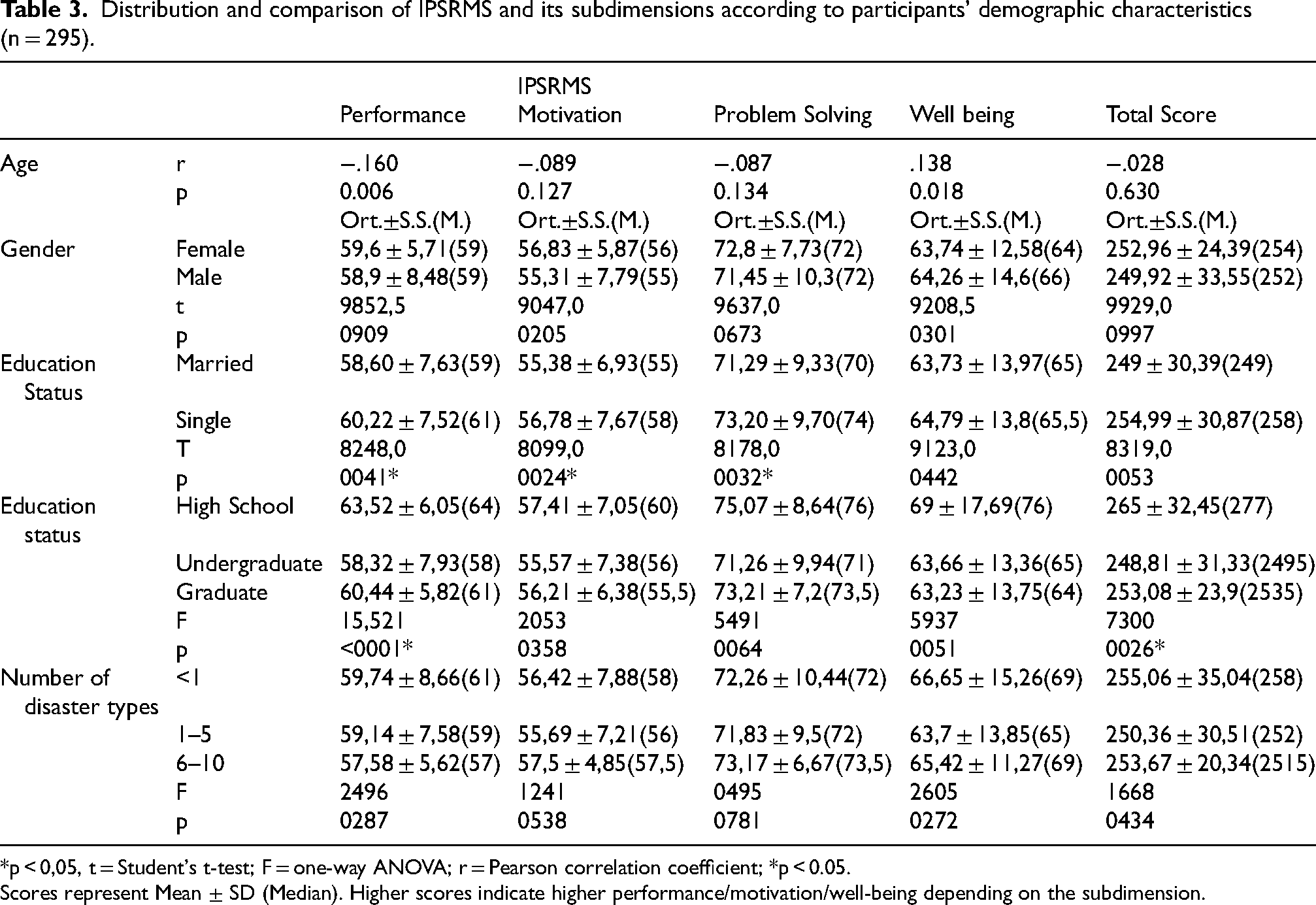
*p < 0,05, t = Student's t-test; F = one-way ANOVA; r = Pearson correlation coefficient; *p < 0.05.
Scores represent Mean ± SD (Median). Higher scores indicate higher performance/motivation/well-being depending on the subdimension.
Participants who were not married had significantly higher scores in the Performance, Motivation, and Problem-Solving subscales compared to those who were married (p = 0.041; p = 0.024; p = 0.032) (Table 3).
When examined by education level, a statistically significant difference in IPSRMS Performance scores was found between high school and university graduates (p = 0.001). High school graduates scored significantly higher in Performance (p = 0.023), as well as in the Motivation and Problem-Solving subscales compared to university graduates. This suggests that high school graduates may exhibit stronger abilities in these areas (Table 3).
No statistically significant differences were found in IPSRMS scale and subscale scores based on gender or number of disaster types experienced (p > 0.05).
Correlation between participants’ average IPSRMS scores and average scores of EPQ-RS, RSA, and CSS
Statistical analyses revealed significant relationships between the total and subscale scores of the IPSRMS and EPQ-RS. Extraversion was positively associated with the total IPSRMS score (r = 0.358, p < 0.01), as well as with the Performance (r = 0.234, p < 0.01), Motivation (r = 0.205, p = 0.05), Problem Solving (r = 0.289, p < 0.01), and Well-Being (r = 0.357, p < 0.01) subscales. In contrast, neuroticism showed weak to moderate negative correlations with these dimensions (e.g., total score: r = –0.159, p = 0.006; well-being: r = –0.402, p < 0.01). Interestingly, the total and well-being scores were positively correlated with the Lie subscale (r = 0.328, p < 0.001; r = 0.162, p < 0.005), suggesting a complex interplay between personality traits and risk perception. These findings highlight the influential role of individual personality characteristics on perceptions of institutional psychosocial risk management (Table 4).
Correlation between participants’ average IPSRMS scores and average scores of EPQ-RS, RSA, and CSS (n = 295).

*p < 0,05, IPSRMS = Inventory of Psychosocial Risk Management in Disaster Settings; EPQ-RS = Eysenck Personality Questionnaire-Revised Short Form; RSA = Resilience Scale for Adults; CSS = Coping Style Scale. r = Pearson correlation coefficient; *p < 0.05.Higher scores indicate higher performance/motivation/resilience depending on scale/subdimension.
Further analysis explored the relationship between participants’ coping strategies and their perception of institutional psychosocial risk management. Active coping styles demonstrated significant associations with IPSRMS scores. Subscales of the CSS, including Self-Confident Approach, Optimistic Approach, and Seeking Social Support, were positively and moderately correlated with all IPSRMS subscales and total scores (e.g., total score and Self-Confident Approach: r = 0.432, p < 0.01; Optimistic Approach: r = 0.397, p < 0.01; Seeking Social Support: r = 0.188, p = 0.001). In contrast, passive coping styles—namely, Helpless Approach and Submissive Approach—showed weak but significant negative correlations with the IPSRMS total and well-being scores (p < 0.05). These results suggest that active coping strategies may enhance psychosocial functionality, whereas passive strategies may hinder it (Table 4).
Additionally, significant positive correlations were found between the total scores on the RSA and all subscales of IPSRMS. Specifically, resilience was associated with Performance (r = 0.255, p < 0.01), Motivation (r = 0.244, p < 0.01), Problem Solving (r = 0.322, p < 0.01), and Well-Being (r = 0.474, p < 0.01) subscales. Moreover, a moderate positive correlation was observed between the total scores of RSA and IPSRMS (r = 0.461, p < 0.01). These findings indicate that as the psychological resilience of disaster workers increases, their perception of institutional psychosocial risk management also improves (Table 4).
Discussion
In this study, the relationships between disaster workers’ perceptions of psychosocial risk management and their personality traits, coping strategies, and levels of psychological resilience were examined comprehensively. The findings revealed that participants generally exhibited high levels of performance, motivation, and problem-solving; however, their psychological well-being appeared to be comparatively lower. This discrepancy suggests a critical tension: disaster workers can maintain operational effectiveness while simultaneously experiencing psychological strain, highlighting the need for institutional measures to address potential burnout and emotional exhaustion. Regarding personality traits, participants showed high levels of extraversion and low levels of neuroticism and psychoticism. Moreover, active coping strategies—such as self-confident, optimistic approaches and seeking social support—were positively associated with IPSRMS scores, while passive strategies—such as helplessness and submissiveness—were negatively associated. These findings critically indicate that individual characteristics significantly shape the perception and management of psychosocial risks, but they also underscore that even adaptive traits cannot fully mitigate the cumulative stress experienced in disaster contexts. Additionally, higher levels of psychological resilience were found to be significantly and positively related to more favorable perceptions of institutional psychosocial risk management. This suggests that resilience not only functions as a personal protective factor but may also enhance institutional performance indirectly, by enabling workers to engage more effectively with organizational protocols and risk management procedures. These findings suggest that the personality structures, coping styles, and resilience levels of individuals working in disaster settings play a crucial role in how they perceive and manage psychosocial risks.
Evaluation of IPSRMS Scores Based on Participants’ Demographic Characteristics
A negative relationship was found between participants’ age and their IPSRMS performance scores, indicating that as age increases, disaster workers’ performance in psychosocial risk management processes decreases. This finding aligns with existing literature suggesting that cognitive, physical, and emotional changes associated with aging may adversely affect individuals’ performance in stressful, fast-paced decision-making environments critical to disaster management.24,25 This suggests that older disaster workers may need targeted institutional support, including task modifications, workload redistribution, and age-sensitive training, to maintain performance while reducing psychological strain. As emphasized in the study by Jia and colleagues, 25 cognitive changes such as reduced attention span, diminished working memory, and slower information processing speed can impair decision-making abilities, especially in situations requiring rapid response and crisis management. Additionally, decreased physical endurance and the emotional burden stemming from previous experiences may reduce older disaster workers’ capacity to cope with stressful situations. Thus, age should be considered not merely as a chronological variable but as one encompassing cognitive and psychosocial dimensions.
It was found that unmarried participants scored significantly higher on the IPSRMS subscales of Performance, Motivation, and Problem Solving compared to their married counterparts. Rather than interpreting this finding as indicating that marital status directly increases or decreases performance, it may be more appropriate to consider differences in work–family conflict and individual resource use as potential explanations. Work–family conflict arises when the demands of work and family roles interfere with one another and this conflict has been shown to negatively affect both employee performance and well-being. In this context, factors such as work–family and family–work conflict may create additional emotional and cognitive burdens for married individuals, which can indirectly impact job performance. 26 Marital responsibilities may increase stress and strain on well-being for some individuals, and the effects of such conflicts on performance are more closely related to personal resource depletion and role conflict dynamics rather than marital status itself. 27 From this perspective, interventions such as flexible work arrangements and family-supportive organizational policies may help reduce role conflict and maintain performance, thus removing marital status as a direct determining factor. Furthermore, the literature provides limited consistent and direct evidence that married professionals generally perform better than their unmarried counterparts; instead, psychosocial factors such as work–family conflict influence work outcomes primarily through stress and well-being pathways. 28 Therefore, performance in high-stress disaster roles is likely influenced more strongly by factors such as workload, role clarity, coping resources, institutional support, and psychological well-being rather than marital status alone. In summary, although differences were observed between married and unmarried participants, it is more appropriate to interpret these findings within the context of work–family conflict and individual resource use dynamics rather than as evidence that marital status directly determines performance. Framing the discussion in this way strengthens the scientific basis of the discussion section and better aligns it with existing literature.
Another noteworthy finding in the study is the significant differences in IPSRMS subscale scores based on educational level. Specifically, participants with a high school diploma scored higher on performance, motivation, and problem-solving subscales than those participants with a bachelor's degree. This observation emphasizes the value of field experience alongside formal academic qualifications in disaster response settings. From an institutional perspective, training programs should balance theoretical instruction with experiential learning, ensuring that less experienced or academically focused personnel are adequately prepared for operational challenges. Practical experience, reflexive decision-making, and strategies developed through field challenges can be as critical as academic knowledge in disaster response. Indeed, the literature emphasizes that decision-making, stress coping, and crisis management skills in disaster environments often develop directly through experience.29,30 High school graduates are likely to spend more extended periods in active field roles, which can contribute to the gradual development of operational knowledge and skills. On the other hand, bachelor's degree holders tend to occupy more administrative or technical positions, which may limit their direct intervention experience. 31 According to Experiential Learning Theory, 32 individuals gain cognitive, emotional, and behavioral outcomes through learning from experiences, suggesting that knowledge and skills acquired on the job may be more effective than purely theoretical knowledge. Therefore, disaster management should emphasize not only academic qualifications but also practical experience, field adaptability, and psychosocial resilience. Considering practical competencies as well as formal education when assigning roles and evaluating disaster workers is crucial for team efficiency.
Correlations between EPQ-RS, RSA, CSS scales and IPSRMS
This study reveals that disaster workers demonstrate strong functional characteristics, exhibiting high levels of performance, motivation, and problem-solving skills. However, the relatively high psychological well-being scores also suggest that these individuals may experience emotional difficulties, indicating a duality in functional and emotional capacity. This duality highlights that despite strong adaptive and social traits, ongoing operational stress can undermine well-being, pointing to the need for continuous institutional monitoring and intervention programs aimed at mitigating chronic stress and secondary trauma. 33 Furthermore, low levels of neuroticism and psychoticism support the idea that disaster workers tend to be balanced, emotionally stable, and socially adaptable.34,35 These findings are consistent with similar studies in the literature conducted with disaster workers. For example, Bek Yağmur and Karaman demonstrated that high psychological resilience among disaster workers enhances coping abilities and helps maintain professional functioning. 36 Nevertheless, the relatively low psychological well-being observed highlights a critical gap in current institutional practices: functional capacity does not guarantee psychological protection. Proactive mental health support systems are essential. A notable finding in our study is the relatively low psychological well-being, aligning with literature warnings suggesting that disaster workers may experience burnout, emotional exhaustion, or secondary traumatic stress following prolonged exposure.37,38 Therefore, it is crucial to regularly monitor and support not only the functional skills but also the psychological well-being of disaster workers.
The study examined the relationship between disaster workers’ levels of institutional psychosocial risk management and their psychological resilience. Findings revealed a positive and significant correlation between the total scores of the Psychological Resilience Scale (RSA) and the Institutional Psychosocial Risk Management Scale (IPSRMS). This reinforces the practical implication that resilience-building interventions—such as structured stress inoculation training, peer mentoring, and resilience workshops—could improve both individual and institutional performance. This suggests that individuals with higher psychological resilience perceive and manage institutional risks more effectively. At the subscale level, psychological resilience was positively correlated—from low to moderate levels—with IPSRMS subscales including performance, motivation, problem solving, and particularly well-being. These results indicate that psychologically resilient individuals have advantages not only personally but also regarding institutional performance, motivation, and problem-solving capacities. The relatively high scores in the “well-being” subscale may indicate that individuals under intense performance pressure may experience reduced subjective well-being, highlighting the psychosocial burdens’ impact on the institutional environment. According to Lazarus and Folkman's (1984) stress and coping model, an individual's coping skills and resilience determine the adequacy of psychological resources in response to environmental demands. 22 In this context, psychosocial supports, training, and systematic intervention programs aimed at enhancing disaster personnel's resilience should be integral components of institutional risk management strategies.
The findings of this study indicate that the coping strategies employed by disaster workers have a significant impact on their perceptions of institutional psychosocial risk management. Critically, promoting active coping strategies is not only personally beneficial but also a strategic organizational intervention. Programs designed to teach problem-solving skills, promote optimism, and facilitate social support networks can enhance both individual well-being and institutional effectiveness. Conversely, addressing passive coping tendencies is essential, as these are associated with decreased performance and increased risk of burnout. Active coping strategies—such as a confident approach, an optimistic attitude, and seeking social support—were associated with more favorable evaluations in areas such as institutional performance, problem-solving, motivation, and overall well-being. This suggests that positive coping skills developed individually strengthen personal psychological resilience and contribute to effective organizational functioning. Active coping mechanisms help individuals maintain a sense of control during stressful situations, facilitating more effective solutions at both personal and organizational levels. Similar conclusions are supported in the literature, where active coping strategies have been found to enhance problem-solving abilities and psychological well-being. 39 Conversely, passive coping strategies—such as helplessness and submission—were observed to negatively affect individual well-being and institutional contribution capacity. These strategies hinder effective stress management and are often associated with loss of control, burnout, and psychological strain. 40 This is particularly critical in disaster contexts, where high-stress environments can severely limit intervention capacity. In light of these findings, supporting active coping skills among disaster workers is of strategic importance—not only for safeguarding individual mental health but also for enhancing institutional risk management. It is therefore recommended that organizations adopt structured training programs and sustainable psychosocial support services aimed at improving coping abilities. Such initiatives can help workers manage stress more effectively and ultimately increase organizational resilience.
Limitations
When interpreting the results of this study, several limitations should be considered. The sample consists of disaster response professionals and volunteers residing in the city of İzmir. Therefore, the findings cannot be generalized to all disaster workers across the country or worldwide. To address this limited generalizability of our findings, we also reference recent research conducted across various high-risk occupational groups—including disaster responders, healthcare professionals, and emergency personnel—that demonstrates similar patterns regarding the roles of psychological resilience, coping strategies, and personality traits in stress adaptation and occupational functioning.41,42,43 These converging findings suggest that, while caution is warranted when making direct generalizations, the observed relationships may not be unique to this specific sample and may reflect broader psychosocial mechanisms.
The cross-sectional design of this study precludes causal inferences, which is an inherent limitation of examining associations at a single time point. To overcome this aspect, we suggest that future research adopt longitudinal or experimental designs that can help to clarify causal relationships between psychological resilience, coping strategies, personality traits, and psychosocial risk management. For example, tracking disaster workers over time or implementing intervention studies aimed at enhancing resilience and coping skills could provide stronger evidence regarding the directionality and causality of these relationships.
The consistency of these findings with established theoretical frameworks, such as Lazarus and Folkman's (1984) transactional model of stress and coping, supports the interpretation that the observed relationships are meaningful and may emerge similarly in different contexts. 44 Therefore, rather than claiming strict causal generalizability, this study contributes to the existing body of knowledge by presenting results consistent with the broader literature while transparently acknowledging the limitations in both generalizability and causal inference.
Conclusion
The findings of this study reveal that the perceptions of institutional psychosocial risk management among disaster workers are deeply shaped by individual differences, with personality traits, coping strategies, and levels of psychological resilience playing significant and decisive roles. While participants demonstrated high levels of performance, motivation, and problem-solving skills—forming a strong psychosocial capital for institutional functionality—the relatively low scores in the psychological well-being subdimension indicate a critical need for emotional support for disaster workers. The positive role of extraversion in enhancing institutional resilience, contrasted with the detrimental impact of neuroticism, underscores the crucial influence of personality structure on organizational performance. Furthermore, the strengthening effect of active coping strategies and the weakening influence of passive coping tendencies on institutional functioning clarify the focus areas for psychosocial interventions. The finding that psychological resilience is a central factor in disaster workers’ risk perception and management highlights the vital importance of programs aimed at boosting resilience. In this context, comprehensive psychoeducational programs that strengthen individual resources, develop functional coping skills, and support psychosocial well-being are evidently essential to create sustainable strength at individual and organizational levels. Future research should prioritize comparative investigations across a variety of professional groups and types of disasters to explore the dynamics of psychological resilience, coping strategies, and risk management perceptions, thereby contributing to the development of more context-specific and effective intervention models.
Footnotes
Acknowledgements
The authors sincerely thank all disaster workers who participated in this study and contributed their valuable time and experiences.
Ethical approval
Before starting the study, ethics committee approval was obtained from Ege University Faculty of Medicine, Medical Research Ethics Committee (ETHICS APPROVAL NO: E. 23.09.11/22).
Participants were thoroughly informed about the voluntary nature and confidentiality of their involvement prior to data collection. Informed consent was obtained from all participants, who were explicitly made aware of their right to withdraw from the study at any stage without any penalty or consequence.
The study has been carried out considering the principles of Helsinki Declaration. Ethical approval has been taken from the University's Non-Interventional Research Ethics Committee with the decision number ETHICS APPROVAL NO: 23.09.11/22 on the date of 28.06.2023. Permissions have been taken for the scales which have been conducted in the study. All participants were clearly informed that participation was based on the principles of confidentiality and volunteerism.
Informed consent
Informed consent was obtained from all individual participants included in the study.
Author contribution
GK: Study conception and design, data collection, data analysis and interpretation, drafting of the article, critical revision of the article. HA: Study conception and design, data analysis and interpretation, drafting of the article, critical revision of the article. GK: Study conception and design, drafting of the article, critical revision of the article. All authors agreed on the submission of the manuscript in the current version
Funding
The authors received no financial support for the research, authorship, and/or publication of this article.
Declaration of conflicting interests
The authors declared no potential conflicts of interest with respect to the research, authorship, and/or publication of this article.
Data availability statement
Due to privacy and ethical restrictions, the data that support the results of this study are not publicly available. Researchers may request access to the data from the corresponding author who can consider access upon reasonable request.