






Abstract
Background
Employees who return to work (RTW) after mental health leave are a vulnerable, yet understudied population. While work adjustments are often implemented to facilitate their return, these changes may conflict with the operational interests of supervisors.
Objective
The present study aims to understand the perspectives of supervisors on (1) work adjustments that conflict with their interests post-RTW, (2) the strategies they used to navigate these conflicts, and (3) reflections on their strategies. The Dual Concern Model was used as a framework for this study.
Methods
A qualitative design was employed, involving semi-structured interviews with 15 supervisors. Data were analyzed using reflexive thematic analysis.
Results
(1) Supervisors identified task adjustments and job changes as primary areas of conflict. (2) To manage their conflicts of interests with employees, supervisors primarily aimed for win-win solutions and compromises. Secondarily, other strategies were used, such a as dominating approach to prioritize organizational interests. (3) The majority of supervisors held a nuanced perspective on their management of perceived conflicts.
Conclusions
The study results cautiously suggest that supervisors play an important role in the sustainability of work changes after mental health leave.
Keywords
Background
Employees who have returned to work after sick leave due to common mental disorders (CMD, i.e., anxiety, stress related and depressive disorders) constitute a vulnerable population.1,2 These individuals may resume their original roles, modified positions, or alternative work, either on a full or partial basis. 3 However, symptoms of anxiety and depression often remain prevalent throughout the first year following their return to work (RTW). 1 Working despite these conditions1,4 can be associated with impaired occupational functioning. Furthermore, more severe symptoms as well as a history of CMDs and sick leave serve as risk factors for recurrent sick leave, 2 which compromises the long-term sustainability of RTW. In the Dutch context, these employees may experience heightened vulnerability after RTW, as they no longer benefit from the 70% salary protection, 5 or the mandatory employer-employee collaboration and occupational health participation required during sick leave. 3 Employers are also affected by these circumstances, as they experience significant productivity losses due to sick leave and presenteeism, i.e., reduced productivity due to illness.6,7 Consequently, it is vital to study the work situations of employees following their return from mental health leave.
Previous research has primarily focused on the work resumption process following mental health leave.8–13 However, the initial months and years after RTW have received limited attention (see, for example,1,14,15). In this study, we posit that supervisors play a critical role in endorsing sustainable RTW by facilitating the continuity of work adjustments implemented during the resumption process. Examples of such structural changes, including reduced working hours or alternative work locations 16 are documented in studies of work resumption following CMD-related sick leave8,12 and sustained employment while managing CMDs. 14 This perspective aligns with Nielsen et al., 14 who suggest that perceiving supervisors as caring, inclusive, and personable may be beneficial for the sustainable work resumption of employees with CMDs. Moreover, Bertilsson et al. also emphasize that supervisors play an important role in the use of work adjustments for employees with CMDs. 17
Nevertheless, supervisors are expected to face challenging circumstances, as work adjustments beneficial to employees who have returned to work may conflict with other managerial interests. For instance, when employees resume work at a slower pace, their reduced productivity may interfere with the interests of others. Colleagues may need to work harder to compensate, which can hinder the supervisor's objective of maximizing team productivity. The notion that individual actions may disadvantage others aligns with Tims et al., who linked job crafting behaviors aimed at reducing job demands to increased burnout among colleagues, mediated by interpersonal conflict and heightened workload. 18 These findings suggest that supervisors often face conflicting priorities when balancing the well-being of an employee requiring adjustments with the needs of the broader team. Consistent with this reasoning, Stochkendahl et al. 19 and Tegninko and Gouin 20 reported that managers may struggle to reconcile the rights and needs of returning employees with the concerns of their work teams.
There appears to be a lack of in-depth knowledge regarding how supervisors navigate the needs of returning employees when they conflict with broader managerial concerns, such as the needs of other staff members, the department, or organizational policies. The Dual Concern Model21–23 provides a valuable framework for understanding how supervisors manage these conflicts, as it delineates various interpersonal conflict management styles. This model is structured around two intersecting axes representing concern for others and concern for oneself. Certain styles reflect high (integrating), moderate (compromising), or low (avoiding) concern on both dimensions. Additionally, some styles involve high concern for others and low concern for self (obliging), or vice versa (dominating).
In practice, integrating behavior aims to improve relationships and resolve conflicts by optimally addressing the goals of all involved parties. Compromising focuses on a ‘give-and-take’ solution, while avoidance involves withdrawing from or ignoring the issue. Furthermore, obliging entails prioritizing the other party's needs over one's own interests, whereas dominating focuses on prevailing in the conflict at the expense of others.23,24 Even without overt interpersonal conflict (defined as: a dynamic process expressed through dissonance, difference of opinion, or incompatibility between social units 23 ), these five styles offer a lens through which to understand how supervisors balance the needs of returning employees with their own managerial interests. Examining the post-RTW phase through this framework is critical, as employees who have returned to work after taking sick leave due to CMD and who encounter conflict with their supervisors face an elevated risk of recurrent sick leave. 25
It follows from the above that this study aimed to understand supervisors’ perspectives on (1) which work adjustments were made during sick leave that conflict with their interests post-RTW, (2) the strategies they used to navigate these conflicts, and (3) reflections on their strategies. This study focuses on direct line managers, or supervisors, who are responsible for guiding employees in their day-to-day work activities.
Methods
Study design and ethics
This qualitative study utilized semi-structured interviews and was conducted in the Netherlands (for pre-registration, see 26 ). Ethical approval for the study was granted by a university (correspondence 6 December 2022; registration number: U202209958).
Participants and recruitment
To be eligible for this study, participants had to be direct line managers (supervisors) with experience supporting employees on full sick leave for more than six weeks due to depressive, anxiety, or stress-related disorders. These employees must have returned to work within the previous three calendar years at the moment of the interview.
Participants were recruited using a combination of purposive and snowball sampling. When recruitment via LinkedIn proved unsuccessful, participants were identified through the professional network of the lead researcher (RB). This network included HR managers, an occupational health physician and a psychologist. They were asked to distribute a recruitment email, which included a study flyer and a description of the inclusion criteria, among supervisors potentially interested in the study. Additionally, RB directly contacted supervisors within her network to solicit their participation and to identify other potential candidates.
Interested individuals contacted RB via email, upon which eligibility was verified. Supervisors meeting the inclusion criteria received a detailed information letter; they were also encouraged to reach out via email or telephone with any questions. Once supervisors agreed to participate, interviews were conducted following a minimum reflection period of seven days. All participants provided written informed consent.
Recruitment was concluded once data saturation was achieved. In this study, data saturation was defined as the point at which additional interviews no longer yielded new information relevant to the research objectives. 27 The final sample comprised 15 participants (Table 1).
Participant characteristics.
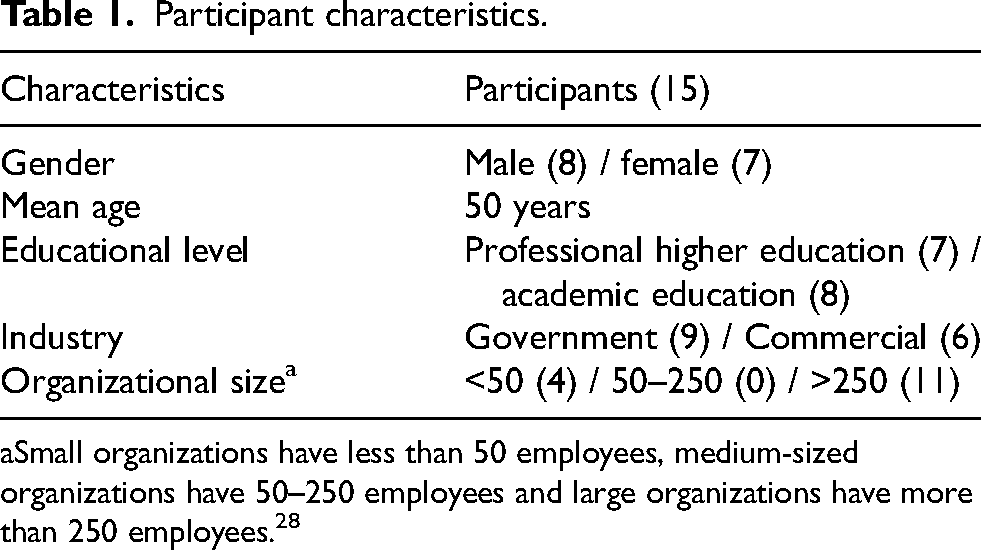
Small organizations have less than 50 employees, medium-sized organizations have 50–250 employees and large organizations have more than 250 employees. 28
Data collection
RB conducted semi-structured interviews from September to November 2023. 14 interviews took place via Microsoft Teams. 29 One interview was conducted face-to-face. The interviews were based on a topic list which aligned with the study objectives. Topics included general participant characteristics, such as occupation, age, and education and specific employee cases as introduced by the supervisors. For cases meeting the inclusion criteria (i.e., employees who were on full sick leave for more than six weeks due to CMDs and who have returned to work within the previous three calendar years), the following topics were discussed: work adjustments implemented during the employee's mental health leave, the sustainability of these adjustments after RTW, the alignment of these adjustments with management objectives, and how supervisors navigated conflicting interests with returning employees.
The topic list was pilot-tested in an interview with a supervisor to assess its utility in gathering in-depth information aligned with the study objectives. RB recorded and transcribed this interview, after which RB and NH discussed the interview's quality and concluded that no modifications to the topic list were required.
The topic list was applied flexibly during the interviews, with RB ensuring that all core themes were addressed. Participants were provided with ample opportunity to ask questions and introduce additional topics beyond those previously outlined. The interviews lasted 41 min on average (range: 18–53 min) and were audio recorded.
Data analysis
The audio recordings were transcribed verbatim by RB using Amberscript. 30 Following a manual review for accuracy, these transcripts were analyzed thematically. 31
Initially, RB recorded notes on potentially significant features within the data (Step 1). Subsequently, she reviewed the transcripts and utilized Atlas.ti 32 to code relevant ‘meanings’ (Step 2). Coding was conducted at both semantic and latent levels, employing an inductive approach for objectives 1 and 3, and a partially deductive approach for objective 2. For the second objective, definitions from the Dual Concern Model21–23 guided the coding process to facilitate a richer analysis, while specific codes within these definitions were still developed inductively.
Next, RB identified candidate themes representing meanings or concepts at a higher analytical level than the underlying codes (Step 3). These themes were reviewed in Step 4 and in Step 5 the themes were refined, defined, and named.
To facilitate this process, RB developed a thematic outline and a mind map to gain a comprehensive overview of the thematic structure. In line with Braun and Clarke, the analysis was refined iteratively until only negligible adjustments were required. In accordance with the principles of reflexive thematic analysis, RB ensured that the final themes were nuanced, distinct, and cohesive, forming a narrative that aligned with the study's objectives. Throughout the analysis and data interpretation, a curious and reflexive lens was maintained. In the final stage (Step 6), the results were synthesized and documented in Dutch. 31
RB conducted the data analysis under the supervision of NH, who provided continuous feedback and guidance. For instance, NH reviewed and refined the preliminary themes identified by RB. This approach facilitated an intensive exchange of ideas and ensured researcher triangulation throughout the process, thereby mitigating potential interpretive bias.
The final manuscript adheres to the majority of the COREQ guidelines, for example regarding participant selection, data collection, and the inclusion of participant quotations within the results. 33 Critical feedback on preliminary versions of the manuscript was provided by both NH and IH. Finally, NH translated the manuscript into English, utilizing DeepL 34 and NotebookLM 35 for language refinement and editing.
Results
Work changes that conflict with supervisors’ interests (study objective 1)
In nearly all employee cases discussed, work adjustments implemented during sickness absence remained in effect following RTW. Supervisors identified two primary types of changes that conflicted with their managerial interests: adjustments to work tasks and instances where returning employees transfered to different roles within or outside the organization. These adjustments and the resulting conflicts of interest are detailed below.
Adjustments to work tasks were noted by the majority of supervisors. Examples included reducing the number of responsibilities and eliminating high-pressure tasks for employees who returned to work. One supervisor explained the decision to reduce a returned employee's workload as follows: “… actually, it [the scope of duties] was too much … We did not give all the tasks back [to the returned employee].” (S3) This supervisor observed that the employee's workload had already been excessive prior to the onset of their illness.
Additionally, supervisors described employees who had transitioned to roles either within the same organization but outside their original team, or to a different organization entirely. In both scenarios, the supervisor was required to find a replacement. In some instances, employees took the initiative to change roles: “And then [during the return-to-work process] she talked to another manager and went on to work in another area.” (S8) In other cases, supervisors actively encouraged the transition by pointing out alternative options: “How would you like that [a specific job]? And in the end, it worked.” (S10)
Notably, supervisors often indicated that the term ‘conflict’ was too strong to describe their interactions with returned employees. While they acknowledged a degree of incompatibility, ‘conflict’ was perceived as overly negative. The timing of RTW may have also played a role; some employees returned early to modified work, while others remained on sick leave until they could resume their original duties, at which point no ongoing adjustments were required.
Following RTW, the two types of work adjustments described above conflicted to varying degrees with supervisors’ responsibilities toward (1) other employees, (2) the team as a whole, and (3) the organization.
Regarding other employees, colleagues often faced increased workloads as they continued to cover the responsibilities of the returned staff member. One supervisor noted: “… a colleague became even busier and the result was that other things [tasks] were not done. … that did not work out so well. This colleague is next on my list [of employees on mental health leave].” (S7) Several supervisors emphasized that delegating work to others can inadvertently pass burnout risks to colleagues.
Furthermore, the team atmosphere could be affected by task adjustments and staff turnover. Some supervisors observed that team members sometimes struggled to accept that a returned employee had a restricted task list: “It seems like you are putting someone in a privileged position that continues even after medical recovery. And that takes some getting used to” (S1). Teams also had to adapt to operating with reduced capacity: “And yes, it affects the people who have to do the work.” (S10)
Finally, at the organizational level, task adjustments and job changes often conflicted with the pressure most supervisors felt to ensure their teams generated revenue. Particularly in commercial and small organizations, supervisors felt that these adjustments prevented employees from taking full responsibility for a period following work resumption, resulting in ongoing costs: “… they no longer contribute to covering operating costs … So, someone like that costs between 40.000 and 50.000 euros a year.” (S5) Most supervisors appeared to prioritize the interests of returned employees unless doing so critically hindered the team's ability to complete its work.
How supervisors manage these conflicts (study objective 2)
Most supervisors described utilizing integrating styles to pursue win-win solutions intended to benefit both the organization and the supervisor-employee relationship. For example, one supervisor noted that while immediate full-capacity work might serve short-term interests, sustaining the employee's position was ultimately better for the organization: “… you can say: ‘Yes, in our interest you have to work at full capacity right away, but then someone will be sick-listed and not much happens. So, I thought it was in the best interest of the organization to see if it was possible to keep them [the employee who returned to work] on.” (S8) Most supervisors achieved integration through open information sharing to clarify the specific interests at stake: “… it's [all of the interests] got to be on the table, and you can tell by someone's reaction what it does, what effect it has.” (S11) Additionally, integration was used to foster support from other employees, the team, or other managers to sustain work changes: “… we just stuck to it [the employees’ work changes, after RTW]. So, we can provide argumentation for it. And people understand it.” (S9)
Slightly more than half of supervisors reported that they had compromised. Some of them have done this by strategically balancing the various competing interests. For instance, one supervisor accepted a returned employee's reduced output to preserve a supportive organizational culture: “And I also wanted others to see that when something goes wrong and someone is suffering, they are supported. Well, at least you have to be careful not to ruin that culture by not treating one of those people well, because then the group turns against you and you lose that culture and you lose your company.” (S12) According to this supervisor, pressuring the employee would have undermined a culture of psychological safety. Other supervisors compromised through a form of job redesign, reassigning tasks to colleagues: “… It was a task that … I thought it fitted very well into the job description of this colleague. So I thought, what do you call it, making a virtue out of necessity? I thought it wouldn’t hurt if I did it for a while. But it didn’t work out so well.” (S7) This participant found that delegating work in this manner could place excessive pressure on other team members, resulting in new cases of sick leave.
Some supervisors employed a dominating style, characterized by forceful communication in certain situations. One supervisor described a case where they prioritized the need for a functioning team over individual needs: “I kind of threatened to fire the employee because yes, I know it is a mental health complaint, and I am really sorry for you but my patience has limits … so I tried to push him out of the organization. I'm sorry it's so blunt.” (S2) Feeling powerless and desperate, this manager felt they had already exhausted all supportive options.
A minority of supervisors adopted an obliging stance, prioritizing the interests of the returned employee over their own or the organization's concerns. For example, one supervisor supported an employee's recovery even after the employee expressed an intention to leave: “even if you don’t want to come back, we want to give you the opportunity to get well here.” (S8) The employee eventually resigned after working for a period following RTW.
Some supervisors utilized avoidance as a strategy, opting not to discuss difficult issues, such as how an employee's private life impacted their energy levels at work: “You have to be careful what you say [to the employee]. Sometimes you think: ‘Come on, you can go out for the weekend or do this or that. Yeah, and then it's Monday and your energy is gone.” (S15) These supervisors viewed employees’ private activities as a sensitive subject.
Almost all interviewed supervisors reported using a combination of these conflict styles. Most typically began by seeking a win-win outcome or a compromise; if these efforts failed, they transitioned to other styles, such as domination. One supervisor explained this shift after three years of trying to help an employee: “I felt I did everything I could to help him. It took three years. At a certain point I lost patience, and the job market was good at that time. So, I tried to get him out of the organization.” (S2) This suggests that supervisors may justify a shift to more dominant behaviors when they feel their long-term efforts to help have been unsuccessful.
How supervisors reflect on their management of conflicts (study objective 3)
The majority of interviewed supervisors maintained a nuanced perspective regarding their management of perceived conflicts between employee work adjustments and their own interests. Most participants reported satisfaction with their handling of certain cases while expressing less satisfaction with others. In instances where supervisors felt successful, they were gratified to have made the right decisions for the returned employee and/or the organization: “I am satisfied that I have done what is best for the employee, but ultimately also for us.” (S14)
Conversely, when supervisors were less satisfied, they often voiced doubts about their approach or recounted lessons learned: “The first [case] I think I was more of a follower … too passive.” (S7) Some participants realized that pressuring employees was ultimately counterproductive. Others, however, felt they had prioritized the employee's interests for too long and should have focused on their own or the organization's needs sooner.
The data cautiously suggest that organizational context may play a role in these reflections and the ability to manage conflicts effectively. In smaller organizations, supervisors noted that a lack of alternative departments made it difficult to match work tasks to an employee's specific abilities, thereby restricting opportunities for integrative solutions: “Well, part of the recovery has also been the departure [of the employee] … that also has to do with the size of the company … We don’t have another department … [where the employee can work].” (S5) In contrast, supervisors in larger organizations were often better positioned to delegate tasks, which ensured business continuity despite the necessary adjustments for returned employees: “… the teams are large enough, so if you divide things up wisely, it's all doable. But in a smaller organization, that won’t be so easy.” (S8) Finally, supervisors in commercial settings indicated that pressure to prioritize organizational interests and revenue generation often hindered their ability to achieve integrative, win-win outcomes.
Discussion
Our study aims were to understand the perspectives of supervisors on (1) the work adjustments that conflict with their interests post-RTW, (2) the strategies they used to navigate these conflicts, and (3) reflections on their strategies.
Regarding the first objective, supervisors identified two primary types of work changes that conflicted with their managerial interests: adaptations to work tasks and job transitions. To manage these conflicting interests, supervisors primarily prioritized win-win solutions and compromises; however, secondary strategies were also utilized, such as pursuing their own interests at the expense of those of the employees. Finally, most supervisors maintained a nuanced perspective regarding the management of these perceived conflicts. While satisfied with their ability to strike a balance between work changes and their own interests in specific instances, they often voiced doubts about their approach or recounted lessons learned from other cases.
Discussion of content
Our findings suggest that while most interviewed supervisors attempted to utilize an integrative approach, their choice of conflict styles was also informed by practical considerations and specific situational demands. This aligns with Hocker et al., who state that the appropriateness of a conflict style depends on the individuals involved and the specific context. 24 In this section, we highlight several factors that might possibly play a role in supervisors’ use of non-integrative conflict styles: feeling powerless, moral self-licensing, prior quality of the supervisor-employee relationship and organizational factors. Please note that our interpretations remain tentative due to our small sample size that does not support detailed subgroup-analyses.
First, a sense of powerlessness might play a role. Over time, some supervisors may adopt dominating conflict styles, enabling them to achieve their own goals when a win-win outcome appears unattainable. In these instances, supervisors may shift from an integrative stance focused on mutual gains to a competitive, win-lose perspective. 24 Supervisors might feel powerless as employees continued to incur costs following their return to work. Consistent with the relational theory of power, 24 supervisors might perceive that employees hold a certain level of power over them, particularly when the supervisor depends on the employee to limit costs and achieve departmental financial targets.
Another potential explanation for this shift toward self-interest is moral self-licensing. This concept refers to a mental process in which individuals initially behave responsibly, which then grants them “permission” to engage in behaviors that deviate from their typical standards. 36 As our results demonstrate, supporting a returned employee for an extended period may have provided a supervisor with the internal justification to switch to a more dominant style. It might be possible that the supervisor lost confidence in the employee's ongoing value for the organization. Moral self-licensing might also have allowed this supervisor to justify his dominant behavior. This pattern shows some similarity with the loss of employer trust observed in cases of long-term sickness absence, which can lead to stricter management. 37 Trust remains essential for employers to provide sustained support during the RTW process. 20
While supervisors who transition to dominant styles might employ moral self-licensing, the prior quality of the supervisor-employee relationship might play a role as well. Our data provide tentative indications that supervisors who were satisfied with an employee's performance and felt sympathy before the sick leave tended to adopt a more supportive, less dominant stance upon the employee's return. Conversely, supervisors who had previously doubted an employee's performance appeared more inclined toward a less supportive approach. This careful and speculative observation is consistent with the Leader-Member Exchange (LMX) theory, 38 which posits that the quality of the dyadic relationship is built through continual exchanges over time. To illustrate, an employee may be committed to achieving goals that are important to the supervisor, and the supervisor may provide that employee with additional job latitude. Such delegation plays a central role in LMX theory. Supervisors provide latitude to employees based on their past contributions. Delegation also predicts the future quality of LMX. Moreover, LMX theory encompasses trust, which continues to be developed in high-quality LMX. 38 Consequently, positive past experiences might lead supervisors to be more trusting and less likely to exercise formal power during the post-RTW phase.
Beyond these challenges, organizational factors might play a role in a supervisor's capacity to adopt an integrative style. Again, our small sample size precludes detailed subgroup analysis. As such, we can only speculate on the potential role of organizational factors. First, it is hypothesized that supervisors in relatively small, commercial organizations might face challenges in providing employees with work that matches their specific abilities. The concept of ‘work that fits’ aligns with Person-Environment Fit theory, which among others posits that a ‘fit’ or ‘misfit’ can exist between an employee's abilities and environmental demands. 39 There is a negative relationship between demands-abilities fit and the experience of strain. 40 Therefore, ensuring alignment between demands and abilities seems to be important for employees who have returned to work following CMD-related sick leave. This theoretical perspective is further supported by empirical evidence. For instance, Sikora et al. found that employees with CMD who rated their work ability as good or very good during the RTW process also reported more work modifications than those who reported moderate work ability. 41 However, supervisors in small organizations might encounter fewer practical options for job redesign or work modification. This aligns with findings by Beerda et al., who noted that smaller enterprises frequently lack the resources and expert knowledge necessary to assist returning employees and their work adjustments. 42 Moreover, we speculate that supervisors in commercial organizations might experience a heightened focus on organizational goals and profits. This is supported by the idea that performance-related pay is generally more prevalent in the private sector than in the public sector. 43 Furthermore, supervisors might consciously navigate competing interests, serving as intermediaries between the organization and the employee. For instance, they might adopt a dominating conflict style to prioritize organizational goals. As such, organizational pressures might limit supervisors’ ability or willingness to implement more integrative approaches. These speculated constraints are consistent with the findings of Stochkendahl et al., whose qualitative study showed that organizational factors may play a role in the ability of hospital supervisors to guide returning employees. 19 Moreover, it can be questioned whether a better ‘fit’ can be achieved when employees from small or commercial organizations return to work with different employers. Theoretically, transferring to a new employer offers more opportunities to achieve Person-Environment Fit.39,40 In practice, however, efforts to facilitate RTW with a different employer are not always successful. Experts suggest several factors contribute to this lack of effectiveness, including a lack of financial incentives for external employers to hire workers with a history of illness and the perceived insufficient quality of support services for external RTW transitions. 44
Strengths and limitations
The strengths of this study include its pre-registration, 26 which contributes to transparency. The ethical committee approval ensures ethical soundness. The study sample was diverse, comprising men and women from small and large organizations across various industries. This diversity favors the transferability of the study results to several organizational settings. Furthermore, data saturation was achieved, 27 and the data were analysed thematically, 31 a methodology that supports analytical rigor.
One limitation of our study is that data collection and analysis were conducted primarily by a single researcher. However, intensive intellectual exchange with a second researcher was maintained at every stage of the process. This form of researcher triangulation helped mitigate potential interpretive bias.
Furthermore, participants were recruited through RB's professional network, which could have introduced selection bias. However, as RB was not a close acquaintance or friend of any of the participants, this concern may be mitigated.
Moreover, supervisors may have presented their behavior in a more favorable light to appear just, which could contribute to social desirability bias.
Our findings tentatively suggest that supervisors in small and for-profit organizations may encounter greater difficulty in utilizing an integrative conflict style. However, the current data do not permit a robust subgroup analysis, which would necessitate a larger number of study participants. Therefore, these possible trends should be interpreted with caution.
This study was conducted in the Netherlands, which features extensive legislation governing cooperation between employees on sick leave and their employers. 3 While this legislation does not explicitly address the post-RTW phase, it may foster a collaborative environment that encourages supervisors to seek win-win solutions following work resumption. Consequently, firm conclusions regarding the transferability of these findings to countries with different or less comprehensive RTW legislation cannot be drawn. Employers in other contexts might be less inclined toward cooperation. In future research, the transferability of these findings could be examined more systematically using the Cross-Country Comparison model. 45
Despite these limitations, our study contributes to a better understanding of Dutch employees’ work changes after CMD-related sick leave that supervisors may perceive as conflicting with their interests and how these conflicts are managed. Thereby, this research expands upon the relatively limited body of literature focusing on the period following return to work from mental health leave (e.g.,1,14,15).
Implications for research and practice
While the present study focuses exclusively on the perspectives of Dutch supervisors, Nielsen et al. have previously examined the perspectives of employees in the United Kingdom, 15 offering a complementary view of supervisor-employee dynamics during the post-RTW phase. Nevertheless, further in-depth qualitative research is warranted to enhance our understanding of the perspectives of both employees and supervisors across various countries with differing legislative contexts regarding return to work.
Additionally, these findings provide a foundation for quantitative longitudinal studies to examine the relationships between specific managerial behaviors, such as the use of integration and employee outcomes, including job performance, well-being, and recurrent sick leave, during the initial years following RTW. Future research could also investigate whether these relationships are mediated by the persistence of work adjustments after RTW.
Moreover, the insights from this and future studies can inform the development of policies, training programs, and educational initiatives for supervisors. Specifically, these results offer practical guidance for supervisors supporting employees after mental health leave by illustrating how conflicting interests can be navigated.
Conclusion
To navigate the tension between managerial interests and workplace adjustments post-CMD leave, supervisors primarily prioritized win-win solutions and compromises. However, they also used secondary strategies such as pursuing their own interests at the expense of those of the employees. The interviewed supervisors engaged in careful reflection on their approaches.
The results of this study highlight that the interviewed supervisors tend to play a prominent role in the type of resolution achieved. In this respect, the study results cautiously suggest that supervisors may play an important role in the extent to which employees are able to sustain work modifications following mental health leave.
Footnotes
Acknowledgements
The authors thank the supervisors for their participation in this study.
Ethical approval
The Open Universiteit has provided ethical approval for this study (correspondence 6 December 2022, registration number: U202209958). This study was registered with the OSF. Hoefsmit N, Bos R and Houkes I. The roles of supervisors in the prolonged implementation of work-related strategies of employees after sick leave due to common mental disorders, http://osf.io/52esw (2023, accessed 15 July 2024).
Informed consent
Written informed consent was acquired from all study participants.
Author's information and contributions
RB is a coach and a psychology student at the Open Universiteit. She collected and analyzed the interview data and was primarily responsible for writing the manuscript.
NH is an Assistant Professor of Work and Organizational Psychology at the Open Universiteit. She has a PhD in sick leave and work resumption from Maastricht University. She contributed to the design of the study, supervised the analysis of the data, and supported the writing process.
IH is an associate professor of Social Medicine at Maastricht University, specialized in work and health. She supervises PhD students, teaches on several program courses, and is the director of the Occupational Health & Sustainable Work master's program. She contributed to the study design, participated in the review process, and provided feedback on preliminary versions.
Funding
The authors received no financial support for the research, authorship, and/or publication of this article.
Declaration of conflicting interests
The authors declared no potential conflicts of interest with respect to the research, authorship, and/or publication of this article.