






Abstract
Background
The increasing integration of artificial intelligence (AI) into vocational rehabilitation (VR) practice introduces ethical challenges beyond existing guidelines. Although current standards emphasize principles such as informed consent and data security, they provide limited guidance on how counselors recognize and respond to ethical risks in AI-mediated contexts.
Objective
This article proposes a conceptual framework to advance ethical AI readiness among VR counselors.
Methods
Drawing on Self-Determination Theory and interdisciplinary literature on AI ethics and VR practice, this article develops a theoretically grounded model of ethical functioning in AI-mediated environments.
Results
The Ethical AI Readiness Framework is conceptualized as an ongoing process consisting of three interrelated capacities: AI literacy, AI ethical attentiveness, and AI ethical action readiness. These capacities support understanding of AI systems, recognition of ethical concerns, and value-consistent response through professional judgment. They operate through AI ethical engagement, where counselors enact decisions and refine practice through experience. The framework also highlights the role of organizational context in shaping ethical action.
Conclusions
This framework shifts the focus from technical competence to ethical functioning in AI-mediated VR practice. It provides a foundation for training, organizational policy, and future research, including the development of context-sensitive measures to support ethical and client-centered VR services.
Keywords
The Digital Transformation of Vocational Rehabilitation
The Rehabilitation Act of 1973 underscores the importance of maximizing employment, independent living, and community participation for people with disabilities through high-quality, ethical, and client-centered vocational rehabilitation (VR) services (Fleming et al., 2024). In recent years, digital transformation has accelerated the integration of technology across state VR agencies, including case management systems, virtual service platforms, and documentation tools (Froehlich et al., 2023; Hartley & Bourgeois, 2020; Iwanaga et al., 2025). Within this rapidly changing landscape, artificial intelligence (AI) is increasingly being explored to support functions such as documentation, job matching, executive functioning supports, and communication (Skerritt & Wolstein, 2025; U.S. Department of Labor, Office of Disability Employment Policy, 2024). As a result, AI is no longer a hypothetical consideration in VR but an emerging and integral component of routine practice.
In VR practice, professional judgment is an ethical responsibility that requires balancing innovation with client autonomy, equity, and accountability (Rubin et al., 2016). Although AI-informed tools may enhance efficiency, accountability for decisions and client outcomes remains with the counselor; ethical responsibility cannot be assigned to technological systems (Naik et al., 2022). Counselors must exercise context-sensitive professional judgment in determining when and how AI should be used in ways that support client well-being. Existing professional codes of ethics and governmental standards provide general guidance on technology use (American Counseling Association, 2014; American Psychological Association, 2017; Commission on Rehabilitation Counselor Certification (CRCC, 2023)) and, more recently, have begun to address AI-related considerations, emphasizing principles such as human oversight, informed consent, and data security (CRCC, 2026). However, this guidance remains largely practice-oriented and does not explain how counselors recognize, interpret, and act on ethical risks in real-world AI-mediated practice. As a result, ethical decision-making is often fragmented and dependent on individual judgment in practice, without a clear framework to guide how ethical awareness translates into action (Skerritt, 2023; Skerritt & Wolstein, 2025). This places increasing responsibility on individual practitioners to identify and respond to ethical risks such as algorithmic bias, data privacy concerns, and exclusionary practices in real-world service contexts (Carrascal-Caputto et al., 2025). This issue is particularly salient in VR, where service decisions directly influence access to employment, independence, and long-term participation (Collett, 2023). To address this gap, the present article proposes a process-oriented conceptual framework of ethical AI readiness that explains how counselors understand AI, recognize its ethical implications, and respond through professional judgment in practice.
Theoretical Bridge: Reclaiming Agency Through Self-Determination Theory
To understand how counselors maintain ethical agency during profound technological change, it is important to look beyond technical skills to the motivational processes that shape professional judgment (Deci & Ryan, 2000; Ryan & Deci, 2017). Self-Determination Theory distinguishes between autonomous motivation, in which ethical responsibility is internally endorsed and aligned with professional values, and controlled motivation, which is driven by external pressure or compliance demands. AI-mediated environments may shift counselors toward controlled motivation by framing AI use as expected or unavoidable, particularly when ethical guidance is limited. Under such conditions, counselors’ attention may shift toward efficiency and procedural compliance, potentially reducing sensitivity to subtle ethical risks embedded in automated systems (Al-Kfairy et al., 2024; Weiner et al., 2025). In contrast, when ethical responsibility is internally endorsed, counselors are more likely to remain attentive to the ethical implications of AI use, even in the absence of explicit rules.
This perspective highlights that ethical readiness is not simply a set of competencies, but reflects the extent to which counselors maintain active ethical engagement in technology-mediated practice. From this perspective, ethical challenges in AI-mediated practice may arise not only from limited technical knowledge, but also from controlled motivational states that reduce active ethical engagement. Self-Determination Theory therefore clarifies why counselors may fail to recognize or act on ethical concerns even when they possess adequate knowledge. Within this framework, AI literacy support counselors′ understanding technological systems, AI ethical attentiveness involves recognizing and reflecting on ethical concerns as they arise, and AI ethical action readiness represents the capacity to respond through values-consistent professional judgement and action under real-world conditions.
Conceptualizing Ethical AI Readiness
Ethical judgment in AI-mediated VR differs from traditional decision-making in several important ways. AI systems are often not transparent, decision processes may be automated, and responsibility is shared across multiple actors, including agencies, vendors, and technologies (Al-Kfairy et al., 2024; Weiner et al., 2025). These conditions make accountability more complex, even though counselors remain responsible for client outcomes. In this context, ethical challenges cannot be addressed by technical knowledge or general ethical principles alone. Instead, counselors must use context-sensitive professional judgment to determine when the use of AI supports or undermines client interests.
Building on this perspective, ethical AI readiness is conceptualized as a dynamic process that reflects how counselors engage with AI in practice. This process includes three interrelated capacities: AI literacy, AI ethical attentiveness, and AI ethical action readiness. Together, these capacities describe how counselors understand AI, recognize its ethical implications, and respond in ways that align with professional values and client well-being.
AI literacy provides the foundation for ethical practice. It involves understanding the capabilities, limitations, and risks of AI systems, as well as how AI-generated outputs are produced. Importantly, technical knowledge alone is not enough. A counselor may be skilled in using a tool but still apply it in ways that are not ethically sound (Ma & Chen, 2024). Existing AI literacy measures have conceptualized AI literacy as a multidimensional construct, including technical knowledge, critical appraisal, and practical application (Laupichler et al., 2023; Markus et al., 2025). For example, a counselor using a predictive job-matching system may understand that its recommendations are based on patterns in past data rather than individualized judgment (Gao, 2025; Skerritt, 2023). This awareness helps the counselor recognize potential issues, such as bias in the data, and evaluate recommendations more critically instead of accepting them at face value. In this way, AI literacy helps ensure that technology supports, rather than replaces, professional judgment (Chiu, 2024; Golden et al., 2024).
AI ethical attentiveness refers to the ability to notice ethical issues as they arise in practice (Reynolds, 2008). This is especially important in AI-mediated environments, where risks such as bias or privacy concerns may be embedded in routine processes and are not always obvious. As a result, ethical problems are often not due to a lack of knowledge, but to a failure to recognize that a situation has ethical significance. For example, a counselor might notice that an AI system consistently suggests lower-wage jobs for certain clients and question whether this reflects bias in the system. In this way, ethical attentiveness serves as a bridge between understanding and action by bringing ethical concerns into focus.
AI ethical action readiness reflects the ability to respond to these concerns through professional judgment and action. It involves self-efficacy, moral courage, and the willingness to make decisions that align with professional values, even in uncertain or constrained environments (Mohammadi et al., 2022; Sekerka et al., 2009). Moral reasoning alone may be insufficient for ethical practice unless professionals also possess the courage to act on their ethical judgements (Khatiban et al., 2021). For example, a counselor who identifies bias in an AI recommendation may choose to override it, document their reasoning, and raise concerns about the system (Skerritt, 2023; Skerritt & Wolstein, 2025).
These capacities come together in AI ethical engagement, which reflects how counselors actually use or choose not to use AI in practice. This may include informed use, reflective decision-making, or the deliberate decision not to use AI tools that do not align with professional values. Each experience with AI also provides an opportunity for learning, helping counselors refine their understanding, awareness, and responses over time. This process is embedded within an organizational context, where policies, norms, and workplace culture can either support or limit ethical practice. Organizational environments that encourage transparency, professional judgment, and open discussion of ethical concerns are more likely to support ethical AI use. In contrast, restrictive or unclear environments may make it more difficult for counselors to act on what they recognize as ethical concerns.
The Ethical AI Readiness Framework in Vocational Rehabilitation
As illustrated in Figure 1, the framework represents ethical AI readiness in practice as an ongoing process embedded within an organizational context. Rather than following a fixed sequence, the framework shows how the three capacities work together in practice. AI literacy supports understanding of AI systems and their limitations. AI ethical attentiveness focuses on recognizing when ethical concerns are present. AI ethical action readiness reflects the ability to respond to those concerns through professional judgment. Their integration is reflected in AI ethical engagement, which represents how counselors actually use, question, or choose not to use AI tools in real-world situations. Engagement may involve informed use, reflective decision-making, or deliberate non-use when a tool does not align with professional values. Each instance of engagement also becomes a source of learning. Through experience and reflection, counselors refine how they understand AI, what they notice as ethically relevant, and how they respond. Over time, this process supports more consistent and effective ethical practice. This process occurs within an organizational context that can support or constrain ethical action, shaping how counselors apply professional judgment in practice.
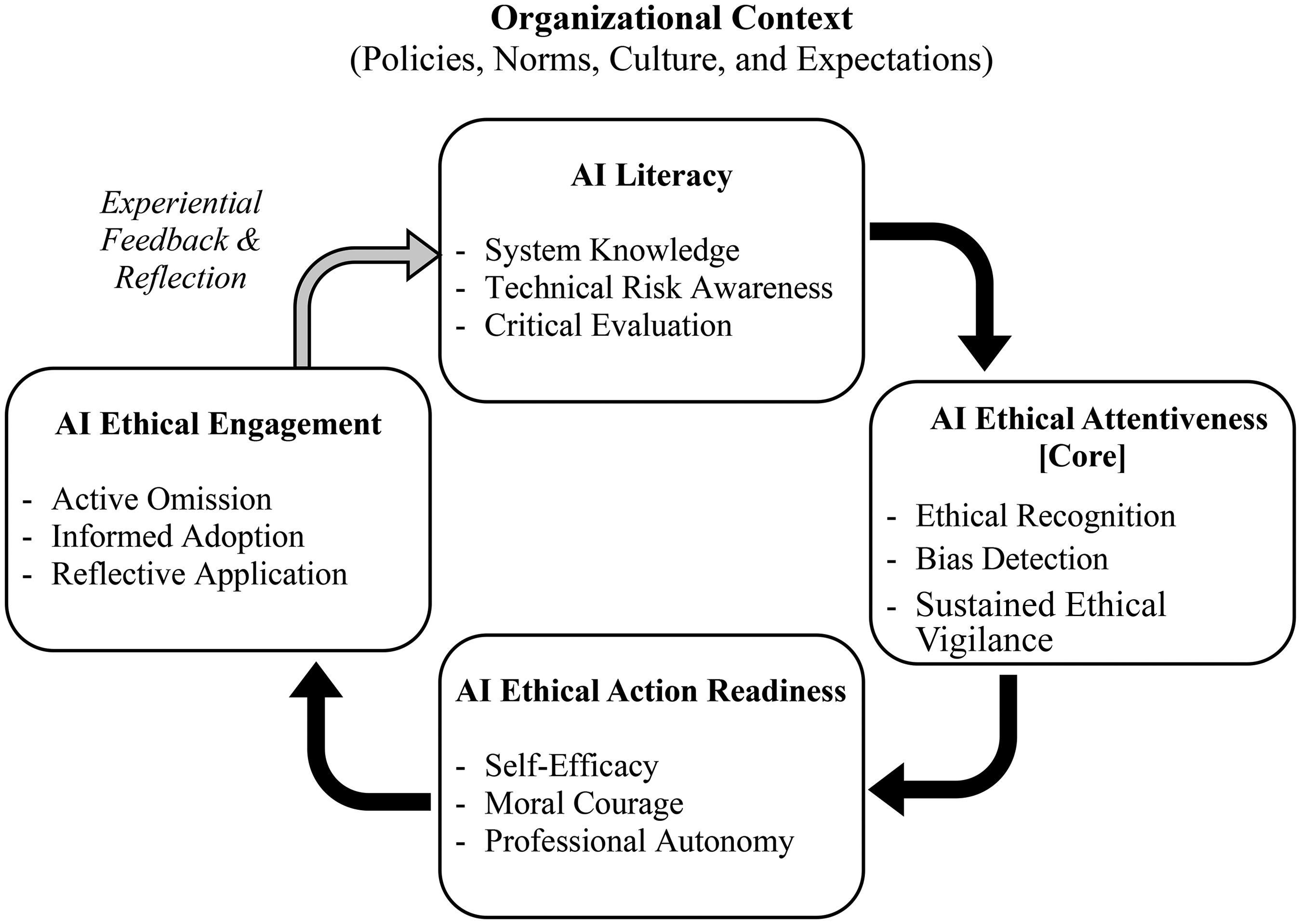
The ethical AI readiness framework in vocational rehabilitation.
Implications for Vocational Rehabilitation
The proposed model has several implications for VR practice, training, and organizational policy. First, it shifts the focus from technical competence to ethical functioning in AI-mediated environments. Though foundational knowledge of algorithms and data remains important, it should support critical evaluation, enabling counselors to recognize AI as a human-made, potentially biased tool rather than an error-free system (Öner, 2025). For example, AI-assisted job matching tools may inadvertently prioritize candidates based on biased training data, requiring counselors to critically evaluate recommendations and consider whether suggested placements align with the client's goals, abilities, and opportunities. Ethical challenges often arise from failures to recognize risks such as algorithmic bias, privacy concerns, and the “black box” nature of complex systems (Öner, 2025; Skerritt, 2023). Thus, developing AI ethical attentiveness, the capacity to consistently recognize ethical dimensions in practice, should be central to counselor preparation. Training should incorporate case-based learning, reflection, and scenario analysis to help identify subtle risks in routine AI use (Öner, 2025; Tenberga & Daniela, 2024). This framework may also inform supervision and training evaluation in VR settings.
Second, distinguishing between AI ethical attentiveness and action readiness emphasizes the need to prepare counselors not only to recognize ethical concerns but also to respond effectively under uncertainty and organizational constraints. This includes skills in ethical communication, decision justification, and systems-level advocacy (Keller et al., 2021). Counselors must be able to critically interpret AI outputs and maintain human accountability in decision-making, particularly in VR, where assessment and job-matching decisions directly affect employment outcomes (Skerritt & Wolstein, 2025).
Third, the model highlights the role of organizational context. Digital leadership and strategy shape whether counselors feel externally pressured or internally motivated to engage with AI (Iwanaga et al., in press). Agencies should foster environments that support ethical reflection by promoting autonomy, competence, and relatedness, providing clear guidance, and encouraging open dialogue about AI-related concerns (Wu et al., 2024). Without such support, even ethically attentive counselors may face barriers to action.
Finally, the framework has implications for research and measurement development. There is a clear need for instruments that assess not only technical literacy but also AI ethical attentiveness and AI ethical action readiness among VR counselors (Lintner, 2024; Jin et al., 2025). The development of theory-driven, domain-specific measures would allow for more precise assessment of these capacities and support the evaluation of training and practice. In particular, efforts to operationalize AI literacy, ethical attentiveness, and action readiness within VR contexts would strengthen both research and applied practice. Future studies should examine how these capacities interact and relate to ethical decision-making outcomes, especially within organizational environments where AI use continues to evolve.
Conclusion
The Ethical AI Readiness Framework conceptualizes ethical AI readiness in VR as an ongoing process that extends beyond technical competence to include recognizing and responding to ethical risks in practice. By integrating AI literacy, ethical attentiveness, and ethical action readiness, it highlights that ethical functioning depends on what counselors understand, notice, and do in real-world contexts. Grounded in Self-Determination Theory, the framework underscores the role of active ethical engagement and the influence of organizational context in shaping practice. It provides a foundation for guiding training, organizational policy, and future research, including the development of context-sensitive measures, to support ethical and client-centered VR services in AI-mediated environments.
Footnotes
Acknowledgments
The author has no additional acknowledgments.
Ethics Statement
This study did not involve human participants or data.
Informed Consent
Not applicable.
Funding
The author received no financial support for the research, authorship, and/or publication of this article.
Declaration of Conflicting Interests
The author declared no potential conflicts of interest with respect to the research, authorship, and/or publication of this article.
Data Availability
No data were generated or analyzed in this study.
