






Abstract
Background
The Workforce Innovation and Opportunity Act (WIOA) of 2014 mandated significant changes to U.S. Vocational Rehabilitation (VR) services, including allocating 15% of state VR funds for pre-employment transition services (Pre-ETS) for youth with disabilities.
Objective
This study examined changes in VR service users, service delivery, and employment outcomes pre- (2014–2016) and post-WIOA (2017–2019) using RSA-911 administrative data.
Method
We analyzed demographic and disability characteristics, service types, and employment outcomes for over 1 million VR service recipients ages 14–64 across all U.S. states. Multivariable logistic regression assessed predictors of employment at VR exit. Post-WIOA, VR service users were younger and more likely to have a “most significant disability.”
Results
Receipt of nearly all service types declined, particularly postsecondary education and job-related services, despite stable spending per person. Employment outcomes decreased across all age groups, most notably among youth ages 14–18. Receipt of job-related services was strongly associated with higher odds of employment, while longer service duration predicted lower odds.
Conclusion
Findings suggest that WIOA's funding shifts may have unintentionally reduced service access and employment outcomes, especially for adults. As VR systems recalibrate, further research is needed to assess cost-benefit tradeoffs and ensure equitable service delivery across age and disability groups.
Introduction
The contemporary history of working-age people with cognitive, mental, physical, and other disabilities in the United States is marked by decades of sub-optimal employment outcomes which contribute to persistent poverty in this population. In 2024, only 38% of people with disabilities in the U.S. (who reported being in the labor market) had a job, compared to 75% of people without disabilities (DeMaria & McLaren, 2024). The federal Vocational Rehabilitation (VR) program, administered by the Rehabilitation Services Administration (RSA), is the main public funder of employment services for people whose disability impacts their ability to find and maintain employment (Roux et al., 2023). State VR agencies oversee distribution of funding for these services which include supported employment, postsecondary education supports, counseling on career options, and others. On average, 56% of people with disabilities who received VR services were successfully employed when exiting VR in program year (PY) 2023 (Rehabilitation Services Administration, 2023).
The Workforce Innovation and Opportunity Act (WIOA) of 2014 was a legislative response to limited improvements in employment rates over time for people with disabilities in the U.S. WIOA aimed to improve access to employment, education, training, and other vocational services for individuals with disabilities and to improve how these services are delivered. States began implementing WIOA provisions in 2016 following the approval of state implementation plans. However, data needed to evaluate changes since WIOA's implementation only recently became available; substantial numbers of VR service users who were exposed to WIOA-driven changes are now beginning to exit VR services, the point at which outcomes are recorded.
Understanding Changes Under WIOA
The passage of Title IV of WIOA reauthorized the funding of VR services administered by state VR agencies and added a requirement for states to shift 15% of their VR funding to a new category of pre-employment transition services (Pre-ETS) for students with disabilities. This change officially expanded the continuum of VR services to include more high school aged youth, in alignment with the finding that earlier exposure to work experiences is associated with paid employment in adulthood (Frentzel et al., 2021). However, this mandate was enacted without increasing overall VR funding to states. Additionally, WIOA significantly broadened the pool of youth who could be served by allowing students who were “potentially eligible” for VR (i.e., were suspected to have a disability) to receive Pre-ETS (Carlson et al., 2020). Thus, by PY 2018, students with disabilities comprised one-third of VR caseloads (Honeycutt et al., 2024). In PY 2022, approximately 280,000 students with disabilities were receiving Pre-ETS, and 42 states spent the mandated 15% of their VR budget by shifting a total of $46 million of state VR funding into Pre-ETS (U.S. Department of Education, 2024).
WIOA also directed that half of state funds for supported employment be used to assist students with “most significant disabilities,” characterized as students with higher levels of functional impairments who require multiple VR services over an extended period (Osmani et al., 2022). WIOA further permitted continuation of services to maintain supported employment when necessary for up to four years for students with disabilities under the age of 25 (What are the Authorized Activities under the State Supported Employment Services Program?, 2025). This change is supported by studies finding higher rates of successful employment, weekly hours, and wages among transition-aged youth with intellectual disability who received supported employment compared to those who did not (Iwanaga et al., 2023).
Few studies have explored the potential effects of WIOA-driven shifts in funding, but emergent research has documented possible unintended consequences of WIOA's implementation. VR state agency administrators expressed concerns about states’ abilities to provide the same level of services across all individuals eligible for VR, given shifts in funding toward transition-age youth and those needing supported employment (McDonnall et al., 2018). The Department of Education (DOE)'s own evaluation in the years before and after WIOA implementation revealed decreases in numbers of individuals applying for VR services across years, rates of eligibility for services among VR applicants, and successful employment rates (although, median wages increased); and increasing use of order of selection (OOS) policies by states to prioritize who could receive services given inadequate funding to serve all eligible persons (Rehabilitation Services Administration, April, 2020). The DOE also reported that following implementation of WIOA, VR service users were younger, and more likely to have been unemployed long term and to be from low-income households – factors which are all associated with lowered levels of employment. However, DOE suggested that some declines in rates of employment following VR services could also be due to changes in data reporting post-WIOA (Rehabilitation Services Administration, April, 2020).
Analysis of state WIOA implementation plans found that states varied considerably in how they interpreted WIOA's policy mandates (Taylor et al., 2022), and the extent to which they incorporated research-validated practices into their plans (Whittenburg, Rooney-Kron et al., 2024). States with fewer constraints on their VR budgets were more likely to employ research-based transition recommendations (Whittenburg et al., 2025). These findings concur with noted variation in whether states were effectively deliving Pre-ETS in the early years of WIOA implementation (Roux et al., 2026).
Factors of Vocational Rehabilitation Outcomes
Demographics, disability type, patterns of service use, and interaction of these factors are all associated with employment outcomes. Lower likelihood of employment following VR services is associated with education below high school level when entering VR; longer duration of unemployment; presence of mental health conditions; having multiple co-occurring conditions; and receipt of SSI or SSDI (Ahonle et al., 2020; Iwanaga et al., 2024; Lund & Cmar, 2019; Sevak et al., 2019). Younger people tend to have lower rates of employment at VR exit among those with autism or physical disabilities (Chen et al., 2015; Iwanaga et al., 2024); but higher likelihood of employment among people with traumatic brain injury (TBI) (Ahonle et al., 2020). While individuals with intellectual disability are more likely to be employed after receiving benefits counseling (Iwanaga et al., 2021), employment among people with physical disabilities is positively associated with receipt of job placement assistance and VR counseling (Iwanaga et al., 2024).
Monitoring changes in characteristics of VR service users, services distribution, and associated outcomes is a critical step in assessing the net effects of critical policy changes like the implementation of WIOA.
Purpose of the Current Study
Investigation of the association of WIOA-related policy shifts and related changes in funding on VR service use and employment outcomes for people with disabilities has been limited to date. The purpose of this study was to conduct an integrated examination of changes in VR service users, service delivery, and employment outcomes pre- and post-WIOA using national level data across disability types and ages. This study adds to the literature by examining how shifts in funding toward transition-age youth and those with the most significant disabilities may have affected users in other age groups and their outcomes. We aimed to address these research questions:
How did overall demographics, impairment characteristics, duration and types of services, and employment outcomes of VR service users change from pre- to post-WIOA implementation? How did successful employment outcomes (at the time of VR exit) change based on demographic characteristics, disability characteristics, and duration and types of VR services? Were there significant differences in employment outcomes pre- versus post-WIOA by age group?
Comparing 2014-2016 with 2017-2019 data, we expected to observe: (1) shifts in types of VR services by age group based on increased allocation of funding to Pre-ETS, (2) decreased rates of successful employment outcomes in older age groups, given increased allocation of funding to programs for younger persons, and (3) increases in service delivery to those with “most significant disabilities.”
Methods
This study used data from the 2014-2019 U.S. Department of Education Rehabilitation Services Administration Case Service Reports (RSA-911). Data from 2014-2016 contain closures in the given federal fiscal year (FFY; for example, FFY 2014 is October 2013 to September 2014), and data from 2017-2019 contain closures in the given Program Year (PY; for example, PY 2017 is July 2017 to June 2018). RSA-911 collects VR administrative data on demographics, individual characteristics, VR service use, and outcomes on all case closures in the year. We considered closures in FFYs 2014-2016 as pre-WIOA, and closures in PYs 2017-2019 as post-WIOA. We did not have concerns about differences in reporting timeframes, as the number of data months remained equal. Our study sample included all case closures for those ages 14–64 years in all 50 U.S. states plus Washington D.C. We limited to those who received VR services, as not all applicants qualify for or go on to receive VR services. This analysis was deemed exempt by the Drexel University Institutional Review Board.
Individual Characteristics
Individual characteristics included sex (male and female), age at application for Pre-ETS or VR, race and ethnicity, highest level of education at signing of the individualized plan for employment (IPE), primary source of impairment, and presence of a “most significant disability.” Age was grouped as 14-18 years, 19–29 years, and 30–64 years. The primary source of impairment was recorded from a list of 37 disabilities, and an applicant could have a primary and a secondary source of impairment. We created four groups of impairment types based on an analytic strategy from a previous study that compared key types of intellectual and developmental disabilities: 1) autism, and 2) intellectual disability; versus 3) psychiatric and neurodevelopmental conditions [including alcohol abuse or dependence, anxiety disorders, ADHD, depressive and other mood disorders, drug abuse or dependence (other than alcohol), eating disorders, mental illness (not listed elsewhere), personality disorders, schizophrenia and other psychotic disorders, specific learning disabilities]; versus 4) all other disabilities [such as traumatic brain injury, orthopedic conditions, blindness or visual impairment, deafness or hearing impairment] (Roux et al., 2026). A “most significant disability” was defined as a physical or mental impairment that seriously limited a person's functional capacities in terms of an employment outcomes and could be expected to require multiple VR services over an extended period of time, as defined by each state (Ability to Serve all Eligible Individuals, 2025).
VR Service and Outcome Characteristics
VR service characteristics included types of services received, duration of services, cost of services, receipt of Pre-ETS, and exit with employment. Types of services received were clustered as administrative services, job-related services, education/training, and other services, based upon further consolidation of the VR service categories provided in 29 U.S. Code § 723. For each of these categories, the individual had to have received at least one of the services within the category. Administrative services included assessment, benefits counseling, diagnosis and treatment, information referral, and VR counseling. Job-related services included job placement assistance, job search assistance, on the job training, supported employment, and short-term supported employment. Education/training included job readiness training and post-secondary education training (junior/community college, four-year college/university, or graduate college/university training). Other services included maintenance, transportation, and other services.
Duration of services was calculated slightly differently for pre- and post-WIOA based on data availability. For 2014-2016, duration was calculated as the number of days between signing of the individualized plan for employment and exit. For 2017-2019, duration was calculated as the number of days between the start of services and exit date. Cost of services was calculated as the total cost for all services provided by either the VR agency or a Comparable Services and Benefits Provider and paid for by the VR agency. We limited to those with nonzero service expenditures, as $0 service expenditures represent people who only received services provided by VR staff (e.g., assessment and VR counseling) – versus community rehabilitation providers who typically provide community-based, job-related services. All costs were adjusted to the annual 2019 inflation rates from the Consumer Price Index for All Urban Consumers (CPI-U). “Exit with employment” was defined as those who have a job in an integrated employment setting, with or without supports, or who are self-employed at the time of case closure.
Statistical Analysis
We first calculated individual characteristics and VR services and outcomes separately for pre- and post-WIOA VR service users. We then created two multivariable logistic regression models to determine the association of individual (model 1) and individual plus all VR service characteristics (model 2) with employment at exit for the post-WIOA years. Because we sought to include Pre-ETS and VR services within “VR service characteristics”, we used employment data for the post-WIOA years as the outcome of interest for both models; outcomes data for people who received both Pre-ETS and VR services was only available for the post-WIOA years. Both models included state as a fixed effect to account for variability in VR administration by state. Because service duration was only included in model 2 and was treated as a categorical variable, we were not concerned about potentially shorter duration of services post-WIOA given changes in the definition of duration. Next, we examined the prevalence of each service type pre- and post-WIOA by age group. We used bivariable logistic regression to compare the percentage of people receiving each service pre- and post-WIOA. Finally, we examined the cost of each services type pre- and post-WIOA for each age group. Chi square testing was used to test the significance of the difference between the difference in percentages. All analysis was conducted using Stata 18 (StataCorp, 2023).
Results
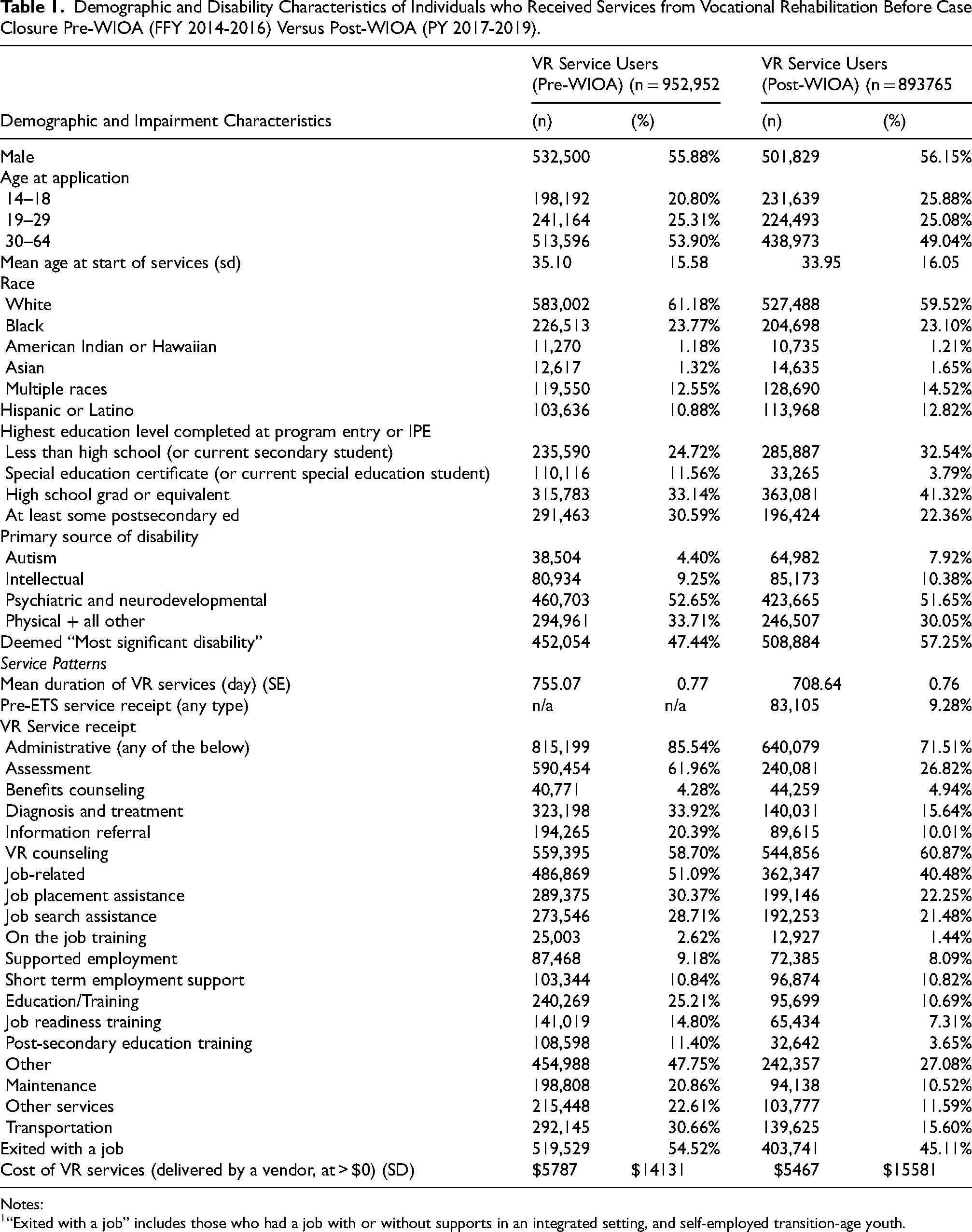
There were similar numbers of VR service users pre-WIOA and post-WIOA, however, a few key characteristics varied from pre- to post-WIOA years (Table 1). VR service users were generally younger at application post-WIOA (25.8% were ages 14–18) than pre-WIOA (20.1% ages 14–18), and fewer had any postsecondary education (22.4% versus 30.6%). More VR service users had a most significant disability post-WIOA (57.3%) than pre-WIOA (47.4%). Receipt of nearly every type of VR service declined post-WIOA except for benefits counseling, VR counseling, and short-term employment supports; although, the increases in these services were slight. Just over one-quarter (26.3%) of VR service users received assessment services post-WIOA, compared to 62.0% pre-WIOA. Similarly, postsecondary education training was more common pre-WIOA (11.4%) than post-WIOA (3.7%). Half as many people received these services post-WIOA versus pre-WIOA: diagnosis and treatment (15.6% versus 33.9%), information and referral (10.0% versus 20.4%), and job readiness training (7.3% versus 14.8%). However, average spending on VR services per person was similar pre-WIOA ($5787) and post-||rmComment||<∼A3B2 h 0,14∼>WIOA ($5467).
Demographic and Disability Characteristics of Individuals who Received Services from Vocational Rehabilitation Before Case Closure Pre-WIOA (FFY 2014-2016) Versus Post-WIOA (PY 2017-2019).
Notes:
“Exited with a job” includes those who had a job with or without supports in an integrated setting, and self-employed transition-age youth.
For all age groups combined, the rate of employment at VR exit was lower pre-WIOA (54.5%) than post-WIOA (45.1%) (Table 1). When examining employment by age group (Figure 1), the percentage of VR services users employed at exit was lower post-WIOA in all age groups, but particularly low among 14–18 year olds (52.5% pre-WIOA versus 38.4% post-WIOA). Service decreases pre- to post-WIOA also varied by age group, with the largest decrease seen in VR service users ages 14–18 years in education and training services (41.3% pre-WIOA versus 14.3% post-WIOA). Across all age groups, receipt of each of the four main categories of service types declined significantly post-WIOA. Although rates of both service receipt and employment declined post-WIOA, these associations (noted within our analysis) are correlational rather than causal.
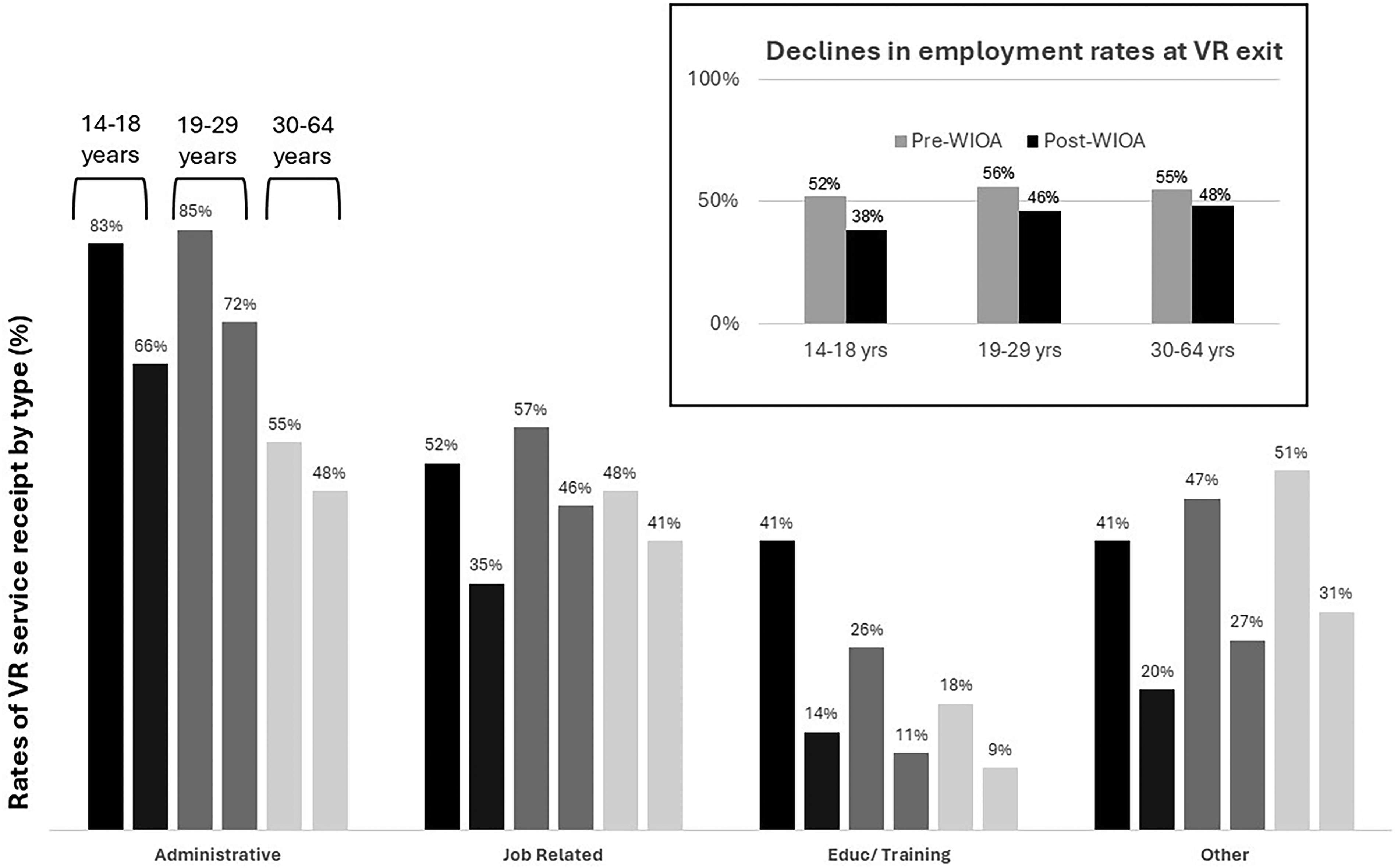
Changes in receipt of vr service types and employment rates at VR exit, by age group.
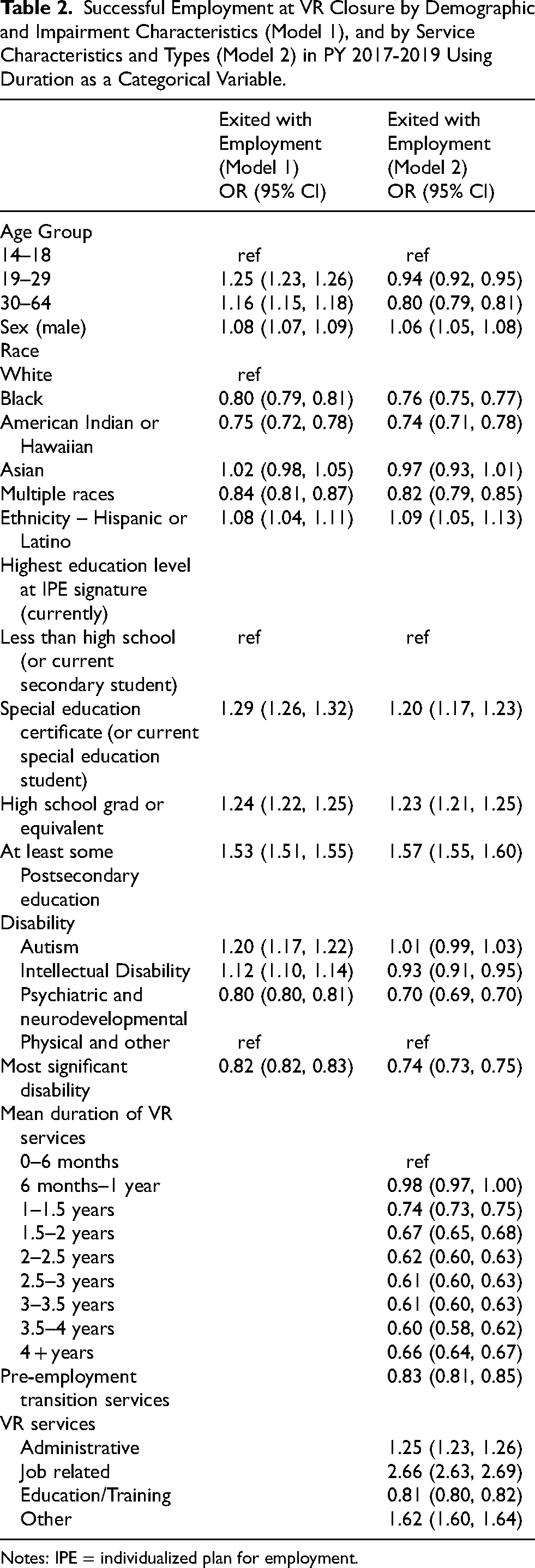
Results of multivariable logistic regression which included service receipt variables indicated that several individual level characteristics were associated with employment at VR exit during the post-WIOA years (Table 2, Model 2). Having at least some postsecondary education at initiation of VR services was associated with greater odds of employment at exit (OR 1.57, 95% CI 1.55, 1.60), compared to those with less than high school education. Lower odds of employment at VR exit were associated with increasing age (OR 0.80, 95% CI 0.79, 0.81), Black race (OR 0.76, 95% CI 0.75, 0.77, compared to White), and having a psychiatric or neurodevelopmental condition (OR 0.70, 95% CI 0.69, 0.70, compared to a physical condition). Receipt of certain services was associated with increased odds of employment at exit, while increased duration of services was associated with lower odds of employment at exit. People who received job related services had 2.66 times the odds of employment at exit than those who did not receive these services (95% CI 2.63, 2.69).
Successful Employment at VR Closure by Demographic and Impairment Characteristics (Model 1), and by Service Characteristics and Types (Model 2) in PY 2017-2019 Using Duration as a Categorical Variable.
Notes: IPE = individualized plan for employment.
Discussion
In this study, we conducted a series of analyses to examine changes in VR service delivery and employment outcomes before and after passage and implementation of WIOA (2014). Overall, our analysis found a combination of declining service receipt and declining employment outcomes—alongside serving a younger and more complex population following passage and implementation of WIOA. Specifically, we noted a sharp decrease in rates of VR service delivery overall and in several specific service categories pre- to post-WIOA, with similarly significant decreases in rates of successful employment outcomes (i.e., closure in competitive integrated employment, or CIE). This shift in overall service delivery and outcomes occurred within the context of multiple changes in service patterns related to changing client demographics, disability-related characteristics, and in types of services accessed. Some of this shift in service delivery—unsurprisingly, given the focus of WIOA—resulted in VR service recipients that were younger and had more complex support needs (i.e., identified as having a “most significant disability” in RSA reporting) than their peers pre-WIOA. This trend toward serving more individuals with complex support needs could hypothetically reflect WIOA funding shifts to prioritize interventions like supported employment, which is often used with individuals with intellectual and developmental disabilities. One potential hypothesis to be investigated by future research is that shifting funding toward Pre-ETS and potentially eligible transition-age youth might have led to states entering orders of selection more frequently post-WIOA (though this was outside the scope of the current study), further shifting their priority toward serving individuals with more complex needs. Interestingly, despite the overall increase in individuals with more complex support needs, we noted a decrease in individuals holding special education certificates and a co-occurring increase in current secondary students who received VR services. These changes in service patterns could reflect states’ moves to phase out the use of special education certificates and expand diploma pathways for students with disabilities. The changes could also reflect increases in coordinated service delivery between VR offices and local educational agencies, resulting in more youth with disabilities accessing VR services before they exit secondary school. Taken in sum, our findings highlight the need for future research to explicitly investigate the causes of these changes in service delivery and employment outcomes.
Several noteworthy trends within service patterns from pre- to post-WIOA emerged from our analysis. Services directly related to placing and supporting individuals in work sites (e.g., job search, job placement, on-the-job training) each decreased in frequency of usage, which is concerning given that these services have been shown to strongly associate with improved employment outcomes (Ahonle et al., 2020; Iwanaga et al., 2025; Roux et al., 2020). Other analyses of RSA-911 data since WIOA have also noted that services most strongly supported by research are less often provided within Pre-ETS or VR services (Taylor et al., 2024; Whittenburg, Avellone, et al., 2024). It is uncertain why these effective services were provided to fewer individuals, but it is possible that service prioritization toward individuals with more complex support needs and more intensive interventions like supported employment led to fewer total individuals provided with these services. Relatedly, supported employment and short-term employment support both held steady even as those other job site specific services decreased, providing further evidence of the shift toward serving individuals with more complex support needs post-WIOA. However, use of benefits counseling remained quite low (received by less than 5% of VR recipients), despite strong evidence showing the association between benefits counseling and higher wages and hours (Iwanaga et al., 2021; Taylor et al., 2024). Decreases were also found in delivery of assessment and administrative services. One potential hypothesis could be that this finding is reflective of increased coordination with schools where VR counselors used IEP records as assessment data and younger transition-age youth did not require administrative services.
Perhaps most noteworthy of the service pattern shifts post-WIOA was our finding of a steep decline in VR services to support postsecondary education (PSE). Given evidence showing positive associations between PSE and successful employment outcomes (Avellone, 2021; Rast et al., 2020), this finding is unexpected and concerning. Expansion of PSE opportunities for youth with disabilities and growth of inclusive PSE programs, via funding for Transition and Postsecondary Programs for Students with Intellectual Disability (TPSID), suggested that VR services and funding for PSE might have increased. Finally, given that counseling in PSE opportunities is one of five required Pre-ETS, it is perplexing that these factors did not lead to consistent—or even increased—PSE service delivery.
One of the marquee components of WIOA (2014) was the mandated 15% budget allocation dedicated to transition-age youth through Pre-ETS, designed to frontload VR services. However, we found that only 9% of those who received individualized VR services within our sample received any Pre-ETS. RSA-911 provides limited data to explain why so few participants transitioned from Pre-ETS to individualized VR services. Among 2017–19 case closures, over 32% entered VR as secondary students, indicating that services were, in fact, being provided to younger individuals—albeit in the absence of combined Pre-ETS and individualized VR services. These findings coincide with previous research findings which estimated that less than 10% of students with a known disability received Pre-ETS in the early years of WIOA implementation (Whittenburg, Avellone et al., 2024). This number has not shifted much over time. Data from the U.S. Department of Education for 2021–2022 suggests that 12% of special education students ages 14–21 years received Pre-ETS (Roux et al., 2026). Until recently, many states were not able to spend their 15% WIOA allotment for Pre-ETS each year (Rehabilitation Services Administration, n.d.b.) As of FY 2022, 75% of states and territories met this federal mandate (Dobak & Steele, 2024), indicating that rates of Pre-ETS engagement may have increased since data used in this study were collected.
Overall, results of our study point to a VR system still in flux in the years immediately following WIOA implementation. Previously, the main goal of the VR system was to identify eligible individuals and help them to secure a job. This focus has shifted since passage and implementation of WIOA toward a broader view of career development, with an emphasis on earlier engagement and a focus on career (rather than “job”) development. This approach may be beneficial long-term in providing earlier and more formative experiences for younger individuals, but initial indications from our study show that those do not necessarily translate into better immediate employment outcomes. We hypothesize that state VR agencies’ capacity for transition programming prior to WIOA, previous implementation of policies like IEP transition planning starting at 14, and variable investments in state VR systems might have contributed to inconsistent patterns of service delivery and outcomes from state to state (Whittenburg et al., 2025). Further, our study also described significant decreases in successful employment outcomes and service receipt post-WIOA implementation for all VR user age groups. It is beyond the capacity of this study to identify the specific factors that may have contributed to those declines, but it seems clear that the major restructuring of state VR systems brought about by WIOA resulted in an immediate period of intense change that impacted a wide range of VR service users. As state VR systems recalibrate to meet WIOA targets and mandates, further attention is needed to how this shift in focus may affect the broader aims of VR agencies in achieving the original purpose of the Rehabilitation Act.
Limitations
In interpreting our findings, several limitations of our current study should be taken into consideration in generalizing our findings. Since the scope of our study was restricted to data drawn from the RSA-911 data set, limited variables were available for analysis. As a result, we were unable to examine many aspects of individuals’ experiences in school, transition, and employment settings outside of their engagement in VR-specific services. Additionally, we used descriptive analyses to respond to the broad scope of our research questions related to experiences and employment outcomes pre- and post-WIOA. While these findings provide new and important insights into the effects of this policy change, our methodology is not designed to make causal or even predictive claims about the association between service patterns and employment outcomes. Furthermore, due to the availability of variables within the RSA-911 data set, we are unable to examine barriers to employment prior to WIOA; likewise, data related to career development (e.g., skill attainment; credentials) were not available pre-WIOA and were thus not included in our analysis. Specific to Pre-ETS data collection and reporting, limited data are collected specific to individuals who receive only Pre-ETS and do not then receive individualized VR services (Taylor et al., 2024). Not only are limited data collected on Pre-ETS participants, but substantial variation in implementation and data reporting have been noted across states (Whittenburg, Avellone et al., 2024). The time-sampled data from pre- and post-WIOA in this study should be viewed as a snapshot rather than a robust aggregate sample. As Pre-ETS delivery becomes more streamlined in state and local service provision, future data may provide better insight into service patterns and outcomes.
Implications for Future Research
In reviewing our findings related to broad examination of service and outcome changes pre- and post-WIOA implementation, more research is clearly needed in this area. In our study, we indicated discrepancies between services and population groups that increased or decreased in terms of service receipt, but future research should also examine the intensity, dosage, and cost-benefit of those services. As more states meet the federal mandate of spending 15% of VR funds on Pre-ETS, further investigation is needed to determine how that reallocation of funding corresponds to service delivery and outcome achievement. The overall number of individuals served by the VR system has remained relatively constant, begging the question of how costs have shifted. As states have continued to implement WIOA mandates including Pre-ETS, questions remain about how staffing and funding may have been diverted from other services. As these service patterns have shifted, research is needed to investigate the cost-benefit of these changes.
Although the focus of our study was national in scope, future research should more closely examine states that have developed successful models (i.e., outreach to more individuals in Pre-ETS, increased ‘hand-off’ between Pre-ETS and individualized VR services, and those that show higher CIE outcomes). To this end, there is still a considerable amount to be learned about state-level service delivery in terms of priorities as well as providers. Previous research has shown that states vary considerably in terms of whether they provide Pre-ETS by VR staff or vendor services (Taylor et al., 2024; Whittenburg, Avellone et al., 2024). Given the notable shifts we observed in our analysis, especially in the context of millions of dollars of funding diverted to Pre-ETS, important overarching questions remain to be answered.
Implications for Policy
Findings from our study highlight the need for federal policies that support efforts to better understand the complexities of VR service delivery and widely disseminate information on promising practices. Given that we found decreases in successful CIE outcomes and specific service usage post WIOA-implementation, targeted federal funding for research is clearly needed to investigate CIE outcomes across multiple groups of VR service users with different patterns of service receipt at the national and state levels. Moreover, federal funding to support cost analyses of Pre-ETS and individualized VR service programs at the state level could provide state leaders with important information about spending patterns, resource distribution, and cost inefficiencies. There is also a clear need for more specific data about students receiving Pre-ETS and the Pre-ETS they receive. Extremely limited data are collected on the experiences of students who only receive Pre-ETS. While the streamlined Pre-ETS application process helps students with disabilities receive services more quickly, the limited information we have about those students and their experiences make it difficult to evaluate the accessibility and availability of Pre-ETS. Federal guidance requiring VR state agencies to collect additional demographic information about Pre-ETS recipients (e.g., disability category, diploma status) and Pre-ETS service delivery (e.g., duration of service, specific activities included within the service) could provide valuable data to better understand the scope and efficacy of Pre-ETS, while minimizing the administrative burden on VR counselors and schools. Finally, RSA has recently funded multiple state-level model demonstration projects to improve CIE outcomes for youth and adults with disabilities (Rehabilitation Services Administration, n.d.a.) Federal support for innovative projects that address the needs of younger consumers with more complex support needs will be critical in increasing successful CIE outcomes, along with sophisticated and multi-tiered approaches to widespread dissemination of key findings and strategies for successful implementation.
Implications for Practice
Our study also has several implications related to practice. Our finding that only 9% of the transition-aged youth with disabilities within this sample received Pre-ETS indicates that more work is needed to improve coordinated service delivery between school and VR staff, in order to substantially increase the number of students with disabilities accessing Pre-ETS. Specifically, school and VR teams need regularly scheduled collaborative meeting/planning time to figure out referral/application processes and approaches to Pre-ETS delivery that address the specific strengths and needs of individual schools (e.g., supplementing school-based transition services, school bell schedule, staffing, transportation). Further, VR counselors would benefit from ongoing training and professional development on working with younger consumers with more complex support needs. Finally, the significant increases in younger consumers being served by VR state agencies post-WIOA implementation highlight the need to develop, pilot, and widely share different approaches to providing VR counseling and case management services to youth with disabilities. VR state agencies are beginning to explore different options (e.g., dedicated youth counselors, split youth/adult caseload counselors, contracting out Pre-ETS counseling and case management), but it is unclear which approaches work best in which specific state and local contexts. Widespread dissemination of different case management options that highlight promising practices and strategies for different populations, geographical regions, and system structures is needed.
Conclusion
Findings from this study highlight the unintended consequences that may occur during widespread systems change. WIOA's emphasis on increasing high-quality employment services for transition-aged youth with disabilities resulted in significant changes to VR service delivery. More youth with disabilities are receiving VR services, including youth who traditionally have more extensive support needs. However, our study also describes some potentially unintended consequences to this significant shift in VR policy. In the early years of WIOA implementation, fewer adults with disabilities were served by state VR agencies, fewer VR services were provided, and successful CIE outcomes decreased, when compared to the years immediately preceding WIOA implementation. As we move forward, it will be critical to identify innovative approaches to VR service delivery that support the successful transition of youth with disabilities from school to work, while also ensuring that other VR consumers are able to access the services and supports they need to achieve their career and employment goals.
Footnotes
Acknowledgments
None

Ethics Statement
This analysis was deemed exempt by the Drexel University Institutional Review Board.
Informed Consent
was not applicable for this administrative data analysis.
Author Contributions
A.R. conceived and designed the study. J.R. contributed to the development of the methodology. J.R. analyzed the data, and H.W. and J.T contributed to data sources for the analysis. All authors assisted with interpretation of results. A.R. led the draft of the manuscript, but all authors contributed. All authors contributed to critical revisions and approved the final version for submission.
Funding
The authors disclosed receipt of the following financial support for the research, authorship, and/or publication of this article: This project is supported by the Health Resources and Services Administration (HRSA) of the U.S. Department of Health and Human Services (HHS) under cooperative agreement UT6MC45902 Autism Transitions Research Project. The information, content, and/or conclusions are those of the author and should not be construed as the official position or policy of, nor should any endorsements be inferred by HRSA, HHS or the U.S. Government.
Health Resources and Services Administration, (grant number UT6MC45902 ).
Declaration of Conflicting Interests
The authors declared no potential conflicts of interest with respect to the research, authorship, and/or publication of this article.