






Abstract
Background
Spinal cord injury is common in the working age population in Bangladesh, and work participation following injury is complex due to its physical, psychological, social and economic impacts on the lives of injured persons, their families and communities. Few evidence-based resources are available to occupational therapists in Bangladesh to guide their practice in supporting work re-engagement of this population.
Objective
To explore the Occupational Therapists’ experiences about the usefulness of the Worker Role Interview in spinal cord injury rehabilitation in Bangladesh.
Method
Occupational therapists at a rehabilitation centre received training to use the Worker Role Interview. Four therapists in the spinal unit were then recruited, and participated in individual semi-structured interviews. Data was analysed using thematic analysis.
Results
Four themes were identified: supports patients’ agency to express themselves and work possibilities; initiates self-inquiry about the prospects of working; facilitates understanding of patients beyond their injury; and contextualising the interview for local practice.
Conclusion
The Worker Role Interview provides a useful way for occupational therapists in Bangladesh to understand how people view their work after spinal cord injury, which may promote the design of client-centred and meaningful interventions.
Keywords
Introduction
Traumatic spinal cord injury (SCI) is one of the most severe disabilities affecting the working-age population in Bangladesh (Hoque et al., 2012; Islam et al., 2011; Kader et al., 2018; Uddin et al., 2023). Recent studies indicate that the majority of adults with SCI are aged 18–45 years; male; married; living in rural areas, with little or no education/primary education (59%), and employed at the time of injury (79%) (Kader et al., 2018; Uddin et al., 2023). Disability following SCI is a lifelong experience, and work participation is complex due to multiple pre-injury and post-injury factors that influence its subjective meaning, and poverty-induced factors, including limited work options and supports in Asian countries, in particular lower-to-middle-income country (LMIC) contexts (Rahman & Nasreen, 2025; Shamrock et al., 2016; Ullah et al., 2025). Therefore, a comprehensive multidisciplinary rehabilitation program is required to enhance adjustment to a new pattern of life by preparing individuals, their family members and friends with the skills and resources necessary for community living. However, in Bangladesh, the absence of nationwide rehabilitation services, the scarcity of rehabilitation professionals at the community level, and financial obstacles limit access to vocational rehabilitation (Rahman & Nasreen, 2025; Uddin et al., 2022; Uddin et al., 2023). Further challenges to implementation of evidence-based rehabilitation practices include (but are not limited to) there being few information gathering tools relevant to the vocational needs of individuals as well as the local cultural context.
While a number of government and non-government organisations provide vocational rehabilitation for people with disabilities (Rahman & Nasreen, 2025), the Centre for the Rehabilitation of the Paralysed (CRP)(Centre for the Rehabilitation of the Paralysed, 2024) is the country's only spinal rehabilitation centre with multidisciplinary rehabilitation professionals and is one of the largest in the Asia region (Hossain et al., 2020). Most persons with SCI in Bangladesh access post-injury rehabilitation, including the vocational rehabilitation program, from this centre. At the time of this study, the vocational rehabilitation program was led by occupational therapists and focused primarily on developing physical capacities and skills for vocational trades such as setting up small businesses (Ullah et al., 2015), with limited focus on psychosocial factors that influence work participation following the injury. Exploring the potential usefulness of evidence-based resources for occupational therapy practice may assist occupational therapists (OTs) in providing more holistic vocational rehabilitation. The Worker Role Interview (WRI)(Braveman et al., 2005) is a well-established tool for identifying psychosocial and environmental factors that influence return to work based on the Model of Human Occupation (MOHO), a practice framework widely used in vocational rehabilitation (Braveman, 1999; Kielhofner et al., 1999; Lee & Kielhofner, 2010; Park et al., 2019; Strømstad et al., 2024).
The WRI Version 10.0 (Braveman et al., 2005) is a semi-structured interview tool that was developed to facilitate an understanding of psychosocial factors that may be barriers or facilitators to work participation (Fisher, 1999). Using the WRI facilitates getting to know the person beyond their functional capacity; it also provides information about psychosocial factors that are important in developing and sustaining successful rehabilitation and return to work outcomes after SCI (Burns et al., 2010; Chevalier et al., 2009; Fisher, 1999; Kent & Dorstyn, 2014; Khazaeipour et al., 2014; Post & van Leeuwen, 2012). Use of the WRI as an assessment tool in vocational rehabilitation or return to work is reported with a range of populations, including those with chronic musculoskeletal disorders, intellectual disabilities, severe mental illness, traumatic brain injury, neuromuscular diseases, amputation (Areberg & Bejerholm, 2013; Asmundsdottir, 2004; Ekbladh & Sandqvist, 2015; Julian & Valente, 2015; Lexell et al., 2017; Moller et al., 2017), but few studies explicitly mention its use with people with SCI and none in low resourced settings like Bangladesh with any client group. Given these gaps, this study aimed to explore the views of occupational therapists (OTs) about the usefulness of the WRI within SCI rehabilitation in Bangladesh, based on their clinical experience.
Materials and Method
A qualitative descriptive approach was used to explore the views of OTs about the usefulness of the WRI in spinal cord injury rehabilitation because qualitative approaches allow clinicians to share their experiences of using assessment tools in daily clinical practice (Ekbladh & Sandqvist, 2015; Enemark Larsen et al., 2021). The study obtained ethics approval from CRP in Bangladesh (R&E 0401-155) and La Trobe University (S15/233). The Consolidated Criteria for Reporting Qualitative Research (Tong et al., 2007) was followed during proposal development and in the reporting of this research.
Setting and Participants Recruitment
This study was undertaken in the spinal rehabilitation service at CRP in Bangladesh. OTs working at CRP were invited to participate in this study via a generic email and invitation posters in common staff areas within the facility. Eligibility criteria included:
• prior experience of conducting vocational assessment at CRP; • being native Bangla language speakers (a skill crucial to interviewing local patients when administering the WRI); • completion of training in using the WRI. • experience of using WRI to interview at least three persons with SCI.
All the OTs working in the SCI unit (n = 5) expressed interest in taking part in this study, and received WRI training provided by the first author (MMU) as below.
Preparing OTs to Use the WRI in Their Practice
The first author conducted WRI training for interested OTs at CRP. The training sessions included a 30-min PowerPoint presentation on the overview and administration of the WRI 10.0 (Braveman et al., 2005), followed by group sessions to discuss the language of the interview; to watch and discuss a video on WRI administration (produced by the University of Illinois-Chicago, USA); a practice session with a volunteer patient; and one-to-one sessions with the lead author regarding practice preparation. The therapists were given a Bangla-translated copy of the WRI-recommended questions used in an earlier study (Ullah et al., 2025), and the WRI manual (Braveman et al., 2005) was provided for further clarification and reference. The five OTs on the SCI unit then had three months to practise using WRI with their patients, prior to being invited to participate in an interview. The first author then contacted each of these five OTs to check whether they had used the WRI interview and if they were still willing to be interviewed about their experience. A detailed participant information statement and consent form were provided to explain the study. Four of the five WRI-trained OTs from the SCI unit were available at this time and gave written informed consent to participate in an interview about using WRI in their practice with patients with SCI.
Data Collection Interview
Each WRI-trained OT participants took part in a face-to-face interview with the first author at a mutually agreed and convenient place. The participant information sheet emphasized that these interviews were confidential, conducted independent of normal work activities, and that the views expressed would be de-identified and carry no job-related consequences.
Each semi-structured interview was conducted by the first author. At the beginning of each interview, practice-related information was collected, including the participant's years of work experience since graduation, the length of their experience, average SCI caseload/week in SCI rehabilitation, familiarity with the WRI, and confirmed their prior experience interviewing patients with SCI about work participation.
The first author used an interview guide (See supplementary information) to explore therapists’ views about the WRI and facilitate relevant follow-up questions. This interview guide was developed by the research team, informed by the literature on the usefulness of assessment tools in Occupational Therapy practice (Toomey et al., 1995; Yngve & Ekbladh, 2015). These questions focused on the challenges and strengths of the WRI regarding administration, environment, patient responses, the content of the questions, suitability within the cultural context, practical considerations or issues, and potential for use in Bangladesh. Participants were also asked to reflect on their vocational assessment practice before and after using WRI. Interviews were conducted in Bangla, the native language of the participants and the first author, ranged in length from 45 to 55 min, and were audio-recorded. Participants were informed that they could add further information later or amend any sections of their recorded interview. One participant sent an email with added notes based on reflections about her experience that she had not mentioned during the interview.
Data Analysis
Interviews were transcribed from audio-recording in Bangla, and then translated into English by the first author for data analysis. Audio-recorded interviews were listened to multiple times to minimise any loss of meaning of the interview data during the translation process. The thematic analysis process, described by Braun and Clark (Liamputtong, 2013), was followed to generate the study findings. MMU and RS developed initial coding independently, met regularly to identify the emerging initial themes. All three authors then reviewed the emerging themes based on the initial coding; and reached consensus by defining and naming the themes through regular discussion.
Researcher Positionality and Reflexivity
First author (MMU) is an Occupational Therapist with 12 years of practice experience at the time of this study, which was part of his PhD project. The study setting, CRP int Bangladesh, was his previous workplace of MMU, two years before the interviews. MMU is a native Bangla speaker, had prior work experience with SCI patients, and teaching WRI to practising occupational therapists. During data collection, the MMU recorded technical decisions, understandings of prior assumptions, beliefs, and challenges with participants in his reflective journal following each interview. Author 2 (EF) and Author 3 (RS) were the academic supervisors. Both are Australian women with backgrounds in occupational therapy, expertise in qualitative research, rehabilitation, and work-related research. The research team critically reflected on their views and beliefs in relation to the findings through regular open discussions during the analysis and manuscript development phases, as well as the writing of personal reflection notes. Findings used verbatim quotations to support the interpretation.
Results
Participants Overview
Four OTs working in the spinal unit at CRP participated in this study. Their background information is summarised rather than individually described to protect their anonymity. The participants were all working full-time in permanent positions and had between one and a half and over 10 years’ experience working with people with SCI. They had an average caseload of seven patients per day as well as regular administrative responsibilities. All participants had used the WRI to interview at least three persons with SCI, with a total of fifteen WRI interviews with male patients having been completed.
Themes on the Usefulness of the WRI
Thematic analysis of OT participants’ views on the usefulness of the WRI generated four key themes: Supports agency for patients to express themselves and work possibilities; Initiates self-inquiry about the prospects of working; Facilitates understanding of patients beyond their injury; and Contextualising the interview for local practice (Figure 1). Each of these is discussed in more detail below with illustrative quotes from participants.
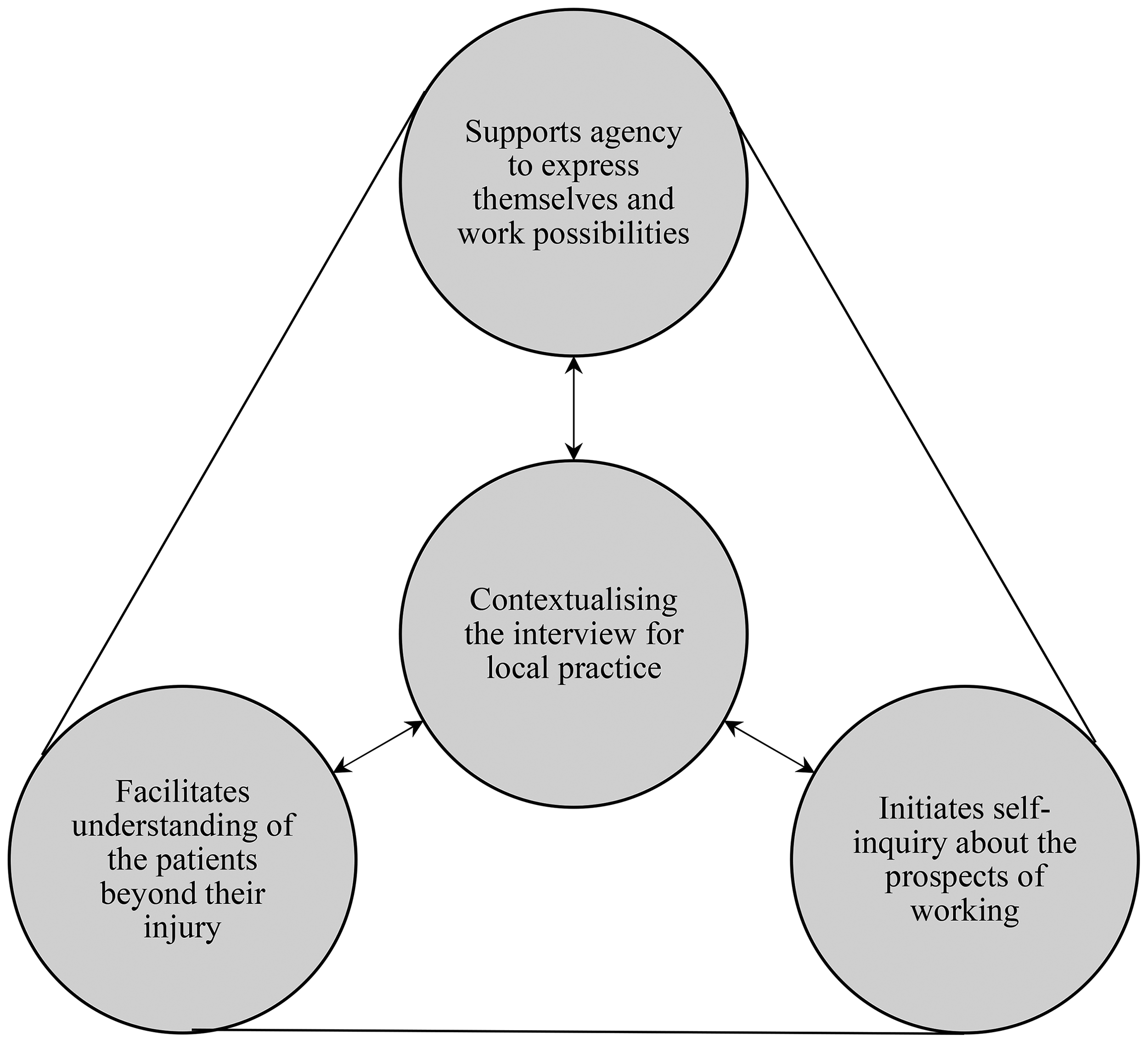
Themes on the usefulness of the WRI for SCI.
Supports Agency for Patients to Express Themselves and Work Possibilities
The interviewed OTs identified that the WRI prompts discussion around patients’ expectations of themselves as workers, and consideration of their future participation in work. They described finding that patients shared their views about work during the interview, and particularly when they were able to facilitate a conversation:
“In the WRI sessions, I have found him an independent individual, not under my control. During the treatment sessions, he is under my control, he listens to what my instructions are. But during the interview, I have seen them make their voice heard. I have seen some ‘empowerment’ type things happen.” (OT 1)
“We have a conversation and discussion, and we do not ask them question by question, and that makes them more comfortable about sharing as they do not take it as it an interview.” (OT 3)
“Especially for my fourth patient, it helped me a lot to understand his plans. Because before, he was saying repetitively that he would not do anything. However, after the WRI interview, finally, he could decide by himself what he will do. He could take control of the situation.” (OT 4)
Initiates Self-Inquiry About the Prospects of Working
OTs described the interview content as providing a trigger for thoughts about work participation after SCI, which seemed to guide patients to develop expectations and initiate analysis regarding their future work participation process.
“I think the patient gets a “stimulation” for vocational decision-making from the interview questions. I can see this stimulation happening while I am conducting the interview.” (OT 2)
“There are some points they have never explored until the question was asked, and they started to think about that, like the influence of his daily living activities and work environment. They did not think about this issue in this way before, they started to think and realised that they need to think more about this.” (OT 1)
“Yes, when the WRI interview was completed, we found that there were some areas which patients had not even thought about before the WRI session, like what are the barriers to work, how do they need to prepare themselves? They become more oriented through these questions. Even after the interview ended, they came back and asked for more information. “ (OT 3)
“I would say very specifically that during the interview, this expectation grows about what they will do in the future, and it grows from inside them. They start to think that they should think like this. To me, this is the beauty of the WRI. His motivation, his plan, and his capacity, everything he assesses by himself.” (OT 4)
Facilitates Understanding of the Patients Beyond Their Injury
This theme highlights the influence of the use of the WRI on the OTs practice, and how they found their role shifted from one of prescriber to that of facilitator, enabling more individualised practice. OTs reported that using the WRI in their practice led them to view patients holistically, which helped them establish communication in a more meaningful way and identify relevant, in-depth information about their clients. After using the WRI, OTs identified that they had changed their understanding of their patients’ perspectives. Knowing more about the patients and their individual feelings, thoughts, and hopes made the OT more appreciative of the patients’ sense of the meaning of work.
“I think it contributed to some changes in my perspective. In the past, all my vocational assessments were very short-cut. Very structured and about physical capacity. There was no scope to know his mental status, why he is interested in a particular training, or why he is not interested. After doing the WRI, it also made me realise that as a therapist I should also focus on these areas.” (OT 3)
“For me, each separate heading was very useful and important, addressing things such as the social environment and previous experience in separate sections, which we did not do in the past. (OT 2)”
“So, when the time of hospitalisation comes to an end, they become worried about their future. More precisely, I can say they are worried about their income-generating activities. But this is the time when we just (previously) overlooked what they are going through. For example, patients living in the community are often thirsty for a sense of social identity. They cannot concentrate much on their therapeutic home program. If we administer the WRI and can know what his/her deep insight is, we can assist in this regard during hospitalisation. So, they need not be so worried about their plan and different aspects of work selection and plan execution.” (OT 4)
“Yes, information about the current routine or previous routine. Even patients felt that the information was not necessary. However, when we find the habits of their previous life and even their current lifestyle, it becomes easier to plan the future. For instance, how he used to start his day, and now how he starts his day - what changes are required? If he returns to work, what strategies should be in place? I have found this part very important.” (OT- 1)
Contextualising the Interview for Local Practice
Although OTs provided positive feedback on the experience of using the WRI in their practice, they also identified several aspects of the tool which needed to be better contextualised for use in Bangladesh. OTs identified culturally based issues arising from both patients’ responses and their professional judgment and addressed these via contextualising the guided question and concepts.
All OTs mentioned difficulties exploring several WRI items related to language. For example, a phrase such as ‘perception about the boss’ was not culturally meaningful, as most of this SCI population came from a background of self-managed or self-employed work. There were also some issues around terminology related to the concepts of ‘routine’ and ‘leisure’, which require further clarification or contextualisation:
“Work routine, interest, and how they spend leisure time were hard to communicate. For a patient who was a farmer, I asked about leisure, and he said, ‘What is leisure for me? I work all day. If I go outside, I am at the farm, when I am inside, I work with my chickens and cattle.’ They find it difficult to identify their leisure hours.” (OT 2)
“Culturally, our work is different, so if we need to modify some parts (of the WRI) for our context, like what we mean by agricultural work, or day labour. Most of our female patients are housewives, but we culturally do not consider home-making activities as “work” like other work; it is counted as normal daily activities. I think that type of question is limited here. Another one, who will be a student's boss? What will a student's previous experience be? If we can modify culturally, it would be better.” (OT 3)
“This is not such a big thing. If there was a farmer who wants to go back to small farming work again and I ask, “what is the relationship with your boss?”, it does not sound appropriate. In this situation, as a therapist, I need to clarify what questions I am going to ask. We need to aware of the context.” (OT 4)
“Yes, I needed to simplify the question. Like, for people who were from the village, when I asked them, “What did you do for your leisure or recreation?” It was hard to explain the leisure or recreation part. For example, they watch TV, or spend time chit-chatting in a tea stall, but they do not count those as leisure or recreation. When I asked about leisure activities, they considered spending time gardening or feeding the cattle as leisure. So, I just write down what they said – gardening or household activities – as their leisure activities. It would be better if we can do some linguistic adaption to our context.” (OT 1)
Discussion
This is the first known study to explore occupational therapists’ experience of using the Worker Role Interview (WRI) in vocational rehabilitation within Bangladesh. It suggests that through using the WRI, occupational therapists may gain a better understanding of individuals’ views about work participation following spinal cord injury to support the provision of client focused rehabilitation programs. For therapists in this study, the usefulness of the WRI was in enhancing engagement between therapists and patients, and in fostering therapists’ understanding of the psychosocial and aspirational aspects of work for their patients. They also suggested strategies to enhance its utility within the Bangladeshi context.
Therapists’ Understanding of Patients’ Perspectives
The information gathered when using the WRI enhanced the OTs’ understanding of their client's point of view, particularly in relation to psychosocial factors beyond the injury itself. This is important since implementing strategies that address psychological factors such as hope, future orientation, motivation, and self-efficacy are linked with improved employment and psychological well-being outcomes following SCI (Bloom et al., 2020). Further, it supports previous research findings that accessing the patients’ ‘voice’ and views about work participation assists therapists to understand their patients’ worker roles and how their volition, habits, and perceptions about social and physical environments might influence their desired work-related rehabilitation outcomes (Egan et al., 2015; Fisher, 1999). Since a matrix of psychological and environmental factors influence these outcomes, therapists’ understanding of these factors is necessary to creating opportunities for returning to work after SCI (Hilton et al., 2018). The importance of understanding the psychological and environmental aspects is supported by previous WRI studies with other client groups, including those with musculoskeletal disorders and mental disorders (Aas et al., 2011; Ekbladh & Sandqvist, 2015). Furthermore, engaging with patients in conversations about return to work or education during inpatient rehabilitation can also create feelings of hope and guide intervention options accordingly (Analytis et al., 2025; Ramakrishnan et al., 2016).
Contextualisation of WRI
The WRI is a tool that enables users to look beyond simply functional capacities (Fisher, 1999). Therefore, it was suitable for addressing the identified practice gap in work-related assessments used at CRP in Bangladesh. However, there are also contextual challenges that need to be addressed, such as some of the tool language and the presence of family members during the interview. The concept of ‘boss’ or ‘co-worker’ in WRI was not usually relevant if the person works independently on their land. The routines of people working in traditional agriculture farming, a group commonly represented by SCI patients, change significantly throughout the year based on the cycle of seasons, e.g., planting seedlings, irrigation, and harvesting. The components ‘perception of Boss’ or ‘work setting’ within the WRI constructs have also been previously identified as difficult to translate in other studies (Fenger & Kramer, 2007; Forsyth et al., 2006; Koller et al., 2011).
The value of involving family members in a more meaningful way to support shared expectations as part of the rehabilitation process has been previously identified (Jeyathevan et al., 2020). Due to the lack of a social security system in Bangladesh for persons with disabilities and the absence of rehabilitation services for persons with SCI at the community level, engaging all those involved after discharge can enhance realistic discussion and understanding of future work prospects, and common issues and challenges (Jeyathevan et al., 2020). Therapists identified the need to use careful reasoning and judgment about when to involve family members in the discussion of the work plan.
Study Methodological Quality
Several factors should be considered when interpreting the findings for practice. The four therapists who participated in this study were recruited from CRP, the specialised rehabilitation centre service in Bangladesh. . Fifteen OTs were practising in the service at the time of this study, of whom only five of them worked with people with SCI and participated in WRI training, and were eligible for interview. This sample is relatively small but represents most occupational therapists providing rehabilitation services for people with SCI at CRP. Their experience of interviewing using WRI was solely with male inpatients, this being the most common patient group in this service. Hence, the findings are directly relevant to occupational therapy practice in the rehabilitation service for men with SCI in Bangladesh, and may also be transferable to contexts where occupational therapy practice is similar.
Conclusion and Implications
This research contributes to the body of knowledge about vocational rehabilitation for people with SCI in Bangladesh. Finding the meaning of work after such a traumatic and chronic illness or injury as SCI is important to post-injury identity development. Practitioners need to encourage and facilitate people with SCI to have opportunities and time to tell their stories in their own way, to encourage and support them to think about work, and to explore work possibilities with them. The use of WRI, an occupation-focused assessment tool provides opportunities for initiating timely interventions within post-injury work rehabilitation programs, and supports a comprehensive understanding of the work-related meanings and aspirations of patients not only their physical and functional limitations.
Supplemental Material
sj-docx-1-jvr-10.1177_10522263261467035 - Supplemental material for Therapists’ Perspectives on Using the Worker Role Interview in Spinal Cord Injury Rehabilitation in Bangladesh
Supplemental material, sj-docx-1-jvr-10.1177_10522263261467035 for Therapists’ Perspectives on Using the Worker Role Interview in Spinal Cord Injury Rehabilitation in Bangladesh by Mohammad Mosayed Ullah, Ellie Fossey and Rwth Stuckey in Journal of Vocational Rehabilitation
Footnotes
Acknowledgements
We gratefully acknowledge the support received from the Centre for the Rehabilitation of the Paralysed, which facilitated this study without influencing its conduct or findings, and we thank all participants (occupational therapists from the Spinal Cord Injury Unit, CRP) for their willingness to share their experiences.

Ethics Statement
The study obtained ethics approval from Centre for the Rehabilitation of the Paralysed in Bangladesh (R&E 0401-155) and La Trobe University (S15/233).
Informed Consent
In accordance with the ethics approval, participants who confirmed their interest received an information sheet, a consent letter and a letter of withdrawal, and provided signed consent before the interview.
Funding
The authors disclosed receipt of the following financial support for the research, authorship, and/or publication of this article: This work was supported by the La Trobe University Postgraduate Research Scholarship, 2014 and La Trobe University Full Fee Research Scholarship, 2014 to Mohammad Mosayed Ullah by La Trobe University, Melbourne, Australia. No other authors received funding for this.
Declaration of Conflicting Interests
The authors declared no potential conflicts of interest with respect to the research, authorship, and/or publication of this article.
Supplemental Material
Supplemental material for this article is available online.
References
Supplementary Material
Please find the following supplemental material available below.
For Open Access articles published under a Creative Commons License, all supplemental material carries the same license as the article it is associated with.
For non-Open Access articles published, all supplemental material carries a non-exclusive license, and permission requests for re-use of supplemental material or any part of supplemental material shall be sent directly to the copyright owner as specified in the copyright notice associated with the article.
