





Abstract
Introduction
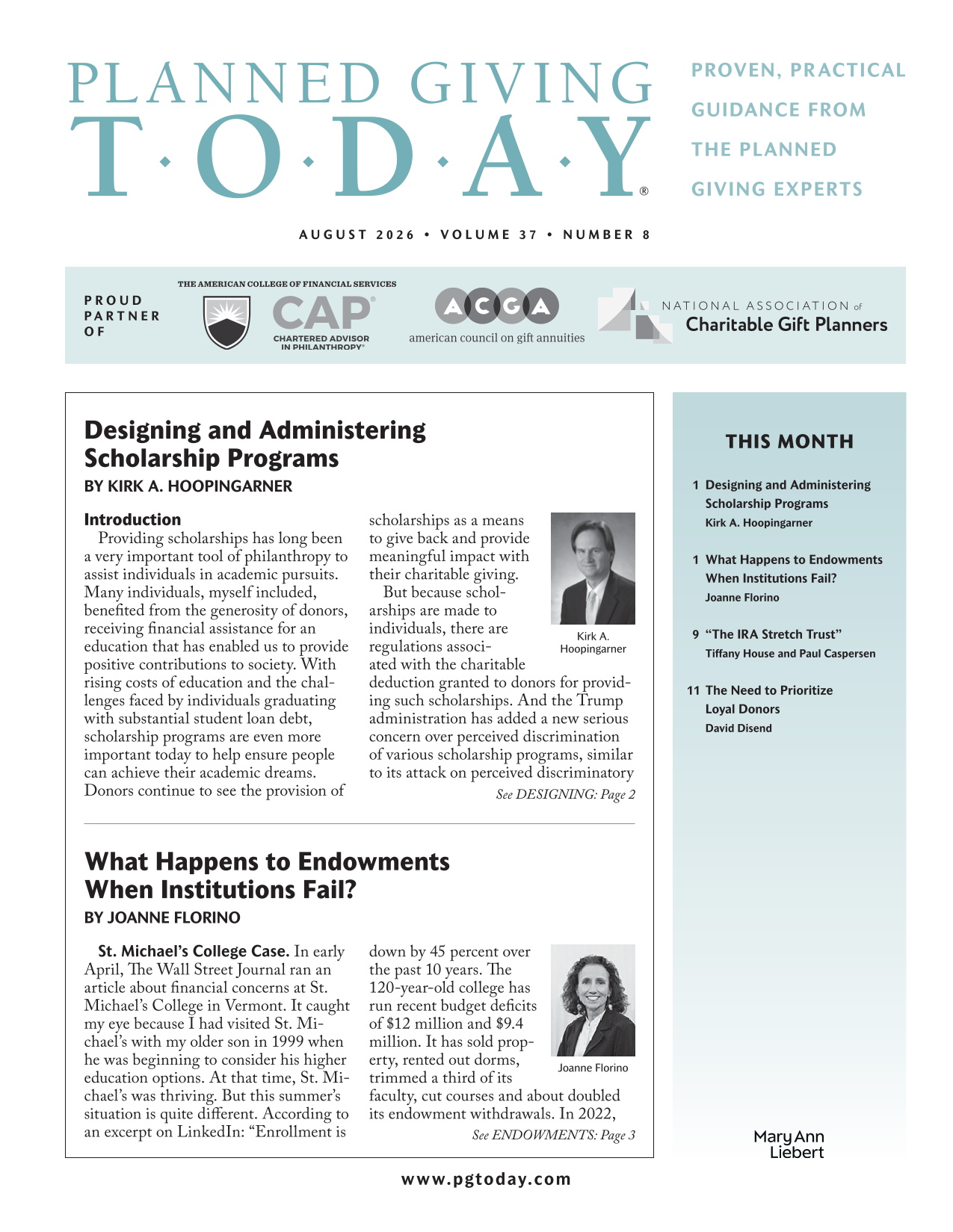
Providing scholarships has long been a very important tool of philanthropy to assist individuals in academic pursuits. Many individuals, myself included, benefited from the generosity of donors, receiving financial assistance for an education that has enabled us to provide positive contributions to society. With rising costs of education and the challenges faced by individuals graduating with substantial student loan debt, scholarship programs are even more important today to help ensure people can achieve their academic dreams. Donors continue to see the provision of scholarships as a means to give back and provide meaningful impact with their charitable giving.
Kirk A. Hoopingarner

But because scholarships are made to individuals, there are regulations associated with the charitable deduction granted to donors for providing such scholarships. And the Trump administration has added a new serious concern over perceived discrimination of various scholarship programs, similar to its attack on perceived discriminatory admissions policies of American secondary education. In addition, academia is increasingly facing private lawsuits alleging such discrimination.
This article will provide a summary of the various ways donors can establish scholarship programs. It will then discuss the Internal Revenue Code and Regulations applicable to private grantmaking foundations that wish to administer their own scholarship programs, and how similar rules apply to donor advised funds. I will then describe the applicability of various pronouncements from the Trump administration against what is referred to as “illegal” diversity, equity, and inclusivity (“DEI”), and how private lawsuits have affected scholarship programs deemed as unconstitutional or against discriminatory prohibitions of the federal contract clause. The article will discuss ways to modify donor restrictions on scholarship funds, and general best practices on endowed scholarship funds, closing with some thoughts on what to do with scholarship funds when a school holding such funds is closing.
Charitable vehicles for scholarships
Donors can choose to create through their own private grantmaking foundation a separate scholarship program that they operate. This is an exception to the general rule prohibiting a private grantmaking foundation from providing benefits directly to individuals.
Donors can create separate scholarship funds at separate charities, primarily the academic institutions themselves, which will then administer the scholarship program, including finding the scholarship recipients.
Donors can establish a scholarship program through their own donor advised funds, subject to rules established in the 2006 tax act.
Donors can create a scholarship fund at institutions devoted to the provision of scholarships such as Scholarship America.
Foundational Legal Requirements Under Internal Revenue Code Section 4945 for Private Grantmaking Foundations with their own Scholarship Programs
Private grantmaking foundations (including private corporate foundations) can make scholarships directly through their own operations as long as they secure advance approval of their scholarship programs from the IRS, pursuant to Internal Revenue Code Section 4945(g).
Such approval can be sought when the foundation first applies for tax-exempt status in its IRS form 1023. This is done by completing Schedule H of that form. If a private grantmaking foundation does not apply for such advance approval when it applies for tax exemption using form 1023, it can later apply for such approval using IRS form 8940.
Failure to apply for such advanced approval could result in scholarships provided by a private grantmaking foundation being considered taxable expenditures and subject to an excise tax equal to 20 percent of the scholarships made. (And, if used extensively, could even result in disqualification of the foundation’s tax-exempt status).
Treasury Regulation Section 53.4945-4 and related IRS rulings provide general guidelines of requirements to be an approved scholarship program, including the following:
◆ Grantees must be chosen based on criteria reasonably related to the purposes of the grant. Examples given include prior academic performance, recommendations from instructors, financial need, demonstration of character, and ability and potential.
◆ The group of potential grantees must be sufficiently broad so that the giving of grants to members of the group would be considered a broad charitable purpose under Internal Revenue Code Section 170(c)(2)(B).
◆ The group of potential grantees must be sufficiently large to constitute a charitable class.
◆ The program must have a reporting mechanism in place to ensure the grantees have performed the activities that the grants are intended to finance.
◆ Grants would constitute scholarships or fellowship grants, which would be subject to provisions of Internal Revenue Code Section 117(a), and be used for study at an educational organization described in Internal Revenue Code Section 170(b)(1)(A)(ii).
◆ Each grant’s purpose must be to achieve a specific objective, produce a report or other similar product, or improve or enhance a literary, artistic, musical, scientific, teaching, or other similar capacity, skill, or talent of the grantee.
Restrictions Applicable to Use of Donor Advised Funds Under Internal Revenue Code Section 4966
Generally, distributions to individuals from donor advised funds are prohibited and, if so made, are subject to excise taxes of 20 percent of the amount distributed. However, if the donor advisor requests a distribution to an academic institution to then give scholarships pursuant to its own scholarship program (i.e., the donor is not doing the selection and grantmaking), such distributions to a qualified public charity will not be subject to this excise tax. Otherwise, they will be treated as an individual grant. Section 4966 also excepts individual scholarship grants from such excise taxes if the selection process is made by a committee appointed by the sponsoring organization, as long as the committee is not controlled by the donor advisor or any individuals related to the donor advisor. The grantmaking is similar to the policies described above for preapproved scholarship programs by private grantmaking foundations.
Implications of Department of Justice Guidance on DEI Programs Deemed to be Discriminatory
On July 29, 2025, Pamela Bondi, as the U.S. attorney general, sent a memorandum to all federal agencies on guidance for recipients of federal funding regarding unlawful discrimination. This identified nonbinding suggestions to help entities comply with federal antidiscrimination laws and avoid legal pitfalls. While the memorandum stated that these were not mandatory requirements, it did say they were “practical recommendations to minimize the risk of violations.”
Among other things, the memorandum stated that race-based classifications would be subject to strict scrutiny, requiring a compelling interest and narrowly tailored means to achieve that interest. Examples of “unlawful practices” included a university’s DEI program that established a scholarship fund exclusively for students of a specific racial group (e.g., “Black Student Excellence Scholarship”) and excludes otherwise qualified applicants of other races. The memorandum further stated that a scholarship program must not target “underserved geographic areas” or “first-generation students” if the criteria are chosen to increase participation by specific racial or sex-based groups.
This memorandum and various subsequent announcements from the current administration have provided insight into the administration’s positions on federally related programs, including federally related tax-exempt organization’s grant-making. It therefore has implications on any scholarship program administered by a federally tax-exempt organization.
In addition, the administration has suggested that any tax-exempt organization that engages in racial discrimination could have its tax-exempt status revoked, based on Revenue Ruling 71-447, which provides that a school that does not have a racially nondiscriminatory policy is not “charitable” within the meaning of Internal Revenue Code Section 501(c) (3). Such tax exemption could also be challenged under Bob Jones University v. US, 461 U.S. 574 (1983), which states that an institution seeking tax-exempt status must serve a public purpose and not be contrary to established public policy. The ruling also noted that the institution must demonstrably serve and be in harmony with the public interest, and the institution’s purpose must not be so at odds with the common community conscience as to undermine any public benefit that might otherwise be incurred.
With this said, there are policy statements that are contrary to this prohibition on racial classification for scholarships, including IRS Publication 557, “Tax-Exempt Status for your Organization,” which includes the following statement:
Financial assistance programs, as well as scholarships and loans made under financial assistance programs, that favor members of one or more racial minority groups and that don’t significantly detract from or are designed to promote a school’s racially non-discriminatory policy won’t adversely affect the school’s exempt status.
This policy, however, is likely subject to change in light of the administration’s view of any policy that favors one race. And attacks on perceived discriminatory policies are not only coming from the administration, but also from independent organizations such as the American Alliance for Equal Rights, whose president, Edward Blum, has stated that “organizations that discriminate based on race, whether their intentions are benevolent or not, are not eligible for public subsidies through the tax code.” An example of a civil complaint launched by this organization and others is the complaint filed on Dec. 3, 2025, by the American Alliance for Equal Rights against the Hispanic Scholarship Fund, an organization that had awarded more than $750 million in scholarships to more than 65,000 students. The complaint alleges that eligibility for the program depends on Hispanic heritage. This “rank discrimination” was asserted never to be lawful and thus barred by the federal statute that bars private organizations from discriminating based on ethnicity when making contracts (42 U.S.C. Section 1981).
Considering these initiatives from both the current administration and private organizations, any tax-exempt organization providing scholarships pursuant to restrictions on grantees considered discriminatory must revisit current scholarship fund guidelines to determine if modifications are needed to ensure the scholarship program is not discriminatory. Unfortunately, it is not clear how to meet this test. Could a program that currently is only available to one race be made available to all races, while still having an understanding that the intention is to provide financial resources to certain people with financial challenges, which may be more applicable to people of a certain race? Certainly, the design of new scholarship funds needs to keep in mind these administration guidelines and possible challenges by private organizations. In this regard, general guidelines that may show a preference but otherwise are considered open to all may work. They need to show inclusivity in the administration of the scholarship program.
Possible Modification of Scholarship Fund Restrictions
This new regime on scholarships does present a challenge for administering current scholarship funds that have restrictions. If the organization is considering lifting or otherwise modifying such restrictions, then it may do so unilaterally without the donor’s consent, but it could be subject to an action by the donor challenging such modification. The donor’s standing to file such an action would depend on applicable state law and on the original gift agreement. Generally, without a stated right to enforce the gift agreement’s restrictions, the primary party to challenge such a change would be the state governmental body charged with enforcement and monitoring of charitable funds. In Illinois, this would be the Illinois attorney general.
It is usually best to obtain donor consent to modify restrictions. If this is not possible, or the donor is not living, then it is possible to modify restrictions through the applicable Uniform Prudent Management of Institutional Funds Act (UPMIFA). This law typically has a provision for going to court to modify a restriction if it becomes impracticable or wasteful, impairs the management or investment of a fund because of circumstances not anticipated by the donor, and such modification will further the purpose of the fund. Notice of this action is given to the applicable state body. Many UPMIFA statutes also include a provision which allows modification without court procedures if the fund is below a certain threshold, such as $50,000, and has been in existence for a number of years, such as 20, as long as notice is given to the applicable state agency responsible for monitoring charitable funds.
Some institutions may choose to not modify current scholarship funds in hopes of getting further clarification on what are considered illegal DEI restrictions or even waiting for a change of the administration’s policy or a change of the administration. In this case, some scholarship funds are effectively being frozen until there is more guidance, which is certainly unfortunate because much-needed funding is not being provided to worthy students.
Best Practices for Endowed Scholarship Funds
In any event, putting aside the challenges described above for scholarship programs perceived to be discriminatory, it is always best to have policies in place and work closely with donor advisors to develop clear and workable scholarship funds. This includes the following:
Drafting gift agreements that help ensure scholarship funds are durable and legally compliant over time and that the donor understands how the fund will be administered.
◆ What is the spending policy for the fund?
◆ How will this impact the number of scholarships made each year?
◆ What are the criteria for scholarship recipients?
◆ If for a particular program, what happens with the fund if that program no longer is offered at the academic institution?
◆ What is the investment policy for the fund? Will it be commingled with the institution’s other endowment funds?
◆ What is the purpose of the fund?
◆ What are the process and criteria for modification in the future?
◆ Does the donor receive periodic reporting of the fund?
◆ Does the donor have standing to enforce the fund?
◆ Can the donor designate a successor with rights to receive reports and enforce after the donor’s passing?
With testamentary scholarship endowment funds (i.e., funds established at the donor’s passing in the donor’s will or trust), there should be communication with the donor’s advisor and the organization receiving the funds during the donor’s lifetime to discuss various matters, such as:
◆ Is there a minimum balance required to establish a scholarship endowment fund?
◆ Can the school live with the donor’s restrictions on (a) eligible recipients, and (b) use of scholarship (e.g., only for tuition, but not room and board, only if the recipient covers a portion of the total cost)?
◆ Will the family be notified at the donor’s death of the creation of the new scholarship endowment fund? Note that if the donor does not want the donee organization to know about this during the donor’s lifetime, the donor’s advisor usually can simply approach the advancement office of the school and describe the intended details of the advisor’s anonymous client to ensure that the school can work with these details.
In any event, once the fund is created, it is best practice to periodically report to the donor (or the donor’s designee) the use of the fund and even details on scholarship recipients.
Considerations for Scholarship Endowment Funds upon School Closure
If a school is preparing to close, all existing fund agreements should be reviewed to determine if there are any provisions for handling a fund upon school closure (e.g., transfer to another school). In any event, all donors who have placed restrictions on use of the fund should be notified and informed of any suggested plan by the school for disposition of the fund. At that time, donors should be given a final accounting of the fund.
The school also should consider a plan for transferring each fund and other uses of the fund for scholarships other than those intended for the school. And this should likely involve a filing with the court per a cy pres process requesting a diversion of each fund to another purpose. This would, at the very least, likely need notice of the applicable state body.
Conclusion
Scholarships have been such a fundamental means of providing opportunities for individuals to pursue academic goals and eventually contribute positively to our society. Without scholarships, many individuals would be unable to pursue their dreams. Scholarships are especially useful for first-generation individuals or individuals from low-income families.
But if they are being made from tax-deductible charitable contributions (either through a private foundation, donor advised fund or directly from a donor to a school to create a scholarship fund), institutions need to be cognizant of federal and state rules for the administration of such funds that are ostensibly aimed at ensuring a public charitable purpose is being met.
And it is important that gift agreements and administration be as transparent as possible to ensure the holders of scholarship funds are accountable to the donors, and the donors have reasonable expectations on how their contributions will be utilized.