







Abstract
Ethics blind spots, which have become a keystone of the emerging behavioral ethics literature, are essentially biases, heuristics, and psychological traps. Though students typically recognize that ethical challenges exist in the world at large, they often fail to see when they are personally prone to ethics blind spots. This creates an obstacle for ethics education—inducing students to act in an ethical manner when faced with real challenges. Grounded in the social psychology literature, we suggest that a meta-bias, the bias blind spot, should be addressed to facilitate student recognition of real-world ethical dilemmas and their own susceptibility to biases. We present a roadmap for an ethics education training module, developed to incorporate both ethics blind spots and self-perception biases. After completing the module, students identified potential ethical challenges in their real-world team projects and reflected on their susceptibility to ethical transgressions. Qualitative student feedback supports the value of this training module beyond traditional ethics education approaches. Lessons for management and ethics educators include (a) the value of timely, in-context ethics interventions and (b) the need for student self-reflection (more so than emphasis on broad ethical principles). Future directions are discussed.
In the past decade, large strides have been made to improve business ethics education. In addition to increased inclusion of ethics in management curriculums, there has been a shift in pedagogy and content. Many educators have realized the traditional approach, which focuses on theory and principles, often fails to effect behavioral changes. This is, in part, because the traditional approach assumes people are rational agents—that avoiding ethical transgressions is a matter of simply identifying right from wrong and having good intentions (Rest, 1986). However, despite the best of intentions, people often fail to translate ethical motives into ethical action (Bazerman & Tenbrunsel, 2011). As a result, pedagogic approaches to ethics have begun to shift away from a focus on philosophy toward the ways that moral judgment and decision making manifest as ethical, or unethical, behaviors (e.g., Arce & Gentile, 2015; Gentile, 2010).
This article begins by reviewing the value of ethics education for modern business schools, then contrasting educational approaches of traditional ethics and behavioral ethics. We suggest that behavioral ethics may benefit from incorporating relevant social psychological theories, such as the “bias blind spot” (BBS; Pronin, Lin, & Ross, 2002). In several domains of social psychology, interventions have been tested which improve both intentions and behavior. Using those methods as a guide, we present a framework for, and initial exploratory assessment of, a pedagogical training module. This ethics intervention was designed with the intention of increasing students’ recognition of their own biases and, in doing so, increasing the odds that general ethical awareness will translate into identification of real-world ethical challenges and behavioral modifications. Representative student feedback about their real-world ethical dilemmas are presented as suggestive evidence in favor of this training module. We conclude with lessons for business ethics education.
Importance of Ethics Education
Though current business leaders presumably studied traditional ethics in their undergraduate and graduate programs, ethical transgressions are still prevalent. In the early years of the 21st century, Enron and other major corporate scandals created broad recognition of the importance of business ethics. In the past few years alone, more than a decade after Enron, unethical behaviors have proliferated within national and international corporations: Wells Fargo’s practices of fraudulent accounts, exorbitant pharmaceutical price increases, predatory for-profit colleges, aggressive subprime mortgage promotions, falsified Volkswagen emissions readings, and conflicts of interest in medical research. These unethical practices not only reduce general well-being (e.g., moral stress; DeTienne, Agle, Phillips, & Ingerson, 2012) but also have large practical costs; the Association of Certified Fraud Examiners (2016) estimates that organizations typically lose 5% of their revenue to fraud, and the U.S. Government Accountability Office (2013) reports $9.1 trillion in home equity losses resulting from the 2008 economic collapse.
Consumers have lost trust in corporations (e.g., Vlachos, Tsamakos, Vrechopoulos, & Avramidis, 2009) and are vocal about their discontent (Creyer & Ross, 1997). Though consumers’ ethical intentions (e.g., to boycott an irresponsible company) do not always translate to behavior (Carrington, Neville, & Whitwell, 2014), businesses are realizing the importance of their reputations in a society that is highly interconnected through both traditional and social media. Establishing the ethicality of an organization can improve customer, investor, and employee loyalty (Singh, Iglesias, Batista-Foguet, 2012; Valentine, Godkin, Fleishman, & Kidwell, 2011), ultimately making the business more successful (Jaworski & Kohli, 1993).
Effectiveness of Traditional Business Ethics Education
Traditional ethics education has primarily emphasized theory and analysis, such as the rules, principles, and standards for deciding what is morally right or wrong in the workplace (Ferrell, Fraedrich, & Ferrell, 2013). For example, a common approach to ethics education is to teach moral philosophies, including theories which fall into the “ends justify the means” category (e.g., utilitarianism, egoism) or the “ends do not justify the means” category (e.g., virtue ethics, deontology). This approach fits well with the premise that rational individuals move through four steps when in an ethical dilemma: moral awareness, moral judgement, moral intention, then moral action (Rest, 1986).
Stakeholder theory and analyses are also common to traditional ethics education (Donaldson & Preston, 1995; Weiss, 2009). This includes identifying parties connected to an organization (such as customers, employees, stockholders, communities, competitors, etc.), analyzing their interests, and deciding how each should be treated. For example, students may be presented with a hypothetical scenario of a company facing an important ethical decision. Students map out relevant parties, weigh pros and cons of different actions, and reach a decision. Though this seems like a strategic approach to ethical dilemmas, it assumes individuals are capable of identifying ethical challenges in the real world, beyond the bounds of a neatly circumscribed academic exercise. In fact, research suggests that people often fail to identify unethical behavior in others (Chugh & Bazerman, 2007) and in themselves (Tenbrunsel, Diekmann, Wade-Benzoni, & Bazerman, 2010).
Traditional ethics education increases ethical awareness, moral judgment, and moral action with varying effectiveness (Luthar & Karri, 2005). One study found that ethics instruction failed to increase students’ awareness of ethical issues in a business context (Halbesleben, Wheeler, & Buckley, 2005). Other research suggests that ethics education may increase the fundamental attribution error (FAE; a perceptual bias whereby individuals attribute others’ unethical behavior to fixed traits, but one’s own shortcomings to situational circumstances; E. E. Jones & Nisbett, 1972), such that students are likely to regard their own decisions as more ethical than their peers’ decisions (Lau, 2010). These perverse effects are a major concern, suggesting that there is still work to do to educate students about ethics in a way which translates beyond academic knowledge to real-world recognition and application. Improvement may be realized by shifting away from traditional ethics and toward curricula that focus on behavioral ethics.
Behavioral Ethics and Recognition of Bounded Ethicality
Despite providing students with a broad understanding of ethics theories, traditional approaches arguably fail to fully develop the skills necessary for ethical behavior. Recognizing the gap between general knowledge and applied skills, the Association to Advance Collegiate Schools of Business (2013) expects curricula to include “experiential and active learning designed to improve skills and the application of knowledge in practice” (p. 28). Behavioral ethics is helping fill this gap.
Behavioral ethics explores why people behave unethically, with the ultimate goal of shaping human action toward ethical decisions (Tenbrunsel & Smith-Crowe, 2008). Rather than assuming people are inherently good or bad, psychological biases are viewed as the mechanisms through which well-intentioned people engage in wrongdoing (see Bazerman & Tenbrunsel, 2011, for thorough coverage of these biases). For example, people may fail to see the ethical implications of workplace actions performed when following orders from an authority (obedience to authority bias; Milgram, 1963).
These ethics blind spots result in bounded ethicality (Chugh, Bazerman, & Banaji, 2005), a key tenet of behavioral ethics. This theory is based, in part, on what is known about failures of rationality in other areas of judgment and decision making (see Ariely, 2009). Specifically, humans are subject to bounded rationality, such that they are limited in their ability to access, comprehend, and process information (Simon, 1955, 1990). Though people tend to feel in control of their thoughts, human judgment is often the result of a fast, nearly automatic system, which relies on heuristics (see Kahneman, 2011). These heuristics are mental shortcuts that allow people to move quickly and easily through their complex world, saving resources for instances that require concentration and deliberation. But they often sacrifice accuracy. One goal of behavioral ethics is to educate people about these psychological traps so that they may be better equipped to avoid them.
Blind spots lead people to be overconfident in their own ethicality (Klein & Epley, 2016) and make decisions without reflecting deeply (Tenbrunsel et al., 2010). People tend to maintain perceptions of themselves as ethical by referencing strongly held beliefs, even if their behavior presents conflicting evidence (Bazerman & Tenbrunsel, 2011). This ignorance about the extent to which our behaviors are subject to biases can be costly. For example, when doctors are asked whether their prescribing behavior is influenced by gifts from pharmaceutical companies, they generally report they are objective (Archer, 2013). Unfortunately, research shows that doctors are affected by these conflicts of interest, often prescribing new, more expensive drugs (despite being no more effective) when pharmaceutical companies give gifts or other benefits (Wazana, 2000). In these cases, even when the stakes are high, professionals and experts struggle to see the impacts of biases on their behaviors.
These psychological traps create challenges when trying to teach students to recognize and respond appropriately to ethical issues. Because of this, we propose that self-perception biases should be included as a crucial piece of behavioral ethics education.
How Social Psychology May Improve Behavioral Ethics Education
While individuals are typically able to identify other people’s susceptibility to biases, they see themselves as relatively immune to such biases (Pronin et al., 2002). This BBS is a meta-bias—a bias about the extent to which we are biased. For example, people readily perceive when others are influenced by group membership, such as political affiliation, but deny that their own behavior is shaped by group loyalty. Because of its broad effects, the BBS may undermine behavioral ethics education, such that students fail to recognize their own susceptibility to biases and therefore disregard ethics training as irrelevant. Therefore, the BBS or closely related concepts (such as the FAE) should be included in behavioral ethics curriculum (Robinson, Keltner, Ward, & Ross, 1995).
The BBS may result from over-reliance on introspective evidence (rather than behavioral evidence) when determining if the self has been subject to biases (“introspection illusion”; Pronin, Gilovich, & Ross, 2004). For example, people might reflect on reasons why they voted for a particular presidential candidate, find a great deal of introspective evidence that they were fair and rational, then reaffirm their actions as unbiased. Conversely, when looking outside themselves, people judge others based on their behavior (e.g., voting along party lines signals the other person’s bias).
This asymmetry between how individuals perceive themselves versus others is closely related to the FAE (E. E. Jones & Nisbett, 1972), a self-perception bias in which people attribute others’ behaviors to internal characteristics and dispositions (e.g., you failed to hold the door for me because you are rude), but attribute their own behavior to situational or environmental factors (e.g., I failed to hold the door for you because my bus was late and I am in a rush). These self-perception biases are important because, despite definitional education about heuristics (e.g., learning what the obedience to authority bias is), individuals often do not recognize biases within themselves. Most important, the introspection illusion (Pronin et al., 2004) suggests that simply asking a person to stop and think about whether they have fallen prey to an ethical psychological trap, such as the obedience to authority bias, will likely prove ineffective.
Evidence of Social Psychology Interventions to Overcome Biases
Despite the tendency for people to underestimate their own susceptibility to biases, interventions may be effective to change behavior. Researchers have demonstrated an educational intervention that mitigates the BBS and introspection illusion effects. Pronin and Kugler (2008) presented participants with a purported magazine article called, “Unaware of Our Unawareness.” The article, written by the experimenters, was based on research about nonconscious influences on judgments and behaviors (e.g., priming: Bargh, Chen, & Burrows, 1996, and framing: Kay & Ross, 2003). Following this simple, in-context educational intervention, participants did not demonstrate the BBS (i.e., they rated their own susceptibility to bias as similar to others).
Beyond the work focused specifically on the BBS, there is additional evidence that biased thinking can be reduced. Research on the Implicit Association Test (IAT; Greenwald, McGhee, & Schwartz, 1998) suggests that, while it is difficult to erase individuals’ implicit biases, it is possible to effect temporary change. The IAT is a computerized psychological test, which measures the strength of associations between groups and their stereotypes. For example, the Black/White IAT measures individuals’ response times when pairing photographs of Black faces and White faces with positive and negative words (e.g., pleasant, unpleasant). This is considered an effective measure of implicit biases, which underlie modern racism (Dovidio & Gaertner, 2000). Exposing people to strong counterstereotypic exemplars results in less prejudiced responding on the IAT, suggesting that biases are elastic (they can be stretched, but eventually return to their original state). For issues of prejudice (one heuristic/bias), it seems that small, but frequent, interventions may be most promising (e.g., Blair, 2002; Dasgupta & Asgari, 2004; Dasgupta & Greenwald, 2001).
Research on honesty paints a similar picture; small, timely interventions often have big impacts on individuals’ behavior. For example, more honest behavior results from asking people to recall the Ten Commandments or reminding them about an honor code immediately before an opportunity to cheat (Mazar, Amir, & Ariely, 2008). Handwritten signatures may have similar ethical benefits (Kettle & Haubl, 2011), because people are motivated to see themselves as honest and signatures prime one’s identity (Chou, 2015; Shu, Mazar, Gino, Ariely, & Bazerman, 2012).
Educating students about the FAE in a classroom setting has proven beneficial (Stalder, 2008). Social psychology students, provided with in-depth information and exercises about the FAE, were more aware of their own susceptibility to the FAE and generated more situational attributions (i.e., less bias) for other’s actions. Other researchers have demonstrated that education about the FAE reduces its likelihood, but that these interventions are limited by the extent of each individual’s BBS. People vary in the extent to which they are biased against seeing their own susceptibility to biases—those who demonstrated stronger BBSs were more likely to persist in demonstrating the FAE (Scopelliti et al., 2015).
This evidence from social psychology suggests two things. First, that the BBS (a self-perception meta-bias) is a threat to effective behavioral change in business ethics. Even if students understand that ethical traps exist, they are likely to see themselves as less susceptible to ethical lapses than others, therefore failing to identify and respond to ethical dilemmas in their lives. Second, that in-context training (even small interventions) may be an effective approach to reduce the BBS. This would lead to an increased recognition of ethical dilemmas, an important first step in ethical behavior.
The Current Study
This exploratory study aims to connect the behavioral ethics literature with what we know from social psychology (in particular, the BBS; Pronin et al., 2002). Focusing on a classroom training module, the study addresses the following questions:
How can we teach and encourage students to recognize and behaviorally respond to ethical dilemmas in their work?
Can we reduce ethics blind spots by improving students’ awareness of their own susceptibility to biases?
Method
Overview of Class Context
The ethics education module (design and delivery described below) was developed by one of the current authors and administered in an interdisciplinary undergraduate innovation course at a public university in the United States. Students were sophomores, juniors, and seniors from various majors (e.g., computer science, chemistry, marketing, early childhood education). These students worked within teams of three to five students on a consulting project with an external business client. 1 This course consisted of approximately 17 teams. To protect student confidentiality and encourage honest responding, demographic information was not collected; however, providing a representative proxy for demographics, the overall campus undergraduate student body is 44.1% female, 30% racial/ethnic minority members, with a mean age of 23.2 years.
In this course, students encountered ethical dilemmas in their projects (including conflicts between teammates, disagreements with clients, stakeholder needs, and communication-related challenges) through a problem-based learning (PBL) approach. PBL has been shown to encourage student learning about ethics in management (Lavine & Roussin, 2012), engineering (Chang & Wang, 2011; Hoffmann & Borenstein, 2014), and medicine (N. L. Jones, Peiffer, Lambros, & Eldridge, 2010). Brownell and Jameson (2004) highlight the relationship between PBL and behavioral ethics, noting “PBL helps students to appreciate multiple perspectives, recognize non-rational elements of decision making and confront ethical quandaries” (p. 558). Of the many approaches for PBL, one is to incorporate live case projects, including consultations with local business clients (Kennedy, Lawton, & Walker, 2001). This context provides opportunities for students to “develop the skills, the scripts, the confidence and the competence to implement their values-driven choices” (Gentile, 2011, p. 305) as they navigate the ethical dilemmas inherent to real-world projects with diverse collaborators and external clients.
Design and Delivery of Ethics Education Module
During the fourth week of the semester, approximately half of the students in the class were randomly selected to participate in a behavioral ethics educational module (34 of 81 students). These students were randomly distributed across the PBL teams (i.e., each semester-long team was composed of students who did and who did not receive the ethics training). Students who participated in the ethics module watched a 30-minute video about ethics, psychological traps, and BBS, which was developed by one of the authors (detailed description of the video content follows). Next, these students participated in a faculty-moderated discussion about the concepts in the video and their applicability to academic and professional contexts. Importantly, after this targeted lesson in Week 4 and discussion in Week 5, no further lessons in the course specifically dealt with ethics.
The ethics training module was designed to incorporate pedagogical approaches from traditional and behavioral ethics with content about self-perception biases. The training module was organized around ethical decision making at three levels—individual, organizational, and industry (Ferrell & Gresham, 1985; Hunt & Vitell, 1986; Trevino, 1986). Within each level, the educational module presented information about biases, heuristics, and forces that lead people to behave in unethical ways. Of particular importance, the discussion of individual-level factors included the FAE, teaching students that self-perceptions may be biased, allowing them to hold overly positive perceptions of their own ethicality. Students were informed at the beginning of the video that its content would be discussed in the following class session.
Individual Level
First, to illustrate the prevalence of biases and the BBS, and to emphasize that as individuals “we all” are susceptible to their influence, the instructor shared a personal anecdote in which “good” people behaved unethically. The instructor recounted their time as an MBA student at the University of Notre Dame in 2005, while the school was coping with potential criminal acts committed by their graduates working for Arthur Andersen (Cohen, 2003). The educator discussed Arthur Andersen’s role in Enron’s accounting fraud and the fact that Arthur Andersen was a top employer of Notre Dame graduates. Ethical transgressions of these graduates occurred despite being in direct conflict with the principles underpinning the university’s founding and daily operations. This personalization was intended to reduce the extent to which students see themselves as immune to ethical transgressions (i.e., reducing the BBS) and to facilitate students’ honest reflection and discussion of ethical dilemmas. While the particular content is likely not critical, the personal account demonstrated the impact of business ethical transgressions for a person familiar to the students (i.e., the instructor).
The intervention then covered concepts from Hoyk and Hersey (2008), focusing on the many psychological traps potentially responsible for wrongdoing. “Primary traps” directly influence people to behave unethically (e.g., obedience to authority, the corrupting effects of power). “Defensive traps” allow people to diffuse guilt in the aftermath of unethical behavior (e.g., self-serving biases, reduction words). “Personality traps” make individuals more susceptible to ethical wrongdoing (e.g., the aforementioned FAE, low self-esteem, empathy). To underscore the universal influence and magnitude of these traps, the content also included video from a recent ABC News Primetime investigation (Borge, 2007) that replicated the classic Milgram (1963) obedience to authority experiments. The instructor highlighted that, while the underlying bases of these traps may be ethically neutral (e.g., our tendency to categorize and label others to simplify our complex world) or even good (e.g., empathy for others), they can manifest in behaviors that have negative ramifications. In conclusion, the goals were to (a) reduce stigma that might prevent students from honestly reflecting on, and sharing, personal experiences of ethical transgressions and (b) give students a well-stocked “tool kit” to identify and articulate reasons why they might behave unethically (i.e., Hoyk and Hersey’s [2008] 45 psychological traps).
Organizational Level
A case study (Osawa, 2012) was incorporated to highlight how Olympus Corporation’s culture, structure, and leadership affected firm performance and a wide array of stakeholders. Students considered organizational-level issues they might encounter while working in teams on their class projects. Specifically, the instructor highlighted the importance of establishing widely understood and shared standards/expectations, balancing the creation of market versus stakeholder value, and ensuring ethical leadership within their team and client organization.
Industry level
The last section highlighted common ethical issues specific to the clients industries. For example, because one team worked with a micro-finance client, the instructor included material highlighting that industry’s specific issues (e.g., increasing default rates, high interest rates, claims of predatory lending practices) and impact on various stakeholders (Evans, 2010). In another example, because one team was working on a public transportation project, the instructor discussed ethical issues surrounding short-term savings from fossil fuel transportation versus long-term benefits of alternative fuel vehicles.
Structure of Supervised Classroom Discussion
At the conclusion of the video, the instructor foreshadowed the following week’s discussion. Students were asked to arrive at class with answers to the following questions:
At an individual level, do you foresee any of the primary, defensive and/or personality traps arising during your project this semester (Hoyk & Hersey, 2008)?
At an organizational level, who are the stakeholders affected by your project? Are there stakeholders who are not currently being considered but should be brought to your clients’ attention? Are there organizational issues that might create ethical dilemmas over the course of the semester?
Are there industry-wide issues that should factor into the execution of your project?
At the beginning of the subsequent week’s conversation (Week 5), the instructor asked students if they viewed the entire online training video and prepared answers for the aforementioned questions. Conveniently, the ratio of students who were fully prepared to those who were less prepared was approximately 1:1. Then, working in teams of two, fully prepared students were responsible for helping a less-prepared partner (a) understand the presentation’s content and (b) generate their own answers for the assigned questions. Students shared their answers with their peers after a 20-minute coworking period. This technique ensured that 100% of the students in the ethics intervention had familiarity with the ethics material and, perhaps more important, thought about ways they, their teammates, and their client might be susceptible to unethical behavior.
Evaluation of Ethics Educational Training Module (Student Feedback Surveys)
During the last class of the 15-week course (i.e., 11 weeks after intervention training and 10 weeks after discussion), the instructor obtained feedback regarding students’ perceptions of ethics. The survey assessed behavioral ethics (the recognition of ethical issues in their projects and of their own susceptibility to ethical transgressions) and traditional ethics (awareness of ethics at individual, organizational, and industry levels). All students in the class completed this survey, whether or not they received the ethics training module, and optional open-ended questions allowed for a qualitative evaluation of the intervention.
For a complete exploration of the students’ end-of-semester responses, Appendices A and B present all student responses. These responses are summarized in Table 1, indicating the frequency of student comments that espoused the tenets of the ethics training module. Comments were included in these counts if they directly acknowledged ethical issues/traps or the importance of ethics in general. Comments were not included in these counts if they (a) contradicted the tenets of the ethics training module or (b) were irrelevant, unclear, or unintelligible. In the following section, the responses of the students who received the ethics intervention are discussed in a narrative format.
Frequencies (and Percentages) of Students Providing Free-Response Comments for Each Question on the End-of-Semester Survey, Separated by Those Who Received the Ethics Training Module and Those Who Did Not.
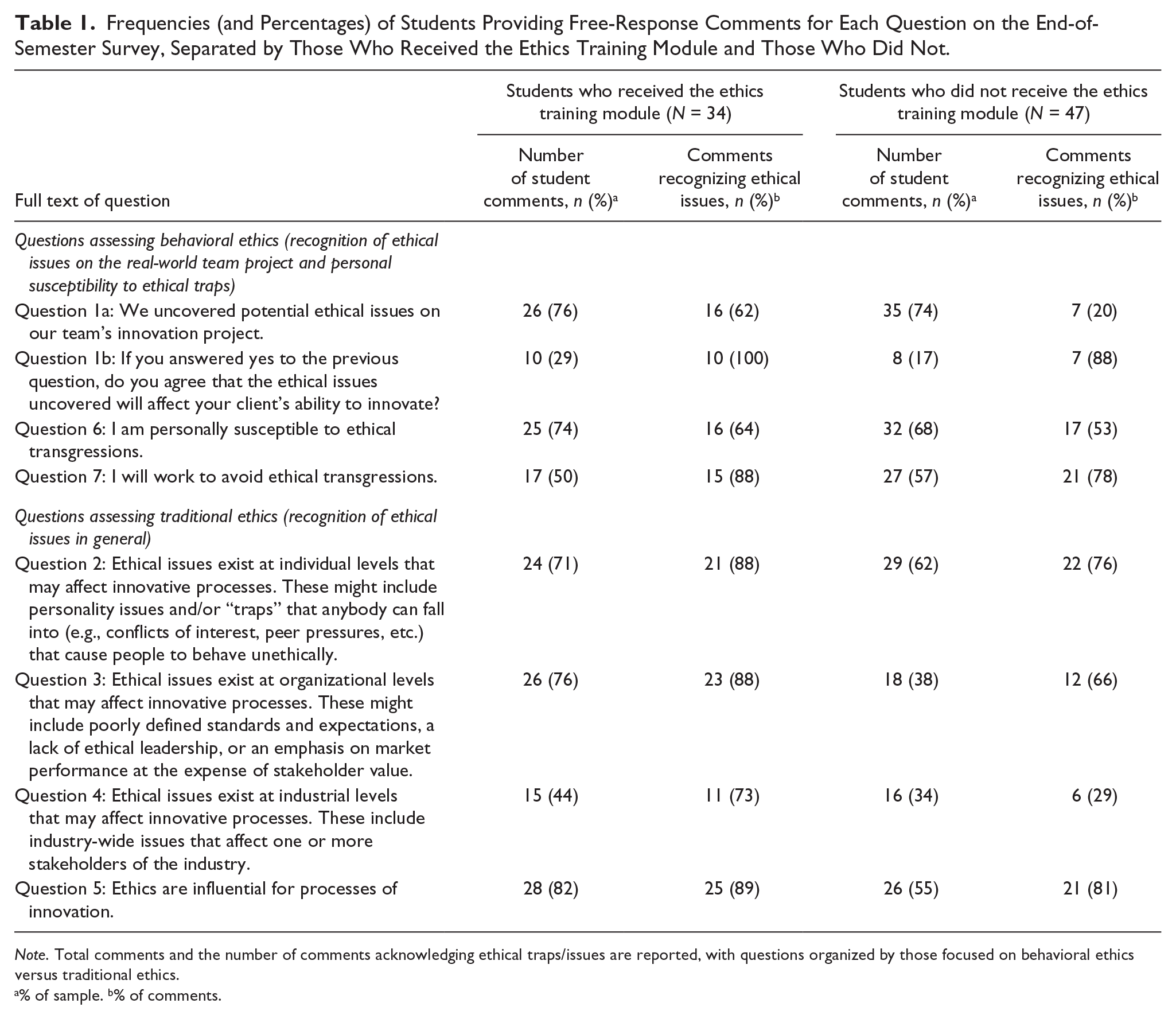
Note. Total comments and the number of comments acknowledging ethical traps/issues are reported, with questions organized by those focused on behavioral ethics versus traditional ethics.
% of sample. b% of comments.
Results
Student end-of-semester comments support the efficacy of the ethics training module in allowing students to recognize, confront, and correct ethical dilemmas within the context of the team projects. Due to the interests of this exploratory study, the discussion focuses on the comments of students who received the ethics training module, to illustrate the potential benefits of this intervention.
General Awareness of Ethical Issues
Students’ comments expressed that behaving ethically is important and that ethics are important for innovation. For example, one student reported that “it’s important to develop a good understanding of ethics and build ethically strong businesses.” Another recognized that although “the client may still be able to innovate [when behaving unethically], these ethical issues can later sabotage their ability to [implement] innovations.” In a similar vein, one student expressed that “if they [the client] are unethical, they may have more options to be ‘innovative’, just in the wrong direction.” Overall, students seemed to possess a robust awareness of both the general importance of ethics for successful innovation and creation of value.
Recognition of Ethical Issues on Team Projects
When asked if they encountered potential ethical issues on their teams’ innovation projects, students who received the ethics training module often directly connected components from the module to their experiences. One student noted how their “team was aware of [ethical] traps and [because of this] we were able to avoid them.” Another commented that they now “understood how to avoid the pitfalls and [ethical] traps.” In addition, that same student suggested that failing to monitor ethical issues can “cause individuals to work for [themselves] and not for the team” and while creating “more options to be ‘innovative’ in [unethical] ways, these self-serving actions will ultimately promote ‘the opposite of innovation.’” Some students expressed concern about unrealistically “high expectations” and “pressure” from the clients. One highlighted the need to “follow their [the client’s and the industry’s] rules,” despite the ethical issues that might arise. Overall, it seemed that the ethics module positively influenced students’ abilities to recognize, and alter their responses to, real-world ethical issues on their team projects.
Recognition of Ethical Issues for Oneself and Intentions to Behave Ethically
Students’ comments also indicate that the training module influenced their recognition of their own susceptibility to ethical lapses. One student discovered their tendency to “take the easy way” and a realization that, despite short-term gains, these shirking behaviors might “lead to a less productive end product.” In recognition of the prevalence of ethical transgressions, several students noted that “everyone is susceptible at some level.” Others reflected on their past behaviors to “cut corners,” “owning responsibilities when it comes to deadlines,” and failing to confront other’s unethical behaviors because of their propensity to be “easily influenced by other peoples’ reactions [and] negative responses.” Many students expressed a willingness to work to avoid these ethical transgressions in the future. For example, one student indicated that they will “grow from [the experience of an ethical issue]” and another “will work to take [unethical behavior] out of my life.”
Comparison With Students Who Did Not Receive Ethics Training
Overall, the students who did not receive the ethics training module appeared to respond differently to the questions about ethics. When asked if there were ethical issues on their team projects, few identified problems (only 6 of 35 comments). More common were claims that “we didn’t have any ethical issues” or “I didn’t notice anything unethical in our project.” Focusing on potential ethical problems at individual, organizational, and industry levels, control students made comments such as, “there were no issues; the project went off without a single hitch,” “I don’t think ethics has to do with whether or not a client organizes things properly,” and “I don’t know how this affects our client.” Though some students naturally recognized a susceptibility to ethical transgressions, there were also strong claims from students that they were immune. For example, “I believe that I would not do something that is unethical, no matter the circumstances” and “I am not inclined to commit such transgressions.”
Summary
Despite the preliminary nature of this data, there are valuable insights from this exploration for management educators. One student from the ethics training group nicely summarizes these takeaways by writing: “I try to avoid ethical issues by keeping my eye out for them. If you know there’s an issue, then you can solve it.” The preliminary data support that students had a well-defined understanding of the general importance of ethical issues that exist in real-world business situations. However, the assessment moves beyond general awareness to focus on the self. Typical college courses often lack opportunities to diagnose and respond to ethical issues, and students are susceptible to psychological biases that prevent them from honestly reflecting on, and learning from, their own ethical lapses. Consequently, a synthesis of behavioral ethics training with PBL provided new opportunities for students to “know there’s issues” that might cause them to behave unethically and to equip them with the tools to “help them solve them.”
Discussion
The current study revealed that, after taking part in an ethics intervention, which focused on self-perception biases and psychological traps, students recognized ethical challenges in their real-world innovation projects. Importantly, students were also likely to recognize their own susceptibility to biases and were committed to avoid ethical transgressions. Students’ feedback provides insight into the impact of the intervention on ethical reasoning and behaviors of students. These insights are particularly noteworthy because the assessment of students’ experiences took place 11 weeks after the intervention was delivered (a marked improvement over similar studies where participants are assessed immediately following interventions), suggesting durability of the training, at least within the context in which it was delivered.
Lessons for Behavioral Ethics Education
Lesson 1: Small, but Timely, in-Context Interventions Work
This study suggests that an effective way to improve ethical behavior may be to provide small, in-context interventions to students. Rather than focusing on broad, one-time ethics training programs, educators could be trained to incorporate behavioral ethics through frequent inquiries about ethical blind spots within each new project. When the prompt is tied to a specific project—and students are reminded that (a) ethical traps exist and (b) they may be blind to the presence of their own biases—students may perceive themselves and their work differently.
In this study, the student project was not merely a simulation or hypothetical case. Though case studies such as Olympus and Enron are discussed, students also spent time reflecting on their own team, client, and industry. The teams worked with real clients to provide a service, creating meaningful consequences of both success and failure. In the same way that behavioral economics research relies on real decisions (e.g., gambles using real money; e.g., Hertwig & Ortmann, 2001), it may be the case that behavioral ethics education should rely on real (rather than case or simulation-based) learning. Research suggests that real and hypothetical decisions are not equivalent (e.g., Pronin, Olivola, & Kennedy, 2008), due in part to psychological distance (Liberman, Trope, & Stephan, 2007). For example, students might recognize biases and psychological traps in a hypothetical case, while simultaneously thinking that they would never head down an unethical path themselves.
Lesson 2: Focus on the Self to Reduce Ethics Blind Spots
This study attempts to demonstrate an important tenet of behavioral ethics—that there is a difference between knowledge of general ethics concepts and actual ethical awareness and behavior. While much of ethics education strives to build a general ethical literacy or moral awareness (e.g., Rest, 1986), our student feedback suggest that ethics education may improve by incorporating psychological traps with education about self-perception biases. Qualitative comments suggest that the ethics intervention was effective in mitigating the BBS within the context of the teams’ applied projects and that students readily identified ethical challenges in their work (rather than denying them).
We suggest that it is crucial that ethics education focus on both ethical traps and self-perception biases (e.g., BBS, FAE). One risk of only educating students about ethical traps is that it simply makes them more aware of how everyone else is prone to them. For example, the Giving Voice to Values framework (Gentile, 2010) does an excellent job discussing biases that people possess in ethical dilemmas (e.g., rationalizing decisions or falling into common scripts), but this may not change behavior if individuals believe they are personally immune from those biases. Thus, we believe the discussion of the FAE was a crucial component of our intervention, because it highlighted self–other perceptional asymmetries—by doing so, it encourages students to question if their self-perceptions were fair or if they had fallen prey to the BBS. Increasing students’ awareness of the likelihood that they are biased, rather than allowing them to rely on flawed introspections, is critical for advancing ethics education.
Limitations and Future Directions
Additional Evaluation Through Experimental Design and Analysis
This study provides a preliminary exploration of the effectiveness of this behavioral ethics intervention. Students provided feedback indicating a strong recognition of real-world ethical challenges and of their own fallibility when it comes to psychological traps and biases—a crucial first step toward shaping behavior to be more ethical. However, the analysis relies only on preliminary qualitative data and does not allow for statistical assessments of the impact of the intervention.
Future studies of this intervention should include a carefully controlled experimental design, allowing researchers to compare the experiences of students in the ethics intervention to those who did not receive the intervention. This design should continue to collect the rich, qualitative data (e.g., open-ended feedback about experiences), but should add key quantitative data (e.g., responses to Likert-type scale items assessing awareness of ethical challenges and self-perceptions of susceptibility to bias). Pre- and posttraining measures could be collected to assess the magnitude of change.
A design such as this would allow for confirmation of the initial patterns observed in this study, as well as the exploration of additional pedagogical questions. For instance, in addition to evaluating individual-level benefits of the intervention, an experimental design would allow for between-team comparisons (e.g., Does the domain of the team’s project impact the effectiveness of the intervention?) and within-team evaluations of contagion (e.g., If only part of the team receives the intervention, does their new perspective on ethics spread to other members of the team?). This information would strengthen the current support for inclusion of self-perception biases in behavioral ethics education.
Directionality and Scope
Because these student comments were collected near the end of the project, we could not determine if the reduction of the BBS led to increased awareness of ethical problems, or vice versa. However, prior research supports the notion that clarity of self-perception (i.e., recognizing one’s own susceptibility to biases) allowed students to see possible ethical traps present in their work.
We have speculated that the training was effective because it took place within the context of the class/project. However, we do not have data indicating whether this reduction of the BBS generalized to other contexts as well. For example, it is possible that students were faced with a similar team project in another course but did not recognize ethical challenges or their vulnerability to unethical behavior in those contexts. Unfortunately, we do not have data illustrating whether students’ reduced BBS was limited to the interdisciplinary team context in which they were tested, because we do not have assessments from other classes.
Conclusion
This pedagogical intervention highlights a potential opportunity for current ethics education—despite learning about the many ways people can be influenced to act unethically, real behavioral change depends on students’ beliefs that they are personally susceptible to such influences. Thus, based on the current findings, we suggest that ethics education should include a focus on self-perception biases (e.g., the BBS or the FAE). After doing so, simple, in-context interventions may be effective for encouraging recognition of ethical dilemmas and ethical behaviors.
Footnotes
Appendix
Complete List of Comments From Students Who Did Not Receive the Ethics Training Module (Control Condition), Collected in Week 15 of the Course.

| Student | Full text of student written response to each question |
|---|---|
| Question 1a: We uncovered potential ethical issues on our team’s innovation project. | |
|
|
|
| 1 | We have a small public government project with no real ethical implications. |
|
|
|
| 3 | We uncovered nothing unethical relating to the project. |
| 4 | Everyone has their own unique way of learning, doing, or innovating. |
| 5 | Our team got along quite well and followed the team charter so there haven’t been many ethical problems. |
| 6 | We didn’t have any ethical issues. |
| 7 | I feel there aren’t any ethical issues that are in the here and now in our team or surrounding projects. |
| 8 | I don’t feel like there was really a big enough issue to have any ethical component. Our solution/problems were not related to ethics. |
| 9 | Good topics to think about. |
| 10 | Everyone works differently and has different strengths. |
| 11 | We talked mostly about positive psych and loving your job. We briefly talked about ethics, but not to any extent. |
| 12 | She is mostly doing what others say to do. |
|
|
|
|
|
|
| 15 | I didn’t notice anything unethical in our project. |
| 17 | Our client brings a neutral presence to the team/project. She “cut us lose “and checks up, making any issue between us nonexisting. |
| 19 | We tried to create environment gains. |
|
|
|
| 21 | We’re converting an existing thing into a more mobile format. |
| 22 | We didn’t go in depth about ethical issues of our individual teams. We mostly discussed the TED talks. |
| 29 | We completed the work ethically, therefore, there are no transgressions. |
| 30 | My team and I completed the work ethically. |
|
|
|
| 32 | We didn’t uncover any issues throughout our time working. |
| 33 | Making people aware about an illness. |
| 34 | Our ethical issues were none, we knew when it is time to work and when to have fun. |
|
|
|
|
|
|
| 38 | There were none that we found, we have had a very stable and consistent team. |
| 39 | Our client’s interactions did not indicate. |
| 40 | Our innovation project had to do with the producing and marketing of a scientific instrument, which did not go against any easily foreseeable ethical standard. |
| 42 | We’ve worked cohesively without any issues beyond a time related one such as falling behind. |
| 44 | Been a pretty smooth ride; only major problem was miscommunication and that has not been resolved. |
| 46 | Our team seems ethical and strong. |
| 47 | The TED talks were more about personal motivation rather than ethical choices related to the team. |
|
|
|
| Question 1b: If you answered yes to the previous question, do you agree that the ethical issues uncovered will affect your client’s ability to innovate? | |
|
|
|
|
|
|
|
|
|
|
|
|
|
|
|
|
|
|
| 33 | People need to be more aware. |
|
|
|
|
|
|
|
|
|
| Question 2: Ethical issues exist at individual levels that may affect innovative processes. These might include personality issues and/or “traps” that anybody can fall into (e.g., conflicts of interest, peer pressures, etc.) that cause people to behave unethically. | |
|
|
|
|
|
|
|
|
|
|
|
|
|
|
|
|
|
|
|
|
|
| 8 | I don’t know if they really affected us because our team got along so well and openly communicated about issues when we could. |
|
|
|
|
|
|
| 13 | Did not happen with us, but I can understand that issues like this can cause distortions. |
|
|
|
| 15 | Didn’t notice any. |
|
|
|
|
|
|
|
|
|
|
|
|
|
|
|
| 29 | There were no issues; the project went off and proceeded without a single hitch. |
|
|
|
| 32 | We didn’t have issues that impacted any of us. |
|
|
|
|
|
|
| 39 | No ethical issues were encountered. |
|
|
|
| 42 | We have not encountered any issues that may affect our client. |
|
|
|
|
|
|
|
|
|
|
|
|
|
|
|
| Question 3: Ethical issues exist at organizational levels that may affect innovative processes. These might include poorly defined standards and expectations, a lack of ethical leadership, or an emphasis on market performance at the expense of stakeholder value. | |
|
|
|
|
|
|
|
|
|
| 3 | Can’t think of any. |
|
|
|
|
|
|
|
|
|
|
|
|
|
|
|
| 13 | I don’t think ethics has to do with whether or not a client organizes things properly. |
| 14 | None demonstrated with myself, team or client. |
| 15 | Didn’t notice any. |
|
|
|
|
|
|
| 30 | We had no ethical issues with the client or his organization. |
|
|
|
|
|
|
|
|
|
| 39 | Didn’t encounter. |
|
|
|
| Question 4: Ethical issues exist at industrial levels that may affect innovative processes. These include industry-wide issues that affect one or more stakeholders of the industry. | |
|
|
|
| 3 | Can’t think of any. |
| 4 | I don’t know how this affects our client. |
| 5 | Not sure how to answer this one. |
|
|
|
|
|
|
|
|
|
| 14 | None demonstrated. |
| 15 | Didn’t notice any. |
|
|
|
| 23 | “Hey I can do this thing . . . and free just give me $100/year for a license.” |
| 29 | No noteworthy issue. |
| 30 | No issues. |
| 32 | None to note. |
|
|
|
| 39 | No issues. |
|
|
|
|
|
|
| Question 5: Ethics are influential for processes of innovation. | |
|
|
|
|
|
|
| 2 | This is true, but technically unethical practices can be just as innovative, if not morally incorrect. |
|
|
|
|
|
|
| 6 | If you are doing something completely new, people might question the ethics because some are afraid of change. |
| 8 | Ethics are important to consider but are not necessarily influential in the actual process. |
|
|
|
| 12 | I don’t think they have much influence on the innovation process, but rather on the sustainability of the organizations as a whole. |
|
|
|
| 15 | Don’t be a scumbag. |
|
|
|
|
|
|
|
|
|
|
|
|
|
|
|
|
|
|
|
|
|
|
|
|
|
|
|
|
|
|
|
|
|
|
|
|
|
|
|
|
|
|
|
|
|
|
|
|
|
|
|
| Question 6: I am personally susceptible to ethical transgressions. | |
|
|
|
|
|
|
|
|
|
|
|
|
| 4 | I usually don’t do unethical things. |
|
|
|
| 6 | It is difficult to work on something if it’s completely against my ethics. |
| 7 | I am nonjudgmental in all aspects and therefore ethics issues don’t really follow me. |
|
|
|
|
|
|
| 10 | I make sure to keep my word and make sure that I do what I am supposed. |
|
|
|
|
|
|
|
|
|
| 15 | Lots of big words. |
| 17 | I believe that I would not do something I feel is unethical, no matter the circumstances. |
| 19 | I believe that I never caused an issue ethical problems. |
| 21 | I am a phenomenal a**hole. |
|
|
|
|
|
|
|
|
|
|
|
|
| 29 | I am not inclined to commit such transgressions. |
| 30 | I am not—but I do my best to act ethically in every situation. |
| 32 | I do my best to steer clear of these and make my voice heard if any bad transgressions are considered. |
|
|
|
|
|
|
| 39 | I try not to act unethically. |
|
|
|
|
|
|
| 44 | I’ve yet to make any notable or impactful ethical transgressions. Most conflicts I’ve been the personal cause of have been solved/fixed quickly and efficiently and none were ethical. |
| 47 | Not sure, very dependent of the situation. |
|
|
|
| Question 7: I will work to avoid ethical transgressions. | |
|
|
|
|
|
|
|
|
|
|
|
|
| 5 | By setting aside our differences, progress can be made rather than hinder. |
|
|
|
|
|
|
|
|
|
|
|
|
|
|
|
|
|
|
| 15 | This sounds like the right answer and I can tell I was in the “control group.” |
|
|
|
| 21 | I try not to be a phenomenal a**hole. |
|
|
|
|
|
|
|
|
|
|
|
|
|
|
|
|
|
|
|
|
|
| 37 | Keeping a clear mind-set and concentrating on the task at hand. |
| 40 | Sometimes we need to be unethical to do justice or right a wrong. |
|
|
|
|
|
|
|
|
|
|
|
|
| 47 | My ethics and different ethics. |
Note. N = 47. Written feedback was optional, resulting in a different number of responses on each question. Responses in bold indicate comments suggesting these students identified ethical issues on their team projects, the ways they are personally susceptible to ethical traps, or the prevalence of ethical issues in general. Statements were not bolded if they (a) were irrelevant, unclear, or unintelligible or (b) did not directly espouse the tenets of the ethics training module.
Acknowledgements
The authors would like to thank the Daniel’s Fund Ethics Initiative at the University of Colorado Colorado Springs for its support of ethics education across the College of Business.
This article is part of the Special Issue “Behavioral Ethics”
Declaration of Conflicting Interests
The author(s) declared no potential conflicts of interest with respect to the research, authorship, and/or publication of this article.
Funding
The author(s) received no financial support for the research, authorship, and/or publication of this article.