







Abstract
This qualitative study’s purpose was to evaluate how undergraduate business students’ perspectives, skills, and behaviors evolved through corporate social responsibility (CSR) education taught with a focus on critical thinking and sustainable problem solving. Business schools are struggling to incorporate CSR into their curriculum despite interest from students and pressure from accreditation agencies. This article primarily contributes practical tools for business schools teaching students to apply critical thinking skills and concepts gained through their business education to develop solutions to economic, social, and environmental problems. Instructors taught the following topics: definitions of CSR, the triple bottom line, stakeholder theory, exposure to social problems, businesses’ roles in exacerbating or mitigating social problems, specific sustainable solutions companies and nonprofit organizations have implemented, and analysis of public companies’ sustainability reports. Topics were taught using critical thinking tools, such as a decision-making model, a funneling exercise, a root problems activity, and reflection and metareflection. The instruction followed a specific teaching model to promote critical thinking skills development, which can be implemented by other faculty. We found CSR concepts motivated students by giving them the tools and confidence in their abilities to solve meaningful problems and learning outcomes for both CSR and critical thinking were achieved.
Keywords
Corporate social responsibility (CSR) encompasses responsible or sustainable business practices with a focus on people, planet, and profit—known as the 3Ps, or the triple bottom line (AACSB International, 2016; Elkington, 1997). Despite gaining considerable attention in corporations and business schools (Christensen, Peirce, Hartman, Hoffman, & Carrier, 2007; Porter & Córdoba, 2009; Toubiani, 2012), CSR remains challenging to implement in both contexts. Great variability exists in companies’ effectiveness implementing CSR practices (Brumagin & Cann, 2012), a phenomenon mirrored in business schools, which often struggle to incorporate CSR education into the curriculum (Christensen et al., 2007; Toubiani, 2012).
As many business students have not been exposed to CSR concepts (Christensen et al., 2007; Toubiani, 2012), the influence of business education on students’ views is yet unexplored. This qualitative study’s purpose was to evaluate how undergraduate business students’ perspectives, skills, and behaviors evolved through CSR education focusing on critical thinking and sustainable problem solving. The following research questions guided the study:
Which mindsets or perspectives held by the students evolved the most from exposure to CSR education in business?
Which skills and behaviors were central to students’ development of a CSR mindset?
The Association to Advance Collegiate Schools of Business (AACSB International; 2016) recently called business schools to “demonstrate a commitment to address, engage, and respond to current and emerging CSR issues” (p. 6), making this study even more timely. The AACSB explained their motivation for the new requirement in the following statement.
Society is increasingly demanding that companies become more accountable for their actions, exhibit a greater sense of social responsibility, and embrace more sustainable practices. . . . Business schools must respond to the business world’s changing needs by providing relevant knowledge and skills to the communities they serve. (AACSB International, 2016, p. 3)
Business schools and faculty will need to respond by creating explicit student learning opportunities around CSR both for accreditation purposes and to meet society’s changing needs. We hope other business schools attempting to incorporate CSR education into their curriculum will be able to adapt the course design presented in this study.
Background
In the following sections, we present the ways prior work on CSR has been applied to business education, first in contrast to business ethics and then presenting the connection between CSR and sustainability.
CSR as Differentiated From Business Ethics
A critical area for teaching and research, business ethics education has been extensively investigated (e.g., Ford & Richardson, 1994; Piper, Gentile, & Parks, 1993; White & Taft, 2004). Though there is overlap (e.g., Arlow, 1991; Giacalone & Thompson, 2006), business ethics and CSR are different. Ethical decision making is usually framed as an individual or internal process (Ford & Richardson, 1994). Decision making for CSR occurs at an organization level and systems level, since organizations operate in the context of a larger system (Porter & Córdoba, 2009). This study and corresponding course were focused on CSR at an organizational level, rather than ethical issues encountered as individuals.
CSR and Sustainability in Business Education
In contrast, CSR and sustainability are more closely related. Modern sustainability efforts extend beyond the environment to include people and profit (AACSB International, 2016; Elkington, 1997). With CSR, companies are held “more accountable for their actions, exhibit a greater sense of social responsibility, and embrace more sustainable practices” (AACSB International, 2016, p. 3). Based on the AACSB’s framing of CSR and sustainability, we partner CSR with sustainability as it relates to business education.
CSR and sustainability have been evaluated in business (Bradfield, 2009; Jonker, 2006) and business school education (Benn & Dunphy, 2009; Kletz, 2009). However, dissonance between practice and intent in CSR motivates the need for quality CSR education in business schools. For example, Lamsa, Vehkapera, Puttonen, and Pesonen (2008) compared Finnish students’ perceptions before and after business school and found students increasingly valued the shareholder model and devalued equal-opportunity employment. These findings imply “the educational context is creating an undesirable tendency among future business professionals” (p. 45). Toubiani (2012) suggested CSR education and implementation lack a social justice focus, which may drive a propensity toward the shareholder model. Toubiani (2012) also found, based on faculty and administrator perspectives, business school cultures are resistant to CSR, which aligns with Giacalone and Promislo’s (2013) discussion of the “stigmatization of goodness” (p. 86) as threatening to the bottom line in business school classrooms. Toubiani (2012) researched only graduate-level programs and focused on the institution level. The research leaves a gap in literature related to undergraduate students and the impact of grassroots efforts, initiated by individual instructors, on changing students’ perspectives.
Specific to undergraduates, Brumagin and Cann (2012) detailed a method for helping business students assess a company’s commitment and implementation of sustainable development, a component of CSR. The researchers claimed requiring students to utilize the method helped them “further develop communication and critical thinking skills that can aid the assurance of learning process required by many accreditation bodies” (p. 303). Our study expands on Brumagin and Cann’s (2012) work; we provide empirical evidence of how CSR and sustainable development education can help business students develop critical thinking skills by evaluating how their perspectives evolve after exposure to such concepts.
Conceptual Framework and Course Design
This study’s contributions are likely more practical than theoretical. Therefore, this conceptual framework is intended to provide other instructors with guidance, should they wish to adapt this course’s design to achieve similar learning outcomes. The conceptual framework, shared by the course and the present study, follows a critical thinking framework developed by Duron, Limbach, and Waugh (2006) and was supplemented by experiential learning theory (Kolb, 1984). Duron et al.’s (2006) five-step model is designed to “move students toward critical thinking” (p. 161) and relies heavily on Bloom’s (1956) taxonomy. In the following section, we describe how the critical thinking framework, supplemented with experiential learning theory, was used to design the course and teach students to use business skills to develop sustainable solutions to social problems.
The present section is intended to support others in developing CSR curriculum or using CSR to teach students critical thinking and problem solving. Two instructors cotaught the course, a researcher who is business faculty and a nonprofit organization founder who has implemented sustainable solutions to social problems, specifically, child slavery. The one-credit-hour, semester-long course was an elective for business majors. Students met as an in-person group with both instructors on a weekly basis. Class meetings totaled 15 hours across the semester, with approximately 3 hours of out-of-class work a week. Each week, students were required to complete independent tasks and bring their work to class for further discussion. Course grades were based on student participation, projects, and papers, rather than exams.
The course covered major CSR topics, including definitions of CSR, the triple bottom line, stakeholder theory, exposure to social problems, businesses’ roles in exacerbating or mitigating social problems, specific sustainable solutions companies and nonprofit organizations have implemented, and analysis of public companies’ sustainability reports. The following sections present learning activities students found most beneficial for skills development, correlated to Duron et al.’s (2006) model and experiential learning.
Step 1: Determine Learning Objectives
This step of Duron et al.’s (2006) model targets skills from the higher levels of Bloom’s (1956) taxonomy. The learning objectives were also supported by the Association of American Colleges & Universities’ (AAC&U; 2010) rubric for assessing problem solving, closely related to critical thinking. According to the AAC&U’s rubric, “problem solving is the process of designing, evaluating, and implementing a strategy to answer an open-ended question or achieve a desired goal” (p. 1). Table 1 presents course learning objectives mapped to Bloom’s higher levels and AAC&U’s problem solving rubric.
Learning Objectives Aligned With the AAC&U Problem-Solving Rubric.
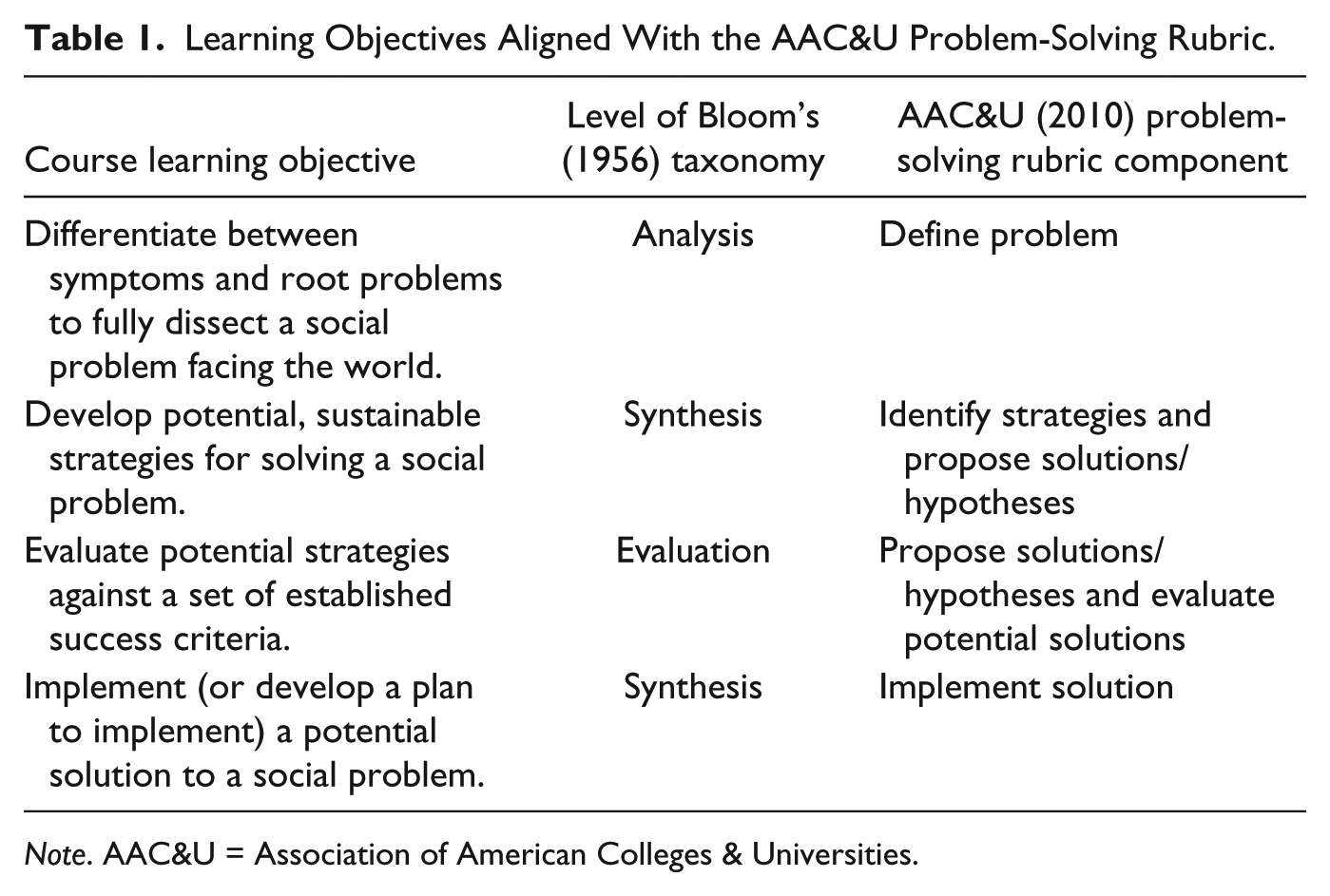
Note. AAC&U = Association of American Colleges & Universities.
Step 2: Teach Through Questioning
Duron et al.’s (2006) model values questions posed by teachers and students (Elder & Paul, 1997). In this course, instructors used divergent questions to purposefully allow for multiple correct responses, in an effort move students through higher levels of Bloom’s (1956) taxonomy (Duron et al., 2006). By their nature, the complex and significant problems addressed in this course never had one right solution; instructors often responded to student questions by explaining their thought processes.
For example, the class evaluated how companies had attempted to solve social problems in the past by reviewing their sustainability reports. Students then evaluated the companies’ practices and developed alternative courses of action. Discussions exposed students to some severe social problems and required them to form opinions, often diverging, about businesses’ roles in exacerbating or mitigating social problems. Additional practice being uncertain and solving challenging problems occurred throughout the semester through active learning and reflection, as prescribed by the third step.
Step 3: Practice Before You Assess
Duron et al.’s (2006) third step is based on Fink (2003), who emphasized the need for active learning to produce deeper thinking and better retention. Instructors incorporated experiential learning elements (Kolb, 1984) into course activities to create a learning environment where students learned through their problem-solving experiences, with support from instructors.
Active Learning Experiences
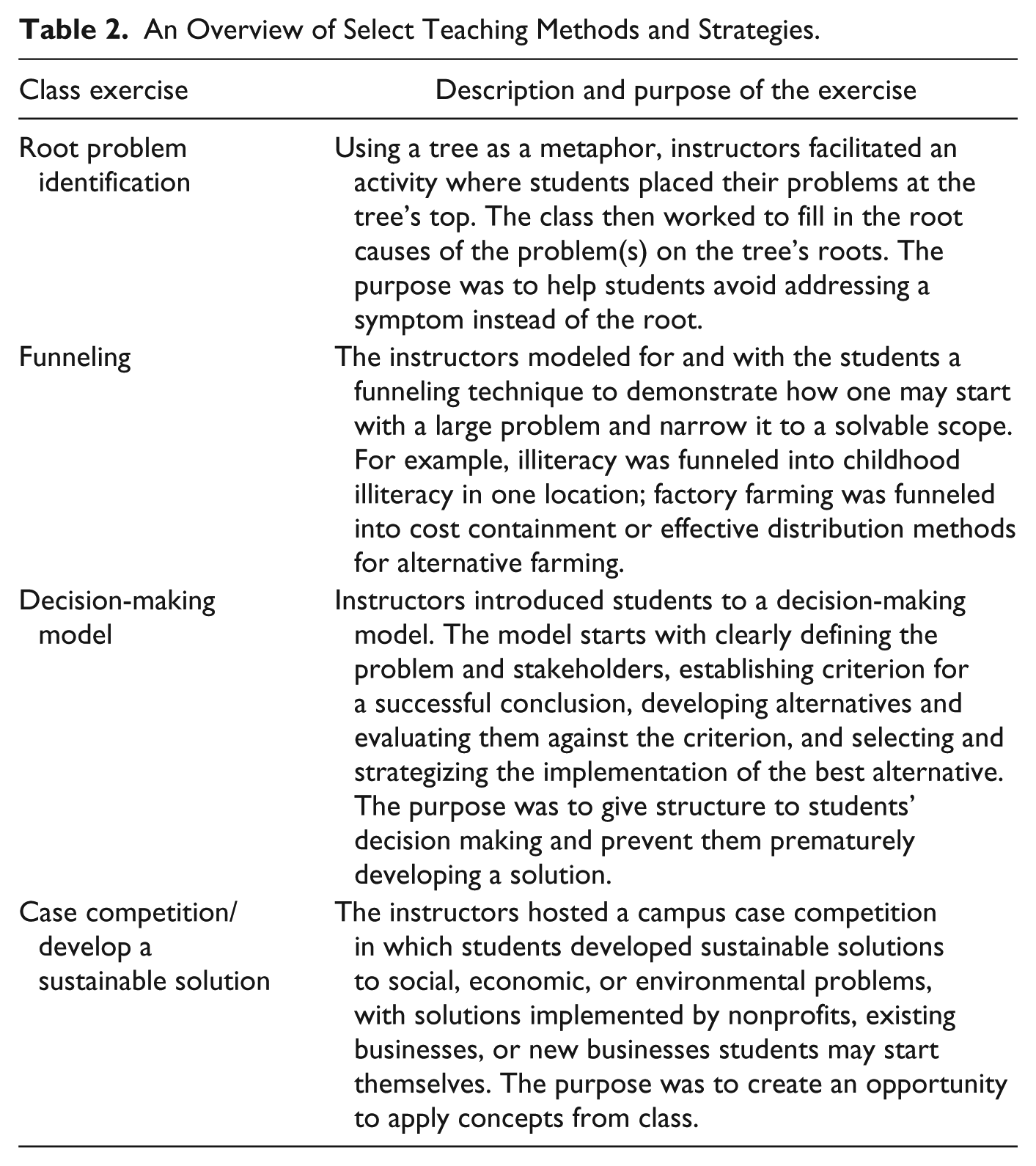
The course design incorporated active experimentation (Kolb, 1984) to prepare students to apply their learning, through the activities described in Table 2. Active experimentation challenges a learner to test knowledge gained through new actions such as decision making and problem solving, through cases and practice problems (Ferguson, Makarem, & Jones, 2016). In this course, a decision-making model, used throughout the semester, grounded students in a problem-solving method. Active experimentation pushes students beyond abstract conceptualization (Kolb, 1984), primarily derived from lecture or readings. The course culminated in a university-wide case competition. Active experimentation typically involves applying solutions to artificial situations. Conversely, the case competition was a concrete experience (Kolb, 1984), requiring students to apply concepts to a tangible problem existing outside the classroom (Ferguson et al., 2016). The case competition also required students to synthesize learning from other business courses, considering, for example, marketing, supply chain, and the financial implications of their solution recommendations.
An Overview of Select Teaching Methods and Strategies.
Reflection
Students participated in reflection as individuals, teams, and through class discussion (Duron et al., 2006). Ferguson et al. (2016) found reflective observation (Kolb, 1984) is an experiential learning component missing from most business school courses. Students’ weekly journal prompts were similar to those outlined by Duron et al. (e.g., What am I learning? What is the value of what I am learning? How am I learning?), but tailored to class content. For example,
Discuss the purpose of business. Elaborate on what you believe and what you have learned in your courses.
What makes you the most excited about making a difference in the world (passion)? What scares you the most about working to make a difference in the world (vulnerability)?
What businesses have you seen exacerbating social problems? What businesses have you seen resolving social problems?
The journal assignment culminated in a substantive metareflection essay, in which students described their progress over the semester regarding changes in mindset, integration of skills learned across their business curriculum, and the course’s overall impact.
Step 4: Review, Refine, and Improve
According to Duron et al. (2006), instructors should constantly review, refine, and improve the course based on student feedback and the instructor’s own reflections to better achieve critical thinking skills development. In this course, instructors used minute papers (a brief written response to an instructor prompt intended to guide student reflection or generate feedback in minimal time) and students’ journals to determine what students were learning, the most valuable content, the most impactful teaching methods, and lingering questions or challenges. Three factors indicated student difficulties: (a) weekly assignments were unsatisfactory, (b) students journaled about their troubles, and (c) open dialogue in class revealed students were struggling. As a result, instructors could identify the source of students’ difficulties and adjust class discussion and activities to bolster the corresponding skills.
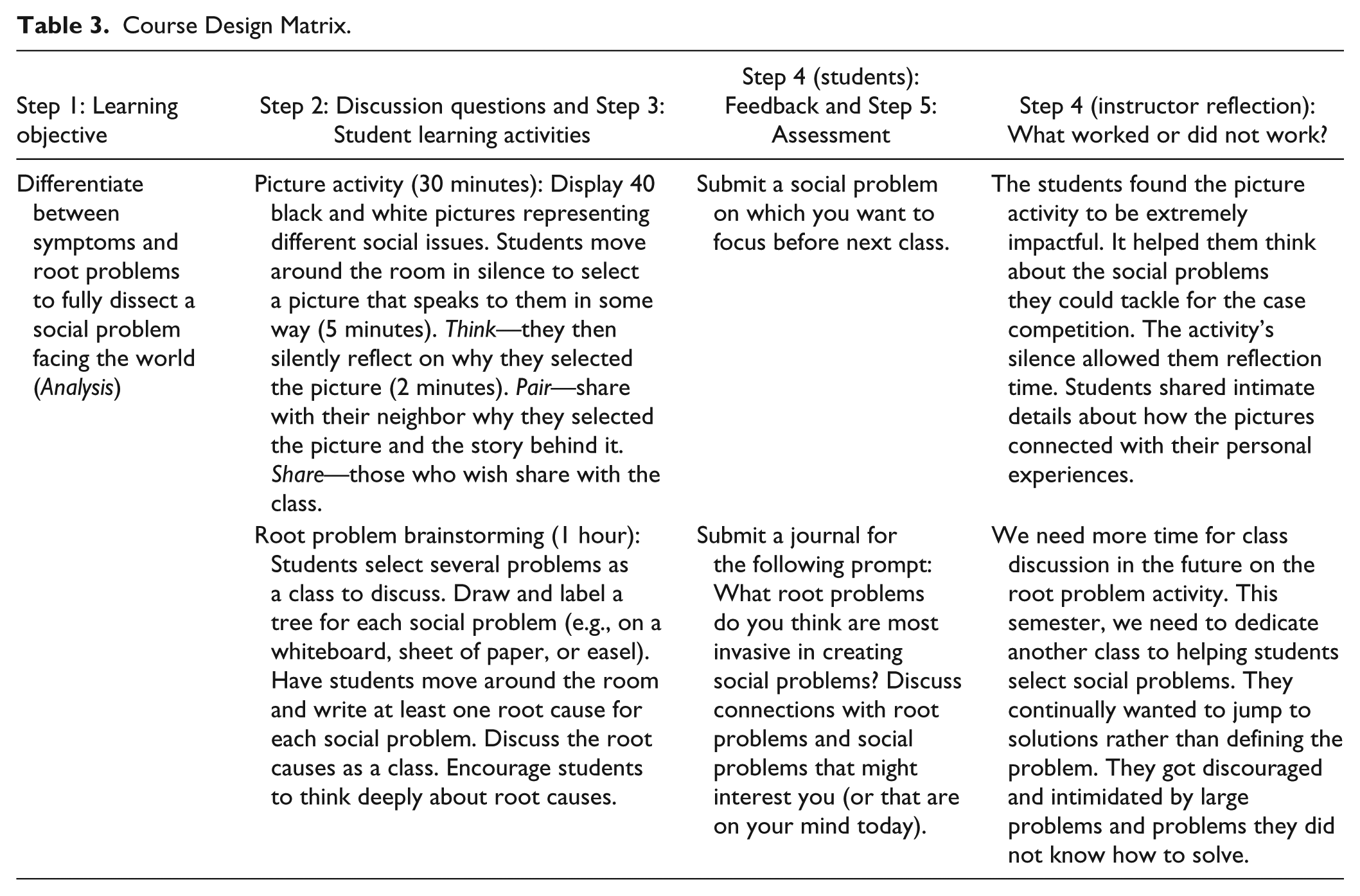
Mirroring Duron et al.’s (2006) model, instructors mapped each class meeting using the course design matrix, an example of which is presented in Table 3. Immediately after each class, instructors reflected on what did or did not work and adjusted as needed for the following class meeting, occasionally developing a new activity. Additional suggestions for future modifications are detailed in the recommendations section.
Course Design Matrix.
Step 5: Provide Feedback and Assessment of Learning
Instructors continually provided feedback to students and assessed their learning. The weekly journals and progressive assignments allowed instructors to monitor student progress and support students who were having difficulty. The students’ learning journals, used for assessment, also provided the foundation for the research to determine the course’s impact, as detailed in the following section.
Methodology
This qualitative study is situated in the context of a newly developed course challenging students to investigate business solutions to economic, social, and environmental problems as elements of CSR. The interpretivist perspective and qualitative research design enabled researchers to explore students’ perspectives with regards to CSR and their own personal learning and growth for the course’s duration, an investigation not possible through other paradigms or approaches (Lincoln & Guba, 1985).
Participants and Data Collection
Study participants were students enrolled in the newly developed CSR course taught in a business school at a top tier research university. All 14 students enrolled in the course were eligible and all consented to participate in the study. A university faculty member not associated with the course conducted the consent process. The course instructors did not know who had consented to participate until after final grades were submitted.
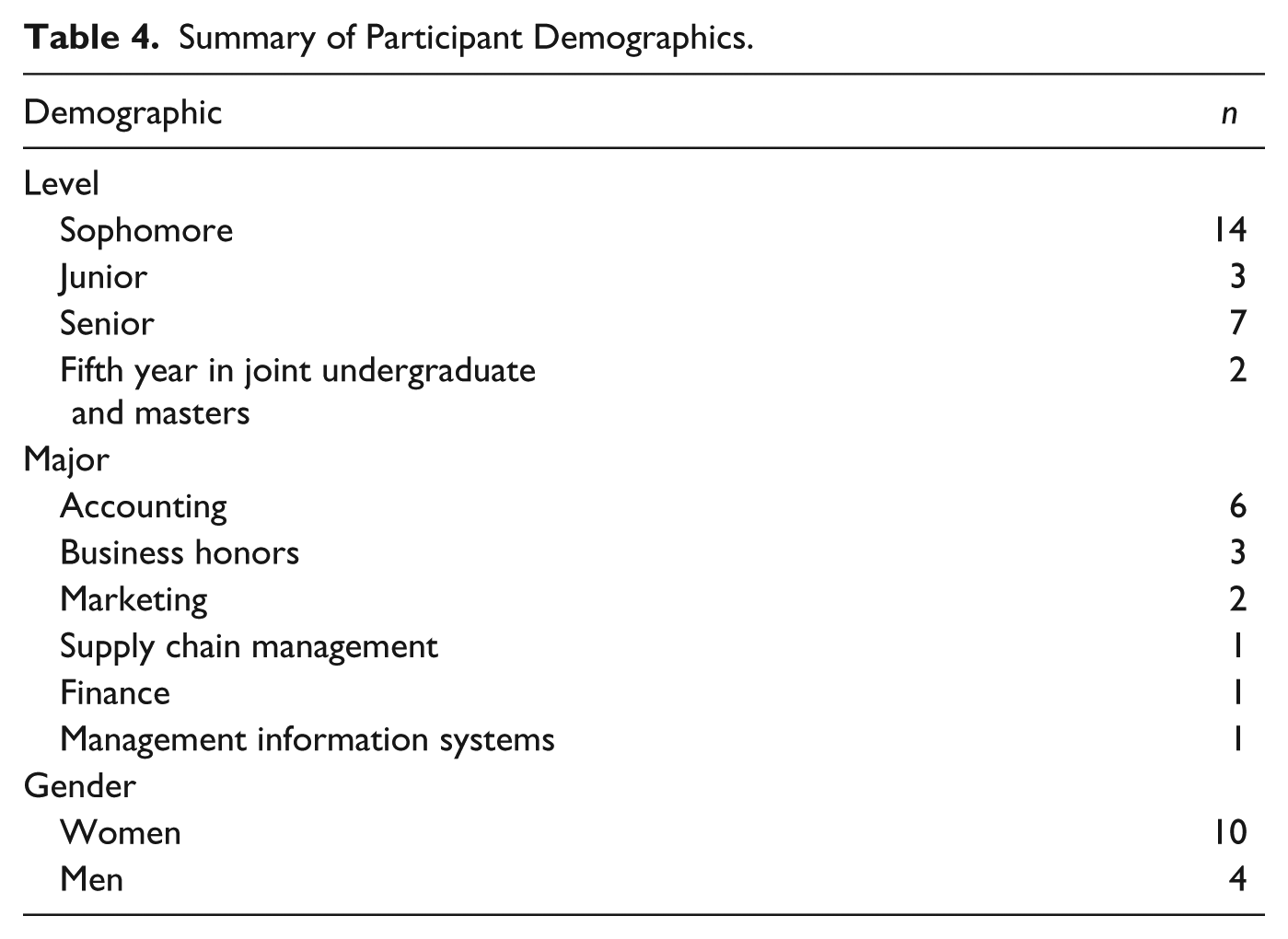
Table 4 presents a summary of demographic information. As traditional undergraduate students, ages 19 to 24, the participants’ lacked meaningful professional experience (experience was limited to low-skill summer, part-time, or volunteer work, and some internships). Therefore, that characteristic, while relevant, was excluded from the data analysis process. All participants are referenced by pseudonyms.
Summary of Participant Demographics.
Data consisted of student demographics and each student’s weekly journal entries and final metareflection essay. Students were required to respond to weekly prompts and included their emotional and cognitive reactions to their learning in the course. The first weekly journal entry was used as a preassessment. The prompt was designed to make explicit students’ perceptions of the purpose of business as learned in other courses and as they believed at the time. For the final metareflection essay, students were asked to reread their journal and write about their overall learning or any themes or patterns that emerged. Instructor observations and other course planning materials and documents were used for reference and triangulation.
As is common in qualitative research, this study did not use a control group. The researchers relied on participants attributing their growth and development to the course, which we do not believe resulted from natural maturation for several reasons. First, through previous studies, scholars have shown business students devalued tenets of CSR and placed additional value on the shareholder model as they progressed through business school (Lamsa et al., 2008). Additionally, the students were not exposed to CSR topics in other courses and the course lasted only one semester while students were on-campus. Participating students had previously encountered a variety of high-impact learning experiences (e.g., study abroad experiences, mission trips, and internships) and still experienced growth and development over the semester.
Data Analysis
Two qualitative analysis methods, thematic and narrative, were used to analyze the data (Merriam & Tisdell, 2016) and examine the stories students presented in their reflections regarding their challenges, successes, and intellectual growth and achievement through the semester. Using thematic analysis, one researcher unitized the data by dividing the metareflection papers into units, which are any phrase or work with independent meaning. A multicoder approach was utilized to contribute to the confirmability and dependability of the data (Lincoln & Guba, 1985), through the following process. Separately, each researcher used open coding, which allowed themes to emerge through a constant comparative method of assigning an existing theme or a new theme to new data as appropriate (Merriam & Tisdell, 2016). Each researcher then grouped the initial codes into common themes or categories using axial coding, finding common themes using the filter of the research questions. The analysis resulted in themes, presented in detail in the findings section, related to the evolution of students’ mindsets and skills development. Coding was independent of students’ journal topics, metareflection topics, and the problems students selected for their projects.
After the thematic analysis, the researchers determined the evolution of students’ views across the semester was important but obscured by the thematic analysis unitization. Therefore, the narrative analytic method was applied to examine the content of students’ metareflection papers as individual stories (Riessman, 2008). Both researchers independently read students’ journals from start to finish, identifying apparent themes in how students’ narratives progressed across the semester. Both analyses were refined through multiple rounds of review, in which researchers compared identified themes, evaluated any differences, and came to consensus for every unit. In the following sections, we present findings from both analyses.
For both the thematic analysis and narrative analysis, initial intercoder reliability, as defined by 75%, was achieved. Through collaborative refinement of the themes and evaluation of differences the researchers came to 100% intercoder agreement (Campbell, Quincy, Osserman, & Pedersen, 2013).
Findings
Findings are based on students’ self-reported data and an analysis of their progress recorded in their learning journals and metareflection. On entering the course participants had a desire to make a bigger and more positive impact on the world than they had previously seen from for-profit business, as evidenced by the students’ initial journal entries. However, students reported lacking the skills to take action. Through the course, participants developed criteria for evaluating solutions to social problems based on their long-term sustainability and viability. The course gave students tools for questioning, transforming, and expressing their beliefs, assumptions, and values. Although there were individual differences among students, findings indicated no notable differences among students’ perspectives based on gender, years in the program, or major.
Findings From the Thematic Analysis
The thematic analysis provided insight into both research questions. Addressing the first research question, students’ mindsets and perspectives changed related to business as a solution to social problems and their future careers. Regarding the second research question, students felt they developed critical thinking skills and gained confidence in their problem-solving abilities, which were important for solving social problems with a CSR mindset.
Perspective Change
Students expressed shifts in thinking about the role of for-profit and nonprofit businesses in addressing or solving social problems. Such perspective changes were evidenced in students’ metareflection and across their journal entries in comparison to the first entries, which served as a baseline for students’ perspectives. For example, Noble realized that “my role in solving generational poverty does not have to come from working in a nonprofit, but can come from working for for-profit corporation.” Honor stated,
After . . . looking at the role of a business from a different perspective, I realized I was compartmentalizing [nonprofit and for-profit]. A business’ goal should not just be to make a profit. A business should also help the community.
The students expanded their perspectives of a business’s purpose from primarily generating profit and maximizing shareholders’ wealth to benefiting society. Building on perspective changes, students also developed critical thinking skills.
Critical Thinking Skills
The course was designed to facilitate students’ use of business skills to generate sustainable solutions to social, economic, and environmental problems. We hoped students would develop as problem solvers and critical thinkers, but we were surprised by the magnitude of that development.
In evidence of success, the thematic analysis revealed ways in which students perceived their own critical thinking and analysis skill development. All 14 students discussed the impact one or more specific tools had on their thinking, in particular the decision-making model, the funneling exercise, and the root problems exercise (refer to Table 2 for details). For example, Felicity shared, “Sometimes I get so caught up in seeing immediate results that I miss out on the root problem entirely. In order to get a real, tangible results I must ponder on the very real, but intangible questions.” The root problem exercise helped her think more carefully about the complexities associated with social action.
In considering complicated issues, like the Syrian refugee crisis, Spring felt she had gained new skills. She explained, “Thinking about the refugee crisis still overwhelms me, but I’ve been able to think more critically now on how we might actually be able to solve some of the problems associated with this humanitarian disaster.” The ability to deal with complexity by applying thoughtful, methodical, and productive strategies was a revelation for students. Spring went on to elaborate, “Whether or not I am actually able to implement a solution to help these refugees, I am grateful to know that I now possess some skills to adequately assess future problems.” Every student was then able to connect those skills to other contexts.
Students described how they would apply their growing skills elsewhere in their lives, including other academic work, employment, philanthropy, and future careers. Felicity saw connections to all of her decision-making and shared, “I can use this frame of mind to solve any issue at hand.” Honor connected his skills to his future work and elaborated, “I think most businesses that want to find sustainable solutions [face] these barricades and challenges, but I believe this course has equipped me with the mindset and perspectives to help these organizations.” Zara summarized her growth this way: “Overall, the ideas I generate now for social problems are more complex and I have noticed how I dig a little deeper than I did before.” These findings were also evidenced in the narrative analysis, which investigated the stories students told in their reflections.
Findings From the Narrative Analysis
In addition to the thematic findings, 8 of the 14 students also had strong narratives in their journals about their changing perceptions and thought processes over the semester. The remaining six students did perceive changes, as described previously, but their development followed individualized paths. By applying narrative analytic techniques to further investigate students’ stories, we found a recurring structure among those eight narratives, as presented in Figure 1. The narrative analysis provided insight into the second research question related to how students’ skills and behaviors changed through the semester.
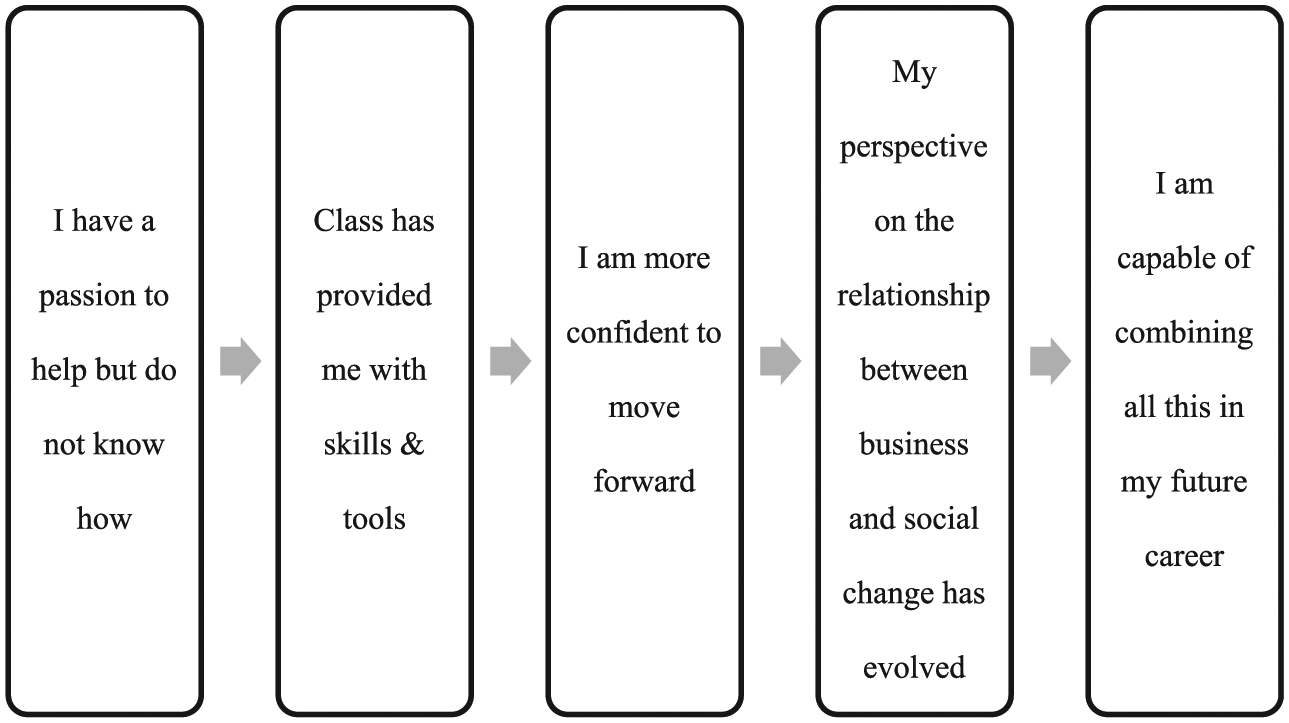
Students’ evolution of thought as evidenced in their narratives.
The students’ stories all began with their passion to help others. Grace shared, “I have been heavily involved in volunteer work since my childhood, and I have always had a passion for serving others,” a sentiment other students echoed. For seven of the eight students, passion and a desire to serve were the motivation for taking the course. Unfortunately, their aspirations were then tempered by feelings of being overwhelmed or not knowing where to begin. For example, as Charity described,
From a young age, I’ve had this vague idea about doing something to help people in poverty, but it’s always been just that, a vague idea. Throughout high school and college, I came up with plans and thought I had it all figured out, but when it comes down to it, I don’t. I’ve done a lot of wishful thinking, and created a lot of ideal scenarios; I’ve envisioned change, but I’ve also oversimplified it.
Charity had a passion to help others but also knew she lacked concrete plans and skills needed to make an impact for people living in poverty. For example, as Joy explained,
I have always been passionate about people, but I fear that I will not be able to make a true difference, or even worse, I will exacerbate the problem even more. . . . Everyone in the class had similar fears, but we could not let these fears stop us from pursuing a solution.
As part of the course design, students learned concrete tools and strategies to address social problems through manageable tasks and sustainable outcomes. Students acknowledged their growing skill set in their narratives. Joy detailed her changed thought process after a critical thinking exercise designed to identify root problems as opposed to symptoms:
It is easy to see the surface level problems that arise from a social problem, but what is really valuable is being able to see the root cause of the problem so you can stop it before it grows any further. For instance, it is easy to give money to someone homeless so that they can buy themselves a hot meal, or maybe a warm winter coat, but once that meal is gone, or that coat is threadbare, your aid is no longer helping them, and they are back in the position they were to begin with. This is a hard concept to wrap your head around because we would like to think donating money is always a good thing to do, and it will really impact those who need help, but when you take a step back and think of where the money actually goes, is it really helping anyone? Donating money is simple and easy, but if our money is going to solve a symptom rather than the root of a problem, then really, we are only holding off the problem in a very unsustainable way.
Joy came to understand, through class activities, how to examine problems critically to identify sustainable solutions, or at least eliminate the unsustainable ones. Similarly, Mercy described her experience with the funneling activity designed to take broad problems and make them more focused and manageable:
I was able to go from the broad idea of helping men, women, and children in prostitution, to a more precise and detailed idea. At the end of the discussion we had narrowed the social problem, it would be: to help runaway children in Texas who are homeless and unemployed by offering a safe heaven, a shelter, and even an opportunity for employment. It was incredible to see how with just a few questions, I was able to create a feasible solution to a problem that could potentially be sustainable.
Joy and Mercy, as exemplars of the eight student narratives, were able to articulate their newfound skills to address problems using course-provided tools.
Using those tools, students expressed an increased sense of confidence in their abilities. Pax believed, “After going through the course, I feel far more prepared to make a difference through sustainability, whether it is through another organization or on my own.” This expression of confidence is the opposite of the uncertainty students expressed early in their narratives.
In these eight narratives, students’ increased confidence developed into perspective changes toward social challenges in general and business solutions specifically. Students began to envision how to make a meaningful impact by beginning their own projects or working though for-profit businesses rather than only nonprofit organizations. For example, Noble realized,
My role in solving generational poverty does not have to come from working in a nonprofit, but can come from working for for-profit corporation . . . [and] . . . this course has grown me as a person to the point where I know I can effectively contribute to a company’s goals for profit, while also striving to solve the issues that are prevalent in our world.
The balance between profit, social good, and sustainability was a new perspective for the students.
The ultimate conclusion of student narratives was a strong sense of their own future agency and efficacy in addressing social problems through business solutions. Spring summarized,
When looking at an issue of this magnitude, it’s almost impossible to not feel overwhelmed and feel helpless to do something. But, I’ve learned to narrow down my focus on what it is I can work to fix and that makes it seem much more feasible . . . Throughout this semester, I think I have really learned just how much of an impact I want to have on the world around me.
Zara concluded, “I am now aware that I can make a radical difference in the world without having to pack my bags and live a drastic lifestyle . . .” and “I am for once excited for where that will take me in the business world.”
Discussion
In the following sections, we discuss the findings outlined previously and respond in detail to the original research questions, linking our findings to existing literature on CSR and sustainability in business education in the context of the course at this study’ center.
Students’ Mindset and Perspectives
Considering the first research question, the mindsets and perspectives that evolved most related to for-profit business’s roles in solving problems. Students began the course with the mindset that nonprofits were the best vehicle for solving the challenges facing the world. As evidenced in the findings, when asked what they had learned about the purpose of business students originally said they knew business was supposed to maximize shareholder wealth. However, students later wanted business to have a broader impact, despite criticism regarding the focus on profit (Louw, 2014; Marens, 2010; Welsh & Murray, 2003). Significant for business schools is CSR education’s role in changing students’ perceptions about ways business can address social, economic, and environmental problems. Exposure to CSR may counteract the tendency of business education, found by Toubiani (2012), to reduce students’ propensity toward social justice. Changes in perception about business’s orientation could entice more students, especially socially conscious students, to pursue business degrees. Additionally, students’ belief in their ability to address problems also changed significantly, which may help further attract and retain business students.
Student Growth and Development in Skills and Behaviors
Regarding the second research question, the most salient findings showed improved critical thinking skills and confidence in problem-solving abilities. The course focused primarily on CSR, but to develop sustainable solutions to difficult problems students needed stronger critical thinking and problem-solving skills. Student development was successful, in part, because of the issues selection process. First, as previously noted, the students struggled to select a problem they did not already know how to solve. If instructors had allowed them to apply known solutions, their journey overcoming a lack of problem-solving confidence would have been less evident. Second, students’ autonomy to select a problem aligned with their passions leveraged their intrinsic motivation and increasing engagement. In the course context, students’ enthusiasm for CSR and sustainability was enhanced because they addressed problems important to them and realized their own potential to solve problems. As evidenced in the findings, many students were already passionate about the problem they selected and CSR, consistent with other findings on millennials (McGlone, Spain, & McGlone, 2011). However, they did not know how to make an impact. The findings also demonstrate, by the course’s end, students felt empowered and excited to address complex social, economic, and environmental problems. We conclude when students gain confidence in their problem solving and have autonomy over which problems they explore, they will be invested and enthusiastic about CSR.
Much like ethical decision making (Meisel & Fearon, 2006), CSR decision making requires problem-solving skills. The earlier distinction we made between ethics and CSR becomes important in practice, because the organizational, or systems, orientation of CSR and sustainability may allow students to better understand the complexities of decision making, even within an ethical context. If students have a tendency to see themselves as “good” people, they may struggle to identify with poor ethical decisions. However, students can be more objective about CSR decisions, and more open to the complexities and nuances of such decisions, thus making CSR an excellent vehicle for teaching critical thinking.
A finding we particularly valued was students’ insight on transferring course skills to other courses and future professions, where CSR and sustainability are valuable and necessary. It is useful to see students consider course ideas and skills not just as academic concepts, but as a practice to adopt and apply elsewhere (Bradfield, 2009; Meisel & Fearon, 2006). We credit the transferability to the course design’s experiential learning elements.
The findings related to both research questions corroborate the value of experiential learning and teaching for critical thinking to help students evaluate their mindsets and perspectives and to aide their growth and development. Class activities created an experiential learning journey, which moved through all stages of Kolb’s (1984) model and challenged them to think critically by aligning questions, practice, review and assessment with learning objectives targeting higher level thinking. The course experience allowed students to be vulnerable and question their own positions, and instilled the confidence to explore challenging problems.
Recommendations and Conclusions
In this final section, we provide some concrete recommendations for practice in business schools and suggestions for future research and study. Instructors should be able to adapt the tools presented in this study to achieve similar outcomes in CSR education at other business schools. The present course (a) challenged students’ beliefs regarding nonprofit agencies, (b) expanded their perspectives toward businesses’ current and potential roles, (c) allowed students to see themselves as future business leaders in for-profit organizations working to address the world’s challenges, and (d) moved students from being overwhelmed by problems to feeling confident in their problem-solving abilities. The course design and framework outlined in this article, and summarized in the following paragraphs, can be used to achieve similar outcomes at other institutions. Furthermore, implementing similar courses can help business schools achieve their vision and mission by (a) meeting accreditation standards, (b) developing responsible future business leaders, (c) recruiting and retaining top students in a more socially conscious generation, and (d) positioning students to succeed after graduation with the ability and confidence gained from being able to address challenging issues.
The course design framework, which followed Duron et al.’s (2006) five-step model, was critical for the course and can be used by any instructor. Though the course was focused on CSR education, instructors recognized students needed stronger critical thinking and sustainable problem-solving skills to develop sustainable solutions to difficult problems. The course design facilitated students’ critical thinking skills development. Additionally, other instructors could adopt the active learning strategies presented in Table 2, and the reflection and metareflection activities integral to Step 3 (practice before you assess) in Duron et al.’s model.
The case competition provided an additional opportunity for students to practice with real problems and apply course concepts. For further detail on coordinating a case competition related to social problems, readers may contact this article’s corresponding author, or refer to Vassar (2015). Allowing students to select the social problem they addressed in the case competition increased their engagement. The freedom to select a social problem and the students’ social consciousness positioned CSR as an excellent vehicle for enhancing students’ critical thinking ability. Additionally, using real, relevant examples allowed students to see how companies address significant CSR challenges. Companies’ sustainability reports connected students to relevant examples of CSR in practice.
While most outcomes were positive, instructors encountered some challenges. The following are possible changes for improving future iterations of the course:
Allow sufficient class time for problem identification, specifically to encourage and support students in selecting problems they do not already know how to solve.
Create additional assignments to facilitate problem selection for students who did not come to the course passionate about a specific social problem. Such assignments could include interviewing nonprofit or business leaders addressing social issues, to discover how others’ found their passion.
Ensure all students are comfortable with each step in the problem solving model before encouraging them to move forward. The instructors established periodic deliverables throughout the course to act as checkpoints for moving through the problem solving model. The deadlines kept students on track but some students needed more flexibility. Instructors could remove intermediate deadlines, allow students to propose their own timeline based on their needs, and/or formalize one-on-one coaching sessions to monitor students’ progress.
This study’s findings highlight remaining gaps in the existing CSR education literature, suggesting more evidence is needed regarding best practices for teaching CSR. Business education could benefit from more action research, seeking the most effective methods for CSR education. Additionally, building on Toubiani (2012), the field could benefit from quantitative studies investigating the impact students’ exposure to CSR education has on critical thinking and problem-solving ability and their propensity for social justice.
Many students are concerned about the contributions they will make to the world (Christensen et al., 2007) and the public is increasingly aware of business’s role in society (AACSB International, 2016). The present study demonstrated that, by teaching business students to evaluate social problems from a business perspective, we have broadened the way they view their roles and the role of businesses in resolving such problems. Through intentional CSR coursework, students as future professionals are better positioned to make a positive impact and forward causes of social justice, sustainability, and diversity in any type of organization.
Footnotes
Declaration of Conflicting Interests
The author(s) declared no potential conflicts of interest with respect to the research, authorship, and/or publication of this article.
Funding
The author(s) received no financial support for the research, authorship, and/or publication of this article.