







Abstract
In recent years, scholars have become critical of mainstream leadership development approaches. In particular, Petriglieri and Petriglieri refer to the dehumanization of leadership, whereby leadership breaks its ties to identity, community, and context.
The purpose of this paper is to present an approach for humanizing leadership using the case example of George Washington University’s Organizational Leadership & Learning (OLL) program. Embedded in the critical leadership studies (CLS) approach, the humanizing principles, and the humanistic leadership paradigm, the OLL program’s leadership learning approach focuses on building a learning community and stakeholder engagement. I describe its pedagogical goals and instructional strategies that help promote a psychologically safe space where learners build trusting relationships, integrate diverse perspectives through respectful dialogues, and develop a sense of the “common good” and culture of equity through issue-centered learning. Using classrooms as “identity spaces” and “leadership learning laboratory” allows learners in the program to practice the co-construction of ideas through mutual influence and interactions. This paper makes a valuable contribution to developing future leadership development programs.
Keywords
Leadership is an important organizational phenomenon. In recent years, it has garnered greater visibility, increased expectations, and widespread dissatisfaction. On the one hand, leaders are increasingly expected to address the world’s grand challenges (George et al., 2016; Howard-Grenville, 2020). Surveys indicate that organizations are pressed to develop the next generation of leaders and improve leadership quality (for example, Ray, 2018 in Global Leadership Forecast). Simultaneously, public distrust of leaders is at high levels worldwide (Edelman, 2020). These negative feelings have been fueled by financial scandals that have highlighted apathy, ego, and greed among corporate leaders. Many scholars, as a result, have made calls for changing the way organizations develop leaders (Collinson & Tourish, 2015; Johnson, 2014) to help restore stakeholders’ confidence (Baron & Parent, 2015; Kellerman, 2012; Muff, 2013; Walumbwa et al., 2008).
While conventional approaches to leadership development (LD) are varied, these have primarily over-relied on narrow sets of assumptions that present leaders as miracle and powerful workers (Collinson & Tourish, 2015). Kellerman (2012) argues this is no longer true, as there has been a shift in the balance of power between leaders and followers, which has made follower-leader dissent more common than before. Collinson and Tourish (2015) also contend that romanticizing leaders, where a leader is considered a great man who can “know it all and do it all,” reinforces a male-centric view of leaders and contributes to society’s current fascination with superstar CEOs. In addition, it creates a disconnect between leaders, followers, and the institutions (Doh, 2003; Muff, 2013), leading to the dehumanization of leadership- a narrowing of leadership to a goal-focused activity that breaks its ties to identity, community, and context. The dehumanization serves as a valuable defense against uncertainties and the complexity of leadership in contemporary organizations (Petriglieri & Petriglieri, 2015). Hence it is no surprise that mainstream LD approaches prepare leaders whose actions and values reflect amoral ideologies, lack of concern for the society, positive attitude towards greed, and gender biases (Collinson & Tourish, 2015; Ely et al., 2010; Wang et al., 2011).
Based on the failure of conventional leadership education models, it is essential to open up the black box of leadership development (Conger, 2004). This shift may begin with efforts to humanize leadership by treating leadership as a personal expression and social stewardship (Collinson & Tourish, 2015; Mabey, 2013; Muff, 2013; Petriglieri & Petriglieri, 2015; Raelin, 2004). Petriglieri and Petriglieri (2015) assert that in order to “humanize” leadership, we must also be willing to “humanize” teaching and scholarship. With this in mind, this study focuses on: How can we humanize leadership education?
The paper integrates the critical leadership studies (CLS) approach, the humanizing principles, and the humanistic paradigm to inform this question. CLS helps emphasize the contextual, non-romantic, and co-constitutive aspects of leadership, and the last two highlight the positive potential of leadership (Alvesson & Spicer, 2012; Mele, 2003; Shapiro, 2016; Western, 2008) to promote human dignity and well-being (Khilji, 2019; Pirson, 2017). While there are several ways to humanize leadership education, this paper offers the example of George Washington University’s Organizational Leadership & Learning program (hereafter referred to as the OLL program) because of its deliberate emphasis on humanizing leadership education. Several other leadership development programs emphasize character building. However, these are the exception and not the norm. I present the OLL program as an additional (and
I present the paper in four sections. First, I discuss mainstream LD approaches, followed by the idea of humanizing leadership education, using basic tenets of CLS, the humanizing principles, and the humanistic paradigm (Alvesson & Spicer, 2012; Khilji, 2019; Mele, 2003; Pirson, 2017; Shapiro, 2016; Western, 2008). Next, I present the OLL program as an example of a leadership educational program with its focus on humanizing. I discuss its underlying values and pedagogical approaches. Where applicable, I use the qualitative data collected through program surveys, course evaluations, and student reflections to discuss OLL learners’ experiences. Based on this discussion, I present an approach for humanizing leadership education to help future LD programs. I conclude by highlighting lessons learned and the challenges experienced in delivering this program.
Leadership Development Approaches
Mainstream Approaches to Leadership Development- The Dehumanizing Effect
Many scholars have criticized the mainstream LD efforts for being ill-advised and misguided (Crossan et al., 2013; Hobson et al., 2014). Most of this criticism stems from LD programs that treat leadership as a transformational and upper echelon phenomenon (Raelin, 2004), create a rigid distinction between the follower and the leaders (Kellerman, 2012), and underestimate the “dynamics of power, the influence of the context, and significance of follower dissent” (Collinson & Tourish, 2015, p. 577). Conger (2004) argues that conventional LD approaches promote the idea of a black box of leadership, whereby complexity and ambiguity are considered unfathomable.
Hobson et al. (2014) argue that leadership education is stuck in a nascent stage and lacks intellectual rigor and institutional structure to address today’s grand challenges (George et al., 2016), such as the global pandemic and rising levels of inequities (Howard-Grenville, 2020). Fueled by the reductionist desire to break leadership into clean processes, conventional LD approaches present a narrow understanding of leadership—as simple prescriptive solutions focused on competencies, goals, and virtues (Mumford & Fried, 2014; Nelsen, 2006). Petriglieri and Petriglieri (2015) refer to this as the dehumanization of leadership (p. 627) because it ignores the nature of leadership as a form of personal expression and social stewardship (Selznick 1957), its emotional dilemmas, and relational dynamics (DeRue & Ashford, 2010). Dehumanization also reduces the act of leading from existential and cultural dimensions to commercial and intellectual ones (Petriglieri & Petriglieri, 2015). Scholars argue that a more realistic understanding of leadership should incorporate co-construction through mutual influence and interactions (Day, 2001; DeRue & Ashford, 2010; Morgeson et al., 2010; Schyns et al., 2011; Uhl-Bien et al., 2007).
Reconceptualizing Leadership Development- Focus on Humanizing
Critical leadership studies (CLS)
CLS offers an alternative and more nuanced approach to advance leadership education beyond a functionalist and leader-centric view of leadership. It foregrounds power, denounces a romantic view of leaders (as superheroes and demigods), and rethinks followership (Collinson & Tourish, 2015). CLS highlights pluralist interests within organizations to focus on leadership dynamics as the product of an ongoing social construction process between a myriad of organizational actors within diverse cultural contexts. In addition, CLS highlights that power relations are “socially constructed, frequently rationalized, sometimes resisted and occasionally transformed” (Collinson & Tourish, 2015, p. 585). Leadership, therefore, emerges as contextual, distributed, relational, situated, and contested. Adopting the CLS lens shifts the focus on the co-constructed, asymmetrical, and shifting dynamics between followers and leaders. Hence an emphasis is placed on: (a) creating awareness of the tensions and paradoxes that are inherent in the process of leading (Smith & Lewis, 2011; Weick, 2012), (b) becoming aware of the power and relational dynamics that enact leadership (and followership) (Collinson & Tourish, 2015), (c) learning to channel leaders’ (and followers’) motivation towards personal meaning (Crossan et al., 2013; Raelin, 2004) and social good (Pless & Schneider, 2016), and (d) treating leadership educational institutions as identity spaces (Petriglieri & Petriglieri, 2015).
The humanizing principles
To highlight leadership’s positive potential in addressing grand socio-economic challenges (George et al., 2016; Howard-Grenville, 2020; Rondinelli, 2009), it is also important to humanize it. Humanizing, in essence, refers to fostering human flourishing and fulfillment (Spaemann, 2000). Scholars have referred to four humanizing principles, including (a) promoting individual dignity, equality, uniqueness and capacity of growth, (b) respect of the individual, (c) fostering “ethics of care,” and (d) a concern for the common good (Mele, 2003).
According to the first principle, dignity is essential in humanizing. Bayefsky (2013), citing Kant, states, “Kant does hold that dignity grounds respect from others, and specifically equal respect” (p. 283). Hence, dignity is a relational act deserved by all parties, who should interact with each other in ways that are equal, honorable, congruent with, and promote human beings’ innate value and rights. Such a co-active view of human dignity works well as a foundation for a co-constitutive and relational view of leadership proposed by CLS. While the recognition of dignity implies essential equality, each person is unique. Hence, it is essential to recognize this uniqueness and diversity between individuals and groups (Mele, 2003). The second principle of respect for the individual is a direct consequence of recognizing the value of human dignity-considered the “golden rule” in many cultures and traditions (Lewis, 1987). The third humanizing principle, ethics of care, refers to affirmative norms related to willingness to take care and provide service. This principle is an expression of benevolence, which is necessary for human flourishing and fulfillment (Spaemann, 2000). An expansive, inclusive world view (Pirson, 2017) proposed by the fourth humanizing principle leads to interconnected individuals who form a community characterized by a sense of responsibility to the “common good.” Muff (2013) argues the importance of broadening the responsibility from serving narrow stakeholders to societal challenges. Overall, humanizing compels leaders to act in ways that honor human beings, upholds their dignity, promote equality, fosters a sense of responsibility, and promote well-being.
The humanistic paradigm
Pirson (2017) uses the aforementioned humanizing principles to lay the foundation of a humanistic paradigm. He posits four basic drives that guide all human decisions: dA or the drive to acquire resources, dD or the drive to defend against threats, dB or the drive to bond in order to form long-term caring relationships, and dC or the drive to comprehend in order to experience engagement and intellectual curiosity. These four drives are strongly independent, frequently in a state of conflict, and need to be continuously balanced in daily lives (Hicks, 2013). At its baseline, the humanistic paradigm presumes the balance of the four drives to provide basic human dignity. However, to allow human flourishing and fulfillment to occur (Spaemann, 2000), humans need to enable balancing of the four drives above the necessary dignity threshold. Doing so allows organizations to learn and promote practical wisdom. Nussbaum (2011) and Sen (2000) argue that humans draw on the capabilities of learning and practical wisdom through a wide range of practices, such as “stakeholder engagement” and “shared responsibility.” The development of these capabilities negates self-maximization and requires constant learning to allow for higher levels of well-being.
Contributions and challenges
The contributions of humanizing principles and the humanistic paradigm are two-fold. First, both highlight the positive potential of human nature, focusing on human dignity, well-being, equality, and learning capabilities. Second, they recognize the complexity of human behavior by emphasizing the need to continually balance the four independent drives. Hence, they align with CLS, which presents leadership as the co-constructed dynamics within organizations, characterized by complex and mutually reinforcing relations between followers and leaders (Collinson & Tourish, 2015). All of them view individuals as interdependent, recognize organizations with their paradoxes and shifting dynamics, and present leadership as relational, distributed, contextual, contested, and co-constitutive. They address leadership and organizational tensions through a balance of human drives, connection with others/relationships, recognition and respect for human dignity, and concern for the social good: by drawing on the learning capabilities and wisdom (Pirson, 2017).
This type of leadership is demanding and complex, particularly within a broader environment that emphasizes simple prescriptions and values efficiency (Nelsen, 2006). However, as leaders go through a global pandemic and face many grand challenges, it is much needed (George et al., 2016; Howard-Grenville, 2020). Hence, to strengthen the positive effects of leadership, organizations ought to acknowledge the complexity of leadership (Conger, 2004) along with its co-constructed aspects (Collinson & Tourish, 2015), and also focus on the humanizing principles (Khilji, 2019; Nelsen, 2006; Nussbaum, 2011; Pirson, 2017; Sen, 2000). Recognizing the limits of leadership (through CLS) while also considering its positive potential (through the humanistic paradigm) requires detailed and situational engagement with leadership education (Alvesson & Spicer, 2012). Below I describe an George Washington University’s Organizational Leadership & Leadership (OLL) program as a case example of leadership education that recognizes these complexities, while also paying attention to the positive aspects of leading.
GWU’S Organizational Leadership & Learning (OLL) Program
OLL is a graduate degree program at George Washington University (GWU). Initially offered as a degree in Human Resource Development since the 1970s, it was redesigned in 2014 and launched in an online format in January 2016. Currently, the OLL program is offered in both online and in-person formats. It is a 30-credit hour program, of which 21 credits are required, and nine credits are electives. OLL attracts students (hereafter referred to as learners) from various organizations and industries, including private, non-profit, international agencies, and the US federal government. In 2020, the average learner age was 29 years for the on-campus cohort and 31 years for online cohorts. Learners can complete the program as full-time or part-time students. There are 135 to 150 learners in the program at any given time, graduating 60 to 75 learners every year. The program caps the cohort size at 19 for online learners and 24 for in-person learners.
Since its redesign in 2014, the program leadership (hereafter referred to as the OLL program, OLL, “they,” “them,” and “theirs”) has collected various student and faculty data. The instruments used to collect data have included university-mandated course evaluations and various program solicited and administered surveys. The latter include (a) end-of-the-program surveys from graduating students, (b) faculty interviews by the program leadership to seek their input, (c) faculty observations of junior and new faculty members to provide them with developmental feedback, and (d) program surveys to capture real-time student experiences with the course content, including use of various assignments, multi-media, etc.
For the past 6 years, much of this data has been used to improve the OLL curriculum, including changing the sequencing of courses, adding new courses (and assignments), and re-evaluating ways to enhance peer-to-peer and learner-faculty engagement. In all of the surveys, learners provide qualitative comments that have proven valuable in OLL program’s continuous efforts to improve student and faculty experience. In this paper, I use selective student survey data to describe their experiences with various pedagogical approaches, assignments, and the process of learning.
OLL Program’s Leadership Learning Framework
The overall program goal is to develop responsible and humanistic leaders with a strong “learning” orientation and the capacity to develop themselves and others in their organizations and environments continuously (Nussbaum, 2011; Pirson, 2017; Sen, 2000). This emphasis makes the OLL program human-centric and learning-focused, where learners are considered interdependent. The CLS view (leadership as contested, contextual, social, and relational embedded within pluralistic organizations) informs the program (Collinson & Tourish, 2015). Overall, the OLL’s program philosophy (refer to Khilji, 2015a) describes organizations as sites of evolving human action, tensions, and paradoxes (Amburgey et al., 1993; Luscher & Lewis, 2008; MacKay & Chia, 2013). As will be explained below, these views inform the OLL program’s instructional strategies and influence class discussions.
Synthesizing the humanizing principles, humanistic leadership paradigm, CLS, and the program goals, three common leadership development themes stand out, including (a) the relational aspects of leadership, (b) honing a sense of responsibility, and (c) the heightened role of learning. These are all firmly embedded within the foundation of human dignity, respect, equality, and growth capacity; and underline the importance of co-construction, social good, and balance in selecting different pedagogical approaches. Table 1 highlights the expression of OLL’s leadership learning approach, along with the leadership development themes mentioned above. The discussion below describes this Leadership Learning Framework for informing their selection of pedagogies, instructional strategies, and outcomes.
OLL Program’s Leadership Learning Approach I—Theory to Pedagogical Goals and Learning Objectives.
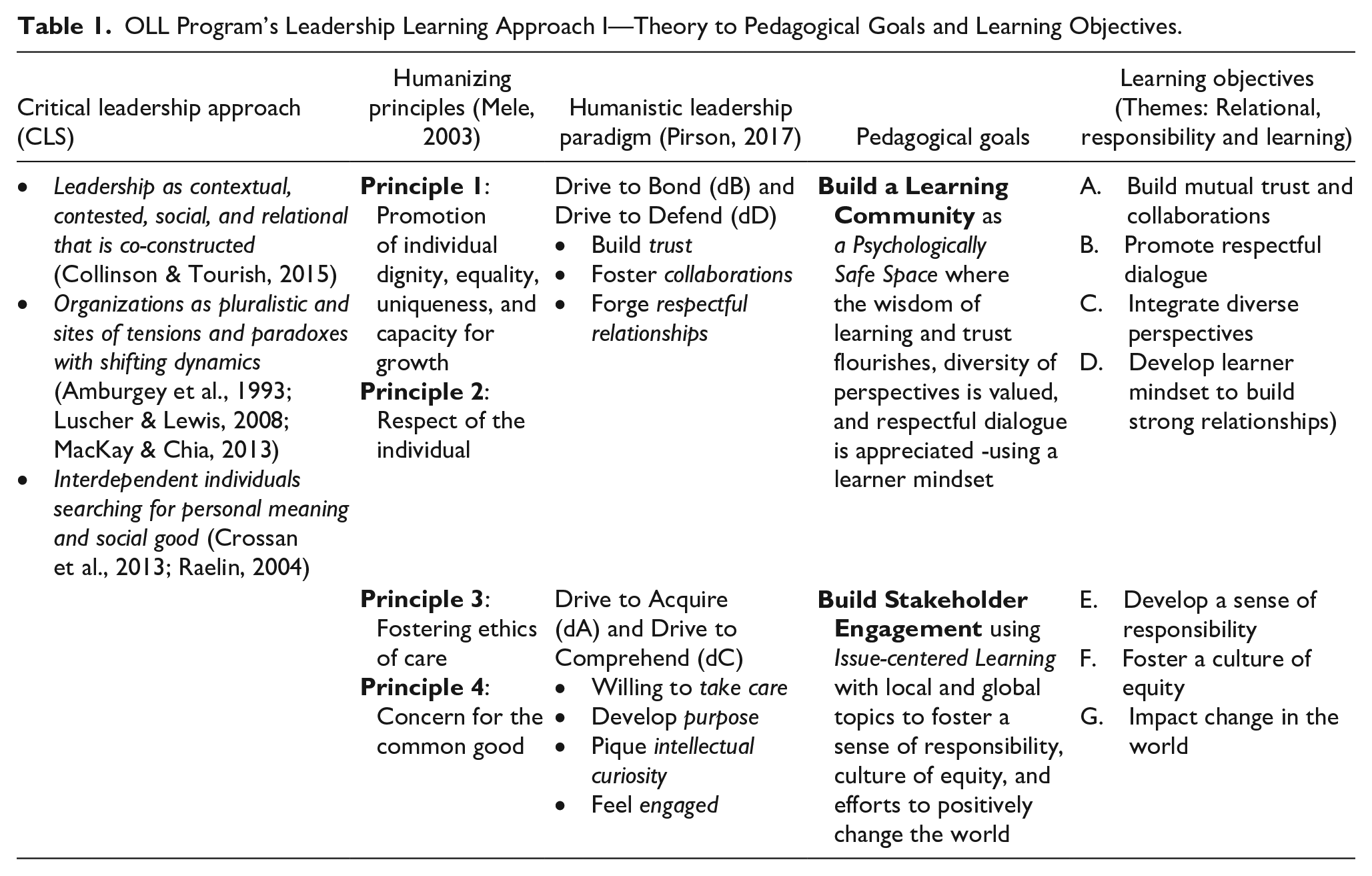
Humanizing principles 1 and 2 focus on recognizing individuals’ respect and promoting dignity, equality, and uniqueness. In essence, these two principles relate to the drive to defend (through collective strength), drive to bond (through long-lasting, meaningful relationships), and emphasize forging good relationships, building trust, fostering collaboration, and encouraging respectful relationships. Humanizing principles 3 and 4 promote ethics of care and concern for the common good. These principles are in line with the drive to acquire and drive to comprehend; they emphasize developing purpose, a sense of responsibility, stimulating intellectual curiosity, and feeling engaged. OLL program incorporates these four drives and humanizing principles into pedagogical goals that focus on building (1) a learning community as a psychologically safe space and (2) stakeholder engagement using issue-centered learning. Collectively, these goals encompass the three leadership development themes identified above, including (a) the relational, (b) honing a sense of responsibility, and (c) learning.
Below I describe a variety of instructional strategies used to reinforce the aforementioned learning agenda. In this paper, I highlight that by coupling CLS with humanizing principles and the humanistic leadership paradigm, OLL expands learners’ capacities to address contemporary challenges. Throughout my description, I use experiential evidence gleaned from OLL learners and program leadership to underscore the relevance of different instructional strategies.
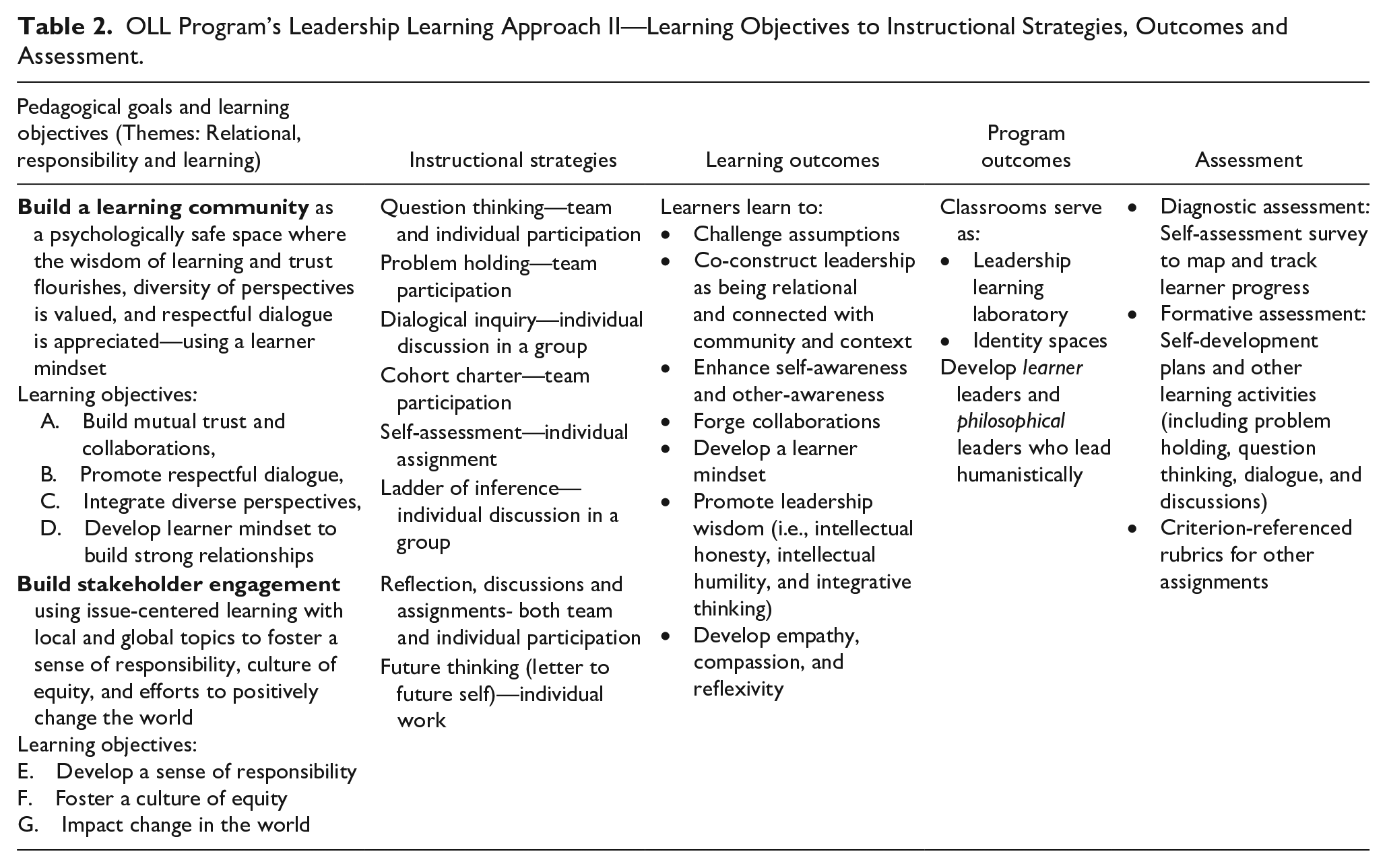
McCall (2010) argues that learning is highly contextualized and personalized, and leadership development often (also) happens through daily interactions (Johnson, 2014). The OLL program has incorporated this understanding into its curriculum. Through extensive and repeated practice (in classroom discussions, assignments, teamwork, learning community, and at work), learners become more fluent and intentional in their leadership practice and conceptualization (Anderson, 1999). Since instructional strategies are used in conjunction with each other and reinforced throughout the program through built-in group and individual activities, it is challenging to discuss each independently. However, I centralize pedagogical goals and learning objectives and present an integrative and nuanced discussion of how various instructional strategies collectively support opportunities for learners’ meaning-making and enhance their capacity to grow as leaders. Table 2 below captures this discussion (learning objectives, instructional strategies, outcomes, and assessment) to highlight the importance of intentional and deliberate planning of leadership learning programs and tying pedagogical goals and instructional strategies to learning outcomes and learning and program outcomes.
OLL Program’s Leadership Learning Approach II—Learning Objectives to Instructional Strategies, Outcomes and Assessment.
Pedagogical goal 1: Building a learning community as a psychologically safe space
Using humanistic paradigm (Pirson, 2017), particularly the drive to comprehend, allows the OLL program to emphasize leadership as a continuous learning process, where leaders “learn to lead” and “lead to learning” (Higgs & Rowland, 2010; Kouzes & Posner, 2012; Raelin, 2004). These underlying values help them build a strong learning community, as described below. They begin by honing in the idea of the wisdom of learning. Contemporary leadership requires making sense of environmental complexities and paradoxes (Smith & Lewis, 2011). Hence, they present leadership as much more than having only functional expertise and having answers to all questions (Collinson & Tourish, 2015). In the foundational course (Human Behavior & Learning within Organizations), they discuss that leadership is about accepting flaws and learning from mistakes. Using quotes such as, “failure sucks, but instructs” (Sutton, 2010, p. 2) and “the wisdom of learning” (Edmonson, 2011, p. 3), they highlight that leaders embrace failures and build a learning culture.
To build a learning community that is psychologically safe (Pedagogical Goal 1), they focus on creating an environment in which learners express themselves without fear and denial of experience, such that they are comfortable, challenge, and trust each other. Hence, the OLL program pursues four learning objectives (to organize the topics and also guide learning activities) throughout the OLL curriculum. These include building mutual trust and collaboration (Objective A), promoting respectful dialogue (Objective B), integrating diverse perspectives (Objective C), and developing a learner mindset (Objective D). Below I describe each learning objective and the instructional strategies used to fulfill the pedagogical goal 1.
Learning objective A (pedagogical goal 1)- build mutual trust and collaboration
Mutual trust is critical in leadership development. The OLL program deliberately builds honest discussion of experiences, deep engagement with issues, diversity of perspectives, and a psychologically safe environment. Hence, each cohort begins by co-establishing a cohort charter or a bill of individual and collective rights and responsibilities. Learners complete this activity over 3 to 4 weeks in a foundational class (in “Work, Groups, and Teams in Organizations”) class. They explore the nature of workgroups and teams in organizations and use an action learning approach to create open discussion, reflection, and co-construction of ideas. Once established, each cohort member is responsible for upholding these guidelines throughout the program. Examples of some rights and responsibilities, as co-established by some cohorts, include (a) seeking to understand each other and treat each other (and themselves) with compassion, dignity, and respect; (b) being open, inclusive, considerate, genuine, and vulnerable in all interactions, (c) commitment to team learning by actively seeking for a diversity of thoughts and challenging assumptions (self-evaluate) to unlearn old habits/views and learn new perspectives that maximize learning and make them effective leaders. A cohort charter helps achieve some important objectives. First, it allows OLL leadership to verbalize their intention of creating classrooms as psychologically safe spaces, where learning occurs through a mutual exploration of ideas and experiences. Second, it establishes a culture that promotes collaborative learning, self-awareness, other-awareness, a sense of responsibility, dignity, and respect. Hence, learners’ responsibility shifts to becoming collectively engaged with the issues (and complexities of leading), allowing them to move away from being passive learners, who may be merely concerned with acquiring skills and content to reflective, and self-directed learners. They come to realize the complexities of leading (Van Hout-Wolters et al., 2000). Their mindset also shifts as they make sense of these complexities to solve critically (Raelin, 2001; Weick, 2012). They begin to form and shape the context of a learning community within which they personalize their learning (McCall, 2010). They demonstrate these skills and internalize the awareness throughout the rest of the program, which other courses also reinforce through various self-assessment surveys. Often, learners reflect on these shifts in their assignments (for example, reflection papers), classroom discussions, program surveys, and course evaluations. The following comments reveal self-awareness, other-awareness, and a mindset shift towards collective and collaborative learning: In Public Reflection as the Basis of Learning, Joseph Raelin discusses the idea of a “collective identity as a community of inquiry.” I believe that the class charter allowed for fostering a collective identity that will continue to spur transformative learning for me. (Learner A, Class discussion, Summer 2019) In response to “what I have learned and unlearned”: I realized that my control-freak tendencies were holding me back from experiencing other ways of learning and approaching situations. I have always been open to different ideas, cultures, backgrounds, etc. However, when it came to the thought and application process, I gravitated towards similar individuals. I think that may have held me back from experiencing alternative processes, interacting with teammates who think outside my box, and falling into the trap that my process is suitable for every situation. I realize it is time to give up that control, embrace teams in a new way (appreciating the complexity of our methods), and trust my teammates a little more. (Learner B, Reflection Paper, Spring 2019)
Learning objective B (pedagogical goal 1)- promote respectful dialogue
Freire (1970) argues that human nature is dialogical. This view frames the OLL program’s deliberate effort to teach through dialogical inquiry. Hence, learners engage in dialogue with each other as they reflect on issues and topics collectively in classroom space. It allows the co-construction of new meaning and promotes the idea of co-constitutive and shared leadership. Through dialogue, learners provide arguments based on validity, evidence, experience, and not power. Overall, all of the classroom activities and assignments have a predisposition for questioning, thus facilitating learners to collaborate with others to find solutions. In these dialogues (through discussion of dilemmas, the multiplicity of ideas, and ambiguities), learners become aware of the complex experience of leading and begin to unpack power dynamics within organizations and teams. For example, while discussing inclusion, issues such as “color blindness” (Mor Barak, 2015) and “identity cover” (Brown, 2018) emerge. A learner may discuss the importance of “seeing individuals as a person” (Kean, 2017) as a way to build inclusive workplaces. However, after engaging in an in-depth dialogue with others, inquiry, reflection, and soul searching, their perspective might begin to shift. Some learners may conclude that seeing all “individuals as a person” takes away from a person’s whole experience and reality. Since brown or black skin is a huge part of their identity, it should not be neglected. Hence, when individuals start seeing individuals as persons, they start promoting color blindness. However, others may argue that seeing a whole person recognizes their complete identities. These open-ended, dialogue-driven discussions and engagement with diverse perspectives help learners reconnect leadership with their own identity, community, and context. However, at the same time, such dialogues help learners challenge their own and peers’ assumptions, construct personal meaning, appreciate relational, plural, and mutually constitutive aspects of leading. One learner articulated the power of dialogical inquiry in the following feedback that she shared with her faculty member: None of us is as diverse as all of us, so in that sense, no one person is qualified to teach this class. We are co-creating, learning through our various experiences and perspectives greater than the sum of its parts. The value of what you have done as the creator and facilitator is twofold: (1) You provided the starting point framework within which we consider and share our experiences, and I think it takes a great deal of thought, foresight, and personal bravery to do that. (2) You created the space and modeled the behaviors that inspire us to deeply consider other perspectives and how we might honor those more thoroughly going forward. The mechanics of the course will likely evolve some more in the future, but I can tell you, this is one of the few academic experiences I have had that I would say was life-altering. (Learner C, Fall 2019)
Learning objective C (pedagogical goal 1)- integrate diverse perspectives
Ladder of inference describes the process individuals go through, usually without realizing it, from a selective experience and existing beliefs to conclusion or judgment (Argyris, 1982; Argyris et al., 1985). Jumping to conclusions can create a vicious circle, where our existing beliefs and experiences exclusively shape our interpretation of new events and experiences. By introducing this concept, the OLL program teaches the learners to step back and become more aware of their existing assumptions/beliefs to challenge themselves. They begin by discussing the concept of the ladder of inference first (in Work Groups and Teams class) to help learners become aware of their biases. Throughout the program, learners review various case vignettes, highlighting conflicts and tensions between different points of view. “Gender and Free Speech at Google” (Hsieh et al., 2018) is an example of a case where some learners often take contradictory positions in disagreeing with Damore’s disparaging memo but also with his firing by Google. Through a nuanced debate and discussion, learners become aware of the complexity of free speech and the need to create inclusive workplaces. Another case (entitled, Leadership-Myth or Reality? written for the Leadership Class in the OLL program) focuses on Fox, CEO of a large, influential bank. The case presents two images of Fox side by side, as a leader whom media praises for being transformational and having the turnaround power, but within his organization, he is seen by many as power-hungry, non-communicative and inaccessible. The case states, As she finished reading, Steve Balmer, Senior Vice President of Investments, marched into her office. He threw the magazine on her desk and asked her, “Have you read the article about Fox?” Alexandra nodded in agreement. “I cannot believe how positively he is portrayed here. If someone had contacted me to inquire about Fox’s leadership style and approach, I would have been more truthful,” added Steve. (Khilji, 2015b, p. 1)
Learners are asked to discuss the case(s) in terms of their initial reaction to these points of view. Often, they begin by focusing on a single point of view and jumping to a conclusion. By posing probing questions and engaging them in a dialogue with their peers, they are exposed to the “other” points of view. Faculty members also ask each learner to return to their initial solution and assess how their view has evolved and what led them to a mindset shift. This pedagogical approach helps them integrate diverse perspectives. Expecting learners to question their assumptions, actions, beliefs, and observations while also relying on their team members’ new insights is valuable to their growth as a learning leader (Argyris, 1982; Raelin, 2001). At the same time, they come to appreciate ambiguities, emotional dilemmas, and the relational dynamics of leading. Through interactions with others, illustrative case vignettes, and other simulation activities, they realize the affective, behavioral, and cognitive aspects of leading. An example of learner feedback shared through course evaluations includes:
If I were asked to use one word to describe leadership, it would be “messy.” I have come to value the “human experience” in leadership with its ambiguities and changing dynamics. The idea of complexity can be mind-boggling, but unpacking it through and in a relationship with “others” in teams and with followers has been transformational for me. (Learner D, Fall 2018)
Learning objective D (pedagogical goal 1)- develop learner mindset to build strong relationships
As mentioned previously, through dialogue, the OLL leadership aims to create a psychologically safe space. In particular, learners begin with the Question Thinking approach (Adams, 2018), making thinking occur through questions. Adams (2018) believes that question thinking is the most appropriate way of thinking, speaking, and listening. A thoughtful internal dialogue can drive our thinking, action, and behavior. She argues that by focusing on learner questions (that are open-ended, curious, collaborative, future-focused, and solution-focused), we begin to forge better relationships with ourselves and others and lead to positive outcomes. With judger questions (that are close-ended, critical, rigid, and past-focused), we get stuck in a vicious cycle of blaming. Learner questions and learner mindset help us become more connected, responsible, calmer, and thoughtful in solving problems and leading.
While the question thinking approach is presented earlier in the program in a class entitled “Work, Groups, and Teams,” OLL program incorporates this concept in the rest of the courses through class discussions, assignments, and case analyses. Its goal is to generate new questions and empower collaborative, creative, and strategic thinking. Using activities such as problem holding (whereby learners serve as holders of problems within a peer group that helps them solve their problem through questions and discussion) and Q-storming, faculty members encourage learners to bring their real-life problems to the classroom. They collaborate with their peers and engage in re-evaluating the problems. Thinking through situations with peers provides them validation, practice, and space for collaborative problem solving, critical thinking, and challenging assumptions. It also orients them to diverse perceptions and dimensions of the problem they identified, thus leads to formulating more creative solutions. Learners learn by “doing,” “thinking,” and engaging in dialogue with each other and themselves. By rotating roles (from the facilitator of the group discussion, the problem holder, and a member concerned with asking learner questions), they see each role’s value in problem-solving. Consequently, they are more prepared to shift their roles (from leaders to followers and back again) to appreciate the mutually constitutive aspects of leadership (DeRue & Ashford, 2010; Morgeson et al., 2010; Schyns et al., 2011; Uhl-Bien et al., 2007). Also, learners realize relational and “in the plural” aspects of leading. They have expressed comments such as “the power of many” and “the sum is more than 1” in the classroom.
Overall, question thinking, problem holding, and ladder of inference (for example) are some sample tools for demonstrating (and practicing) that moving beyond limitations in perception can advance new solutions and understanding. The OLL program uses them to emphasize habits of the mind to highlight further leadership and leading are ongoing learning processes (DeRue, 2011). They also use instructional strategies mentioned above in an integrated way, to enhance learners’ capacity and to develop a learning community. They provide many other opportunities for them to engage collaboratively with each other, using case vignettes, simulation, and role-plays. In the Adult Learning class, learners complete a Collaborative Inquiry project, in which a group of learners engages in a shared question and problem to construct new meanings. In each case, they help learners apply specific concepts to solve these problems and “rethink the way they think” by asking questions. In the process, learners learn to challenge assumptions and have their assumptions challenged through collaborative teamwork in a supportive and psychologically safe environment. In their year-end surveys, students have commented on the transformative effect of these pedagogical approaches. One learner wrote: As I graduate from the OLL program, I understand the complexity of leading and the importance of contextual realities. Throughout the program, I learned to challenge my assumptions and was trained to challenge others (respectfully and thoughtfully). Carefully considered use of (for example) question thinking, the ladder of inference, and collaborative dialogues have strengthened my ability (consequently my team’s and organization’s) to lead effectively. In OLL, we were given a psychologically safe space to create our identities as leaders and helped shape others’. The outcome was an enhanced capacity to think critically, feel empathy, appreciate respect, and preserve human dignity. (Learner E, End of the Program Survey 2018)
Pedagogical goal 2: Build stakeholder engagement using issue-centered learning
Messy and contextualized leadership knowledge enriches understanding (Collinson & Tourish, 2015; Muff, 2013). The OLL leadership helps learners realize that leadership is not always a clean process (Nelsen, 2006; Weick, 2012). Hence it cannot be pursued without (personally and collectively) attending to its shifting realities, complexities, and paradoxes. By placing leadership within a complex and paradoxical environment, they open up the black box of leadership development (Conger, 2004) and emphasize the importance of self-awareness and other-awareness (Avolio & Gardner, 2005; Higgs & Rowland, 2010), which begins with reflection in class discussions and a variety of assignments. Raelin (2001) defines reflection as the practice of stepping back to ponder the meaning of an event or action that has recently transpired. He argues that reflection helps us illuminate what has been experienced and provides a basis for future action. By stepping back to reflect upon our experiences, we allow ourselves to make meaning of our actions, beliefs, and feelings. Reflection, defined as an intentional assessment, is critical in leadership because it allows the leader to learn; that is, move from unawareness to awareness. Scholars also argue that public reflection, inquiring with others, is the basis of all learning (Crossan et al., 2013; Raelin, 2001). Giddens (1991) argues that “one doesn’t just live for oneself, but develops meanings through relationships with others and a feeling of wholeness with earth’s ecosystems” (p. 223).
To help learners become aware of and work with multiple stakeholders and engage them in issue-centered learning (Pedagogical Goal 2), OLL pursues three learning objectives. These include developing a sense of responsibility (Objective E), fostering a culture of equity (Objective F), and impacting change in the world (Objective G). Below I describe each learning objective and the instructional strategies used to fulfill the pedagogical goal 2.
Learning objective E (pedagogical goal 2)- develop a sense of responsibility
Rondinelli (2009) argues that leadership is crucial for stimulating economic, social, and political changes that promote human development. This understanding forms the basis of OLL’s leadership philosophy—whereby they see leaders as positively impacting the world focused on critical issues of the time. Also, addressing the world’s grand challenges (such as rising poverty, global inequities, COVID-19, ethnic violence, immigration, environmental challenges) requires leaders to engage in coordinated global efforts (George et al., 2016; Howard-Grenville, 2020). No single leader or organization can achieve this alone. The OLL program refers to it as issue-centered learning, focused on understanding, addressing, and leading grand challenges that impact humanity. Nowell et al. (2020) argue that incorporation of grand challenges in coursework can develop problem-solving skills and provide opportunities to experience real-world dynamics.
In line with this view, OLL promotes a stakeholder perspective and argues that leaders must learn “jointness of interest” with multiple parties (such as customers, employees, shareholders, suppliers, and communities) to create value (Freeman et al., 2007). They foster a sense of responsibility among learners from the outset. For example, faculty members begin their conversations with the learners as they enter the program (in their foundational courses) by discussing the increasing levels of global inequalities, public dissatisfaction with leaders, environmental issues, and other global challenges. They ask them to reflect on their roles, what it would take, and how they can act responsibly. Further, they reinforce these ideas throughout the program with various classroom discussions and course assignments. For example, in a discussion of inclusion, learners are encouraged to think of diversity to advance workplace equity. By inserting social-dominance orientation in the discussion (which argues that leader’s perception of diversity may shift with their social motivation and agenda (Unzueta et al., 2012), faculty members may ask, (a) does broadening the definition of diversity lead to narrowed outcomes and more inequitable outcomes; and (b) should organizations define diversity in terms of persistent inequalities. These questions generate a healthy discussion that allows learners to foreground responsibility and reconnects the leader to the community and the context. At the same time, it allows learners to reflect and share their perspectives while allowing them to become aware of the changing external environment and the shifting of relational dynamics within organizations.
Learning objective F (pedagogical goal 2)- foster a culture of equity
The OLL program uses equity and other grand challenges as the context within which many other topics are framed and explored with the learners. Nowell et al. (2020) argue that incorporation of grand challenges in coursework can provide opportunities to experience real-world dynamics. The purpose is also to help learners consider acting with responsibility as well as promoting human dignity. In one particular assignment, learners discuss (a type of) inequality and its relevance to leaders and organizations. Within the past few years, they have selected gender inequities, climate change, racial discrimination, global pandemic, data privacy, rising levels of global inequities, generational and aging issues to make a case for human dignity and responsible leadership. The following are some conclusions that learners have made (in their assignments) about the changing context and the enormity of responsible leadership: Technology, globalization, and government share a human commonality. None of these forces are natural—they are all created, maintained, and dismantled by human hands. This being said, to contextualize global inequality calls for understanding the complex, interrelated human systems, how they work, and how they impact each other and sensitive populations. The deployment of new technologies, opening a new trade, and government collaboration must be considered major inequality drivers. This means that the next generation of leaders will enjoy immense power—and the question is how they will deploy it. Accounting for the inequality and welfare of the world’s most sensitive populations cannot be systematically addressed with philanthropy. Instead, an adjustment of focus and accepting agency will mark the coming generation of leaders in business, technology, and government. If inequality is treated as an inevitable casualty of capital progress, then the divide will grow. (Learner F, Spring 2019)
Learning objective G (pedagogical goal 2)- impact change in the world
As discussed previously, the desire to positively change the world is central to the curriculum at OLL. This emphasis injects idealism among learners. The curriculum balances it with action through assignments, discussion, and reflection on what positive change’ means for the learner and how they could implement it. The OLL program incorporates future thinking by asking them to write a letter to their future selves concerning how they want to change the world positively. Here the world can be defined as their community (and not necessarily the global world). Learners select one particular “social innovation and cause” that they care about and want to contribute. This letter describes why this particular “cause” is essential to them and how they would like to contribute. This letter is shared with the faculty member and peers in the class to discuss the types of “social causes” learners are interested in and how collectively they can support each other. Often, there are several learners interested in the same cause. This assignment helps build strong camaraderie in the program. In their foundational Leadership class, learners can also prepare a self-leadership development plan that would allow them to kickstart their social innovation project. Some of the social innovation projects have included focusing on preventing bullying on playgrounds, building women empowerment and entrepreneurship programs, and creating socially responsible youth. Future thinking inspires learners to critically consider their future and promote the desired state to make responsible decisions (after they graduate from the program).
While the leadership learning approach is described here as unconventional compared to prevailing functionalist approaches, it is not unique. There are other leadership education programs that have embedded some of the aspects mentioned above. For example, the World Economic Forum, the Ulysses experience (Pless & Schneider, 2016), the UN PRME initiative- Principles for Responsible Management Education, Darden Business School’s IBIS Initiative using Mary Gentile’s Giving Voice to Values, and Advanced Leadership Fellowship Program at Harvard (Kanter, 2012) also emphasize developing responsible leaders. Collinson and Tourish (2015) refer to offering a few critical courses that help students reconceptualize leadership beyond functional understanding. However, OL may be distinct in (a) intentionality in embedding the given context to prepare humanistic leaders, (b) using humanizing principles to frame discussions and pedagogies, (c) offering an integrated leadership education approach (McCall, 2010; Rosier, 2009), (d) emphasis on the search for personal expression and social stewardship, which allows students to draw individualized and collective meaning, and (e) appreciation of the co-constitutive aspects of leading. Beyond merely imparting content knowledge through integrated activities, the OLL program assists learners in the process of learning that transforms their conceptualization and practice of leadership.
Learning outcomes and program outcomes
As mentioned previously, learning objectives are used to organize the topics and guide learning activities across the OLL curriculum. However, in presenting the leadership learning approach, it is also important to identify the learning outcomes (or the overall purpose and goals) for the participants and the program outcomes to identify the “big ideas” learners can articulate and put into action during and after completing the degree. For OLL, program outcomes also describe the overall purpose with which they approach leadership learning and the structure they utilize to help learners achieve specific learning outcomes (Refer to Table 2).
The pedagogical objectives, explained previously, fulfill the overall program goal (i.e., to develop responsible and humanistic leaders with a strong “learning” orientation and the capacity to develop themselves and others in their organizations and environments continuously). The instructional strategies also help the OLL program create classrooms as identity spaces (Petriglieri & Petriglieri, 2010, 2015) and leadership learning laboratory, which may be conceptualized as program outcomes (Refer to Table 2).
Identity space refers to a physical, social, and psychological environment where individuals engage in active identity work with others, with the purpose of “crafting, protecting, and modifying their views of themselves, as well as gaining social validation for those views” (p. 46). As described above, the OLL program also serves as a leadership learning laboratory. Hence, in the program, learners learn to experiment with ideas through dialogue, question thinking, and reflection with others. They increase their capacity to learn by challenging their own and their peers’ assumptions and beliefs. Learners learn to revise and reshape their identities. They openly discuss their personal history, expectations, and aspirations and learn to accept others (among their peer group and in their organizations) (Ibarra & Barbulescu, 2010; Petriglieri & Petriglieri, 2015). This vulnerability allows them to shift the power away from themselves and transfer to the relationships they build with others and their contexts. They realize that leadership is never fully acquired but co-constructed.
Such a view makes them sensitive to investing in follower and community development with a sense of responsibility. They become comfortable with experimenting with others while fully accepting tensions, ambiguities, and dilemmas they face. Their self-concept evolves as they work with peers and faculty members. However, at the same time, by focusing on viewing leadership as a “human experience,” they highlight humanizing principles of human flourishing and promoting human dignity and well-being (Khilji, 2019; Pirson, 2017). These are reinforced and embedded in a discussion of many concepts throughout the program.
For example, in a discussion of leading transformational change, faculty members present change as an ongoing process (Tsoukas & Chia, 2002) enacted in time (Ashforth et al., 2014) that adapts and disrupts (Amburgey et al., 1993). They randomly assign learners different roles in a change management simulation activity (for example) of a sunglass manufacturing company rolling out an environmental sustainability change initiative. As learners select different change levers (in the simulation) to influence other members to adopt change, they are asked to consider their actions as reweaving human beliefs, habits, and actions within the organization. Learners share their experiences with time constraints, company structure, inaccessibility of information, and peer pressures that impacted their ability to achieve goals. As they try to gain credibility within the sunglass manufacturing company, many learners also describe their emotional responses and conclude the humanness of the change process and how leaders make decisions that run counter to their knowledge, despite their best intentions. One group concluded in their report, We also have a greater appreciation for differing perspectives on change within an organization and how initiators may receive varied results based on their roles and credibility. Additionally, we learned that change effectiveness hinges on what you do and when and how you do it. In the end, it is all about the human experience.
The OLL program conceptualizes their courses in terms of “thinking” and “doing” courses. The latter type of courses focuses on creating action plans and solving problems (such as Leadership Development, Organizational Change, Assessing the Impact of Change, and Strategic Change), thereby aligning with the human drive to acquire (dA) knowledge and the drive to defend (dD) or become competitive in the market (Pirson, 2017). On the other hand, thinking courses address many open-ended questions with a desire to train learners to become “philosopher leaders” (Cunliffe, 2009; Khilji, 2019). Using the humanistic paradigm (Pirson, 2017), thinking courses particularly align with the human drive to comprehend (dC), experience engagement, and intellectual curiosity. Thinking courses (such as responsible and humanistic leadership) focus on infusing idealism and building leadership wisdom rather than just practice. Meacham (1990) argues that the essence of wisdom “lies not in what is known but rather in the manner in which the knowledge is held and in how that knowledge is put to use. To be wise is not to know particular facts but to know without excessive confidence or excessive cautiousness” (p. 185). Further, “to both accumulate knowledge while remaining suspicious of it, and recognizing that much remains unknown, is to be wise” (p. 187). Using question thinking and reflection approaches, the OLL program hopes learners can balance knowing with doubting (Weick, 2012) to appreciate the importance of leadership wisdom in leadership practice fully.
To lead with wisdom requires intellectual honesty, intellectual humility, and integrative thinking. These aspects do not come easy, as individuals are inherently biased and deeply embedded in their values and belief systems (Razzetti, 2019). OLL approaches humanity with faith and with the belief that leaders are neither superheroes nor demigods (Khilji, 2019). They teach their learners to accept “all of humanity” (i.e., ourselves and others) as is (Mathers, 2019). When individuals acknowledge humanity with its flaws and virtues, they humanize the act of leading and leadership education (Petriglieri & Petriglieri, 2015). This position allows the OLL program to adopt a “developmental” view of leaders and engage more humanistically within the given context. Learners also begin to understand the paradoxes that surround their actions, behaviors, and intentions. This understanding helps them resolve the tensions and arrive at more integrative and collaborative solutions (Mathers, 2019). On a more philosophical level, such a mindset allows them to lead with idealism and more beautifully (Razzetti, 2018).
In open discussions, faculty members ask learners to explore the idea of “beauty” in leadership. The question generates multiple responses, including themes such as the power to change the world, humility and authenticity, connection with the community and identity, helping others, embodying the purpose, being your true self, focusing on others’ betterment, empathy, and impacting change. Several of these themes embody the underlying goal of leadership, for example, leading humanistically (Khilji, 2019; Pirson, 2017).
To overcome the popular leadership education programs’ follies, the OLL program focuses on strengthening leaders’ ability to think critically and reflexively through experimentation and exploration. As discussed previously, the OLL program dispels the myth of failure to foster the habit of learning from mistakes (Edmonson, 2011). They train learners to open up to new perspectives and challenge their assumptions through discussions and dialogues (such as an action learning approach) with others. Learners are exposed to issues-centered problem solving that mimics the types of social problems organizations face and learn to collaborate across disciplines to co-create. They are encouraged to work with ideas that they initially oppose to arrive at integrative solutions. These efforts aim at helping leaders become “learning leaders” (i.e., focused on learning) and “philosophical leaders” (i.e., problem-solving through discussions, experimentation, and dialogues with themselves and others). In addition to strengthening reflexivity, these approaches also help build empathy and compassion through meaningful interactions with others and highlight wisdom through exploration, honesty, and humility. As a result, leadership begins to emerge as an existential and cultural rather than intellectual and functional expertise (Petriglieri & Petriglieri, 2015). Learners have expressed comments such as: OLL has provided us a supportive learning environment (community), within which I have felt highly comfortable exploring my ideas and shaping my practice. (Learner G, End of the Program Survey 2018) There is so much power in experimentation, as long as we engage in honest and open dialogues with intelligent minds. (Learner H, Spring 2019- Class discussion)
Approach for humanizing leadership
The discussion above has informed the question posed earlier (i.e., how can we humanize leadership education?). As a summary, I offer three guiding principles or action values to leadership educators to humanize leadership programs. Guiding principle 1 compels them to focus on experimentation and exploration of ideas. Guiding principles 2 and 3 infuse idealism in the discussions and focus on leadership wisdom more than its practice. Figure 1 captures OLL program’s “humanizing approach,”| which presents how humanizing serves as the central tenet of OLL’s leadership learning framework. To that end, OLL’s pedagogical goals emphasize developing a learning community and stakeholder engagement. In classrooms, they challenge learners, help them co-construct learning with peers, forge collaborations, develop a “learner” mindset, empathy, respect, reflexivity, and compassion, and increase their self-awareness and other awareness. These learning outcomes help learners adopt a more realistic understanding of leading in today’s complex environment and offer them the skills and mindset required to succeed in a rapidly changing environment.
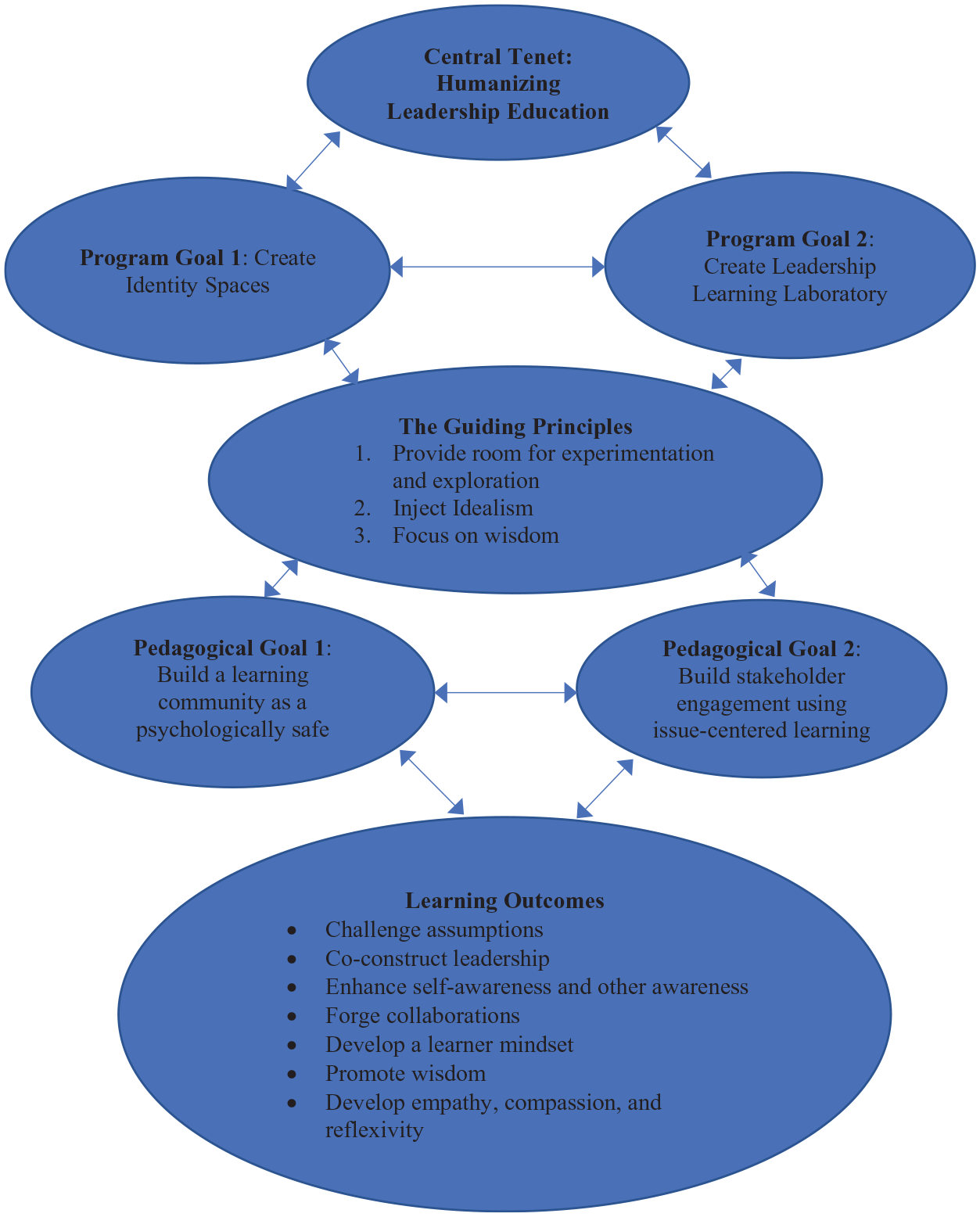
Approach to humanizing leadership education.
To help LD practitioners and educators, I present OLL’s humanizing approach (as seen in Figure 1) in terms of the overall purpose of creating a “leadership learning laboratory” and “identity spaces” for learners, which can be established using three guiding principles that were discussed above, including (1) provide room for experimentation and exploration, (2) inject idealism, and (3) focus on leadership wisdom. These principles serve as the action values to establish a broad approach for learning strategies and expected learner behavior. As explained previously, these guiding principles help foster a learning community that is psychologically safe and uses issue-centered to promote stakeholder engagement to meet the three leadership development themes (relational, responsibility, and learning) identified above. Hence, learners leave the program with a learner mindset and a realistic understanding of shifting realities and are empowered to make a positive change in their communities collaboratively and lead humanistically.
Assessment of learning
While there are many types of assessment available for leadership learning, the content and nature of learning activities in the OLL program lend themselves to formative and diagnostic assessment. A majority of the assessment used is low-stakes in that these primarily provide opportunities for practice and feedback. For example, self-awareness surveys are diagnostic assessments (Barkley & Major, 2016). These are completed at the start of the program (and the foundational courses) to allow learners the opportunity to map and track their growth in the program. This is accompanied by self-development plans that discuss their development goals, focusing on growth opportunities. Class discussion, dialogue, question thinking, and problem holding activities are formative in that these shape learner behavior through continuous practice and feedback from peers and other faculty members (Barkley & Major, 2016). As mentioned previously, reflection papers, case analyses, letter to future self, and simulation build learner repertoire for thoughtful, engaged, and connected learning. All of these learning activities also serve as assessments themselves. The OLL program uses carefully structured criterion-referenced rubrics to evaluate learners’ performance in each course, focusing on their engagement levels, the ability to think critically, reflect, and mastery of various topics. Qualitative mid-semester feedback (in each course) affords learners plenty of opportunities for reflecting on their growth in the program.
The OLL program utilizes a highly engaged approach to learning. Its emphasis on building a learning community requires deep commitment (to self and peer development, above and beyond mastery of the concepts) and investment of both subjective and objective time (Shipps & Jansen, 2021). While the OLL program is careful with selecting its student population, it is not always a good fit for all students. Over the past several years, the degree completion rate has averaged 90% to 92%. Hence, their initial expectation is to lose up to 8% to 10% of the learners in the first few weeks of their first semester. Based on the exit interviews, they have learned that drop-out is primarily due to shifting professional/ personal obligations and the rigor of the program (when learners realize that the OLL learning approach does not match the level of effort they can commit). Approximately 99% of the learners who stay through the first-semester complete all program requirements and graduate. Data gathered through the end of the program and other surveys indicate high levels of student satisfaction (up to 85% of learners stating the program meets or exceeds their expectations) with the program content and the learning approach described in this paper.
Challenges and lessons
Developing the OLL program has been a “work in progress” for OLL leadership. They learn daily through their interactions with learners, the context, their ideals, what they read and watch in the news, journals, etc. They continue to reflect on the OLL program, its content, pedagogical approaches, and delivery methods through idealism and experimentation. For example, the idea of humanistic leadership has started gaining popularity in recent years (Pirson, 2017; Pless & Schneider, 2016). Over time, it has become central to their understanding of leadership ideals. Therefore, they have developed a new course that exclusively focuses on the humanistic leadership paradigm. Based on learners’ demands, they have also developed and offered a course on diversity, equity, and inclusion. As discussed previously, through program-end surveys and course evaluations, they continue to gather feedback that aligns their content and delivery methods to learner expectations and needs while also shaping the market demand. The program’s foundation continues to evolve based on contextual changes, such as learner demographics. Over the past several years (as mentioned throughout this paper), the scope of class discussions has also been intentionally strengthened to effectively support the inquiry-led and question thinking approaches. Following the killing of George Floyd and nationwide protests in 2020, they further strengthened their curriculum to directly discuss how racism perpetuates within organizations (Ray, 2019). Such a shift is not always easy given the diversity of perspectives in the program. However, they are using the strategies mentioned in the paper to be inclusive and also learn from their mistakes.
The paper outlines the mechanisms of building a learning community as a psychologically safe space and issue-centered learning. The OLL program’s success has been highlighted as many alums of the program have returned to join the Courageous Conversations the program leadership hosts monthly to hold themselves accountable for addressing racism through their teaching and learning efforts. Alum has cited that if there was one place they felt most comfortable, it was the OLL environment. Indeed, the process does not always run as smoothly. In recent months, when some members of the newest cohorts experienced and expressed racial tensions, the OLL program used the strategies mentioned previously to resolve these tensions.
Steve Karr of GE once commented, “You should not send a changed person to an unchanged environment.” (as quoted in Raelin, 2004, p. 131). Hence throughout the OLL program, they offer learners a community in which they belong and collectively practice question thinking. This learning community ensures that the change endures. A legitimate question arises: what happens after learners graduate? The OLL program leadership hopes that learners continue to stay authentic in their learning and practice what they learned. Many graduates return to talk about their challenges and excitement in embodying the OLL values (see above Courageous Conversations). The OLL program influences their graduates continue to form learning communities within their organizations and commit to their own and follower development. They hope that the graduates would continue to act with responsibility, lead humanistically, and positively transform the world—as they have focused on this program. The OLL program realizes that these ideas are likely to evolve with time. However, it is their learning orientation and openness that would help learners succeed.
Conclusions
With its deliberate attempts at breaking the cycle of dehumanizing, the OLL program recognizes the complexities of leadership. Its leadership learning approach, described above, aims to humanize leadership by reconnecting the leader with its community, context, and identity. This paper has described pedagogical goals and various instructional strategies used. Overall, OLL allows its learners to deconstruct and reconstruct their understanding and identity as leaders through various class activities. By continually assessing who they are, observing themselves and leaders/ learners around them, engaging in dialogue and reflection, facilitating co-construction of individual and followers’ leadership development (Collinson & Tourish, 2015), they connect with their community and the context. Most importantly, OLL’s leadership learning approach indicates educational institutions can play an essential role in establishing new organizational norms and re-conceptualizing leadership.
Within an environment where organizations face many grand challenges, leaders need to actively engage in coordinated efforts and collaborative solutions (George et al., 2016; Howard-Grenville, 2020). Simultaneously, they need to also contribute to the social justice movement by rewriting the racialized organizational systems and structures (Ray, 2019). With its emphasis on building a learning community and stakeholder engagement, OLL’s leadership learning approach is suited to address these challenges. It helps leaders reconnect with their community and context, co-constitute leading/ organizing, develop a learner mindset, and cultivate empathy, compassion, and reflexivity. In a society of the spectacle (Debord, 1967), where representation and appearance have replaced authentic social life and “being,” humanizing leadership is vital for re-energizing the leadership practice and reclaiming public trust in leaders.
McCall (2010) argues that leadership development is not a precise science. There are indeed many ways to develop leaders. While I do not present the OLL approach as superior to other approaches, I believe it helps humanize leadership. By encouraging leaders to question their taken-for-granted assumptions and engaging in dialogue/ reflection for their own and others’ development, the educational experience contextualizes leadership as a messy and meaning-making process that increases continuous learning. I hope that the OLL program inspires many other academics and practitioners to develop programs for a newer generation of leaders who adopt a more questioning and reflective approach while also rising to address the grand challenges.
Footnotes
Acknowledgements
An earlier version of this paper was submitted to AOM’s Writing Workshop in Aug 2020. I am grateful to Carolyn Egri, James Spee, and other workshop participants for their feedback. All errors are mine.
Declaration of Conflicting Interests
The author declared no potential conflicts of interest with respect to the research, authorship, and/or publication of this article.
Funding
The author received no financial support for the research, authorship, and/or publication of this article.
