







Abstract
A disconnect has long existed between what is typically taught in management education programs and what real-world organizations seek in their leadership candidates, particularly regarding interpersonal skills. Primary complaints from the business community revolve around issues of curriculum relevance and delivery methodologies that do not facilitate the transfer of skills learned in the classroom to the workplace. A review of the literature yields very few examples of business programs that have added courses, or topics within existing courses, that address interpersonal skills. We describe a graduate-level course designed to intentionally develop interpersonal skills to meet the needs of local hiring managers, maximize organizational outcomes, and enhance leaders’ career opportunities. The course is delivered via active, experiential instructional methodologies to facilitate the transfer of new knowledge and skills to the workplace. A pre- and post-test comparison of students’ results on a competency-based behavioral model of emotional intelligence showed an increase in students’ scores, indicating that the course has been effective in developing students’ practical interpersonal skills. This article describes the fundamental design and delivery elements of this successful leadership course that can be replicated and implemented at other universities to more effectively align what students learn with what organizations need.
Keywords
Introduction
A disconnect exists between what is typically taught in management education programs and the interpersonal skills that real-world organizations seek in their leadership candidates. While organizations seek leaders with skills that result in effective workplace relationships, leading to positive organizational outcomes, they are dissatisfied with the lack of emphasis placed on these necessary skills in management and leadership courses. This is a long-standing issue that dates back to Porter and McKibbin’s 1988 study of American management education in which they found that members of the business community wanted business schools to design education programs that were more practical, realistic, and hands-on with an emphasis on the development of skills related to the effective management of people in organizations (Porter & McKibbin, 1988).
Recent evidence in the literature informs us that the gap between the skills developed in business programs and those that organizations desire still exists today (Arnold, 2019; Avolio et al., 2019; Lyons, 2012; Martin, 2019; Thomas & Cornuel, 2012; Usdiken et al., 2021). While some business schools successfully introduced courses related to interpersonal competence into their curriculum or added relevant topics such as communication, collaboration, teamwork, and interpersonal effectiveness to existing courses in recent years, not all have been successful in aligning what is taught to what is needed to succeed in business (Baliga, 2021; Boyatzis, 2018; Joyner & Mann, 2011; Muff, 2012; Pfeffer & Fong, 2017). The misalignment in business course content is attributed mainly to the failure of business schools to include input from the business community when developing curricula (Bedwell et al., 2014; Maellaro, 2008; Muff, 2012). While this issue was first noted several decades ago (Palomba & Palomba, 2001; Porter & McKibbin, 1988; Richards-Wilson, 2002), it has been a concern throughout the years.
The Association to Advance Collegiate Schools of Business (AACSB), the premier accrediting body for management education programs, convened a management education task force in 2002 to study curricular relevance. The study concluded that business schools must teach core management skills, such as interpersonal, leadership, and communication skills, which are highly valued by students, alumni, and employers, but are often rated as the least effective components of business school curricula (Olian, 2002). The disconnect remains today, as evidenced by an AACSB and the Society for Human Resource Management (SHRM) briefing in 2020 that questioned whether “. . . business schools and their industry partners were speaking the same language regarding leadership development” (AACSB International and SHRM, 2020, p. 13).
Another criticism of the gap between management education and business needs targets business schools’ use of passive versus active learning methods to deliver relevant content (Avolio et al., 2019; Baliga, 2021; Bedwell et al., 2014; Berggren & Söderlund, 2011; Görgens-Ekermans & Roux, 2021; Muff, 2012; Stoten, 2018). In addition to the notion that active and experiential learning methodologies are more likely to result in the transfer of knowledge and skills to the workplace, Bedwell et al. (2014) contended that “students must also have the ability to practice the newly learned [skills], and must be provided with feedback during and after any practice opportunities” (p. 174).
In this article, we present the case of The Effective Leader course, a required course for all graduate programs in the college of business at a private university in the Southwestern United States, that successfully addresses the shortcomings noted above. Our motivation for this article is the fact that even though some business schools have included interpersonal skill development in their business curriculum, the literature includes only a few examples. For further information on these programs, refer to the following courses listed on the respective university’s website (listed in the Reference Section): The Head and Heart of Leadership: Neuroscience and Emotional Intelligence course at the University of Denver’s (2022) MBA Program; the Accelerate Leadership Center with coaching, and courses in Immersive Leadership and Boundless Leadership at the Tepper School at Carnegie Mellon University (n.d.); and the Interpersonal Dynamics course at Stanford’s Graduate School of Business (n.d.). Nor are there many cases that describe how stakeholder needs were addressed and how active learning methods were used to effectively deliver course content – with a notable exception being the Weatherhead School of Management’s (WSOM) MBA program at Case Western Reserve University “as they transformed the way they responded to their stakeholders” (Boyatzis et al., 1995 as cited in Vroman, 1995, p. 80). In the late 1980s seconds, WSOM changed its MBA curriculum based on outcome studies and customer needs, which led to identifying learning outcomes and before-and-after studies on the new MBA to assure they were adding value.
The objective of our course is to develop skills that can be readily applied to improve students’ interpersonal effectiveness at work. The course content is derived from a study of local hiring manager preferences for interpersonal competencies with topics that address discrete skills (known as micro-skills) that can be used in various combinations to enhance workplace relationships and, ultimately, result in more positive organizational outcomes. The course is delivered via experiential instructional methods with opportunities for students to practice and receive feedback on a newly-acquired skill set structured around a behavior-based model of emotional intelligence (EI).
The following sections of this article include a review of literature related to the design and delivery of The Effective Leader course; a description of the course content and delivery methods; a report on the results of pre- and post-measures of the course’s effectiveness; and finally, a discussion of implications for practice and future research.
Literature Review
This literature review addresses the topics that guided the development of content and selection of the delivery methods for The Effective Leader course. These topics explore various models and conceptualizations of EI and the associated debates; an exploration of emotions at work; the impact of EI on effective leader behaviors; and learning theories that underpin course design.
Emotional Intelligence
The concept of EI originated late in the 20th century when Salovey and Mayer (1989) coined the term emotional intelligence, which they defined as a “subset of social intelligence which entails the mental ability to monitor one’s own and others’ feelings and emotions, to discriminate among them and to use this information to guide one’s thinking and actions” (p. 187). Bar-On (1997) is credited with originating the term emotional quotient, which views EI as a mixed intelligence model with cognitive ability and personality dimensions. He viewed the ability aspects of EI as non-cognitive capabilities, competencies, and skills that can be applied to well-being: understanding oneself and others, relating to people, and adapting to and coping with the immediate surroundings to be more successful in dealing with environmental demands. Goleman’s (1995) research introduced the idea of EI to the public and private sectors with his mixed model of performance that combined an individual’s abilities and personality to apply their corresponding effects in the workplace. Boyatzis (2009, 2018) then developed a competency-based behavioral model of EI comprised of personal and social competencies clustered into the four domains of self-awareness, self-management, social awareness, and relationship management.
EI has been a controversial topic since its introduction 30 years ago that remains unresolved at present, provoking vigorous debates among scholars and between scholars and practitioners. Some key points of contention include whether EI legitimately is an intelligence, whether it differs significantly from personality traits, how it relates to social intelligence, its varied and ambiguous definitions, trait versus ability versus mixed models of EI, and the insufficiency of empirical research about EI. Much debate also exists relative to the questionable motives of consultants who recommend EI training agendas for clients that will result in the consultants’ personal financial gain. Specifically, some claim that consultants may push for the inclusion of EI training even when it may not be warranted. For example, consultants may offer EI training when leader ineffectiveness is due to the personality traits or cognitive intelligence of the client’s leaders. This is done, some critics claim, because consultants may view EI training as a way to realize great financial outcomes for their practices, even when empirical evidence does not suggest that it would improve client leader effectiveness (Antonakis et al., 2009; Dasborough et al., 2021; Lam & Kirby, 2002; McCleskey, 2014; Sadri, 2012).
Ashkanasy and Daus (2005) organized the EI literature into three streams of research and their associated measures (Walter et al., 2017). Stream 1, proposed by Mayer and Salovey (1997), defines EI as a four-branch abilities model focused on “a set of interrelated abilities for effectively dealing with one’s own and others’ emotions (i.e., perceiving, using, understanding, and managing emotions” (Walter et al., 2017, p. 46). It is measured by the Mayer-Salovey-Caruso Emotional Intelligence Test (MSCEIT) (Mayer et al., 2004) and the Diagnostic Analysis of Nonverbal Accuracy (DANVA) (Nowicki & Duke, 2001). The same Mayer and Salovey EI model also falls within Stream 2, where it is measured by several self- and peer-report measures, including the Wong-Law Emotional Intelligence Scale (WLEIS) and the Workgroup Emotional Intelligence Profile (WEIP) developed by other EI researchers (Jordan et al., 2002; Wong & Law, 2002). Stream 3 consists of so-called mixed models of EI that are “an array of dispositions, competencies, and perceptions related to the effective management of emotions (e.g., self-awareness, empathy, positive mood, and decision-making, etc.; Walter et al., 2017, p. 46). This stream is measured by the Emotional Competency Inventory (ECI) (Wolff, 2005) and the Emotional Quotient Inventory (EQ-i) (Bar-On, 2000). The question of which stream is the most accurate classification of EI theories, models, and measures remains unanswered as of today (Ashkanasy & Daus, 2005; Dasborough et al., 2021).
Walter et al. (2017) caution teachers and trainers to be aware that “. . .the field of EI has not yet reached consensus regarding key definitional and measurement issues [and that]. . . it is important to be very clear about the stream of EI being used in a specific training course” (p. 55). In light of this, it is important to note that The Effective Leader course was structured around Boyatzis (2009, 2018) competency-based behavioral model of EI, which he refers to as a fourth stream. This model is behavioral in the sense that it addresses “how EI appears in a person’s actions” and contends that it is related to “work and life outcomes beyond general mental ability and personality traits” (Boyatzis, 2018, p. 1). He differentiates between emotional intelligence competencies related to the awareness and management of oneself and the social competencies that deal with understanding the emotions of others and using that knowledge to create more effective working relationships that ultimately lead to more positive organizational outcomes. In this model, Boyatzis (2009) defines behavioral EI as: (a) an emotional intelligence competency [that] is an ability to recognize, understand, and use emotional information about oneself that leads to or causes effective or superior performance; and (b) a social intelligence competency [that] is the ability to recognize, understand and use emotional information about others that leads to or causes effective or superior performance (p. 757).
Goleman and Boyatzis (2017) created the Emotional and Social Competence Inventory (ESCI) to measure the 12 competencies within four domains that comprise the behavioral EI model.
Personal Competencies:
(1) Self-Awareness Domain—emotional self-awareness
(2) Self-Management Domain—emotional self-control, adaptability, achievement orientation, positive outlook
Social Competencies:
(3) Social Awareness Domain—empathy, organizational awareness
(4) Relationship Management Domain—influence, coach and mentor, conflict management, teamwork, inspirational leadership
The behavioral EI model and its 12 competencies will be discussed in further detail in a subsequent section of the article that describes The Effective Leader course.
While Ashkanasy and Daus (2005) “. . .do not endorse a Goleman . . .type of approach to studying emotional intelligence in the workplace. . .,” they “. . . do not wish to discourage researchers who wish to study the measures in applied settings” (p. 443). The aforementioned debates notwithstanding, it is in the spirit of these sentiments that we felt comfortable using a behavior-based model of EI for The Effective Leader course. The college of business, in which the course is located, views itself as a teaching school and includes in its mission statement the desire to prepare its students to become principled and moral leaders who are ethical and effective decision-makers. Further, the full-time faculty in the college can be described as scholar-practitioners in that all possess terminal degrees as well as years of practical business experience in their respective fields of teaching.
Emotions and Behavior
Managers who possess EI skills—especially with the understanding of emotions and emotion management—will also have advantages relative to more effective leadership and teamwork in the workplace. George and George (2000) refers to a growing body of literature that reveals the central role that emotions play in cognitive processes and behaviors. Ashkanasy and Daus (2002) suggest that “emotionally intelligent managers may be able to ‘read’ the emotional climate in their organizations and to understand the emotional concerns of employees” (p. 82). They may also use cultural forms (i.e., symbols, language, narratives, and practices) that rely on evoking emotion to help employees identify more strongly with their organizations (Ashforth & Humphrey, 1995; Trice & Beyer, 1993). In that organizations can be experienced as social institutions, research has also shown how positive workplace affect can enhance creativity (Ashkanasy, 2004; Estrada et al., 1997; Isen, 2003). Emotional competence also has been found to be a strong predictor of group performance and conflict resolution style (Jordan & Troth, 2002, 2004).
Damasio (1994, 1999, 2003) and Goleman (1995) found neurological evidence that feelings are necessary to make good decisions, reinforcing the connection between emotion and everyday thought processes. Additional research shows that fluctuations of emotions contribute to being more flexible in planning, the ability to generate multiple alternatives, and having a broader perspective on problems (Mayer, 1986; Salovey & Mayer, 1989). Epstein and colleagues researched how EI enhanced the ability to solve problems or think constructively with less stress (Epstein, 1990; Katz & Epstein, 1991). Overall, as Ashkanasy and Daus (2002) affirm “management of emotions in organizations must now be seen as an important tool in every manager’s kit, one to which managers will increasingly need to pay attention in the future” (p. 82). Ashkanasy et al. (2002) go on to describe 21 “management tools” (p. 287) that will help manage emotion in a changing workplace, which include a focus on open communication, displaying interpersonal sensitivity, setting norms to create positive emotional climates in teams, and creating an organizational culture that recognizes the legitimacy of emotion, among others.
Emotional Intelligence and Leader Effectiveness
Despite skepticism among scholars and the aforementioned topics of debate, evidence to support the value of EI skill development for leader effectiveness exists. As reviewed in the literature below, common themes concerning the awareness of emotion, the management of emotion, and the ability of relationship management skills to influence workplace behaviors represent a link between EI and interpersonal skills. Additionally, studies have made the case that higher levels of EI have a positive impact on team process effectiveness and goal focus (Jordan et al., 2002); allow individuals to be more likely and able to engage in collaborative conflict resolution (Jordan & Troth, 2002); contribute to more productive communication between team members (Troth et al., 2012); and are significantly related to increased trust among coworkers (Christie et al., 2015).
Leader behavior research indicates that leadership consists of influencing relationships that are emotional in nature (Allen & Roberts, 2011; Paglis, 2013; Walter et al., 2017) and that the essence of leadership at its core is about the interaction of leaders with others (Wong & Law, 2002). To succeed at building emotionally-based influential relationships, leaders must take the initiative and model effective relationship behaviors, which requires that they clearly understand themselves and others (Service & Guess, 2015). The notion that relational skills consist of the leader’s abilities to reflect inwardly, honestly assess their strengths and weaknesses, learn from mistakes, and align their behavior with their intentions serves as an argument that a relationship exists between EI and effective leadership (Contreras & Sandoval, 2019; Sejeli & Mansor, 2015). In support of this is the claim that leaders who possess EI skills will establish effective working relationships with internal and external stakeholders (Sejeli & Mansor, 2015).
Callahan and McCollum (2002) highlight a social interactionist perspective that suggests emotions are created or constructed as part of a common sensemaking process in social structures. Antonakis et al. (2009) purport that “relationship approaches to leadership are inherently emotional” (p. 252). They refer to earlier work by Dasborough and Ashkanasy (2002), which argued that the quality of the leader-member exchange relationship is enhanced through the emotional intelligence of leaders. Further, Görgens-Ekermans and Roux (2021) cited the results of several recent studies showing that higher levels of effective EI skills are directly related to the practice of transformational leadership. Additionally, they argue that transformational leadership has been recognized as one of the most effective styles of leadership in light of its positive impact on desirable organizational outcomes, such as increased job satisfaction of employees, increased organizational citizenship behaviors, and lower intention to leave. They go on to suggest that this positive relationship between EI and transformational leadership behaviors offers evidence of the importance of developing the EI skills of leaders and potential leaders. Lastly, the EI construct resonates with many practitioners because it appears to be a reasonable description of something extra that great and effective leaders seem to possess over and above mere cognitive intelligence (IQ), which had previously been difficult to articulate (Riggio, 2002).
Relevant Learning Theories
Unlike IQ and personality traits, which typically remain stable throughout our lives, EI is a set of behaviors that can be learned to improve interpersonal relationships and, ultimately, effectiveness at work (Bradberry & Greaves, 2009; Druskat & Wolff, 2001). There is consensus that EI can be improved via study and intentional effort (Boyatzis, 2001; Cherniss, 2001; Goleman, 1998). However, the methods for teaching EI are a significant factor in the ultimate success that students might achieve in developing interpersonal effectiveness. The following section addresses learning theories and instructional methodologies that lend themselves well to helping students develop the EI skills that can lead to improved interpersonal skills. The application of these theories to The Effective Leader course will be discussed in the subsequent section of the article that further describes the course.
Experiential learning
Concerns about the misalignment of business programs and organizational needs could be minimized if the pedagogies used to develop EI and interpersonal skills were more solidly grounded in adult learning theory (Scott, 2010). Leonard (2017) suggests that professors actively engage students through discovery rather than lecturing to them from an expert’s perspective and encourage students to formulate personal insights after engaging in active learning activities. These suggestions align with the phases of Kolb’s (1984) experiential learning model, which is also supported by Pfeffer and Fong (2017) in their view of business education’s teaching methodologies. They contend that students learn better by doing and recommend Kolb’s experiential learning model as an effective method for accomplishing this, whereby “concrete experience is the basis for observation and reflection” (Pfeffer & Fong, 2017, p. 85).
The experiential learning model (Kolb, 1984) evolved from the work of several education theorists over the past century and serves as an effective tool for linking education, work, and personal development (Miller & Maellaro, 2016). It entails students completing an activity in the classroom (concrete experience), then reflecting on the activity to make observations about it (observation), from which they can articulate insights (abstract conceptualization), and subsequently formulate plans to respond more effectively when they encounter similar situations in the future (active experimentation), whether in the classroom or at work (Dewey, 1938; Kolb, 1984; Kolb & Kolb, 2005; Merriam & Caffarella, 1999; Revans, 1976). Guiding students through the examination of their past and current leadership behaviors and helping them plan different behaviors can result in behavioral changes within their current fixed frames of reference (Argyris & Schön, 1974) that will allow them to interact more effectively with others at work. Therefore, it is a logical initial step toward developing EI and interpersonal skills on the journey to becoming a more effective leader.
Reflective practice
The second phase of the experiential learning process provides an ideal platform for students to assess their current EI skill levels and gain insights into how to change their behavior to result in more effective interpersonal interactions. Doing this through written assignments such as learning journals and skill development portfolios can help students explore and make sense of their past behavior more deeply. The act of writing helps students better understand how they think and feel, which evokes a connection to their true beliefs about their past and current behavior (Scott, 2010).
In examining their underlying assumptions during reflection, students are operationalizing Mezirow’s (2000) theory of transformational learning. As such, students can identify the disconnection between previously held assumptions and what they experience in a class activity or assignment. This process is known as intensive reflection, whereby in the process of examining their underlying assumptions and considering alternative courses of action, students are actually “changing conceptual meanings, altering internal perspectives, and modifying future behaviors” (Peltier et al., 2006, p. 6). Intensive reflection is the first step in changing those assumptions to result in more effective subsequent use of interpersonal skills. Argyris and Schön (1974) refer to this process as double-loop learning, which allows students to honestly examine the underlying assumptions that may be preventing them from knowing which of their behaviors need to change and how to change them. As opposed to single-loop learning, which precludes the examination of underlying assumptions, therefore perpetuating behaviors that may be ineffective, the double-loop learning process allows students to create new frames of reference that are more inclusive, open to other viewpoints, and capable of real change (Argyris & Schön, 1974).
Development of discrete skills
When considering the improvement of EI skills to create more effective interpersonal interactions at work, we are not talking about single or isolated actions. Instead, we deal with a system and sequence of behaviors (Boyatzis, 1982) that consists of several discrete, specific actions, sometimes referred to as micro-skills (Hayes, 1994, 2002). Cavaleri and DeCormier (1991) developed a high-speed leadership model of discrete skills designed to help managers develop the ability to successfully direct interpersonal exchanges in the present while also maintaining the quality of working relationships over the long term. Hayes (1994), noting that “interpersonal skills are goal-directed behaviors used in face-to-face interactions which are effective in bringing about a desired state of affairs” (p. 5), used discrete skills as the basis for management interpersonal skills training.
Once developed individually, these discrete skills can be used in various combinations during interpersonal interactions to influence others toward accomplishing organizational goals. Teaching discrete skills lends itself well to developing business students’ EI, in that once students master a repertoire of individual skills, they would have expanded their range of behaviors that allow behavioral flexibility in the course of interpersonal interactions that are directed toward positive organizational outcomes (DeCormier & Jobber, 1993; Hargie, 1997; Hargie & Dickson, 2004; Wright & Taylor, 1984).
Evidence of the successful application of discrete skills in management education can be found in the work of British scholar-practitioners Wright and Taylor (1984). In the process of creating a program to teach managers how to conduct effective performance appraisal interviews, they realized they were essentially training people in skills that would be useful in any type of leadership interpersonal interactions. To offset these skills’ broad and abstract nature, Wright and Taylor (1984) identified groups of small skills that comprised broader behaviors to provide managers with a complete range of tools that could be applied as appropriate in any given leadership situation. They suggested that developing the appropriate discrete skills could be the missing link between the abstract leadership concepts historically taught in management education programs (Leonard, 2017) and the actual leadership skills desired in business. Hunt and Sorenson (2001) demonstrated how this could be done in a course structured around micro-skills that they deemed successful in developing the interpersonal skills of management students at a business school in the Southwestern United States.
In light of this, another way management education programs can facilitate the development of interpersonal competence for business students would be to help them build a repertoire of individual skills that are learned one at a time via practice and feedback in the classroom after an initial introduction to the theoretical foundations of the behaviors (Cavaleri & DeCormier, 1991; DeCormier & Jobber, 1993; Hargie & Dickson, 2004). This method of instruction is supported by a similar training process that Bedwell et al. (2014) recommended for the development of interpersonal skills that consists of four steps: (1) providing students with information about the skills to be developed, (2) demonstrating the effective use of the skill, (3) allowing students to practice the skill, and (4) finally providing them with feedback on their performance of the skill.
The Effective Leader Course
The Effective Leader is a core course required for all MBA and M.S. students in the college of business at a private university in the Southwestern United States. It is offered in a 12-week trimester in face-to-face and online formats. While it does introduce some fundamental leadership theories to students, its primary focus is on developing effective interpersonal skills and how to apply them to interactions on the job. The course is built around Boyatzis (2009, 2018) competency-based behavioral model of EI based on evidence in the literature that EI is a precursor of transformational leadership, which in turn results in measurable positive outcomes of effective leadership, such as employees’ improved performance, job satisfaction, and organizational citizenship behaviors, as well as lower intention to quit (Boyatzis, 2009, 2018; Doe et al., 2015; Görgens-Ekermans & Roux, 2021; Kim & Kim, 2017). The definition of EI adopted for use in the course is: Emotional intelligence (EI) is the ability to perceive, recognize and understand emotions in ourselves and others, along with the ability to manage our emotions proactively and positively direct our behavior as we interact with others (Ashkanasy & Dasborough, 2003; Jordan & Lawrence, 2009; Talent Smart, 2003)
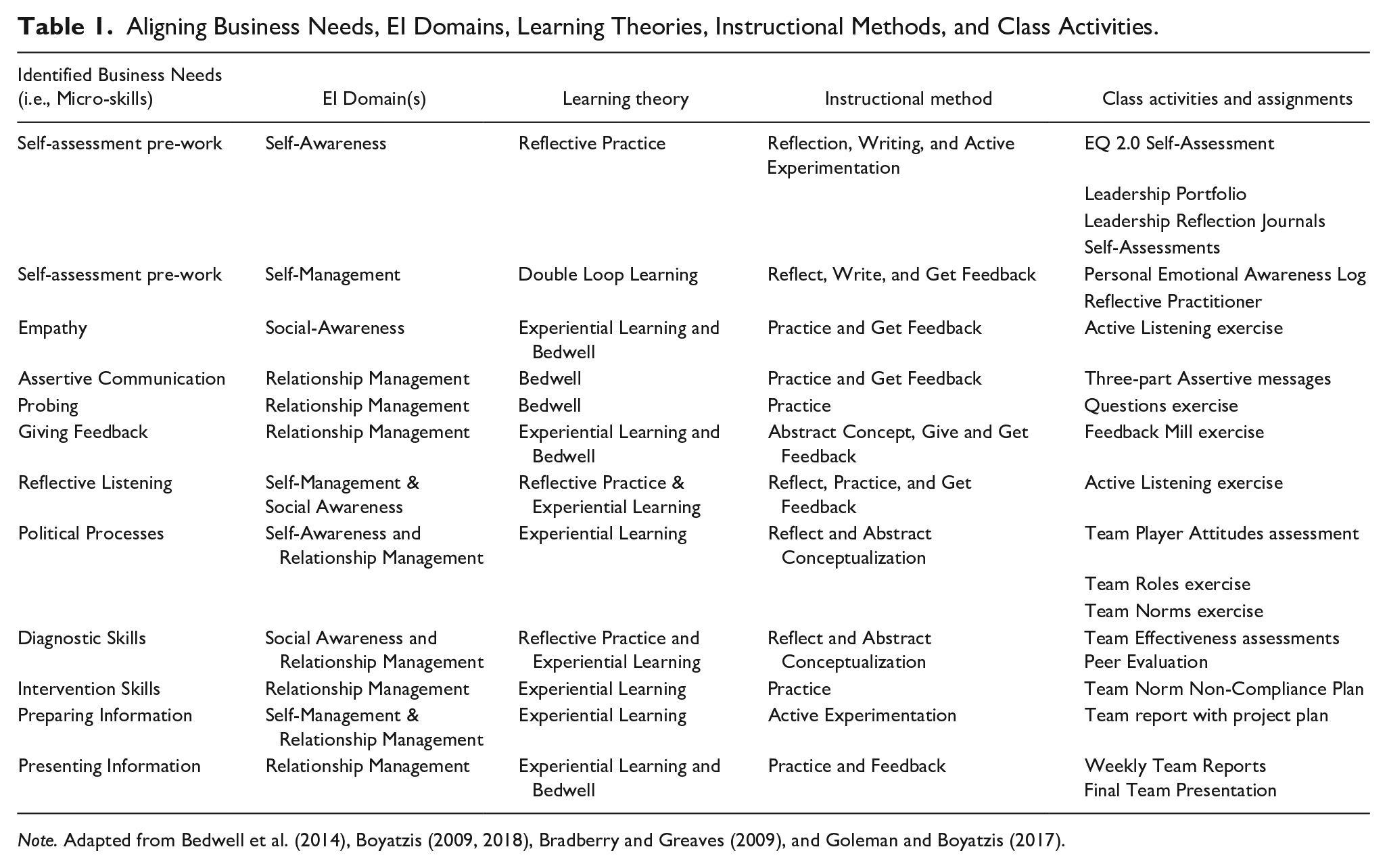
To address the ongoing issue of business leaders’ lack of input in the development of management education curriculum, Maellaro (2008) conducted a study of hiring managers in the Southwestern United States to determine which combination of interpersonal skills they most desired in the business school graduates they hired. Using a model based on Hayes (1994, 2002) interpersonal micro-skills framework, a conjoint analysis survey revealed that the following discrete skills were most preferred by the 207 local hiring managers that participated in the research study: Empathy, Assertiveness, Collaborative Bargaining, Political Processes, Giving Feedback, Probing, Reflecting, Diagnostic Skills, Team Intervention Skills, Preparing Information, and Presenting Information. These 11 discrete skills comprise the content of The Effective Leader course. Please refer to Table 1 in the next section to see the alignment of these skills with EI competencies.
Aligning Business Needs, EI Domains, Learning Theories, Instructional Methods, and Class Activities.
Note. Adapted from Bedwell et al. (2014), Boyatzis (2009, 2018), Bradberry and Greaves (2009), and Goleman and Boyatzis (2017).
The EI model upon which the course is built is shown in Figure 1 (Bradberry & Greaves, 2009; Goleman, 1998; Goleman et al., 2002). In addition to the fact that the skills identified in Maellaro’s (2008) hiring manager study closely mirror the skills that fall within the four domains of this model, several factors drove the selection of this model of EI for the course. First, it is based on behaviors (as opposed to being a trait or mixed model) and has its roots in the Emotional and Social Competency Inventory (ESCI), a validated behavioral measure of EI that is “more outcome-oriented and realistic in real settings” (Boyatzis, 2009, p. 756). Additionally, the domains that comprise this model are closely aligned with other EI models commonly used in organizations (Boyatzis, 2009; Goleman, 1998; Goleman & Boyatzis, 2017). Second, it conveys the theoretical underpinnings of EI in a relatable format in the book Emotional Intelligence 2.0 (Bradberry & Greaves, 2009), and it addresses practical skills that students can readily transfer to the workplace. The third factor was one of practicality; the book, which was adopted as one of the textbooks for the course, includes an online self-assessment that can be taken at the beginning (pre-test) and the end (post-test) of the course. The self-assessment results report provides students with a detailed report of their EQ strengths and weaknesses and offers specific and practical developmental activities that students can use to improve their EI behaviors.
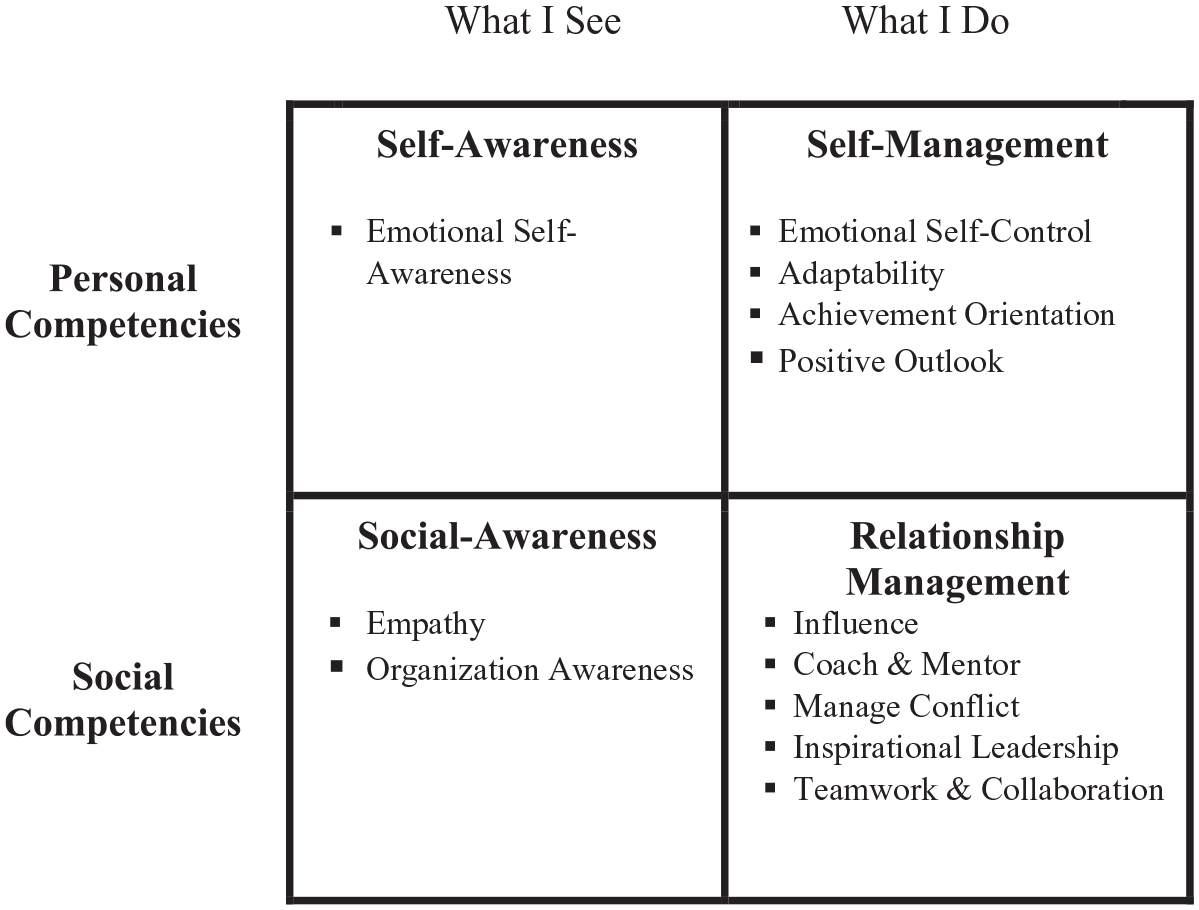
EI domains and competencies targeted for development.
Application of Learning Theories to The Effective Leader Course
The course builds on the pedagogical strategy of experiential learning that heightens student awareness and application (Dachner & Polin, 2016; Kolb, 1984; Kolb & Kolb, 2005) and on the notion that it is not simply experience that teaches but rather it is evaluated experience that teaches (Hendricks, 2003). Early in the course, students are introduced to Boyatzis (2009, 2018) behavior-based EI model and how it can positively impact leader effectiveness. Concurrently, students work in teams to complete an assigned project, allowing them to practice newly-acquired skills. Within the overall framework of active and experiential learning methodologies, course instruction follows the pattern of the proven information-demonstration-practice-feedback model suggested by Bedwell et al. (2014). Each course unit addresses specific micro-skills and follows the same four-step pattern each week. For the first information step, students complete readings and self-assessments prior to class, and the class session begins with a brief lecture and a discussion of the concepts underlying the skills. This is followed by class activities such as individual practice done in small groups, application of skills in team meetings, and feedback from peers and the professor, which operationalize the demonstration, practice, and feedback steps. Subsequent exercises—particularly the Reflective Practitioner case study assignment—engage students in the double-loop learning process described earlier. Via the application of the Awareness Wheel model (Miller et al., 1994) and the exchange of feedback among team members about the effectiveness of each student’s utilization of EI skills during actual interpersonal interactions, students are able to surface the underlying assumptions that typically drive their behavioral approach to interpersonal interactions for the purpose of re-examining and altering those assumptions. One student’s thoughts on the Reflective Practitioner session suggest this shift in thinking: “The biggest lesson learned in this class was towards the end where we were able to provide an example of a conversation that took place between a previous colleague and myself. For the longest time, I honestly believed that I handled that situation as rationally as possible. I attributed the reason for the conflict to the other party’s character flaws and not how they may have felt about the situation. I had not asked for their perspective in setting the schedule.”
Table 1 summarizes how The Effective Leader course integrates our responses to the ongoing criticism about the gaps in management education.
Column 1—lists the identified business needs (i.e., micro-skills) identified as important by local business managers. The self-assessment pre-work, while not being a micro-skill, is an essential preparation step for students to create self-awareness and practice self-management as the foundation for the development of the listed micro-skills.
Column 2—indicates which EI domain is associated with each micro-skill, using Boyatzis (2009, 2018) behavioral competency EI model.
Column 3—tells the reader the learning theories used to design class activities for each micro-skill. The development of discrete micro-skills learning theory is the basis for each item.
Column 4—calls out the specific active instructional methods used to develop each listed micro-skill. These include various phases of Kolb’s (1984) experiential learning model and Bedwell et al.’s (2014) four-step interpersonal skill development model. The first phase of experiential learning (activity) and the first two steps of Bedwell et. al.’s model (information and demonstration) being inherent in each method.
Column 5—lists examples of activities and assignments that students complete to develop each micro-skill.
Evaluating the Effectiveness of The Effective Leader Course
We used the EI online self-assessment from the textbook Emotional Intelligence 2.0 (Bradberry & Greaves, 2009)—which students completed twice—to quantitatively assess the effectiveness of The Effective Leader course. The test is proprietary, so students completed their surveys by logging onto TalentSmart’s website with a passcode that comes with the book. The survey can be accessed here: https://www.talentsmarteq.com/test/. Upon completion of the assessment, the students received a report with their scores that we used for the analysis. The students provided their self-assessment results from the beginning (pre-test) and the end (post-test) of the course. Thus, we were able to determine if there was a significant increase in EI over the course of the 12-week term. The data were collected from the students enrolled in The Effective Leadership course in the trimesters between the Summer of 2019 and the Fall of 2020. Our initial sample included 179 students. Upon completion of the data cleaning, the sample comprised 139 students consisting of 36.0% females (n = 50) and 64.0% males (n = 89). The race distribution was 25.9% White (n = 36), 25.9% Black (n = 36), 25.2% Asian (n = 35), 20.9% Hispanic (n = 29), and 2.2% identified as other (n = 3). Age was solicited in age ranges based on generational cohorts, with students born between 1946 and 1964 being considered Baby-boomers, students born between 1965 and 1981 being considered Generation X, and students born between 1982 and 2000 being considered Generation Y (Abrams & Frank, 2014). The majority of the students belonged to Generation Y–79.1% (n = 110), followed by Generation × – 19.4% (n = 27) and Baby-boomers – 1.4% (n = 2). A total of 62.6% (n = 87) were employed full-time, 10.8% (n = 15) were employed part-time, and 26.6% (n = 37) were unemployed. The students had an average work experience of 9.06 years (SD = 7.87).
Students initially completed the survey during the first week of the trimester, at which point they reported the result of this pre-test EI assessment, along with their demographic information. Students completed the survey for the second time during the last week of the trimester, at which point they reported the result of their post-test EI assessment. The data were matched utilizing the students’ university I.D. numbers provided in each survey. After the matching, the students’ university I.D. numbers were deleted to ensure the data were anonymous before data analysis was conducted. The data were analyzed using the IBM® SPSS® 28 software package. The EI score can range from zero to 100 (Bradberry & Greaves, 2009). The average EI score was 76.95 (SD = 9.17) for the pre-test and 84.37 (SD = 8.73) for the post-test. The result of the paired-samples t-test indicates a statistically and practically significant difference in the scores (t[138] = −11.68, p < .001; d = 0.99). Hence, quantitative support was found for an increase in EI from the start to the end of the course, which indicates the effectiveness of The Effective Leader course.
The student evaluations also supported the positive findings of The Effective Leader course. We reviewed responses to two relevant questions on evaluations completed within the same timeframe that the quantitative data were collected. These two questions were scored on a 5-point Likert-type scale, with 1 indicating strongly disagree and 7 indicating strongly agree. On the question “This course covers topics that are (will be) useful to me in my career,” the students provided an average score of 4.49 (SD = 0.91). Their response to the question, “This course is a valuable part of my overall education,” was similarly favorable with an average score of 4.45 (SD = 0.91). Students also voluntarily added comments to their ratings, a sampling of which include:
• “I want to share with you the lasting impact that your leadership class has had on me. To this day, I continue to practice and share the tools you gave me in both my professional life and my personal life. Many of these tools have helped me navigate difficult and complex situations and relationships. I continue to be grateful for your teachings.”
• “I am very happy that I am using many of the concepts from this course [in] the workplace. I recently was complimented by the risk management officer thanking me for my display of positive attitude in stressful situations. I would have never accomplished this without this course.”
• “Great content and extremely valuable moving forward, no matter what position or career path one is on. . .”
These findings support that students perceived value in the course and that it would be helpful to them not only as part of their education but also for their careers.
Discussion
EI is the ability to perceive, recognize and understand emotions in ourselves and others, along with the ability to manage our emotions proactively and positively direct our behavior as we interact with others (Ashkanasy & Dasborough, 2003; Görgens-Ekermans & Roux, 2021; Jordan & Lawrence, 2009; Talent Smart, 2003). Meta-analytic findings indicate statistically significant positive relationships between EI and various forms of leadership (Harms & Credé, 2010; Miao et al., 2018). The literature also supports EI as a precursor of transformational leadership, which in turn results in measurable positive outcomes of effective leadership, such as employees’ improved performance, job satisfaction, and organizational citizenship behaviors, as well as lower intention to quit (Boyatzis, 2009; Doe et al., 2015; Görgens-Ekermans & Roux, 2021; Kim & Kim, 2017). Hence, the described Effective Leader course was designed for students to hone their interpersonal skills in order to apply these improved skills in their leadership capacities at their jobs.
Our results indicate that this course is an effective tool for developing the EI of our students. We observed a statistically significant increase in EI from the initial assessment to the end-of-course assessment. In addition, the student evaluations supported the positive statistical findings from the pre- and post-tests. We believe these positive results were a function of our comprehensive approach to designing and delivering the course. This entailed including business community input in our development of the course content and building the curriculum around a behavioral competency-based behavioral model of EI. We used active and experiential learning methods in the classroom and allowed students to practice newly-acquired skills in a safe classroom environment, where they received honest feedback on their interpersonal competencies.
Implications for Practice and Research
Allen and Roberts (2011) asserted that “Leadership is a capacity that can be developed potentially in all people. While not everyone has the same innate potential, all have the possibility in them” (p. 65). An important dimension of this leadership capacity is interpersonal skills as operationalized by EI. The course described here is unique because it was developed using data obtained directly from hiring managers in the local business community (Maellaro, 2008; Maellaro & Whittington, 2012). We believe that the missing interpersonal skill development so frequently identified in critiques of management education can be addressed through intentional efforts. Hence, the direct input from these hiring managers provided the foundation for a comprehensive approach to assessing and developing students’ EI to apply to interpersonal interactions on the job. This builds on the research studies cited earlier that have made the case that higher levels of EI have a positive impact on team process effectiveness and goal focus (Jordan et al., 2002); can enhance collaborative conflict resolution (Jordan & Troth, 2002); contribute to more productive communication between team members (Troth et al., 2012); and increase trust among coworkers (Christie et al., 2015).
The comprehensive approach to leadership skill development described in this article aligns management education with the specific needs identified by organizations that hire business school graduates. We believe that The Effective Leader course soundly refutes the sentiments of many business managers who believe an MBA may not add value because it does not address the human element of management. Management education programs have been criticized for many years because of their strong focus on technical skills, often developed at the expense of enhancing the interpersonal skills necessary to develop effective working relationships with others. The complaints have been relentless and apparently ignored for the most part (Adams, 2014; Berggren & Söderlund, 2011; Maellaro & Whittington, 2012; Paglis, 2013; Scott, 2010; Usdiken et al., 2021). In this article, we have provided a report on one business school’s successful response to these concerns.
We also see that The Effective Leader course has maintained its relevance over time. The need for leaders to have strong interpersonal skills based on their EI grows in significance in a recently changed workplace impacted by COVID-19, which is trying to reimagine the new normal. “Collaboration, flexibility, inclusion, and accountability are qualities organizations have been striving for years, with some progress. But the massive change associated with the coronavirus could and should accelerate changes that foster these values” (Sneader & Singhal, 2020, p. 2). Leaders need to think about how to reorganize a distributed workforce and retain valuable employees in a talent war. The new constructs of leadership may rely on a leader-follower model (Uhl-Bien, 2006), where EI would be a more relevant criteria for effectiveness. Gosling and Mintzberg (2003) suggest that a shift from heroic management (based on self) to engagement management (based on collaboration) is required to approach an organization as an interacting network, not a vertical hierarchy. They go on to describe how leadership mindsets will need to bring out the positive energy of people by actively inspiring and engaging others and earning the respect of others, not through hierarchy or top-down analysis (Gosling & Mintzberg, 2003). According to Rzepka and Bojar (2020), leadership in an agile organization—one that can respond quickly to unexpected change—requires the ability to communicate, solve employee conflict and ensure the autonomy of subordinate employees to make decisions. When collective genius is needed, Hill et al. (2014) suggest that the “role of a leader is not to set a vision. . .but to create a community that is willing and able to innovate” (p. 5) with shared purpose and values, and discovery-driven learning. The Effective Leader course reinforces these roles. Based on the success of our course, the good news is that EI and interpersonal skills can be learned and developed for effective leadership.
Limitations and Directions for Future Research
The findings of the study support the notion that students can develop EI competencies with intentional efforts, as exemplified in The Effective Leader course. However, our study does have some limitations. First, the study relies on students from only one university, limiting the generalizability of the findings. Future studies could offer the same course using the same learning methodologies and assess whether the findings can be replicated.
Second, the results reported here were based on student experiences in a short 12-week course. Without collecting data from students beyond their course completion, we cannot draw any conclusions as to whether the observed improvements in interpersonal skills will be relatively stable and enduring beyond this window of observation. Ideally, future research should seek to track students longitudinally beyond the completion of their education.
Third, a particular strength of our sample was that the majority of our participants (62.6%) were employed full-time while pursuing their graduate degrees. However, the measures we obtained were in the immediate context of the course in which they were enrolled, and we were not able to observe whether the improvements in students’ EI transferred into improved interpersonal skills at the workplace (or in other life arenas).
Lastly, we used a behaviorally-based measure of EI, which is a strength of our design. However, the measure was based on the participants’ self-reports and while self-report measures are acceptable (O’Boyle et al., 2011), the observed increase in EI can have a bias of measure inflation. Future studies could try to replicate the findings using EI rated by others, such as coworkers who have the opportunity to observe the students frequently, or a combination of an EI self-report measure and an EI rating by others. We realize that creating such a design would be complicated; however, future research on improving students’ EI should explore this opportunity.
Conclusion
The discrepancy between what business students learn in management education programs and the interpersonal skills hiring organizations desire in leadership candidates can be traced as far back as 100 years (Usdiken et al., 2021). Although many business schools have incorporated interpersonal effectiveness topics into their curricula, a review of the current literature indicated that the disconnect still exists. Evidence remains to indicate that not all such efforts have successfully minimized the long-standing discrepancy points, including a low incidence of business community involvement, disputes about the positive impact of EI on leader effectiveness, and the ability of students to transfer interpersonal skills learning to the workplace.
The Effective Leader course described in this article has addressed the reasons for failure by conducting research with local hiring managers to identify interpersonal skills they desire in individuals they hire. Then the identified interpersonal skills were developed in students utilizing a behaviorally-based model of EI and using active (rather than passive) proven adult learning methods. As a result, students developed new skills that improved their interpersonal competence for application in the workplace. Increases in students’ EI scores from the start to the end of the course indicate improved EI skills. Hence, the course is viewed as successful in helping students become more adept at building and maintaining interpersonal relationships that can benefit employees and their organizations.
Footnotes
Declaration of Conflicting Interests
The author(s) declared no potential conflicts of interest with respect to the research, authorship, and/or publication of this article.
Funding
The author(s) received no financial support for the research, authorship, and/or publication of this article.
