







Abstract
Entrepreneurial passion is a key driver of entrepreneurial behavior, yet its structural and cultural antecedents remain underexplored in entrepreneurship education. This study examines how childhood socioeconomic status and the perceived impact of entrepreneurship education shape harmonious and obsessive passion, and subsequently entrepreneurial intention, through the mediating role of the desire to gain face—a culturally embedded motive salient in collectivist emerging economies. Drawing on Social Class Theory, Face Theory, and Self-Determination Theory, we test a conceptual model using two-wave survey data from 273 entrepreneurship students in Vietnam. Partial Least Squares Structural Equation Modeling is used to assess the measurement and structural models. Results show that childhood socioeconomic status exerts competing direct and indirect effects on harmonious passion, yielding a non-significant total effect and no significant association with obsessive passion. The perceived impact of entrepreneurship education positively influences both forms of passion. The desire to gain face mediates its relationship with harmonious passion but not obsessive passion. Both harmonious and obsessive passion are positively associated with entrepreneurial intention. These findings highlight the importance of socio-cultural background and motivational internalization processes in entrepreneurship education design.
Keywords
Introduction
Entrepreneurial passion is central to entrepreneurship research and new venture success (Chen et al., 2025; Nguyen & Nguyen, 2024). Recent work has focused on its two forms in the Dualistic Model of Passion: harmonious passion (HP) and obsessive passion (OP; Adomako & Ahsan, 2022; Vallerand et al., 2003; H. Zhao & Liu, 2023). These forms reflect how passion is internalized into identity, with HP generally linked to more positive outcomes than OP (Vallerand, 2015). Prior studies have connected them to persistence, career achievement, commitment, resilience, venture success, and entrepreneurial intention and behavior (Fisher et al., 2018; Minh et al., 2025; Murnieks et al., 2014; Obschonka et al., 2019; Türk et al., 2019).
Importantly, the development of entrepreneurial passion does not occur in a social vacuum. In many societies, particularly collectivist and emerging-economy contexts, entrepreneurial engagement is closely intertwined with concerns about social status, family honor, and public recognition (Triandis, 1995; Wei & Shen, 2025). In such settings, individuals’ socioeconomic background and educational experiences are likely to shape entrepreneurial motivation not only by providing resources or skills, but also by activating status-related motives that influence how entrepreneurship is socially valued and psychologically internalized. One such motive is face, broadly understood as the public self-image that individuals seek to claim for themselves (Brown & Levinson, 1987), which has been shown to play a central role in guiding behavior in status-conscious cultures such as Vietnam (D. Y. F. Ho, 1976; Kim & Nam, 1998).
More specifically, although the outcomes of HP and OP are well documented, prior research has mainly explained entrepreneurial passion and intention through cognitive and resource-based mechanisms such as skills, self-efficacy, and human capital (e.g., Murnieks et al., 2014; Newman et al., 2021; Rauch & Hulsink, 2015). Less is known about how entrepreneurial passion is socially constructed (Bouhalleb & Haddoud, 2024; J. L. Gao et al., 2021; Newman et al., 2021). This study addresses that gap by examining how childhood socioeconomic status (SES) and the perceived impact of entrepreneurship education shape harmonious and obsessive passion through culturally embedded status motives, particularly in collectivist contexts where social recognition, prestige, and public image strongly influence identity and motivation (D. Y. F. Ho, 1976; Kim & Nam, 1998; Triandis, 1995).
Against this backdrop, face serves as a culturally salient motivational mechanism linking socioeconomic background and educational experiences to entrepreneurial motivation. In collectivist societies such as Vietnam, where achievement is closely tied to family reputation and social standing, face strongly shapes career aspirations and engagement choices (D. Y. F. Ho, 1976; Kim & Nam, 1998; Lin, 1935; Smith & Pham, 1996). Although face has been examined in business and entrepreneurship research (Lu et al., 2025; Tang et al., 2022; Wei & Shen, 2025; Wei & Wang, 2025), its role in linking socioeconomic origins and educational experiences to distinct forms of entrepreneurial passion remains underexplored.
Drawing on Social Class Theory (Kraus et al., 2012), this study argues that childhood SES shapes harmonious passion—and potentially obsessive passion—through status-oriented motives, captured here as the desire to gain face. These motives influence how entrepreneurial engagement is internalized and, in turn, entrepreneurial intention. Higher-SES individuals may pursue face to maintain status, whereas lower-SES individuals may do so as a compensatory aspiration under resource constraints.
This study also examines how the perceived impact of entrepreneurship education influences harmonious and obsessive passion, and whether these relationships operate through the desire to gain face, an area that remains underexplored (Bouhalleb & Haddoud, 2024; Y. Gao & Lu, 2024). By comparing the roles of social class and perceived impact of entrepreneurship education in fostering entrepreneurial passion and intention through the mediating role of the desire to gain face, it offers a more nuanced understanding of passion development in collectivist and emerging market contexts.
Responding to calls to move beyond cognitive and resource-based explanations of entrepreneurial passion (Y. Gao & Lu, 2024; Tang et al., 2022), this study examines how childhood socioeconomic status and the perceived impact of entrepreneurship education shape harmonious and obsessive passion, directly and through the desire to gain face. Focusing on Vietnam as an emerging collectivist context, it advances understanding of the socio-cultural foundations of entrepreneurial passion by showing how social origins and students’ interpretations of educational experiences jointly influence entrepreneurial intention. The findings highlight the mediating role of culturally embedded motives and offer both theoretical and practical insight for fostering entrepreneurial passion in prestige-oriented settings.
The sample comprises entrepreneurship students in the pre-venture stage of opportunity identification and venture planning (Bae et al., 2014; Nabi et al., 2017; Rauch & Hulsink, 2015). Studying this group sheds light on how entrepreneurial passion forms while motivations and identities are still developing (Cardon et al., 2009; Murnieks et al., 2020), particularly in resource-constrained collectivist contexts. The following sections present the theoretical framework and hypotheses.
Literature Review and Theoretical Framework
Theoretical Framework
This study draws on Social Class Theory (SCT; Kraus et al., 2012), Self-Determination Theory (SDT; Deci & Ryan, 2000), Face Theory (D. Y. F. Ho, 1976; X. A. Zhang et al., 2011), and the Dualistic Model of Passion (DMP; Vallerand et al., 2003) to explain how childhood SES influences entrepreneurial intention through culturally embedded motivational mechanisms and differentiated forms of entrepreneurial passion.
According to SCT, childhood SES shapes not only material resources but also socialization patterns and goal orientations (Kraus et al., 2012; Piff et al., 2010). Lower SES backgrounds are associated with resource scarcity, limited skill development, and reduced perceived control (Brändle & Kuckertz, 2023; Schoon & Duckworth, 2012), which may constrain opportunity pursuit (Kraus et al., 2009). At the same time, such conditions can foster upward mobility motives, encouraging risk-taking as economic compensation rather than symbolic status enhancement (Kish-Gephart & Campbell, 2015).
In collectivist, status-conscious cultures, face consciousness functions as a key motivational mechanism. It comprises the desire to gain face (seeking prestige and recognition) and the fear of losing face (avoiding shame; X. A. Zhang et al., 2011). This study focuses on the desire to gain face as a mediator between SES and entrepreneurial passion. Higher SES may strengthen prestige-oriented motives linked to status preservation (Kraus et al., 2012), whereas lower SES may orient individuals more toward economic improvement and self-development.
Self-Determination Theory distinguishes between autonomous and controlled internalization (Deci & Ryan, 2000). Harmonious passion reflects autonomous engagement, whereas obsessive passion reflects controlled, pressure-driven involvement (Vallerand et al., 2003). Although the desire to gain face may stem from introjected motives, it can foster harmonious passion when autonomously endorsed, particularly in status-oriented cultures where gaining face is socially valued (Kim & Nam, 1998).
The DMP links passion to entrepreneurial intention: harmonious passion, rooted in autonomous motivation, supports sustained intention, whereas obsessive passion may also predict intention through more rigid processes (Cardon et al., 2009; Vallerand et al., 2003). Building on this framework, we propose that childhood socioeconomic status and the perceived impact of entrepreneurship education influence entrepreneurial intention through the desire to gain face and its differential associations with harmonious and obsessive passion.
Childhood Socioeconomic Status and Entrepreneurial Intention
Childhood SES shapes cognitive and motivational development through exposure to resource scarcity and environmental unpredictability, influencing risk preferences and goal pursuit central to entrepreneurship (Griskevicius et al., 2013; Mittal & Griskevicius, 2014; Polak et al., 2019; Song et al., 2025; Wolfe & Patel, 2017; Z. Zhang et al., 2022). Although lower SES may discourage entrepreneurship by limiting resources and perceived feasibility, it may also encourage it as a pathway to upward mobility when formal opportunities are constrained (Audretsch et al., 2013; Brändle & Kuckertz, 2023; Jiang, 2024; Schoon & Duckworth, 2012; Wolfe & Patel, 2017).
Although structural pathways have been examined, less is known about the emotional and identity-based mechanisms linking childhood SES to entrepreneurial intention. One such mechanism is the desire to gain face, or the proactive pursuit of social recognition and status, which may be especially salient in collectivist contexts where entrepreneurship offers both economic mobility and symbolic prestige (X. A. Zhang et al., 2011).
This study proposes that the desire to gain face links childhood socioeconomic background to entrepreneurial passion and intention. While prior research has emphasized cognitive mechanisms such as entrepreneurial self-efficacy (Brändle & Kuckertz, 2023), identity-based motives offer a complementary explanation for how socioeconomic position shapes entrepreneurial motivation in status-oriented contexts.
Childhood Socioeconomic Status, Desire to Gain Face, and Harmonious Passion
In this section, we theorize how childhood socioeconomic status shapes entrepreneurial passion through a specific status-related motivational mechanism: the desire to gain face. While face is a broader cultural construct, our focus is explicitly on the individual-level motivational orientation to gain face, rather than on face consciousness or culturally shared face norms. Childhood socioeconomic status is conceptualized in this study as a continuous structural position that shapes the relative salience of different motivational mechanisms rather than as a set of discrete categories (Kraus et al., 2012; Stephens et al., 2014). Prior research suggests that individuals located at different points along the socioeconomic spectrum may attach different meanings to entrepreneurial engagement, reflecting variations in material security, social expectations, and perceived feasibility (Schoon & Duckworth, 2012; Shane, 2008). At higher levels of childhood SES, entrepreneurship is more likely to be evaluated in terms of status maintenance and enhancement, as individuals are embedded in social environments that emphasize prestige, reputation, and symbolic achievement (Côté et al., 2021; Kraus et al., 2012). Under such conditions, the desire to gain face becomes particularly salient, as entrepreneurial activities carry implications for social recognition and the preservation of family and social standing.
In contrast, at lower levels of childhood SES, entrepreneurial motivation is more strongly shaped by economic necessity and feasibility considerations, including resource constraints, limited safety nets, and restricted access to social and financial capital (Brändle & Kuckertz, 2023; Shane, 2008). In these contexts, entrepreneurship may be primarily viewed as a potential pathway for financial improvement or survival, rendering symbolic status considerations and the desire to gain face relatively less dominant compared to economic-improvement concerns. Importantly, this does not imply the absence of status concerns among lower-SES individuals; rather, such motives may be constrained or suppressed by more pressing material considerations.
Building on this continuum perspective, the present study models childhood SES as a single continuous construct while theorizing that different motivational pathways dominate at different points along the SES spectrum. This approach allows us to capture the net effects of socioeconomic background on entrepreneurial passion while acknowledging that status enhancement and economic compensation motives may coexist but exert unequal influence depending on individuals’ structural positions. Accordingly, the goal of this study is not to compare high- and low-SES groups per se, but to theorize and test the dominant motivational mechanisms linking socioeconomic background to entrepreneurial passion across the SES spectrum. As a result, the desire to gain face is expected to play a more prominent role in shaping entrepreneurial passion among individuals from higher socioeconomic backgrounds than among those from lower socioeconomic backgrounds.
Originating in China, face is a status-related construct comparable to prestige in Western societies and plays a central role in regulating social behavior in collectivist cultures such as China and Vietnam (D. Y. F. Ho, 1976; F. L. Hsu, 1981; Kim & Nam, 1998; Lin, 1935). Prior research has examined face in business contexts, including consumer behavior and entrepreneurial intention (Lu et al., 2025; Tang et al., 2022; Wang et al., 2020; Wei & Shen, 2025). This study instead focuses on the desire to gain face as an individual-level motivational orientation rather than broader constructs such as face consciousness or shared cultural norms.
The desire to gain face, defined as the motivation to earn prestige, honor, and positive social evaluation from others, has been discussed in prior research as one mechanism through which individuals seek to affirm or enhance social standing (Frank, 1985; Henry, 2009). However, the salience of this motive depends on contextual feasibility and socialization processes. In conditions of material insecurity, where economic survival and resource constraints are more immediate concerns, status-oriented motives may become relatively less dominant compared to economic-improvement considerations. From a Social Class Theory perspective, however, individuals from higher social classes are socialized in environments that emphasize personal agency, autonomy, status preservation, and competitive self-enhancement (Kraus et al., 2012). Children from affluent households are embedded in value systems that prioritize social distinction and the accumulation of symbolic capital (Bourdieu, 1986). They are frequently encouraged to participate in elite activities such as classical music, international travel, and competitive sports, which reinforce achievement-oriented and status-enhancing norms (Côté et al., 2021; Lareau & Cox, 2011). Over time, these experiences shape preferences, aspirations, and a stronger orientation toward maintaining or increasing social prestige. In collectivist cultures such as Vietnam, this orientation often manifests as a pronounced desire to gain face, understood as the pursuit of social recognition and honor for oneself and one’s family (Kim & Nam, 1998; Smith & Pham, 1996).
Self-Determination Theory (Deci & Ryan, 2000) explains how the desire to gain face can be internalized in ways that influence entrepreneurial passion. When the desire to gain face is pursued in a manner that aligns with personal values and is experienced as self-endorsed, it becomes autonomously regulated and supports harmonious passion, defined as freely chosen and intrinsically meaningful engagement in entrepreneurial activity (Vallerand et al., 2003). Although the desire to gain face may originate from extrinsic sources, in autonomy-supportive contexts it can be internalized in ways that foster sustainable and intrinsically rewarding entrepreneurial engagement.
Based on this reasoning, individuals from higher SES backgrounds, who are more frequently exposed to prestige-oriented norms and competitive environments, may develop a stronger desire to gain face. When such a desire is autonomously internalized, it is likely to promote harmonious passion for entrepreneurship. Therefore, we hypothesize:
Childhood Socioeconomic Status, Desire to Gain Face, and Obsessive Passion
Harmonious passion reflects autonomous internalization of activities, whereas obsessive passion emerges from controlled internalization driven by ego involvement, external pressure, or contingent self-worth (Vallerand et al., 2003). When the desire to gain face is pursued primarily to prove one’s worth, avoid perceived inferiority, or meet demanding social expectations, it may create conditions conducive to the development of obsessive passion (Galindo-Martín et al., 2023). In such cases, engagement in entrepreneurship is sustained less by intrinsic enjoyment and more by internalized pressure to maintain social approval or fulfill externally valued standards.
Self-Determination Theory (Ryan & Deci, 2020) characterizes this pattern as introjected regulation, in which individuals partially internalize external expectations but continue to experience psychological tension and ego involvement. Individuals from higher-SES backgrounds are often socialized in environments emphasizing prestige maintenance and competitive achievement. When the desire to gain face is activated in such contexts and internalized in a controlled rather than autonomous manner, it may increase the likelihood of obsessive passion for entrepreneurship. Accordingly, we hypothesize:
Perceived Impact of Entrepreneurship Education, Desire to Gain Face, and Harmonious Passion
The perceived impact of entrepreneurship education reflects students’ beliefs about the extent to which entrepreneurship education enhances entrepreneurial desirability, perceived competence, social recognition, and entrepreneurial intention, rather than the objective design and delivery of curricular content. Prior research suggests that entrepreneurship education often communicates not only skill-related content but also symbolic signals regarding achievement, legitimacy, and social value (Fayolle & Gailly, 2015; Nabi et al., 2017). Accordingly, this construct captures students’ subjective interpretations of entrepreneurship education rather than its formal pedagogical design or curriculum features.
Entrepreneurship education not only provides knowledge content but also shapes how students engage with and internalize entrepreneurial learning processes. A key pedagogical mechanism underlying this process is scaffolding. Scaffolding refers to structured instructional support, delivered through instructors, peers, and learning activities, that enables learners to accomplish tasks beyond their immediate capabilities, with support gradually withdrawn as competence develops (Palincsar, 1986; Reiser, 2004; Rosenshine & Meister, 1992; van de Pol et al., 2010). In entrepreneurship education, such support is often distributed across multiple actors and activities rather than confined to a single expert–novice relationship, consistent with work on whole-class scaffolding in business education (Hermkes et al., 2022). Scaffolding involves diagnosing learners’ current capabilities, calibrating support accordingly, and progressively transferring responsibility to learners. Through these mechanisms, students develop not only task-specific competencies but also broader metacognitive and motivational capacities that can be transferred across learning contexts (Pea, 2004; Puntambekar & Hubscher, 2005).
In this context, scaffolded learning shapes how students interpret entrepreneurial experiences and the meanings attached to entrepreneurial success. Through guided exposure to role models, formative feedback, and progressively more challenging tasks, entrepreneurship education shapes not only what students learn about entrepreneurship but also how they interpret its personal and social significance. In collectivist contexts, where social evaluation and status-related concerns are particularly salient, such scaffolded experiences may strengthen students’ perceptions that entrepreneurship is a socially valued and status-enhancing pathway. This perspective helps explain why the perceived impact of entrepreneurship education reinforces status-related motives such as the desire to gain face and shapes how these motives are internalized.
In status-conscious and collectivist contexts, entrepreneurial success is frequently associated with social recognition, honor, and family prestige (Castillo-Palacio et al., 2017; Fuentelsaz et al., 2025). When students perceive entrepreneurship education as highlighting these prestige-oriented norms—such as through exposure to celebrated entrepreneurial role models or narratives of social admiration—the desire to gain face may be activated (D. Y. F. Ho, 1976; Kim & Nam, 1998).
The desire to gain face refers to an individual’s motivation to achieve social recognition and enhance one’s status in the eyes of others (X. A. Zhang et al., 2011). Within entrepreneurship education settings, students may come to associate entrepreneurial engagement with prestige and positive social evaluation (Bae et al., 2014; Honig, 2004) based on how educational experiences are interpreted and internalized. When the desire to gain face is activated and internalized within autonomy-supportive entrepreneurship education contexts, it can be integrated into the self-concept in a self-endorsed manner, thereby supporting harmonious forms of motivation (Ryan & Deci, 2020).
According to the Dualistic Model of Passion (Vallerand et al., 2003), autonomous internalization of the desire to gain face fosters harmonious passion, characterized by volitional and meaningful engagement in entrepreneurial activities. Entrepreneurship education thus both activates the desire to gain face and shapes its autonomous internalization, fostering harmonious entrepreneurial passion. Therefore, we hypothesize:
Perceived Impact of Entrepreneurship Education, Desire to Gain Face, and Obsessive Passion
In collectivist societies, the desire to gain face is particularly sensitive to socially constructed expectations regarding success, prestige, and social approval (Y. Ho & Peng, 1998; Triandis, 1995). From the perspective of Self-Determination Theory and the Dualistic Model of Passion, obsessive passion emerges when individuals internalize activities in a controlled manner, driven by external demands, normative pressures, or concerns about evaluation by others (Ryan & Deci, 2020; Vallerand et al., 2003).
In the present study, entrepreneurship education is conceptualized not as objective exposure to curricular content, but as students’ perceived impact of entrepreneurship education, reflecting beliefs about how entrepreneurship education shapes entrepreneurial desirability, perceived competence, social recognition, and intention. Importantly, it is not the content of these beliefs per se, but the manner in which they are internalized that determines their motivational consequences.
When students perceive entrepreneurship education as emphasizing social recognition, high-status success, and symbolic achievement, entrepreneurial engagement may be construed as linked to external evaluation and social approval. For individuals characterized by a strong desire to gain face, such prestige-oriented signals can activate concerns about status affirmation and contingent self-worth. When engagement is internalized in a controlled manner—marked by ego involvement and reliance on external validation—it becomes obligation-driven rather than autonomously endorsed. According to the Dualistic Model of Passion, controlled internalization is theoretically associated with obsessive rather than harmonious passion.
Accordingly, we propose that the perceived impact of entrepreneurship education may foster obsessive passion indirectly by activating the desire to gain face under conditions of controlled internalization. Thus, we hypothesize:
Harmonious and Obsessive Passion and Entrepreneurial Intention
Harmonious passion has been shown to enhance entrepreneurial behavior, strengthen venture commitment, and promote psychological well-being (Murnieks et al., 2014; Newman et al., 2021; Riar et al., 2025). As a form of autonomous motivation, it energizes entrepreneurial intention by aligning entrepreneurial activity with personal values and intrinsic enjoyment (Vallerand et al., 2007), leading individuals to engage in entrepreneurship as a meaningful and self-congruent pursuit (Galindo-Martín et al., 2023).
In contrast, obsessive passion arises from controlled internalization driven by external contingencies such as social approval or fear of failure (Ryan & Deci, 2020; Vallerand et al., 2003). Although often associated with rigidity and emotional tension (De Mol et al., 2018; Muzaffar, 2023), it can also stimulate entrepreneurial intention when individuals are motivated by recognition, competitive success, or social impact (Galindo-Martín et al., 2023; Thorgren & Wincent, 2015). Thus, we hypothesize:
Figure 1 presents the theoretical model examined in this study.
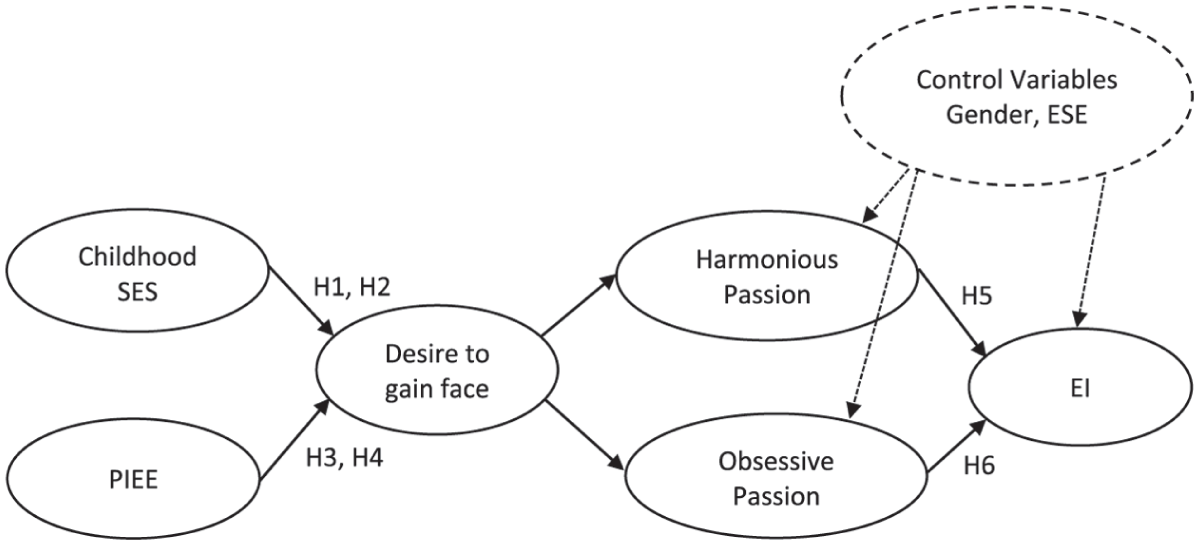
Conceptual framework.
Research Methods
Participants
Data were collected from a large public university in Vietnam during the second semester of 2025, where entrepreneurship education was delivered primarily through required courses embedded within the undergraduate business curriculum across the Standard, Integrated, and English programs, rather than through a standalone entrepreneurship major. A separate small, selective English-medium joint-degree entrepreneurship program conducted in collaboration with foreign universities was excluded from the study because it was institutionally and pedagogically distinct from the university’s core business programs.
Accordingly, respondents were business students from various majors who had completed at least one entrepreneurship course or program as part of their degree requirements. Their responses therefore reflect the perceived impact of entrepreneurship education within a general business curriculum rather than a specialized entrepreneurship major.
This sampling approach reflects many emerging-economy contexts, where entrepreneurship is taught as part of business education rather than as a standalone major. General business students are therefore a relevant population for examining how entrepreneurship education shapes motivation, passion, and intention prior to venture entry.
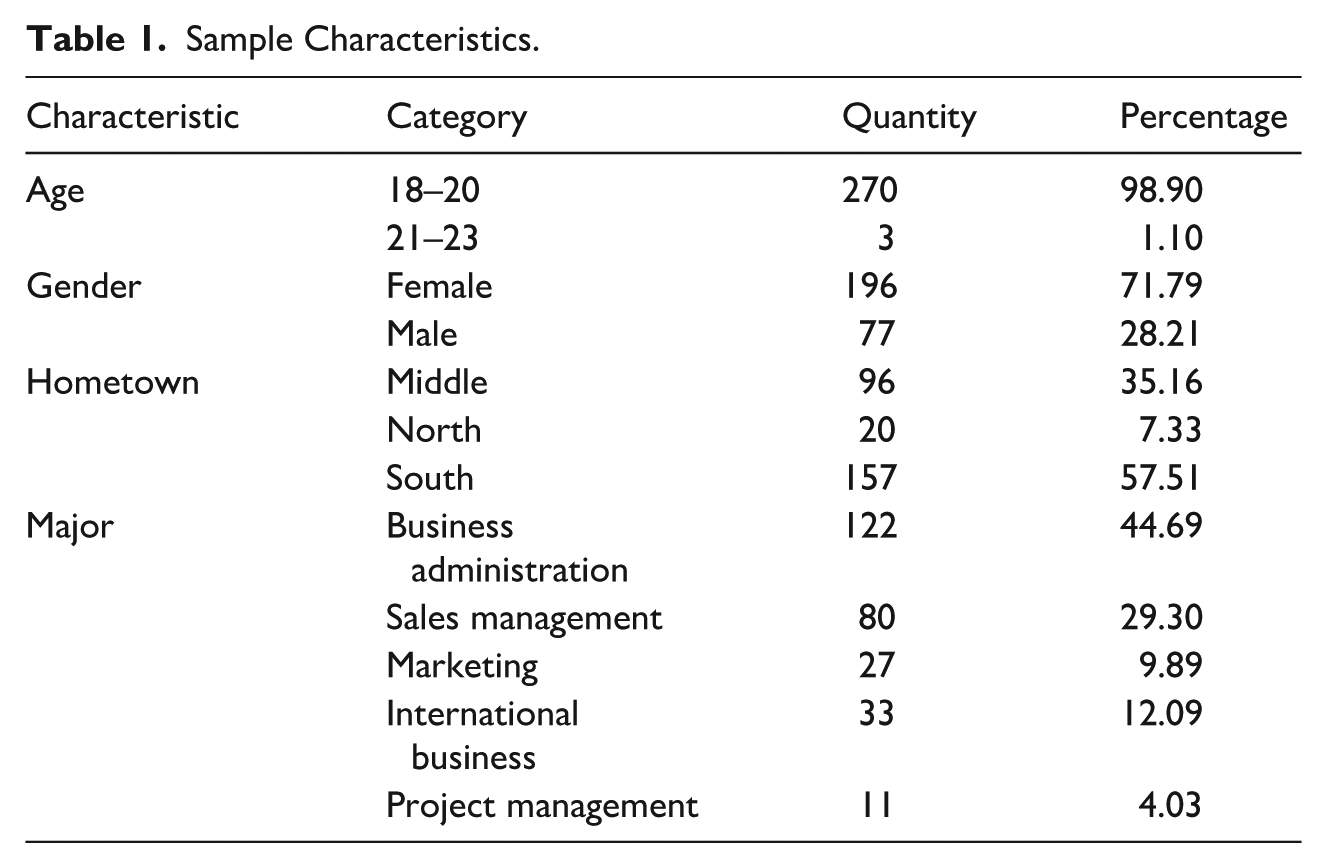
Questionnaires were distributed in person, and 283 of 322 were returned (87.9% response rate), consistent with similar studies (Nguyen & Nguyen, 2024). A two-wave design with a two-week interval was implemented to measure independent and dependent variables at different points in time, thereby reducing measurement error (Peytchev & Peytcheva, 2017) and enhancing data quality (Adigüzel & Wedel, 2008). In the first survey (Time 1), we measured childhood socioeconomic status, desire to gain face, perceived impact of entrepreneurship education, and entrepreneurial self-efficacy, whereas the second survey (Time 2) assessed harmonious passion, obsessive passion, and entrepreneurial intention. After excluding ten incomplete or invalid responses, the final sample consisted of 273 valid cases. The demographic and background characteristics of the participants are presented in Table 1.
Sample Characteristics.
Entrepreneurship Education Context
At the study site, entrepreneurship education is delivered primarily through dedicated courses embedded within the broader business curriculum rather than through a standalone undergraduate entrepreneurship major. The focal entrepreneurship course is a required module across the sampled business program tracks, although its delivery and emphasis vary somewhat by program structure. Some sampled classes were delivered in English-medium format within the university’s regular business programs. These courses incorporate scaffolded elements—including guided exercises, case-based learning, iterative feedback, and increasingly complex tasks—through which students are supported in developing entrepreneurial competencies.
In the Standard and Integrated programs, the focal course Khởi sự kinh doanh (“Start Your Business”) provides foundational tools for developing a venture from idea formation to early-stage planning. Across 15 weeks, it covers entrepreneurship fundamentals, mindset, ethics, social responsibility, opportunity evaluation, business model development, core functional planning, legal requirements, and business plan preparation.
In the English Program (International/English-medium), the corresponding course “Entrepreneurship and Innovation” addresses similar core stages of the entrepreneurial process but places greater emphasis on innovation, opportunity evaluation, and international entrepreneurial practices, reflecting the program’s global orientation and full English-language delivery.
Across all program tracks, teaching combines lectures and case-based discussions, supplemented by group presentations and applied exercises. Assessment includes class participation and group work and culminates in an individual written business plan or venture report aligned with course learning outcomes. Consistent with many undergraduate entrepreneurship offerings, these courses primarily emphasize pre-entry stages of the entrepreneurial process, particularly opportunity identification and venture planning. Accordingly, while post-entry phases such as market entry, scaling, and adaptation may be discussed conceptually, they are not enacted experientially within the course, and thus are only partially addressed—an important boundary condition of the present study.
The courses are delivered by business school faculty responsible for entrepreneurship-related modules, whose qualifications follow standard university appointment requirements and national higher education regulations. As is common in public universities in emerging economies, curriculum design is aligned with national education frameworks, which may shape an emphasis on formal planning, ethical compliance, and structured venture development. This institutional context is taken into account when interpreting the findings and deriving curricular and pedagogical recommendations.
Instrument and Measures
All constructs were measured using established multi-item scales on 7-point Likert scales (1 = strongly disagree, 7 = strongly agree). Desire to gain face was assessed with four items adapted from X. A. Zhang et al. (2011; α = .76). Perceived impact of entrepreneurship education (five items) and entrepreneurial intention (six items) were adapted from Liñán et al. (2011), with the former reflecting students’ subjective beliefs about how entrepreneurship education shaped entrepreneurial knowledge, role recognition, preferences, perceived abilities, and intention (see also Nguyen & Nguyen, 2024). Harmonious and obsessive passion were measured using established scales (Fisher et al., 2018; Murnieks et al., 2014, 2020; α = .76 and .85, respectively). Childhood socioeconomic status was measured with three items adapted from Griskevicius et al. (2011; α = .87), and entrepreneurial self-efficacy with five items from Wilson et al. (2007). Full items and results appear in Table 2.
Evaluation of Measurement Items.
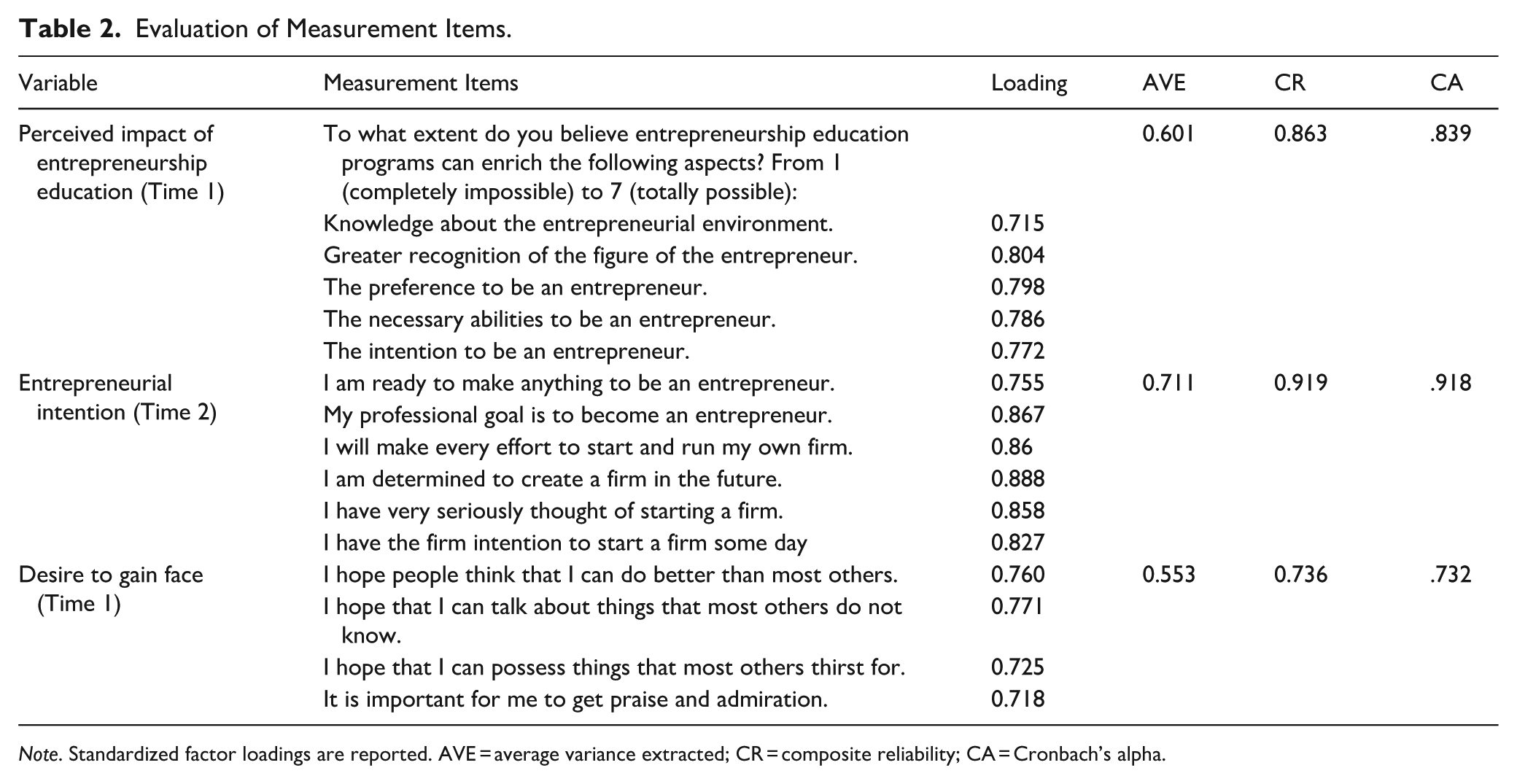
Note. Standardized factor loadings are reported. AVE = average variance extracted; CR = composite reliability; CA = Cronbach’s alpha.
Common Method Variance (CMV)
To mitigate common method bias, procedural remedies were applied (Podsakoff et al., 2003), and statistical tests indicated no serious concern. Harman’s single-factor test showed no dominant factor, and full collinearity VIFs ranged from 1.00 to 2.14, below the 3.30 threshold (Kock, 2015). The two-wave design further reduced potential bias (Minh et al., 2025; Podsakoff et al., 2003).
Data Analysis
Given the model complexity, partial least squares structural equation modeling (PLS-SEM) was employed, as it is well suited for complex models and theory development and does not require multivariate normality (Henseler et al., 2009; Sarstedt et al., 2021). The sample size (N = 273) was adequate for PLS-SEM (Hair et al., 2011), and analyses were conducted using SmartPLS 4.0 (Ringle et al., 2022).
Control Variables
Gender, age, and entrepreneurial self-efficacy were initially considered as control variables. Gender (1 = female, 0 = male) and age were included based on prior links to entrepreneurial passion and intention (Engle et al., 2011; Kiani et al., 2020; Kyriakopoulos et al., 2024; Riar et al., 2025), although age was later excluded due to limited variance in the undergraduate sample. Entrepreneurial self-efficacy was retained given its established associations with both entrepreneurial passion and intention (Bouhalleb & Haddoud, 2024; D. K. Hsu et al., 2019).
Results
Table 3 shows that the strongest correlation is between harmonious passion and entrepreneurial intention (r = .809).
Correlation Matrix Among Variables.
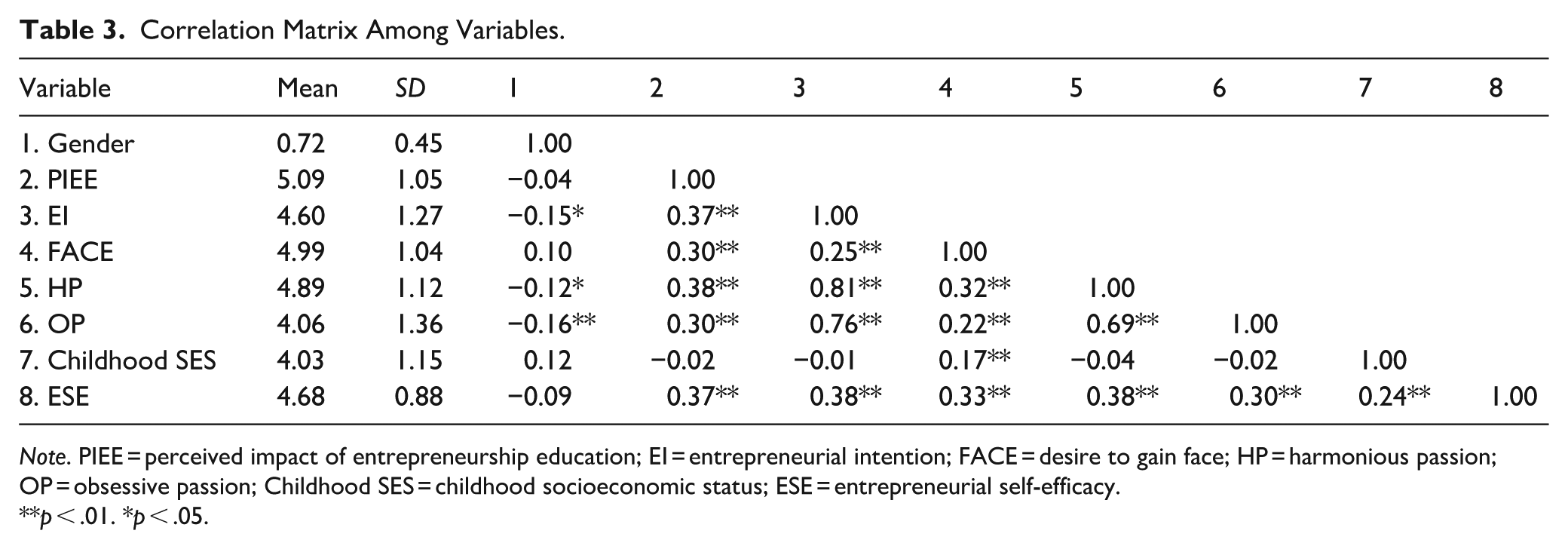
Note. PIEE = perceived impact of entrepreneurship education; EI = entrepreneurial intention; FACE = desire to gain face; HP = harmonious passion; OP = obsessive passion; Childhood SES = childhood socioeconomic status; ESE = entrepreneurial self-efficacy.
p < .01. *p < .05.
Measurement Models
Table 2 presents the results of the measurement model evaluation. All constructs demonstrated satisfactory internal consistency, with Cronbach’s alpha and composite reliability scores exceeding the recommended threshold of .70 (Fornell & Larcker, 1981; Nunnally, 1978). The average variance extracted (AVE) values for all constructs were above .50, indicating strong convergent validity (Hair et al., 2022).
Discriminant validity was assessed using the Fornell–Larcker criterion and the heterotrait–monotrait (HTMT) ratios (Fornell & Larcker, 1981; Henseler et al., 2015). All constructs met the Fornell–Larcker criterion (Table 4), and HTMT values were below 0.90, indicating satisfactory discriminant validity.
Discriminant Validity Analysis Results.
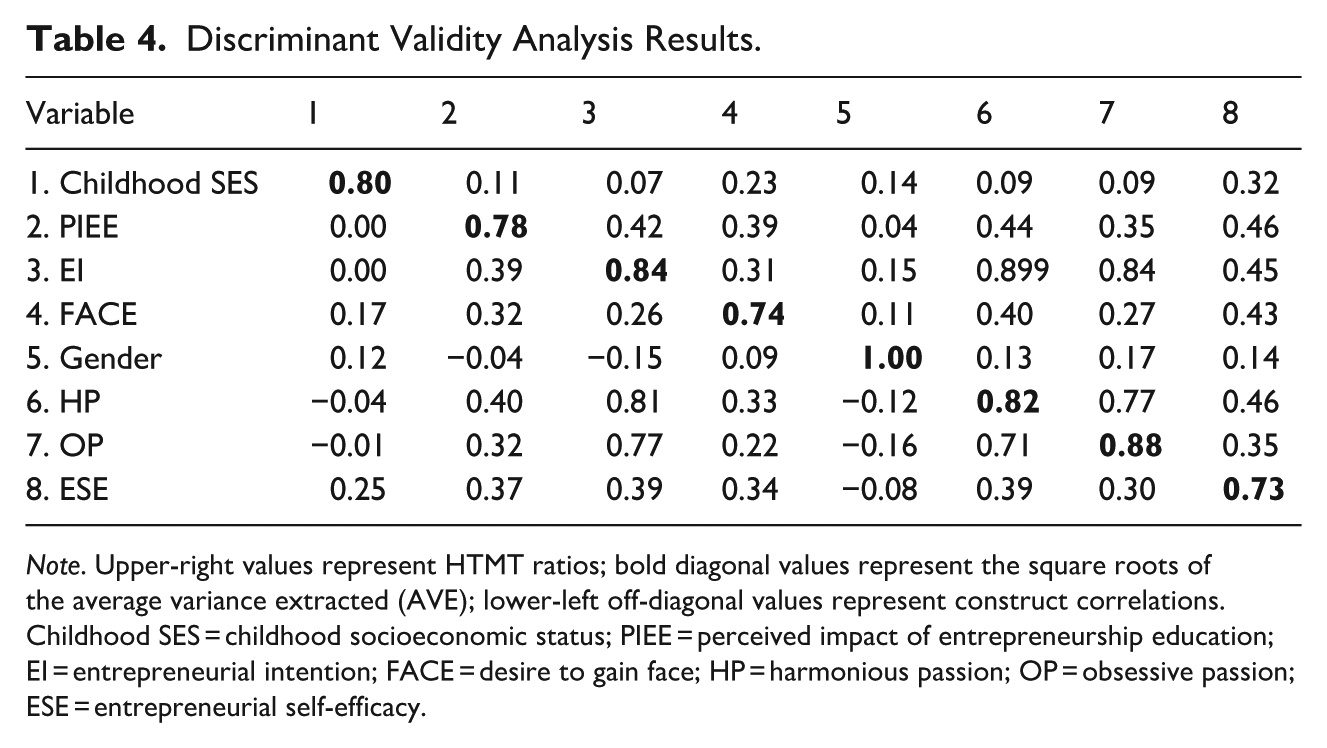
Note. Upper-right values represent HTMT ratios; bold diagonal values represent the square roots of the average variance extracted (AVE); lower-left off-diagonal values represent construct correlations. Childhood SES = childhood socioeconomic status; PIEE = perceived impact of entrepreneurship education; EI = entrepreneurial intention; FACE = desire to gain face; HP = harmonious passion; OP = obsessive passion; ESE = entrepreneurial self-efficacy.
Structural Model
Following Hair et al. (2017), the structural model was evaluated using collinearity diagnostics, R2, Q2, and path significance. First, variance inflation factors (VIFs) were below the recommended threshold of 5, indicating no multicollinearity concerns (Hair et al., 2022).
Second, the R2 values for harmonious passion (.274), obsessive passion (.176), and entrepreneurial intention (.746) suggest acceptable to substantial explanatory power, with entrepreneurial intention showing particularly strong variance explained (Hair et al., 2017).
Predictive performance was assessed using PLSpredict (Shmueli et al., 2019). All Q2 values exceeded zero, indicating predictive relevance. In addition, the standardized root mean square residual value of 0.065 was below the recommended 0.08 threshold, indicating acceptable model fit (Henseler et al., 2014).
Path Coefficient Analysis
Following recommendations in recent PLS-SEM research (Ali et al., 2020; Streukens & Leroi-Werelds, 2016), we applied bootstrapping with 5,000 subsamples (N = 273) to assess the significance of the structural relationships. Statistical inference was based on bias-corrected and accelerated (BCa) 95% bootstrap confidence intervals. For direct effects, we additionally report two-tailed bootstrapped p-values. For indirect (mediation) effects, consistent with contemporary mediation guidelines (Hair et al., 2022; Hayes, 2013; Hayes & Scharkow, 2013), significance was determined primarily by whether the 95% confidence interval excluded zero.
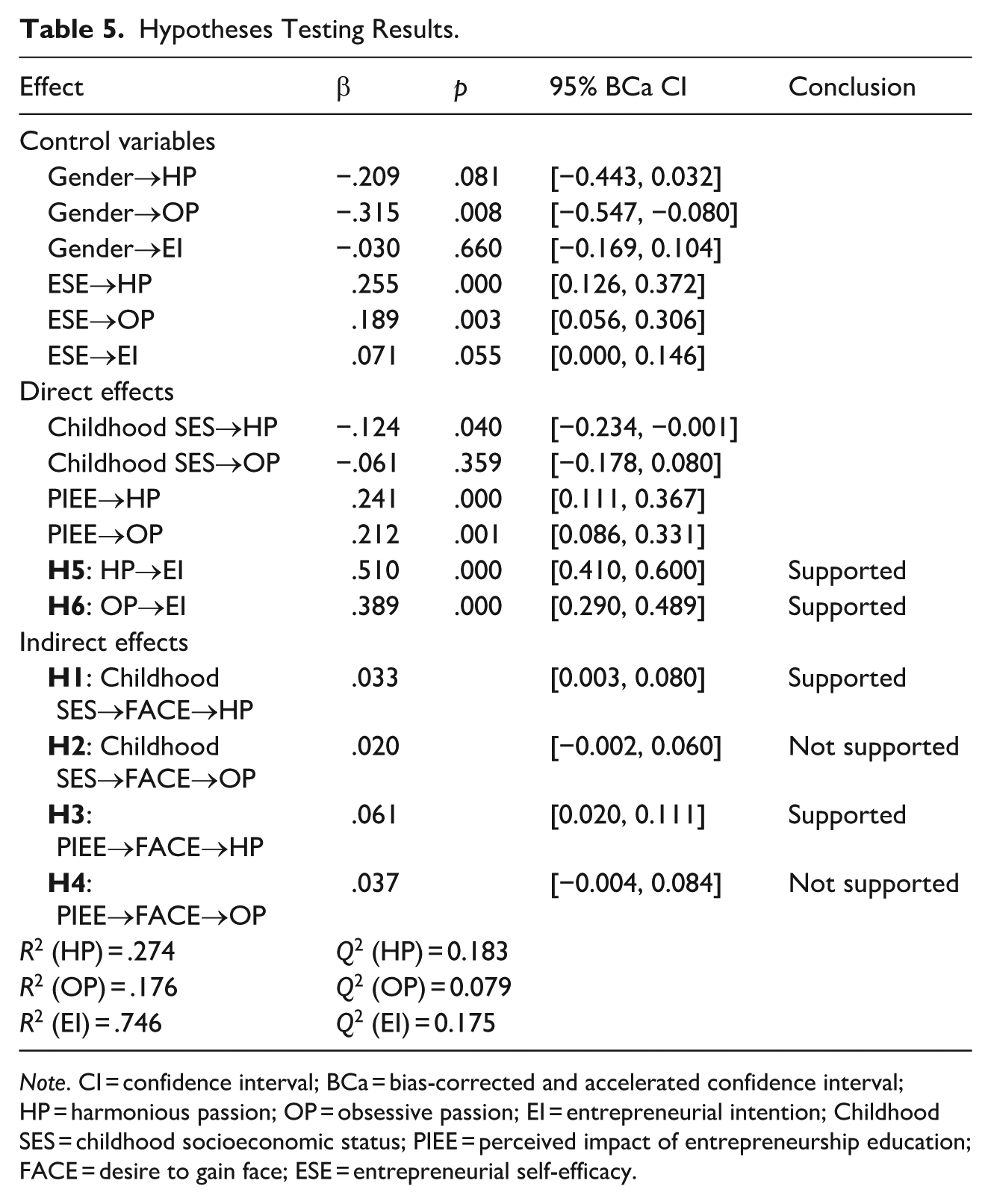
The results indicated that most of the proposed direct effects were statistically significant (see Table 5). Harmonious passion was positively related to entrepreneurial intention (
Hypotheses Testing Results.
Note. CI = confidence interval; BCa = bias-corrected and accelerated confidence interval; HP = harmonious passion; OP = obsessive passion; EI = entrepreneurial intention; Childhood SES = childhood socioeconomic status; PIEE = perceived impact of entrepreneurship education; FACE = desire to gain face; ESE = entrepreneurial self-efficacy.
Mediation Analysis
The procedure recommended by Hair et al. (2022) was used to assess the mediating role of desire to gain face. Consistent with contemporary mediation guidelines emphasizing bootstrap confidence intervals as the primary inferential criterion (Hayes, 2013; Hayes & Scharkow, 2013), mediation is established when the confidence interval for the indirect effect does not include zero. For Hypothesis 1, the indirect effect of childhood SES on harmonious passion through desire to gain face was significant, as the 95% bias-corrected bootstrap confidence interval excluded zero (β = .033, 95% BCa CI [0.003, 0.080]). The direct effect of childhood SES on harmonious passion was also significant but negative (β = −.124, p = .040, 95% BCa CI [−0.234, −0.001]), indicating that higher SES was directly associated with lower harmonious passion. This pattern represents competitive mediation, in which the direct and indirect effects operate in opposite directions (Hair et al., 2022; X. Zhao et al., 2010), thereby supporting Hypothesis 1.
For Hypothesis 2, which proposed that desire to gain face mediates the relationship between childhood SES and obsessive passion, the indirect effect was not supported. In this case, the 95% bias-corrected bootstrap confidence interval for the indirect effect included zero (β = .020, 95% BCa CI [−0.002, 0.060]), indicating no evidence of mediation. The direct effect of childhood SES on obsessive passion was also not significant (β = −.061, p = .359, 95% BCa CI [−0.178, 0.080]). Accordingly, Hypothesis 2 was not supported.
For Hypothesis 3, which proposed that desire to gain face mediates the relationship between the perceived impact of entrepreneurship education and harmonious passion, the indirect effect was supported. The 95% bias-corrected bootstrap confidence interval excluded zero (β = .061, 95% BCa CI [0.020, 0.111]), indicating a significant indirect effect. The direct effect was also significant (β = .241, p < .001, 95% BCa CI [0.111, 0.367]). Because both direct and indirect effects were positive and significant, this pattern represents complementary (partial) mediation (Hair et al., 2022; X. Zhao et al., 2010), thereby supporting Hypothesis 3.
For Hypothesis 4, which proposed that desire to gain face mediates the relationship between the perceived impact of entrepreneurship education and obsessive passion, the indirect effect was not supported. The 95% bias-corrected bootstrap confidence interval for the indirect effect included zero (β = .037, 95% BCa CI [−0.004, 0.084]), indicating no mediation. Although the direct effect remained significant (β = .212, p = .001, 95% BCa CI [0.086, 0.331]), the absence of a significant indirect effect indicates that mediation was not established. Accordingly, Hypothesis 4 was not supported.
Among the control variables, gender was negatively associated with obsessive passion but not with harmonious passion or entrepreneurial intention. Entrepreneurial self-efficacy was positively associated with both forms of passion, but not with entrepreneurial intention.
Post hoc Analysis
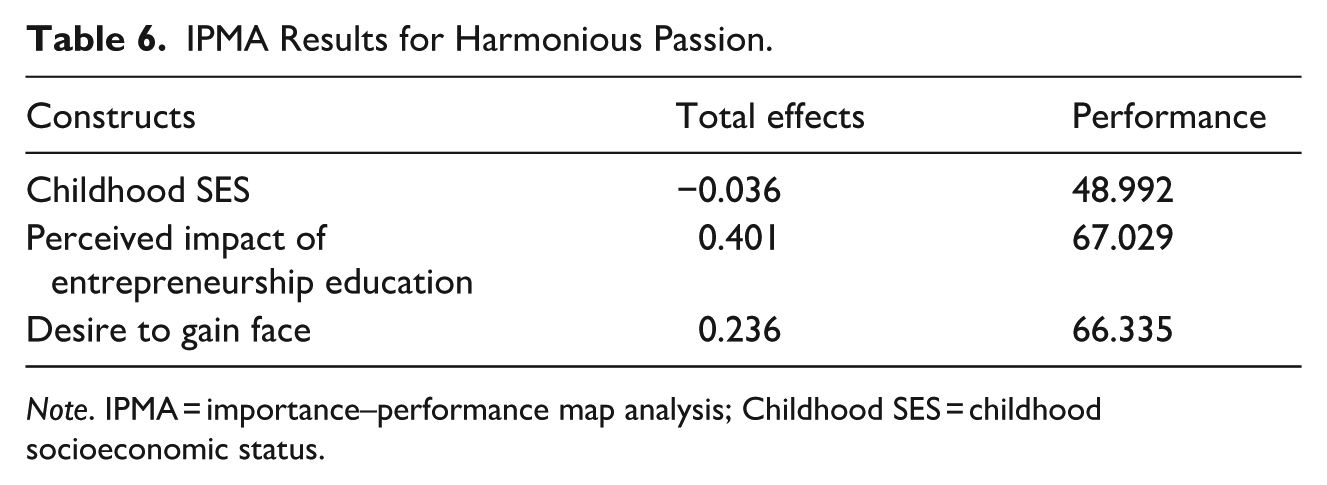
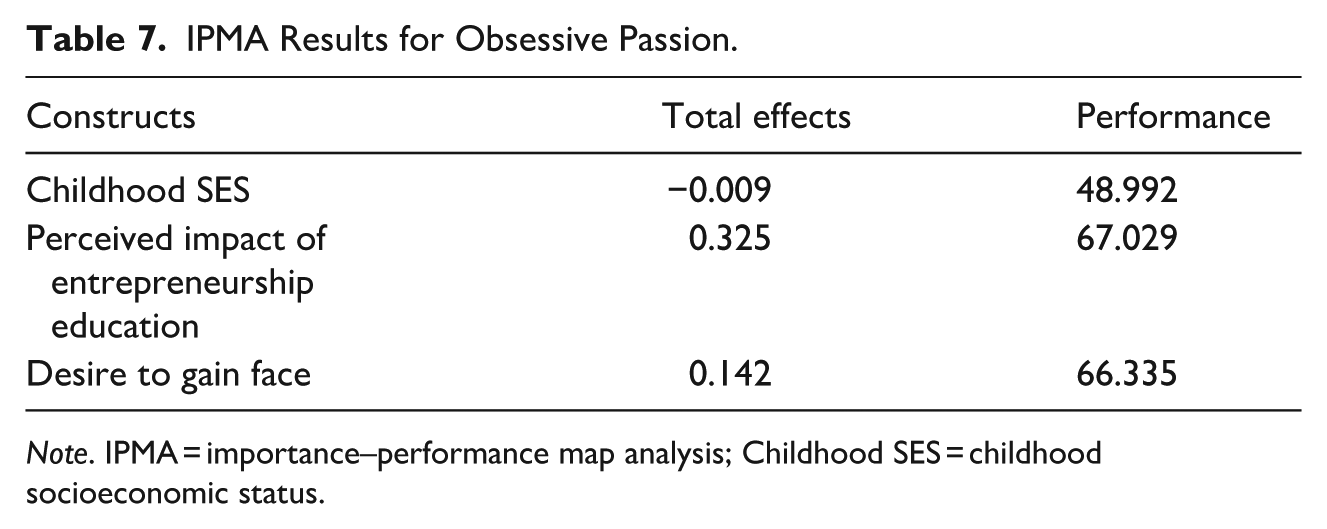
Importance–Performance Map Analysis (IPMA; Tables 6 and 7; Figures 2 and 3) showed that the perceived impact of entrepreneurship education was the strongest predictor of harmonious passion (0.401) and obsessive passion (0.325), followed by desire to gain face (0.236; 0.142). It also had the highest performance score (67.03).
IPMA Results for Harmonious Passion.
Note. IPMA = importance–performance map analysis; Childhood SES = childhood socioeconomic status.
IPMA Results for Obsessive Passion.
Note. IPMA = importance–performance map analysis; Childhood SES = childhood socioeconomic status.
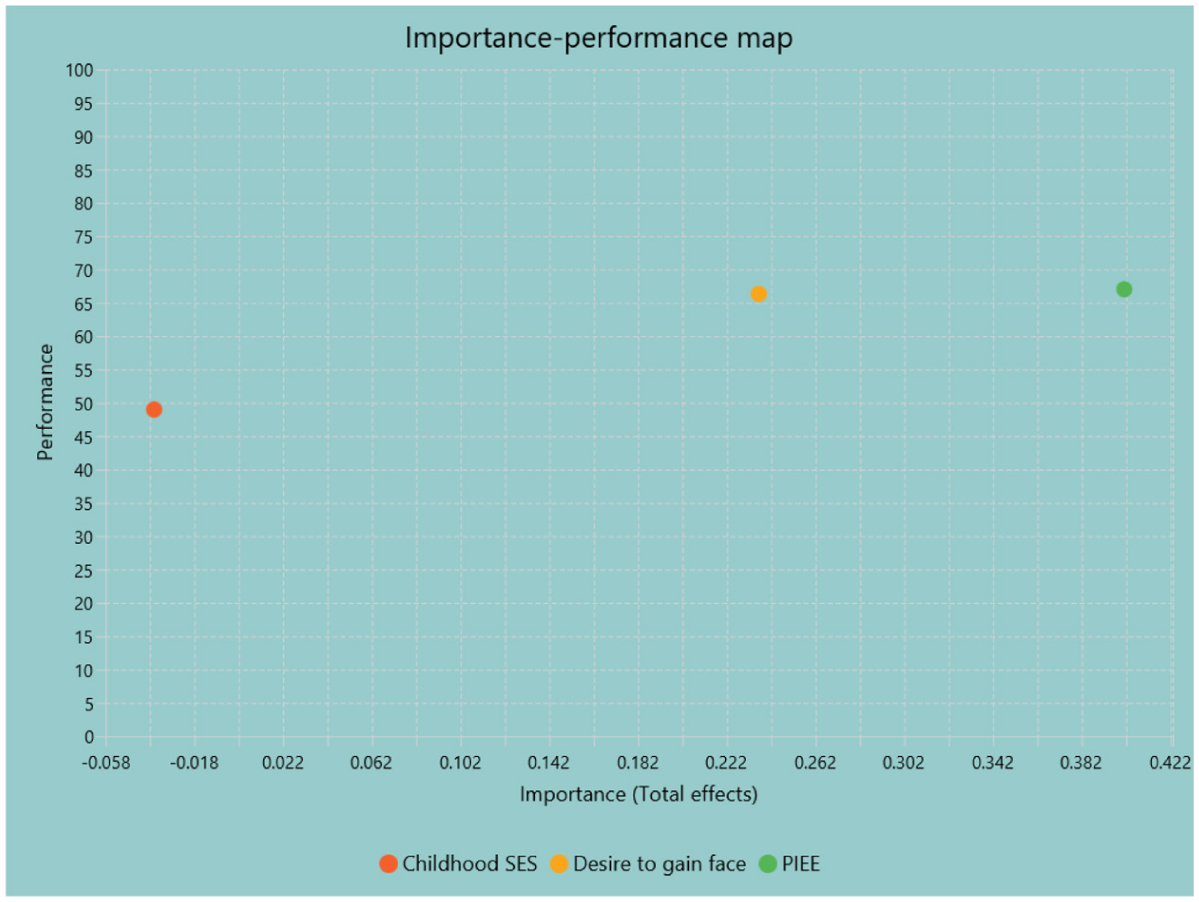
Importance-performance map for harmonious passion.
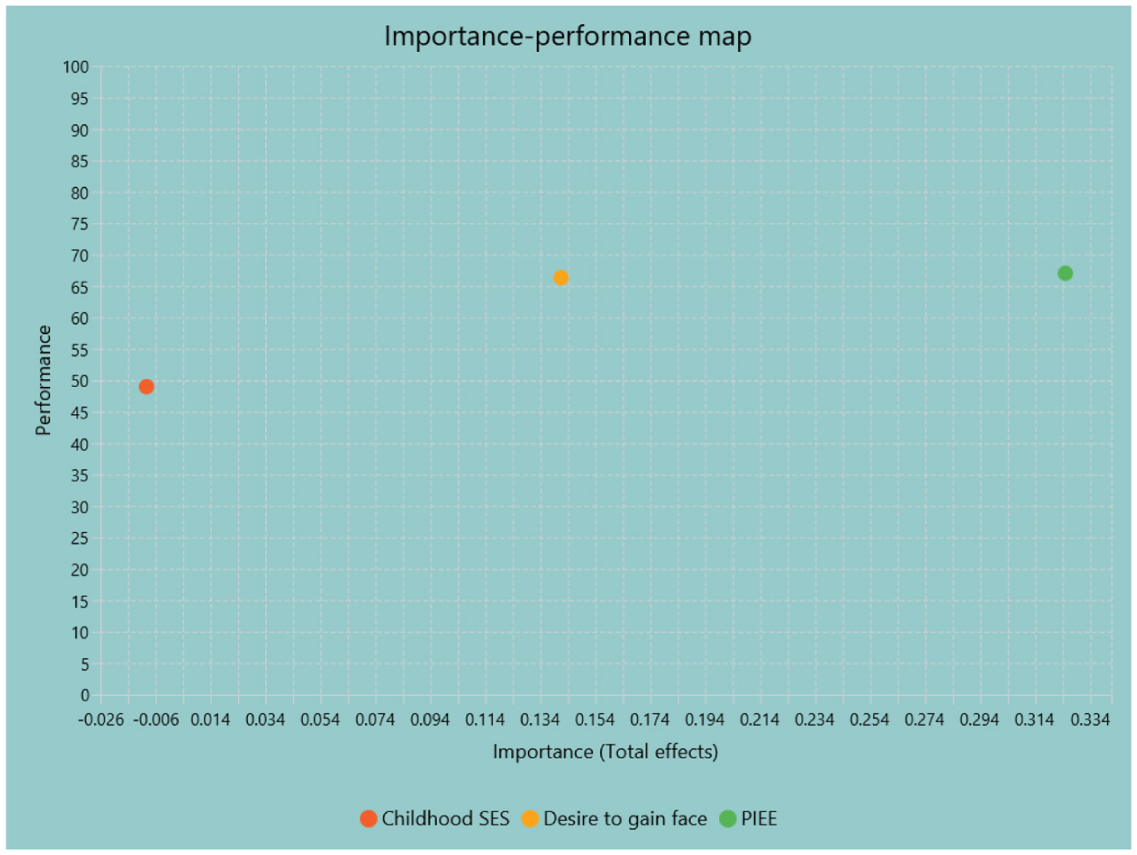
Importance-performance map for obsessive passion.
The Gaussian copula test indicated no endogeneity (p > .05; Becker et al., 2022). Finite mixture partial least squares results showed no substantive unobserved heterogeneity, as segment sizes were below recommended thresholds (Hair et al., 2016, 2022).
Discussion
This study advances understanding of entrepreneurial passion by integrating overlooked contextual and psychological perspectives from an emerging economy. The findings show that the desire to gain face mediates the influence of childhood socioeconomic status and the perceived impact of entrepreneurship education on harmonious passion, but not on obsessive passion. In collectivist contexts, entrepreneurial behavior is shaped by a combination of economic conditions and status-oriented norms (Kim & Nam, 1998; X. A. Zhang et al., 2011). These insights offer actionable guidance for designing public higher-education policies, entrepreneurship education programs, and support initiatives that reflect local values and leverage culturally salient motivational drivers (Fayolle & Gailly, 2015; Nabi et al., 2017).
Theoretical Contributions
This study is among the first to examine how childhood socioeconomic status and the desire to gain face jointly shape entrepreneurial passion, particularly harmonious and obsessive forms. Although both constructs have received increasing attention in entrepreneurship research (e.g., Lu et al., 2025; Sheng et al., 2024; Tang et al., 2022; Wolfe & Patel, 2017), their specific and differential roles in driving entrepreneurial passion, particularly distinct forms of passion, remain largely unexplored. As a result, entrepreneurship research has often overlooked the background values embedded in socioeconomic status and cultural contexts, especially in collectivist Asian countries where such influences may be subtle yet profound. Addressing this gap advances theoretical understanding of the motivational mechanisms underlying entrepreneurial passion and offers practical insights for management education programs to foster passion and enhance entrepreneurial behavior in culturally appropriate ways. By theorizing entrepreneurial passion as internalized within a collectivist cultural context, this study provides a contextually grounded conceptual baseline against which future research in Western or more individualistic settings can meaningfully compare how entrepreneurial motivation and passion are formed. While empirically situated in a collectivist context, our theoretical arguments regarding internalization processes and passion development are intended to inform, rather than replace, existing entrepreneurship education theories largely developed in Western settings.
The findings suggest that lower childhood socioeconomic status may foster harmonious passion through pathways oriented toward economic improvement rather than status enhancement. Consistent with prior research linking economic hardship to entrepreneurial engagement (Schoon & Duckworth, 2012; Shane, 2008; Uusitalo, 2001; Wolfe & Patel, 2017), early exposure to resource scarcity can encourage greater risk acceptance and a focus on improving one’s material circumstances. Under such conditions, entrepreneurship may be perceived as a viable avenue for financial advancement or economic security (Evans & English, 2002; Gino et al., 2011; Jiang, 2024; Kish-Gephart & Campbell, 2015). When these aspirations are autonomously internalized rather than externally pressured, they may evolve into harmonious passion oriented toward achievement and self-improvement (Deci & Ryan, 2000; Vallerand et al., 2003).
In contrast, individuals from more privileged backgrounds are more frequently socialized into environments emphasizing prestige, self-enhancement, and social distinction (Côté et al., 2021; Kraus et al., 2012). In collectivist cultures, such socialization strengthens the desire to gain face (Kim & Nam, 1998; Smith & Pham, 1996). Although social recognition is typically considered an extrinsic goal, it may be internalized when personally endorsed, thereby contributing positively to harmonious passion under autonomy-supportive conditions (Ryan & Deci, 2020; Vallerand, 2008). However, our findings indicate that this positive indirect pathway coexists with a negative direct effect of childhood SES on harmonious passion, resulting in a non-significant total effect due to opposing direct and indirect pathways. This pattern reflects competitive mediation (X. Zhao et al., 2010), whereby opposing mechanisms operate simultaneously and partially offset one another. Rather than indicating a simple overall association, the results suggest that distinct motivational pathways are activated across the socioeconomic spectrum. Among individuals with higher childhood SES, status-oriented motives can foster harmonious passion when autonomously internalized. At the same time, privilege may also be associated with other (unmeasured) pathways—such as reduced necessity-driven commitment, greater career optionality that diffuses entrepreneurial identity, or stronger contingent achievement norms—that could dampen harmonious passion directly. In contrast, individuals from lower childhood SES backgrounds may develop economic-improvement and competence-development motives that strengthen harmonious passion when autonomously internalized. Thus, childhood SES does not exert a uniform influence on entrepreneurial passion; its effect depends on the interplay of competing motivational processes. Consistent with self-determination theory, it is the mode of internalization—rather than the specific content of the motive—that ultimately determines whether harmonious passion develops.
Consistent with a more autonomy-based interpretation of obsessive passion, childhood socioeconomic status did not significantly influence obsessive passion, either directly or through the desire to gain face. While low socioeconomic status is often associated with entrepreneurial engagement (Schoon & Duckworth, 2012; Shane, 2008), such motivation may frequently be internalized autonomously rather than driven by pressure or ego-involvement (Ryan & Deci, 2020; Vallerand et al., 2003). Likewise, individuals from high socioeconomic backgrounds may pursue prestige through entrepreneurship, but when these goals are voluntarily endorsed, the desire to gain face does not necessarily lead to obsessive passion (Côté et al., 2021; Galindo-Martín et al., 2023).
Second, this is the first study to integrate the perceived impact of entrepreneurship education, face motivation, and passion types into a single framework. In doing so, we conceptualize entrepreneurship education as a psychological and symbolic influence, captured through students’ perceptions of its impact, rather than as an objective assessment of curriculum content or pedagogical design. While previous research has examined the link between education and entrepreneurial passion (Bouhalleb & Haddoud, 2024; Y. Gao & Lu, 2024; Iyortsuun et al., 2021), few studies have investigated the mediating psychological mechanisms. The findings suggest that the perceived impact of entrepreneurship education is associated with a heightened desire to gain face, likely by signaling prestige-oriented norms. Empirically, this activation was positively related to harmonious passion when internalized autonomously. However, the indirect pathway to obsessive passion was not supported, indicating that prestige-oriented signals in this context did not translate into the controlled internalization pattern characteristic of obsessive passion. Theoretically, had such norms been internalized under external pressure or contingent self-worth, they might have contributed to obsessive passion; yet this pathway was not observed in the present data. This suggests that in the examined educational context, prestige signals may have been framed in competence-supportive rather than pressure-inducing ways.
Finally, this study extends prior research by clarifying how harmonious passion and obsessive passion differentially influence entrepreneurial intention, an area that has received relatively limited empirical attention despite its theoretical significance (Galindo-Martín et al., 2023; Huyghe et al., 2016). The results provide new evidence on the distinct motivational pathways through which different forms of entrepreneurial passion shape intention. Importantly, this study focuses on the formative, pre-venture phase of the entrepreneurial journey. Rather than seeking to capture the full entrepreneurial process, we examine how early educational experiences and socio-cultural backgrounds shape the internalization of entrepreneurial motivation into harmonious versus obsessive passion and, in turn, entrepreneurial intention. From this perspective, undergraduate entrepreneurship education is not assumed to “produce entrepreneurs,” but rather to shape how students come to value, interpret, and emotionally engage with entrepreneurship prior to actual venture enactment. Consistent with prior work, we do not treat harmonious and obsessive passion as exhaustive of the entrepreneurial passion domain; rather, they represent theoretically salient forms of passion that capture distinct internalization pathways at the formative, pre-venture stage examined in this study. Viewed through an embodied and temporal lens, entrepreneurial passion is shaped not only by cognitive instruction but also by students’ affective engagement and identity work over time—an implication that we take up in our curricular and pedagogical recommendations.
Practical Implications
This study offers actionable insights for educators, policymakers, and entrepreneurship support organizations. The findings suggest that entrepreneurial passion develops through distinct motivational pathways shaped by childhood socioeconomic background and students’ perceptions of entrepreneurship education, with outcomes depending on whether these motives are autonomously internalized.
For individuals from lower socioeconomic backgrounds, harmonious passion is more likely to emerge when economic-improvement and competence-development motives are self-endorsed. Programs should therefore emphasize feasibility, capability building, and realistic opportunity structures, focusing on skill acquisition, structured venture planning, and incremental experimentation rather than status-related cues and prestige-oriented entrepreneurial success narratives, such as highly visible venture success stories and elite entrepreneurial role models.
For individuals from more privileged backgrounds, status-oriented motives may be more salient. In collectivist contexts, the desire to gain face can support engagement when autonomously internalized. Educators can acknowledge the symbolic and reputational aspects of entrepreneurship while incorporating reflective activities, mentoring, and feedback to align achievement aspirations with self-endorsed values and reduce externally driven engagement.
The findings also highlight the importance of how entrepreneurship education is perceived. Beyond formal content, educational environments transmit symbolic signals about success, recognition, and competence that activate different motives. The key pedagogical task is therefore to scaffold the autonomous internalization of these motives rather than suppress them.
Finally, while both harmonious and obsessive passion can drive entrepreneurial intention, sustainable engagement is more likely when motivation is autonomously internalized. Entrepreneurship education thus functions not only as knowledge transmission but also as a context for identity formation and motivational development.
Curricular and Pedagogical Implications
Building on our findings, entrepreneurship education in public universities—particularly in emerging-economy and collectivist contexts—should attend to how structural program features (e.g., tuition level, language medium, and institutional positioning) may embed status signals. These signals may emerge through prestige-associated program branding, selective admission structures, international affiliations, or exposure to highly visible entrepreneurial success narratives, all of which may shape how students internalize entrepreneurial motivation. Although program tracks do not necessarily correspond directly to socioeconomic groups, they may nevertheless differentially activate economic-improvement motives and the desire to gain face. The developmental implications of these motives, however, depend on how they are internalized.
In the Standard Program, Vietnamese-medium foundational curricula should foreground feasibility, resource access, and incremental venture development. Emphasizing low-cost experimentation and locally grounded role models can strengthen competence beliefs and support harmonious passion grounded in realistic opportunity pursuit rather than social comparison. Framing entrepreneurship as structured capability building reinforces autonomous internalization and reduces externally pressured engagement.
In the Integrated Program, a stronger international orientation may transmit prestige signals that activate students’ desire to gain face. Such activation is not inherently problematic; its implications depend on the mode of internalization. Structured reflection (e.g., guided discussion, milestone review, and mentoring) should therefore accompany exposure to high-profile role models and global innovation narratives. Providing space for students to articulate personally endorsed meanings of success may help channel prestige-related motives toward more harmonious rather than externally pressured forms of engagement.
In more internationally oriented or English-medium business tracks, where elite and global positioning cues may be especially salient, curricula should deliberately integrate process-oriented and identity-development components alongside prestige-oriented entrepreneurial success narratives, such as elite founder stories and celebrated venture success cases. Milestone-based projects, iterative venture development, and reflective exercises can anchor engagement in competence development and evolving entrepreneurial identity rather than contingent self-worth. Such scaffolding may reduce ego-involved regulation and support sustained, self-endorsed engagement.
Across tracks, internalization safeguards are essential. Process-based assessment, motivation-focused reflection, peer dialog, and structured failure debriefs can normalize experimentation and reduce status-driven anxiety. Entrepreneurial passion develops not only through cognitive instruction but through affective engagement and identity development over time.
Entrepreneurship education does not merely transmit venture skills; it shapes how students interpret and internalize entrepreneurial activity. While program structures may activate economic or status-related motives, developmental outcomes ultimately depend on whether these motives are autonomously internalized or internalized under social pressure. Aligning curricular design with this distinction enables universities to foster more sustainable and developmentally adaptive forms of entrepreneurial passion. Future research could more directly compare specialized entrepreneurship programs and internationally oriented business tracks to examine how institutional positioning and language-medium contexts shape entrepreneurial motivation and passion internalization, because the present study did not include data from the university’s separate joint-degree entrepreneurship program.
Limitations and Directions for Future Research
This study has limitations that future research should address. First, this study focuses on entrepreneurial intention. Future research could examine how harmonious and obsessive passion influence later entrepreneurial outcomes, including opportunity recognition, persistence, venture growth, and long-term sustainability.
Consistent with a process-relational perspective, future research should adopt longitudinal and process-oriented designs to capture the temporal and emergent nature of entrepreneuring (Chiles et al., 2010; Steyaert, 2007; Whitehead, 1929/1978). Embodied approaches—such as ethnography, diaries, or repeated interviews—would be particularly valuable in capturing lived experiences beyond cross-sectional self-reports. Such designs could further illuminate how entrepreneurial passion evolves over time and how desire to gain face, socioeconomic background, and educational experiences dynamically interact from intention to enactment.
Second, this study relies on self-reported and perceptual measures, especially regarding the perceived impact of entrepreneurship education. While this aligns with the study’s focus on psychological internalization and a two-wave design was employed to mitigate common method bias, future research could incorporate objective indicators of pedagogical design or experimental approaches to compare perceived and actual educational effects.
Third, childhood socioeconomic status was modeled as a continuous construct to capture net effects. Future studies could explore nonlinear or threshold effects, differentiate between higher- and lower-SES groups, or adopt person-centered approaches to better capture potential asymmetries in motivational mechanisms.
Fourth, entrepreneurship education was examined as a psychological and symbolic influence rather than as specific programs. Future research could investigate how particular pedagogical features—such as experiential learning, role-model exposure, and assessment design—shape the desire to gain face and passion internalization.
Fifth, the study is situated within a single cultural context, which may limit generalizability. Cross-cultural comparisons between collectivist and individualistic contexts would help identify boundary conditions under which socioeconomic background and culturally embedded motives influence entrepreneurial passion.
Sixth, because the study focuses on public higher education, future research could examine how institutional governance and policy environments shape program design and the status meanings attached to entrepreneurship. Finally, comparative studies between general business students and those in specialized entrepreneurship programs could clarify how program structure and self-selection influence the development and internalization of entrepreneurial passion.
Conclusion
This study explains how childhood socioeconomic status, the perceived impact of entrepreneurship education, and culturally embedded motives jointly shape harmonious and obsessive passion in an emerging-economy context. The findings highlight that students’ interpretations of entrepreneurship education are central to passion development—especially harmonious passion—while childhood SES operates through competing motivational pathways, with the desire to gain face emerging as a key mechanism in collectivist settings.
Theoretically, the results show that entrepreneurial passion depends less on specific motives than on how they are internalized. Practically, they suggest that educators and policymakers should attend to the symbolic meanings and status-related cues embedded in program design, including entrepreneurial success narratives, to foster more enduring and developmentally adaptive forms of entrepreneurial passion and intention.
Footnotes

Author Contributions
Gia Ninh Nguyen: Writing—review & editing, Writing—original draft, Visualization, Validation, Supervision, Software, Resources, Project administration, Methodology, Investigation, Formal analysis, Data curation, and Conceptualization. Trieu Khoa Nguyen: Writing—review & editing, Writing—original draft, Visualization, Validation, Resources, Investigation, Conceptualization, Formal analysis, and Methodology.
Funding
The authors received no financial support for the research, authorship, and/or publication of this article.
Declaration of Conflicting Interests
The authors declared no potential conflicts of interest with respect to the research, authorship, and/or publication of this article.
Data Availability Statement
The data that support the findings of this study are available from the corresponding author* upon reasonable request.