







Abstract
For nearly half a century, management educators have utilized Kolb’s (1984) learning style theory to inform their teaching and learning practices. However, certain elements have been misapplied, including the matching hypothesis (e.g., meshing), the belief that teaching should be tailored to align with learners’ learning styles, and the predictive hypothesis, the belief that learning styles predict academic performance. We argue that when Kolb’s original theory is applied as intended, it offers substantial pedagogical value. Kolb describes learning styles as preferences across the learning cycle. He characterizes learning styles as mental categories, emphasizes within-person variance in learning, and treats them as developmental tools that promote reflection, flexibility, and self-awareness. Learning styles remain an effective instructional tool because they can support multimethod instruction, frame lessons across the learning cycle, and foster situational interest by helping learners connect course material to their experience.
Keywords
Introduction
D. A. Kolb’s (1984) learning style theory has both shaped instructional methods and helped learners develop a broader understanding of their learning preferences across the experiential learning cycle (Knoll et al., 2016). As is common with widely used theories, misapplications of learning style theory have proliferated (Cassidy, 2004; Hattie & O’Leary, 2025). These misapplications have overshadowed Kolb’s theory and have come to define how it is evaluated, critiqued, and used in practice. In addition, confusion surrounding learning styles has arisen due to differences in definitions and underlying assumptions about learning styles, their intended purposes, and their practical applications. While critiques have abounded, discussions of the positive benefits have languished. We argue that Kolb’s experiential learning theory provides a foundation for reinvigorating the use of learning styles in management education and propose advancing their application.
Here we present a brief history of the use of learning styles in management education and summarize debates about their value. We then introduce Kolb’s approach and highlight its benefits, focusing on two common misapplications: the “matching hypothesis” (e.g., meshing), where instructors align their pedagogy with a specific learning style, and the belief that learning styles can predict academic performance. In the third section, we detail what distinguishes Kolb’s approach from other learning-style theories and why these features are relevant to management educators. Specifically, the ability to navigate the entire learning cycle and adopt different learning styles requires flexibility, a competency essential to being an effective management professional. In the final section, we describe how learning style theory supports (1) the introduction of multimodal methods, (2) a deeper understanding of the learning process and enhanced self-awareness of individual learning preferences, and (3) the cultivation of situational interest.
A Brief History of Learning Style Theory
Proliferation and Debates
There is general agreement that learning styles provide a framework for understanding differences in learning preferences both between and within individuals. However, beyond this broad description, there is significant disagreement regarding the specific definitions, mechanisms, and measurements of learning styles.
As learning style theory gained popularity, the definitions and applications of learning styles became “fragmented and diverse” (Cassidy, 2004, p. 419). As a result, the sheer number of learning style definitions and the variability of underlying theories have led to confusion and misunderstanding. Scott (2010) identified over 71 approaches to learning styles in the UK alone. Among these definitions, learning style has been used to reference brain hemispheres, learning strategies (Reynolds, 1997), practical intelligence (see Glenn, 2009), cognitive styles (Kozhevnikov, 2007; Willingham et al., 2015), personality, attitudes toward learning, and multiple intelligences (see Gardner, 2019).
Each learning style approach implies a distinct underlying theory and emphasizes different learning mechanisms. Some theories draw on brain mapping, which posits that different brain regions foster distinct learning processes (Powers Dirette & Anderson, 2015). Some approaches assume that learning styles are innate; others suggest they develop over time; and still others define learning styles as synonymous with cognitive processes (Kozhevnikov, 2007).
Learning style often characterizes subprocesses in learning. For example, the VARK model—representing visual, auditory, reading, and kinesthetic learning—frames learning style as between-person differences in sensory perceptions and information gathering (see Snook, 2007, for a review). This model has been criticized for lacking empirical support and providing a limited conceptualization of the learning process (Furey, 2020). Unfortunately, the shortcomings of specific models, such as VARK, have raised broader concerns about the concept of learning style. We find this misdirected; using the VARK model to represent all learning styles is like using the Myers-Briggs Type Indicator to dismiss the entirety of personality theory. In the same way, we cannot discard personality theory due to the shortcomings of a single approach; the use of learning style should not rest on the critique of a single approach.
The proliferation of definitions and theories of learning styles underscores the concept’s influence. This influence has grown, in part, due to trends toward individualizing the learning process, as promoted by the Organisation for Economic Co-operation and Development (OECD, 1983)–sponsored review of recommended changes in higher education (Brookfield, 1986, p. 70). Learning styles have served as a convenient means to categorize learners and develop more personalized modes of learning.
Learning style theory has been influential in education generally (e.g., Nancekivell et al., 2019) as well as in management education, guiding new pedagogies, priorities, and practices in learning and teaching (Sims & Sims, 1995). Research has shown that D. A. Kolb’s (2015) learning style correlates with various nonacademic outcomes in management education. For example, cross-correlational studies have identified positive relationships between learning style and cultural values, exchange student status (Holtbrugge & Hohr, 2010), and cultural intelligence (Li et al., 2016).
Growing debates about the role of learning styles in management education intertwine with discussions of the underlying political and social processes associated with learning (Reynolds, 1997; Vince, 1996), the nature of learning and the intricacies of psychometrics (Freedman & Stumpf, 1980), and the historical influences of Western education (Fallace, 2019).
Questions about the value and validity of learning styles have extended beyond academic journals and now appear regularly in popular discourse. For example, Gilbert (2019), a historian writing in The Chronicle of Higher Education, went so far as to blame “bad ideas” such as learning style theory for everything from poor literacy rates among eighth graders to the proliferation of educational assessment trends. Grant (2018) mentioned the debate on Twitter, remarking that “learning style is about how you like to learn, not how you learn best.” Several commentaries have discredited learning styles as a “neuromyth,” challenging the belief in the variability of how people learn and advocating for behavioral theories of knowledge (Khazan, 2018; Online Learning Consortium, 2019; Pinker, 2021; Supiano, 2019).
Kolb’s Experiential Learning Style Theory
Kolb’s learning style theory, one of the earliest and most influential models of learning styles, was introduced in the mid-1970s by D. A. Kolb and Fry (1975) and later advanced by D. A. Kolb (1984). This approach stems from experiential learning theory and has been applied across more than 30 disciplines. It is among the most cited models, often serving as the foundational theory in discussions of learning styles (Dantas & Cunha, 2020). The evolution of Kolb’s theory and the associated measurement approach have been well documented, with studies providing evidence of its psychometric soundness (Kayes, 2005; A. Y. Kolb & Kolb, 2021; Manolis et al., 2013).
D. A. Kolb (1984, 2015) describes learning along two orthogonal dimensions: knowledge acquisition and knowledge processing. Each dimension is characterized by polar differentials. The knowledge acquisition dimension involves concrete experience (engaging emotions and directly experiencing the environment) versus abstract conceptualization (thinking and forming ideas). Knowledge processing involves active experimentation (testing and practicing) versus reflective observation (reflecting on one’s own experience). Taken in turn, concrete experience, reflective observation, abstract conceptualization, and active experimentation each constitute a phase of the entire experiential cycle of learning, as depicted in Figure 1. This learning cycle represents a normative theory of learning, illustrating an ideal learning situation that engages all four phases.
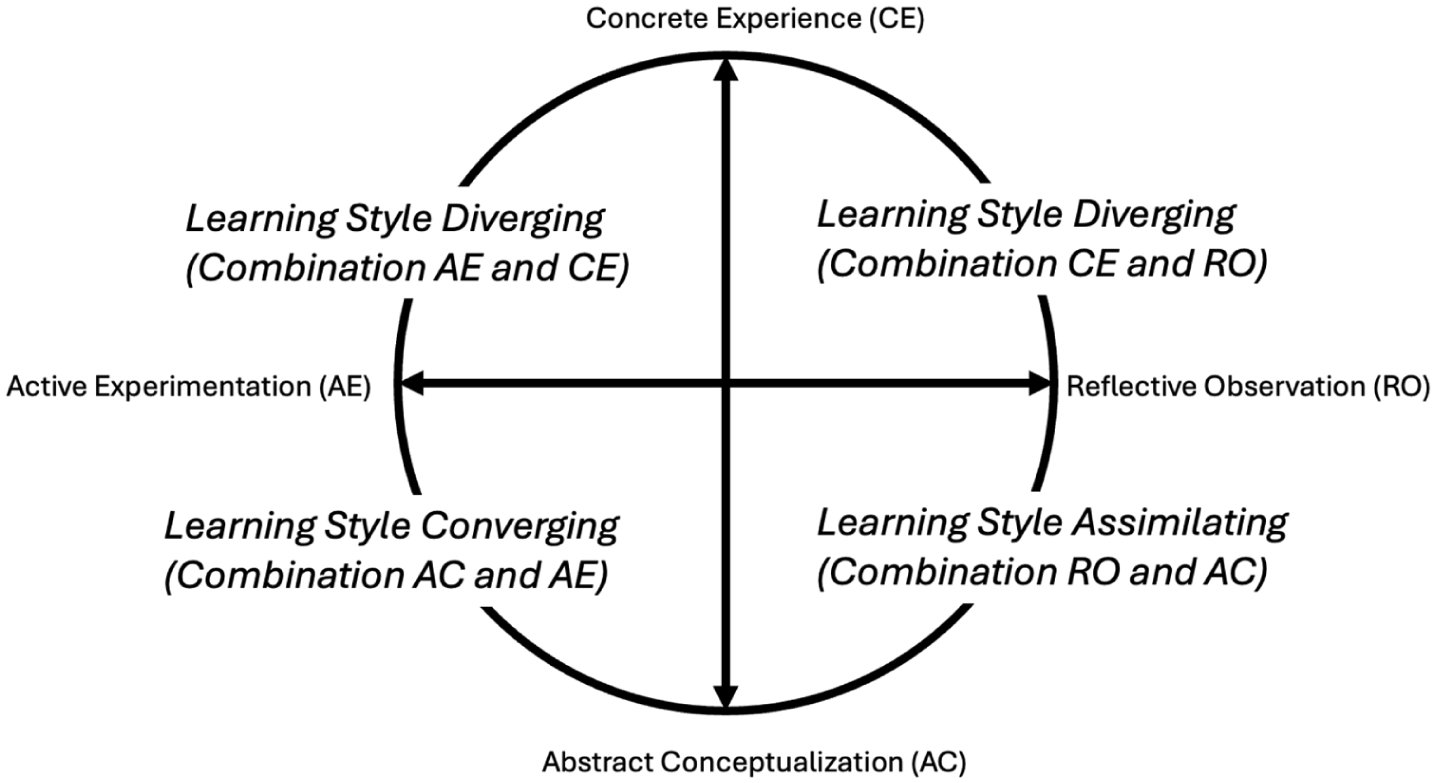
Kolb’s learning style theory.
Learning style is embedded in Kolb’s experiential learning cycle and refers to preferences for using one learning phase over another. Individuals differ in their degree of engagement across phases, indicating that learning style is associated with between-person variance. Further, an individual may have different preferences over time, suggesting that learning style is also associated with within-person variance. Kolb hypothesizes four primary learning styles, which combine the two dimensions of the learning model. Diverging is the preference for using concrete experience and reflective observation; assimilating, for using reflective observation and abstract conceptualization; converging, for using abstract conceptualization and active experimentation; and accommodating, for using active experimentation and concrete experience.
An updated version proposes nine learning styles (A. Kolb & Kolb, 2021; A. Y. Kolb & Kolb, 2005), which include preferences for each of the four dimensions independently as well as for the four combined dimensions. This version also introduces a “balanced” style, indicating no strong preference for any dimension. The learning preferences are referred to as a “profile,” further emphasizing the importance of connecting learning styles to the stages of the cycle. However, we focus on the four-style model because it is more widely adopted, and its underlying mechanisms are the same as those of the nine-style model. We also find that the four-style model, because it is more parsimonious, provides an accessible introduction to the learning styles, and the nine-style model serves as an extension of the four-style model.
Discussions of learning styles have largely focused on them as measures of differences between individuals, neglecting the significance of within-person variance. Learning style is shaped by experience, context, and development, rather than being a fixed trait or indicator of ability. From a between-person perspective, learning style is a preference and is best viewed as a dependent variable influenced by latent variables, including personality, educational level, career choice (Sims & Sims, 1995), knowledge specialization, culture (Yamazaki & Kayes, 2007), and other factors.
We emphasize within-person variance because it is often overlooked and constitutes a key differentiating factor in Kolb’s model. An individual’s preference for one phase of the cycle may come at the expense of others, making it challenging to move to them. The learning goal is to operate across different learning styles and avoid becoming stuck in a single phase of the learning cycle.
Learning style is assessed using a paper or online questionnaire. The ipsative structure (e.g., forced-choice rankings) is considered preferable as a measure of within-person preferences because it maximizes within-person variation (Hicks, 1970). Participants are classified into one of four major learning styles based on their scores in two dimensions: knowledge gathering and knowledge processing. They receive scores indicating the strength of their preferences across all four phases of the cycle.
The instructor’s role in administering the questionnaire is to help learners understand the various phases of the learning cycle, develop the ability to navigate the cycle, and build competencies for operating in each phase. The instrument was not designed as a predictive measure, but rather to illustrate individual scores and the relationships among the variables within the learning model. It was not intended to predict performance outcomes or classify learners into rigid categories. Learning style, therefore, describes tendencies rather than fixed traits.
Misapplications of Learning Style Theory
Since Kolb popularized the term “learning style’ (see Freedman & Stumpf, 1980), it has been expanded to encompass a broad range of factors associated with learning. This expansion has deviated considerably from Kolb’s original definition. In many instances, the theory has been misapplied, obscuring its unique value. When these misapplications dominate practice, the consequences extend beyond theoretical misalignment; they distort instructional decision-making, encourage attributions for poor performance, and reduce learning style to a static trait rather than a dynamic state. While a variety of misapplications exist, we focus on two that occur frequently, are inconsistent with the theory, and often serve as the basis for discrediting learning style theory more generally.
The first misapplication is the so-called “matching hypothesis” or “meshing,” in which instructors align their pedagogy with a specific learning style of their students (see Glenn, 2009, for a discussion). The matching hypothesis suggests that learning improves when instructional methods align with a learner’s preferred learning style. For example, a lecturer might distribute a questionnaire at the beginning of the semester to assess the class’s learning styles, determine that the class is predominantly composed of individuals who prefer group-based, activity-oriented learning, and then tailor classroom exercises to emphasize group activities. This approach has gained popularity, as demonstrated by an editorial in The Guardian, which described learning styles as the “belief that individuals can benefit from receiving information in their preferred format, based on a self-report questionnaire” (Hood et al., 2017, para. 2).
We found no evidence from studies to support the use of Kolb’s learning styles for pedagogical matching. In empirical research, support for matching instructor methods to learning preferences remains weak and inconsistent. There are studies on matching, but they do not use Kolb’s measure and show little to no evidence of the effectiveness of matching. For example, Clinton-Lisell and Litzinger’s (2024) meta-analysis of 21 studies on the matching hypothesis did not include Kolb’s measures. It found limited positive crossover interactions, leading them to conclude that the effects of matching are too small and infrequent to warrant widespread pedagogical adoption of this approach. Hattie and O’Leary’s (2025) meta-analysis of learning styles confirmed Dunn et al.’s (1995) prior analysis, which indicated that there is insufficient evidence to support the matching hypothesis. Further, Pashler et al. (2008) recommended discontinuing matching pedagogies on methodological grounds, arguing that testing this hypothesis would be challenging and would require multiple studies across various time frames (see also Vermunt & Endijk, as cited in Mayer, 2011).
Underlying these critiques is a broader issue in learning research: Learning theories that show promise in small samples, such as individual classrooms or programs, often fail to replicate in large-scale studies. Even well-established and widely adopted learning theories, such as the growth mindset, demonstrate small effect sizes in large-scale studies (Yeager & Dweck, 2020). From a pedagogical perspective, the problem is not merely that matching lacks empirical support. Instead, matching limits instructional variety and fosters the belief that students learn best only through their preferred styles, rather than through engagement across the entire learning cycle. In addition, Kolb never hypothesized instructor-learning matching as a benefit of learning style, and thus, it is one application of learning style theory to avoid.
A second misapplication views learning style as a proxy for aptitude or ability. An and Carr (2017) exemplify this perspective, suggesting that learning style serves as an independent variable in predicting performance outcomes, such as grades, standardized test scores, or overall academic performance. For instance, a person with a strong auditory learning style might learn more effectively while listening to a podcast, whereas someone with a strong kinesthetic learning style may excel in assignments that require physical activity. Willingham et al. (2015) emphasized that aptitude is central to the concept of learning style, arguing that “for ‘styles’ to add any value to an account of human learning, it must mean something other than what ability means. While styles refer to how one does things, abilities concern how well one does them” (p. 267).
Outcomes-based reviews of learning styles, which view learning style as an aptitude that enhances learning efficiency and productivity, have existed for decades (An & Carr, 2017; Mayer, 2011; Peterson et al., 2009). Cook et al. (2007, 2009), for example, conducted several studies in the medical field and found no relationship between learning style and outcome variables using a learning style questionnaire “similar to Kolb’s” (Norman, 2009, p. 3). These efforts echo early studies in aptitude–context matching, which began with Cronbach and Snow’s (for a review, see Snow, 1989) examination of interactions between learning aptitude and teaching approaches, with the latter serving as treatments.
Treating learning style as an aptitude can frustrate instructors and lead them to attribute difficulties in student achievement to an incompatible learning style. However, learning style theory suggests otherwise: there is no single best way to learn; instead, learning requires engagement in every phase of the learning cycle. Rather than attributing learning difficulties to learning style, instructors can introduce the learning cycle and emphasize its importance by cycling through its phases.
In summary, there is limited empirical support for the matching hypothesis or for framing learning style as an aptitude. Based on these findings, we recommend against relying on instruction-method learning-style matching. Instead, we propose reiterating Kolb’s approach to learning and learning styles, which emphasizes the learning cycle and learners’ preferences for engaging in its different phases. In the next section, we clarify underrecognized features of Kolb’s learning style theory.
Advancing Pedagogy Through Learning Style Theory
In this section, we clarify three aspects of Kolb’s learning style theory: (1) it describes learning style as a mental category rather than a cognitive process; (2) it emphasizes within-person variance in learning style instead of solely between-person differences; and (3) it presents learning style as a developmental tool to increase self-awareness and enhance understanding of the learning process, rather than as an evaluative tool predicated on aptitude.
Learning Style as a Mental Category
Learning styles are situated within experiential and constructivist learning theories and describe general categories of tendencies and preferences. They do not represent single mechanisms, such as biological, cognitive, or neurobiological processes, nor are they fixed traits. Instructors should heed the caution offered by Immordino-Yang and Damasio (2007) that all approaches to learning theory are approximations—representations of the learning process. Feldman Barrett (2017) exemplifies this constructivist approach, arguing that what we consider biological processes are better understood as mental categories constructed through experience and shaped by social context, rather than reflections of objective phenomena. As a constructed category, learning styles provide a framework to organize the vast complexity of neurological, psychological, social, and physical events involved in how people engage in the learning process.
In the spirit of Kolb’s original conceptualization of learning styles as “possibility processing” categories, learning styles fit the definition of “ad hoc” categories—mental constructs that guide action toward goals (Barsalou, 1983). These categories enable individuals to articulate their experience relative to the learning cycle, identify and communicate perceived frustrations and curiosities, and express emotions through the language of experiential learning. Reynolds (1997) has suggested that learning styles reflect learning strategies, or the ways learners approach learning. For example, students might adjust their learning strategy based on preferences, leading them to read an article, watch a film, try an activity, or consult an expert.
A Within-Person Emphasis in Learning Style
Second, learning styles emphasize a within-person approach rather than a between-person perspective, as within-person variance is often overlooked in learning style research (Vaughan & Birney, 2023). Simply put, between-person variance describes how individuals differ from one another, while within-person variance describes when an individual varies over time.
Factors that might influence within-person variance in learning style include learning preferences, socioeconomic factors, life stage, culture (Holtbrugge & Hohr, 2010), and self-regulation strategies (Chen et al., 2017). Individual learning styles may fluctuate across timeframes, subjects, methods, and programs. For instance, an individual might prefer watching a video on calculus theory (e.g., reflective observation) but choose to work through a finance problem using formulas (active experimentation).
The within-person approach helps instructors understand how individuals may change over time and across assignments or topics. By using Kolb’s learning style classification, instructors can explain why learners may exhibit changes in their responses to different assignments or activities. The within-person focus ensures that learners can navigate the entire learning cycle rather than focusing on a single style.
Experiential learning assumes that professional competence requires flexibility across the learning cycle. Management education should encourage students to engage with all four phases of the learning cycle in various ways. This approach will better prepare students for the diverse learning activities they will encounter beyond the classroom. Research with MBA students has shown, for example, that Kolb’s learning styles correlate with management skills and that learning styles may shift depending on the type of activity undertaken (Mainemelis et al., 2002).
Learning Style as a Developmental, Not Evaluative, Tool
The third distinguishing factor of Kolb’s learning style theory is that it is designed as a developmental tool. A key goal of management education is to foster lifelong learning, ensuring that knowledge gained during formal education can be applied later to solve problems and to learn from new experiences. Learning style is a topic that helps achieve these lifelong learning goals. By including learning style as a deliberate topic and using the learning cycle to organize classroom activities, learning style serves as a developmental tool and enhances students’ self-awareness of the learning process, their learning preferences, and their need for learning flexibility (McCune & Entwistle, 2011).
Learning is already a topic taught across a range of management education courses, including general management and organizational behavior courses, as well as leadership development and human resource management and development. Learning is included in these courses because the field of management values learning as content in and of itself.
Instructors can use learning styles as an organizing framework for a class, which helps foster this deeper understanding of learning. Hunt (1987) described how learning styles can effectively clarify both the entirety of learning and its individual components. For example, when teaching leadership, instructors can teach learning-style flexibility as a necessary leadership competency by engaging each phase of the learning cycle in an assignment. The instructor could build a requirement that a student learn a new leadership skill to initiate the learning cycle. This might be outside the classroom or through an in-class simulation. Next, the student would reflect on the experience through journaling to engage reflective observation. The student would then develop a personal learning theory by drawing on existing leadership theory. Finally, the student would engage with a peer or coach to further refine next steps. The student could try the activity again to restart the learning process.
The instructor can make learning style a deliberate topic and encourage students to self-identify their preferred learning style, either formally through a learning style inventory or informally by asking them to indicate their preferred phases. Following this, students identify underutilized phases and develop an action plan to incorporate additional learning phases into their study and learning practices. Instead of stopping at the question, “What is my learning style?”, students respond to questions such as, “Which modes are overused?”, “Which modes are avoided?”, and “How can modes that are less familiar be intentionally practiced?” In addition, learning style can serve as a broad theoretical model for decision-making preferences (Goosen & Steenkamp, 2023) and for navigating cross-cultural learning experiences (Holtbrugge & Hohr, 2010; Li et al., 2016; Yamazaki & Kayes, 2007).
These often underrecognized aspects of learning style—its status as a mental category, its emphasis on within-person variability, and its role as a holistic developmental tool for engaging in the learning process can be leveraged to enhance pedagogy.
Advancing the Use of Learning Styles
Building on the aspects of learning style highlighted above, we propose three ways in which learning style theory can reinvigorate management pedagogy.
Introduce Multimodal Instructional Methods
First, learning styles serve as a guide for diversifying instructional strategies through the introduction of multimodal instructional methods. Multimodal instruction assumes that learners benefit from various approaches, specifically an active and reflective component, which may better support learning than a single-phase method (Lyle et al., 2023). This approach contrasts with matching, which focuses on the perceived “one best” method—identifying learning preferences, selecting methods that align with those preferences, and then implementing a limited range of instructional strategies. Matching assumes that individuals have fixed dispositions for learning in specific ways, which can lead to another issue: if one approach benefits one group, it may disadvantage another.
Strengths-based approaches, familiar to management educators, prioritize maximizing learners’ existing abilities (Rath, 2007), while Kolb’s framework prioritizes building flexibility and learning capacity across different phases of the learning cycle. Strengths-based models often ask, “How can I perform best by doing what I already do well?” In contrast, Kolb’s theory asks, “How can I become a more effective learner by developing capacities I currently underuse?” Thus, encouraging engagement with nonpreferred phases is not a deficit-based approach; rather, it reflects complementary perspectives on human development: one oriented toward maximizing existing capabilities, the other toward expanding the range of capabilities. Learning styles inform the design of learning experiences that engage multiple learning strategies to broaden capabilities.
Preferred learning style serves as an entry point, but the instructor then accommodates multiple learning styles (Evans & Waring, 2011). Hattie and O’Leary (2025) concluded that the most effective teaching approach is to help students develop flexibility that address material complexity and learning goals, rather than simply matching learning styles. The instructor intentionally varies instructional strategies to cultivate a more versatile learning repertoire, rather than adhering to a preferred learning style. For example, when introducing a new concept in an introductory organizational behavior class, an instructor might start with a brief lecture, followed by a hands-on exercise—such as building a structure that represents the concept—and conclude with a small-group discussion. This rotation exposes students to multiple approaches and helps them practice learning across the various phases of the cycle, including those that align with their preferred learning styles. This process fosters self-awareness, encouraging students to view their learning style as a dynamic set of strategies rather than a fixed set of traits.
Similarly, learning style can guide the design of adaptable assessments. Rather than matching assessment formats to learning styles, adaptability involves offering multiple pathways for students to demonstrate their learning. Educators might create outcome assessments aligned with different learning styles or allow students to design their own options for showcasing mastery. Examples include writing a research paper, creating a multimedia presentation, or developing a training program for a target audience, all while meeting the same learning objectives. This flexibility respects individual preferences while challenging students to experiment with unfamiliar formats to broaden their skill sets. Another approach is to introduce multiple assessment methods within the same course. By integrating learning styles flexibly and intentionally, management educators can respect individual preferences while encouraging flexibility learning across diverse contexts.
Emerging research in neurodiversity raises new questions about how learning styles might support learning, as certain tasks can impose a high cognitive load. Students may find certain types of assignments especially taxing on working memory and executive function (Le Cunff et al., 2024). Research in medical education has shown that learning style correlates with stress levels, with students high in reflective observation and abstract conceptualization reporting higher stress than their peers with other learning styles. Introducing varied methods allows students to engage in their preferred phase of processing (e.g., active experimentation and reflective observation), helping them allocate cognitive resources more efficiently and reduce extraneous load (Burger & Scholz, 2014).
Deepen Understanding of the Learning Process
Learning style also deepens understanding of the learning process by identifying a learner’s general approach to learning. This concept, often referred to as “meta-learning,” involves awareness of the learning process itself. Instructors can assist students in identifying which phases of the learning cycle they prefer and use this information to help them understand how their learning fits within the cycle.
Research in physics education has suggested that faculty can enhance the learning environment by understanding how a student perceives a problem. This perception, in turn, reflects how the student approaches a solution (Deslauriers, 2011; Deslauriers et al., 2011). Instructors need to comprehend how students perceive problems. That is to say that instructors need to understand the mental processes that students use to solve problems. An educator might use learning styles to help students develop a language around learning and then ask them to list their preferences for different approaches to a problem.
Learning style serves as a framework for designing lessons across different phases of the learning cycle. In a human resources course, for example, an instructor could concretely present a workplace policy by projecting the text and highlighting key words, reflectively ask students to think about the policy and relate it to experience, conceptually ask students to connect these insights to abstract course concepts, and actively ask them to redesign the policy based on their insights throughout the process.
Build Situational Interest
Third, learning style theory offers a pathway to foster situational interest. Situational interest refers to how external factors can enhance motivation to learn by stimulating curiosity and emotional connection to the material (Rotgans & Schmidt, 2014). When learners lack interest in a topic, they often lack the internal motivation to seek knowledge, perceiving the topic as irrelevant. This disinterest can hinder learning, making it difficult for them to initiate, sustain, and increase effort. Conversely, when individuals are interested in a topic, they are more likely to persist in learning, engage in exploratory activities, and maintain focus for extended periods.
Research has suggested that interest fluctuates within individuals, and learning style, in part, helps explain these fluctuations (Tanaka & Murayama, 2014). By leveraging learning styles to elicit situational interest, instructors can help shift learners from extrinsic to intrinsic motivation by helping them see the material’s personal relevance (Hidi & Renninger, 2006).
Instructors can facilitate learners’ entry into the learning cycle by connecting their experience to the topic. For example, when starting a module on motivation, the instructor might ask students to reflect on a time they felt motivated and a time they felt complacent. The goal is to help learners recognize the relevance of the course content by relating it to their own experience. However, direct experience is not the only way learners can enter the cycle; they can also enter through any of the four learning phases. For example, a learner may enter through abstract conceptualization, which involves theoretical understanding of ideas or concepts; through active experimentation, which entails assuming a new role or acquiring a new skill; or through reflection, such as meditation, contemplation, or observation.
Learning style can enhance situational interest through three additional strategies. First, instructors can encourage students to align their academic specialization with a research topic or final project thematically connected to the course content. Studies have found a correlation between educational disciplines and learning style preferences (see D. A. Kolb, 2015), suggesting that such alignment can boost motivation by reinforcing the relevance of learning to students’ academic and professional trajectories. For example, a management student focused on accounting might be more interested in examples related to accounting, while an engineer might be more engaged by examples that involve solving problems with algorithms.
Second, aspirational roles often shape students’ learning orientations (D. A. Kolb, 2015, p. 127). Instructors can create opportunities for students to connect theoretical frameworks and course concepts to their professional aspirations. This can include emphasizing the significance of specific topics and skills across various careers, jobs, and professions.
Third, instructors can help students develop adaptive flexibility competencies, which are the skills needed to navigate the learning cycle by adopting a variety of learning strategies. Adaptive flexibility (D. A. Kolb, 2015, see p. 132) describes competencies that link learning style preferences to practical capabilities, enabling students to select assignment formats that align with their strengths and identify areas that require new skills. For instance, instructors can design learning activities across the learning cycle: experiments that appeal to abstract learners, collaborative projects for concrete learners, and data analysis tasks for active learners.
Concluding Thoughts
Kolb’s learning style theory remains a valuable framework for advancing management education when understood as an extension of experiential learning. Because Kolb characterizes learning styles as flexible rather than fixed, the theory can serve as a developmental tool to enhance students’ self-awareness of the learning process and guide the design of flexible learning environments. The persistent debates surrounding learning styles often stem from narrow or misplaced assumptions, such as the matching hypothesis and the aptitude hypothesis, which diverge from Kolb’s original intent. These misapplications diminish the richness of the theory by focusing on fixed preferences or predictive outcomes.
We frame learning style as a component of how individuals construct meaning from experience, shift between engagement phases, and develop self-awareness of their learning processes. By emphasizing learning style as a mental category and adopting a within-person approach, educators can support learners in developing flexibility across diverse contexts. This approach fosters inclusivity and accommodates differences in cognitive load, motivation, and preference, allowing students to engage through multiple pathways.
Learning style theory enriches management pedagogy by encouraging instructors to vary instructional methods, frame lessons across multiple learning phases, and foster situational interest to promote intrinsic motivation. Rather than seeking alignment between instruction and preference, educators can use learning styles as a tool to expand learners’ capacity to engage in new forms of learning, to connect experience with theory, and to strengthen reflective and action skills. When applied in this developmental and integrative manner, Kolb’s learning style theory not only enhances instructional effectiveness but also deepens students’ engagement with the experiential nature of management learning.
Footnotes

Funding
The author received no financial support for the research, authorship, and/or publication of this article.
Declaration of Conflicting Interests
The author declared no potential conflicts of interest with respect to the research, authorship, and/or publication of this article.