






Abstract
The National Staff Development Council recommends that principals devote 10% of the school budget and 25% of teacher time to professional development (PD). While PD requires time, it is crucial that the time be organized, carefully structured, and purposefully led to avoid the waste of human and financial resources. Despite the millions of dollars spent on professional development nationally, student learning outcomes continue to stagnate or dwindle, discipline issues continue to skyrocket, and teacher moral plummets. This may be due, in part, to leaders paying little attention to learning transfer. Culture plays a key role in one’s ability to learn because learning is a social endeavor. Because our schools worldwide are more and more diverse, professional development that is grounded in culture is paramount for educators whose goal is to improve learning outcomes for all students. Because attending professional development does not necessarily equate to the implementation of knowledge or skills, this conceptual paper proposes a Culturally Proficient Professional Development (CPPD) framework that includes a Multidimensional Model of Learning Transfer (MMLT). The MMLT and its rubrics aim to be culturally responsive tools that school leaders in PK-12 schools can use to organize, deliver, and assess professional development offerings while also enhancing learning transfer and improve educators’ cultural proficiency. Considering culture as the main enhancer or inhibitor to transfer is innovative and useful because schools spend large amounts of money and resources on PD, yet the money invested does not often produce the desired outcomes.
Keywords
Introduction
Lindsey et al. (2018) define culture as “everything you believe and everything you do that enables you to identify with people who are like you and that distinguishes you from people who differ from you” (p. 29). Learning is a social endeavor that is influenced by culture (Bandura & McClelland, 1977; Cafferalla & Daffron, 2013; Vygotsky, 1962; Yang et al., 2009). Consequently, our culture also affects the implementation of the learning, also known as learning transfer. Additionally, because everyone brings his/her culture to work, these diverse cultures, worldviews, and core values form the organizational culture. Researchers such as Schein (2010) and Warrick et al. (2016) use the term organizational culture to refer to the culture of an organization or any unit of people working together within the organization. This organizational culture affects policies, practices, actions, and behaviors. The organizational culture also impacts how people think and work (Grossman & Salas, 2011; Hughes et al., 2018).
The increase of diversity in schools has influenced scholars to study the role of culture in education. Scholars have examined the importance of considering students’ cultures to improve teaching, learning, and well-being with culturally responsive pedagogy (CRP) and teaching or culturally sustaining pedagogies (Gay, 2013; Hammond, 2014; Ladson-Billings, 2005; Villegas & Lucas, 2002, Paris & Alim, 2017). In the field of educational administration, scholars have studied the impact of culture on leadership with culturally responsive and culturally proficient leadership (CPL; Khalifa et al., 2016; Lindsey et al., 2018).
To date, the literature is scant on the impact of culture on professional development (PD) and learning transfer. In this paper, the author aims to fill this knowledge gap by proposing a culturally grounded professional development framework. The Culturally Proficient Professional Development (CPPD) framework includes a Multidimensional Model of Learning Transfer (MMLT) that intends to enhance the implementation of knowledge acquired during PD. This model is a practical tool that school leaders can use to organize, plan, deliver, and evaluate their PD events. This paper begins by providing contextual information before situating CPPD in a CPL framework. It then examines theories supporting the creation of CPPD and MMLT and the implications for research and practice.
Culture and Context of Schools
Public schools in the United States are serving an increasingly heterogeneous student population (Riehl, 2000). By 2050, it is estimated that the United States will become a nation of minorities with less than half of the population being non-Hispanic White (Lindsey et al., 2018; Marx, 2002). This diversity denotes the cultural wealth that exists in our current educational institutions (Hammond, 2014; Lindsey et al., 2018; Yosso, 2005). Students are diverse in age, gender, sexual orientation, socioeconomic status, physical and mental ability, language, race, and ethnicity (Gardiner & Enomoto, 2006). This diversity brings richness to schools because students bring their cultures with them. Students benefit from cultural diversity because they experience higher learning outcomes, improve their cognitive skills, broaden their thinking, and increase their intercultural and cross-racial knowledge. Cultural diversity also augments students’ empathy and prepares them for employment in the global economy (Wells et al., 2016).
This increase in diversity also brings challenges for some educators who may hold a deficit perspective and blame students who belong to minorities and marginalized groups for their performance (Roy & Roxas, 2011). When these stakeholders are not prepared to embrace and work with students and teachers from different cultures, there are students who inevitably fall behind in their studies, teachers who become frustrated, and families who are alienated (Wells et al., 2016). Due to the demographic shift that has occurred in American schools, many families and their children have different cultural values than the prevailing Anglophone perspective. Consequently, it is crucial that school leaders understand the culture of their stakeholders to promote student learning and well-being.
Aspects of Identity that Constitute Culture.
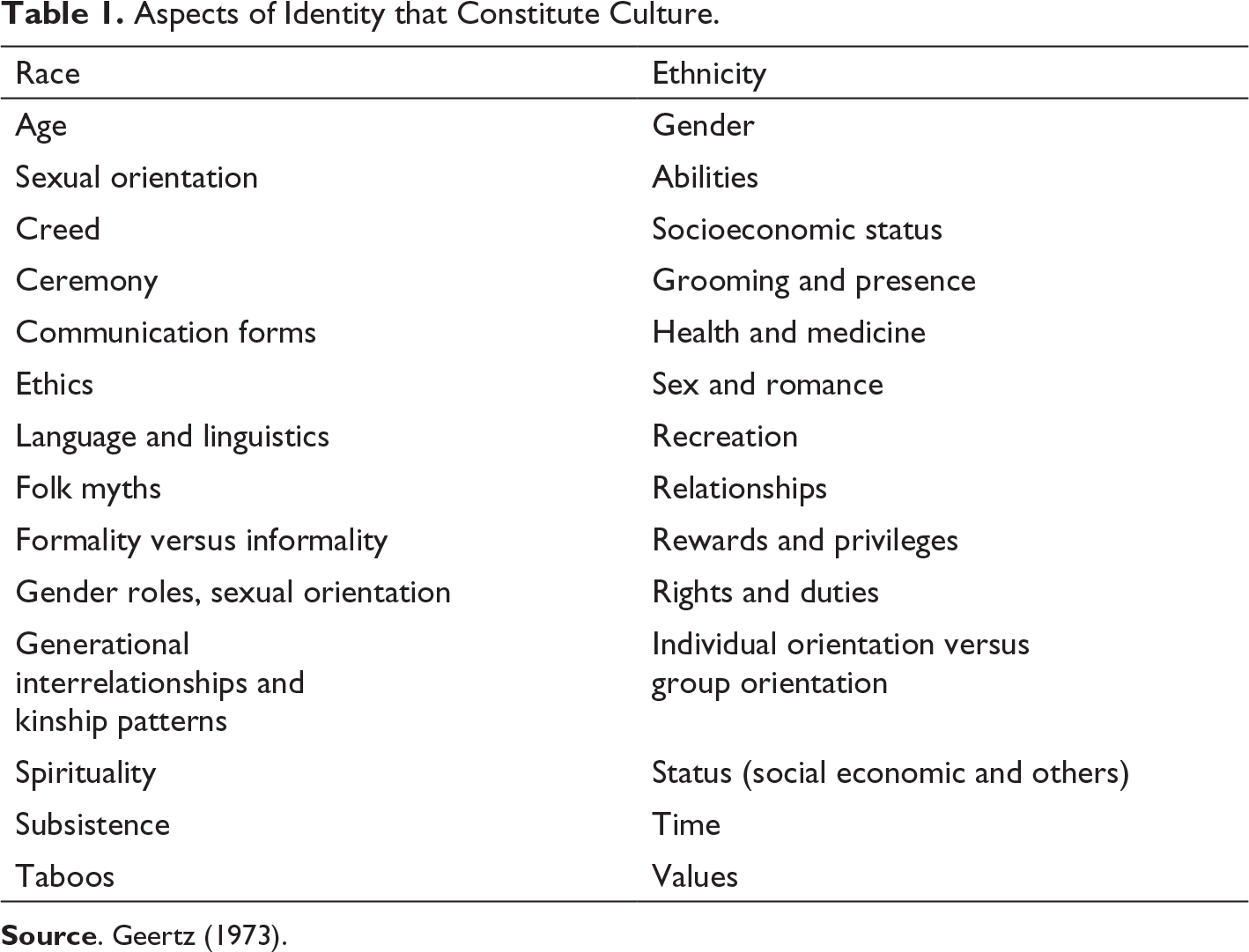
Influential authors have studied the importance of culture in education. Gay (2013), Ladson-Billings (2005), and Villegas & Lucas (2002) have written about CRP and culturally responsive teaching (CRT) (Hammond, 2014). CRP recognizes that knowledge is a socially constructed process that cannot be divorced from learners’ social contexts. Across cultures, people have different ways of communicating, interacting, and learning. Understanding cultural differences fosters leadership that uses the learner’s culture as a platform for accelerating students’ learning. Paris and Alim (2017) based culturally sustaining pedagogies (CSP) on the seminal CRP work of Ladson-Billings (2005). CSP seeks to perpetuate and foster—to sustain—linguistic, literate, and cultural pluralism as part of schooling for positive social transformation and revitalization.
Other authors have focused on culturally responsive leadership (CRL) (Khalifa, 2018; Khalifa et al., 2016) and CPL (Lindsey et al., 2018). The link between culture and leadership “is the ways in which leaders create and manage culture and their ability to understand and work with culture” (Schein, 2010, p. 5). In schools, principals and educational leaders lead colleagues who belong and identify with various cultural groups. For example, a leader may work with teachers coming from different national cultures for whom English is not the first language. In addition, educators and staff may identify with different religions, sexual orientations, abilities, races, or ethnicities. One of the key responsibilities of school leaders is to provide instructional guidance for their teachers (Fullan, 2005; Marzano et al., 2005). To do so, principals should understand the cultural background and perspectives of their staff, just as teachers should comprehend and take into consideration their students’ cultures when they teach. Leaders should provide professional learning experiences for teachers that account for the various cultures of the participants in order to serve them equitably while also collaborating and learning with peers who belong to various cultural groups. In order to optimize adult learning and its implementation, it is essential that school leaders understand the role culture plays in PD. CPPD and MMLT are grounded in culturally minded leadership. Next, I provide more information about the guiding principles of two culturally grounded leadership frameworks.
Culturally Responsive Leadership
CPPD is rooted in culturally responsive and CPL (Khalifa, 2018; Khalifa et al., 2016; Lindsey et al., 2018). These authors assert that leaders need to adopt a culturally proficient mindset in order to develop teachers who can serve diverse students. If we expect teachers to adjust their craft and use CRP, we should expect that leaders support diverse faculty and student populations, embrace and celebrate their cultural differences, and become culturally proficient leaders (Gay, 2010).
Khalifa (2018) focuses on how urban school leaders can support minority students. He posits that while culturally responsive methods have been presented and taught to teachers, most school leaders are not familiar with the concept. Khalifa presents a strong argument, in which Culturally Responsive School Leadership (CRSL) must be a priority for urban school leaders in order to become effective instructional leaders and have a positive impact on student learning regardless of the students’ cultural and racial origins and heritages. In their literature review and synthesis, Khalifa et al. (2016) define CRL as “the ability of school leaders to create school contexts and curriculum that respond effectively to the educational, social, political, and cultural needs of students” (p. 7). Culturally responsive leaders promote inclusion among all stakeholders, look critically at curriculum, articulate a vision that reflects equity, inclusion, and diversity, and look at their own biases in order to model critical reflection. Culturally responsive leaders value all cultures. These leaders focus on developing teachers’ competencies so that they can better serve diverse students. CRL does not emphasize how culture affects adult learning and thus learning transfer. The CPL framework (Lindsey et al., 2018) provides a helpful lens to think about professional development and its implementation.
Culturally Proficient Leadership
The premise for CPL is that “We are all embedded in our respective cultures, and our responses to individuals and groups relate to our learning in very specific cultural contexts” (Khazzaka, 1997, p. 121). Lindsey et al. (2018) assert that CPL is a mindset. In CPL, leaders do not need to know everything about every single culture, but they are willing to learn about cultures in their school communities and are inclusive in their practices. CPL aims to serve the common good in a multicultural society and world. In CPL, leaders value students’ and adults’ cultures, languages, and learning styles. These leaders understand that when they account for cultural differences among adults, learning occurs.
Culturally proficient leaders lead learning in their school communities by promoting and celebrating diversity among teachers, staff, and students. They also understand that leading in school communities where diverse cultures are represented involves different ways of learning, communicating, and resolving conflicts. These leaders expect change and seek to create socially just schools and classrooms by constantly learning and seeking quality PD that considers the culture of the participants. CPPD and MMLT use the work of Lindsey et al. (2018) by adapting PD to diversity, and institutionalizing cultural knowledge through culturally proficient PD.
Culturally Proficient Professional Development
PD is at the center of the practice of improvement because it develops teachers and leaders’ skills and abilities in order to impact student academic achievement (Desimone, 2011; Desimone & Garet, 2015; Elmore, 2002; Fullan, 2005; Guskey, 1997; Koonce et al., 2019; Reeves, 2010). As a result, educational leaders must ensure that they foster the highest standard of learning among their adults. Desimone (2011) claims that effective PD embraces the following attributes: It focuses on content and how students learn best that content; it uses active learning; it is coherent in that it aligns with the teacher’s, school’s, and district’s goals; it is continuous over the course of the academic year; and it is collective and collaborative in that teachers from same subjects should participate in the same PDs together. Desimone & Garet (2015) offers a conceptual framework for successful PD. The model consists of four steps: (a) It assesses the teachers’ experiences of the PD, (b) PD increases the teachers’ knowledge, skills, attitudes, and beliefs, (c) Teachers use the newly acquired knowledge to improve instruction, and (d) The new knowledge improve students’ learning. This framework assist leaders to assess if teachers learn and if they alter their practices. The model takes into consideration implementation of new knowledge but does not take culture into account as a possible enhancer or hindrance to transfer. The current lack of attention to factors that could improve the transfer of learning often leads to a low return of investment, high teacher attrition rates, and stagnating students learning outcomes.
The National Staff Development Council recommends that principals devote 10% of the school budget and 25% of teacher time to professional development (Kelleher, 2003). While PD requires time, it is crucial that the time be organized, carefully structured, and purposefully led to avoid the waste of human and financial resources (Guskey, 2003). Too often, budgets are spent on professional development that yields little results (Hess, 2013; Speck & Knipe, 2005). Despite the millions of dollars spent on professional development nationally, student learning outcomes continue to stagnate or dwindle, discipline issues continue to skyrocket, and teacher moral plummets (Hess, 2013). This may be due, in part, to leaders paying little attention to culturally proficient PD that accounts for learning transfer.
Successful PD should model for teachers what they ought to do in class with their diverse student population. However, oftentimes PD activities are lecture-based and do not account for cultural diversity. If culture was embedded before, during, and after PD, teachers will understand what they can do in their classes to become culturally competent and equitable. CPPD and MMLT were designed to promote cultural awareness by respecting participants’ cultures when planning, organizing, conducting, and evaluating PD events. In CPPD, leaders understand the role culture plays in adult learning because knowledge is a socially constructed process that cannot be divorced from learners’ social contexts (Caffarella & Daffron, 2013; Yang et al., 2009).
Learning Transfer
By cultural differences and using the adult learner’s culture, professional development could be more effective, especially in transferring learning from the training setting to the classroom. Learning transfer, also referred to as training transfer, is defined as “the effective and continuing application by learners—to their performance of jobs or other individual, organizational, or community responsibilities—of knowledge and skills gained in learning activities” (Broad, 1997, p. 2). The American Society of Training and Development estimated that the USA alone spent $125.88 billion on employee learning and development in 2009 (American Society of Training and Development, 2010). Yet, only 10% of the money invested in training results in transfer of knowledge, skills, or behaviors in the workplace or at home (Broad & Newstrom, 1992). Although the idea that only 10% of the money spent yields changes in practices has been disputed (Ford et al., 2011; Saks & Belcourt, 2006), these researchers agree that the money invested in developing employees’ human capital yields low to moderate results at best.
Being able to transfer newly acquired knowledge is the ultimate goal of teaching, yet it is the most challenging to achieve (Thomas, 2007). Although scholars have had difficulties measuring learning transfer and its impact, seminal authors have written about what promotes and inhibits the transfer of learning (Baldwin & Ford, 1988; Broad & Newstrom, 1992; Caffarella & Daffron, 2013; Kolb et al., 2002; Ford, 1994; Holton et al., 2000; Hung, 2013; Illeris, 2009; Knowles, 1980; Taylor, 2000; Thomas, 2007; Warr & Allan, 1998).
Learning Transfer System Inventory (LTSI).
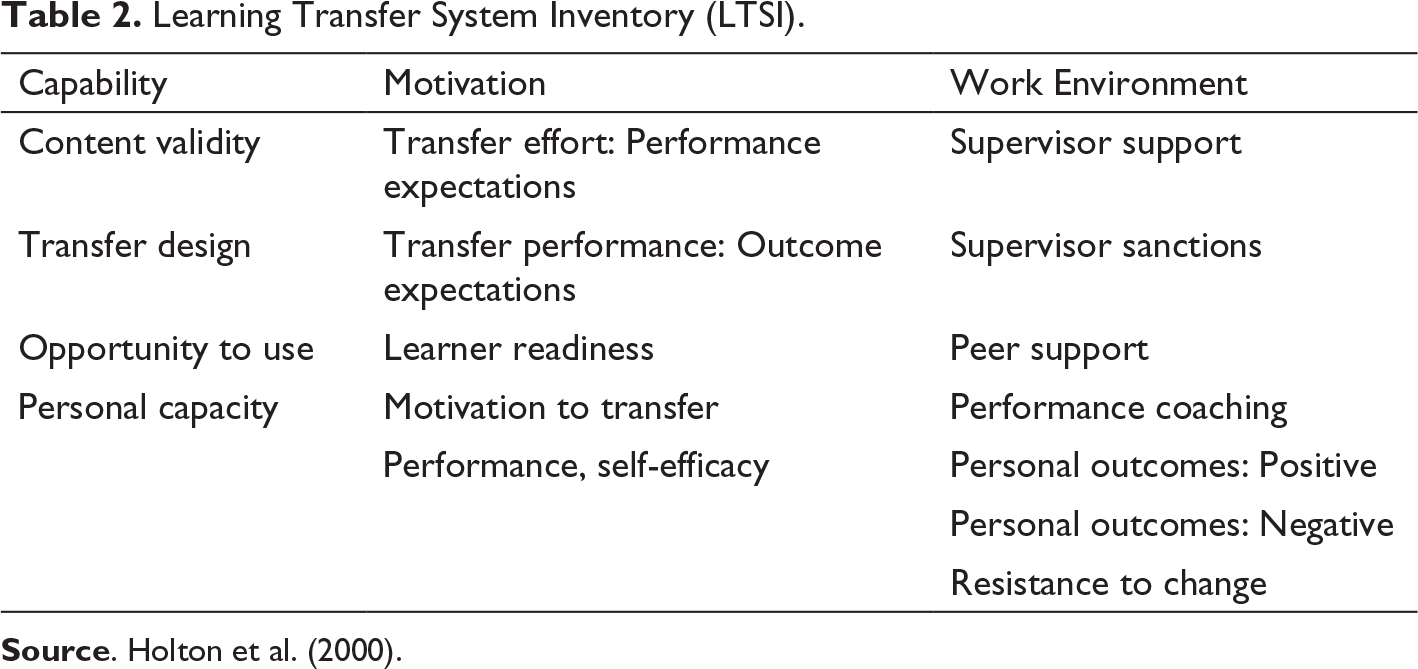
Despite the considerable amount of literature on the factors influencing learning transfer, there are a limited number of research studies that examine the relationship between culture and the transfer of learning (Caffarella & Daffron, 2013; Closson, 2013; Rahyuda et al., 2014; Silver, 2000). Yang et al. (2009) asserted that the fundamental reason why culture impacts training is that learning is not only an individual intellectual activity but also a social process that takes place in certain cultural contexts. These authors posited that cultural factors affect training events via the content and methods chosen, the selection of facilitators, and the trainee characteristics because each national culture has its learning style. Similarly, the trainers' expertise in the subject, credibility, and training style influence the trainees' motivation and learning efficiency (Hofstede et al., 2002).
Closson (2013), Caffarella and Daffron (2013), and Rahyuda et al. (2014) are among the few authors affirming a relationship between cultural factors and learning transfer. Closson (2013) posited that racial and/or cultural differences do not only impact learning (Raver & Dyne, 2017) and the training process (Yang et al., 2009), but that cultural differences also influence learning transfer. Beyond an awareness of who is represented in the room socially and ethnically, Caffarella and Daffron (2013) suggested that the content of the materials should reflect the cultural differences to enable transfer. The author asserted that learning transfer should be discussed within contexts because context affects the way we teach, what we teach, and how we teach. Moreover, Caffarella (2002) affirmed the necessity for trainers and facilitators to be culturally sensitive and understand norms, traditions, and cultures to facilitate the transfer of learning. According to Caffarella (2002), the planning phase of a training is when facilitators can deliberately include culturally responsive approaches and determine how prominent his or her own cultural identity is in the training.
On the basis of the literature on culture’s role in transfer, some authors argue that there is a need for a comprehensive, multidimensional, and unifying model of learning transfer that considers culture as a key factor (Raver & Dyne, 2017). Therefore, the author merged and extended existing models of CPL and learning transfer by proposing the MMLT. This new model is intended to help school leaders organize, deliver, and evaluate their PD while also enhancing learning transfer and leaders’ cultural proficiency. Based on the MMLT, the author provides practical rubrics to assist PD leaders and organizers. This model is salient for all schools and districts as diversity is expressed through race, ethnicity, ability, sexual orientation, socioeconomic status, creed, as well as additional elements that constitute culture (Table 1).
Multidimensional Model of Learning Transfer
The MMLT grew out of several qualitative longitudinal studies that sought to understand the influence of culture on learning transfer in Burkina Faso, Ghana, Liberia, Rwanda, and Ethiopia (Brion, 2018, 2021). The researcher examined the role culture played in the transfer of learning process because PD is costly, and she wanted to ensure that the knowledge participants gained was implemented in their schools. The sites were low-fee private schools. Participants were school principals and teacher leaders. The researcher collected data over a period of six years between 2013 and 2019. Data collection included one-on-one interviews with 70 principals and 30 teacher leaders, observation notes pertaining to 100 PD sessions, as well as document analysis, journal, and field notes. Even though the data was collected in Africa, the findings are applicable to all nations because culture is a predominant force in people’s lives and organizations.
MMLT is inspired by the seminal work of Broad and Newstrom (1992). The author combined two of Broad and Newstrom’s (1992) factors, namely organizational context and societal community forces, into one category called Context and Environment. The author posits that the Context and Environment categories encompass Broad and Newstrom’s (1992) ideas by including the micro and macro contexts of both organizations and societies. The author provides two additional dimensions to learning transfer: pretraining and follow-up. These new dimensions complement Broad and Newstrom’s (1992) learning transfer framework.
For the MMLT the author refers to Culture with a capital letter as it includes individual, sectional, departmental, organizational, regional, and national cultures as well as cultures related to a continent. Considering Culture as the main enhancer or inhibitor to transfer is innovative and useful because schools spend large amounts of money and resources on PD, yet the money invested does not often yield to improved students’ outcomes, teacher retention, and well-being. MMLT is composed of seven dimensions: Culture, Pretraining, Learner, Facilitator, Material and Content, Context and Environment, and Follow-Up (Figure 1). In Figure 1, the MMLT is exemplified by a tree that represents learning transfer. The tree embodies rebirth, continuation, hope, and fruitfulness. At the base of the tree, one can find Culture because our individual, departmental, organizational, regional, and national cultures impact our PD through the other six dimensions of learning transfer– Pretraining, Learner, Facilitator, Material and Content, Context and Environment, and Follow-Up. When leaders understand and take into consideration the influence of Culture on each of the MMLT’s dimensions, they promote learning transfer among their teachers while also moving towards cultural proficiency because they learn about their constituents’ cultures during the PD’s planning, delivery, and assessment phases. In turn, the teachers also become culturally minded by understanding the impact of culture on learning and teaching. Teachers are then able to better understand their students who come from diverse cultures and use some of the elements of the MMLT in their own teaching. On the MMLT tree, this occurs when the orange is ripped, falls, and the cycle perpetuates itself, producing more and more effective PD events that yield a return on investment, and increase leaders’ and teachers’ cultural proficiency. When educators journey towards cultural proficiency, they help create socially just educational systems because the culture of all students, teachers, and staff is celebrated, respected, and considered when teaching and learning occur.
When practitioners use the MMLT, they start, continue, or make progress towards cultural proficiency because the MMLT enables leaders and PD organizers to reflect on their own culture, learn about the culture of the participants and the facilitators while also considering culture in the design of the PD content. A description of the MMLT elements is provided below.
Culture
The author asserts that Culture is the predominant enhancer and inhibitor to transfer and that Culture affects the entire learning transfer phenomenon (Brion, 2020). Culture includes individual, sectional, departmental, organizational, regional, and national cultures as well as cultures related to a continent. Culture also incorporates the differential effects of age, gender, race, ethnicity, social class, religion, sexual orientation, and abilities, as well as various other elements of culture, some of which are presented in Table 1. Culture impacts learning transfer because if people do not learn because of cultural barriers, they will not be able to implement the new knowledge to their jobs (Brion, 2021). Thus, PD organizers and facilitators should take into consideration culture at every stage of the learning transfer process: from pretraining to follow-up. When people’s cultures are not included in the PD design, delivery, and follow-up learning transfer is likely to be minimum because participants cannot efficiently learn (Lindsey et al., 2018; Paris & Alim, 2017). Additionally, ignoring cultural issues in schools present numerous risks including reinforcing stereotypes, increasing intolerance among groups, raising potential misunderstandings, escalating frustrations and defensiveness, as well as learners and facilitators’ withdrawals (Caffarella & Daffron, 2013; Lindsey et al., 2018; Williams & Green, 1994). When leaders utilize the MMLT, they learn about the various cultures represented in their school and in doing so increase their cultural proficiency. For example, leaders may learn that their teachers coming from countries that values collectivism, for instance, African countries, would learn better when collaborating with others and participating in activities such as debates whereas it may not be the case with people coming from individualistic cultures such as the United States and Europe. Understanding this prior to PD sessions would facilitate the planning for materials and activities while also allowing facilitators to train teachers on these concepts. When facilitators use the learners’ cultures in their teaching, they facilitate learning, retention, and the implementation of that knowledge in schools.
Pretraining
As Figure 1 indicates, pretraining includes the orientation of facilitators and other key stakeholders so that they can support the professional learning once it has begun. Pretraining also includes communicating expectations to facilitators and learners explaining who will benefit from PD, stating that participants are accountable to implement new knowledge (Yang et al., 2009) and sharing the schedule, goals, and information that is perceived as mandatory (Baldwin et al., 1991). For example, Brion (2021) found that in some African cultures, pretraining plays a key role in the learning transfer process because people in these particular societies prefer knowing in advance and in writing what will happen during the PD, how it will be led, and by whom. With these details in mind, leaders and PD organizers can adapt accordingly and enhance the learning transfer process.
Learner
Learners are the participants in the professional development programs. This dimension refers to understanding the learners’ motivation, the cultural background of the facilitators and participants, and how history and social events affect stakeholders, including self, facilitator, peers, and colleagues. The learner category also includes understanding cultural differences in learning styles (Lindsey et al., 2018) as well as language and writing differences. Learner is also comprised of the participants’ beliefs and attitude toward their job (Yelon et al., 2013), whether or not they have the freedom to act, and the positive consequences of that application. Finally, it involves the participants’ belief of the efficacy of the knowledge and skills learned (Yelon et al., 2013). In this dimension, leaders and PD organizers would seek to know how the learners learn best, learn about the participants’ experiences, and how they intend to use the new information in their context.
Facilitator
Effective facilitators must understand the cultural background of the participants and oneself. It also includes how history and social events affect stakeholders (including self, students, peers, and colleagues). Facilitator also refers to the understanding of language and writing differences, setting goals, and the selection of participants (Yang et al., 2009). Leaders and facilitators should examine the biases they may have towards certain groups of people before teaching and gathering materials for the PD event. Principals should also hire facilitators who have a culturally proficient mindset as to promote learning transfer.
Content and Materials
The professional development content and information involves using evidence based, culturally relevant, and contextualized materials. It also involves using a pedagogical approach based on andragogy, or how adults learn best (Knowles, 1980; Mezirow, 2000). Material and Content also involves using symbols and meaningful artifacts to cue and help recall (Debebe, 2011). In this dimension, culturally proficient leaders would ensure that the content reflects the participants’ needs and cultural backgrounds. For example, if the PD event is about communicating with parents and families at school, the principal and facilitators would ensure that participants from different cultural backgrounds share what is or is not appropriate in their cultures and contexts.
Context and Environment
This element comprises the professional learning environment and the work environment (micro and macro cultures within context), sociocultural context, transfer climate, peer contact, and the presence of social networks. It also refers to having enough time to transfer knowledge, the support for action, the resources, the freedom to act, and peer support (Burke & Hutchins, 2008; Facteau et al., 1995). Finally, Context and Environment refers to the incentives: intrinsic incentives such as providing educators with growth opportunities, and extrinsic incentives, such as reward or promotion (Facteau et al., 1995). For this dimension, leaders and facilitators would consider the organizational culture. Is the school culture conducive and supportive to transferring new knowledge?
Follow-up
Post-training is often overlooked and is necessary to avoid skill decay and training relapse. Examples of follow-up include tutor-facilitated networks via mobile technology (Brion, 2018), micro-learning using mobile technology, coaching, testimonials, professional learning communities (PLCs) or community of practice (COPs), apprenticeships, coaching, and E-coaching (Speck & Knipe, 2005; Wang & Wentling, 2001). Trainees’ reports and assessing transfer also help to create a culture where learning and its application are valued (Bates, 2003; Saks & Burke, 2012). For example, follow-up can be done during teacher-based meetings or PLC. Follow-up should take into consideration the participants’ preferred styles of learning and communicating.
Understanding how the various cultures of participants practically impact the dimensions of the MMLT could help leaders and teachers implement new knowledge, improve student learning outcomes and well-being while also supporting a better return on schools’ PD investments. To provide quality PD, Guskey (1977) recommended that leaders focus on evaluating three components. The first component measures knowledge and skills which participants acquire as a result of professional development. This information helps improve program format, content, and organization. In the MMLT, this is accomplished during the pretraining, the content and materials dimensions, and the follow-up. The second element measures the participants’ use of knowledge and skills they have gained and incorporates the new knowledge and skills into practice. In the MMLT, the transfer of knowledge can be evaluated in the follow-up dimension. Lastly, the third element focuses on measuring the impact of participants' changes in knowledge and skills on student learning. Improving student outcomes and well-being by providing culturally proficient PD that takes into account learning transfer which is the ultimate goal of the MMLT. MMLT enhances the quality of PD because when culture is taken into account, learners are able to focus on their learning rather than trying to navigate various individual, organizational, or national cultural norms (Brion, 2021). Since culture affects learning, the MMLT enhances learning and the transfer of that learning to schools while also assisting leaders become culturally proficient.
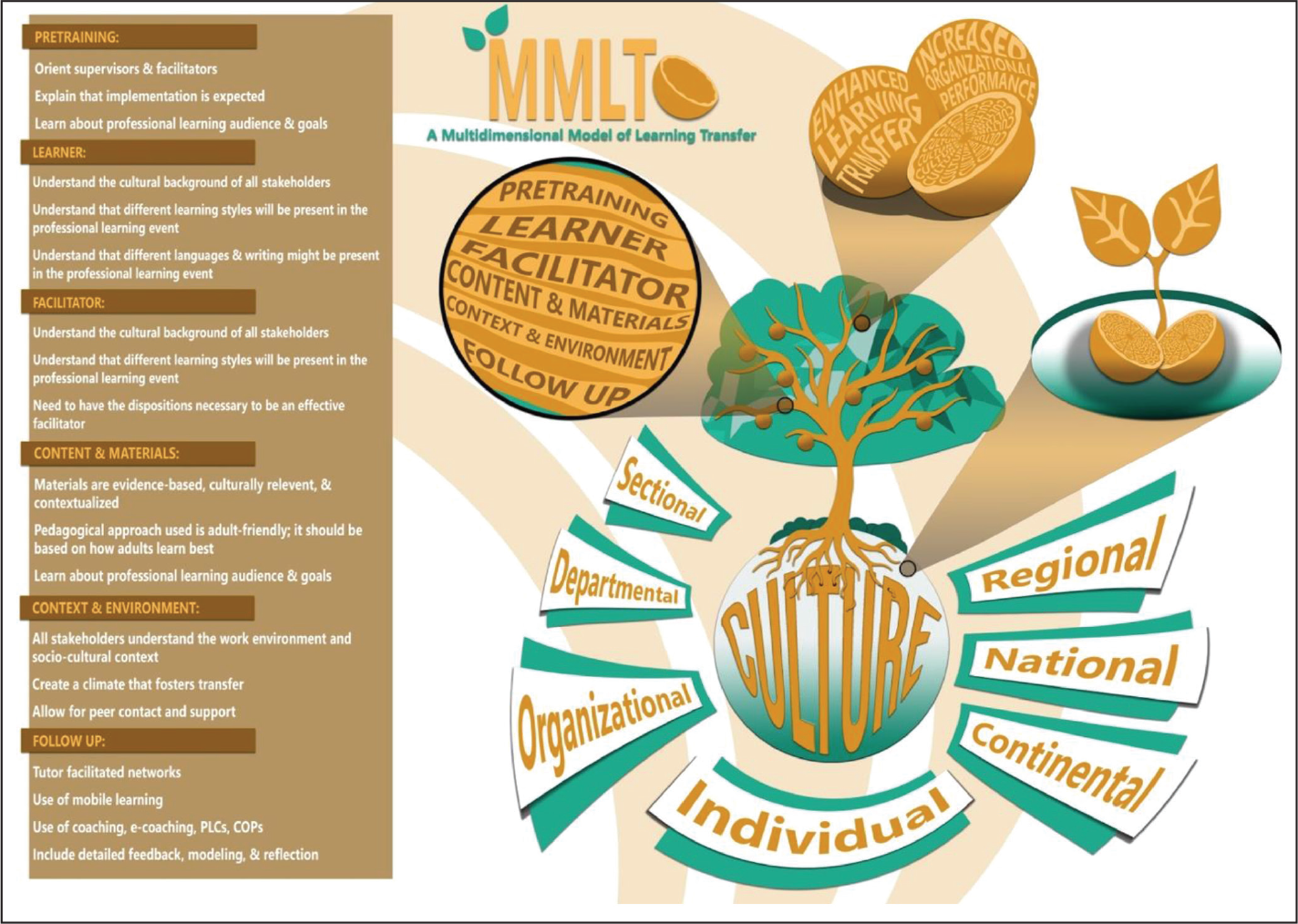
The Multidimensional Model of Learning Transfer.
Implications for Practice
Improving student outcomes and well-being by providing culturally proficient PD for teachers that takes into account learning transfer is the ultimate goal of the MMLT. The author offers two recommendations for practitioners in order to increase the skills and abilities of adult learners, enhance learning transfer post PD, increase educators’ cultural proficiency, and get a return on investment that would in turn positively affect students’ outcomes. First, to provide PD that accounts for culture before, during, and after PD events, school leaders should consider using the MMLT and its rubrics to organize, prepare, and assess their PD offering (Appendix A). These rubrics are designed to help practitioners think through the seven dimensions of the MMLT before, during, and after the PD. Within each of these dimensions, there are several items practitioners can self-assess. For example, during the pretraining phase, school leaders and PD organizers should reflect on the culture of their participants and how they learn best. This is important because this step affects the content and the delivery of the materials. Leaders should also conduct a needs assessment and offer PD that is relevant and individualized to each teacher’s needs. Because learning is a social endeavor, the MMLT and its rubrics enable leaders to take Culture into consideration for each of the MMLT dimension for maximum learning transfer and impact on student learning. To measure success, leaders should reflect and fill out the rubrics (Appendix A). Appendix A shows one page of the pretraining rubric only and provides an example on how to score the first element on the aforementioned pretraining rubric.
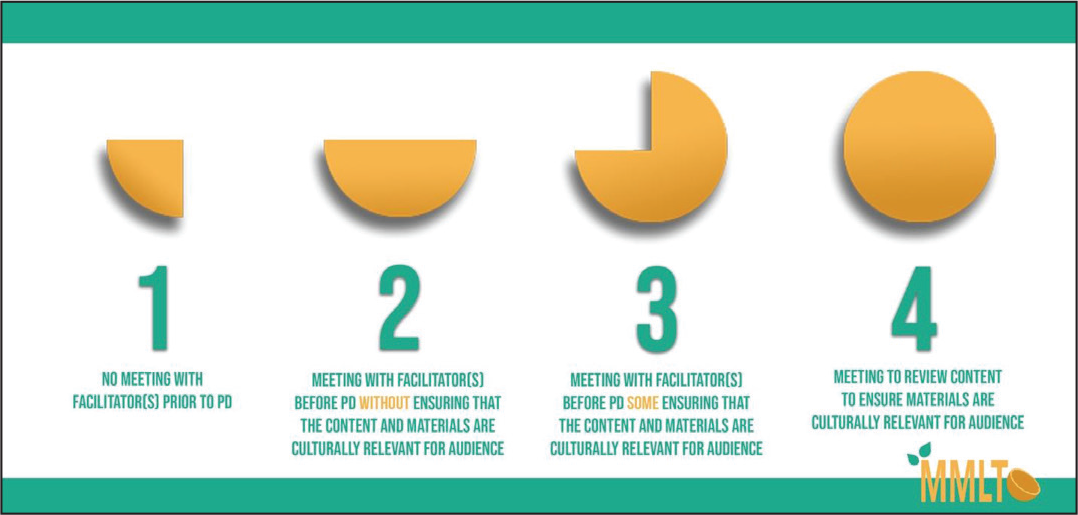
When leaders score full oranges, they have greatly enhanced the chances for learning transfer to occur while also increased their cultural proficiency. When leaders have the whole oranges on every single rubric, that is a measure of complete success. Full oranges mean that leaders have taken into consideration cultures in all the areas of the MMLT. Although this is the highest level of success, leaders can still see other measures of success on a smaller scale. When they see a quarter of an orange go to a half of an orange, that is meaningful progress.
Second, it is necessary for leaders and facilitators to remain open to learning about different cultures and adjust their practices accordingly without judgment. Culturally proficient leaders offer PD that is anchored in participants’ cultures because they understand the role culture plays in learning. These leaders are also constantly learning about other’s cultures as well as their own by modeling and organizing culturally proficient PD. It is also key that facilitators reflect on the impact their culture has on participants and colleagues in terms of language, history, and traditions. When organizing PD, principals should carefully select the facilitators, brief them on team members, and provide them with the MMLT.
Conclusion
Culture plays a key role in students’ and adults’ ability to learn and implement new knowledge because learning is a social endeavor (Bandura & McClelland, 1977; Cafferalla & Daffron, 2013; Vygotsky, 1962; Yang et al., 2009). Current PD offerings seldom consider the culture in the learning transfer process. Because of the lack of attention placed on learning transfer, PD does not often yield changes in practice. By forgetting to account for learning transfer in the organization, delivery, and follow-up of PD events, teachers and leaders often become frustrated and lose interest in the professional learning. PD offerings would be most impactful and yield a return on investment if all dimensions of the PD took culture into consideration (Brion, 2020; Yang et al., 2009). CPPD is a framework grounded in culture. CCPD aims to enhance the learning transfer and promote cultural proficiency by using the MMLT. The MMLT can serve as an innovative lens that school leaders can use to prepare, organize, and evaluate the PD in order to promote learning transfer. The rubrics deriving from the model could also assist principals and PD organizers in enhancing learning transfer before, during, and post PD, while also augmenting their cultural proficiency.
Understanding the role culture plays in PD and in the learning transfer process would promote the transfer of learning in schools and would contribute to educators’ cultural proficiency, increase academic achievement and well-being for all students, teachers, and leaders regardless of race, ethnicity, gender, religion, sexual orientation, language, abilities, and other elements that constitute culture. In this way, MMLT promotes equity too. If all teachers and leaders received culturally proficient quality PD, they would in turn be able to implement in their classrooms the newly acquired knowledge and model the importance of culture. As a result, students would be more equitably served because teachers would be more aware of the impact of culture on learning. Providing an equitable education to students from all walks of life and students who embrace various cultural identities would in the long run create socially just educational systems and societies.
Appendix A
Sample Rubric for Practitioners
Appendix A shows one page of the pretraining rubric only and provides an example of how to score the first element on the aforementioned pretraining rubric.
Purpose
The purpose of the MMLT’s rubrics is to help practitioners enhance the transfer of knowledge and skills to the workplace while promoting cultural proficiency.
Who can use these rubrics?
All stakeholders, PD organizers, and facilitators are encouraged to use these rubrics before, during, and after PD events.
How does it work?
These rubrics are designed to help practitioners think through 7 dimensions before, during, and after PD events. These dimensions are culture, learner, facilitator, content and materials, context and environment, and follow-up. Within each of these dimensions, there are several items practitioners can check before, during, and after the PD session. One orange slice represents a 1 on the Likert scale, 1 being the lowest score and 4 the highest. The half orange is a 2, the 3 quarters is a 3, and the full orange is a 4. For example, when looking at the sample pretraining rubric below, a full orange signifies that the leader organized a meeting with the facilitator(s) to review the content of the materials and ensure that the materials are culturally relevant for the audience. For the same item, a 2 may mean that the leader and facilitator(s) met but the leader did not go over the PD materials with the facilitator(s) (Example or pretraining rubric and scoring table below).
First page of the pretraining rubric
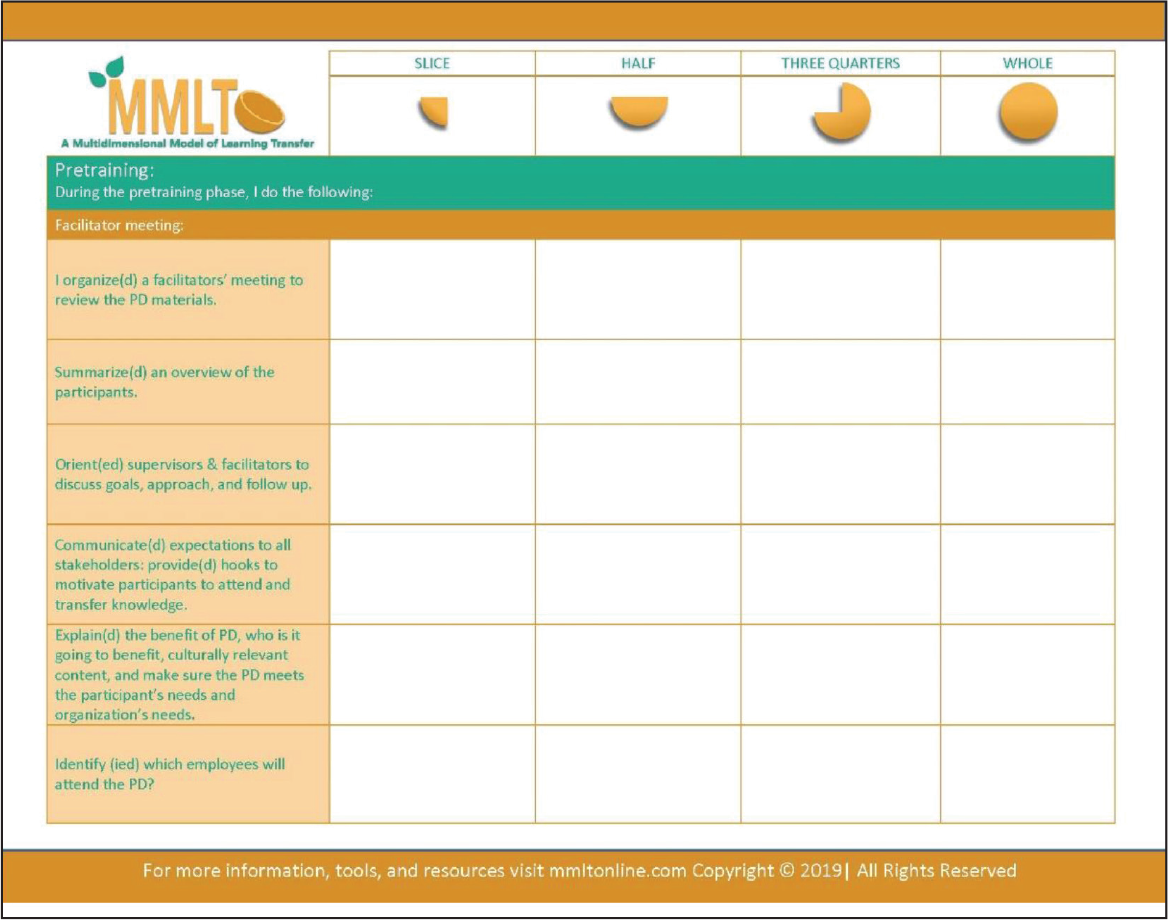
How to score the first element of the pretraining rubric
Footnotes
Declaration of Conflicting Interests
Funding
The author(s) received no financial support for the research, authorship, and/or publication of this article.
