







Abstract
Despite students of color comprising more than half of the K–12 student population, the principal pipeline remains predominantly white, with roughly four of five principals identifying as such. This demographic mismatch has been linked to the inequitable experiences and outcomes for students of color, suggesting that the disproportionately white principal pipeline is failing to meet their needs. As gatekeepers, principal preparation programs are tasked with remedying this incongruence by increasing the recruitment and admission of teachers of color for leadership preparation. Conflicting with these expectations, are recent attacks on diversity, equity, and inclusion (DEI) at the federal, state, and local levels, seeking to undermine these efforts. In this essay, a review of the literature on recruitment and admission practices across principal preparation programs was undertaken to explore the strategies used by scholars to support efforts to diversify the principal pipeline. Recommendations are presented to guide principal preparation programs’ “tactful” navigation of anti-DEI legislations across three areas. Implications are also offered for policy and future research.
Although K-12 schools have grown increasingly diverse over the past three decades, with racial minorities now making up more than half of the total student population, these patterns are not mirrored in the principal pipeline (Fuller & Young, 2022; Irby, 2021; Perrone, 2022). The inequitable experiences and outcomes of marginalized students make a compelling case that the leadership of a disproportionately white principal pipeline is failing to meet the needs of students of color, especially when one considers that principals are among the most significant predictors of student achievement (Grissom et al., 2021; Leithwood et al., 2004). This argument is supported by a growing body of research that highlights positive experiences and outcomes for students of color such as their increased placement in gifted programs, higher academic outcomes, and lower rates of exclusionary discipline when matched with principals of color (Bartanen & Grissom, 2019; Grissom, Rodriquez, et al., 2017; Lomotey, 2019). These benefits also extend to teachers of color, who are more likely to be hired and retained by principals of color, which also correspond with their greater job satisfaction (Goff et al., 2018; Jones, 2002; Viano & Hunter, 2017). In response to these findings, scholars and policymakers have called for proactive measures to increase the representation of racial minorities in the principalship (Clement et al., 2022; Fuller & Young, 2022).
Given the gatekeeping role played by principal preparation programs over the principal pipeline (Boske et al., 2018; Browne-Ferrigno & Shoho, 2004; Fuller et al., 2019), these calls have in recent years fallen at their doorsteps. In addition to the moral imperative for these programs to prepare educational leaders who look like the student population and communities they serve, scholars have identified benefits of diverse students in principal preparation programs as contributing to the development of critical consciousness among especially their white peers (see Jackson & Moraguez, 2025; Lac, 2024; Parker & Shapiro, 1992; Rasmussen & Raskin, 2023). The above discussions create an imperative for faculty and coordinators across principal preparation programs to not only increase the enrolment of teachers of color, but also commit to their successful entry into the principal pipeline through inclusive and equitable practices. Conflicting with these expectations, the growing sociopolitical attacks on diversity, equity, and inclusion (hereon referred to as DEI) threaten the ability of higher education institutions to commit to diversifying their clientele and support for these individuals. Because principal preparation programs are often housed in these institutions, these attacks present implications for how faculty across these programs recruit, admit, and support teachers of color for principal preparation.
Defining Diversity, Equity, and Inclusion (DEI)
To preface discussions about the origination and proliferation of anti-DEI policies, it is important to first understand what is meant by these terms, and what they mean in the principal preparation context. First, although the discussions contained within this article center around racial and ethnic diversity, diversity also encompasses differences across a spectrum of other demographic markers such as gender, sexual orientation and identity, religion, language background, and national origin. This also extends to diversity of thoughts, experiences, values, and perspectives. In the context of principal preparation, diversity is defined based on whether school leaders’ demography reflect that of their student population (Reyes-Guerra et al., 2022). It is this article’s contention that achieving a diversified principal pipeline requires equitable and inclusive practices across principal preparation programs (Theoharis & O’Toole, 2011).
While acknowledging the varying conceptualizations of equity, including equality which operates on the premise of sameness, equal treatment, or equal opportunity, this study defines equity as compensatory and anti-oppressive (Comstock, 2025). From a compensatory lens, equity refers to “fairness in processes, practices, and outcomes within the context of historical, economic, social, and institutional forces that have resulted in an unequal playing field, particularly for Black, Latinx, Indigenous, Pacific Islander, and Asian American students” (Ishimaru & Galloway, 2020, p. 473). In practice, equity facilitates the redistribution of resources and opportunities to ensure marginalized individuals are provided with more or different resources that will guarantee their success (Galloway & Ishimaru, 2015; Jackson, 2024). On the other hand, conception of equity as anti-oppressive entails combatting and ameliorating systems of oppression and inequities (Comstock, 2025). From the two perspectives, equitable practices across principal preparation programs reflect those that remedy the demographic incongruence across schools, in part, to redress the impact of desegregation orders on the pipeline of educators (Templeton et al., 2021; Tillman, 2004) by eliminating biases against teachers of color and other marginalized identities, instead, embracing those practices that support their successful admission, enrolment, and training—inclusion.
While inclusion is often regarded as an educational philosophy that advocates for schools’ attention to the educational needs of all students, these discussions have typically centered around students with disabilities and special needs (DeMatthews & Mawhinney, 2014). Slee (2007) challenges this conceptualization, instead asserting that true inclusion should address the politics of exclusion and representation. Stated differently, inclusion mandates rethinking who has access to, who is represented across, and who is excluded from principal preparation programs.
DEI initiatives have emerged as critical components across the K-12 and higher education landscape, leveraged to cultivate academic environments that are both inclusive and supportive of all learners. These initiatives have been developed to confront and remedy the inequitable experiences and outcomes that have long persisted among racial minorities (Long & Bateman, 2020). As one example, the underrepresentation of racial minorities in higher education, especially across selective universities motivated the introduction of affirmative action policies. Relatedly, inclusion efforts are typically geared at enhancing the experience and sense of belonging for racial minorities, thereby countering challenges that might stifle their overall academic experience, performance, and progress. However, the current political climate across the United States have created backlash and outrage at these concepts, maligning their intentions with liberal indoctrination and woke ideologies, resulting in the widespread introduction of anti-DEI legislations (Carroll, 2025; Farley et al., 2021; Jackson, 2025; Schoorman & Gatens, 2025).
The Origination of Anti-DEI Attacks
The launch of the New York Times’ 1619 Project was the spark that ignited the attack on CRT and truth telling (Johnson, 2024). Johnson noted that these attacks stemmed predominantly from conversative activists, groups, legislators, and scholars who accused the project of promoting race division and hatred through leftist ideologies and indoctrination. This led to the introduction of the first anti-DEI legislation in Arizona titled, the Saving American History Act of 2020, which called for federal funding to be withheld from schools that adopt the 1619 Project. In addition to the racial injustices from slavery that lingers institutionally, as per the 1619 Project, the publicized killing of Black people (e.g., George Floyd, Ahmaud Arbery, Breonna Taylor) lead to increased public awareness (and confirmation) of the arguments proffered in the Project (Schwartz, 2023). This further led to the public support through the #BlackLivesMatter (BLM) movement which echoed globally, attracting national and international conversations around racial injustices.
In response, universities and other institutions committed to remedying these racial reckonings through initiatives intended to increase the diversity of their students and faculty. Institutional efforts to provide anti-bias training to create more inclusive experiences for diverse individuals led to another layer of attack at the federal level, after training materials from an anti-bias initiative in Seattle caught the attention of conservative activist, Christopher Rufo, who sounded the alarm on Critical Race Theory (CRT), labelling it as an existential threat to the United States. This inspired President Trump’s Executive Order 13,950—an order that prohibited trainings that used nine concepts, deemed ‘divisive’ (Lowery & Gautam, 2025). In the words of Rufo, We have successfully frozen their brand—“critical race theory”—into the public conversation and are steadily driving up negative perceptions. We will eventually turn it toxic, as we put all of the various cultural insanities under that brand category. The goal is to have the public read something crazy in the newspaper and immediately think “critical race theory.” (Rufo, as cited by Carroll, 2025, p. 4)
The language from this order provided a model for a slew of state legislations that prohibits DEI initiatives, or the adoption of any concept deemed ‘divisive’ (Schoorman & Gatens, 2025). Although these orders initially targeted the K-12 landscape, they quickly made their way to higher education space, which conservatives have deemed major sites of liberal indoctrination (Whittington, 2020).
Even though the attacks initially targeted CRT, an academic concept and legal framework for understanding the systemic impact of race and racism in the United States, the backlash quickly expanded to DEI efforts (Hazel, 2025). The Chronicles of Higher Education DEI Legislation Tracker have classified conservative attacks on DEI across five areas: diversity statements, identity-based preferences, DEI offices and staff, and mandatory DEI training, and mandatory diversity/CRT-informed courses (The Chronicle of Higher Education, 2025). First, the use of diversity statements in admission and hiring processes, a designated opportunity for applicants to communicate how their background and experiences will contribute to the diversity of the campus community or support the diversity and or equity efforts of the university, has been constrained. Second, legislations restricting identity-based preferences during admission and employment decisions have impacted efforts to increase diversity and remedy racial disproportionality. Next, university provisions intending to improve the experiences of marginalized students and expand the capacity of university stakeholders to support these individuals have not escaped these attacks as DEI offices and mandatory DEI training have been prohibited by some legislations. Finally, bans on mandatory diversity and CRT informed courses have also been introduced and signed into law across several states. The introductions of these bills were most prominent across Missouri (15), Texas (9), Oklahoma (8), Iowa (7), Arizona (6), Mississippi (6), South Carolina (6) and Tennessee (6). In sum, anti-DEI legislations have been introduced in at least 29 states including in the US Congress and signed into law in 16 (The Chronicle of Higher Education, 2025).
These legislations have had far reaching implications on higher education institutions and their practices, especially institutions with DEI-related mission. In addition to undermining academic freedom through curricula censorship (see Briscoe & Jones, 2024; Gupton & O’Sullivan, 2024), university DEI efforts have been curtailed by bans on using state funds to support these initiatives, resulting in the elimination of offices, positions, and programs. Failure to comply correlates with a host of consequences including but not limited to loss of institutional funding (see case of Columbia and Harvard for noteworthy examples), revocation of tenure and threats to tenure system, among others (Schoorman & Gatens, 2025; Taylor & Watts, 2024), creating a ‘chilling effect' on free speech and academic freedom which forces institutions and their faculty to alter their operational and curricula practices (Goldberg, 2024; Jackson, 2025).
Purpose and Structure of this Essay
While this essay acknowledges the influences of legislative attacks on the curriculum practices of higher education institutions such as critical race theory bans and other forms of curriculum and institutional censorship, its attention here is to those that might undermine diversification goals. This essay is intended to be solution-oriented to the legislative landmines seeking to undermine DEI efforts in higher education, providing strategies that principal preparation programs could consider in support of their efforts to recruit diverse teachers. It is guided by the question: How can principal preparation programs (faculty and program coordinators) prioritize diversity, equity, and inclusion in its recruitment and admission practices in light of legislations that seek to restrict these efforts?
The structure of this essay is as follows. First, the need to diversify the principal pipeline is problematized through a description of demographic mismatch between principals and students across K-12 schools. In the same space, factors contributing to the predominantly white principal pipeline are discussed to articulate systemic disadvantages faced by teachers of color, which serve as barriers to their entry into the school leadership pipeline. Furthermore, this section is intended to support attention to principal preparation programs as critical to efforts to diversify the principal pipeline, recognizing these programs as gatekeepers to the profession. Second, through a review of the literature on recruitment and admission practices across principal preparation programs, the article engages with how preparation program programs have enacted practices to support the diversification of the principal pipeline. The impact of anti-DEI policies on the recruitment and admission practices of higher education institutions is then discussed to preface recommendations for principal preparation programs. Lastly, implications are offered for principal preparation programs, policy, and directions for future research.
Problematizing the Racial Composition of the Principal Pipeline
The racial and ethnic representation of teachers and principals have been the subject of scrutiny for several years. These concerns are rooted in shifts in the demographic makeup of the K-12 student population, becoming more diverse; yet these changes are not reflected in the educator pipeline (Irby, 2021; Templeton et al., 2021). As noted by several scholars, the once predominantly white student population is now the minority across the United States, constituting less than 50% of the total student population (de Brey et al., 2019; National Center for Education Statistics [NCES], 2024). In contrast, the percentage of students of other racial identities have increased, with the greatest increase being documented among Hispanic students. Notwithstanding these changes, the teacher and principal pipelines remain predominantly white, with four of every five principals and teachers identifying as such (Perrone, 2022). The disparate representation of minority principals coupled with the inequitable experiences and outcomes of minority students give support to arguments that the disproportionately white educator pipeline is failing to meet the needs of students of color. These arguments are further substantiated by the body of literature on principal student race match, delineating improved outcomes for students of color when served by principals matching their racial identity (see Bartanen & Grissom, 2019; Grissom, Rodriquez, et al., 2017; Lomotey, 2019).
Factors Contributing to Pipeline
Scholars have identified multiple factors contributing to the lack of racial diversity in the principal pipeline. From a historical standpoint, the disproportionate firing and demotion of African American principals in response to desegregation orders in the 1950’s resulted in large numbers of these individuals being fired and demoted from their jobs (Karpinski, 2006; Peters, 2019; Tillman, 2004). Milner and Howard (2004) also recognized that thousands of Black teachers were also impacted, preventing them from being able to join the principal pipeline. The landscape of minority principals has not yet recovered (Templeton et al., 2021).
More recent discussions among scholars have highlighted the role played by different segments of the leadership pipeline in shaping the disproportionate representation of racial minorities (Fuller & Young, 2022; Weiner et al., 2022). Although limited studies have examined the recruitment and admission efforts of principal preparation programs, scholars have reported a predominantly white student population at this stage of the pipeline (see Anderson et al., 2018; Browne-Ferrigno & Muth, 2008; Karanxha et al., 2014; Parker & Shapiro, 1992). For example, Honig and Donaldson Walsh (2018) argue that despite the state of Washington’s population consisting of roughly 30% people of color, the percentage of candidates of color in their preparation program was on average less than 23%, and at one point as low as 12.5%, highlighting their disproportionate absence. Furthermore, nationally representative data on the racial breakdown of graduates of educational leadership programs report that the proportion of white graduates was three times the number of Blacks and Hispanics (Perrone, 2022; also see Orr, 2011).
Studies also show that disadvantages for teachers of color persisted even after their graduation from preparation programs. As one example, despite Black teachers showing greater interest in the principalship, seeking and obtaining principal certification at higher rates that their white counterpart (Berry & Reardon, 2022; Fuller et al., 2019; Williams & Loeb, 2012), they were least likely to enter the principalship (Davis et al., 2017; DeAngelis & O’Connor, 2012; Templeton et al., 2021) and experienced longer time to principal appointment (Bailes & Guthery, 2020; Fuller et al., 2016). Grissom, Mitani et al. (2017) found that while teachers of color were more likely to seek administrator certification by completing standardized tests (e.g., School Leadership Licensure Assessment [SLLA]), failure rates among these individuals was roughly three times higher than their white peers in Tennessee. In Texas, these findings were similar, as Blacks and Latinx teachers were 80% less likely to pass certification exams on the first attempt (Fuller & Young, 2022). In North Carolina, Bastian and Henry (2015) found that among first time principals, white principals received higher licensure exam scores than their minority peers. However, given the lack of meaningful association between licensure exam scores and principals’ job performance and effectiveness (Grissom et al., 2019; Grissom, Mitani et al., 2017), scholars have argued that these exams serve as a barrier to diversifying the principal pipeline.
Although several factors contribute to the disproportionate representation of diverse individuals in the principal pipeline (e.g., certification tests, hiring biases, racism, etc.), implications for remedying these disparities can be assigned to principal preparation programs (Davis et al., 2017; Reynolds & Tabron, 2022; Stanley, 2025). These recommendations are rooted in the gatekeeping roles played by these programs, and particularly their faculty, over the pipeline, influencing who gets access since most states have certification requirements to become principals, mandating aspiring principals’ completion of master’s in educational leadership degrees (Agosto et al., 2015; Anderson et al., 2022; Anderson & Reynolds, 2015). As articulated by Milstein (1992), application and acceptance into leadership preparation programs is the first and most important step towards entry into the profession.
Recruitment & Admission Practices Across Preparation Programs
Despite ongoing calls among scholars for principal preparation programs to give greater attention to diversifying the principal pipeline, few have offered practical strategies that programs should consider. Even fewer research exists on the efforts of principal preparation programs (Crow & Whiteman, 2016). Responsiveness among scholars have resulted in a slowly developing body of research delineating strategies, recommendations, reflections, and evaluations of preparation programs’ recruitment and admission efforts. Importantly, these studies are often based on the social justice and equity efforts of principal preparation programs, recognizing the association between programs’ social justice orientation and attention to diversifying their clientele.
From a conceptual standpoint, few recommendations have been offered to inform the recruitment and admission practices across preparation programs (Boske et al., 2018; McKenzie et al., 2008). Boske et al. (2018) argues for holistic admission to ensure no single factor is more influential in admission decisions. Instead of reliance on often used quantitative metrics known to disadvantage minorities such as the GRE (Creighton & Jones, 2001), faculty are urged to expand required credentials to include those that can serve as artifacts and indicators of teachers’ knowledge, skills and disposition, and the potential of these to influence candidates’ success through the program and beyond. Portfolios, behavioral interviews, and writing samples that allow candidates to demonstrate an understanding of, and alignment with the mission of the department, and social justice engagements are offered as examples.
The growing popularity of the Journal of Research on Leadership Education have resulted in increased attention to redesign, restructuring, and evaluation of principal preparation programs and their different features, which is beneficial to discussions about efforts to diversify the principal pipeline (e.g., Honig & Donaldson Walsh, 2018; Merchant & Garza, 2015; Thornton et al., 2022; Trujillo & Cooper, 2014). For example, Fusarelli et al.'s (2019) reflection on NC State’s Principal Leadership Academies gives insight to the redesign of the program centered around the mandate to prepare school leaders for high needs, low performing schools. In pursuit of this aim, they noted intentionality in preparing leaders who reflect the student population they will eventually lead, resulting in the unit being the second most racially diverse program at the predominantly white institution. Teachers with successful experience working with historically underrepresented students were heavily prioritized during recruitment. The authors also discussed the importance of external funding in supporting the programs’ redesign efforts and overall success.
Through an evaluation of one leadership preparation program’s admission decisions, Karanxha and colleagues (2014) examined the recommendations (yes, no, tied) of four white faculty (see also Agosto et al., 2015). They found that applicants of color were disproportionately rejected and placed in a “tied” category. A fifth faculty member was invited to make final decisions for 16 applicants placed in the tied category. The intervention of the African American female resulted in six additional applicants from underrepresented groups being accepted and the realization that five of the six individuals initially placed in the maybe group exceeded the minimum requirements for admission in all areas. To conclude, they recognized the disproportionate rejection of underrepresented applicants as a “hidden curriculum” that signals the racial biases associated with traditional admission practices (Karanxha et al., 2014).
Reyes-Guerra et al.’s (2022) attention to these discussions came through a case study of a 10-year university-district partnership co-constructed to diversify the school leadership pipeline. The partnership titled, BOOST, attributed their success to a variety of strategies used to recruit and select diverse teachers for principal preparation including: (1) marketing to principals who are encouraged to make nominations with attention to the diverse needs of students and schools, (2) waived, and ultimately eliminated GRE requirement, (3) holistic admission processes that require candidates to engage with leadership scenarios such as those centered around discriminatory behaviors among students, and (4) prioritizing teachers from Title I and high needs schools.
In addition to drawing on more personalized recruitment practices and utilizing network of partners to identify teachers of color of color for principal preparation, Yamashiro et al.’s (2022) discussed programmatic revisions to remove cost barriers their enrolment. In addition to competitive fellowships that prioritized aspiring principals of color, streamlining their course offerings to require five less units while offering the same content was deemed necessary to reduce the overall tuition burden faced by these individuals.
Agosto and Karanxha’s (2012) article, Searching for a Needle in a Haystack: Indications of Social Justice Among Aspiring Leaders, demonstrated the efforts of faculty in one program to assess the social justice orientation of aspiring principals through a context analysis of their admission essays. The essay prompted students to describe their leadership experience related to the programs’ equity mission statement and their goals related to equity and diversity. From a total of 34 applicants, seven were deemed to be exemplary because their response to the essay prompt signaled an authentic orientation towards social justice. Exemplary candidates described their interest, experiences, and motivation using concepts reflecting realistic hope, advocacy, multilevel critique, insistence, and culturally diverse bridge building. Although all seven applicants had experience teaching marginalized students, five were teachers of color. Unfortunately, two of the five teachers of color withdrew their application due to financial reasons, leading the authors to conclude that the financial burden associated with enrollment sometimes serves as a deterrent for teachers of color (Agosto & Karanxha, 2012; see also Hernandez & McKenzie, 2010; Shore et al., 2021).
Only two studies found examined these efforts across multiple preparation programs (Clement et al., 2022; Thornton et al., 2022). Thornton et al. (2022) described how faculty from two preparation programs responded to the need to recruit, select, and admit principal candidates from underrepresented groups. Although both programs had different diversification priorities, their mission was to increase the representation of teachers who are Black, Hispanic, and from any non-white backgrounds. Several strategies were adopted across the two programs including strategic partnership with superintendents and principals to nominate teachers from underrepresented groups, application fee waivers, and changing the admission essay to not only inquire about students’ commitment to diversity and equity, but also signal the programs’ commitment to these values. Across both programs, making their values clear in their recruitment materials was also intended to appeal to underrepresented teachers.
In the second study, Clement and colleagues (2022) provide the most comprehensive analysis to understand the efforts of preparation programs to diversify the principal pipeline. Through in-depth interviews with coordinators from 26 of the most racially and ethnically diverse principal preparation programs, they found that these efforts spanned three themes: aims, supports, and partnership. Program aims encompassed the strategies used by programs and faculty to signal their commitment to principles of equity and social justice to appeal to candidates of color. Support for diversity was also evident in efforts used to encourage applications from racial minorities and sensitivity to their cultural backgrounds and experiences through screening. At least one participant reflected that interviews often come from a white space that at times present challenges for people of color who are forced “code switch and …. to feel some stereotype threat” (p. 72). These barriers influenced programs’ decision to view candidates’ applications holistically, perform second interviews, or recommend their reapplication another year. The final theme, partnership, meant leveraging relationships with surrounding schools, districts, and alumni to tap prospective candidates with diversity in mind. Partnership also extended to post-completion, with efforts such as professional development with district partners to support the successful entry of diverse teacher into a stable leadership pipeline (Clement et al., 2022).
How Are Recruitment and Admission Practices Impacted?
Summary of Legislative Attacks on the Recruitment Efforts of Higher Education Institutions.
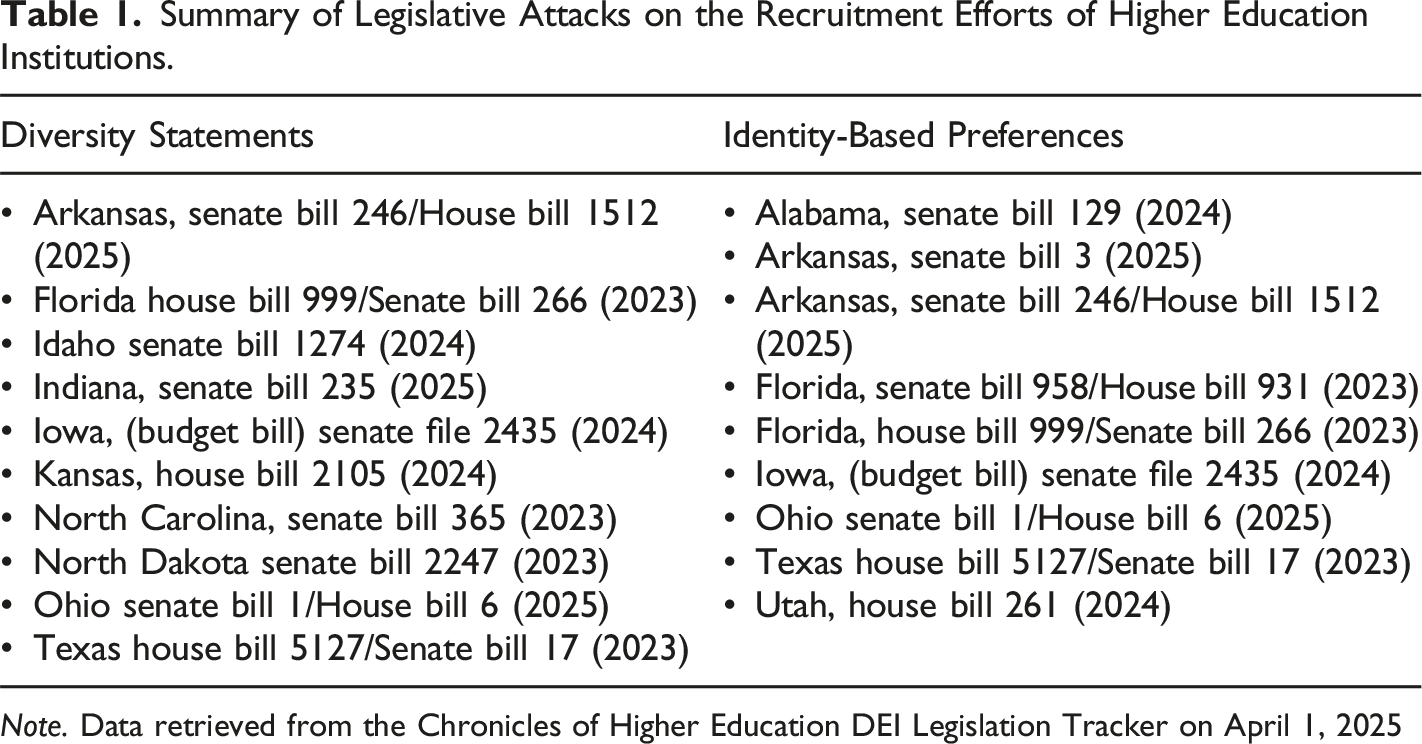
Note. Data retrieved from the Chronicles of Higher Education DEI Legislation Tracker on April 1, 2025
Recommendations
Legislations that restrict initiatives to increase diversity are often supported by claims of discrimination among especially white individuals (Jackson, 2025; Trainor, 2025), though critical and legal scholars have dismissed these arguments as functioning to reify white supremacy, maintaining a system that have long benefitted their interests (Carroll, 2025; Feingold, 2021). Among them, legal scholar Johnathan Feingold (2021) argues that these efforts have sought to delegitimize anti-racism by depicting it and associated movements as perpetuating preferential treatment, anti-White discrimination, and reverse racism. Contrary to these arguments, this article contends that the contested strategies (and DEI movement as a whole) are intended to and have sought to reduce discrimination and biases against non-white teachers, individuals who are typically disadvantaged by traditional recruitment and admission practices.
Two interrelated arguments motivate these recommendations. First, the moral imperative to remedy the demographic incongruence across schools; in part, to redress the impact of desegregation orders on the pipeline of educators (Templeton et al., 2021; Tillman, 2004). Another factor underpinning these recommendations is the improved experiences and outcomes when marginalized students have principals who mirror their racial identities (Bartanen & Grissom, 2019; Lomotey, 2019). Both arguments serve as a call for principal preparation program faculty to challenge traditional recruitment and admission practices that have long favored white applicants, and instead embrace those that are accepting and affirming of the experiences and backgrounds of teachers of color—rethinking how merit is conceptualized.
The recommendations presented here are gleaned from the body of literature reviewed above, filtered through legislative restrictions, and are intended to offer guidance to faculty and coordinators across principal preparation programs about strategies that can be used to “skillfully” navigate anti-DEI legislations. They are framed through three major categories that emerged from the literature as factors influencing the enrolment of minority individuals in educational leadership preparation programs—recruitment, admission, and financial assistance. While all three categories are equally significant, preparation programs must center careful attention especially to their recruitment practices. As the category least subject to anti-DEI scrutiny, recruitment strategies that increase the yield of teachers of color applying for principal preparation programs will ensure that corresponding admission practices and financial support benefit these individuals.
Recruitment
(1) Principal preparation programs should leverage relationships with school districts and alumni to strategically “tap” teachers of color and other marginalized identities into their programs. As Honig and Donaldson Walsh (2018) reflected, diverse candidates most likely to apply for their programs were individually tapped by on-site mentors. Because tapping is often achieved informally, this strategy is particularly suited to evade anti-DEI restrictions (Reyes-Guerra et al., 2022). A study by Myung et al. (2011) gives support to the benefits of tapping in supporting diversification efforts, citing that teachers of color were more likely to be tapped than their white colleagues for school leadership roles. Tapping teachers of color is especially beneficial in overcoming much of the self-selection into principal preparation programs and the “first come, first served” mentality at the school and district levels that have long favored white applicants (Clement et al., 2022). (2) Recruitment for principal candidates must be crafted in ways that increase the likelihood of students of color being interested. As an example, using diverse individuals on promotional materials, and verbiage such as “commitment to social change”, “candidates with diverse experiences” or “commitment to meeting the needs of students in high needs and low performing schools” might appeal to these individuals since they might be able to see themselves in these opportunities (see Brown & Scott, 2014; Fusarelli et al., 2019; Thornton et al., 2022). (3) Recruit teachers with demonstrated classroom success. Going further, preparation should prioritize applicants with successful teaching and commitment to teaching in diverse school settings such as Title I schools, high-needs, and those serving larger proportions of marginalized students (Fusarelli et al., 2019; Mallory et al., 2017; McKenzie et al., 2008; Merchant & Garza, 2015). (4) Increased personalization including smaller and more frequent information sessions, personal communication and following up with interested applicants could help in troubleshooting issues that might potentially impede their application and enrollment (e.g., finances, imposter syndrome, incomplete application, etc.) (Agosto & Karanxha, 2012; Honig & Donaldson Walsh, 2018). (5) Recognizing the influences of additional experience on candidates’ preparedness for enrollment, reaching out to unsuccessful applicants of color and encouraging them to reply in the future with feedback on areas for improvement (Clement et al., 2022). (6) Increasing the faculty of color in the department serves as a conduit for drawing students of color to apply to the department (Friend & Watson, 2014; McKinney & Capper, 2010). Although programs are unable to explicitly consider race in these processes, crafting faculty job descriptions in ways to appeal to these individuals and prioritizing individuals with research commitments around critical scholarship could support this recommendation.
Admission
(1) Explicit admission requirements and selection criteria to overcome racial and cultural biases that persist when vague and ambiguous admissions policies are applied (Boske et al., 2018). (2) Broadening admission criteria beyond traditional metrics (GRE, GPA) to reduce racial and cultural biases. Several scholars have suggested adopting multi-level, holistic selection processes such as performance-based tasks and simulations that can be used to discern commitment to the success of all students (Boske et al., 2018; Fusarelli et al., 2019). (3) Diverse representation in educational leadership departments, especially on selection committees is likely to challenge and remedy racial biases that impact admission decisions (Karanxha et al., 2014; McKinney & Capper, 2010).
Financial Support
(1) Waiving application fees (Clement et al., 2022; Thornton et al., 2022). (2) Principal preparation programs should consider seeking external funding from state, federal or non-profit entities to offset enrollment expenses for diverse teachers, first generation students, and teachers in high needs schools (Fusarelli et al., 2019; McKinney & Capper, 2010). Because teachers of color are typically paid less than their White peers (Steiner et al., 2024), the use of income-based criteria could support them benefitting from these provisions. (3) Principal preparation programs could establish partnerships with school districts serving large proportions of teachers of color to facilitate cost-sharing agreements that would ease the financial burden for teachers (Shore et al., 2021). By establishing these relationships with districts having a large population of teachers of color, these relationships could inevitably lead to a greater number of these individuals benefitting. Service agreements could be instituted to ensure candidates return to sponsoring districts for a specified period.
To conclude these recommendations, preparation programs must answer two questions to evaluate whether their efforts have successfully diversified the principal pipeline (see Clement et al., 2022; Reyes-Guerra et al., 2022). First, have the strategies resulted in the increased admission and enrolment of teachers of color into the principal preparation program? Going one step further, do admission and enrolment patterns mirror the local landscape of the student and teacher demography? Relatedly, a more indirect indicator is if administrative-certified teachers of color have translated to assistant principal and principal roles, and whether these mirror the demographic profile of their student populations. The success and effectiveness of these strategies warrant ongoing assessment and adjustment to ensure they are serving and continue to serve their intended functions.
Conclusion and Implications
The recommendations offered here come at a time when the concepts DEI and their associated initiatives are under attack nationally and are intended to provide support to principal preparation program faculty and their efforts to recruit and admit diverse teachers for principal preparation. Although the recommendations are intended to serve as tactful strategies to maneuver the current sociopolitical climate, the political, legal, and economic consequences associated with embracing DEI initiatives must be acknowledged. Take for instance, the latest battle between higher education powerhouse, Harvard University and President Donald Trump, regarding the institutions’ unwillingness to comply with his political agenda to renounce DEI efforts. In addition to federal funds in excess of two billion US dollars being frozen and threats of the institution’s tax-exempt status being revoked, the institution’s recent SEVIS revocation impacts their ability to admit international students, emphasizing extreme consequences in the war against DEI. Consequent to said, preparation programs and their faculty must carefully weigh their sociopolitical context prior to and while embracing the recommendations presented within. This might also warrant ongoing revisions and modifications to recruitment and admission policies to keep up with the evolving nature of these attacks. Afterall, survival and sustainability are important if preparation programs, and their faculty are expected to continue this important work.
Post Recruitment and Admission Imperatives
As evident from most of the reviewed articles, the context of the principal preparation programs studied had explicit commitment and mission around equity and social justice, suggesting that these values are foundational to diversification efforts (Hernandez & McKenzie, 2010; McKinney & Capper, 2010). However, it is not enough for programs to give lip service to social justice commitment (Marshall, 2004), these efforts must transcend preparation programs’ entire operations (Honig & Donaldson Walsh, 2018). An explicit social justice mission that informs the operation of these programs is likely to not only recruit diverse teachers, but also commit to supporting their successful entry into the principal pipeline. For example, even after enrolling teachers of color, principal preparation programs must foster learning spaces where their experiences, identities, and cultural backgrounds are valued and included across the curriculum (Honig & Donaldson Walsh, 2018; Khalifa et al., 2016). This comes at the heels of findings about limited opportunities for discussion of race and ethnicity across principal preparation programs, or discussions in “unsophisticated ways” (Boske, 2010; Weiner et al., 2019; Zarate & Mendoza, 2020). Moreover, given the unstated expectations for Black faculty to facilitate discussions about race and racism (Diem & Carpenter, 2013), preparation programs’ social justice commitment should also be visible in the diversity of their faculty and their personal and research commitment to these principles. Although the benefits of race matching are usually centered at the K-12 level, these benefits are also applicable in the higher education context since faculty of color in principal preparation programs are most likely to provide mentorship, advocacy, and support for students or color, functions often neglected by white faculty (see Boske & Elue, 2017; Herman, 2024; Karanxha et al., 2014).
Implications
In addition to its recommendations for principal preparation programs, this essay also offers implications for discussions about a national attention to the principal pipeline and future research.
National Database on Educational Leadership
The literature reviewed here confirms criticisms about the limited empirical attention to the recruitment and admission practices across principal preparation programs (Crow & Whiteman, 2016). This is further compounded by the incomplete portrait of the principal pipeline at this stage, which scholars have attributed to the lack of robust data to support research (Anderson et al., 2022; Perrone et al., 2022). Thus, our current understanding of the principal pipeline pales in comparison to that of the teacher pipeline, leaving policymakers with incomplete information on which to act, especially pertaining to the diversity of candidates entering and leaving preparation programs.
The anti-DEI movement complicates discussions about the principal pipeline and its unrepresentativeness of the student population. Said complications reinforce calls for national attention to the principal pipeline from preparation to employment to better understand what Fuller and Young (2022) describe as teachers of color “leaking from the pipeline”, and to identify areas for intervention. A national database on educational leadership is recommended to collect data on the personal and professional characteristics of teachers from their enrolment into preparation programs and track their entry and ultimate exit from the profession (Browne-Ferrigno & Muth, 2009; Crow & Whiteman, 2016; Browne-Ferrigno & Shoho, 2004; Perrone et al., 2022). And although most states have collected and maintained data on the educator pipeline, including principals, Perrone and colleagues (2022) contend that these are typically not available in forms that are readily accessible to researchers, with the exception of a few states (e.g., North Carolina, Texas, and Tennessee).
Perrone et al. (2022) argue for a federally maintained, nationally centralized database to provide data that track teachers’ career paths, experiences, and performance, allowing for comparison across states. They identified three tiers of data that would support an enhanced understanding of the principal pipeline at the principal preparation stage, and corresponding efforts to support its diversification including: (1). Statistical counts of the entrants and graduates of principal preparation programs and their demography, (2). Data on the required courses, context, and internship experiences, and (3). More confidential types of data including survey of students’ experiences, licensure scores, and employment pathways. This essay extends these discussions to the opportunity for a national database to collect data on the demography of applicants for principal preparation, which would allow scholars to not only answer questions relevant to graduates from educational leadership programs, but also the proportion of teachers of color who apply for principal preparation in contrast to those who get accepted. This type of data will likely shed light on institutional barriers to the enrolment of teachers of color for principal preparation.
Future Research
This study also presents implications for future research, and scholars interested in studying educational equity, and how the current sociopolitical tensions have impacted said across the P-20 continuum. Although studies have emerged documenting the experiences of faculty navigating anti-DEI legislative attacks (e.g., Briscoe & Jones, 2024; Pedota et al., 2025), these have focused generally on the experiences of higher education faculty. In so doing, these studies ignore the additional tensions that preparation program faculty must navigate, since their curricula is often shaped by educational leadership standards that warrant engagement with DEI issues (National Policy Board for Educational Administration, 2015). Additional research is needed to understand how principal preparation programs and their faculty have been impacted by anti-DEI legislation. Specifically, there is a need for research that examines the impact of these legislations on the recruitment and admission practices of preparation programs. As an immediate next step to this essay, scholars should examine how DEI bans (e.g., affirmative action, bans on diversity statement, etc.) have impacted the diversity-focused recruitment and admission practices of principal preparation programs. In essence, has the enrolment of teachers of color across principal preparation programs decreased since onset of anti-DEI legislations? These studies should also engage with the strategies used by faculty across these programs to navigate these tensions, while prioritizing diverse teachers in their recruitment and admission of aspiring principals, which could lend support for the recommendations offered in this paper, while expanding this body of literature.
Footnotes
Declaration of Conflicting Interests
The author(s) declared no potential conflicts of interest with respect to the research, authorship, and/or publication of this article.
Funding
The author(s) received no financial support for the research, authorship, and/or publication of this article.
