







Abstract
Women artists and superintendents in the U.S. and around the world continue to face gender- and race-based discrimination when attempting to obtain leadership positions. In this paper, we offer a comparative case study design of a racially diverse group of three prominent women artists and six women superintendents on Long Island who were all mentored by white males and have succeeded in white, male-dominated professions. While we found many similarities between the artists and superintendents regarding how they overcame sex-role stereotyping and interpersonal racism in their respective career trajectories, we suggest that the women superintendents can learn much from the artists about how to center their gender and racial identities and transform their leadership practices in ways that would disrupt the status quo that continues to produce inequities and outcomes in schools. Indeed, women superintendents seemed to experience tensions between emulating male superintendents’ leadership styles and resisting gender stereotypes. They also must navigate a competitive culture of accountability and rankings. This competitive culture among mostly male superintendents is detrimental for women leaders who have less opportunities to seek out women mentors for advice. Our analysis provides important implications for future women superintendents aspiring to practice, what we call a “women-centric approach to culturally responsive school leadership,” or WC-CRSL.
Keywords
Introduction
Women in the U.S. and around the world continue to face gender- and race-based discrimination when attempting to obtain leadership positions (Dana & Bourisaw, 2006; Muñoz et al., 2014). In K-12 public education, 77% of all U.S. teachers are women (Schaeffer, 2024); yet women superintendents only make up 29% of leaders in U.S. schools (AASA, 2024). If the race of the superintendent is factored in, Black superintendents account for a mere 4% and Latinx superintendents make up just 3% (AASA, 2023).
This underrepresentation of women and superintendents of color in education crosses over to the arts. One study found that African American women artists “made up just 3.3% (190 of 5,832) of the total number of female artists whose work was collected by US institutions” (Halperin & Burns, 2019, n. p.). Additionally, in a study of 18 major U.S. museums, 85% of the artists were found to be white and 87% were men (Topaz et al., 2019).
In this paper, we offer a comparative case study design (Bartlett & Vavrus, 2017) of women artists and superintendents who have all experienced gender and/or racial discrimination in professions dominated by white males, but at the same time, have all successfully navigated and overcome gender- and race-based obstacles. While some readers might question the comparison, we are not the first to examine the similarities between education and the arts. Indeed, instead of choosing other education-related professions to compare with the superintendents, we were inspired by the “cultural worker” concept (Giroux, 2005; West, 1990), a term that is derived from the art and education fields and defined here as individuals who transform their leadership practice in women-centric and culturally-responsive ways that would disrupt the “dominant whiteness and maleness of educational leaders” today (Blackmore, 2013, p. 147). Both the artists and superintendents selected for this study are inspirational in their leadership pathways and attempts to push back on society’s gender- and/or race-based stereotypes and discrimination. We also acknowledge that the art and education professions are very different in terms of freedom of expression, job security, and oversight, which we account for and recognize as a limitation in our comparative analysis.
Our study explored the narratives of three prominent women artists and six Long Island women superintendents to answer the following questions: (1) What are the similarities and differences between women artists and superintendents in the ways in which they navigated gender- and/or race-based discrimination in their leadership experiences and practices? (2) In what ways do they center their gender and/or racial/ethnic identities in their work? (3) How, if at all, do they cross gender and/or racial boundaries and push back on society’s expectations of women in the art and education professions?
The need to hear from women and women of color who break through the barriers of race and gender is significant, particularly in terms of the vital importance of racial and gender representation in educational leadership positions.
Representation matters because the student demographics in many U.S. public schools have racially diversified but remained segregated and highly inequitable by race and class (Turner, 2020), particularly on Long Island where this research took place (Erase Racism, 2023). Indeed, evidence from Long Island, with its 125 school districts in a relatively small geographic area, suggests that Black and Latinx students are segregated within districts that receive less resources and are denied access to higher level classes and suspended more, compared to their white and Asian peers (Erase Racism, 2023). The system also maintains a mostly white teaching staff, which can lead to lowered expectations for students of color and their academic potential (McGrady & Reynolds, 2013).
Yet, we also argue that how leaders choose to lead is just as important as their representation in the field. By drawing on the experiences of prominent women artists of color, we introduce a women-centric approach to culturally responsive school leadership (WC-CRSL) informed by previous scholarship on CRSL with school principals (Khalifa et al., 2016) and the findings from our comparative analysis. This analysis provides important implications for future women aspiring to be ‘cultural workers’ in education who critique and transform the taken-for-granted educational systems that most public schools subscribe to with the goal of reforming school district leadership practices through a feminist and CRSL lens (Alston, 2005; Blackmore, 2013; Castagno & Brayboy, 2008; Giroux, 2005).
Literature and Framework
In this paper, we draw on the following background literature and frameworks to analyze the interviews with women superintendents and artists: feminist theory, culturally responsive school leadership, effects of neoliberalism, and the “cultural worker” and “tempered radical” concepts that bring race and gender together.
Feminist Theory
Feminist theory is grounded in the reality that gender inequality shapes all aspects of social institutions (Bell et al., 2018) and was used in our analysis to help explain the barriers that women and women of color continue to experience in their leadership trajectories and job. While the women’s movement that arose in the 1960s led to better representation of women in the public sphere, women continue to face inequitable access to leadership opportunities and outcomes via gender discrimination, sex-role stereotyping, and the “good old boy network” (Quilantán & Menchaca-Ochoa, 2004, p. 1; see also Gaus et al., 2023; Hoyt & Murphy, 2016; Munoz et al., 2014). Indeed, a mere 29% of women are superintendents in the U.S. (AASA, 2024), and that percentage is dramatically lower for women of color. bell hooks (1989) and others (Aaron, 2020; Peters & Nash, 2021) have documented how Black women in leadership face double oppression because of their race and class, with some counteracting it with anti-racist practices. For example, research has shown how African American women superintendents are often required to transform their persona into one that does not appear “too Black” or “too female” to fit in (Fordham, 1993). Recent literature, however, has shown evidence of Black women resistance through a type of “intersectional leadership” that “centers race and gender…to serve and protect historically underserved communities” (Peters & Nash, 2021, p. 7). Our work adds to this intersectional leadership approach with the introduction of the WC-CRSL framework.
CRSL
To combat inequities in schools, leaders can adopt culturally responsive school leadership behaviors, or CRSL, which acknowledges that schools reproduce inequities in society (Khalifa et al., 2016). School leaders that practice CRSL train teachers and administrators in cultural responsiveness, create and foster inclusive school settings for historically marginalized youth, provide curriculum and pedagogy that is responsive to student culture, and develop strong relationships with the communities in which they serve. Like social justice and transformative leadership approaches, CRSL leaders’ “challenge teaching and environments that marginalize students of color, and they will also identify, protect, institutionalize, and celebrate all cultural practices from these students” (Khalifa et al., 2016, p. 1278).
Representation matters and prior research has suggested that Black women superintendents bring “deep instructional leadership [skills] and an ability to work with stakeholders and facilitate conversations about race and equity” (Superville, 2023). Research has also shown that women superintendents of color face many race and gender-based barriers in their leadership trajectories, including biased school boards, a lack of mentors, glass ceilings, and so on (Alston, 2005; Brunner & Grogan, 2007; Young & Skrla, 2003). What is missing in the CRSL approach is any specific mention of gender concerns in leadership practices—a focus of our study.
Effects of Neoliberalism
However, neoliberalism in education can challenge school leaders’ efforts in enacting CRSL. Neoliberalism denies the fact that standardized testing is associated with students’ socio-economic status (Lipman, 2011). Therefore, labeling schools with low test scores and concentrated poverty as ‘failing’ can lead to an emphasis on raising test scores and a narrow curriculum (outputs) instead of providing a culturally relevant curriculum and equitable access to resources and opportunities (inputs) (Khalifa et al., 2014; Roda, 2017). Test scores and grades are also used to assign students to high level, accelerated classes or advanced academic programs, resulting in racialized tracking within schools (Brooks et al., 2013; Roda, 2020). Khalifa et al. (2014) suggested that this effect of neoliberalism on educational leadership reform has led educational leaders to “deflect issues of race, focus exclusively on neoliberal, data-driven reforms, and then reproduce racialized disparities in school…perpetrating racism” (p. 502).
As we will show in the results, the superintendents in this study are still working under the vestiges of No Child Left Behind and a highly segregated and competitive school district context on Long Island, which can turn their focus away from equity-oriented CRSL practices in lieu of tests and other competitive accountability measures (Radd et al., 2021; Roda et al., 2024). The U.S. Department of Education’s Office for Civil Rights (OCR) has consistently reported discipline disparities by race, disability, and transgender status, as well as disparate access to advanced academic classes by race, disability, and linguistic background (OCR, 2017). In their book about racial equity leadership practices, Radd et al. (2021) wrote that “much can be done to change these circumstances, yet school leaders don’t always have the tools, knowledge, and resources to actually do so…we’ve found that racism is the most difficult form of inequality for educators to discuss and address” (p. 4 and 6). The authors argue that the educational system must be transformed by educational leaders because it was intentionally designed to produce these persistent inequities (Radd et al., 2021). Yet, as we will show, the women superintendents in this study faced external pressures to maintain the status quo.
Cultural Worker
CRSL is more than just advocating for racial equity; it is putting these ideas into practice. In this way, CRSL is related to West’s (1990) conceptualization of a cultural worker, which brings art and education together. This term was first applied to artists who rejected deficit-based perspectives through their artwork. They pushed back on society’s oppression of people of color and challenged practices of privilege through their art. Drawing on feminist and other critical theories, Giroux (2005) applied the cultural worker concept to U.S. public school educators and leaders who as “engaged intellectuals” critique the status quo to “address the most pressing social and political issues of their neighborhood, community, and society” (p. 8). Cultural workers in education use their discretionary authority to “create alternative public spheres… in which social equality and cultural diversity co-exist” (Giroux, 2005, p. 22; see also Cooper, 2009; Roda, 2023). Cultural workers in schools are advocates that simultaneously critique and transform the taken-for-granted educational practices and policies, like neoliberal marketing strategies, test scores, and racialized tracking, that most public schools subscribe to (Roda, 2023).
Tempered Radical
In this way, cultural workers go beyond “tempered radical” leaders “who identify with and are committed to their organizations and also to a cause, community, or ideology that is fundamentally different from, and possibly at odds with the dominant culture of their organization” (Meyerson & Scully, 1995, p. 586). While cultural workers resist and transform the status quo of inequality, tempered radicals find themselves torn between upholding the status quo and becoming change agents from within. In the case of women leaders, they can experience tensions with how to hold onto their “radical ideals” based on their intersectional identities (gender, race, etc.) and working within “the confines of their institution” (Alston, 2005, p. 677). Furthermore, Meyerson and Scully (1995) found that tempered radicals are often women and/or people of color who feel isolated due to their beliefs and face external pressures to coopt their agendas, which can lead to emotional strain to fit in and go along with the status quo. This reality often leads to tempered radicals leaving their institutions (Meyerson & Scully, 1995), which, we argue, must change if the goal is to achieve and sustain more racial and gender representation in public school leadership roles and to encourage the WC-CRSL approach.
Methodology
Our study utilized a comparative case study (CCS) design that relied on “purposive sampling” to choose cases (Bartlett & Vavrus, 2017, p. 117), which contain similar dimensions but offer contrasting cases for comparison. Bartlett and Vavrus (2017) recommend the CCS approach for studies that are focused on “practice and policy…that consider how social actors, with diverse motives, intentions, and levels of influence, work in tandem with and/or in response to social forces to routinely produce the social and cultural worlds in which they live” (p. 1). CCS was used to trace the similarities and differences of a racially diverse sample of prominent women artists and Long Island superintendents who experienced a similar phenomenon of racial and gender discrimination in their leadership pathways, experiences, and practices. We analyzed secondary source data collected by others for the women artists and primary source data were collected for the superintendents.
Both authors of this article are white women educators, advocates, and leaders who are affiliated with an educational leadership doctoral program for diverse learning communities on Long Island, and advocate for more women in leadership roles. Dr. Allison Roda specializes in race, educational leadership, and qualitative methods and has prior experience teaching in a Head Start program. Dr. Victoria Catalano worked many years as a New York City principal and is now a teacher educator. We share a background of teaching in high needs schools and strive to incorporate CRSL and racial consciousness into our own teaching and leadership practices. However, we have never been superintendents and were unknown to the participants. Due to our insider and outsider positionalities, we took an open-minded stance by allowing the participating superintendents to share their stories, using quotes to center their experiences and not allowing our own ideas or interpretations to take center stage. We wrote reflective memos and met regularly to interrogate any racial or cultural biases we might have had when analyzing the data and interpreting the results (Milner, 2007).
Data Collection and Analysis
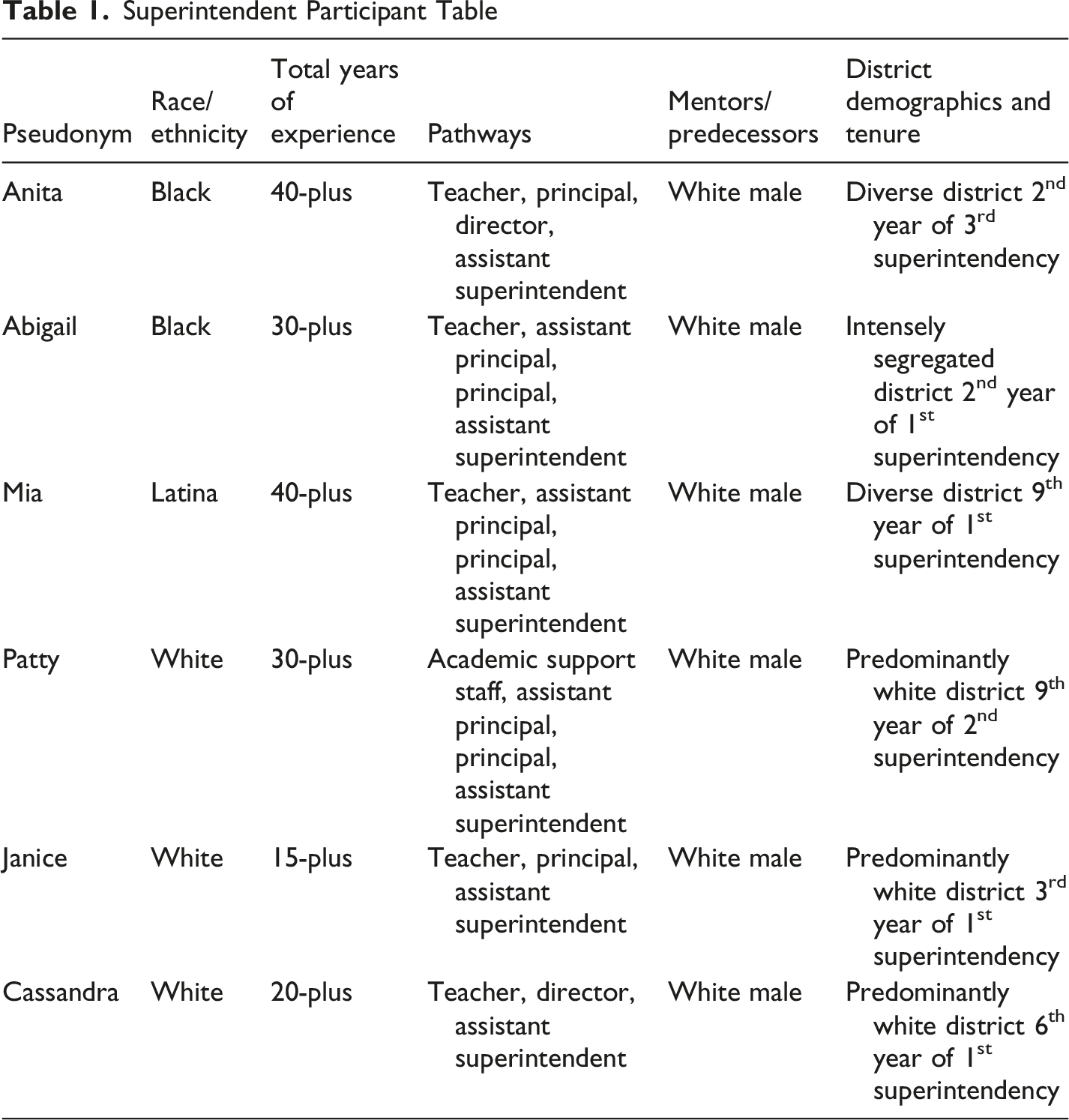
Interview data with six women superintendents were taken from a larger study conducted by Dr. Catalano on the leadership journeys these women took to the superintendency (Catalano, 2022). Out of a total of nine participants, we excluded the three white superintendents who had women mentors and/or predecessors in their respective school districts because we were interested in how women succeeded in white male-dominated environments. In the larger study, the women superintendents were purposefully selected to include a range of racial/ethnic backgrounds and geographic locations (Catalano, 2022), as well as leaders who represented the three distinct demographic district types across Long Island, including predominantly white districts, racially diverse districts, and intensely segregated districts with mostly Black and/or Latinx students (Erase Racism, 2023).
Superintendent Participant Table
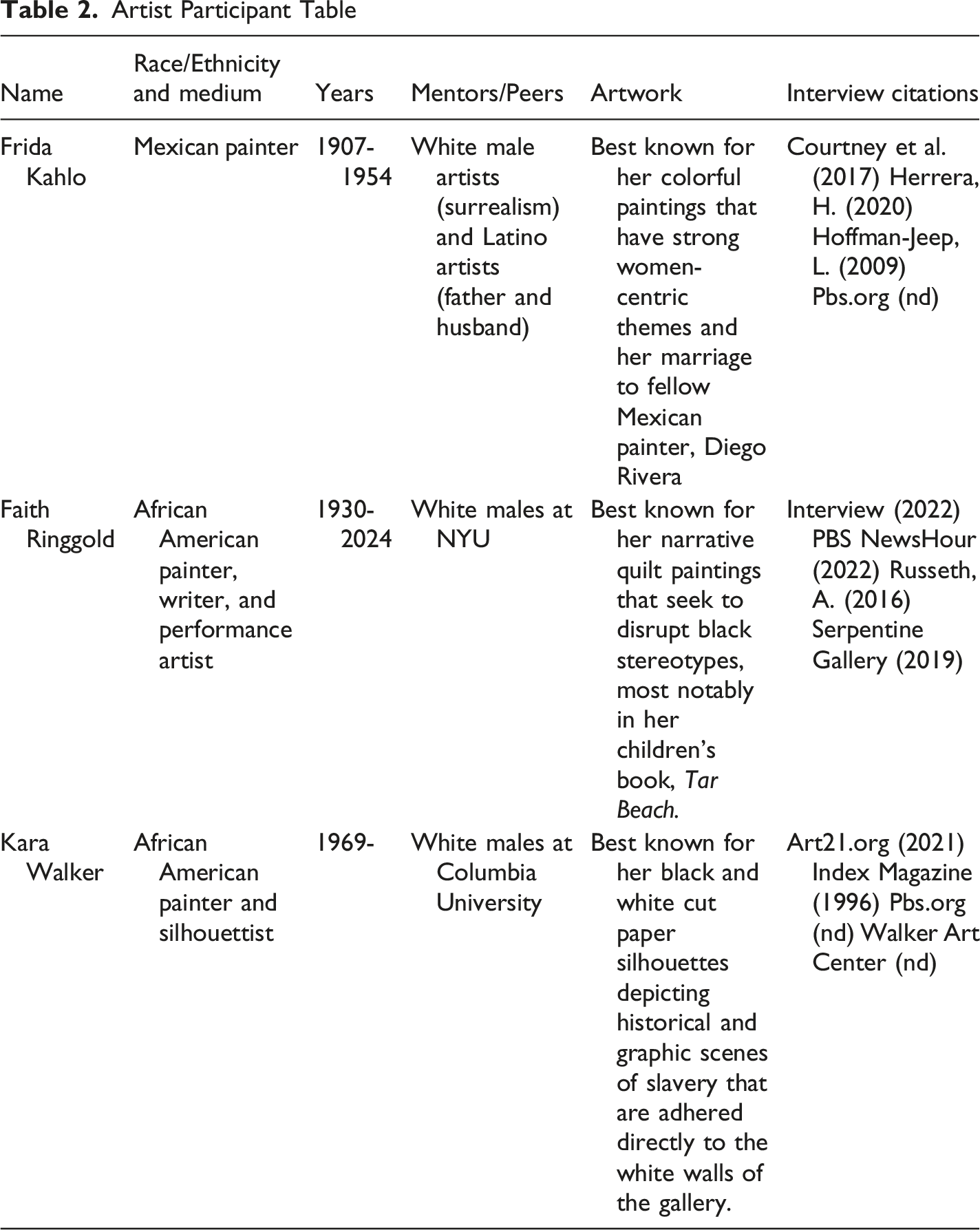
All three of the women artists of color in this study were similarly chosen because they had male mentors during their leadership journey in the art field. Yet, what set them apart from other artists is that they are considered feminists who explore racial and cultural identity in their work. We classified them as cultural workers because they are considered more than just artists; they are activists for racial justice and disruptors of the status quo. Selected interview quotes with each of the artists from the last 30 years was found from secondary sources when they were interviewed by galleries or museums about their leadership journey through art and activism, or in prominent online art publications (PBS, Art21, Art News) about each artist’s inspiration for their artwork. Dr. Roda compiled the quoted excerpts and citations in a spreadsheet for the comparative analysis and data were collected until data saturation was reached for each artist.
Artist Participant Table
Data Analysis
After compiling the data for our analysis, we read through each primary and secondary source interview transcript/excerpts and developed a code book collaboratively. Sample codes included background influences, centering gender and/or race in their work, sense of responsibility to the field, pushing back on society’s expectations, moments of inclusion or exclusion, and internalizing gendered norms. To ensure internal validity, we each coded two interviews separately in Dedoose to compare and then divided up the rest of the interviews to code independently. After the first stage of coding was completed, we developed a data analysis table to engage in vertical comparisons within each case (e.g., evidence of how the superintendents experienced tensions around centering their race and/or gender (tempered radicals) vs. artists who centered their race and gender (cultural workers) and horizontal comparisons across cases (e.g., how they responded differently to external influences by fitting in or pushing back in white male dominated professions) using the feminism and CRSL frameworks (Bartlett & Vavrus, 2017). Corresponding to the three research questions, the codes from our analysis were combined into three main themes (Saldaña, 2015): (1) navigating sex-role stereotyping and racism by drawing on their background influences and external expectations; (2) expressing their gender and racial/ethnic identity in their work during moments of exclusion and inclusion in their respective fields, and (3) internalizing or pushing back on society’s expectations of women leaders through their emulation of white male leadership approaches or via their activism and sense of responsibility to defy expectations.
Limitations
It is important to note several methodological limitations to our study. At times, the purpose of the artist interviews taken from secondary sources and the superintendent interviews from primary sources were different. Yet, similar to the superintendents, the artist interviews were often retrospective accounts of their leadership journeys in the art field, in which the artists responded to questions about their education, artistic inspiration, turning points in their careers, barriers that they overcame, and activism. These interviews often corresponded to a gallery or museum exhibition and pertained to a certain body of work, such as Faith Ringgold’s 85th birthday exhibition where she reflected on her education, art, and activism (Russeth, 2016). Yet, unlike the superintendents, the specific questions asked were sometimes omitted from the write-up. Since we were not in charge of conducting these interviews, the artists could not be asked for follow-up interviews and the quoted material used in the writing was not controlled or contextualized in the same way as the superintendents because these were interviews conducted by others. However, even with these limitations, we still felt that the comparative case study was relevant and important given the strong themes that emerged across the primary and secondary data sources.
Findings
In this study, we found that the women artists and superintendents did not originally aspire to be a superintendent or a famous artist. Yet they all had male support networks and strong beliefs about their abilities that helped them along the way, despite the many gender and/or racial obstacles they faced. What set these two groups of women leaders apart were the external pressures and expectations that impacted their leadership approach.
The artists could be classified as cultural workers who had transformative moments during their educational and career journeys that reminded them to center their racial and gender identities in their work. These seminal moments made them reflect on where they came from, who they wanted to represent, and what they wanted their legacy to be. Meanwhile, the women superintendents seemed to embody the tempered radical concept, as they experienced tensions between leading as a woman or woman of color and the pressure to emulate white male superintendents’ leadership approaches and styles of behavior (e.g. being personable, charismatic, and relatable) due to external expectations. As we will show, the superintendents were successful at navigating gender and racial biases in their interpersonal relationships in the workplace (interpersonal racism), but how they translated that into their leadership approaches that combatted systemic racism and gender discrimination in schools was less clear.
The Artists: Centering Race and Gender Identity in Their Work
As women of color in a white male-dominated art profession, it was very clear from interview data with the focal artists that they felt a responsibility to center their race and gender identity in their artwork. In the sections below, we provide evidence of how they pushed back on gender discrimination and racism along their career journeys, and how they were expected to center race and gender in their artwork.
Navigating Gender Discrimination and Racism by Pushing Back
All three artists navigated gender discrimination and racism in society by defying conventions and pushing back on society’s biased perceptions of women and women of color in the artworld. For example, many people wrongly assumed that Frida learned how to paint from her famous artist husband, Diego Rivera, to which she would adamantly reply: “No… I didn’t study with Diego. I didn’t study with anyone. I just started to paint…. Of course, he does pretty well for a little boy, but it is I who am the big artist” (Herrera, 2020, p. 5). This quote exemplifies Frida’s pro-feminist stance in her life and in her art, in which she constantly had to defy expectations when people wanted to define her as Diego’s wife first. In Herrera’s (2020) book about the artist, she wrote: “It was not from other painters, nor from schools, but from within herself that she derived the matter and even the manner of her painting… she has never resembled anyone, or almost anyone” (Herrera, 2020, p. 12). In other words, Frida set herself apart from other artists, including her husband, by saying that she taught herself how to paint in a manner that reflected her life as a woman of color.
Similarly, Faith Ringgold described how she navigated gender discrimination when she attempted to pursue a liberal arts degree at City College in New York City in the 1940s. At the time, only men were allowed to obtain an art degree. As Ringgold reflected in a 2016 interview for ArtNews: They’re sitting there trying to make me understand that I cannot get a liberal arts degree there [at City College] …and I am refusing to understand. And out of it, one woman [in the office] says, ‘She can do it. Let me tell you how. She can [enroll in the School of Education] and major in art’ (Russeth, 2016).
In this quote, Ringgold explains how a woman in the college office helped her push back on the gender barriers of the time by majoring in art education to achieve her goal of becoming an artist. By “refusing to understand” that she could not obtain an art degree, she was successful at defying expectations of women in the art field.
Kara Walker explained how she pushed back on discriminatory views of Black women in the U.S. through her narrative artwork: I think one of the things that’s happened here and there with the work that I’ve done is, because it mimics narrative—and narrative is kind of a given when it comes to work that’s produced by black women in this country—is there’s almost an expectation [of]… a female heroine actualizes through a process of self-discovery and historical discovery, and comes out from under her oppressors, and maybe doesn’t become a hero but is a hero for herself. (Art21.org, 2011)
Here, Kara Walker explains how her artwork is a story of self-reflection and discovery of becoming a heroine that “comes out from under her oppressors.” In all three examples, the artists could be viewed as cultural workers who overcame the status quo of gender and racial inequality in society through their ability to defy expectations in their artwork, education, and training.
Sense of Responsibility to Center Gender and Race in Their Work
The artists all spoke about the sense of responsibility they felt to center their gender and racial identities in their work to enact change. When speaking about the legacy of Artist Frida Kahlo, Herrera, the author who wrote a book about the artist, was quoted in a PBS interview that her artwork gave other artists “permission to be personal and to be autobiographical” (Pbs.org, nd). When Herrera (2020) interviewed Kahlo about her work, she asked what is the greatest truth that a human being can have, to which she answered: Being faithful to yourself. The more faithful the artist is to themselves, the better they reflect the concerns of their time. Thus, it can be said: the greater an artist’s genius, the better their work exposes the problems of their society. Artists have more sensitive and receptive antennas than most men: they are the first to perceive and express the concerns of their time. (p. 35)
Kahlo was unapologetic in what she chose to paint, resisting societal norms and expectations of women and charting her own path. In this quote, she implies that women artists must be faithful to their convictions, and, compared to men, they are better able to expose “the problems of their society” through art.
In the following excerpt, Artist Kara Walker was asked about the inspiration for her exhibition, to which she answered that it speaks to developing her identity as an African American artist in the U.S., how that manifests in her work and comes with a “certain set of expectations:” I guess it [my artwork] comes from a feeling of being a black woman, an African American artist—that in itself is a title with a certain set of expectations that come with it from living in a culture that’s, maybe, not accustomed to a great majority of African American women artists. It’s like a thing in itself…. It’s about: ‘How do you make representations of your world, given what you’ve been given?’ (Art21.org, 2011)
Kara Walker’s words embody this theme about how artists of color are expected to represent racial and gender identity in their work. In a profession that does not have many Black women artists, Walker felt that pressure to represent what it means to be a Black woman in American culture. Not only that, but she brings up the idea that as an African American woman artist, there is a “set of expectations that come with it.”
During an interview with Faith Ringgold, when asked about her creative process and works, she compared her work to the history of being a Black woman in the U.S.: “My ancestry is the history of me, and I’m very interested in that. I always come from the perspective of being a Black woman in America— that’s my story, at all times of my life” (Interview, 2022). Similar to Kara, Faith Ringgold’s story of her first encounter with a New York City art collector exemplifies what was expected of Black women artists. It was 1963 and at that time there were few Black artists being represented. Ringgold was painting images of flowers and leaves because that was what she was taught in college. However, as Ringgold recounted, the collector took one look at the work and said to her: “You”—pause— “can’t”—pause— “do that.” In an interview about this moment, she remembered thinking: “What is she talking about? I was taught that! she says I can’t do that. I can do anything I want! Hmmm. Hmmm. That’s interesting!” (Russeth, 2016).
Ringgold reflected on the exchange with the critic, saying: You know something? I think what she’s saying is—it’s the 1960s, all hell is breaking loose all over, and you’re painting flowers and leaves. You can’t do that. Your job is to tell your story. Your story has to come out of your life, your environment, who you are, where you come from (Russeth, 2016).
She described this moment as “transformative” for her career. After that day, she made paintings that depicted the racial tensions of the time with her “American People” series. When asked about her piece called Die that reflected the tumultuous civil rights era for Black people in the late 1960s, Faith replied, “You can’t necessarily change what’s going on, no, but I can say what I think about it. I’m free to do that and I will” (PBS NewsHour, 2022). Her work continues to “challenge African American identity and gender inequality” (Serpentine Gallery, 2019).
Overall, the artists developed a sense of responsibility after overcoming barriers to depict their personal stories and struggles around being a Black or Latina woman in their work. They defied expectations, were cultural workers and activists, and pushed back on society’s negative perceptions of their worth through their art.
The Superintendents: Tensions Around Centering Their Gender and Racial Identity in Their Leadership Approaches
Compared to the artists, the women superintendents did not seem to have those same expectations or transformative moments during their careers. Instead, they could be viewed as tempered radicals that experience tensions between centering their gender and racial identities in their leadership work and fitting into the dominant culture. For example, no one seemed to expect the superintendents to lead in a way that reflected CRSL. Instead, their mostly white male mentors and district constituents reinforced gender role stereotypes which were either internalized by the women superintendents when they made comments about working harder than men and acting more personable in their job or resisted. In the sections below, we discuss the following three themes: Navigating Gender-Based Discrimination and Racism by Fitting In, Emulating White Male Superintendent Leadership Styles, and Internalizing or Resisting Gender and/or Racial Stereotypes in a Competitive Context.
Navigating Gender-Based Discrimination and Racism by Fitting in
All of the women superintendents spoke about gender-based discrimination and, for some, interpersonal racism that they experienced when applying to jobs, in their mostly male central offices, and in their interactions with community members, school board members, and outside workers in their school districts. Clothing and hair were often scrutinized and criticized by men. Superintendent Mia remembered a time when her male supervisor once said, “How come you’re not wearing your high heels today? I like when you wear three-inch heels.” When asked if she had to change her behavior to avoid being stereotyped, Mia said that “clothing is a big thing…you have to shop in JCPenney, not Talbots, and having nice clothes and dressing nicely and taking care of yourself and driving a nice car, these things often can be perceived negatively by others.” In these quotes, Mia felt pressure to fit in and dress a certain way, instead of standing out as a woman of color in a position of power.
Similarly, Superintendent Janice recalled how a male school board member gave her advice about how to wear her hair so she would look less “attractive.” As she explained: Females have a harder time with the constant criticism. After being in this district for probably 14 years, one of the board members questioned me about maybe I could pull my hair back a little bit and try to look a little less attractive. He made a comment that the other Moms might think that I might date their husbands. I’ve never dated anybody at work in my entire career. I never dress inappropriately; I wear flats so that my legs don’t look as attractive.
In this quote, Janice experienced gender-based discrimination, and while it is not clear if she changed her hair because of the comment, she did change her footwear to appear less attractive to parents and colleagues in the school community.
The superintendents of color also spoke about gender- and race-based stereotypes that come with the job. Superintendent Abigail told a story of being asked by a construction worker in her building if he could speak to her boss. She quickly replied, “I am the boss.” Superintendent Anita also discussed racial and gender stereotypes in the workplace: “The first thing you see is my color and my gender. So, I mean, without knowing me. There are perceived ideas about who I may be, what I may bring to the table. So, my whole life has been about being 150%, so that those stereotypes are not used to define my progress.” Anita went on to speak of the challenges of exclusion as a woman of color as she navigated the superintendency: “People define where you can work and what districts you could apply to, which mean the best districts are reserved for white men. And I defied all of those odds. I’ve never listened to that, so you could allow people to penetrate your minds, but I didn’t.” These comments illuminate how gender and racial stereotypes are expressed by members of the larger school community. In these quotes, Anita counteracts these exclusions by working hard and proving people’s low expectations of her wrong by “being 150%” and getting jobs in districts that were considered out of reach for women of color like herself.
Likewise, the data shows that the women superintendents were often compared to their male counterparts and treated differently because of their gender. Superintendent Cassandra felt that women must “prove themselves more than men do” when she gave the following example: “And there’s a statement we hear all the time. ‘[Well Cassandra], if you were a man that wouldn’t have happened.’ I agree.”
Superintendent Patty commented about the stereotypical view that women are better at the “fuzzy area” of curriculum and instruction, and men are better at the business side of running a school district. She replied: I sit now as a superintendent who has really strong school business knowledge. And I think people are surprised by that. Here now where I am, they get it, they know it, but it’s not an automatic expectation, even though a good superintendent really has to know the inner workings of school business, but I do…. And I know that stereotypically people don’t expect that of me.
In Patty’s quote, the stereotypes about women superintendents include deficit-based ideas about their knowledge of the business side of the job.
As this theme showed, women superintendents faced gender- and race-based stereotypes in the form of criticism of their style of dress or hairstyles on the job. They responded by changing their behavior to fit in and meet expectations, with some pushing back on the stereotypes by being fully prepared for the business side of the job, applying to districts that were considered out of reach for women of color, or putting up with disrespectful behavior that they said male superintendents do not encounter.
Emulating White Male Superintendent Leadership Styles
To combat some of the microaggressions and discrimination, most of the women superintendents seemed to be expected from colleagues and the community to emulate white male qualities and leadership styles (e.g. charismatic and personable) that came before their tenure. Instead of pushing back on these expectations, the women superintendents seemed to try to emulate them. Mia compared the typical male superintendent’s leadership qualities with women leaders: I’ve seen some men who are not necessarily as knowledgeable as some of the women that I know, but they have charisma, they have a presence, they have kind of the good old boys club, they can connect with men in a way that women don’t, that kind of good old boys’ type of relationship that women… you can’t do that. Women don’t do that, in general. And so, you have to approach it from another way. But you also have to be personable, and you have to be genuine. You have to be relatable as a human…I think as a woman, you have to be able to do that, too, and many women can. I work at it. I still work at it to make sure that I am relatable. But I think it just comes easier to men.
In this quote, Mia seems to experience a tension around acting more like male superintendents because there is an expectation to be relatable, genuine, and have a strong presence vs. approaching “it from another way.” These male leadership qualities, Mia believed, come easier to men than they do for women. She went on to explain that “People see men as strong leaders, they see women as weaker, they see women as hysterical.”
Superintendents Anita and Patty both explained how they learned everything about being a superintendent from their white male superintendent mentors. Patty said, “I had a superintendent, he was a male, and I love the way he led. Wasn’t a very successful superintendent ironically, but he just was a wonderful mentor.” Although this male superintendent was not the best leader, Patty aspired to lead her district in similar ways. Similarly, Anita emphasized that sentiment when she replied: “So I’ve tried to walk in his [prior male superintendent] footsteps and mirror what he’s done, and I feel an obligation to mentor the new group of superintendents in the same way.” Anita also unintentionally reinforced gender stereotypes when she compared women and men superintendents: “But I can tell you, when you get a woman [superintendent], you can bet that that woman is going to work harder and be more personal. And the parents are going to love the personal motherly touch. That’s what comes with a woman as a leader.” Here, she implicitly compares a woman superintendent to a male superintendent by saying that women work harder, are more personal, and “motherly.”
In a similar vein, Superintendent Janice made the comment, “I think if you’re a strong woman, you’re labeled a bitch. I think that’s just how it is…. I think the women are held to a different degree of accountability than men. I don’t particularly think that’s fair.” Her advice to women aspiring to be a superintendent is to have “thick skin because of the constant criticism.” In all these quotes, there is an underlying sentiment that women leaders are expected to act in a certain way either to avoid gender stereotypes and emulate male approaches, or, as Anita said, to embrace the expectations and be more “motherly.”
Meanwhile, Janice reflected on her experience with gender stereotypes during interviews. Twenty-five years ago, a board member once asked her during an interview: “You don’t look very tough. How are you going to handle the kids?’ but men don’t get asked that.” She compared that early experience to an interview that she was recently on with a principal candidate: When they [hiring committee] asked the questions, and it was almost the same exact questions [I had 25 years ago]. And I chimed in and redirected it. And at the end of the meeting, I said to them, ‘You can't tell females that they don’t look like they’re going to be able to handle a situation.’ That is so sexist and we’re, 25 years later. What is how tough I look, or my physical appearance, have to do with how I’m going to run a school or district… That doesn’t make any sense to me.
Janice’s quotes illuminate how gender stereotypes show up during interviews with prospective women leaders and are reinforced over time. Acting tough and having certain physical characteristics are apparently associated with strong male leadership qualities.
Unlike the other women superintendents, Janice spoke about one woman superintendent from another district who she admired because, “She didn’t give up her identity, she just was who she was, and she wasn’t going to dress like she was 65 years old, which is what they expect of us…. But I remember thinking to myself, ‘that’s who I want to be.’” Similarly, Superintendent Abigail said she does not change her behavior or “role play,” like she has seen other women do to be more like male leaders/superintendents. Yet at the same time, like Anita’s quote above, she said she works harder than other people in the district office and works “later than she probably should.” When she experiences microaggressions because of her race and gender, she responds by overcompensating: “I’m used to it [discrimination] because it’s all I know. And I just try to overcompensate by being who I am. I try to be outgoing, friendly, because I generally like people. I really do like people.” This quote reflects what could be called a stereotype management strategy (e.g. overcompensating by being outgoing and friendly) that Abigail has developed to avoid being racially discriminated against in the workplace (McGee & Martin, 2011). Instead of fully resisting gender-based stereotypes, however, Abigail also reinforced them with the advice she said she would give other women aspiring to be in leadership positions: “We’ve [women] got to have a little more, I don’t know, they call it testosterone… We have to be a little more macho about these things, we can’t underestimate ourselves.”
In sum, the superintendents in this study seemed to be torn between embracing or resisting male superintendent leadership styles, which we suggest is a form of tempered radicalism. To fit in and be accepted, most emulated white male superintendent styles because it was what the community expected and they wanted to avoid discriminatory behaviors. While Abigail said she resisted changing her behaviors or role-playing, she has developed stereotype management strategies to fit in.
Resisting and Internalizing Gender- and Race-Based Stereotypes Within a Competitive Context
In this highly fragmented and segregated Long Island school district context, the women superintendents in our sample shared that there is a competitive test-based culture of accountability and rankings. This competitive culture among mostly male superintendents is detrimental for women leaders who have fewer opportunities to seek out women mentors for advice. Aligning with the tempered radical concept, these women superintendents are often isolated and lonely due to an organizational culture that does not always fit with their beliefs or the work that they want to do (Meyerson & Scully, 1995). For example, Superintendent Mia’s two mentors in her previous districts were both white male superintendents. She mentioned that there’s a competitive culture among Long Island superintendents to be the best: “Here, people are, I would say, somewhat competitive, and there’s a lot of pressure to be the best district. So sometimes a lot of sharing does not go on, because people want to be the best district, and don’t like to share what they’re doing.” In other words, Mia is implying that this competitive school district culture breeds isolation on the job and not many women colleagues to go to for advice. She went on to say that the community context has a lot to do with hiring more women of color in leadership roles: “especially today, there are many communities that have… I don’t want to use the word racist, but for lack of a better word, very strong views on race, and they may not always be favorable to bringing in people of color in leadership roles.”
When Abigail was appointed superintendent, the first thing she tried to change was the negative reputation of her mostly Latinx, low-income district: The previous [white male] superintendent did a great job. I didn’t want to do it, to be honest with you. But I felt that I wanted to see a change. I wanted our scores to go up…I wanted to just kind of change the image because when you hear our district’s name a lot, it’s not always in a positive connotation, and I wanted it… It wasn’t always a positive tone, and I couldn’t understand why, because it’s such a great place. People care, the teachers go over and beyond, the administrators do whatever I asked. I mean, so I just wanted to change the image, reimage the brand.
To change the negative reputation, Superintendent Abigail spoke about how she does promotional videos to post on the website about all the positive things that the district can offer students. Her intentions were to break the stereotypes that people have about districts with mostly Latinx students by highlighting the positives, like caring teachers, that went beyond test scores and rankings.
Alternatively, Superintendent Anita seemed to reinforce deficit-based views of districts that serve low-income communities of color by stating that “nobody wants the headaches” of being a superintendent in those types of districts where she replied there is no “teaching and learning” occurring: Well, the mindset that leadership or the top job is for the white male. It’s a corporate world; we mirror the corporate world. And when a woman gets the job, it’s generally not a long sought-after job. In fact, the large urban districts are going to women, and women of color, because nobody wants them. It’s a real headache. The meal distribution, the transportation, changing facilities to accommodate the health conditions. Nobody wants that. And with a large district, that’s all you do. There is no teaching or learning. So that’s where women are getting the jobs, but a really fine district that has resources and education in place, that’s going to the white males.
It should be noted that Anita has only worked in what she considered the “really fine” districts with “resources and education in place” that white males typically lead. While Anita works with recruitment firms and advocates for more women of color in superintendent positions, she qualifies that belief by stating that women of color should not be tracked into the districts that “nobody wants” to lead because of the low-income student populations, reflecting neoliberal, deficit-based notions of “failing” districts based on test scores. Her views on low-income districts stand in stark contrast to Abigail’s viewpoint of her mostly Latinx and low-income district’s assets and strengths.
In conclusion, Mia and Abigail both critiqued the competitive culture among the superintendents on Long Island, which does not promote collaboration or sharing of ideas. Indeed, Abigail seemed to be going it alone to promote her district in a positive light to external stakeholders since there were negative perceptions based on the district’s demographic composition and lower academic achievement levels compared to surrounding districts. Meanwhile, Anita reinforced neoliberal and stereotypical ideas about good and bad districts based on race and class in her comments that the “best” districts tend to be led by white male leaders, while at the same time reinforcing the deficit-based idea that the so-called failing districts that “nobody wants” are led by women.
Discussion
In this paper, we have shown how the artists and superintendents discussed the importance of racial and gender representation in their everyday life and work. Both sets of women understood their diminished place in society and in their professions, with the superintendents emulating male leadership approaches and developing stereotype management strategies (working hard, overcompensating) to avoid microaggressions and discriminatory behavior based on their gender and/or race. At times, it seemed that superintendents internalized gender stereotypes and felt external pressure to lead like a man in order to fit into the dominant culture. In comparison, the artists resisted stereotypes from society to either defy or work around standard conventions and center their racial and gender identities in their work. For example, Frida Kahlo had to fight assumptions that she learned how to paint from her artist husband, Faith Ringgold was denied an art degree and had to work around it by earning an education degree instead, and Kara Walker was burdened by societal expectations about being Black and female. Over time, these artists seemed to realize that they had a responsibility to represent their racial and gender identities in their work, given their lack of representation in the field. Ringgold and Walker both experiencing external pressures to depict their lives as Black women in their artwork are key examples of this sense of responsibility.
Indeed, due to differences in context, demographics, and professional standards, the artists were able to become cultural workers who defy expectations, bring in their personal and autobiographical stories, and set their own path in their artwork. Meanwhile, the women superintendents seemed to be tempered radicals who experience tensions between leading as a woman or woman of color vs. leading like their white male predecessors (e.g. macho, personable, or relatable). They also were scrutinized and criticized for how they dressed and wore their hair, and constantly compared to men with their comments about being held to different standards, called names when they displayed strong leadership, or questioned whether they were tough enough to handle the students, which at times led to changes in their behavior to fit in.
The artists resisted societal expectations by making work that reflected women and people of color’s struggles in the U.S. and how they overcame them. However, superintendents faced the remnants of neoliberalism in education with the burdensome focus on marketing, test scores, competition, and accountability. These external influences along with the lack of women superintendent mentors seemed to turn their focus away from centering race and gender in their work, with some internalizing and reproducing deficit-based views of women and historically marginalized students and families of color during their interviews (Anita, Patty, Mia, Cassandra), and others actively working to push back on these stereotypes of women leaders (Janice, Abigail).
While the art and education professions are very different, we have shown an enduring pattern of how gender- and race-based discrimination exists across disciplines, time, and place. We believe that the superintendents can learn much from the women artists of color highlighted in this study. The WC-CRSL concept adds a feminist dimension to Khalifa et al.’s (2016) CRSL approach and opens new possibilities for women leaders and women superintendents of color on Long Island and beyond. All three of the artists advised others to represent their racial/gender worldviews and identities in response to the major concerns of the time. As we shared in the findings, when Ringgold first presented her paintings of flowers and leaves, the New York City art critic reportedly told her: “You can’t do that. Your job is to tell your story. Your story has to come out of your life, your environment, who you are, where you come from” (Russeth, 2016). Women superintendents should be expected and encouraged to become a heroine of their own story, as Kara Walker stated.
While we are limited by space in this article to fully develop the WC-CRSL approach, we believe future research should focus on superintendents and other leaders who are emulating this intersectional-type of leadership (Peters & Nash, 2021) by contributing to the CRSL framework that focuses on culture and not gender. The WC-CRSL approach would call on women superintendents to 1) interrogate and challenge white male leadership practices and behaviors in their respective districts to overcome the tendency to replicate past leadership styles, 2) provide professional learning opportunities to uncover their own and others internalized biases about issues related to gender- and race-based opportunity gaps in education to challenge the status quo, 3) reposition deficit-oriented perspectives of female students and families and children of color and devise activist approaches that create systemic change and more equitable outcomes. In practical ways, instead of trying to fit in by acting more like male leaders, women superintendents who engage in the WC-CRSL approach would emulate Frida Kahlo’s feminist stance by choosing to be faithful to themselves by resisting any comparison with white male leaders and charting their own unique leadership style that exposes and challenges the problems in society and schools. As Superintendent Abigail shared, they should resist “role playing” to be like other superintendents with certain behaviors or status symbols. Instead of competing with other school district leaders for “better” academic outcomes, women superintendents engaging in WC-CRSL should stand out like Kara Walker by reflecting on their own and others internalized biases and beliefs about race and gender-based opportunity gaps in society and in educational systems that reflect white, middle class norms (Blackmore, 2013). We argue that women superintendents must use their discretionary authority to change the racialized and gendered status quo of inequality (Roda, 2023) through a different set of WC-CRSL practices and policies for the common good, an area for future research.
It also must be noted that the women superintendents in this study are faced with external pressures and expectations that do not always provide the conditions needed for these WC-CRSL ideas and practices to thrive, which must change for real transformation to occur. The focal superintendents advocated for more women and women of color in teaching and leadership positions and were able to successfully navigate interpersonal racism and gender-based discrimination in the workplace. They should create and maintain ties with other women leaders inside and outside of their school districts who are like-minded and can collaborate on enacting WC-CRSL practices. Yet the women superintendents in our study also vacillated between acting more like a male leader because it’s what expected of them vs. being their true authentic selves who resist gender and/or racial stereotypes.
Ultimately, we hope that women superintendents are inspired by the focal artists highlighted in this paper, working together in formal and informal ways to promote and mentor future women leaders interested in becoming cultural workers in education and doing this important WC-CRSL work. Given the structural constraints in the education leadership field, this leadership approach could start from the grassroots level by pushing back on society’s negative perceptions of women and women of color in leadership positions and centering their own racial/gender struggles and experiences in how they choose to lead.
Footnotes
Acknowledgements
The authors would like to thank the women superintendents who participated in this research and shared their lived experiences of school leadership.

Funding
The authors received no financial support for the research, authorship, and/or publication of this article.
Declaration of Conflicting Interests
The authors declared no potential conflicts of interest with respect to the research, authorship, and/or publication of this article.
IRB Approval
Our study was reviewed and approved by the Molloy University IRB office, ensuring that we maintained all ethical guidelines as it pertains to research with human subjects.