







Abstract
Students with mild to moderate disabilities, English language learners, and other at-risk groups frequently struggle academically in general education science and social studies classrooms. In this article, the research surrounding preteaching as an academic intervention for content area instruction is reviewed. General suggestions for preteaching science and social studies content to students from upper elementary to high school levels are given based on the theoretical and empirical literature. Subsequently, suggestions for implementing three types of preteaching are described in detail: vocabulary preteaching, preteaching with advance organizers, and preteaching targeting background knowledge. Conclusions are drawn regarding the utility of preteaching and the need for further research investigating preteaching interventions.
Many students with disabilities and other struggling learners show delayed progress in science and social studies achievement. In 2009, the National Assessment of Educational Progress found that, among students with disabilities, 49% of 4th graders and 70% of 12th graders were performing in the “below basic” range in science (U.S. Department of Education, 2011). Similar results were found for U.S. history in 2010, where 54% of 4th graders with learning disabilities and 81% of 12th graders with learning disabilities performed at “below basic” levels (U.S. Department of Education, 2011). These numbers illustrate the struggles teachers face in appropriately differentiating instruction to meet the needs of all students in content area classes. General education teachers are presented with the challenge of serving a wide range of ability levels in content area classrooms (Fernstrom & Goodnite, 2000).
When faced with this challenge, there are many reasons to support content area learning for all students. First, these classes may contain the most engaging content for students. Motivation is a critical component of learning, and creative teachers are able to make many social studies and science lessons highly engaging for all students (Fernstrom & Goodnite, 2000). A second reason to provide support in these classes is that they are often an opportunity for inclusion (Cawley, Hayden, Cade, & Baker-Kroczynski, 2002). With accommodations and modifications, the least restrictive environment for many students during social studies and science instruction may be the general education classroom. In addition, special education mandates require schools to provide access to the general education curriculum for all students in these subjects (Individuals With Disabilities Education Improvement Act, 2004).
Content area instruction generally takes one of two forms: textbook-oriented instruction or whole-class lecture (Scruggs, Mastropieri, & McDuffie, 2007). Many adaptations and strategies for use during textbook-oriented instruction and student independent learning have been identified. Most of these interventions for content area learning involve teaching students strategies to better gain information from text (Garija, Jitendra, Sood, & Sacks, 2007; Mastropieri, Scruggs, & Graetz, 2003). Less research has been done on ways teachers can provide better instruction for students with mild to moderate disabilities. Some strategies for improving teacher delivery of whole-class instruction have been investigated, including the use of content enhancement routines (Bulgren, Deshler, & Lenz, 2007), but the research base on changes to teacher instructional behavior is less robust than that of text-based strategies.
One method for teachers to differentiate instruction for all struggling learners, not just those with disabilities, is preteaching. Preteaching can be defined as the advance introduction of information that prepares students for upcoming instruction (Munk, Gibb, & Caldarella, 2010) and can be accomplished through a variety of instructional strategies. Preteaching may include instruction on new information or vocabulary that students will revisit and build on during the lesson (Hawkins, Musti-Rao, Hale, McGuire, & Hailley, 2010). Other preteaching strategies might involve instruction of concepts that provide a framework or schema for upcoming instruction. Preteaching could also target prerequisite knowledge and provide students with foundational understandings that they need to take in new knowledge during the lesson (Neuman, 1988).
Preteaching can provide many benefits for both teachers and students. It encourages planful thinking on the part of the teacher, through explicit identification of the most important concepts that will be presented in upcoming instruction (Darch, Carnine, & Kameenui, 1986). When used in a coteaching or collaborative setting, preteaching encourages effective collaboration between general and special educators (Munk et al., 2010). For students, effective preteaching can provide the benefit of additional time spent actively engaged with content material (Bos & Anders, 1990) and can also help avoid the need to spend extra time reteaching material to students who are unable to grasp concepts during regular instruction. Also, if students are struggling to master concepts during regular instruction, preteaching provides the chance for teachers to supplement their typical instructional style with explicit instruction or other instructional procedures that better fit the students’ learning style (Hudson, 1996).
Research has found preteaching to be useful for learners from elementary (Neuman, 1988) to high school levels (Hawkins, Hale, Sheeley, & Ling, 2011). Students from classrooms with a diverse range of abilities may benefit from preteaching. Preteaching interventions have benefited not only students with mild to moderate disabilities but also general education students (Cantrell, Fusaro, & Dougherty, 2000), English language learners (O’Donnell, Weber, & McLaughlin, 2003) and at-risk students (Dufrene, Henington, & Townsend, 2006). Preteaching may be presented as a whole-class, small-group, or one-on-one activity. It is recommended that grouping should be flexible and responsive to student abilities and take into account both student needs in the current unit of study and performance in previous units (Munk et al., 2010). Selection of who needs preteaching may require targeted assessment or pretesting regarding content knowledge of the upcoming lesson or unit.
Decisions regarding who will implement preteaching should also be flexible. For example, general educators may best implement some preteaching strategies as part of their regular routine (Lenz, Alley, & Schumaker, 1987), whereas other preteaching strategies may be better implemented by special education teachers in a coteaching team (Munk et al., 2010). A third option is the use of peers as preteaching interventionists (Dufrene et al., 2006). Although not yet investigated in the research literature, the use of classroom volunteers or other school staff, such as instructional assistants, to deliver preteaching instruction under the direction of the teacher may be a viable option as well.
Preteaching may occur during special education resource instruction (Bos, Anders, Filip, & Jaffe, 1989) or during regular education instruction (Hawkins et al., 2010). If small groups are receiving preteaching, teachers must consider in what activities other students will be engaged during that time. The frequency of preteaching should, like other decisions, be flexible. Preteaching may occur at the beginning of a unit, once per week, or at the beginning of every lesson, depending on student needs as well as the amount of information, the type of preteaching implemented, and the goals of the preteaching intervention. For example, some high school students with learning disabilities have shown academic gains with a relatively intensive preteaching intervention only once at the beginning of each unit (Munk et al., 2010), whereas others have benefitted from daily integration of smaller preteaching components (Hudson, 1996).
This article reviews the empirical literature on several preteaching strategies that have been found effective in improving the academic performance of students with learning disabilities in primarily lecture or reading-oriented content area instruction. Although studies have addressed learners from 2nd through 12th grade, the strategies presented are likely most effective for upper elementary through high school students.
Vocabulary Preteaching
One strategy that is often suggested for supporting content area learning is vocabulary preteaching, which involves targeted student interaction with selected vocabulary words from the upcoming lesson. Much of the theory behind vocabulary preteaching comes from research on the role of vocabulary in reading comprehension, but the concepts can be easily applied to prepare students for other instructional activities, such as teacher lecture or hands-on activities. In all activities, if struggling learners do not have a working knowledge of words that are central to a lesson, they are unlikely to build a sufficient understanding of the concepts presented in that lesson (Anders & Bos, 1986). In addition to building word meanings from context through reading or listening, explicit instruction in vocabulary is essential for students with learning disabilities (Jitendra, Edwards, Sacks, & Jacobson, 2004).
In preparing for vocabulary preteaching, it is important to select words strategically. Ruddell (2002) recommended consideration of words that are (a) central to the meaning of the lesson, (b) potential barriers for comprehension of the main ideas of the lesson, or (c) potentially problematic for students who lack background knowledge of the subject being studied. The number of words selected for preteaching may vary based on the characteristics and needs of the students and the lesson objectives. Although Manzo, Manzo, and Estes (2001) recommended targeting no more than 5 words per preteaching session, studies have found success when preteaching more than 10 vocabulary phrases (Bos et al., 1989).
Myriad instructional strategies have been devised for teaching vocabulary (Manzo et al., 2001), and several effective, research-based strategies are recommended specifically for struggling learners (Jitendra et al., 2004). Both explicit instruction and cognitive strategy instruction have been found effective for preteaching vocabulary to students with mild to moderate disabilities.
Vocabulary Preteaching Through Explicit Instruction
Explicit instruction is one of the most common methods of preteaching vocabulary. Although some general education teachers contend that it is an ineffective method for vocabulary instruction (Heverly, 2011), research supports the use of direct vocabulary instruction for struggling learners (Jitendra et al., 2004). Vocabulary preteaching may involve the following steps included in Table 1 (Carnine, Silbert, Kame’enui, & Tarver, 2010; Munk et al., 2010).
Steps for Vocabulary Preteaching Through Explicit Instruction.
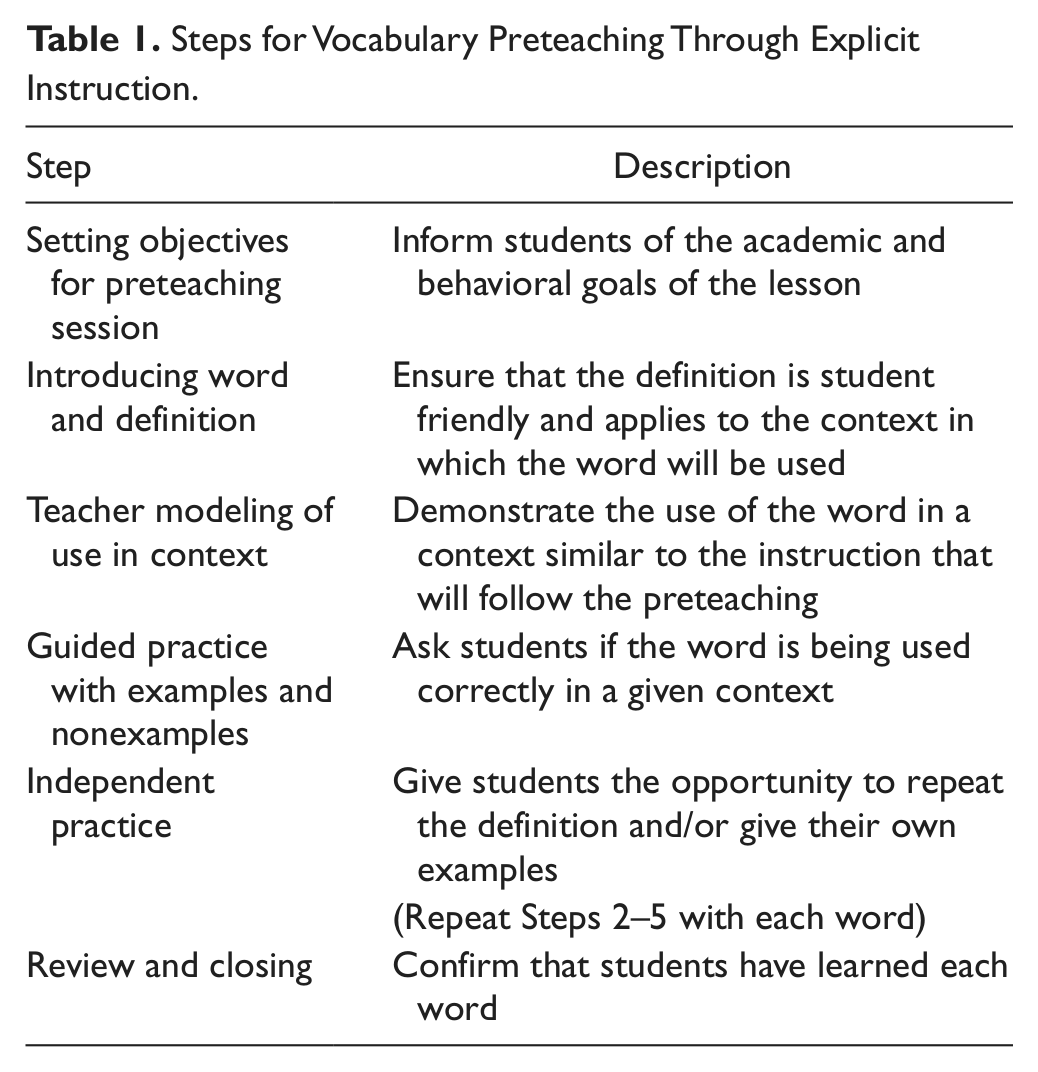
Throughout this sequence, teachers should make frequent checks for student understanding and provide ample feedback and praise to all students. This explicit teaching model allows students multiple exposures and opportunities to practice words before applying them in the subsequent lesson. However, the intensity of preteaching should depend on the level of word comprehension required for the upcoming task, the difficulty of the targeted vocabulary, and the amount of prior knowledge that students have surrounding the broader concepts. For example, introduction and reading of definitions with repeated independent practice was sufficient for improving the content area comprehension of below grade level high school students (Hawkins et al., 2011). In another study, a more robust method approximating that outlined above was found to increase the test performance of high school students with learning disabilities in general education science classrooms (Munk et al., 2010).
Vocabulary Preteaching Through Cognitive Strategy Instruction
Cognitive strategy instruction is a form of instruction designed to “provide students with strategies and a framework for understanding a semantic network of words” (Jitendra et al., 2004, p. 312). One type of cognitive strategy instruction found to be effective for students receiving special education services is semantic feature analysis (SFA; Anders & Bos, 1986). Although primarily studied as a prereading strategy, SFA is also suggested for use before whole-class instruction for struggling learners (Bos & Vaughn, 2006). In SFA, a relationship chart is created by the teacher using key ideas from the unit or lesson and related essential vocabulary (see Figure 1). First, each key idea is introduced to students. If students are familiar with it, they are asked to generate a definition; otherwise, the definition is provided by the teacher. Students are then asked to give examples based on any previous experiences with that main idea. This procedure is then repeated for each of the vocabulary terms. Finally, students predict relationships between key ideas and vocabulary as positive (+), negative (–), no relationship (0), or unsure (?). After instruction, the relationship chart may be reviewed and revised as appropriate by the students independently or in conjunction with the teacher.
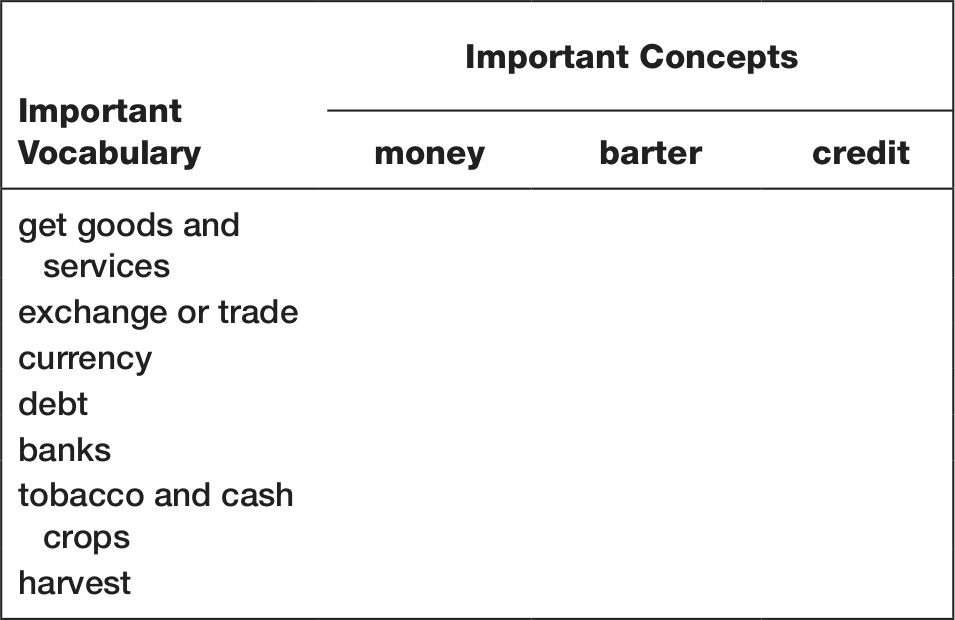
Forms of exchange in colonial America.
In a number of studies, SFA has been found superior to dictionary instruction for students with learning disabilities both before science instruction in middle school (Bos & Anders, 1990) and before social studies instruction in high school (Bos et al., 1989). In these studies, the impact of SFA extended beyond the memorization of vocabulary terms; it improved long-term retention of the concepts being taught. Because it is a relatively intense strategy, SFA is recommended for use before large units of study; it may not be practical to use on a daily basis.
Advance Organizers
Preteaching with advance organizers involves instruction in which “appropriate and relevant subsuming concepts (organizers) are deliberately introduced prior to the learning of unfamiliar academic material” (Ausubel, 1960, p. 267). Advance organizers serve as a framework to prepare students to organize future learning (Hartley & Davies, 1976). They may take many forms (Lenz et al., 1987), ranging from simple statements to complex outlines. The level of detail in advance organizers depends, as in the vocabulary preteaching strategies detailed previously, on the amount and difficulty of material that is to be covered in the upcoming lesson or unit. Although not noted specifically in the literature, advance organizers may integrate well with classroom technology, such as Smart Boards or concept mapping software.
A variety of advance organizers in a range of inclusive secondary content area classes was investigated by Lenz et al. (1987). The results of this study show that teachers can actively increase their use of advance organizers. Furthermore, the authors found that teachers were generally satisfied with student performance as a result of the use of advance organizers, and 81% of the teachers in the study planned to continue using them in their classes.
Behavioral Objectives as Advance Organizers
Perhaps the simplest form of an advance organizer is the presentation of behavioral objectives, which are direct statements of the academic goals of the lesson. Preteaching using behavioral objectives involves a simple statement before a lesson begins that informs students of the content they are expected to learn during the lesson (Hartley & Davies, 1976). Behavioral objectives should be stated in clear, operational terms. Some examples of appropriate behavioral objectives are the following:
Chemistry: “Today’s objective is to identify how the periodic table is organized.”
World geography: “Today you will learn three ways how technology has changed the way that humans impact our environment.”
Sixth grade science: “At the end of our lesson, you will be able to list the events in the formation of a cloud.”
Behavioral objectives may come from curriculum frameworks, state standards for a given course, or a review of the material to be covered in a given instructional task. The presentation of behavioral objectives alone can affect student performance but may be more effective combined with one or more other strategies, including (a) review of previously learned content, (b) connection to previously learned content, (c) explanation of the relevance of new content, (d) statements of conduct expectations, (e) positive statements encouraging student investment in the upcoming lesson, or (f) other brief orienting comments. In a study with middle school students with learning disabilities, Hudson (1996) found the combination of behavioral objectives, review of previously studied content, and presentation of a rationale for learning resulted in increased comprehension of social studies content presented in lecture format. The use of behavioral objectives phrased in the form of guiding questions was found to increase the test performance of high school students with learning disabilities more than repetition of key information (Lenz, Adams, Bulgren, Pouliot, & Laraux, 2007).
Outlines as Advance Organizers
Several studies have demonstrated the utility of outlines as advance organizers for struggling learners. These outlines may take traditional forms (see Figure 2; Darch & Gersten, 1986), or may be depicted in a visual representation (see Figure 3; Darch & Carnine, 1986).
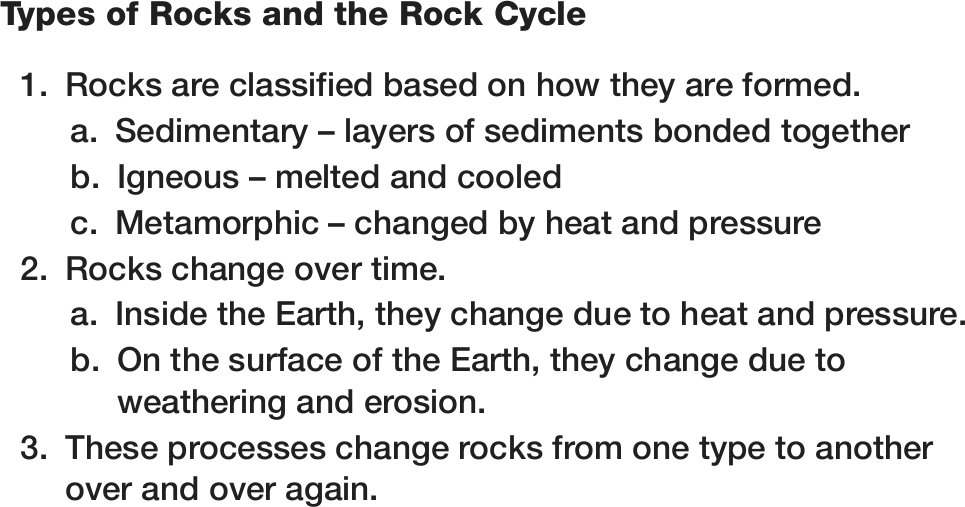
Traditional outline.
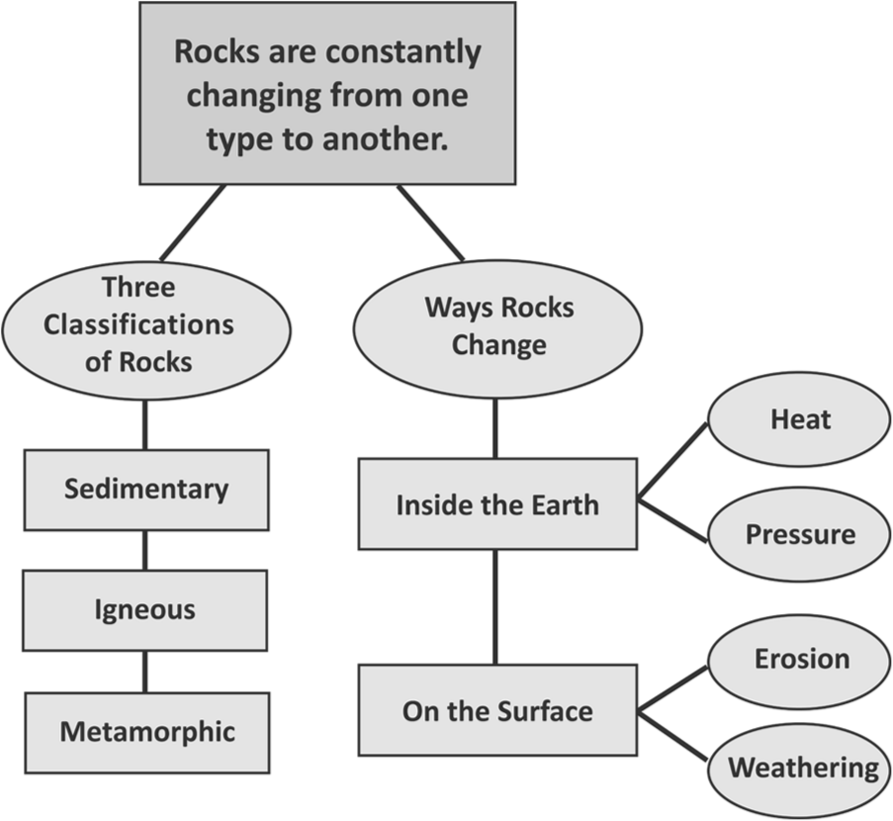
Graphic outline.
In generating either type of outline, teachers should review the intended objectives of the lesson or unit and include only the most critical elements in the outline. Outlines should not include every piece of information to be presented but rather should provide a framework for organizing new knowledge from the lesson or unit. The integration of key vocabulary from the lesson will allow for extra exposure to new words that may cause students difficulty. When introducing an outline during preteaching, teachers should guide students through each element of the outline and student engagement should be facilitated. Students should also be encouraged to ask questions during preteaching, as the outline review is also an opportunity for development of prior knowledge necessary for comprehension of upcoming academic instruction. If students ask questions that will be covered thoroughly during the lesson, a simple statement such as “Great question! Listen carefully during class to see if you can figure out the answer,” will be sufficient; teachers should not spend so much time preteaching that all material from the upcoming lesson is introduced. Like the relationship maps generated in SFA, outlines can also be revisited for review after instruction.
Background Knowledge
Preteaching using background knowledge is a third commonly suggested strategy for supporting struggling learners in content area classes and may take one of three forms: review of previous instruction, activation of preexisting prior knowledge (of concepts not recently taught in class), and active instruction to build background knowledge (Christen & Murphy, 1991; Graves, Cooke, & Laberge, 1983). Strong background knowledge provides benefits similar to advance organizers: a context for receiving new information and an anchor to which students can attach new information (Healy, 1989).
Review of Previous Instruction
In this simple preteaching strategy, suggested earlier as a complement to behavioral objectives, previous instruction on a given topic that is foundational to the understanding of the current lesson’s objectives is reviewed. This is not an exhaustive reteaching of all material in the previous lesson, but rather a targeted reminder of the key concepts that will support retention during upcoming instruction. An interactive method of review of the previous day’s or week’s instruction has been found to be an effective instructional component for students with learning difficulties in content area classes (Hudson, 1996).
Activation of Prior Knowledge
Activation of prior knowledge involves making students aware of information they already know about a subject that will support the learning of related concepts. Suggestions for activities include (a) brainstorming, (b) asking questions, and (c) conducting discussions surrounding a problem or scenario (Christen & Murphy, 1991). However, for students with disabilities, it is important for teachers to be methodical in conducting these activities. Activation of prior knowledge must be purposeful to be effective. A discussion of prior knowledge should be guided toward concepts the teacher has deemed key for understanding the upcoming lesson. In activating prior knowledge to prepare students for a lesson on physical characteristics of the ocean environment, a broad question (“When you go to a beach, what do you see?”) is less effective than a more specific one (“What words could you use to describe the environment of the ocean and the beach?”). Discussing people playing volleyball on the beach will not prepare students to learn about salinity. Instead, when targeting the concept of salinity, teachers should make sure that students mention how salty the water is at the beach. Teachers should identify ahead of time which important prerequisite facts need to be a part of the discussion and direct the discussion accordingly.
Building Background Knowledge
Building background knowledge is a more intensive preteaching intervention than reviews and activation of prior knowledge. It involves instruction on concepts that are critical to support the learning of upcoming instructional content. Depending on the type of material presented, background knowledge might be obtained through many activities, ranging from direct instruction to demonstrations (Christen & Murphy, 1991). The differentiated instruction provided during this type of preteaching may take many forms, but should use effective teaching strategies for struggling learners (for foundations of effective instruction for these students, see Mastropieri & Scruggs, 2000). Although no research has been conducted explicitly on building background knowledge for struggling learners in content area classes, the presentation of prerequisite knowledge passages has been found effective in improving the science learning of typically developing ninth grade students (Healy, 1989), and preview passages building background knowledge have been effective in improving the reading comprehension of low ability high school students (Graves et al., 1983).
Conclusion
The current state of content area instruction for students with high-incidence disabilities is not allowing many of them to meet even basic levels of performance on national assessments (U.S. Department of Education, 2011). The effective use of academic interventions can increase the content area learning of struggling students (Scruggs, Mastropieri, Berkeley, & Graetz, 2010). General and special educators have many options for differentiating instruction to meet student needs. It is important that they choose research-based interventions; teachers are advised to use caution when implementing strategies with little research base. Fortunately, researchers have established many strategies, such as the preteaching strategies described in this article, which, when implemented effectively, can improve students’ access to and ability to benefit from content area instruction. It is important that teachers be flexible and reflective when making the instructional and logistical decisions involved in planning preteaching. If teachers select the type of preteaching that best meets the needs of their particular students in a specific lesson or unit of study, they can provide students with the level of support needed for success in accessing and learning from content area instruction.
Footnotes
Declaration of Conflicting Interests
The author(s) declared no potential conflicts of interest with respect to the research, authorship, and/or publication of this article.
Funding
The author(s) received no financial support for the research, authorship, and/or publication of this article.