






Abstract
The coexistence of visual impairments and learning disabilities presents unique challenges. It is imperative that teachers be apprised of the characteristics of this population as well as instructional strategies targeted at meeting their unique needs. The authors highlight typical patterns of performance and provide suggestions for effective intervention.
Although coexisting visual impairments (VI) and learning disabilities (LD) are recognized in the literature (e.g., Layton & Lock, 2001), prevalence rates are difficult to ascertain because of variability in definitions over time and issues in identification (Erin & Koenig, 1997; Layton & Lock, 2001). A seminal work on coexisting VI and LD indicated that 14% to 45% of individuals with VI also had LD (Erin & Koenig, 1997; Corn & Ryser, 1989; Troughton, 1992; Woods & Lindsey, 1994). More recently, Wagner and Blackorby (2002) surveyed parents of special education students and found that 10.2% of parents of students with LD eligibility reported coexisting VIs, while 3% of parents of students with VI eligibility reported coexisting LD. Reports definitively inform us, however, that 57.2% of students with VI spend 80% or more of their school day in general education classrooms and typically receive only consultant services from itinerant teachers (Office of Special Education and Rehabilitative Services, 2008). Thus, classroom teachers are often charged with administering appropriate instruction.
Considerations for Instruction
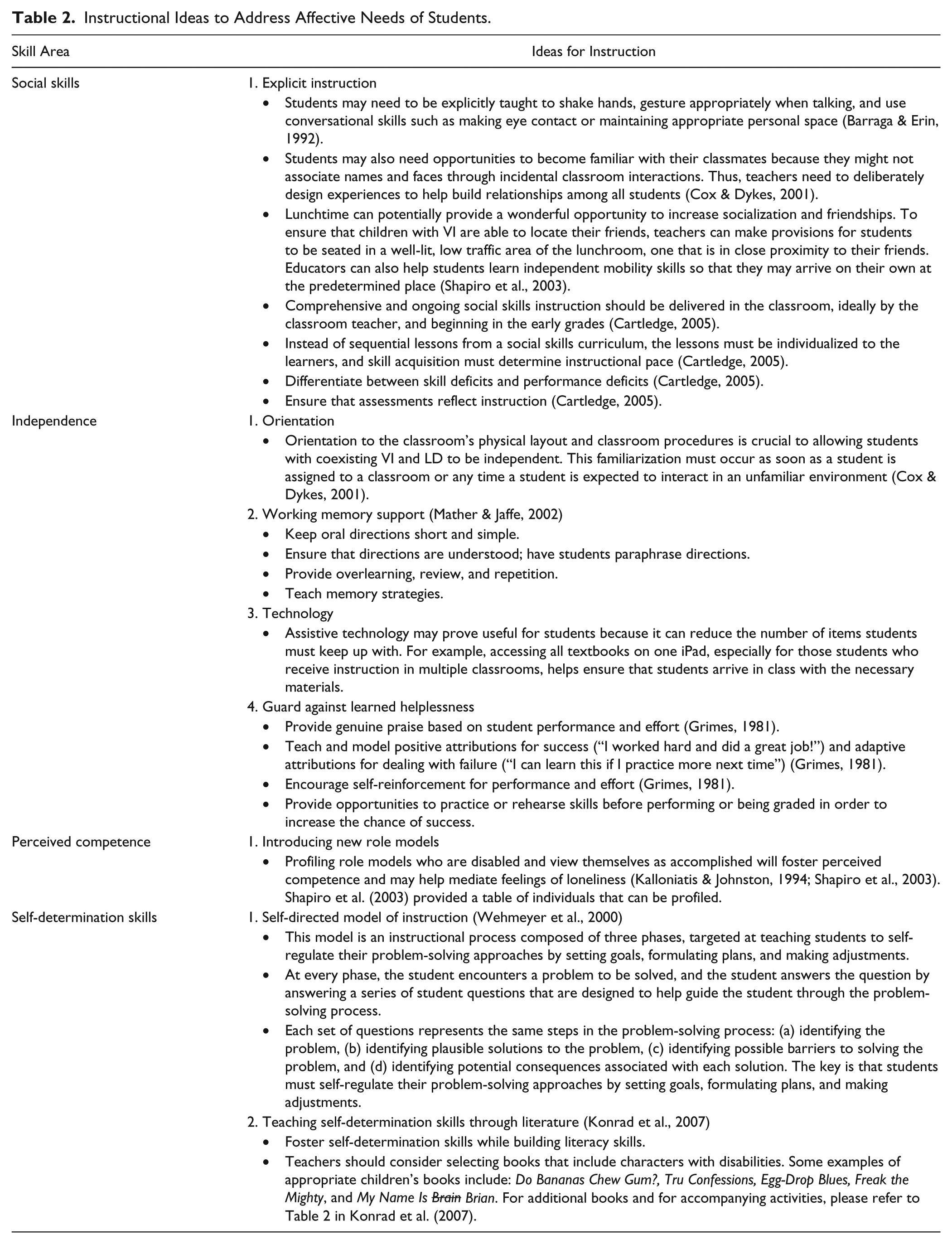
In addition to making classroom adaptations for instructional delivery, general educators need to be aware that students with coexisting VI and LD will need specific instruction to foster social skills development, promote independence, increase perceived competence, and develop self-determination skills. What is more, teachers need an understanding that all of these areas are interrelated—with many suggested interventions in one area benefiting other areas—and are all necessary elements for instructing the whole individual (see Tables 1 and 2). In the following sections, we delve into instructional strategies purposed to address global student needs.
General Accommodations for Students With Coexisting VI and LD.
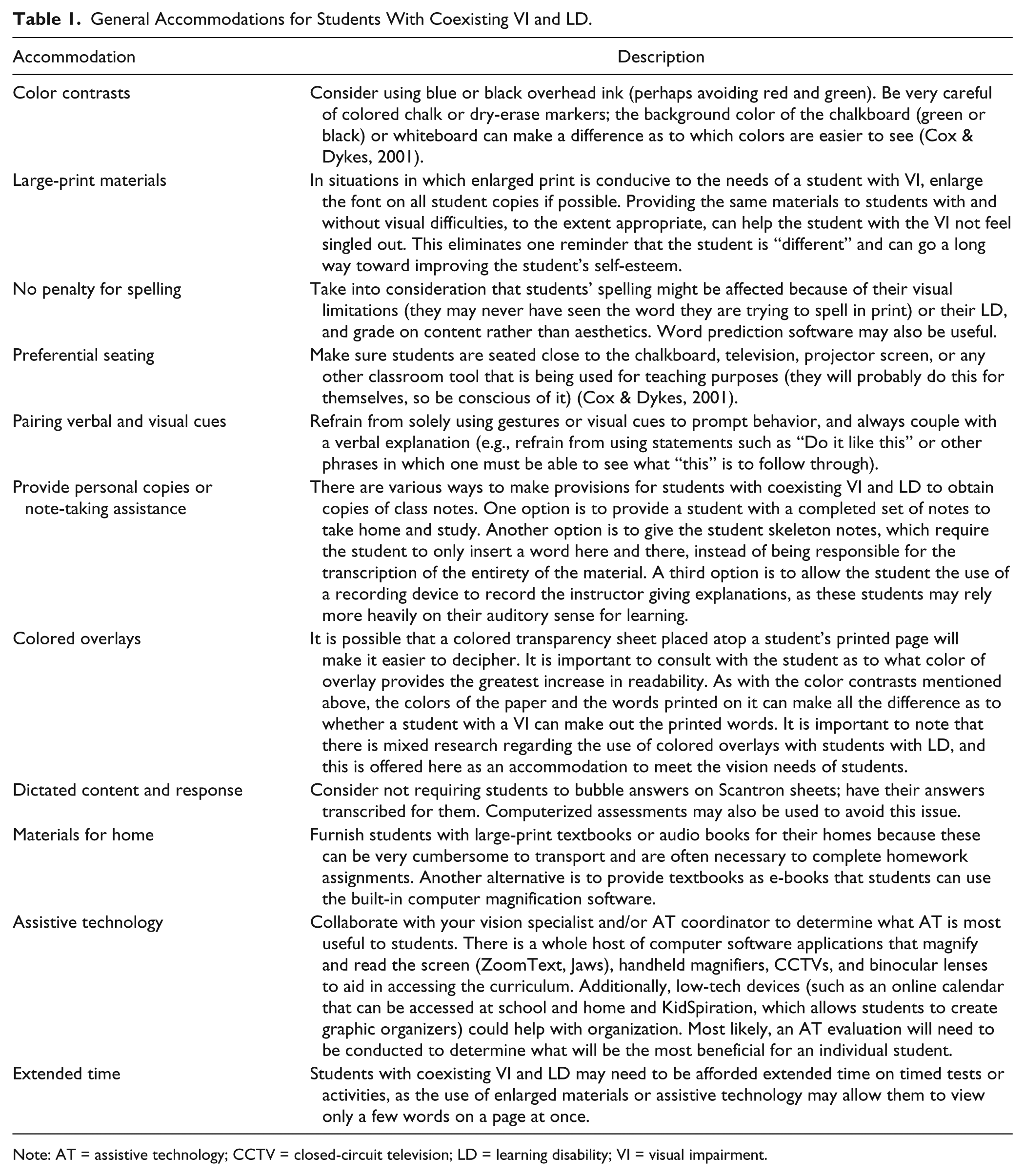
Note: AT = assistive technology; CCTV = closed-circuit television; LD = learning disability; VI = visual impairment.
Instructional Ideas to Address Affective Needs of Students.
Academic Accommodations
Students with VI and students with LD exhibit similar patterns in academic performance. Research has demonstrated that reading is the most affected academic subject for students with LD (Handler & Fierson, 2011; Judge & Bell, 2010; Lerner & Johns, 2009; Shaywitz, 2003). Specifically, students with LD may struggle with reading accuracy, fluency, poor spelling, and decoding (Vellutino, Fletcher, Snowling, & Scanlon, 2004). Likewise, students with VI are often below grade level in reading fluency, vocabulary, and concept development (Emerson, Holbrook, & D’Andrea, 2009; Kennedy, 2004; Wall & Corn, 2004). Teachers of students with coexisting VI and LD should work carefully with reading specialists and VI coaches to understand any adaptive technology equipment and other strategies that may help these students become more successful readers.
Before any decisions are made about accommodations, students should receive learning media assessments from certified teachers of students with VI. Such assessments will provide information about students’ ability to access print materials, including appropriate font size, reading distance, reading speed, lighting needs, and contrast sensitivity (Swenson, 2013). Once these assessments are complete, teachers can select from various classroom accommodations that can be instrumental in ensuring that students with coexisting VI and LD are afforded appropriate instructional experiences and do not miss out on opportunities for learning (see Table 1). Although mixed results are described in the VI and LD literature regarding the effectiveness of several popular accommodations, such as large-print materials, extended time, and dictated response (Bolt & Thurlow, 2004), there may be specific instances in which particular accommodations may be more appropriate than others. For example, large print may be an appropriate accommodation when referring to notes to give oral presentations. Other times, such as when having more of the text on one page is helpful, it may be more beneficial for a student with VI to use regular print and an optical aid (Swenson, 2013).
Fostering Appropriate Social Skills
Students with VI and/or LD often fall behind their typical peers in social skills development (Cartledge, 2005; Estell et al., 2008; Shapiro, Lieberman, & Moffett, 2003). Although social skills data pertaining to students with coexisting VI and LD are lacking, research has shown that both of these groups have difficulty with peer acceptance, less extensive social networks, and fewer friendships (Bauminger, Edelsztein, & Morash, 2005; Shapiro et al., 2003). Students with VI have been found to remain close to their teachers in social situations, infrequently socialize with other children, feel a lack of control over friendships, be excluded from groups, and withdraw from group activities (Robinson, 2002). For students with both VI and LD, the increased feelings of loneliness reported by students with VI (Kalloniatis & Johnston, 1994) are likely magnified by social difficulties specifically related to LD (i.e., deficits in social information processing, understanding complex emotions, and understanding simultaneous conflicting emotions; Bauminger et al., 2005). Explicit instruction and practice in conflict resolution, turn taking, and conversational skills may help children overcome such difficulties. Students with coexisting VI and LD may experience social anxiety and potential rejection experiences surrounding interactions with typical peers, as well as peers with VI but no LD and peers with LD but no VI. Educators of students with both VI and LD should be in communication with school counselors regarding signs of social difficulties and strategies to reduce isolation within their classrooms.
Students with coexisting VI and LD may have difficulties with social skills due in part to a lack of or reduced perception of visual cues. Therefore, students may not have learned specific behaviors appropriate in social situations. Specifically, students may need to be explicitly taught to shake hands, gesture appropriately when talking, and use conversational skills such as making eye contact or maintaining appropriate personal space (Barraga & Erin, 1992). Students may also need opportunities to become familiar with their classmates, because they might not associate names and faces through incidental classroom interactions. Thus, teachers need to deliberately design experiences to help build relationships among all students (Cox & Dykes, 2001). Lunchtime can potentially provide a wonderful opportunity to increase socialization and friendships. To ensure that students with VI are able to locate their friends in the noisy, crowded lunchroom, teachers can make provisions for students to be seated in a well-lit, low traffic area of the lunchroom, one that is in close proximity to their friends. Educators can also help students learn independent mobility skills so that they may arrive on their own at the predetermined place. Advance planning and skills training will foster positive social opportunities during lunchtime that may extend beyond the school day (Shapiro et al., 2003).
Cartledge (2005) recommended that comprehensive and ongoing social skills instruction be delivered in the classroom, ideally by the classroom teacher, and beginning in the early grades in an effort to prevent severe social skill deficits from developing. Instead of sequential lessons from a social skills curriculum, the lessons must be individualized to the learners, and skills acquisition must determine instructional pace. Additionally, teachers need to differentiate between skills deficits and performance deficits to determine whether students simply require reinforcement techniques or direct social skills instruction. Last, a key component of effective social skills instruction is ensuring that assessments reflect instruction. Many social skills measures are designed to provide information regarding students’ performance on a range of social skills and may include only a few questions related to one skill. Thus, teachers should use assessments that more accurately pinpoint the specific skill that was taught.
Promoting Independence
Lewis and Iselin (2002) conducted a study related to the independent-living skills of children with and without VI. They found that the inability to walk independently to a friend’s house or around the school building could lead to dependence and isolation. VI may also affect a student’s ability to function independently and confidently in the classroom. For example, the “absence of or reduced visual cues, such as a schedule written on the chalkboard or seeing the clock, can prevent these students from following classroom procedures or anticipating coming events” (Cox & Dykes, 2001, p. 68). Orientation to the classroom’s physical layout and classroom procedures is crucial to allowing students with coexisting VI and LD to be independent. This familiarization must occur as soon as a student is assigned to a classroom or any time a student is expected to interact in an unfamiliar environment (Cox & Dykes, 2001).
In addition to the obstacles hindering independence experienced by students with VI, those with coexisting VI and LD may encounter intensified difficulties in this area. It is possible that the LD may actually compound the problems associated with the VI by making it difficult to learn and remember compensatory skills. For example, LD has been found to affect executive functioning related to working memory, which may impede the ability to get around and locate needed materials because of impaired recall of the spatial layout of rooms as well as difficulty remembering auditory information and multiple-step directions (Schuchardt, Maehler, & Hasselhorn, 2008). Instructors should expect that students with VI and LD may need a longer period of support than other students with VI when working to learn locations of frequently used objects and routes to preferred destinations. Effective memory strategies, such as the use of self-talk and tactile clues, should be explicitly taught along with frequent review. Repetition should be implemented in mobility instruction as well as academic instruction. In general, instructors should keep all oral directions short and simple and may want to have students paraphrase directions back to ensure comprehension (Mather & Jaffe, 2002). Additionally, assistive technology may prove useful in counteracting working memory difficulties because it can reduce the number of items a student has to keep up with, thus accommodating academics and independence simultaneously. For example, accessing e-books on one device, especially for those students who receive instruction in multiple classrooms, helps ensure that students with coexisting VI and LD have both minimal and easily portable materials that are easily adapted for font size (Swenson, 2013).
Research also shows evidence of tendencies toward learned helplessness among students with LD in social and academic situations (Hallenbeck, 2002; Settle & Milich, 1999). Students with LD may display characteristics such as lowered expectations of oneself and avoidance of the tasks at hand after experiencing failure (Grimes, 1981). Instructors should guard against learned helplessness in these students by teaching and modeling appropriate ways of dealing with failure, positive attribution statements (e.g., “I can be successful with more practice” rather than “This task is simply too difficult and I’m not smart enough to do it”), and self-reinforcement for success. Teachers should also be careful to offer only genuine praise based on effort in addition to performance. Nongenuine praise, or praise regardless of student behavior, may send the message that students do not really need to try their best (Grimes, 1981). Teachers may also help students increase their chances for success by giving them the opportunity to prepare ahead of time or rehearse before participating in a cooperative group, reading in front of peers, or completing a novel task (e.g., perform or maneuver on a stage).
Enhancing Perceived Competence
Related to the issue of improving social dynamics and independent functioning for students with coexisting VI and LD is the need to enhance their self-confidence. One’s self-confidence is influenced by perceived competence for participating in and completing activities. Perceived competence influences both the initiation of mastery attempts and the development of achievement behaviors, such as effort and persistence (Kosma, Cardinal, & Rintala, 2002). Students with healthy perceptions of competence “exert more effort, persist longer, feel more in control, experience pride, and are intrinsically motivated to continue to participate in areas in which they feel competent” (Shapiro et al., 2003, p. 69).
Coexisting LD may increase the likelihood that students with VI will suffer from a lack of perceived competence. Students with coexisting VI and LD may become discouraged as they become aware of their inability to do what their peers (those who are nondisabled as well as those with VI but no LD) are able to do or their need to exert great effort to do what their peers seem to do easily. Academic difficulties and related lack of perceived competence is associated with emotional problems, behavior difficulties, and depression among students with LD (Jaffe, 2011; Marti, 2004), and it follows that coexisting LD may increase the risk for these problems in children with VI. Marti (2004) recommended teaching students coping, organizational, and problem-solving skills as well as helping them learn to advocate for their own needs to increase perceived competence.
Early intervention focused on the development of self-perceived competence is necessary because perceptions of competence become more stable and resistant to change with age (Shapiro et al., 2003). Shapiro et al. (2003) suggested strategies to increase perceptions of athletic and social competence. For example, they suggested profiling role models with disabilities who view themselves as accomplished athletes and providing a table with information about such individuals. In addition to fostering perceived competence, this introduction of other, successful individuals with disabilities may help mediate the aforementioned feelings of loneliness by making students aware of others with similar impairments.
Building Self-Determination Skills
Self-determination involves a combination of skills that equip a person to regulate and direct his or her behavior (Agran, King-Sears, Wehmeyer, & Copeland, 2003). Researchers have found that students with VI have low levels of self-determination (Robinson, 2002), resulting in individuals other than the students typically making many of their decisions. This phenomenon may occur because students are too shy, are scared of rejection, or lack confidence (Shapiro et al., 2003). Furthermore, for students with LD, acquisition of self-determination skills can be crucial in decision making related to education and training, career development, and overall adjustment to life demands (Durlak, Rose, & Bursuck, 1994). Students with VI and LD must be explicitly taught self-determination skills such as self-advocacy, self-awareness, and initiative taking, and research has demonstrated that these students can acquire, maintain, and generalize these skills with systematic instruction and opportunities for authentic practice (Durlak et al., 1994; Lipkowitz & Mithaug, 2003; Sacks, Lueck, Corn, & Erin, 2011). Research has shown that greater self-determination skills are associated with more successful achievement of stated goals, as well as positive academic and transition outcomes (Field, Sarver, & Shaw, 2003; Fowler, Konrad, Walker, Test, & Wood, 2007; Lee, Wehmeyer, Soukup, & Palmer, 2010; McGuire & McDonnell, 2008). These outcomes are evidenced in the areas of employment, recreation, independent living, quality of life, and life satisfaction.
To become more self-directed, students must learn effective problem-solving skills and be armed with strategies for overcoming barriers and fears (Shapiro et al., 2003). Wehmeyer, Palmer, Agran, Mithaug, and Martin (2000) proposed that for students to become “causal agents,” instruction must become student directed. Instead of the classroom teacher having full control over “when, what, why, where, and how” a student will learn, student-directed learning involves the student in every aspect of his or her educational programming, placing the responsibility for learning on the student (Wehmeyer et al., 2000, p. 440). Wehmeyer et al. suggested the use of the self-directed model of instruction, which is an instructional process composed of three phases, targeted at teaching students to self-regulate their problem-solving approaches by setting goals, formulating plans, and making adjustments. At every phase, the student encounters a problem to be solved, and the student answers the question by answering a series of questions that are designed to help guide the student through the problem-solving process. These student questions are included in three separate tables provided by the authors, but each set of questions represents the same steps in the problem-solving process: (a) identifying the problem, (b) identifying plausible solutions to the problem, (c) identifying possible barriers to solving the problem, and (d) identifying potential consequences associated with each solution. The key is that students must self-regulate their problem-solving approaches by setting goals, formulating plans, and making adjustments.
Another method, which allows teachers to make their instructional time go further, is to use child and adolescent literature to foster self-determination skills while also building literacy skills (Konrad, Helf, & Itoi, 2007). To do so, teachers should consider selecting books that include characters with disabilities. The books need to have well-developed structure and characters, appeal to children and teachers, have realistic portrayals of children with disabilities, and address key issues related to special education (Smith-D’Arezzo, 2003). To aid in the selection process, Konrad et al. (2007) provided guidelines for evaluating children’s books for bias. Namely, teachers need to examine the illustrations and storylines for stereotypes and characters’ roles, examine power and leadership roles portrayed, consider which characters are cast as the heroes, evaluate the language used to describe characters, and check the copyright date, because more recent books are more likely to convey realistic characterizations. Some examples of appropriate children’s books include Do Bananas Chew Gum?, Tru Confessions, Egg-Drop Blues, Freak the Mighty, and My Name Is Brain Brian. Of course, this teaching technique would be another method for introducing students to accomplished role models with disabilities, as discussed previously.
Conclusions
The increased inclusion of students with VI in the general education classroom and the knowledge that students with VI may in fact have coexisting LD renders it absolutely crucial that educators be informed of the various ways to accommodate these students (Office of Special Education and Rehabilitative Services, 2008). Considering the instructional provisions students require, both academically and socially, is essential to effectively teaching individuals with coexisting VI and LD. This article outlines research-based suggestions for each of these components of effective instruction; however, because there is such variety in degree and scope of VI and LD, teachers need to become responsible for researching and selecting effective interventions for the students they serve, specific to their individual needs.
Footnotes
Declaration of Conflicting Interests
The author(s) declared no potential conflicts of interest with respect to the research, authorship, and/or publication of this article.
Funding
The author(s) received no financial support for the research, authorship, and/or publication of this article.