







Abstract
Academic procrastination is a common problem among secondary students. This paper provides secondary teachers with evidence-based strategies to reduce or prevent academic procrastination in their classrooms. Given that reducing academic procrastination is a responsibility for teachers as well as students, the paper describes teacher-administered strategies related to assignment and course design as well as student-administered strategies related to self-management and its variations. In conclusion, a framework encompassing these strategies and modifications for different learner types, the three-tier anti-procrastination (T-TAP) model, is presented.
Ms. Leaf’s teaching experience best illustrates the prevalence and consequences of academic procrastination among secondary students. Ms. Leaf has been teaching English in an inclusive classroom at Sunflower Middle School for 10 years. At the beginning of the last school year, she assigned some major works of American literature, instructing the students that reflective essays would be due when the school year ended. Although all of the students submitted their assignments at the end of the school year, much of the work was late and of poor quality. She asked those students why their work was late, and they admitted that putting off the assignments until the last minute left them with insufficient time to proofread or make revisions. (See Note 1.)
Ms. Leaf is not the only teacher who struggles with student procrastination. Secondary students often work on long-term projects that are required to be completed by a certain date. However, not all students know how to budget their time wisely; some are likely to hold off on the assignments for weeks and start to work only as the deadlines draw near. Compared to their peers, students with learning disabilities (LD) are even more vulnerable to academic procrastination (Klassen & Welton, 2009). When working on academic assignments, they often exhibit inadequate self-efficacy (Hen & Goroshit, 2014) and insufficient self-regulatory capabilities (Klassen, 2008). Students with LD presenting such characteristics are more likely to procrastinate because they lack the confidence to initiate tasks and the discipline required for task completion.
Problems arise when secondary students procrastinate on academic tasks. First, they are more likely to have unhealthy sleep and diet patterns. As the deadline approaches, they often have to work more intensively and under higher-pressure conditions (i.e., rushing to meet task requirements on time) than their peers who do not procrastinate (Sirois & Tosti, 2012). Second, students who procrastinate often exhibit high levels of stress, anxiety, and guilt, which tend to culminate when they realize the work takes more time and effort than they expected (Sirois & Tosti, 2012). Third, students who procrastinate are at a higher risk of engaging in academic misconduct, such as cheating. They are overwhelmed by the cumulative work and thus more likely to take undesirable shortcuts (Clariana, Gotzens, del Mar Badia, & Cladellas, 2012). Finally, given that procrastinators typically rush to complete their work in the final minutes before the deadline, the final product is infrequently of the same quality as that of peers who do not procrastinate.
The aforementioned academic difficulties affect students with LD and their typical peers throughout both middle and high school, and students with LD face more academic barriers than students without LD when they enter college. Various studies have described the academic barriers associated with procrastination that students with LD face in college, pinpointing poorer time management skills, lack of academic strategies (Reaser, Prevatt, Petscher, & Proctor, 2007), higher levels of stress and anxiety, lower academic self-efficacy (Sparks & Lovett, 2009), and poorer stress management abilities (Kariv & Heiman, 2004). It is hardly surprising that with the increasing demands for independent learning, students with LD exhibit a wide range of academic struggles that escalate if social support systems are not programmed and provided.
Considering the prevalence and lasting negative impact of academic procrastination, it becomes clear that teachers need tools to reduce procrastination in order to enhance learning and self-regulation skills for all students at the secondary education level. Fortunately, there is evidence suggesting that student procrastination can be reduced using behavioral techniques (Malott, 2005). This article provides secondary teachers with evidence-based strategies to reduce academic procrastination of their students. Given that decreasing academic procrastination is a responsibility for teachers as well as for students, teacher-administered strategies are described that are related to assignment and course design as well as student-administered strategies related to self-management and its variations. After describing various techniques, the three-tier anti-procrastination (T-TAP) model is presented (see Figure 1). Secondary teachers can use this framework to strategically employ and differentiate their anti-procrastination efforts.
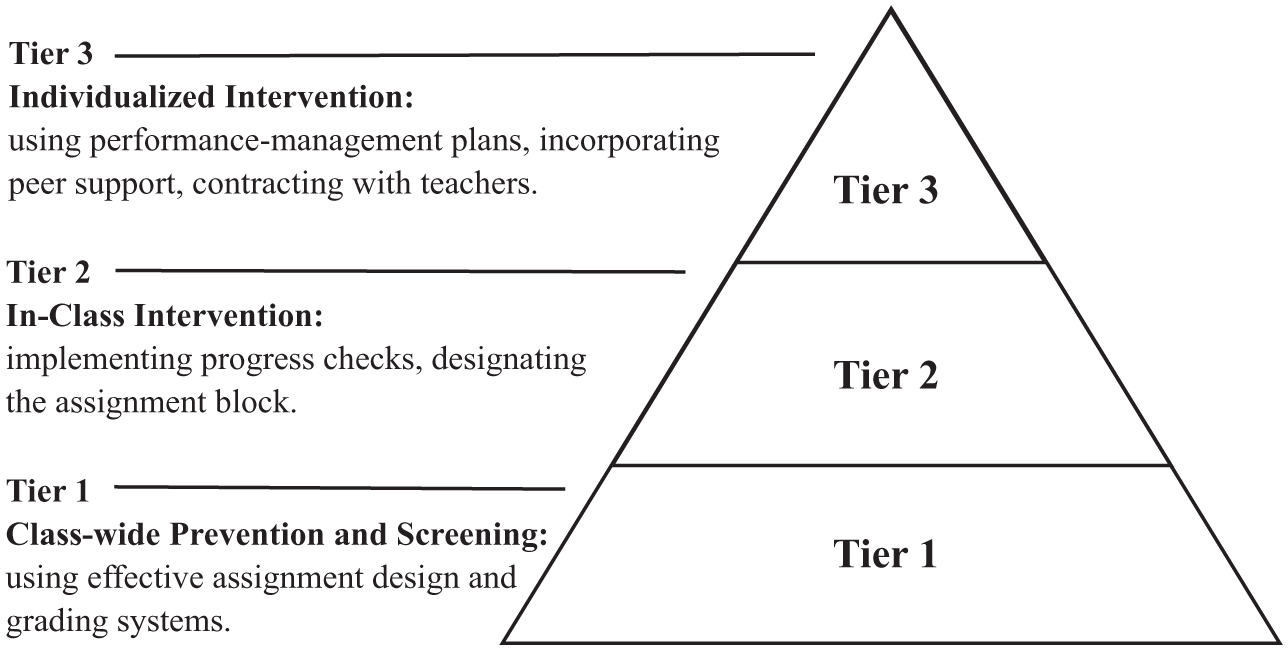
The three-tiered anti-procrastination (T-TAP) model.
Teacher-Administered Strategies
Academic procrastination is partially attributed to ineffective curriculum design (Malott, 2005; Michael, 1991; Paden & Stell, 1997). To prevent issues related to poor course design, teachers should take a proactive role in appropriately structuring the course and related assignments in ways that motivate students to start and complete tasks sequentially throughout the school year.
Assignment Design
A student’s perception of the task may determine whether he or she would prioritize or procrastinate on it (Margolis & McCabe, 2006; Paden & Stell, 1997). Teachers should consider how students think of the tasks and design academic assignments that motivate.
Increasing task importance
Students prioritize tasks as being important (Paden & Stell, 1997), and there are several ways to reinforce the importance of academic assignments. First, teachers can establish classwide norms. The most commonly used method is to post clear, concise, and positively phrased classroom rules that serve as a visual reminder for students, and research indicates that both students with and without LD respond well to visible classroom rules (Sprick, 2009). Some good examples of rules include (a) “Produce quality work,” (b) “Work hard and do your best,” and (c) “Submit high-quality assignments on time.” Teachers can either post the rules in a prominent, visible location or add them to students’ assignment sheets. Every time a project is assigned, teachers can review the rules by demonstrating examples and nonexamples. For instance, teachers may contrast the features of a high-quality assignment with one of lower quality. Upon assignment submission, teachers can reinforce following directions by quickly glancing at students’ papers and providing immediate, positive feedback (e.g., “Nice job following the assignment guidelines!”).
Second, teachers can also design interdependent tasks and set frequent deadlines. That is, a long-term assignment can be broken into smaller tasks with individual deadlines, and students need to complete one task to proceed to another. It should be noted that a single deadline that is months away does not motivate students to work (Malott, 2005; Michael, 1991); students’ study behavior is better paced by frequent deadlines (Ariely & Wertenbroch, 2002; Malott, 2005). For example, instead of having students turn in several reflective essays at the end of the school year, teachers can require an outline, first draft, and final draft for each paper. Each quarter of the school year could then be subdivided to create a three-stage submission cycle for each paper. The outline of the first paper would be due near the beginning of the quarter, and the first and final drafts would be submitted around the middle and end of the quarter, respectively. Some students with LD may struggle with generating a timeline to keep track of upcoming deadlines for individual tasks. To accommodate their needs, teachers can use a printed calendar on which they mark the dates when a specific task is due. Also, special symbols can be used to help students who are struggling to understand classroom expectations (Konrad, Joseph, & Itoi, 2011). For example, teachers may add a star symbol on the calendar to indicate the deadline so students know by which day they should complete their assignment and bring it to class. By assigning interdependent tasks and setting frequent deadlines, teachers can grade and give feedback on each submission, which allows them to evaluate student performance on an ongoing basis and provide timely feedback that contributes to the improvement of the next assignment.
Enhancing task appeal
Students may procrastinate because the assignment is not fun. To enhance task appeal, teachers can assign tasks to be completed in a variety of formats (Paden & Stell, 1997), such as oral or poster presentations and collaborative partner or small-group work. Furthermore, teachers can motivate students with LD by providing them with the opportunity to make choices (Margolis & McCabe, 2006; Schumaker & Lenz, 1999). For example, students might choose one of four books to read, one of three assignments to do, or one of two deadlines to meet. Teachers could offer a menu of task options. Each option should be developed and presented in a way that is acceptable to the teacher and meaningful for the students.
Accommodating task difficulty
To facilitate the completion of high-quality work, teachers need to clarify and provide visual displays of their expectations and the scope of the assignment (Margolis & McCabe, 2006; Paden & Stell, 1997; Schumaker & Lenz, 1999). For example, teachers can develop an assignment handout explicitly listing the due date, total points, task analysis of completing the assignment, grading criteria, and supplies or resources that may be needed (Schumaker & Lenz, 1999). When explaining assignments, the teacher should refer to the assignment handout, orally explain the scope of the assignment, and encourage and answer student questions. After reviewing the assignment handout, the teacher should ask open-ended questions (e.g., “What is the required structure of your essay?”). Depending on students’ expressive language skills, teachers can ask them to respond either orally (i.e., choral response), by writing on small white boards (i.e., write-on response cards), or by holding preprinted response cards (Randolph, 2007). Doing so enables the teacher to assess whether the students understand what is required. Immediate positive and corrective feedback should be given to assure students’ understanding of the teacher’s expectations.
In addition to the aforementioned antecedent-based strategies, teachers are also recommended to use a developed grading rubric and give timely, performance-specific feedback on each submission of assignment. To encourage students to modify their own thinking or behavior to improve learning, teachers should provide students with opportunities to revise and resubmit the task. These consequence-based techniques involve students as partners in assessment, inform instruction, and most importantly, accommodate task difficulty and provide scaffolding for learners (Irons, 2008).
Course Design
In addition to motivating students through assignment design, teachers should also consider purposely planning the whole course and individual class sessions to encourage on-time completion and prevent academic procrastination.
Using effective grading systems
Given that some students may rush their work at the last minute but still get high grades (Michael, 1991), teachers should use a differential evaluation system to motivate early work, such as bonus points for early completion (Lamwers & Jazwinski, 1989) or the graduated scoring system (Morris, Surber, & Bijou, 1978). The two grading systems are similar in that both give extra points to early completion, but in the graduated scoring system, the value of extra points decreases gradually as the deadline approaches. For example, if the assignment is due on Friday, submissions on Tuesday earn three extra points, and submissions on Thursday earn only one extra point.
After a grading system is selected, teachers need to decide how to define and operate each element of the system. For example, if a bonus-point system is going to be used, details, including early submission criteria, how many points can be earned, and whether the points will count toward student grades or be exchanged for other rewards, should be considered. To teach students how the grading system works, teachers should clearly describe the grading system to the whole class when assigning the task, assess students’ understanding using active student responding methods (e.g., choral response, response cards), and embed a visual presentation on the assignment sheet, which is highly recommended especially for students with LD.
Implementing progress checks
Another method to reduce student procrastination through course design is using progress checks (Lazar, Soares, & Terman, 1977). To implement progress checks, teachers need to break a long-term project into two or three smaller tasks, assign recommended completion dates for individual tasks, regularly check students’ progress, and compare it with the recommended completion schedule. For example, if a book report is due within 1 month, teachers can give students handouts recommending that they read the book and develop a concise plot summary by the 2nd week, draft the analysis or critique of the book by the 3rd week, and complete the book report by the 4th week. The recommended completion schedule should be developed in a way that is meaningful for each student. For typical students, a list of recommended dates and the corresponding tasks can be an effective prompt, but for students with LD, teachers should consider using calendars and graphic prompts that facilitate students’ understanding of the expectations. Each week, the teacher can assess whether students have followed the schedule.
There are several variations of progress checks. Either students can be informed of the days when progress checks will occur or the dates can be kept secret (i.e., unannounced checks). To keep the progress checks efficient, teachers can conduct a small-group progress check or randomly check with only one or two students. Progress checks can inform teachers of who is behind or in need of extra support. Further, progress checks motivate students to start early and enable them to distribute their studying time appropriately.
Designating the assignment block
To increase studying time, teachers can set aside some regular class time for struggling students to work on their assignments. For example, teachers can arrange a 15-min assignment block at the end of each class period and require students to work on the assignments in class during that time. Before the class, teachers should make copies of class schedule sheets for high-need students so they can have a clear knowledge of what class activities they should expect during the class session. While the students are working individually during the assignment block, the teacher should walk around the classroom, monitor the students’ progress, and answer questions as needed. The assignment block in class provides the opportunity for teachers to learn about students’ progress and needs, provide immediate support or prompts, and enhance instructional effectiveness and efficiency.
Student-Administered Strategies
Adolescence is the transition period between childhood innocence and adulthood responsibilities. Some students may have trouble managing their time and adapting to ever-increasing demands in secondary classrooms. To address this issue, teachers should equip students with self-management skills that give them a greater sense of ownership and prepare them for college life or professional careers. There are some well-developed self-management applications on smartphones and tablets that teachers can recommend to students (see Table 1). As an alternative, teachers can also use some low-tech self-management strategies to motivate and encourage learning.
Sample Smartphone or Tablet Apps to Self-Manage.
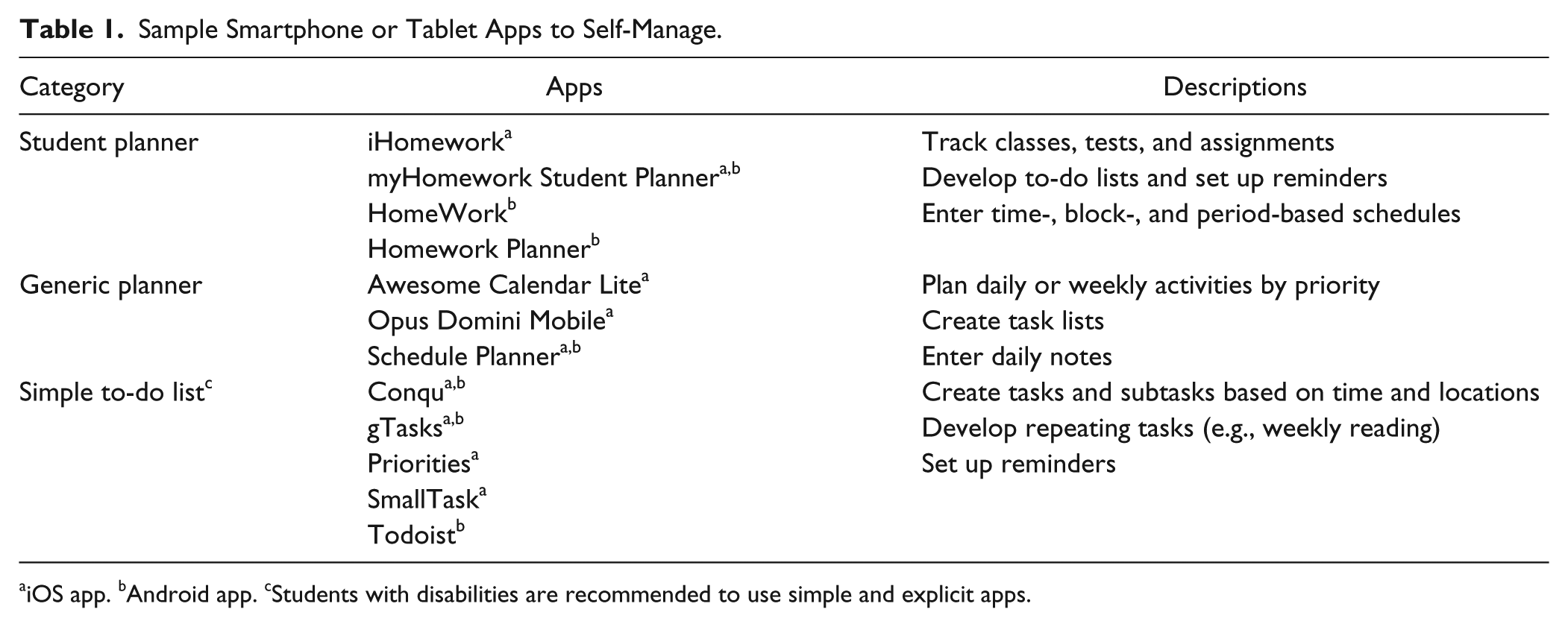
iOS app. bAndroid app. cStudents with disabilities are recommended to use simple and explicit apps.
Performance Management Using an Action Plan Sheet
When given a long-term academic assignment, self-managers break it into small, achievable tasks; make each task a concrete and measurable goal; work toward the goal; and exchange a specified amount of achieved goals for a small but significant award (Cooper, Heron, & Heward, 2007; Malott, 2005). To support students’ use of self-management techniques, teachers can ask students to fill out individualized action plan sheets (see Figure 2). On the action plan sheet, the student is required to identify the assignment associated with the self-management plan, determine the small but significant reward he or she is working for (e.g., listening to music during independent work sessions, getting extra gym time with another class), decide on the number of met goals needed to earn the reward, specify the short-term goal (e.g., the goal for next week), describe how to achieve the goal, identify difficulties that may occur, and develop problem-solving strategies that can be used to help to meet the goal. Every week, teachers can collect students’ action plan sheets, keep a record of goals that have been met, and exchange the achieved goals for designated final rewards. Modified action plan sheets that provide multiple graphics and visuals, give students choices to circle, allow students to select and paste (e.g., for those with fine motor difficulties), or are electronic and can be used on assistive technologies can be helpful when working with students with LD.
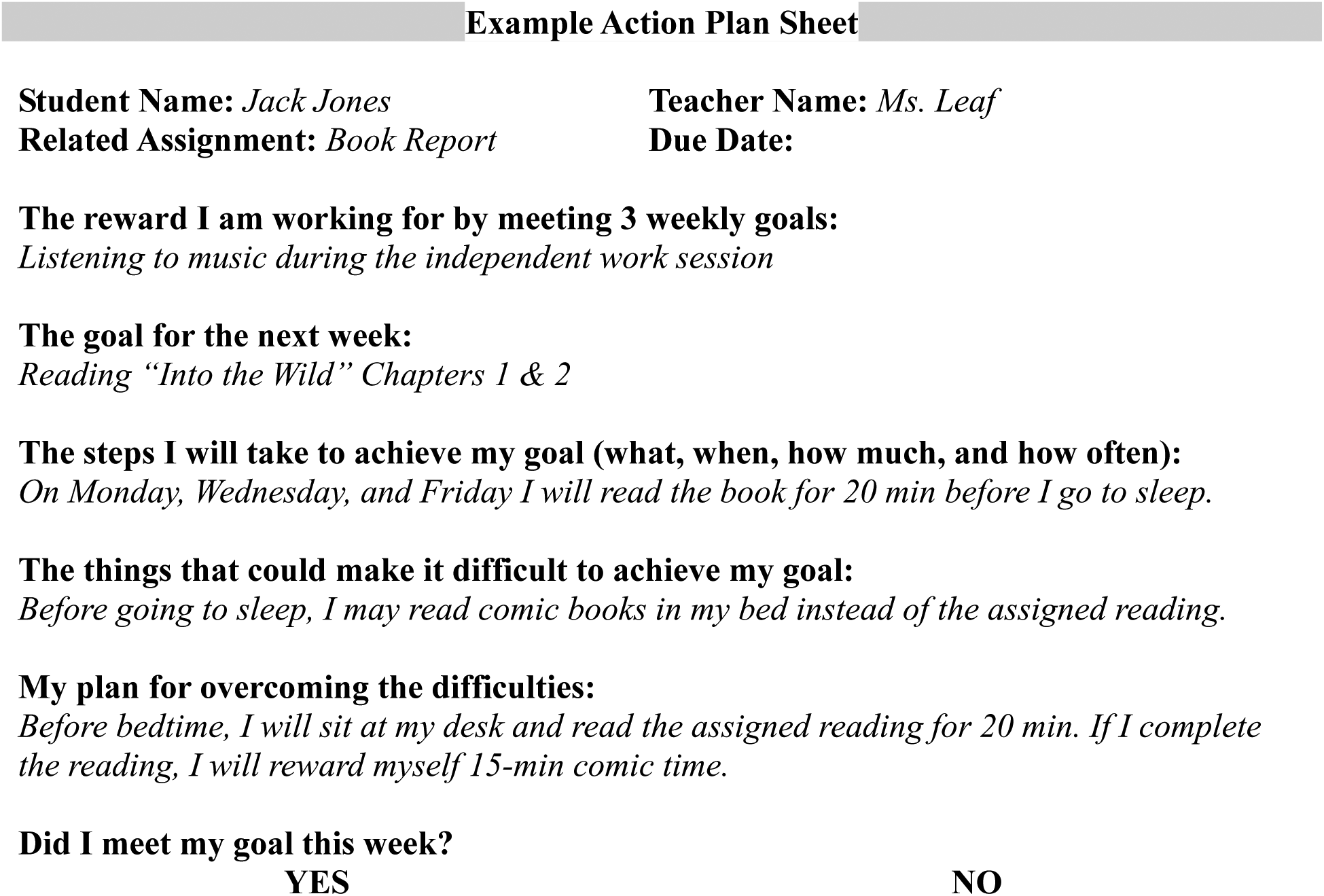
Example action plan sheet for self-management.
Performance Management With Others’ Involvement
Young adolescents may struggle with self-management skills. Some students may not be able to independently implement their self-management plans with fidelity. If that is the case, it will be favorable to bring significant others into the plans.
Incorporating peer support
Given that peer interaction is a significant part of adolescents’ school life, teachers may consider incorporating peer support into self-management plans. Existing research demonstrated cooperative learning have positive effects on a variety of important educational outcomes, such as academic achievement, intergroup relations, self-esteem, cooperativeness, and altruism (Slavin, 1996). To embed cooperative learning in performance management, the teacher can have three to five students make up small study groups and assign group coordinators whose responsibilities are (a) coordinating group meetings twice a week, (b) checking whether each member sticks to the self-management plan, (c) enacting reward policies when all members meeting their goals (Cooper et al., 2007), and (d) reporting to the teacher the group members’ progress on a regular basis. Teachers are recommended to pair students with LD with typical students. In this way, teachers can enhance students’ social interactions and ownership of their choices and actions as well as more efficiently monitor student progress on academic tasks.
Contracting with teachers
Another evidence-based method to enhance students’ self-management and decrease procrastination is contracting with teachers (Bristol & Sloane, 1974). Contracting for the student involves setting weekly goals of academic tasks and making a contract with the teacher, meeting with the teacher weekly to check the goals under the contract, earning the predetermined reward if the goals have been met or receiving corrective feedback from the teacher if the goals have not been met (e.g., “You did not meet your goals this week, so next week you need to spend more time on them.”), and making a contract for the following week based on the current week’s performance (i.e., setting new goals if previous ones have been met, keeping the same goals if not yet achieved). Teachers can develop task cards with specific contract items listed (see Figure 3) and add graphic cues based on specific needs or preferences of students with LD, which not only serve as a visual reminder for students and teachers but also help to track student progress. Short-term contracting (e.g., weekly) is more favorable than long-term contracting (e.g., monthly) in terms of reducing student procrastination (Brooke & Ruthven, 1984). Therefore, teachers who would like to use contracting need to choose a relatively short contract term, such as 3 days or 1 week.
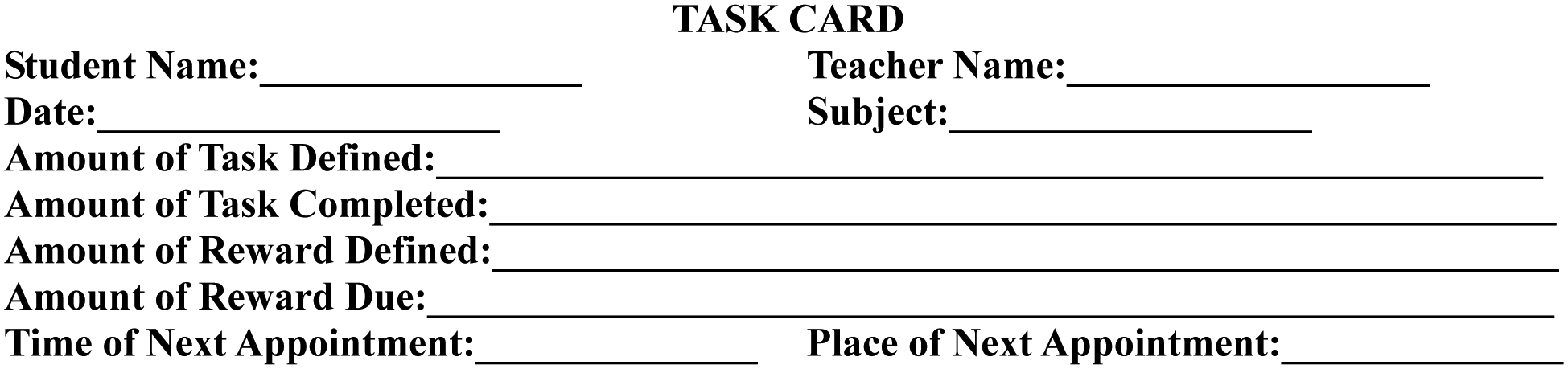
Example task card for contracting.
T-TAP Model
Encompassing all of the aforementioned strategies, the T-TAP model is a multitier approach to the early identification and support of students who procrastinate academically. The T-TAP model begins with classwide preventative strategies and screening of all students in the class. Students who procrastinate are provided with support at increasing levels of intensity to properly manage their studying progress. Educational decisions about the intensity and duration of support are based on results of the Procrastination Assessment Scale (see Figure 4) and individual students’ response to the instruction.
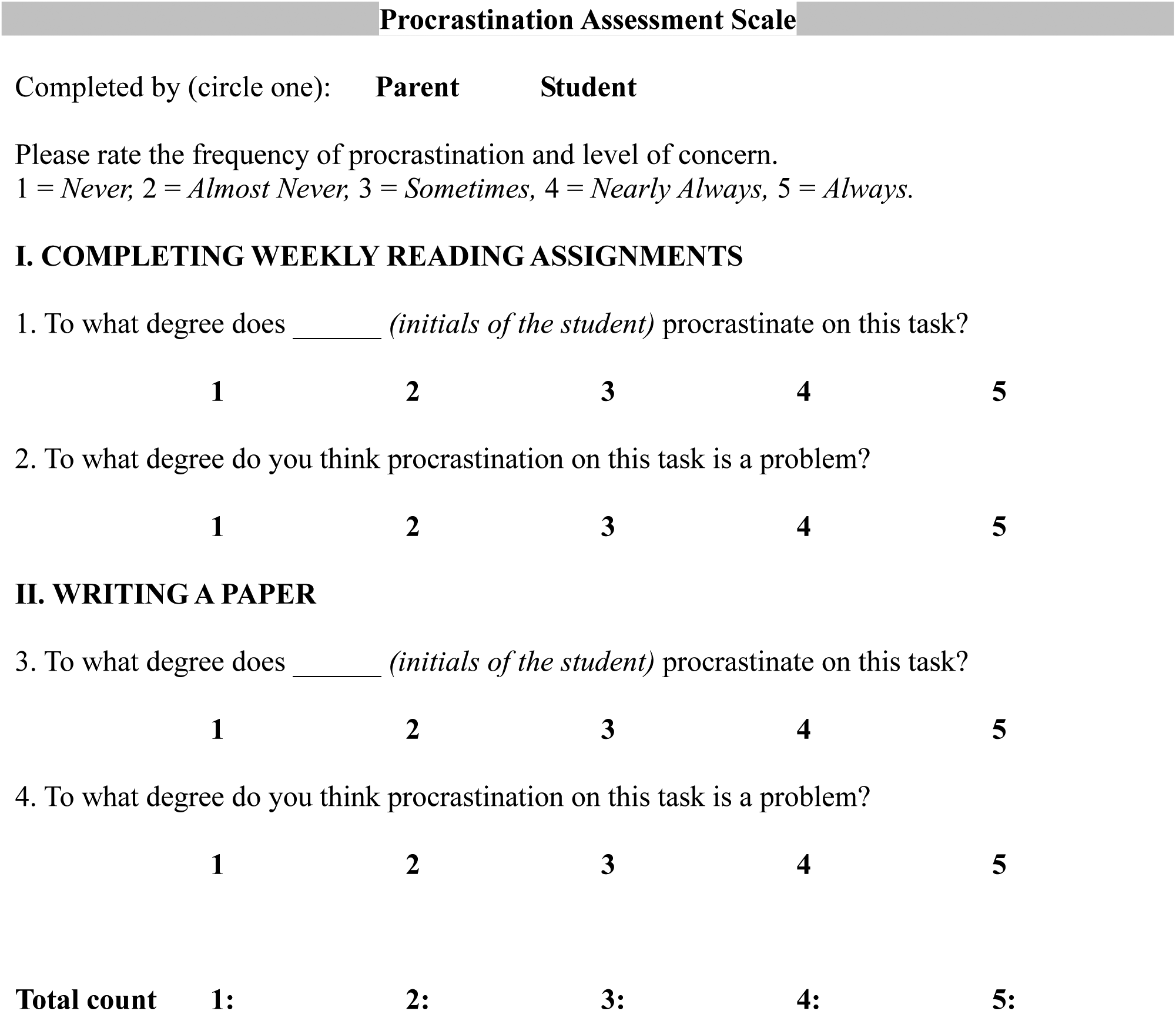
Procrastination Assessment Scale to be completed by the students and their parents. Students with any 4s or 5s are identified as at-risk procrastinators. Teachers who would like to address “cramming for exams” can add a section of “reviewing for an exam” and list similar rating items.
Tier 1: Classwide Prevention and Screening
Within Tier 1, teachers use appropriate assignment designs (i.e., increasing task importance, enhancing task appeal, and accommodating task difficulties) and effective grading systems (e.g., bonus points, point deduction, or graduated scoring system) to prevent academic procrastination in their classrooms. At the end of the first 2 weeks, all students are screened using the rating scale, and students with any 4s or 5s are identified as at-risk procrastinators.
Tier 2: In-Class Intervention
Students who are identified as at-risk procrastinators in Tier 1 are provided with increasingly intensive classroom instruction in the form of in-class progress checks and assignment blocks. The length of time for this step can vary from 2 to 4 weeks. At the end of this period, students showing no progress on their procrastination scores (i.e., having 4s or 5s) or failing to pass progress checks for two consecutive opportunities are considered for more individualized interventions as part of Tier 3.
Tier 3: Individualized Intervention
At this level, students are asked to self-manage using action plan sheets. Teachers collect their action plan sheets periodically and keep records of the goals that have been met. If a student has not met his or her goals for two consecutive opportunities or showed no progress on the Procrastination Assessment Scale, teachers should consider integrating peer support. For students who still show no progress in their goal records, teachers can use contracting and closely monitor their study progress on a weekly or more frequent basis.
Considerations for Cramming for Tests
The T-TAP model can also be adapted to address procrastination in test preparation. For example, teachers can (a) give frequent quizzes for newly taught concepts and use quiz questions as review guidelines for the midterm or final exam (Tier 1), (b) designate a review block in class and give recommended review schedules and practice quizzes based on the suggested review progress (Tier 2), and (c) implement a self-management plan (i.e., action planning sheets, peer support, and contracting) that involves setting short-term goals for the time spent on studying or the content that needs to be reviewed (Tier 3).
Conclusion
As a multileveled approach, the T-TAP model provides students with scaffolding assistance to reduce procrastination and increase self-efficacy and self-regulation skills. Using the strategies presented here, teachers can help all students to replace maladaptive patterns with more effective, efficient learning habits. With self-efficacy and self-regulation skills, students will develop a more optimistic, “can-do” attitude and set out on a more productive and satisfying academic and life path (Margolis & McCabe, 2006)—something all teachers want to see!
Footnotes
Declaration of Conflicting Interests
The author(s) declared no potential conflicts of interest with respect to the research, authorship, and/or publication of this article.
Funding
The author(s) received no financial support for the research, authorship, and/or publication of this article.