







Abstract
Challenging student behavior remains one of the biggest trials for classroom teachers. Understanding why a student performs a specific behavior is important in determining how to develop an intervention that targets the function of the behavior. This column focuses on how thinking functionally about behavior can help teachers understand why students engage in challenging behaviors. Specifically, three levels of functional thinking are discussed: (a) maintaining function, (b) deficits determination, and (c) intervention selection. Functional thinking is not meant to be a replacement for formal assessments; however, thinking about behavior in this way may help teachers to determine behavior function and develop a function-based intervention to alleviate the challenging behavior.
There are numerous explanations as to why students engage in challenging behaviors. These explanations may include psychological diagnoses (American Psychiatric Association, 2013), culture (White & Renk, 2012), or a difficult neighborhood environment (Herberle, Thomas, Wagmiller, Briggs-Gowan, & Carter, 2014). In addition to the various out-of-school explanations affecting student behavior, school-based explanations can also be a factor, such as academic challenges (Nelson, Benner, Lane, & Smith, 2004), student–teacher interaction patterns (Sutherland, Conroy, Vo, Abrams, & Ogston, 2013), and peer interactions (Bulotsky-Shearer, Fernandez, Dominguez, & Rouse, 2011).
Considering the difficult task of deciphering which variable may be most affecting the behavior, teachers are often left uncertain where to start. Some teachers may realize that they are unqualified to manage some variables (e.g., psychological diagnoses requiring counseling), which can render the teacher to inaction; thus, the challenging behavior remains. Other teachers may be inclined to seek assistance from other professionals (e.g., school psychologists, special educators, district-level consultants) who are knowledgeable regarding challenging behavior. It is unfortunate that these professionals often have caseloads that prevent them from being able to offer immediate assistance; thus, the challenging behavior remains. Ideally, teachers can independently determine behavioral functioning (i.e., the variable that reinforces or maintains the behavior) and develop a function-based intervention (i.e., an intervention that specifically addresses what is maintaining the behavior). Being able to better determine function and intervention empowers teachers to simplify the explanations for challenging behavior, think about behavior functionally, and develop an intervention to change the behavior; thus, the challenging behavior is reduced or eliminated.
Teacher Intention Versus Behavioral Outcome
Prior to understanding function, it is vital to have an awareness of how consequences differ between a teacher’s intention and a behavioral outcome. Figure 1 provides a brief overview of reinforcement and punishment. Most important to remember is that reinforcement maintains or increases the likelihood of a behavior recurring. Punishment decreases the likelihood of a behavior recurring.
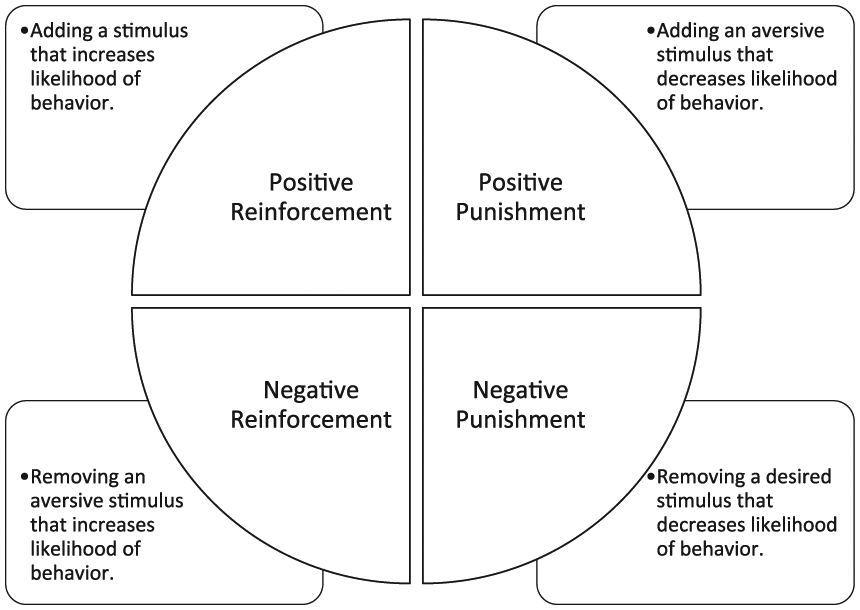
Behavior box that discriminates between punishment and reinforcement.
Due to the disconnect between intent and outcome, it is critical to focus on what happens to a behavior following a consequence. Typically, teachers want to increase (i.e., reinforce) appropriate behavior and decrease (i.e., punish) inappropriate behavior. Although this is the intent of a teacher’s consequences, it may not always be the outcome. Understanding this distinction is paramount to developing effective behavioral interventions because some challenging behaviors may be inadvertently reinforced, whereas some appropriate behaviors may be inadvertently punished. Consider the following examples of common interactions in the classroom (see Note 1).
Peter was asked to complete independent math work. A few minutes into the work, Peter screamed obscenities. Mr. Paul, the teacher, responded by telling Peter that his language was not appropriate. Mr. Paul wrote a discipline referral and sent Peter to the office with instructions to “think about how you need to behave.” After this interaction, Mr. Paul noted his frustration because he found himself often sending Peter out of class during independent work. As a result of this interaction, Mr. Paul intended to punish Peter’s behavior; however, the outcome was that he negatively reinforced Peter’s challenging behavior by allowing him to escape independent work.
Ms. Serra was providing small group instruction to several students, while the remainder of her class worked in nonteacher-led small groups. Martha, who was not in Ms. Serra’s group, was told to write her name on her paper, which is something that Martha can do. Martha responded to Ms. Serra, “You are not my mother, so you will not tell me what to do.” Ms. Serra and Martha engaged in a verbal duel where Ms. Serra said, “Do your work,” and Martha said, “No.” This ended when Ms. Serra took Martha into the hallway and talked sternly with her for 3 minutes. Ms. Serra reported missing instruction time because of these repeated hallway interactions with Martha. As a result of these interactions, Ms. Serra intended to punish Martha’s behavior by talking sternly with her in the hallway; however, the outcome was that she positively reinforced Martha’s challenging behavior by giving her individualized attention.
James raised his hand and answered a question correctly. Ms. Martin said, “James, you got it! Way to go! You are really working hard today!” The high amount of public attention embarrassed James. Over the following days, Ms. Martin began to notice that James did not raise his hand as much anymore. She could not understand why because she always gave him lots of praise. As a result of the interaction, Ms. Martin intended to increase James’ behavior through praise; however, the outcome was that she positively punished his hand-raising behavior by providing aversive social attention.
In these examples, each teacher noticed a behavior change. In addition, each teacher had specific intentions in mind to change the behavior; however, the outcome of the intervention was not what the teacher desired. As can be seen, the significance of understanding intention and outcome cannot be overstated. When thinking functionally, teachers must maintain an awareness of how their behavior and the consequences they apply actually affect student behavior.
Functional Thinking
Thinking of behavior functionally is grounded in applied behavior analysis (ABA). Addressing challenging behavior through focusing on function narrows potential explanations for the behavior from countless reasons to two possible reasons (i.e., function): (a) positive reinforcement or (b) negative reinforcement. In other words, teachers need to consider what the student is gaining (i.e., positive reinforcement) or avoiding/escaping (i.e., negative reinforcement) by engaging in the behavior. Students will either gain or avoid/escape the following variables: (a) social adult or peer attention, (b) activities, tangibles, or objects, and (c) sensory stimulation (see Umbreit, Ferro, Liaupsin, & Lane, 2007). Considering these three variables within the two possible functions greatly narrows explanations for behaviors and allows teachers to focus solely on determining what the student is gaining or avoiding/escaping as the function of the behavior. Viewing challenging behavior in this way can help teachers better understand their students’ challenging behaviors.
Several approaches for determining behavioral functioning have been used in ABA literature and range from systematic manipulation of variables to descriptive assessments. Functional analyses (Beavers, Iwata, & Lerman, 2013; Hanley, Iwata, & McCord, 2003), structural analyses (Gage & Lewis, 2010; Stichter & Conroy, 2005), and functional behavior assessments (Gresham, Watson, & Skinner, 2001; Scott et al., 2004) have all been suggested as effective assessments for determining behavioral functioning. Each assessment provides teachers with invaluable information to determine function. This information helps in the development of function-based interventions, which are more effective at changing challenging behavior than nonfunction-based interventions (Ingram, Lewis-Palmer, & Sugai, 2005). An obstacle to conducting the aforementioned assessments is often the time and training it takes to complete and interpret them, which can be a hindrance for teachers in need of immediate assistance to manage the behavior. Furthermore, many teachers do not have the basic training in classroom management (Oliver & Reschly, 2010) to begin to understand how to use these assessments. It would be ideal to have all teachers trained to fidelity on these assessments; however, presently, teachers are underprepared for the task. For that reason, if teachers can take the first step toward understanding behavioral functioning and begin to think about behavior functionally, they may be better equipped to manage the challenging behaviors presented to them on a daily basis.
Levels of Functional Thinking
The purpose of functional thinking (FT) is to help teachers discern why a student engages in a behavior, what deficit may be fueling the behavior, and what intervention may be best to address the challenging behavior. There are three levels of FT: (a) maintaining function, (b) deficit determination, and (c) intervention selection. Figure 2 provides a graphic that shows an example of the levels of FT. This type of thinking is not meant to replace formal functional assessments or multitiered systems of support (e.g., schoolwide positive behavior supports). Rather, FT is meant to enhance teachers’ knowledge of behavioral functioning, improve intervention selection, increase confidence in managing behavior, and remove emotion from challenging behavior.
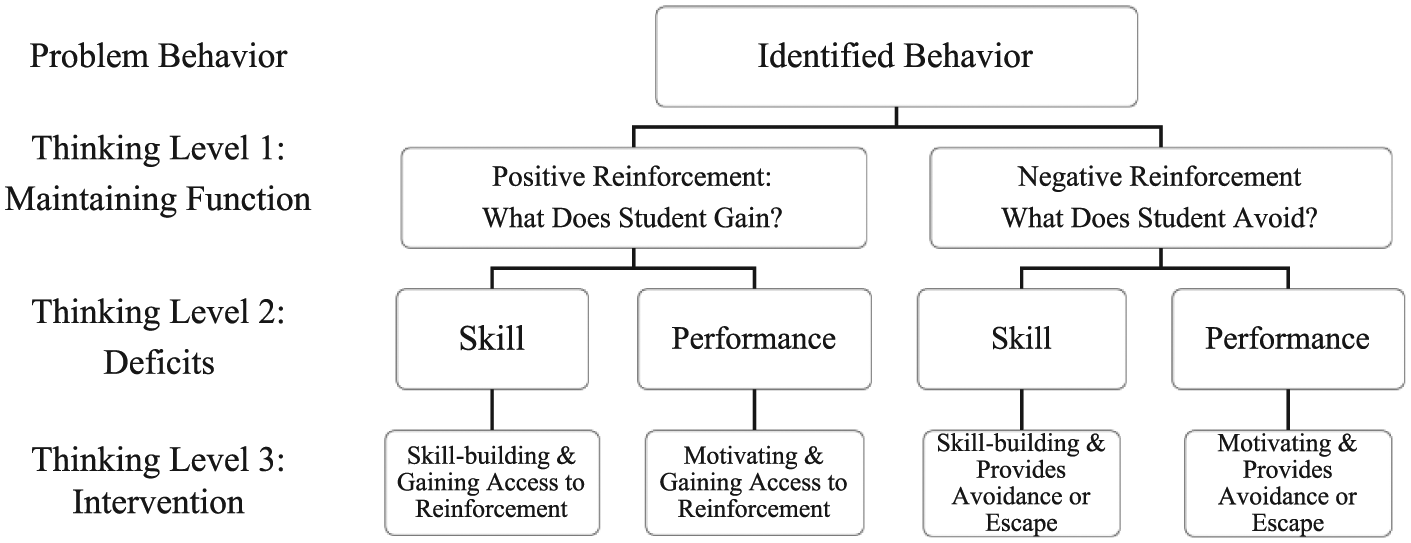
Example using levels of functional thinking with possible interventions.
Level 1: Maintaining Function
The first level of FT is determining why challenging behavior occurs. As discussed earlier, from an ABA perspective, behavior is maintained by either positive or negative reinforcement (i.e., gaining or avoiding/escaping, respectively). Focusing on gaining or avoiding/escaping helps teachers narrow why a behavior is occurring. Concomitantly, thinking of behavior in terms of function helps teachers to avoid becoming emotionally charged when dealing with challenging behavior. As noted in the above example of Martha and Ms. Serra, when Ms. Serra thinks functionally about Martha’s challenging behavior, she will be less likely to take Martha’s “you are not my mother” as a personal attack. Rather, she will question what Martha is trying to gain or avoid/escape through engaging in the behavior.
There are several things teachers can do to determine behavioral functioning, including observation and data collection. The most accurate method is some variation of functional or experimental analyses (Bloom, Iwata, Fritz, Roscoe, & Carreau, 2011). At the simplest level, anecdotal or antecedent–behavior–consequence data collection may provide enough data to move forward. Rather than write a long narrative, teachers can identify only the events surrounding the occurrence of a behavior, specifically, the nature of the behavior (e.g., aggression, noncompliance), common antecedents (e.g., task demand, peer grouping, leaving preferred activity, required nonpreferred activity), and common consequences (e.g., reprimand, task removed, peer/teacher attention, access to preferred activity). When the student engages in the challenging behavior, teachers can simply note the behavior, the antecedent, and the consequence. Following several occurrences of the behavior, teachers may begin to see a pattern of response develop. Although these data only help form a hypothesis, as opposed to hypothesis testing, they can help teachers think about the behavior functionally.
In reviewing the examples, Mr. Paul noticed the pattern of Peter’s behavior. He noted that when Peter was given independent work (antecedent), Peter was more likely to say obscenities (behavior), which increased the likelihood of Peter being removed from class (consequence). Mr. Paul noticed that Peter did not engage in obscenities when doing group work. This led Mr. Paul to surmise that Peter may be engaging in the behavior to avoid/escape independent work. Ms. Serra noticed that during small group instruction (antecedent), Martha was more likely to be noncompliant (behavior), which resulted in her being taken into the hallway (consequence). Ms. Serra noted that when she was in Martha’s small group, Martha was less likely to engage in the noncompliant behavior; therefore, Ms. Serra concluded that Martha may be engaging in the behavior to gain teacher attention. Finally, Ms. Martin noticed that when engaging in large group question–answer sessions (antecedent), James was less likely to raise his hand (behavior) in order to avoid being called on by Ms. Martin (consequence). Ms. Martin concluded that James’ behavior may be maintained by avoiding/escaping public attention.
Level 2: Deficits
After thinking about maintaining function of a behavior, the secondary level of FT focuses on the potential deficits that may be fueling the behavior. Practically, this level identifies deficits related to student knowledge of other appropriate behavior or if the student is simply not motivated to engage in appropriate behavior. These deficits can be divided into two categories: (a) skill deficits or (b) performance deficits (Duhon et al., 2004). Skill deficits occur when a student either cannot perform a skill or cannot perform a skill with fluency, often resulting in the student engaging in a challenging behavior because she or he does not have a more appropriate behavior in her or his repertoire. Skill deficits are often the result of a lack of training or education on a social or academic skill. Performance deficits occur when the skill is in the student’s repertoire, but the student does not engage in the skill because the problem behavior receives more reinforcement than the desired behavior. This can be thought of as an issue with motivation to perform a skill. Performance deficits are often the result of the student not recognizing the need to engage in the behavior, although it is in the student’s repertoire of behaviors. Determining what a student cannot do versus what the student chooses not to do is critical to FT. This level helps teachers gauge the type of intervention that will be needed to address a challenging behavior. If a student is unable to exhibit a behavior, intervention selection will be more focused on skill acquisition and fluency. If a student can engage in a behavior but does not exhibit the behavior when desired, intervention selection will be more focused on providing external reinforcers or motivators or making antecedent manipulations.
As with the first level of FT, functional and experimental analyses (Duhon et al., 2004) are the gold standard to determine deficit type. When these analyses are not readily available, teachers may provide a student with a highly motivating contingency (i.e., if–then). Within the contingency, teachers should offer a substantial motivator for engaging in a desired behavior. For example, if a student likes computer time, it can be offered as a reward for engaging in the behavior. In addition, the teacher can simply ask the student what reward she or he would like to earn for completing a task or engaging in a desired behavior. If the student engages in the appropriate behavior with accuracy, then the teacher can presume that the student has the skill to perform the behavior; thus, it is likely a performance deficit. If the student attempts to engage in the appropriate behavior but does so erroneously or does not engage in the behavior, then the teacher can surmise that it is likely a skill deficit.
Considering the previous examples, Peter was asked to complete math work independently. When Mr. Paul reflected on Peter’s math performance, he noted Peter’s struggles with the concepts and how Peter skipped problems that he did not know how to complete. This led Mr. Paul to conclude that Peter was engaging in the behavior to avoid/escape the work due to a skill deficit. Ms. Serra noted that Martha had the ability to complete the task, as she completed similar tasks when they were in the same group. However, she noted that perhaps Martha did not have the skill to recruit Ms. Serra’s attention in an appropriate manner. From this, Ms. Serra concluded that Martha had a skill deficit in how to recruit attention appropriately. Finally, Ms. Martin noted that James had exhibited the hand-raising behavior in the past during large group instruction. She knew he had the ability to perform the behavior; therefore, Ms. Martin judged that James did not participate in order to avoid/escape receiving public attention due to a performance deficit.
Level 3: Intervention
This third level of FT is focused on intervention selection. An important aspect of intervention planning is to match function and intervention. Ingram et al. (2005) found that function-based interventions were more effective than nonfunction-based interventions at improving challenging behavior. Implementing an intervention focusing on providing more teacher attention for a student trying to escape a task will be ineffective because it is not addressing why the student is engaged in the behavior. Therefore, deriving interventions from accurate functions and deficits increases the likelihood that behavior will change in the desired direction (i.e., decrease challenging behavior and increase socially appropriate behavior).
There are four considerations that can help guide intervention decisions. First, teachers should set the goal of the intervention to increase or decrease a behavior. For instance, call-outs may be a behavior that needs to be decreased, so a teacher may choose an intervention designed to decrease the behavior. Completing work is a behavior that needs to be increased, so a teacher may consider an intervention that focuses on the student’s choice making. Perhaps there is a need to increase and decrease two behaviors simultaneously, in which case a teacher may implement a token economy or behavioral contract.
Second, in light of the function, the teacher should consider the deficit that is fueling the behavior. This consideration helps when determining intervention selection, as skill deficits will require a different type of intervention from performance deficits. Overcoming skill deficits generally requires explicit or direct instruction of the desired skill, multiple opportunities to respond, and effective reinforcement following each successful occurrence of the skill. Teachers must teach students when and where to perform the new skills. Reinforcing a new skill encourages a student to view the new skill as more desirable than the challenging behavior because the new skill leads to reinforcement. In addition, providing reinforcement following the new skill must continue as the student gains fluency (i.e., “able to perform the skill quickly and accurately”; Scott, 2017, p. 104) and moves toward skill mastery. Overcoming performance deficits generally requires the addition of explicitly stated reinforcing contingencies. When students know that highly valued reinforcers and motivators are associated with the contingencies, they may be more likely to engage in a desired behavior.
Third, teachers need to consider intervention complexity, remembering that interventions do not have to be difficult to implement. For example, providing increased opportunities to respond simply requires the teacher to present students with additional chances to exhibit the academic or social behavior. This intervention may involve the teacher asking a higher frequency of academic questions. Opportunities to respond can be effective in giving students attention and praise, as well as improving a skill deficit or motivating a performance deficit.
Finally, teachers should consider how to evaluate the intervention to ensure that intention matches the desired outcome. Following several school days (7–10) of implementing an intervention with fidelity, teachers should re-evaluate their intervention. Should the behavior change in an undesirable direction, perhaps a change in intervention is needed along with a formal referral for support from a behavior specialist. On the other hand, should behavior change in a desirable direction, the intervention continues.
Example interventions
Determining and implementing effective interventions are the creative part of FT. There are more effective interventions than space to report within this column. Table 1 offers some interventions focused on function and deficits, along with references that can provide more detail regarding the interventions. When considering interventions, it is important to note that some interventions can serve to address both functions and both deficits.
List of Potential Interventions by Function and Deficit With Citations.
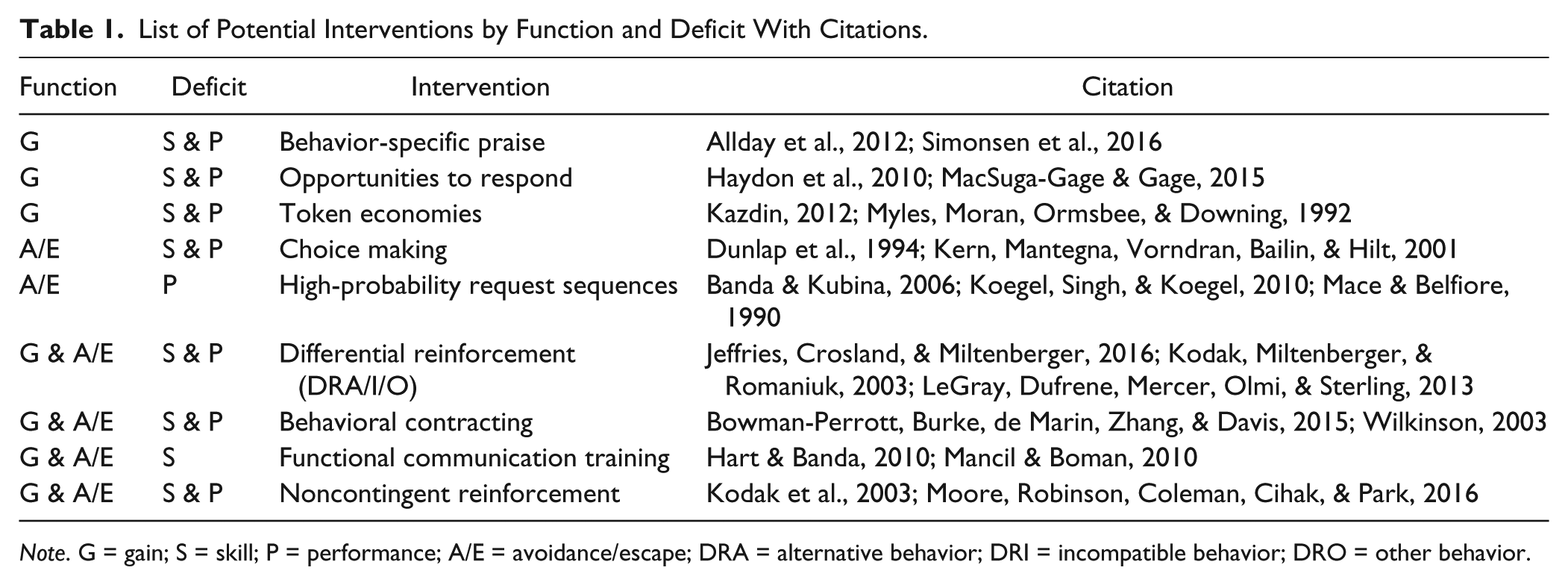
Note. G = gain; S = skill; P = performance; A/E = avoidance/escape; DRA = alternative behavior; DRI = incompatible behavior; DRO = other behavior.
Interventions may take place in the antecedent (i.e., before the behavior) or in the consequence (i.e., after the behavior). Antecedent manipulations are changes to the environment that are meant to prevent the problem behavior from occurring by changing the variables that are more likely to cause the behavior to occur. An example of an antecedent manipulation could be choice making. Choice making provides a student with a variety of task options (e.g., list of 5–10 tasks) associated with the content, allows the student to choose which task will be completed first, and provides praise following the completion of the task. This intervention focuses on preventing the problem behavior due to the student having the control of the order of tasks, which would decrease the need to escape a difficult task.
Interventions that focus on the consequences (i.e., what happens after the behavior) attempt to provide reinforcement for appropriate behavior. Behavior-specific praise can be an example of this type of intervention that can be employed for a student with a function of gaining teacher attention. It focuses on providing teacher attention, following a desired behavior, that would include a praise statement that addresses the specific behavior exhibited. For example, if the student walked quietly between classes, the teacher may state, “Joe, you showed great leadership skills by walking in the hallway!” The inclusion of the behavior in the praise statement focuses on what the teacher would like to see exhibited in the future.
In considering the examples, Mr. Paul decided to reteach Peter the math skills explicitly to improve his fluency (i.e., skill deficit). In addition, Mr. Paul decided not to allow Peter to avoid/escape (i.e., function) his work for the obscenities. Rather, Mr. Paul explicitly taught Peter to use a cue card to signal when he needed a break, which allowed him to avoid/escape his work temporarily. Mr. Paul reinforced the use of the card with a temporary break. He did not allow avoidance/escape when obscenities were used but would remind Peter to use the card if he needed a break. Ms. Serra decided to give Martha attention, through praise, when Martha was being compliant. Ms. Serra decided that she would praise Martha for any appropriate behavior she was engaged in during nonteacher-led small group work. Finally, Ms. Martin created a token reinforcement system for James to encourage his participation in large group instruction. She told him that she would not verbally praise him for participation but would give him a token that could be exchanged for time at the reading rug, a preferred activity for James.
Conclusion
Functional thinking is not meant to be a replacement for formal assessments (e.g., functional analysis, functional behavioral assessments). These assessment strategies work through the complexities of student behavior and should remain the primary procedures for managing extreme student behavior. However, on a day-to-day basis, FT can help teachers to better manage challenging behavior. Functional thinking is meant to empower teachers to engage with challenging behavior through thinking about (a) why a student is engaging in the behavior, (b) what deficit is related to the behavior, and (c) how to match a behavior’s function and related deficit with an appropriate intervention. Although there is no method that is foolproof, FT can help the teacher to make better intervention decisions.
Footnotes
Acknowledgements
The author would like to thank Collin Shepley and J. M. Joseph for assistance with the manuscript.
Declaration of Conflicting Interests
The author declared no potential conflicts of interest with respect to the research, authorship, and/or publication of this article.
Funding
The author received no financial support for the research, authorship, and/or publication of this article.