







Abstract
Executive function is an umbrella term involving working memory, planning, organization, social inhibition, self-regulation, and cognitive flexibility. It is an area where many students with disabilities struggle. This column describes practical ways to enhance executive functioning in students with disabilities using the universal design for learning framework and executive function coaching.
Executive functions (EF) permit individuals to plan and flexibly adjust to changes in the environment as they execute goal-oriented behaviors (Lai et al., 2017). They represent a range of higher level skills crucial for effective functioning in everyday life. Executive function disruptions can lead to reductions in attention, challenges generating and implementing strategic plans, an inability to acknowledge critical feedback, and obstinate thinking. For example, a student with poor EF might remember to grab his backpack on the way out the door in the morning. However, instead of planning ahead and placing his materials in the bag the night before, he arrives at school without his homework, lunch, or permission slip for the field trip. In homeroom, he fails to acknowledge responsibility for forgetting the materials, becomes frustrated, and belligerent with his teacher.
Effective EF performance has been highly correlated with increased productivity, enhanced self-esteem, higher income levels, improved job satisfaction, and heightened decision-making consistency. Unfortunately, cognitive scaffolds associated with EF are not typically addressed in K-12 general education school settings. This article addresses the issue by articulated a process where teachers (a) identify varying levels of EF performance in their classrooms, (b) analyze how this variability can lead to instruction or assessment barriers, (c) apply evidence-based coaching strategies to enhance executive functioning, and d) utilize the universal design for learning (UDL) framework to scaffold instructional pathways and maximize student performance and persistence.
Identifying Variations in Executive Function Performance
A quick search on the internet using the key words “executive function checklist” will provide a plethora of instruments and instructional supports, some of which are free. When considering which tool(s) to select, remember EF is an umbrella term with many subdomains. These include planning, organization, working memory, attention, inhibitory control, set shifting (e.g., being able to shift from one task to another without significant disruption), and concept formation. A full evaluation will provide a wholistic picture of the student. Examples of assessments include the Test of Variables of Attention (TOVA), the Stroop Color and Word Test, the Digit Span and Spatial Span subtests of the Wechsler Intelligence Scale for Children (WISC), and the Delis–Kaplan Executive Function System. These assessments can be very expensive, but many districts own a copy so be sure to ask your school psychologist what instruments are available.
While a full evaluation is always best, astute teachers can use their observational skills to generate inferences about student executive functioning. For example, take a look in the student’s backpack or desk. Are the materials neat and organized? A student who has books and papers organized by subject and laid out in the order they will be needed during the day needs much less support than one who throws everything in a pile and then spends several frustrating minutes trying to figure out where their materials are for the next subject. Ask students to generate a plan of action after you introduce goals and objectives for the day. Do they shout out the answers or do they deconstruct the goal, identify the components necessary to achieve it, and write a plan of action. Talk to the students, their parents or guardians, and others who interact with the student on a regular basis. Educators can create a profile for each student so you know their strengths and challenges. This strategy allows you to visualize the instruction and assessment barriers they might encounter and proactively address them. Figure 1 identifies aspects of EF to be included in the individual learning profile.
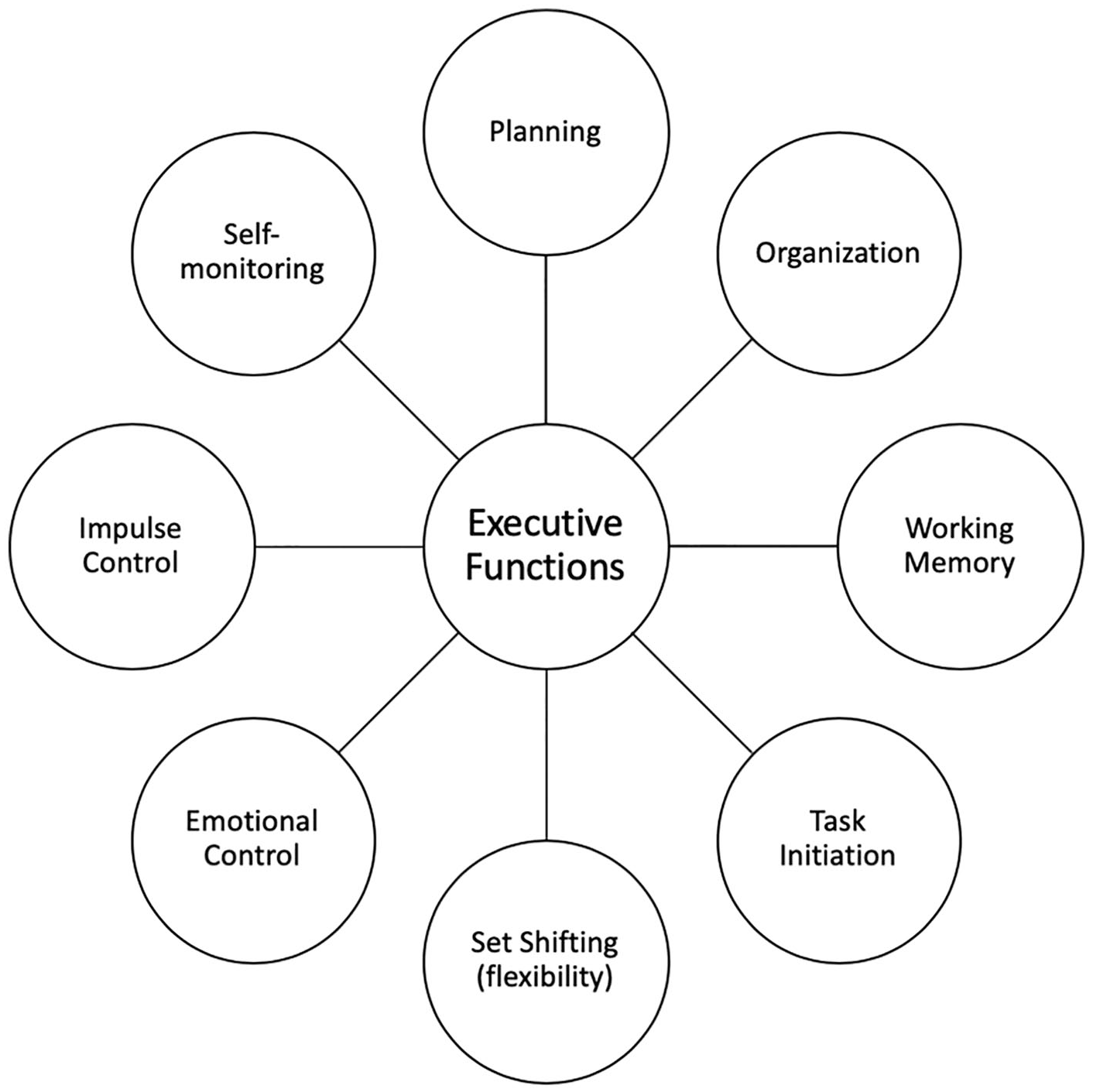
Executive functions to include in the learner profile.
Some teachers and students prefer to use games as a way to assess aspects of EF like working memory, critical thinking, and problem solving. Many of these are inexpensive. For example, at https://www.teacherspayteachers.com/ search for “working memory” and you will see a range of games from US$3 to US$30. Another option is the game Simon, which can be purchased for less than UD$15 online. This game has four different color buttons, which illuminate as a tone is played. Students then repeat the tone by pushing the buttons in the same order as they were presented. The pace increases as students progress through the game. This can be played individually or in small groups. At https://www.identifor.com/games/skills teachers can find a number of games that assess attention, problem solving, efficiency, and memory. For each of these activities, teachers should sit next to students, observe their actions, and record the results to develop their unique learner profile. It is tempting to prompt students during these assessments. Do not! You are gathering critical baseline data to inform future instructional practices.
Analyzing Barriers
Now it is time to analyze instruction and assessment barriers. After the students have left for the day, use their learner profiles to group students with similar strengths and challenges. There are four domains to consider as you conduct a barrier analysis (see Figure 2). Cognitive (e.g., planning, organization, and working memory), social (e.g., set shifting, emotional, and impulse control) and physical (e.g., task initiation and self-monitoring) barriers are most common in students with executive function deficits.
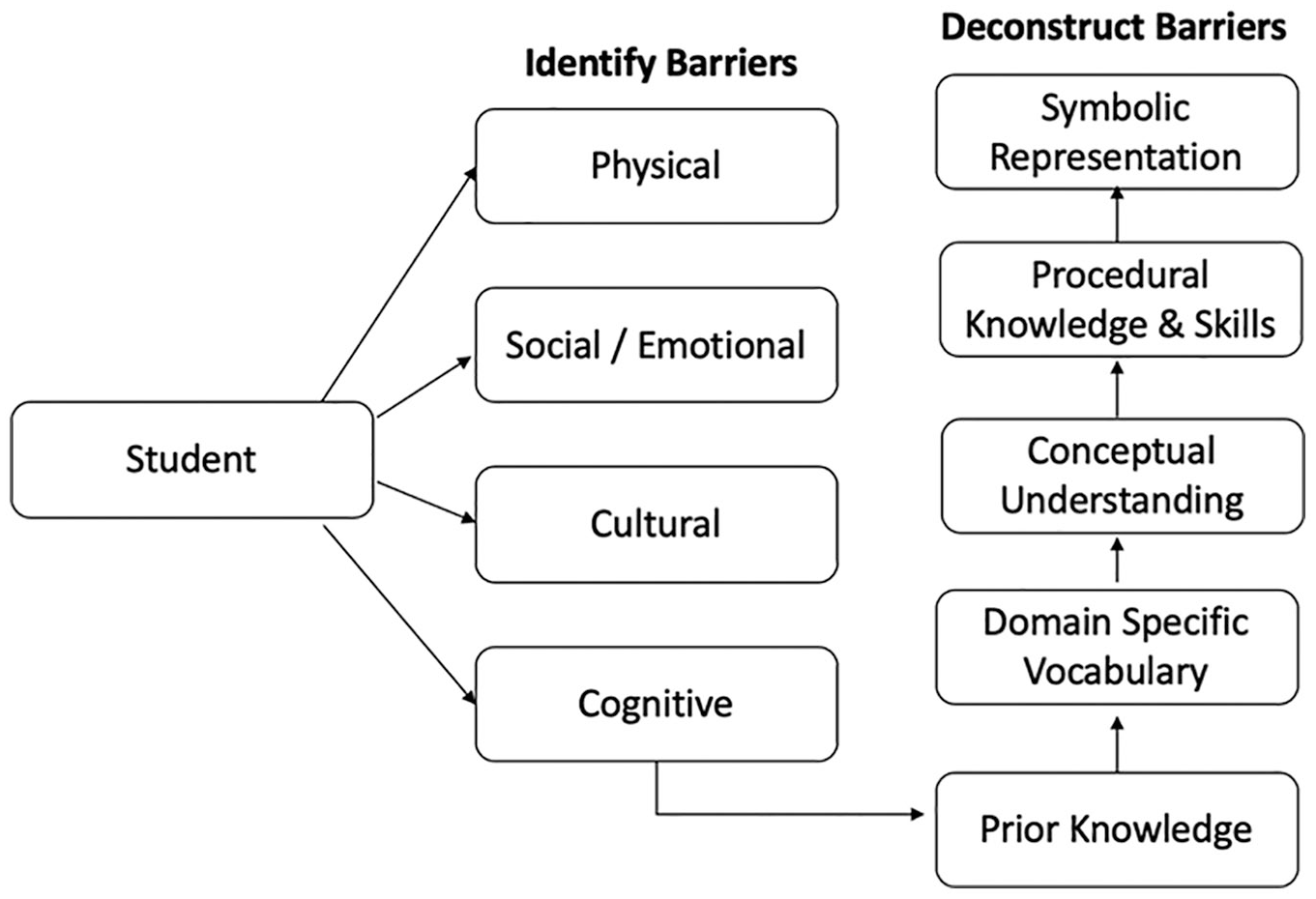
Barrier analysis prior to initiating instruction.
Consider middle-school physical science teachers who are teaching a unit where students must “Plan an investigation to provide evidence that the change in an object’s motion depends on the sum of the forces on the object and the mass of the object” (Next Generation Science Standards, 2017, MS-PS2-2). Several EF deficits could act as barriers to the learning and assessment process. For example, students may not have the prerequisite knowledge and skills to plan or organize the investigation. These cognitive barriers can be circumvented by providing students with an outline as a starting point for the planning process. Another potential EF barrier relates to the physical aspects of self-monitoring during the investigation. For example, the student may become easily distracted by a group of students nearby and lose track of the goal of the experiment. In another scenario, the student could become impulsive and pose a safety hazard for the group. Students who struggle with set shifting may have difficulty transferring from one object, such as from a ball bearing, to an object with a different mass like a glass marble. The instructor should proactively scaffold the learning process once barriers are identified. The goal is to maximize students’ abilities to complete the experiment as independently as possible. A three pathway or three-center approach within the classroom can accomplish this task by providing students with varied levels of scaffolding using a gradual release model (see Figures 3, 4, & 5).
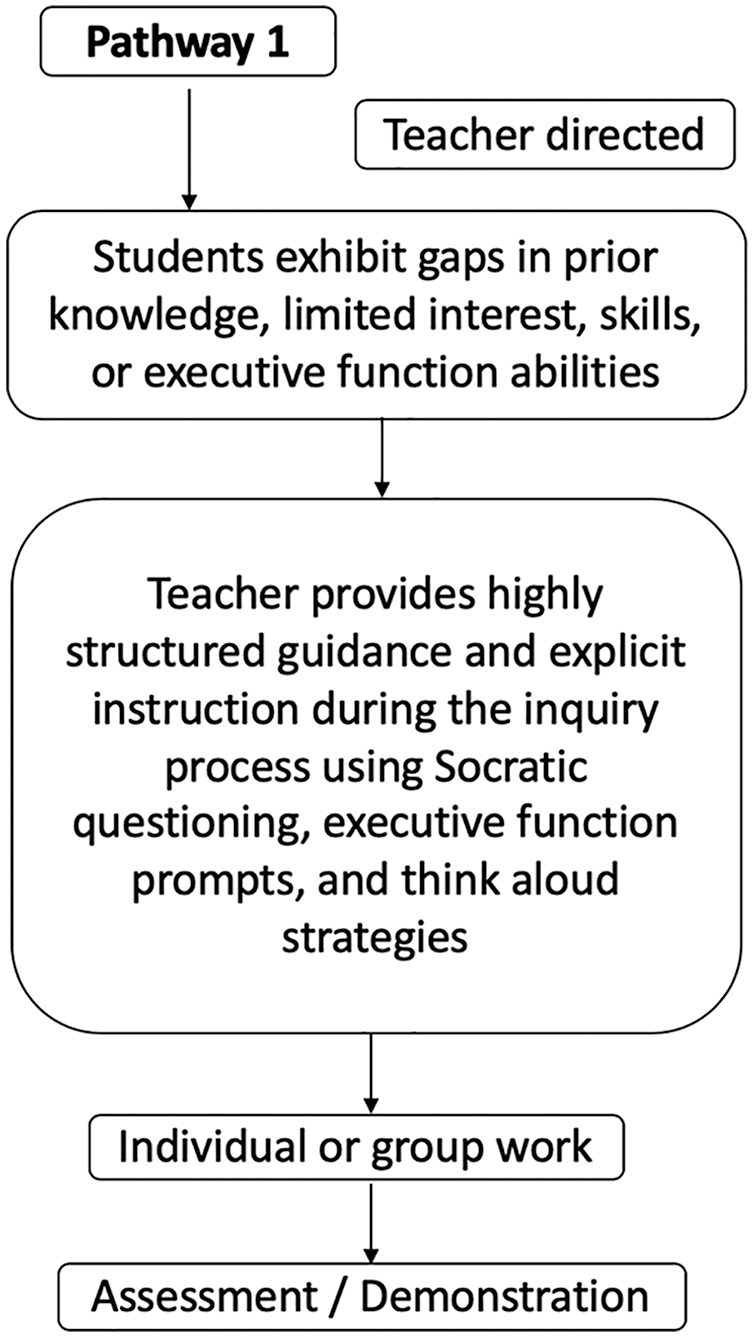
Universal design for learning pathways to achieve performance expectations pathway 1.

Universal design for learning pathways to achieve performance expectations pathway 2 (Marino & Vasquez, 2020).

Universal design for learning pathways to achieve performance expectations pathway 3.
Each consecutive pathway provides differential levels of scaffolding designed either to enhance EF, conceptual understanding, or procedural skills. The pathways can be established as learning centers within the classroom. Students with the most significant needs should likely be placed in Pathway 1 because it includes the most structured approach. However, students should have the ability to change pathways based on their performance levels. Meaning, a student in Pathway 1 could move to Pathway 2 or 3 as the performance expectation changes. A specific example of a student in Pathway 1 working toward this performance expectation might include the use of a reading, followed by video examples and nonexamples of the phenomena occurring in nature. The teacher could provide an outline for the students to follow as the investigation unfolds. Throughout the class the teacher will circulate during center time. The teacher may also consider using simulation software as a means to provide additional EF supports to students in Pathway 1.
Students with the most severe EF deficits can participate in the teacher-directed investigation. This model provides explicit structure, modeling, and progress monitoring for students along with immediate corrective feedback when necessary. An option for students with less severe EF deficits will be the student-assisted model. This group of students can be assigned roles based on their strengths. For example, if a student excels at planning, ask her or him to collaboratively plan the experiment with a weaker student. Students should be prompted to discuss their thinking as they work through the plan. This will inform their organization, materials list, and self-monitoring. The weaker student can then record the plan either in writing or using an oral recording device. Other students can be paired around task initiation, set shifting during the experiment, or self-monitoring. Each group should discuss a strategy and formulate a specific plan prior to starting the experiment. The final group is student directed. This allows students with advanced EF skills to complete the task either independently or in small groups, depending on the student and instructor goals for the investigation.
Students in Pathway 2 will formulate their plan to achieve the performance expectation with assistance from the teacher. These students may also use technologies such as simulations, videos, and games or they may choose to create their own experiment with variables they identify from the classroom. Students in Pathway 3 will develop their plans independently or in small groups. It should be noted group size can inhibit participation when more than three students are working toward a performance expectation. The teacher should review the plans for students in Pathways 2 and 3 prior to students engaging in the inquiry. This ensures the plans are obtainable in the allotted time period.
Coaching Students to Enhance Executive Function
A central aspect of this three-level model (i.e., teacher directed, student supported, student directed) is consistent EF coaching. Coaching is a short-term personalized approach to help individuals acquire specific skill sets, such as planning, task initiation, or set shifting. Empirical evidence supports the hypothesis coaching can enhance EF skills for individuals with disabilities. Consider a student who struggles with planning, organization, and self-monitoring. An EF coach must first build a relationship with the student based on mutual respect and growth mind-set. The student must be encouraged to shift their cognitive patterns from, “I can’t do it” to “I’m making progress toward it.” This fundamental shift reduces negativity and allows for personal growth. Once the relationship is established, the EF coaching can begin.
Think-aloud protocols make your thought processes visible to students. Given the scenario described previously where the student is participating in a physical science lab, the coach/teacher might ask herself, “What learning goal are we trying to accomplish?” She would then articulate the goal using collaborative discourse in their own words. Next, she would ask the student, “What resources do we need to accomplish the goal?” Following discussion she would write down or type the resources. Typing or using voice recognition software to create a typed version of the goals, materials list, and procedure allows the student to seamlessly import the work into a laboratory report, thus maximizing the effectiveness and reducing redundancy.
Once resources are identified it is time to initiate prior knowledge. The teacher/coach can ask, “What do we already know about this topic?” and, “Is there a strategy we have used in the past that we can replicate or modify to be successful here?” Use positive reinforcement to keep the student engaged and contributing. For example, “You were correct last time we did a lab we took a video on the phone so we could watch the experiment multiple times and ensure our data was accurate.” It is also beneficial to use Socratic questioning to help students clarify their thinking. For example, “Does this latest evidence support or refute our hypothesis? Why?” Paul and Elder (2006) identified six types of Socratic questions: (a) questions for clarification, (b) questions probing assumptions, (c) questions probing reasons and evidence, (d) questions about viewpoints and perspectives, (e) questions probing implications and consequences, and (f) questions about the question. These Socratic questions enhance critical thinking skills during the inquiry process.
Active listening is also important. Make eye contact with the student and paraphrase what they are saying. For example, “I hear you saying this strategy might need some improvement. What might we do to improve our performance? Then follow through by implementing the suggestion, even if you’re sure it will not be successful. The student needs to see you believing in them. Ask the student for a fair evaluation of the practice once you have tried it. If it is a miserable experience, don’t be afraid to laugh. One aspect of coaching often overlooked is humor. Students benefit when they realize a coach is having fun, making jokes, and laughing while learning with them. A final concern is providing students with a suite of strategies to promote effective EF and success in the UDL environment. These can include a number of strategies ranging from positive self-talk to assistive technologies.
Universal Design for Learning to Maximize Performance
Universal design for learning is a framework for the design and implementation of efficacious instructional materials. The instructor must identify variability within the students prior to the class and proactively circumvent barriers inhibiting learning. Instruction is guided by three principles: (a) multiple means of engagement (i.e., considering how to engage students in multiple ways), (b) multiple means of representation (i.e., providing content in multiple formats), and (c) multiple means of action and expression (i.e., providing opportunities for students to demonstrate their understanding in multiple ways). Each principle is further delineated by guidelines and subsequent checkpoints (CAST, 2018).
Instruction should be intentionally planned so it is personally challenging for all students. When planning for learner variability, teachers should take into account specific considerations such as individual and group strengths, weaknesses, abilities, prior knowledge, and motivation for participating in the learning activity. Universal design for learning helps teachers consider student-level variability as well as content and physical accessibility. During the instructional process, teachers should target specific methods and materials which engage learners and provide multiple ways for students to gain information, build conceptual understandings, and express their knowledge. The UDL classroom instruction cycle is presented in Figure 6.
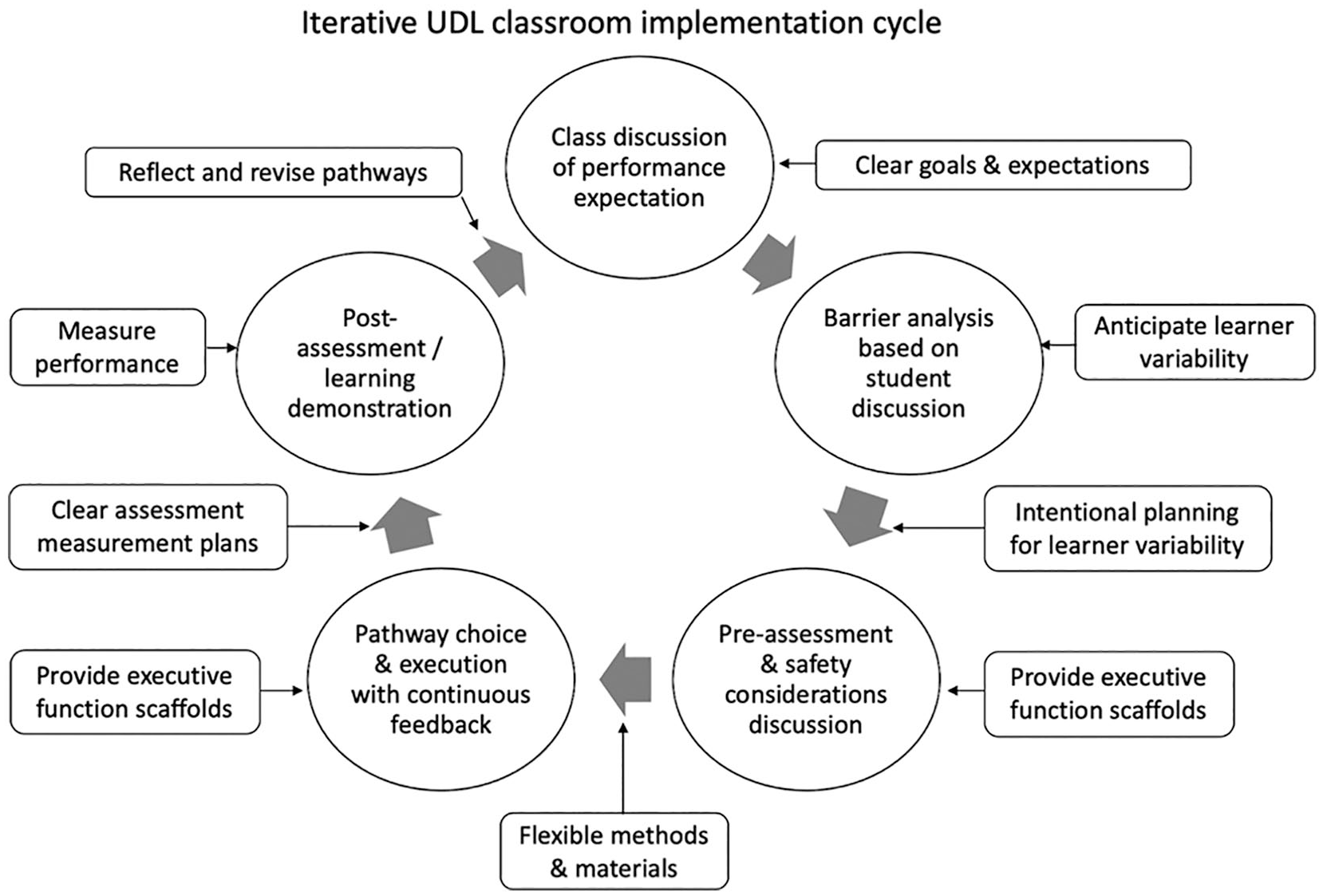
Universal design for learning implementation protocol.
The implementation of UDL focuses on integrating the three principles above across four critical instructional elements: (a) clear goals, (b) intentional planning for learner variability, (c) flexible methods and materials, and (d) timely progress monitoring (Nelson & Basham, 2014). Practitioners can use a five-step model to implement UDL in the classroom: (a) establish clear outcomes, (b) anticipate learner variability, (c) establish clear assessment and measurement plans, (d) design the instructional experience, and (e) reflect/develop new understandings. Universal design for learning harnesses the power of technology-enhanced, evidence-based strategies and resources to support instruction for all students. However, as Edyburn (2010) pointed out nearly a decade ago, a fundamental question is whether UDL is the responsibility of teachers or developers of instructional products. Current research indicates it is a combination of the two (Vasquez et al., 2015).
Executive Function Coaching
Transformative technologies such as smart phones and video games have become ubiquitous within our society. These devices hold the potential to provide all learners with enhanced EF performance. Learners with disabilities are more motivated to learn using technology-enhanced instruction than traditional paper and pencil methods. Several technologies including the use of robots, serious video games, virtual reality, mobile technologies, and augmented reality show promise as a means to teach students complex concepts and relationships.
Implementing UDL in classroom environments is an iterative process, often taking three or more development cycles to fully address variability across students’ interests, strengths, skills, EF abilities, and background knowledge. Any student misconceptions should be clarified as they are identified. Students with adequate prior knowledge, skills, and EF abilities then move to a planning phase, where they articulate their process for demonstrating the performance expectation.
Conclusion
Executive function and learner variability are clearly constructs practitioners should consider when preparing instruction and assessment. This article described how teachers can evaluate EF and learner variability to proactively circumvent curriculum barriers. An evidence-based coaching model combined with UDL framework provided information to enhance instruction and assessment practices.
Footnotes
Declaration of Conflicting Interests
The author(s) declared no potential conflicts of interest with respect to the research, authorship, and/or publication of this article.
Funding
The author(s) disclosed receipt of the following financial support for the research, authorship, and/or publication of this article: This material is based upon work supported by the National Science Foundation under grant 0505202. Any opinions, findings, and conclusions or recommendations expressed in the material are those of the authors and do not necessarily reflect the views of the National Science Foundation.