







Abstract
It is essential that middle school content-area and special education co-teachers adopt evidence-based literacy practices that they can integrate into their content-area instruction to address the needs of all of the students in their classes. This article provides co-teachers with four planning tips to improve implementation of the practices they adopt. The planning tips are organized using the acronym FIRST: (a) monitor
To support students with learning disabilities (LD) as they learn content from complex text in the middle school general education content-area setting (e.g., science), it is essential for teachers to provide opportunities for students to engage with text while providing co-occurring evidence-based literacy instruction (Bulgren et al., 2013). Specifically, teachers should provide students with explicit instruction in key concepts and vocabulary prior to their reading text, as well as instruction in strategies that they can apply on their own to improve comprehension. In addition, teachers need to be facile at evaluating students’ ongoing use of these strategies and comprehension of text so they can provide differentiated support. Integrating this type of literacy support into the co-taught setting is one way that content-area teachers and special education teachers can provide the specialized instruction that many students with LD require (Lemons et al., 2018).
To provide literacy instruction in the co-taught setting, co-teachers should adopt a limited set of evidence-based practices that they can feasibly integrate into their typical content-area instruction. Co-teachers who are new at working together or new at implementing literacy instruction in the co-taught setting might wonder which literacy practices they should adopt. Currently, several trusted resources exist that provide guidance for teachers about how to evaluate and choose practices (e.g., https://iris.peabody.vanderbilt.edu/module/ebp_01/). With the support of their administrators and other instructional leaders (e.g., literacy coaches), co-teachers can use these resources to determine which practices have the highest levels of evidence with a population of students similar to the one they are serving.
Considering the variety of challenges co-teachers often face (e.g., meeting the needs of a variety of learners), they might also wonder how they can ensure ongoing efficient and effective implementation as well as how they can sustain the use of their adopted practices. For example, some content-area teachers have cited challenges such as finding time to integrate evidence-based literacy instruction in the content-area setting, and others have noted a general lack of accessible text (Wexler et al., 2018). Complicating matters further are challenges inherent to co-teaching, such as defining each teacher’s roles and responsibilities (Rice & Zigmond, 2000).
Together, these challenges can make it difficult for co-teachers to implement evidence-based literacy instruction with fidelity (i.e., the manner in which they are intended to be implemented; Gresham, 2009) and even more difficult to sustain implementation of the practices. Although all the multifaceted issues related to sustaining evidence-based literacy instruction (e.g., administrative support) are beyond the scope of this article, one way to enhance the likelihood that co-teachers sustain the long-term use of adopted practices is to dedicate time to systematically plan for the effective and efficient implementation of practices before actually implementing them. More specifically, co-teachers can preemptively consider issues related to their literacy-focused instruction. For example, how will they determine fidelity of implementation of the adopted literacy practices? When and how will they integrate the adopted literacy practices into their other content instruction? How will the co-teachers balance who plans for and implements the literacy instruction? How will the co-teachers select appropriate text needed for their literacy-focused lessons?
This article presents four planning tips that co-teachers can consider prior to implementing evidence-based literacy instruction. Each planning tip addresses one of the questions posed previously, is organized using the acronym FIRST, and is addressed in the corresponding section that follows. The first tip provides ideas to help co-teachers monitor
Planning Tip 1: Monitor Fidelity of Implementation
The first step in planning to implement a set of evidence-based literacy practices is for co-teachers to think about a plan for monitoring their fidelity of implementation of those practices. Broadly defined, fidelity of implementation is the degree to which a teacher or teachers implement an instructional practice as intended (i.e., structural fidelity) and the quality with which the instructional practice is implemented (i.e., process fidelity; Mowbray et al., 2003). Implementing instructional practices with a high level of fidelity is essential. In fact, authors of a previously conducted study of evidence-based literacy practices confirmed that teacher fidelity to instructional practices mediates student reading outcomes (Vaughn et al., 2015). In other words, with higher fidelity, student-level effects are greater.
Monitoring fidelity of implementation among teachers can yield essential information because documenting whether or not a teacher adheres to the essential components of an instructional practice and the level of quality with which the teacher delivers the practice can help identify PD needs (Harn et al., 2013). With more targeted PD, co-teachers can improve fidelity of implementation and, ultimately, student outcomes.
How to Monitor Fidelity
One of the most common ways to monitor fidelity is to use a checklist (McKenna et al., 2014). Although there are many ways to organize a fidelity checklist, important components of a checklist include (a) a way to document whether or not teachers implement components of an instructional practice, (b) the quality with which teachers deliver the components of an instructional practice, (c) essential information specific to the instructional practice teachers implement (e.g., which co-teacher led instruction), and (d) logistics (e.g., class period observed).
For the purposes of monitoring CALI IF fidelity, co-teachers can use an existing fidelity checklist that reflects the use of the practices. See Figure 1 for an excerpt from the world knowledge section (see Kearns et al., 2021) of the fidelity checklist.
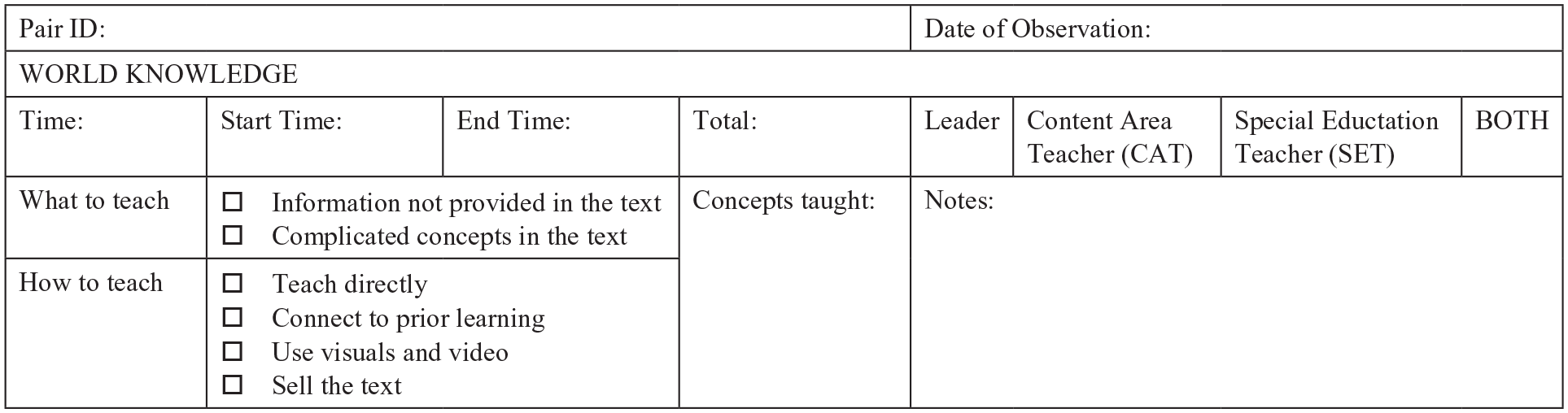
Excerpt from the CALI instructional framework fidelity implementation checklist.
Each instructional practice included in the CALI IF includes a section on the checklist that lists guidelines for what to teach and how to teach the practice. The what-to-teach guidelines (i.e., structural fidelity components) reflect essential components of each practice that co-teachers are expected to implement (e.g., complicated concepts; see Figure 1). The how-to-teach section includes essential components related to the co-teachers’ quality of delivery of each practice (e.g., teach directly; see Figure 1), and the checklist includes process fidelity components as well. Finally, the checklist also includes a section for other essential information about the lesson (e.g., whether the content-area teacher (CAT), special education teacher (SET), or both co-teachers led instruction) and logistical information (e.g., class period observed).
Who Monitors Fidelity?
One way to monitor fidelity is to have an administrator, instructional leader, or another colleague who is knowledgeable about the adopted set of evidence-based literacy practices monitor co-teachers’ fidelity by observing a live or video-taped lesson. It is also possible to self-assess one’s fidelity (McKenna et al., 2014). For example, co-teachers could use a fidelity checklist to reflect independently upon their lesson implementation after a lesson and then meet to reflect together and set future goals. Alternatively, it is possible for co-teachers to share responsibility for using the fidelity checklist to evaluate each other’s teaching when only one co-teacher is leading instruction and as long as it does not interfere with each teacher’s other responsibilities.
When to Monitor Fidelity
Co-teachers should also determine when they will have someone monitor their fidelity or when they will self-assess their fidelity. Although clear guidelines about when and how often to monitor fidelity do not exist, the idea is to monitor fidelity enough times to see how implementation of each adopted evidence-based literacy practice evolves over time. For example, because co-teachers scaffold the implementation of the CALI IF practices over the year (i.e., see section “Planning Tip 2: Integrate Evidence-Based Practices” for details), co-teachers’ fidelity should be monitored at least once after they have had a chance to implement each practice for a minimum of 3 weeks (e.g., enough time for co-teachers to work out any kinks in their implementation). Co-teachers’ fidelity checks should reflect all the practices that have been introduced up to that point (e.g., world and word knowledge in addition to get the gist; see Kearns et al., 2021; Shelton et al., 2021). Thus, implemented cumulatively, co-teachers may see improvement in practices over time.
Using Fidelity Data to Inform Instructional Changes
Once co-teachers have data from a fidelity of implementation checklist, they can decide whether and in what areas their instruction is falling short. Typically, co-teachers’ instruction is in need of improvement when fidelity falls below approximately 90%. Using their fidelity checklist, the co-teachers should be able to calculate their overall structural and process fidelity score and then answer questions such as the following: Are we implementing the steps in a particular literacy practice as intended, but not implementing them with quality? Are we not even implementing the practice as intended? Having this information can guide them in knowing where they need to improve. The co-teachers might be able to come up with a plan for improving fidelity on their own, or they might consider reaching out to an instructional leader, administrator, or other experienced implementer for support.
Planning Tip 2: Integrate Evidence-Based Practices
By providing frequent opportunities for all students in a co-taught classroom to engage with text while providing co-occurring literacy instruction, co-teachers can provide students with exposure to essential background and vocabulary knowledge and practice applying comprehension strategies. Implementing a set of evidence-based literacy practices (e.g., the CALI IF) can help co-teachers achieve these goals. However, it is important to consider that because students with LD typically need many opportunities to respond, practice, and receive immediate corrective feedback (Archer & Hughes, 2011), co-teachers should ensure frequent (i.e., at least once a week), ongoing implementation of the practices. To make this a feasible goal, co-teachers can scaffold the implementation of the practices across the year. The next section provides ideas to ensure that co-teachers’ implementation of evidence-based literacy practices is frequent and, yet, also feasible.
Ensuring Frequent Implementation
It can be daunting for co-teachers to integrate practices such as those included in the CALI IF into their typical content-area instruction on a frequent basis because of the pressure they face to cover a lot of content at a rapid pace. Several strategies are outlined for co-teachers to use that can help them seamlessly integrate adopted practices into their typical content-area instruction weekly.
Consider text selection
In addition to the text selection guidelines to be described in more detail, it is important to consider how co-teachers’ selection of text can encourage the frequent integration of evidence-based literacy practices into their content-area instruction. For example, one of the benefits of CALI IF is that it includes practices that are curriculum and text agnostic, meaning that co-teachers can apply the practices to any text in any content area on any topic. Therefore, it is possible for co-teachers to select text for their lessons that are already required in the curriculum. If, by chance, the required text does not meet all of the text selection guidelines, it is possible for co-teachers to adapt the text to fit the guidelines (e.g., add section breaks to text that does not already include them). Co-teachers can also choose text that covers the same key concepts but meets the lower level reading needs of students in the class. Resources such as Newsela.com or ReadWorks.org have texts on a wide variety of curricular topics.
Finally, co-teachers can select text that supplements their typical instruction. For example, co-teachers can select a text and plan a lesson that supplements a theme in a novel they are reading in an English language arts classroom (e.g., a text about the Great Depression to supplement reading the novel To Kill a Mockingbird by Harper Lee).
By choosing text that students are already required to read or that aligns with class content, co-teachers can provide students regular opportunities to engage in the CALI IF practices and supplement content they already have to teach. This provides students additional exposure to content while providing an opportunity to engage with text.
Address classroom climate
With limited instructional time, co-teachers should structure their literacy-focused lessons so they experience minimal interruptions and maximum student engagement. Therefore, co-teachers should use positive behavior supports (e.g., clearly stating and reinforcing the expected behaviors) to improve engagement and decrease the occurrence of problem behaviors. In addition, co-teachers can prevent behavior problems and other interruptions using the following strategies: (a) Show excitement about the evidence-based literacy practices they are implementing, (b) state clear expectations, and (c) continuously monitor students as they work.
Co-teachers can show excitement about the adopted literacy practices in many ways. For example, they can be transparent with their students by telling them how text is complex at the middle school level, and how the practices can enhance their understanding of text in that class and in other classes.
Spending time setting clear expectations is also important. For example, in the fourth article in this special issue (i.e., Lyon et al., 2021), the authors describe how co-teachers can implement station teaching student support lessons as part of the CALI IF. Along with station teaching comes expectations for students to rotate groups and work on their own in independent stations. Explicitly teaching students how to do this by modeling and practicing station rotation will help students stay engaged and on task.
Finally, to maintain a good classroom climate, co-teachers should continuously monitor students as they work. While monitoring students, co-teachers should remind students about procedures for applying strategies and redirect off-task behavior. For example, co-teachers should monitor students when they are engaging in peer-mediated literacy practices such as associate gist (see Shelton et al., 2021) to ensure that they are following the peer-mediated instructional procedures.
Predetermine roles and responsibilities
A third strategy to ensure frequent implementation of evidence-based literacy practices with high fidelity is for co-teachers to predetermine their roles. If co-teachers are unclear about their role in planning or implementing a literacy-focused lesson, it is likely that they will not implement the lesson with fidelity and the lesson will take more time away from other essential instruction. As an example, strategies for thinking about co-teachers’ roles in implementing the CALI IF are presented in the “Planning Tip 3: Determine Roles” section below.
Ensuring Feasible Implementation
In addition to the importance of implementing evidence-based literacy practices frequently, it is also important for co-teachers to consider how they will implement the practices in a feasible manner so that they do not overwhelm themselves or their students. Therefore, as mentioned above, co-teachers should scaffold instruction of the practices, such as those included in the CALI IF, over time. See Figure 2 for an example schedule of how to scaffold the CALI IF practices throughout the year.
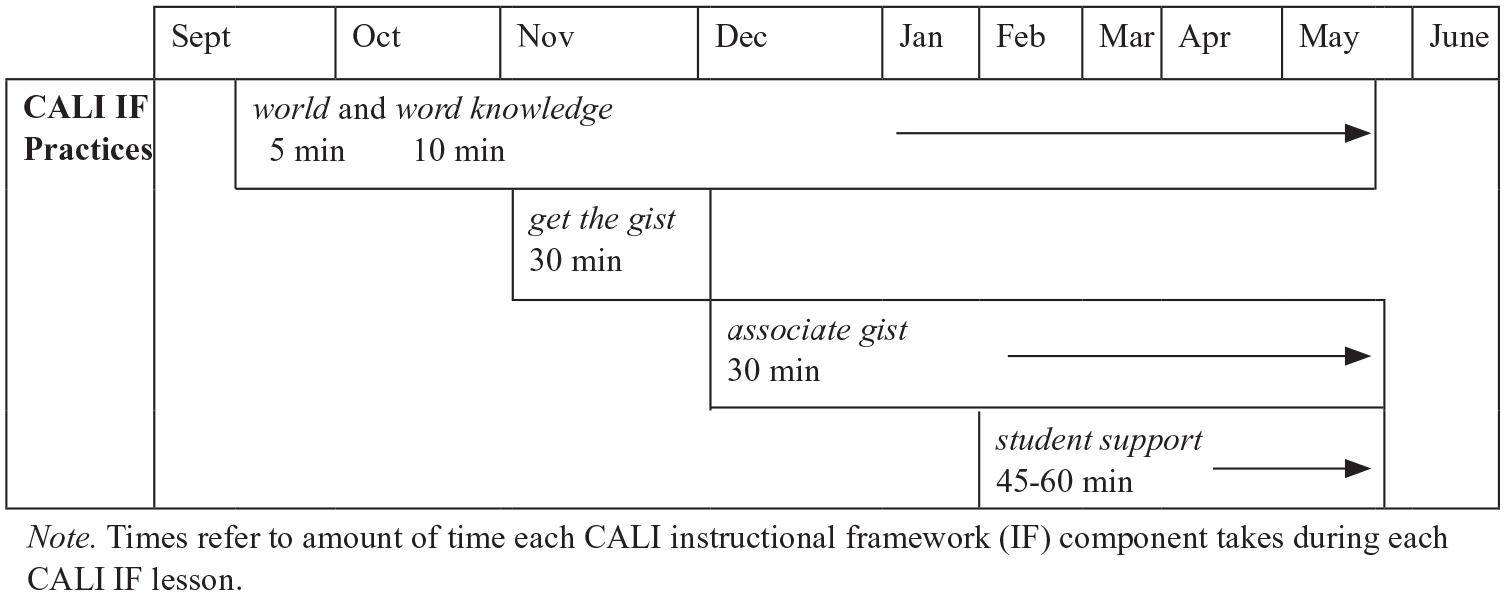
Suggested schedule for integrating CALI IF practices across the year.
Planning Tip 3: Determine Roles
Recent observational study research confirms that the special education teacher typically takes on a subordinate role in the co-taught classroom (Wexler et al., 2018). This may, at least in part, be a reflection of the lack of planning co-teachers put into what role each teacher plays in instruction. In an ideal co-taught service delivery model, the roles that content-area teachers and special education teachers play in planning and lesson implementation should capitalize on the strengths each teacher brings to the classroom (Lemons et al., 2018). For example, because the special education teacher presumably has unique training in how to provide specialized instruction to students with LD, co-teachers should plan their lessons accordingly (i.e., allowing the special education teacher ample opportunities to deliver this type of instruction). However, the content-area teacher may have deep content knowledge that enables the smooth delivery of parts of a lesson that require such knowledge. Therefore, the co-teachers should also plan to capitalize on this specialized knowledge.
Not only should the role of each teacher in delivering literacy-focused lessons be predetermined during planning sessions, but this process should be dynamic such that each teacher’s role may change depending on the objectives of a lesson and the knowledge and skills of each teacher. As mentioned earlier in the section “Planning Tip 2: Integrate Evidence-Based Practices,” strategically determining the role of each teacher for planning and implementation of each lesson can help ensure the smooth delivery of the instruction, resulting in high levels of fidelity.
Determining the Roles of Co-teachers: Planning
Planning for instruction of any lesson takes time but is essential for making sure that teachers implement lessons with high fidelity (Benner et al., 2011). Before actual planning begins, co-teachers should discuss and adopt one of the following planning techniques: (a) Work together, (b) divide and conquer, or (c) take the lead. These planning techniques can apply to any adopted literacy practices in a co-taught classroom. The template incorporates ways for co-teachers to plan required content for each practice as well as logistical information, such as which co-teacher will implement each portion of a lesson.
Work together
The most traditional planning technique is for both teachers to work together in person during a mutual planning period. Although working together in person can have team-building benefits, because co-teachers rarely have planning periods together (Sinclair et al., 2018), an alternative is for co-teachers to fill out a shared lesson plan template independently on their own time in a shared word processor (e.g., Google Doc). In this scenario, co-teachers collaborate electronically by each using a template to document their plans, asking their partner questions, and making comments. Co-teachers can also use other technology that allows them to plan together at the same time (e.g., Skype, Zoom).
Divide and conquer
Because co-teachers often have busy schedules, it is likely that they may have to divide and conquer lesson planning, and there are many ways to do this. Put simply, this typically entails one teacher planning one portion of a lesson (e.g., world knowledge) while the other teacher takes on the planning of another portion of the lesson (e.g., word knowledge). Ideally, teachers should have an opportunity to review the portion of the lesson plan that their co-teacher planned prior to implementing the lesson.
Take the lead
The last planning technique involves one teacher taking the lead on planning a lesson, whereas the other has an opportunity to make modifications. For example, in the interest of time or because the lesson requires deep content knowledge, the content-area teacher may take the lead on a certain lesson, whereas the special education teacher incorporates specialized instruction for students with LD.
Co-teachers can choose to use the same planning technique each time they plan for a literacy-focused lesson, or they can change their technique. The goal is to find one or more methods that work for both teachers while allowing them to master the content and be familiar with their roles during the lesson prior to implementing it.
Determining the Roles of Co-teachers: Implementation
In addition to determining co-teachers’ roles in lesson planning is determining each teacher’s role in lesson implementation. Several co-teaching models (e.g., team teaching; see Sinclair et al., 2018, for a review of common co-teaching models) exist, and each has implications for the role each teacher has in implementing a lesson. Co-teachers can use a variety of co-teaching models to implement their literacy-focused lessons. For example, when introducing world and word knowledge in a CALI instructional framework lesson, co-teachers might choose to use team teaching in which they both teach the lesson in tandem. In another lesson, the same co-teachers might choose to implement the lesson using one-teach-one-assist in which one teacher is leading the lesson and one teacher is assisting in some way. In fact, the only prescribed co-teaching model for a CALI instructional framework lesson is for co-teachers to use station teaching when implementing student support lessons (see Lyon et al., 2021). The CALI lesson plan template allows co-teachers to record which co-teaching model they plan to use during each lesson and who will implement each component within the model.
Planning Tip 4: Select Text
Text becomes increasingly complex at the middle school level (Swanson & Wexler, 2017). Given that co-taught classrooms contain students with LD who typically struggle with reading and comprehending text, as well as typically achieving students, it is important for co-teachers to carefully select or adapt text for literacy-focused lessons so that it is accessible to all students. As explained in the section “Planning Tip 2: Integrate Evidence-Based Practices,” the text that co-teachers use can be (a) already required in the curriculum, (b) another text that meets the same objectives but is on a lower reading level, or (c) text that supplements the content in the unit of study. Text selection guidelines that co-teachers can use to implement a CALI instructional framework lesson are described.
Covers Key Concepts
Co-teachers should select text that supports lesson objectives and links to content standards. For example, consider a seventh-grade co-taught English language arts class where co-teachers are teaching a unit on the civil rights movement and reading the novel The Lions of Little Rock by Kristin Levine, a story that deals with delicate segregation issues. The co-teachers in this class might choose to supplement the content in this novel by selecting another text about civil rights issues from Readworks (2014): Civil Rights on a City Bus. This text covers key concepts in the co-teachers’ unit on the civil rights movement by teaching students about Rosa Parks and her important contribution to the Montgomery bus boycott that fought against segregation. It also links to content standards (e.g., CCSS.ELA-LITERACY.RI.7.3; Analyze the interactions between individuals or events, or how individuals influence ideas or events).
Is Comprehensible
The next set of text selection guidelines focuses on helping co-teachers make sure that the text they select to use is comprehensible for the students in their classroom. Although the point of using evidence-based literacy practices such as those in the CALI instructional framework is to enhance student comprehension of the text, it is important to ensure that the text is not too far above or below their average instructional level.
Average instructional length
The first criterion related to comprehensibility of text is that the text teachers select is at their students’ average instructional level. There are several ways to do this, but one relatively simple way is for teachers to identify the Lexile band that matches the average instructional level of the class and then identify or adapt texts so that they fall within that Lexile band. If a co-teacher is unsure of what Lexile band to use, she can access several online resources to help (e.g., https://www.lexile.com). For example, the average instructional level for a class is fifth grade. According to lexile.com, the Lexile band for reading at a fifth-grade level is 950 to 1255. Civil Rights on a City Bus (Readworks, 2014) has a Lexile level of 1090. Thus, it falls within the appropriate Lexile range for this class.
Unknown vocabulary words
When students do not know the meaning of a majority of the vocabulary words in a text, they are less likely to comprehend the overall meaning of the text (Tunmer & Chapman, 2012). Therefore, the second criterion to meet to ensure that text is comprehensible is for the text to contain few unknown vocabulary words. For CALI IF purposes, unknown vocabulary words include academic words (e.g., analyze) or content-specific words (e.g., boycott) that are essential to understanding the text. In addition, a word is considered to be unknown when most students would be unable to explain the word or determine its meaning easily in context.
Although the CALI instructional framework requires co-teachers to provide direct instruction in essential vocabulary before students engage in reading text (i.e., word knowledge), it is still important to make sure that the text does not include too many unknown words. If there are too many words that are unknown in a text, it is a clear sign that the text is too difficult (e.g., the Lexile level is too high), and the co-teachers should select another text. When co-teachers can verify that no more than 10% of vocabulary words in a text are likely unknown, they can be sure that the text meets the criterion of having few unknown vocabulary words. To determine whether a text meets this criteria, co-teachers can take the following three steps.
Step 1: Read through the text and make a list of words that are essential for understanding the text. In Article 2 of this special issue (see Kearns et al., 2021), the authors explain how there can be useful words (i.e., words commonly used across content areas) or text and content-specific useful words (i.e., words that are useful to understand the text but less helpful outside of the content area or text).
Step 2:Eliminate words from the list. To eliminate words, co-teachers can ask themselves questions to determine whether their students likely already know the words (e.g., Have we already taught this word? Are students likely to figure out the meaning of this word because it is related to other words they know? Is there context in the text that can help students figure out the meaning of this word?). When there is context provided in the text itself to help students determine the meaning of a word, the co-teachers can consider an otherwise challenging word to be a known word. For example, consider the following sentence from the Civil Rights on a City Bus (Readworks, 2014) text: “For violating the laws of segregation, referred to as the ‘Jim Crow laws’ (which were meant to keep White people and Black people separate), Rosa was arrested and fined.” The word “segregation” is one that middle school co-teachers might consider an unknown word. However, because the author defines the word directly in the sentence, the co-teachers can consider this a known word. However, consider the word “boycotted” in the sentence, “In response to Rosa’s arrest, Blacks in the city of Montgomery boycotted the public bus system for more than a year.” “Boycotted” is a word that co-teachers can consider unknown. Not only do the co-teachers confirm that they did not previously teach this challenging word to the students, but the author also did not provide any context to help the reader determine the meaning.
Step 3: Calculate the percentage of vocabulary words that are unknown (i.e., the words that are remaining on the list). For example, if co-teachers listed 10 important vocabulary words and only one was unknown, co-teachers can consider 10% of the words to be unknown, and thus, this text meets the CALI IF text selection guideline of having few unknown words.
Obvious organizational structure
One way that students can enhance their comprehension of text is to use features of the text itself (e.g., headings; Fisher et al., 2008). Therefore, the last criterion included in making sure a text is comprehensible is for the text to have an obvious organizational structure. This means that the text has (a) short, clear paragraphs; (b) section breaks; and (c) headings when possible. For example, in CALI instructional framework lessons, co-teachers guide students in using the text’s organizational structure when students are directed to generate the main ideas of different sections of the text. Co-teachers can adapt the text and add in their own headings or section breaks if the text is ideal in other ways but lacks clear sections.
Promotes Student Engagement
To improve students’ ability to read and comprehend complex text, it is important for teachers to use strategies to enhance motivation to read and engage with text. Therefore, the final text selection guidelines help co-teachers decide whether the actual text they choose to use in their literacy-focused lessons will promote student engagement. First, co-teachers should determine whether the text is a manageable length (i.e., about two pages or 1,000 words). Using a text that is not much longer than two pages will decrease the likelihood that students will disengage, while providing enough content for co-teachers to use for a full lesson.
Teachers should also determine whether the text is worthy of a good conversation. To determine this, co-teachers can ask themselves the following: Does the text link to other ideas we are teaching in the unit? Is the text intriguing in a way that will excite students? Does it have an interesting style (e.g., written from an interesting point of view)? Will the text generate helpful discussions that can enhance learning of the overall unit we are teaching? Does the text clarify content related to the overall unit we are teaching? For CALI instructional framework lessons, it is not necessary for co-teachers to answer “yes” to all of the questions posed, but a text should meet at least several of these criteria.
Conclusion
It is essential for middle school co-teachers to integrate evidence-based literacy instruction into their content-area instruction. Implementing literacy-focused lessons can help students with LD improve content learning and overall reading comprehension of complex content-area text. Co-teachers should adopt a set of evidence-based literacy practices and engage in thoughtful planning about how they will most effectively implement these practices. Middle school co-teachers can refer to the four planning tips and the CALI instructional framework examples presented in this article. In doing so, they will be able to plan and implement the adopted practices effectively.
Footnotes
Declaration of Conflicting Interests
The author(s) declared no potential conflicts of interest with respect to the research, authorship, and/or publication of this article.
Funding
The author(s) disclosed receipt of the following financial support for the research, authorship, and/or publication of this article: This project was supported, in part, by Grant R324A150181 from the U.S. Department of Education, Institute of Education Sciences. Opinions expressed in the article are those of the authors and do not necessarily represent the position of the U.S. Department of Education, and no official endorsement by it should be inferred.
