







Abstract
The Individuals With Disabilities Education Act requires schools to conduct a manifestation determination (MD) meeting when suspending students with disabilities for more than 10 days. The MD procedure is intended to safeguard educational access by providing a process to determine if a student’s disability is related to the suspending behavior. An accurate decision requires educational team members to effectively collaborate to review relevant data and the student’s Individualized Education Program. Collaborative and proactive solutions (CPS) offer a framework for collaboration that may ensure that all team members meaningfully participate during the MD meeting while encouraging a rigorous analysis of student-specific data. The use of CPS is proposed as a framework to generate meaningful collaboration in MD meetings, which may result in positive student outcomes that reach beyond merely addressing a behavioral violation.
In 2015–2016, approximately 702,000 students receiving special education services were excluded from school due to challenging behaviors described as student misconduct (U.S. Department of Education, Office for Civil Rights, 2019). Notably, students with disabilities are more than twice as likely to be suspended as their typical peers (U.S. Department of Education Office for Civil Rights, 2014). There are two major points of concern with using suspensions for addressing student misconduct. First, federal legislation and regulations, such as the Individuals With Disabilities Education Improvement Act (IDEIA, 2004) and Section 504 of the Rehabilitation Act (1973), discourage the use of reactive disciplinary procedures (e.g., suspension, expulsion) in addressing student misbehavior. Furthermore, legislation and regulations encourage the use of proactive strategies, such as functional-behavioral assessments (FBAs) and positive behavior intervention plans (BIPs). Second, school suspension can lead to negative outcomes for the student such as repeated suspensions (Fabelo et al., 2011); decreased academic outcomes, which is an indicator of the likelihood for a student to drop out of school (Perry & Morris, 2014); and future incarceration (Loosen et al., 2015). As the fictionalized account that follows illustrates, suspension acts much like a “band-aid” to address a behavioral concern. Simply put, while school suspensions temporarily address problem behaviors through punishment and removing the student from the school, school suspensions provide little to no support for student growth as a result of a behavior incident.
Michelle is a first-year special education middle school teacher. One of Michelle’s sixth-grade students, Henry, qualifies for special education services as a student with a serious emotional disability. Recently, Henry broke one of the school rules by pushing a peer to the ground in his PE class. This led to yet another out of school suspension and a manifestation determination meeting conducted by his educational team this year. Michelle found this to be extremely concerning, given that it is only 3 months into the school year and Henry has already been suspended a total of 26 school days. Although Michelle participated in all of Henry’s MD meetings held earlier this school year, she didn’t feel that anything had changed for Henry. Despite all the meetings and multiple suspensions, Henry continues to struggle to receive a free, appropriate public education (FAPE). Michelle is concerned that Henry’s team is simply “checking off” the boxes that are legally required for the MD meeting rather than truly working together to identify Henry’s needs and supports. Looking for answers to support Henry, Michelle explored his previous discipline records and cumulative file only to discover that this pattern of suspensions occurred in past years as well. Michelle begins to wonder if Henry’s team needs more support to critically evaluate how Henry’s disability affects his behavior through the MD process. After looking through the data, Michelle decided that this meeting would be different from the others. She planned to include all team voices and ensure rigorous data analysis and documentation of Henry’s needs and behaviors in relationship to his disability. Michelle was confident that this was the most appropriate direction to best address Henry’s needs (see Note 1).
Manifestation Determination Explained
In the Individuals With Disabilities Education Act (IDEA) Amendments of 1997, Congress addressed the discipline of students with disabilities. One provision of the IDEA requires that school district personnel conduct a manifestation determination (MD) when taking certain disciplinary actions against a student with disabilities. Essentially, the MD is an evaluation of the relationship between a student’s disability and the student misbehavior that caused the disciplinary action. The 2006 regulations to the IDEA required that the MD be made within 10 days of any decision to change the placement of a student with disabilities because he or she violated the school’s code of student conduct (34 CFR § 300.530 (c)). Each public agency is tasked with evaluating what constitutes a change of placement on a case-by-case basis (§ 300.536 (b)(1)) using the following criteria: (a) the removal is more than 10 consecutive school days (§ 300.536 (a)(1)) or (b) the student’s cumulative removals demonstrate a pattern because they total more than 10 days in a year (§ 300.536 (a)(2)(i)), the behavior is substantially similar to the student’s behavior in previous removals (§ 300.536 (a)(2)(ii)), and by considering the length of each removal, the total amount of time the child has been removed, and the proximity of the removals to one another (§ 300.536 (a)(2)(iii)). It is important to familiarize oneself with the state and district policies regarding change of placements because many districts provide detailed procedures for clarifying the legal requirements. Team members may formally disagree with the MD outcome through due process and judicial proceedings (§ 300.536 (b)(2)).
The purpose of the MD provision was to ensure that students with disabilities are not being excluded from educational opportunities due to factors that relate to their disability. Relevant MD team members are identified by the parent and school and convene to collaborate by analyzing relevant student information and behavioral data. These data include the student’s file, Individualized Education Program (IEP), student observations, and any relevant information provided by the parent to answer two primary questions: (a) if the conduct in question was caused by, or had a direct and substantial relationship to, the child’s disability (IDEA, 34 CFR § 300.530 (e)(1)(i)); or (b) if the conduct in question was the direct result of failure by the local education agency (LEA) to implement the IEP (IDEA, 34 CFR § 300.530 (e)(1)(ii)). When teams are able to answer yes to either of the two-prong MD questions, they are required to return the student to their current educational setting or follow IEP procedures to discuss a more intensive service delivery model. However, when teams answer no to both of the two-prong MD questions, thereby finding that the student’s behavior is not related to their disability and that the behavior did not result because of a failure to implement the IEP services, then the school district can impose the same disciplinary sanctions, such as suspension, as for a student without a disability (IDEA, 2004). The MD provision is inherently flawed as there is no empirically validated method that can be utilized to link the student’s behavior and their disability (Katsiyannis & Maag, 2001). Therefore, it is essential that teams are provided the necessary collaborative frameworks to support a thorough discussion of the student’s relevant data and make determinations based on the student’s unique needs. After all, the MD decision-making process directly affects educational access for students who demonstrate behavior challenges that warrant discipline procedures.
A number of factors can influence team decision-making during the MD process. First, educators sometimes engage in behaviors that minimize parent involvement, such as using jargon/acronyms and exhibiting power-over-parent behaviors during meetings (Cavendish & Connor, 2018; Elbaum et al., 2016; Mueller et al., 2019; Zeitlin & Curcic, 2014). Second, biases from each member of the team can directly impair the collaborative process, leading team members to withhold pertinent information (Esquivel et al., 2008). For example, consider how documentation may be interpreted or analyzed for the members of Henry’s MD team who are tired of class being interrupted, feel the school is unable to support Henry’s needs, or who have already concluded there is no link between his behavior and disability. Third, the challenges of navigating the MD process require a level of knowledge, rigor, and robust analysis that many educators are simply not prepared to conduct (Lewis, 2017). For example, when determining an MD, many team members struggle with the fundamental understanding of disabilities, especially those encompassing emotional and behavioral needs (Katsiyannis & Maag, 2001). Fourth, there is a lack of empirically validated methods that allow educators to objectively link disabilities and cause of behavior (Katsiyannis & Maag, 2001; Walker & Brigham, 2017). Unfortunately, short of providing the two aforementioned guiding questions that must be answered, the law provides minimal guidance to support the data-driven team decision-making process that is necessary to adequately answer the questions (Zilz, 2006).
A Framework for the Manifestation Determination Process
In light of the aforementioned barriers to a meaningful MD meeting, there exists a framework that can be used to support meaningful collaboration throughout the MD process with the intent to generate thoughtful dialogue that could aid in granting all team members, despite varying levels of behavioral knowledge, meaningful participation during the meeting. Specifically, the use of collaborative and proactive solutions (CPS) is proposed as a framework to generate meaningful collaboration in MD meetings that can result in positive student outcomes that reach beyond merely addressing a behavioral violation. Collaborative and proactive solutions use a team approach designed to identify how best to support a student with behavioral concerns (Greene, 2008). Although originally intended as a proactive collaborative framework for promoting student skill development while working with a student who exhibits challenging behavior, it also provides a viable framework for MD meetings. Collaborative and proactive solutions use a scaffolded framework that promotes meaningful dialogue for all team members to contribute to the understanding and solutions that may affect student behavior. This approach often leads to enhanced team relationships, improved communication, increased empathy and perspective taking, disagreements without conflict, and honesty (Greene, 2019). See Table 1 for an application example of how CPS and MD meetings align.
Alignment of CPS Strategies and MD Procedures.
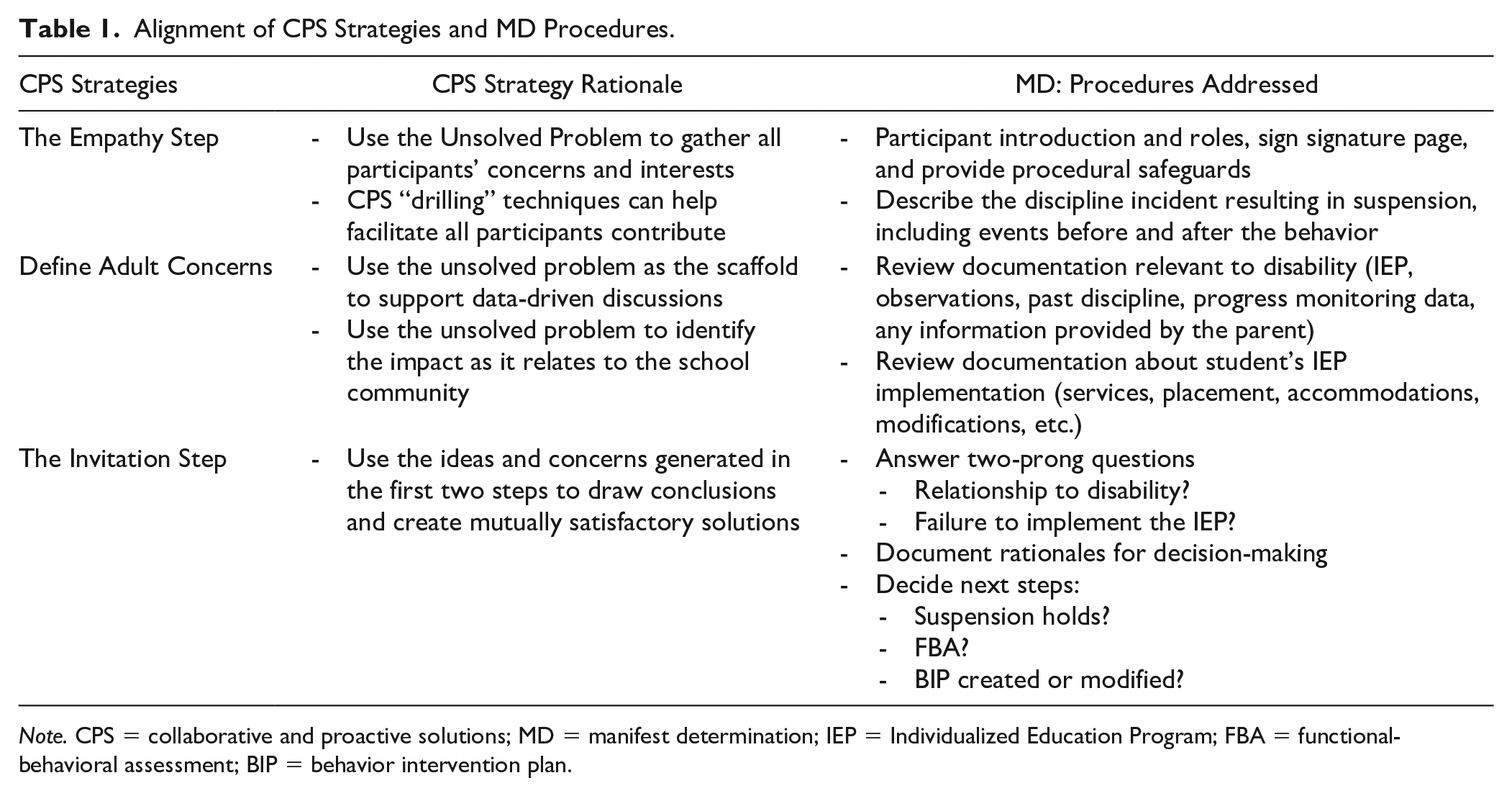
Note. CPS = collaborative and proactive solutions; MD = manifest determination; IEP = Individualized Education Program; FBA = functional-behavioral assessment; BIP = behavior intervention plan.
The CPS practice was originally designed and promoted for individualized student behavior assessment and planning in the classroom by organizing three different plans for addressing problem behaviors, referred to as Plan A, Plan B, and Plan C. In a CPS model of collaboration, Plan A is used minimally and saved only for situations that directly and immediately relate to ensuring safety.
Plan A can best be described as unilateral adult-imposed consequences. Many students with challenging behaviors may have a number of expectations they are struggling to meet. It can be necessary to prioritize the most important and make modifications to the other expectations that are less important.
Plan C has its place in the CPS model by providing an option to prioritize the skills and unsolved problems you want to address first. Because IDEIA codified a procedural practice for the MD meeting, the remainder of this article focuses on the CPS Plan B, because it provides a comprehensive and meaningful collaborative framework for understanding and addressing student behavior (Greene, 2008) that can be repurposed and used within MD meetings, and simultaneously used in conjunction with positive behavior interventions and supports, as outlined in IDEIA (2004). Specifically, the proposed MD model encompasses the essence of the CPS model in three major steps.
The empathy step, in which the adult or facilitator is investigating or “drilling” for information, ideas, and student/team member perspectives;
The defining the adult concerns step, in which the adult shares concerns regarding any unmet behavioral expectations;
The invitation step, which includes the creation of mutually satisfactory conclusions and solutions to the behavioral problem/incident such as any information gathered from the empathy and adult concerns stage of the collaborative process (Greene, 2008).
The Empathy Step
The crux of this step includes the MD team sharing concerns, perspectives, and information related to the unsolved problem that resulted in the suspension. Via communication “drilling” techniques, the team uses several strategies to generate more information that can assist MD meeting facilitators in gathering necessary information from all team members about the events that precede the student’s unsolved problem. These techniques can include asking or answering reflective and clarifying statements; asking questions related to the who, what, where, and when of the unsolved problem; asking why the problem occurs in one instance but not in others; breaking the problem into smaller parts; discrepant observations; and tabling and summarizing relevant data. For example, facilitators may use reflective listening; clarifying; asking about the who, what, where, and when of the unsolved problem; and summarizing participant ideas (Greene, 2008). Using the unsolved problem and drilling techniques, the empathy step of the MD meeting facilitation encourages the team to collect information about the incident that resulted in the suspension and what participants know, or think they know, about the student that might be contributing to the problem behavior.
For example, one teacher may share that Henry is being picked on by one of the boys in his PE class. This would be helpful in determining supports needed for Henry in his PE class. Other examples might include the team collectively sharing concerns about Henry’s emotional regulation.
The Adult Concerns Step
Team member concerns related to the relevant data are brought to the meeting to explore connections between the unsolved problem resulting in a suspension and the student’s disability, as well as the IEP implementation (Greene & Winkler, 2019). To encourage a thorough analysis of student needs and possible patterns of behavior, discussion of two categories of adult concerns are brought forward: (a) the impact of the unsolved problem on the student and (b) how the unsolved problem is affecting other people (e.g., peers and staff).
It is during this step that the team is able to highlight relevant data, or lack thereof, as they relates to the student’s disability, services, and history (impact on the student), as well as any other concerns regarding the impact of the unsolved problems on the school community. Because the primary purpose of this framework involves honoring the intent of the legal provision through meaningful data analysis and team discussion of the unsolved problem behavior, it is essential that the team not immediately jump into discussing solutions to the problem (Greene, 2008) or attempt to answer the two required MD questions yet. Rather, this step is solely used for analyzing data and visually noting trends. Consequently, the facilitator should be prepared to go back to meeting norms, the agenda, or CPS drilling techniques, to gather all the necessary and relevant information from the data brought to the meeting, including any additional concerns. Finally, this step ensures all necessary information is included to support making mutually satisfactory decisions about the manifestation of the student’s disability, IEP implementation, and identifying next steps to support the student.
The Invitation Step
The final step involves the team concluding their collaborative efforts and developing a proposed solution that addresses all concerns. The perspectives generated in the first two steps should drive the final invitation step. It is during this final step that the team will answer both MD questions and determine mutually agreed upon next steps for supporting the student. If an educational team determines that the student’s behavior is not a result of the disability, or is not the result of the district’s failure to implement the IEP, then a student can be disciplined in the same manner as a student without a disability (IDEA, 34 CFR § 300.530 (c)). However, teams that use CPS as an MD facilitative tool will collect valuable information beyond the relationship of the student’s disability to the behavior and IEP implementation. The CPS model also allows teams to plan beyond the meeting to use shared perceptions and concerns collected during the meeting to develop a plan of support with the student. Using CPS as an MD facilitative tool takes these meetings beyond answering the questions to creating solutions that can support the student despite the outcome. For example, if Henry’s MD team answered “no” to both MD questions, there is still information about the factors that set the stage for the challenging behavior; thus, teams can use that information to work with the student to build a plan of supports that may decrease the future likelihood of the behavior, while promoting new skills. Furthermore, if the team determines the IEP has not been implemented, they can draw from the information gathered in the empathy step and the adult concerns to make a plan for remedying this deficiency. Five tips for using CPS as an MD facilitative meeting tool follow
Pre-plan as much as possible before the meeting by connecting with each team member, gathering relevant data (i.e., IEP, discipline records, progress monitoring, evaluation records), and explaining the legal and meeting purpose and procedures.
Practice and master the CPS “drilling” techniques: You will drill throughout the entire MD process, not just when you gather the team’s concerns.
Be sure to use unsolved problem language to describe the incident resulting in suspension throughout the entire process as you are asking for each member to contribute at each step (e.g., “Henry is having difficulty keeping his hands to himself when agreeing on rules for soccer during physical education class”). Remember objective language is necessary.
Use visuals for each step. This will ensure all concerns and ideas are at the forefront of discussion, and create opportunities to address these concerns with relevant student data.
Your goal is collaboration. The meeting is not over until a solution is created upon which all team members can agree and are willing to try. In other words, the MD decision may be “no” for both questions; however, you still want to find ideas to support student behavior.
Meanwhile, if the team determines that the behavior resulting in a suspension is related to the students disability, the team must, if one hasn’t already been conducted, complete an FBA (IDEA, 34 CFR § 300.530 (f)(1)(i)) to identify triggers, consequences, and the overall function of what a student accesses (i.e., positive reinforcement) or avoids (i.e., negative reinforcement) through the problem behavior so that a more appropriate replacement behavior can be taught (Maag & Katsiyannis, 2006). Using the FBA, a BIP must then be created or updated to decrease the behavior that resulted in the suspension (IDEA, 34 C.F.R. § 300.530 (f)(1)(ii)). An FBA and resulting BIP provide environmental adaptations, identification of target behaviors requiring instruction, a plan for teaching replacement behaviors to decrease target behaviors, as well as consequences to strengthen the intervention. Finally, for those situations in which the MD team determines the district failed to implement the IEP, the LEA must take immediate steps to remedy any deficiencies (IDEA, 34 C.F.R. § 300.530 (e)(ii)(3)). Unless the IEP team agrees to a change of placement through the BIP, the student is returned to the placement from which they were removed (IDEA, 34 C.F.R. § 300.530 (f)(2)).
Conclusion
Regardless of the MD outcome, students benefit cognitively, academically, socially, and emotionally when parents and schools work together (Weiss et al., 2010). Collaborative and proactive solutions provide a framework that fosters parent and school partnerships by creating mutually satisfactory solutions that all members of the team are willing to try due to the solutions containing important aspects of each team member’s concern(s). It is important to note that the solutions are not always every team member’s best-case scenario; however, mutually satisfactory solutions should contain elements that each member sees as valuable, agreement from each member with a willingness to try, and a follow-up plan to review student progress. Essentially, CPSs offer a framework that allows teams to move beyond merely addressing the legal MD process; instead, it combines the letter and intent (the heart of the law) to meaningfully support behavior skill development as a team. See Figure 1 for a flowchart outlining each step of the MD process and correlating CPS step.
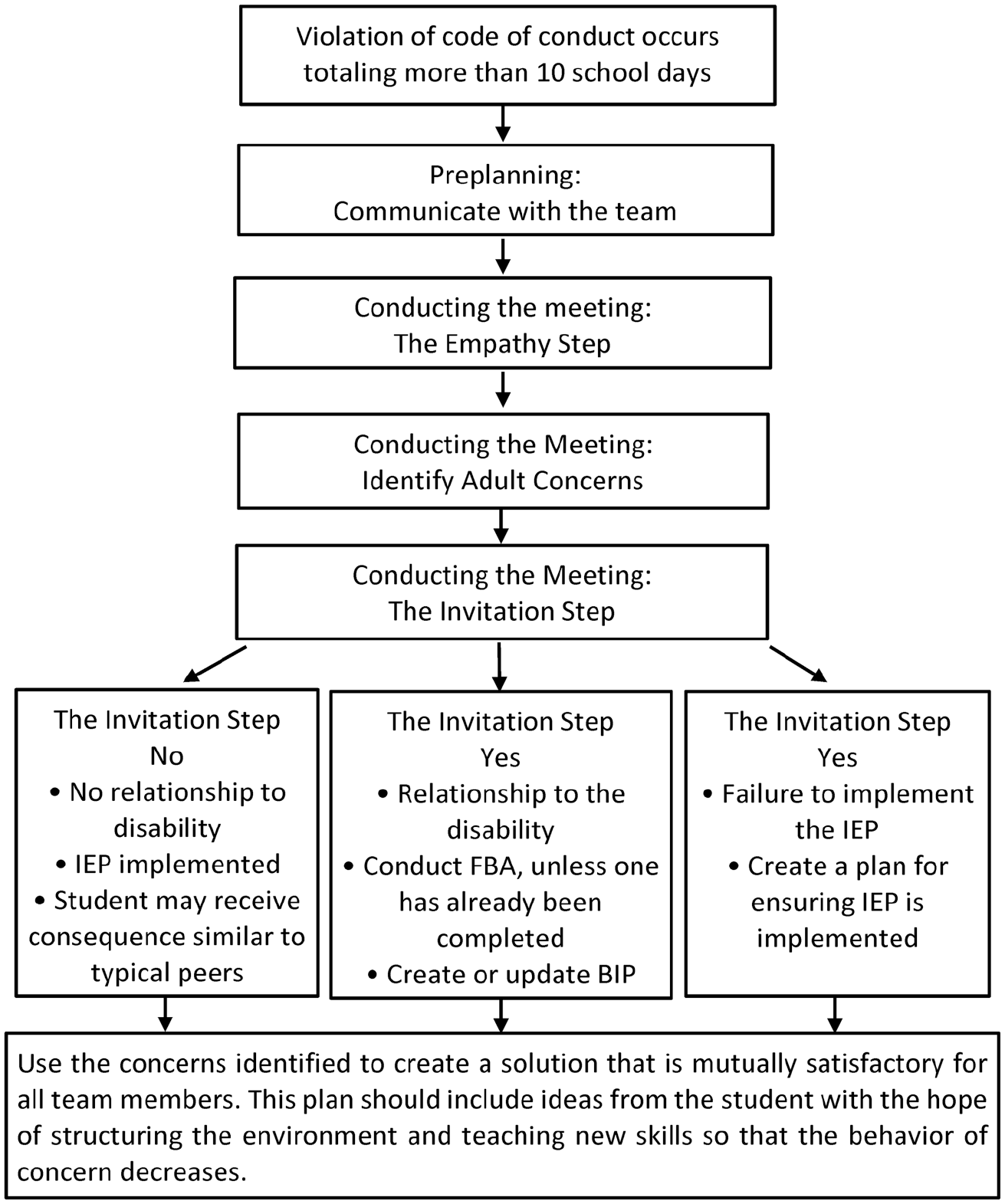
Combining MD procedures and CPS facilitation.
The current MD standard is subjective in nature and is vulnerable to team biases, thereby making it a complicated process to implement (Lewis, 2017). Despite the inherent limitations associated with the current MD process, when the CPS framework is used for MD facilitation, it not only supports the team decision-making process, it also enables student skill deficits to be more effectively supported in the long term. Indeed, MD teams who incorporate each members’ perceptions, concerns, and ideas along with a rigorous analysis of student data are better equipped to honor the intent of the law, thereby increasing an opportunity to safeguard FAPE (IDEA, 34 CFR § 300.530 (c)). See Table 2 for additional CPS resources.
Additional Resources.
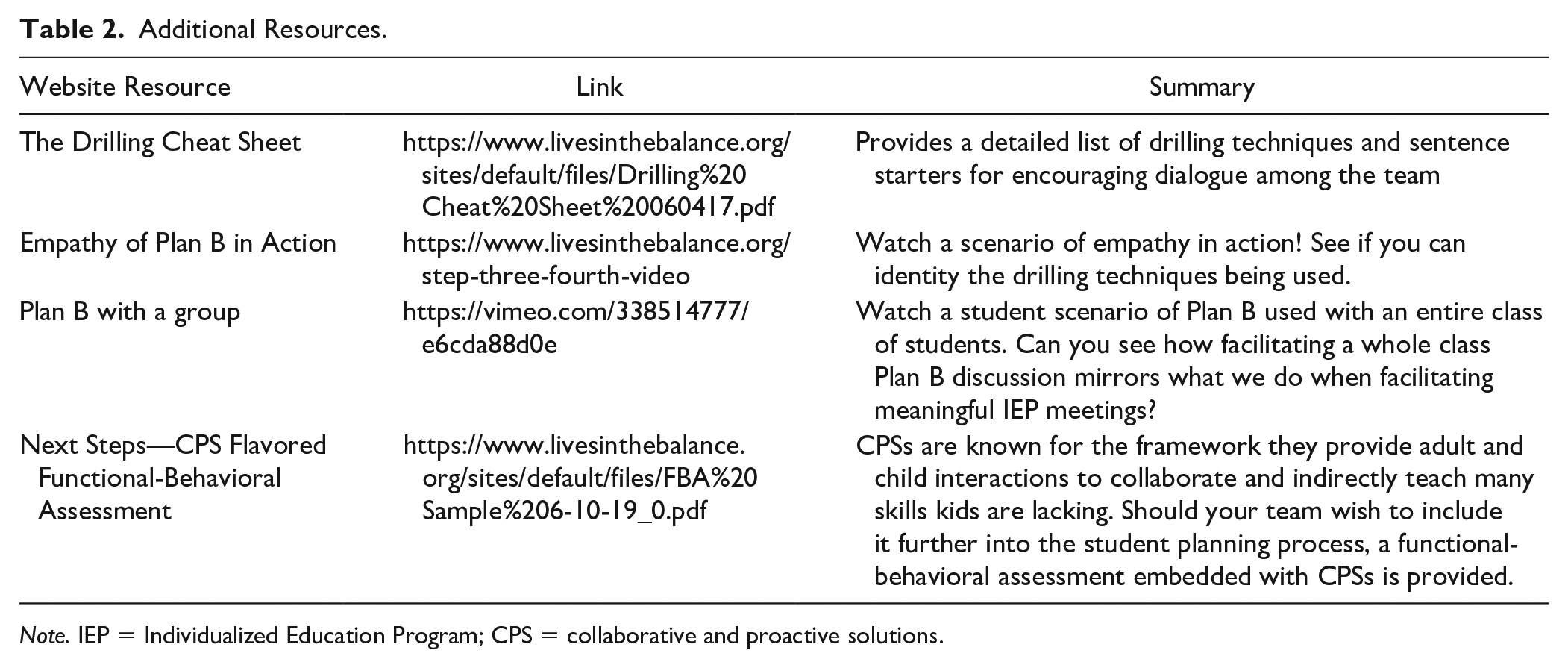
Note. IEP = Individualized Education Program; CPS = collaborative and proactive solutions.
Footnotes
Declaration of Conflicting Interests
The author(s) declared no potential conflicts of interest with respect to the research, authorship, and/or publication of this article.
Funding
The author(s) received no financial support for the research, authorship, and/or publication of this article.