







Abstract
Dave L. Edyburn, PhD, is a professor emeritus in the Department of Exceptional Education at the University of Wisconsin-Milwaukee and more recently the associate dean for research in the College of Community Innovation and Education at the University of Central Florida. His teaching and research interests focus on the use of technology to enhance teaching, learning, and performance. He has authored more than 175 articles and book chapters on the use of technology in special education, and his work represents a variety of contributions to theory, research, policy, and practice.
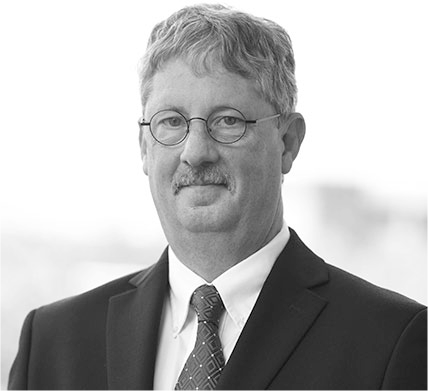
Dr. Dave L. Edyburn has served as editor of several journals, including Journal of Research on Technology in Education, Learning Disability Quarterly, Remedial and Special Education, Special Education Technology Practice, and Teaching Exceptional Children. He has held several national leadership positions, including president of the Pioneers Division and Technology and Media Division of the Council for Exceptional Children (CEC), founding president of the Special Education Technology Special Interest Group (SIG) in the International Society of Technology in Education, and chair of the American Education Research Association’s Online Teaching and Learning SIG. He has received numerous awards, including Distinguished Alumni awards at Illinois State University and the University of Illinois, the Georgia Tools for Life Award, the International Society for Technology in Education SIG-TE Award, and most recently, the 2020 Romaine P. Mackie Award for “outstanding leadership” from CEC. This interview with Dr. Edyburn reveals a multifaceted and successful professional life as a university professor, an educational entrepreneur, and university administrator.
Looking first at your life as a professor, teaching at university, writing grants, conducting research, and of course writing for publication; which of these three jobs do you identify with most? As a follow up, how have you dealt with these competing requirements of life in academe.
Among the things I enjoy the most about being a professor are the multiple domains of responsibilities. However, the challenge is reconciling all the demands of teaching, research and scholarship, and service, each of which can be a full time job. Early in my career I was given some advice by Larry Johnson (dean, University of Cincinnati) about the need to figure out how to triangulate the three areas of professorial responsibilities in order not to have three full-time jobs.
To this end, I’ve found synergy. My teaching is informed by my professional development work with in-service teachers who inspire me with the authentic problems of practice that they were ill-prepared to address. This helps me guide my current students. Similarly, my research is new knowledge that I can bring to my current students and in-service teachers who desire new ideas. I especially enjoy my research-to-practice writing where I try to connect models and frameworks with tools and classroom practices.
You’ve always had your finger on the pulse of new technological innovations and thinking. How have you managed to keep up with—and often be ahead of—this rapidly changing field?
You are very kind. I spend a great deal of time reading outside of the field of special education. Reading about new technologies, trends, and how futurists connect the dots is part of my routine reading.
One focus area early in my career was technology integration. This helped me think about ways in which we integrate curricula within and across subjects. My doctoral dissertation examined information retrieval (requiring me to learn about information science and databases) and individuals with disabilities. The overlapping of these two disciplines placed me in a space to learn about using online databases to answer factual questions we did not know. (If only I could have anticipated Google!) Overall, I would say reading widely enables me to integrate knowledge from many disciplines into my personal theories of how systems work and the consequences of incremental technology adoption as well as scenarios concerning disruptive technologies. Perhaps my biggest failures involve never engaging in Facebook or Twitter since I thought these would be passing fads!
You must have worked with many of the pioneers in the field of special education over the years. Who has had the most profound effect on you as a professional?
It’s interesting to think back about all the people one has met during their career. There are many people who’ve had a profound impact on my work at different stages in my career. Early in my doctoral studies there was Bob Henderson (University of Illinois), who played an important role in mentoring me. Ted Hasselbring recruited me to Vanderbilt University to direct the implementation research for the Adventures of Jasper Woodbury (https://jasper.vueinnovations.com/) video-based problem-solving curriculum, where I got to work with cognitive psychologist John Bransford and special educator Herb Rieth. This was an intense period of personal and professional development as I learned about academic excellence, research and development, and grant writing. During the middle part of my career, I was fortunate to work with a network of amazing people, including: Ed Blackhurst (University of Kentucky), Randy Boone (University of Nevada-Las Vegas), Jim Gardner (University of Oklahoma), Kyle Higgins (University of Nevada-Las Vegas), John Langone (University of Georgia), Rena Lewis (San Diego State University), Mary Male (San Jose State University), Cindy Okolo (Michigan State University), Roger Smith (University of Wisconsin-Milwaukee), and Cheryl Wissick (University of South Carolina). Each of these individuals inspired me, super-charged my productivity, and taught me about why we do what we do.
In addition to the regular or more traditional types of work associated with the professoriate, you have been engaged in other academic enterprises, including being an internationally known speaker, running an academic publishing company (Knowledge by Design, Inc.), and designing and creating educational software products. What triggered this foray into these extra-academic activities? And tell us a bit about each of these hats that you’ve worn over the years and which you are still wearing.
My experience at Vanderbilt taught me that sometimes we need to do development before research (D & R rather than R & D). By mid-career I had reached a point that some days working within the university was very frustrating. When I discovered how to establish my own publishing company, I felt liberated in having a new venue for creativity and innovation. My first product was a professional magazine, Special Education Technology Practice. I sought to apply all I had learned about publishing research-to-practice articles as editor of Teaching Exceptional Children to the field of special education technology. I published five issues each academic year (September–June). Looking back, I wonder where all that energy came from? After that we branched into books and interactive digital products. All of these activities created products and resources I could use in my teaching, share with in-service teachers, and apply to my scholarship. Owning my own business afforded me the opportunity to learn a lot about business, management, legal compliance, risk, strategy, taxes, and more. At the time, I did not realize how becoming an entrepreneur would contribute to my success as an associate dean for research and faculty development.
I continue to run my business. It’s been a great vehicle for publishing and consulting. We’ve been able to publish one new book a year. I am continuing to learn about web authoring and databases as we seek to create new digital products.
With a field as varied as assistive and instructional technologies to online teaching and learning, what is the area you believe has not been explored as well in terms of students with disabilities?
I spent a significant part of my career studying research methodologies concerning the use of technology to enhance learning. I’m disappointed that so little attention has focused on measuring the outcomes of assistive technology and universal design for learning. It is disconcerting to see how much professional energy is lost due to our propensity to chase the latest shiny object.
What are you most optimistic about in the field of special education technology?
Personalized learning holds so much promise. However, we need a deeper understanding of theoretical frameworks and learning analytics in order to create pathways for students to be successful. Helping students with disabilities be academically successful is a grand challenge that we should unite around as a profession in order to create personalized learning systems.
Why technology? How did this end up being your line of research?
As a teacher, I was involved in adopting microcomputers in our junior high school. At the same time, I was completing my master’s degree in reading and engaged in a research study on computer-based reading. I discovered these tools were very motivating for my struggling students with learning disabilities and that my traditional toolkit wasn’t powerful enough. I looked into graduate studies at University of Oregon and University of Illinois and ended up at the latter. My first post-doctoral position was at a state-wide special education technology center at the University of Missouri-Kansas City. My role was to support initiatives to capture the potential of assistive and instructional technology. From there I went to Vanderbilt University, where I coordinated the research for an innovative videodisc-based math problem solving curriculum. During that time, I learned the transformative power of development followed by research. I left Vandy for a tenure-track position at the University of Wisconsin-Milwaukee, where I spent the bulk of my career engaged in teacher preparation, grant writing, and publishing.
You have served as editor of several academic journals in the field of special education in addition to having started and edited your own journal. Which of these editorial positions brought you the most gratification? Which did you learn the most from?
My first editorship was Teaching Exceptional Children (TEC). It was extraordinarily rewarding as I was able to outline a vision to make the journal more timely, relevant, and transparent about journal operations. When I took over there was a significant backlog in manuscripts that had been accepted but not yet published. I sought to reduce the time required to complete reviews in order to make timely decisions for authors, remove the backlog, and make the content more relevant. I instituted a process for annual reporting to the readership to pull back the editorial curtain and allow the field to understand how many manuscripts were received each year, what percentage where selected for publication, and how long the entire process would take. We worked hard to ensure that all manuscripts would receive an initial decision within 6 weeks of submission, and that if a manuscript was accepted, that it would be published within 1 year of submission. Of course, none of this would have been possible without an excellent editorial board that I expanded and for which we created metrics to monitor our commitment to diversity when making these prestigious appointments. This first editorship was the most gratifying because of the vote of confidence I received from the Council for Exceptional Children to award this editorship to an assistant professor who had the audacity to anticipate that publishing could be transformed with technology. Perhaps there was a dose of smugness when I received the appointment and I went to inform my acting dean who had previously told me I couldn’t apply for the position—fortunately the application process did not require a letter of support from the institution so I didn’t need her permission or support to apply.
The focus of the journals that you have edited is quite diverse, ranging from unique research with Learning Disability Quarterly to the practitioner-focused TEC. Can you speak to the relative importance of these types of publications? And provide any interesting anecdotes from your time as an editor.
I think editing a research journal like Learning Disability Quarterly or the Journal of Research on Technology in Education is very straightforward. You are looking for things that fill a gap in the literature and have sufficient methodological rigor to advance the field. On the other hand, publishing practice-based journals like Teaching Exceptional Children and Special Education Technology Practice requires insight about what is of contemporary value. Here, there is much more attention to layout, design, sidebars, and embedded links to make the package interesting, relevant, and actionable.
My editorships afforded the opportunity for lots of personal growth. For example, how to write a personalized, and compassionate, rejection letter. How to deal with authors who are distressed about a review or editorial decision. How to motivate very busy reviewers to complete their review on time. And of course, how to provide authors with specific guidance about how to make revisions that will contribute to a final decision of acceptance.
I learned so much about the value of articulating and operationalizing a vision; the importance of communication with authors, reviewers, and publishing staff; the need to create systems that work efficiently but also provide an audit trail for trouble-shooting when things go awry; and the intoxicating reward of seeing each new issue return from the printer.
In 2014, when MOOCs were emerging in popularity, I realized that the opposite of a MOOC was mentoring. I created an online space (Dave Edyburn’s Informal Journal Editor Mentoring Program [DEIJEMP]; see Figure 1), where I could mentor faculty interested in becoming journal editors. I sent an invitation to members of the Journal of Research in Educational Technology asking if anyone was interested in learning about becoming a journal editor through a personal mentoring program I created. I received eight applications and accepted four. I created 42 lessons in five modules to introduce them to issues a journal editor would face. The intent was to help them demonstrate their knowledge and expertise about the role when they applied for a journal editor position. Years later it is very rewarding to know that all four participants have become journal editors since our work together. This experience is very rewarding and fulfills a responsibility when Jim Patton (Pro-Ed) once told me that “Editors hold the keys.” We open doors for people. Or, serve as gatekeepers to keep doors closed. Mentoring is so rewarding!
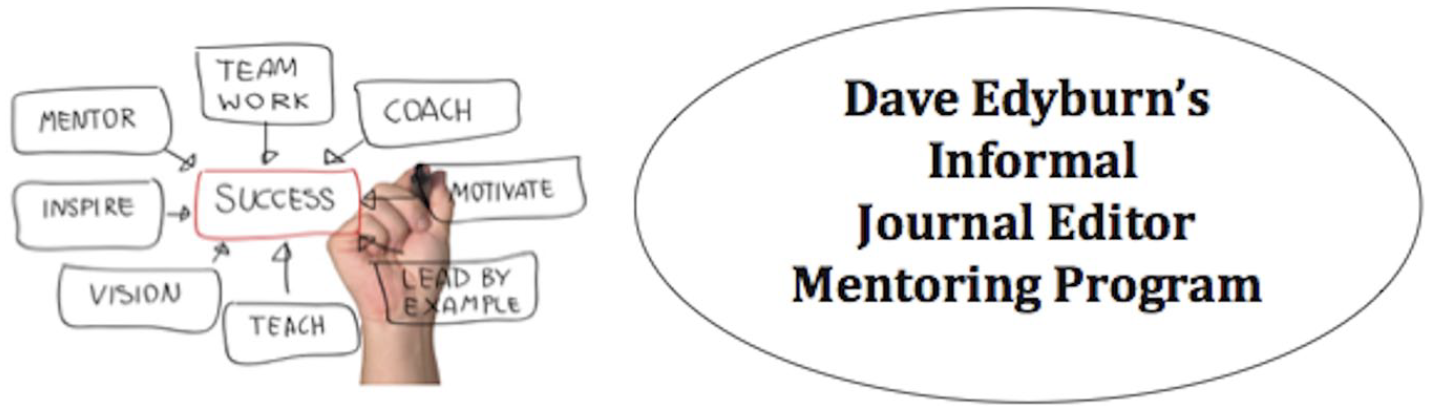
“I created an online space where I could mentor faculty interested in becoming journal editors.”—Dave Edyburn.
Your most recent university position was as associate dean for research in the College of Innovation and Education at the University of Central Florida (UCF). With all the many facets of your professional life as a professor, entrepreneur, and editor, what was the allure of becoming a dean?
(Laughs). When I was first invited to apply for the position it was in the middle of winter in Wisconsin. Obviously, Florida weather had significant allure! I had served as director of research for my college so the opportunity to serve as an associate dean for research was an opportunity that seemed like a next logical step in my career. Interesting, the call came on a day a short time after I had experienced chairing a particularly contentious faculty meeting. The combination of winter, the fresh frustration of faculty leadership, and the on-going dis-investment in higher education in Wisconsin created a unique mental context to seriously consider the invitation to move into college administration.
I knew several faculty members when I interviewed at UCF and was aware that they were highly satisfied with their personal and academic lives. It seemed like a promising opportunity. When I interviewed, I learned a lot about their campus ethos and their commitment to excellence and scale. This appealed to my entrepreneurial instincts as the sandbox of possibilities was quite a large space to play. I also began to understand that certain aspects of the research administration process had snags that needed attention. Hence, I saw opportunities for process improvements as well as faculty development needs that needed to be addressed in order to expand the capacity of the number of faculty involved in writing and managing grant-funded projects. It felt like the capstone of my career and would require all the skills I had developed over the years.
So we’ve learned quite a bit about you after receiving your PhD. Can you tell us who was Dave Edyburn prior to that? What brought you into the field of special education and technology? And why the PhD?
I started college interested in becoming a high school speech and theatre teacher. I had several minor roles in plays in high school in theatre and thought becoming a teacher might be a good career. As a first generation college student, I had no idea about college, no plan, and was clearly not in the college-bound tracks in high school. During my first semester at Illinois State University I met an upper class-person from my high school who suggested that I might want to get a special education license. She told me that it was a great way to go because I would also earn the secondary education license I was seeking. Leaving with four teaching licenses seemed like a good deal, so my second semester I changed my major to special education.
Because I had no experience working with individuals with disabilities, when I changed my major to learning and behavioral disabilities, the department chair suggested that I might want to volunteer to get some experience. I found an opportunity to volunteer in industrial arts class in the campus lab school. On my first day, the teacher assigned me to work with a student who was blind who needed to use the band saw. Yikes! The whole time we were standing there holding his hands in front of the band-saw blade, I was thinking, what am I doing?
When I graduated, I found a teaching position in a small rural community in northwest Illinois and taught middle school students with learning disabilities and behavior disorders. To support my efforts to mainstream my students, I also served as the eighth-grade girls volleyball coach and an assistant wrestling coach. I had met my future wife just before leaving campus to take this new teaching position. Returning to summer school for my master’s was a way that we could be in the same town.
It was during these years that I helped establish our school’s first computer lab. I was particularly interested in technology because my traditional instructional toolkit was not powerful enough to help the struggling students I worked with. I would bring my Atari computer to school and teach the students how to use the computer to calculate the answers to their math problems. I developed a project where each October my students would make a prediction of who would win the World Series based on their analysis of each player’s biorhythms. It was so exciting to see them make all the calculations on the computer and then explain to the local newspaper sports editor how they came to their decision of which team would win and how many games it would take. It was really a big deal for the students and their families to see their names and pictures in the paper with their prediction! And, so sweet when the prediction was borne out later! During my master’s studies I learned basic programming and created a computer-assisted reading program that I used to conduct a study about whether or not computer graphics helped improve reading comprehension. I was hooked. This research experience caused my master’s advisor to recommend that I continue my research studies by earning a PhD. He suggested that my wife and I head to Stanford. When we saw the price of tuition, we immediately crossed that option off the list. However, what if we had been at Stanford around the same time Google was founded?
You indicate that you are “technically” retired. How is that going? And what are you continuing to be involved in professionally? Non-professionally?
I would say I am transitioning to retirement. I left full-time university employment in July 2019. At the present time, I continue to mentor doctoral students in learning technologies at the University of North Texas. I have an appointment at University of Wisconsin-Milwaukee that allows me to continue my grant writing. I teach an online course in assistive technology for George Mason University. In addition, I am involved in several research and development projects. I am mentoring four faculty members from around the country on grantsmanship issues and still respond to inquiries from faculty and students with questions about special education technology. For now, all is good.
One of my avocations is serving as a master certified BBQ judge. The BBQ contest circuit has experienced the impact of Covid-19. As a result, I was able to judge only three BBQ contests in 2020. The BBQ season is much longer in the Midwest (May–October) than in Florida (November–February). For anyone interested in expanding their knowledge of BBQ, I highly recommend taking a 4-hour course to become a Kansas City Bar-B-Q Society certified judge (https://www.kcbs.us/judging_classes.php). Once you are certified, you can serve as a volunteer BBQ judge around the world at KCBS sanctioned contests!
What advice would you give to a new assistant professor just beginning their career?
I would encourage new assistant professors to meet as many new people as possible within their department and college as well as across campus. Ask each person what advice they would share as you start your career. Look for new collaborators. And of course, look for new friends, people you genuinely enjoy spending time with.
One of the biggest challenges for everyone in academe is time management. Ask people how they manage their to-do list. What tools do they use? How do they decide what to say no to? How do they make enough time for their teaching and grading? How do they find time for research and writing? And of course, how to do they find time to rest and recharge?
Spend time planning your research and writing agenda. When and where will you publish articles from your dissertation? Who will you collaborate with for your next research project? How will you maintain a research agenda with unfunded projects? What types of grants do you plan to apply for? Do you have any colleagues who can nominate you to serve on a journal editorial board?
Finally, it is never too early to begin backwards mapping your path to tenure and promotion. Find out what the expectations are. Speak to everyone you feel comfortable with in your program, department, college, and across the university to solicit their advice. This is also a good time to reach back out to your major professor to see what advice they would offer about this process. I am a big fan of the literature on career trajectories in academe. I think the book, Marketing for Scientists: How to Shine in Tough Times by Marc Kuchner should be a gift to every faculty member. While some will argue the stars in our profession are born with privilege and advantage, this book describes very specific behaviors that can lead to success in academe. Thanks for this conversation!
Footnotes
Declaration of Conflicting Interests
The author(s) declared no potential conflicts of interest with respect to the research, authorship, and/or publication of this article.
Funding
The author(s) received no financial support for the research, authorship, and/or publication of this article.