







Abstract
Functional communication training (FCT) is an evidence-based intervention that has been widely used and implemented to reduce problem behavior and teach replacement behavior in a variety of settings. Specific procedures have been researched and documented to ensure correct implementation. Functional communication training can be broken into three steps: (a) identifying the function of the problem behavior through a functional behavior assessment (FBA); (b) selecting an appropriate replacement communicative response; and (c) building new skills acquisition through teaching and rehearsal while using reinforcements and extinction.
Children with autism spectrum disorder (ASD) are more likely to exhibit severe problem behaviors than typically developing children (Alimovic, 2013; Matson et al., 2008). Commonly reported problem behaviors include self-injury, severe tantrums, aggression, and property destruction. Students who engage in these types of behaviors are at risk for decreased learning opportunities and their behaviors may also negatively impact the learning environment of their peers (Westling, 2010). Teachers have reported high levels of stress when required to manage students who engage in problem behavior (Friedman-Krauss et al., 2014). Given these widespread concerns, effective strategies are critical for addressing these behavioral concerns.
Functional Communication Training
Functional communication training (FCT) is an evidence-based intervention that has been used to reduce problem behavior and teach replacement behavior in clinical, home, and school settings (Carr & Durand, 1985; Casey & Merical, 2006; Gerow et al., 2018). Functional communication training was first introduced by Carr and Durand (1985) to teach children with developmental disabilities communicative alternatives to reduce disruptive behaviors. The rationale for FCT is to replace problem behavior with an appropriate communicative response that serves the same function or purpose as the target problem behavior. Using FCT can quickly decrease problem behavior maintained by social-negative or social-positive reinforcement (Gerow et al., 2018; Tiger et al., 2008). Despite the demonstrated effectiveness of this approach, FCT is not widely practiced in school settings. An overview of FCT is warranted to increase practitioners’ awareness and use.
Steps in Functional Communication Training
Identifying the Function of Problem Behavior
Functional communication training involves three general steps, which can be found in Table 1 along with an example for each step. First, the function(s) of the student’s problem behavior must be identified. Behavioral function can be identified through a functional behavior assessment (FBA). Functional behavior assessments can be conducted in multiple ways that vary based on the type of data that are gathered (Cooper et al., 2014). The most informal and least data-based FBA is an indirect assessment in which educators gather information about problem behavior through structured interviews, rating scales, or checklists. A more direct FBA approach involves conducting a descriptive assessment which consists of direct observation in natural settings (e.g., scatterplots, continuous or narrative recordings). The most experimental approach to FBA involves conducting a functional analysis (FA) in which antecedent and consequent variables are systematically and repeatedly manipulated to help determine environment–behavior relationships. Functional analyses are used to test problem behavior maintained by social-negative reinforcement (e.g., escape), social-positive reinforcement (e.g., attention, tangible), or automatic reinforcement (Iwata & Dozier, 2008). An FA often consists of free play, demand conditions, tangible conditions, attention conditions, and alone conditions as are described by Iwata et al. (1994) and Mace and West (1986). The procedures, which can be implemented in schools, are included in Table 2.
Guidelines for Implementing Functional Communication Training.
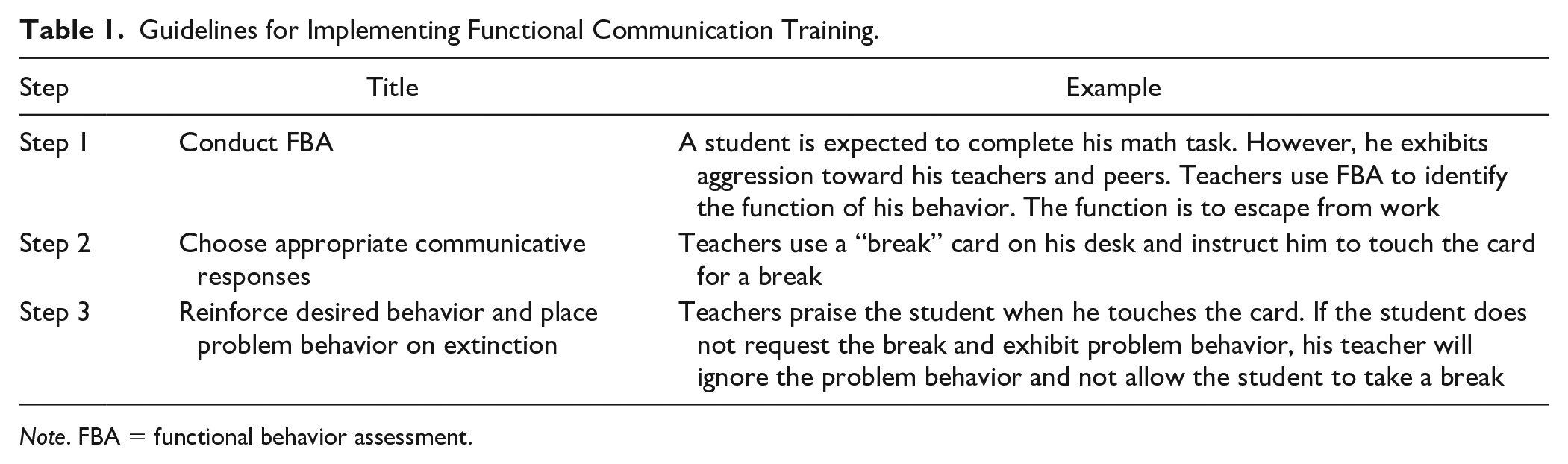
Note. FBA = functional behavior assessment.
Functional Analysis.
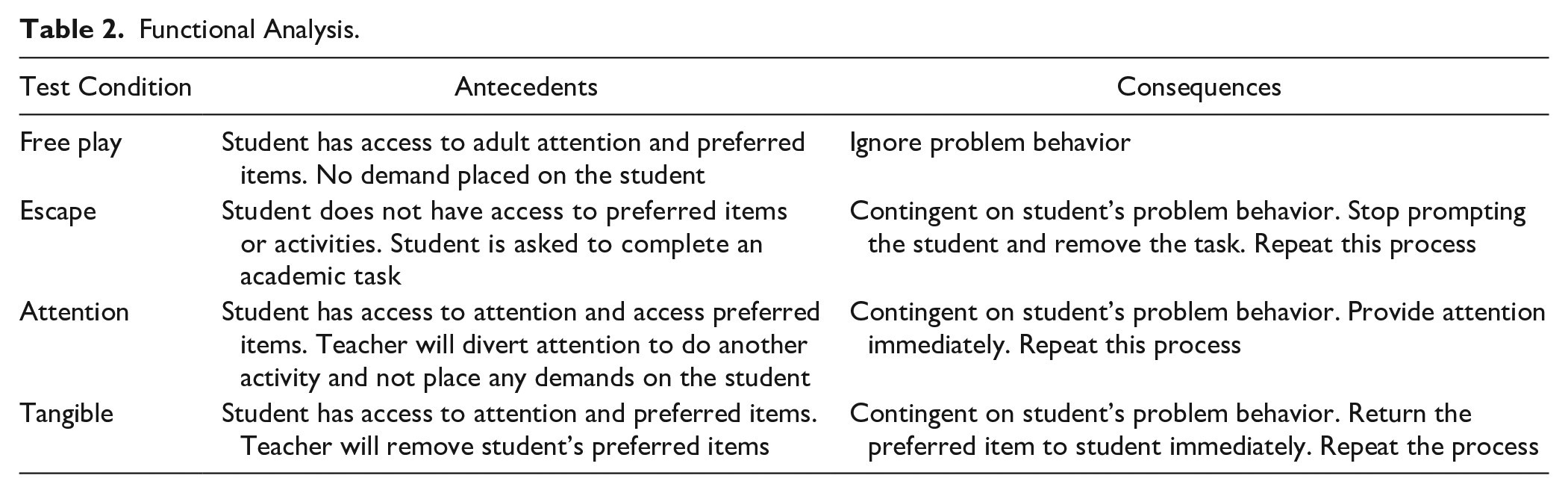
During the free play session, the teacher sits in close proximity to the student, and the student has access to toys, an iPad, computer, and attention they want. No demands are given. The teacher ignores the student’s challenging behavior and provides praises and physical contact when the student exhibits appropriate behavior.
During the academic demand session, educational materials are selected based on the student’s grade level, but are challenging for the student to complete. No toys, iPad, or computer are in the room. The teacher places verbal demands on the student and provides attention while the student is working. If no response occurs, the teacher repeats the instructions. Demands are discontinued for 30 s contingent on the instances of challenging behavior at any time during the session. After 30 s, the teacher presents the task to the student again.
In the tangible session, the teacher allows the student to play with a preferred item (e.g., iPad, a toy) for a few minutes. Then, the preferred item is removed, and the teacher tells the student that it is the time to play with another toy that is less preferred. The teacher provides attention throughout the entire tangible session. If the student displays challenging behavior while playing with the less preferred item, the teacher reintroduces the highly preferred item to the student and allows them to play with it for 30 s. After 30 s, the teacher removes the highly preferred item and presents the less preferred item to the student.
During the attention session, the teacher directs the student to play with toys while the teacher is doing another activity (e.g., reading a book). The teacher does not give the student any form of attention and does not attend to the student even if they ask questions. If the student shows problem behavior, the teacher turns to the student and provides a brief statement (e.g., “do not do that”; “we do not do that here”), redirects the student to play, and returns to the previous activity.
In the alone condition, the student is alone in a room without demands, attention, or access to toys. The teacher observes if the student’s behavior is evoked by self-produced reinforcement.
The following fictional vignette segments describe how a functional analysis can be conducted. Please see Note 1 regarding how this vignette was developed. All names are pseudonyms.
Jose, a middle school student with autism, throws pencils and toys at people and tears math materials apart during math instruction. Whenever his teacher tried to stop him, his behavior escalated into hitting, biting, and running out of the classroom. His teacher asked another teacher to help conduct an FBA. They chose to conduct an FA in a small classroom with tables, chairs, and a variety of toys. The results showed that the function of Jose’s behavior was maintained by demand.
As described in this example, implementing FAs requires teachers not only to be familiar with the test conditions but also to consider practical barriers, such as safety and time. During FA, the first and the most important thing is to address safety of the student and the teacher. In fact, the teacher can focus on precursor behaviors that reliably precede problem behavior (Hanley, 2012) and are functionally related (Vladescu et al., 2017). For example, during the FAs, the teacher can reinforce Jose’s precursor behaviors (e.g., throwing items) rather than dangerous behavior (e.g., aggression). This provides the teacher with an opportunity to design a safe analysis. In addition, the teacher can also place soft toys and padded tables in the environment to ensure additional safety measures.
Due to limited time, teachers can conduct either brief (e.g., 5 min) FA sessions (Vladescu et al., 2017) or a single-function test with the student (Iwata & Dozier, 2008 ). If the data from preliminary information (e.g., observations) suggest the challenging behavior is maintained by escape, it would be time efficient to only test an escape test condition instead of all conditions. It is also easier for the teacher to implement one test condition in the classroom rather than in a different setting.
Choosing Appropriate Communicative Responses
Following determination of the function of problem behavior, the next step in FCT is the selection of an appropriate communicative response. Five broad communicative response modalities are most commonly utilized in FCT: (a) vocal response, (b) picture exchange, (c) sign language, (d) gestures, and (e) augmentative devices (Tiger et al., 2008). Several considerations should be taken into account when selecting a communicative response, such as social recognition and response effort (Mancil & Boman, 2010; Tiger et al., 2008).
The communicative response should be understood and accepted by others. For example, if a student only knows sign language to communicate and his problem behavior is maintained by tangible items, FCT will only be effective if sign language is incorporated into the communicative response. If the teacher and support staff are unfamiliar with sign, collaborative discussion can occur about whether the student should be taught other communicative responses such as programming a microswitch that says, “toy please.” This method would be appropriate for people in the classroom who are not familiar with sign language but would be able to respond to a voice output device or pictures.
When a communicative response requires less effort than the problem behavior, the response is more likely to occur (Horner & Day, 1991). For example, in the context of a student with ASD who is nonverbal and demonstrates problem behavior maintained by attention, a teacher may show the student how to sign “Help” if the student prefers motor response to vocal behavior. Back to the example vignette: Through observations, the teacher found that Jose learned by reading pictures and had no interests in any augmentative devices. To help Jose make appropriate requests during math class, Jose’s teacher placed a “Break” card on his desk and taught Jose to touch the card to request a break.
Reinforcing Appropriate Behavior and Placing Undesired Behavior on Extinction
The last step of FCT is a form of differential reinforcement of alternative behavior (DRA), consisting of reinforcement of a socially desirable communicative response that serves the same function (purpose) as the problem behavior and reduces undesired behavior. More specifically, the teacher should provide reinforcement to the student when the desired behavior occurs and withholds the reinforcer contingent on the challenging behavior. The purpose of using extinction is to reduce problem behavior. However, research suggests that pairing extinction with reinforcement procedure to address challenging behavior (Vollmer & Athens, 2011) rather than using extinction alone (Hanley, 2012) leads to larger effect size. Teachers should prepare for unwanted side effects from extinction, such as extinction burst, and emotional responding. Consider the following example:
Functional communication training initially consists of the use of a first-then visual schedule in which Jose is presented with work (e.g., single math problem) followed immediately by a break. Once Jose finishes the math problem, the teacher immediately places a “break” picture card on his desk and says, “Good work! Touch the card for a break.” As soon as he touches the card, Jose is praised and receives a break. If Jose exhibits problem behavior and refuses to do the math problem, his teacher responds neutrally and re-presents the work until Jose completes the task.
As part of an FCT treatment plan, it is important to facilitate the students’ ability to generalize their skills to different environments so that the desired communication occurs with different people, in different settings, and with different tasks (Tiger et al., 2008). In addition, teachers should collect data to determine whether the problem behavior has decreased and that FCT was effective in increasing a socially accepted communicative response. For instance, the teacher could use partial interval recording to see whether there is a decrease in challenging behavior and use whole interval recording to measure appropriate behavior.
Conclusion
Research has demonstrated that FCT can effectively address escape-, attention-, and tangible-maintained problem behavior (Reichle & Wacker, 2017). Moreover, teachers use FCT to not only teach students with disabilities appropriate behavior, but also reduce their challenging behavior. Students may become more motived to learn new communicative responses when they are receiving reinforcement through FCT. Finally, FCT has several advantages, including helping decrease negative behavior and can result in generalizing alternative communicative response (Cooper et al., 2014). It is important for practitioners to implement this intervention based on the function of the problem behavior to increase the success of FCT. In summary, there is a substantial amount of research demonstrating the effectiveness of FCT to address challenging behavior. Teaching students acquire socially acceptable responses can overcome communication barriers as well as achieve academic, social, and developmental goals.
Footnotes
Declaration of Conflicting Interests
The author(s) declared no potential conflicts of interest with respect to the research, authorship, and/or publication of this article.
Funding
The author(s) received no financial support for the research, authorship, and/or publication of this article.
