






Abstract
Visual schedules use a series of images and text to visually illustrate a sequence of events, prepare the individual for the following action or step within an activity or chain of activities, and prompt them to follow a series of activities or tasks independently. As an evidence-based practice, visual schedules can be effectively used in different settings across age groups and a range of skills and behaviors for learners with autism spectrum disorder. The authors summarize the key steps of making and using visual schedules using the acronym CHECK. Special education and general education teachers or professionals can use the CHECK strategy to increase the participation and independence of their students on the autism spectrum.
Ms. Smith is a Grade 5 teacher for 25 students in a suburban school. Sam, an 11-year-old boy on the autism spectrum, joins her class for lunch, recess, and music with support from special education staff. Sam enjoys being in the class, although he sometimes struggles with spoken instructions. Sam likes to listen to music, play with Play-Doh, and read cartoon books. Sam can understand simple one-step verbal instructions but has difficulty with multi-step instructions. To support comprehension, the school team used a first-then board with Sam, which was helpful. Then, the team made visual schedules for Sam in other settings and activities. Ms. Smith would like to investigate whether a visual schedule could be of benefit during the lunchtime routine (e.g., “stand in line,” “get milk,” “get food”). Currently, Sam requires regular verbal prompting for the lunchtime routine. Ms. Smith thought it would be a good opportunity to support Sam in learning greater independence.
Visual Schedules
Visual schedules use a series of pictures, photographs, line drawings, and/or written words that illustrate a sequence of events to visually prepare the individual for the following action or step within an activity or chain of activities and prompt them to follow a series of activities or tasks independently (Bryan & Gast, 2000; Knight et al., 2015; Koyama & Wang, 2011; Liang et al., 2024). A visual schedule can take multiple representational forms (including the written checklist, picture or photograph schedule, and object schedule) or length of schedule (one item, two items, or first-then board, half-day schedule, and full-day schedule). Visual schedules are an evidence-based practice (EBP) that can be widely used in different settings across age groups and a range of skills and behaviors for learners with autism spectrum disorder (ASD; Hume et al., 2021; Knight et al., 2015; Steinbrenner et al., 2020). Therefore, teachers should feel confident in using visual schedules to support their learners with ASD.
Visual schedules can help the learner with ASD: (a) achieve greater independence in an activity, especially helpful when a learner can perform a skill but only with adult prompting (Koyama & Wang, 2011; Morrison et al., 2002); (b) make smoother transitions between activities, which could benefit all individuals (staff and students) from support in understanding the sequence of activities for the day (Banda & Grimmett, 2008; Pierce et al., 2013); and (c) experience reduced anxiety by knowing the schedule of activities or what will happen next (Lequia et al., 2015; Massey & Wheeler, 2000). Mesibov et al. (2005) suggested the use of visual schedules to communicate the sequence of upcoming activities or events where the verbal instruction or language might not be fully understood or might be forgotten, learners with ASD may be disrupted or confused by a transition or unexpected change of routines, and learners with ASD may need additional prompting from or over-reliance on adults.
Based on the effects of visual schedules,
is a predictable event. Events like brushing teeth and the typical sequence of school activities that happen every (or nearly every) day. High-stress events, like trips to the dentist, are also predictable and may benefit from incorporating a visual schedule.
follows a predictable sequence. Activities like washing hands, getting ready for circle time, and moving from class to class follow a predictable sequence and can be good visual schedule opportunities.
requires ongoing adult support and/or causes anxiety. Visual schedules can help learners become more independent with activities they can perform with adult support but struggle to complete independently. Visual schedules also help learners know what will happen during the day, which may help to reduce their anxiety about transitions from one activity to the next.
is easier to understand when images or text are provided. Pictures often make it easier to understand the expectations of an activity. The use of pictures (and text) can be reviewed multiple times.
After reviewing the four key considerations, Ms. Smith decided to make and use a visual schedule to assist Sam with the lunchtime routine. Now, Ms. Smith is ready to incorporate the “CHECK” visual schedule strategy.
CHECK Strategy
Based on the multiple literature reviews (Banda & Grimmett, 2008; Knight et al., 2015; Lequia et al., 2012; Liang et al., 2024) and empirical studies (Akers et al., 2016; Pierce et al., 2013), the key steps of making and using the visual schedules were summarized, and the acronym CHECK was used to help teachers or professionals memorize these steps. The CHECK strategy includes: (1) Consider the steps, preferences, and/or choices for the learner; (2) Help the learner with meaningful representations and layouts that support self-monitoring; (3) Engage the learner using models, guided practice, and independent practice; (4) Collaborate to support widespread use; and (5) Keep data and make changes as needed. The first and second steps focus on making a good visual schedule, and the remaining three focus on teaching individuals to use the visual schedule.
Step 1: Consider the Learner’s Steps, Preferences, and/or Choices
Steps in the Activity
The visual schedule should help the learner with ASD break a big task into smaller, more manageable steps. As the smaller steps are mastered, the learner with ASD becomes more independent in his/her ability to perform the overall task (Steinbrenner et al., 2020). Their needs will determine the size of each step. Ideally, each represented step (e.g., each photo) can be recognized and performed by the learner with ASD before they need to look at the visual schedule again. That is, they can recognize and perform each step before returning to the schedule. Each step in the activity should be small enough to be easily represented as a meaningful step and big enough to represent each desired activity in four to six steps.
Preferences and/or Choices
Learners’ preferences include multiple categories, such as food or snacks, activities, materials, tokens, and praise. These preferences can be used as reinforcers, which are earned through the reinforcement process. By incorporating the preferences of the learner into the schedule of the day, teachers or professionals can (1) help to smooth transitions between activities, (2) ease a student through a complex set of activities, or (3) encourage a student to complete activities independently by interspersing preferred activities, or by providing a reinforcer at the end.
By interspersing preferred activities, the task presentation is modified so that those requiring less-effortful responses (i.e., high probability response sequences that are completed at least 80%) occur before those requiring more difficult responses (i.e., low probability response sequences that are completed 40% or below; Planer et al., 2018). In this way, learners with ASD will receive reinforcement earlier and will be more likely to remain engaged and persist with the more challenging tasks or requests. Therefore, this sequencing can improve the compliance rate for low-probability academic, social, communication, and behavioral tasks. By providing a reinforcer at the end, learners with ASD who engage in the scheduled behaviors (e.g., schedule-following, independent completion, and other related behaviors) are reinforced, which can maintain or increase the frequency, rate, intensity, or duration of the behavior or improve the form of behavior (Scheuermann et al., 2022).
Visual schedules should include opportunities for a learner with ASD to make choices. When learners with ASD have choices within their day, they feel a greater sense of control and are less likely to engage in challenging behavior (Lory et al., 2020). Providing a choice can even help to increase engagement with activities that are not highly preferred (e.g., a choice between two academic activities). The opportunity to make a choice can be represented in many different ways in a visual schedule (see Figure 1). Learners with ASD can choose from two preferred activities (reading a book or listening to music) at the end of the visual schedule, or they can choose from the choice board.
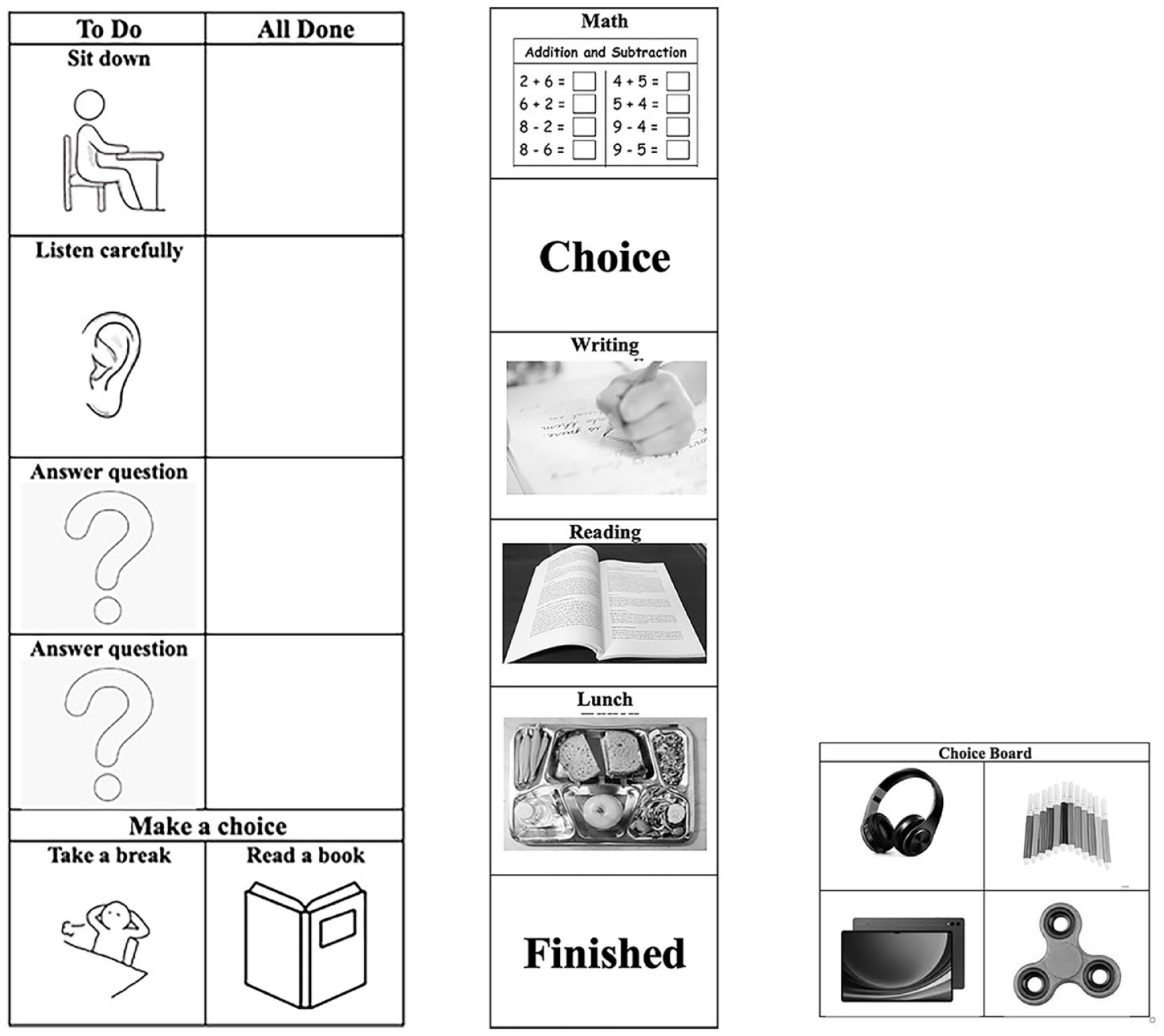
Visual Schedules With Opportunities for Making Choices.
Ms. Smith analyzed the task of lunchtime routine and divided this activity into manageable steps: (1) stand in line, (2) get milk, (3) get lunch, (4) sit at a table, and (5) clean up. In addition, Ms. Smith identified Sam’s preferences through classroom observation and informal interviews with his parents. Then, Ms. Smith planned to provide an opportunity to choose between book or music time when his schedule is completed.
Step 2: Help the Learner With Meaningful Representations and Layouts That Support Self-Monitoring
Teachers can help make the visual schedule more engaging and easier to understand for the learner with ASD through meaningful representations. Visual schedules are a great opportunity for these students to learn and practice self-monitoring—recording when they have completed each step in an activity.
Multiple Representations
Representations can include objects, real photos, pictures, line drawings, and clear, simple text (Meadan et al., 2011). The goal of meaningful representation is for learners with ASD to use the visual schedule independently. Therefore, teachers need to choose a representation form that they will be able to use independently after the initial teaching (Hume, 2009). The representation form should be easy for the learner with ASD to understand so instruction can focus on learning the steps of the activity, not learning the meaning of the representation itself. Meaningful representations should be selected based on the learner with ASDs comprehension level. Therefore, teachers need to experiment with the type of visual representation to assess what will work best for their learners with ASD, which may involve trial and error. In this way, teachers should evaluate their learner’s ability to match objects to objects, photos, or pictures to objects to gauge their comprehension level. Suppose a learner with ASD requires three-dimensional representations to gain meaning from activities (e.g., unable to match photos in activities or respond to picture cues). In that case, staff should select objects, not photos, in the appropriate format. Suppose a learner can understand two-dimensional representations (e.g., pictures in a reading activity or matching pictures in an academic activity). In that case, staff may determine that photographs are a meaningful format for a visual schedule. Some learners with ASD can read and use written checklists of activities for the day. Many learners can learn to understand and follow schedules involving simple pictures or photographs. A more straightforward system involving a concrete object to indicate “what comes next” can be used with the youngest and most concrete learners (Mesibov et al., 2005). Some tips that teachers can consider when selecting images (and text) include (1) take clear photos that focus on the target skill; (2) use line drawings or other graphic systems if they are familiar to the learner with ASD, and (3) label the images with words and short phrases to support the use of the visual schedule by other individuals.
Layouts of Visual Schedules That Support Self-Monitoring
Typically, visual schedules are presented left-to-right or top-to-bottom and used by putting the cue in a terminal or finished location or marking off visual cues on the schedule to mark the completed steps. In this way, the layout can communicate to learners with ASD and others what has been accomplished and what still needs to be done, and it can help build a sense of accomplishment for the learner with ASD.
Ms. Smith evaluated Sam’s comprehension skill level by matching images (real photos, pictures, and line drawings) to objects. She found that he could understand real photos in a reading activity and match real photos in an academic activity. Based on this, Ms. Smith determined that real photos are a meaningful representation of a visual schedule for Sam. Then, she used online word processing software to make a visual schedule for him (see Figure 2). Based on the steps, she took real photos of lunchtime routines for each step, uploaded them to the online word processing software, and labeled each photo with text. Then, she considered the layouts that support self-monitoring and planned to ask Sam to mark off visual cues on the schedule after completing each step.
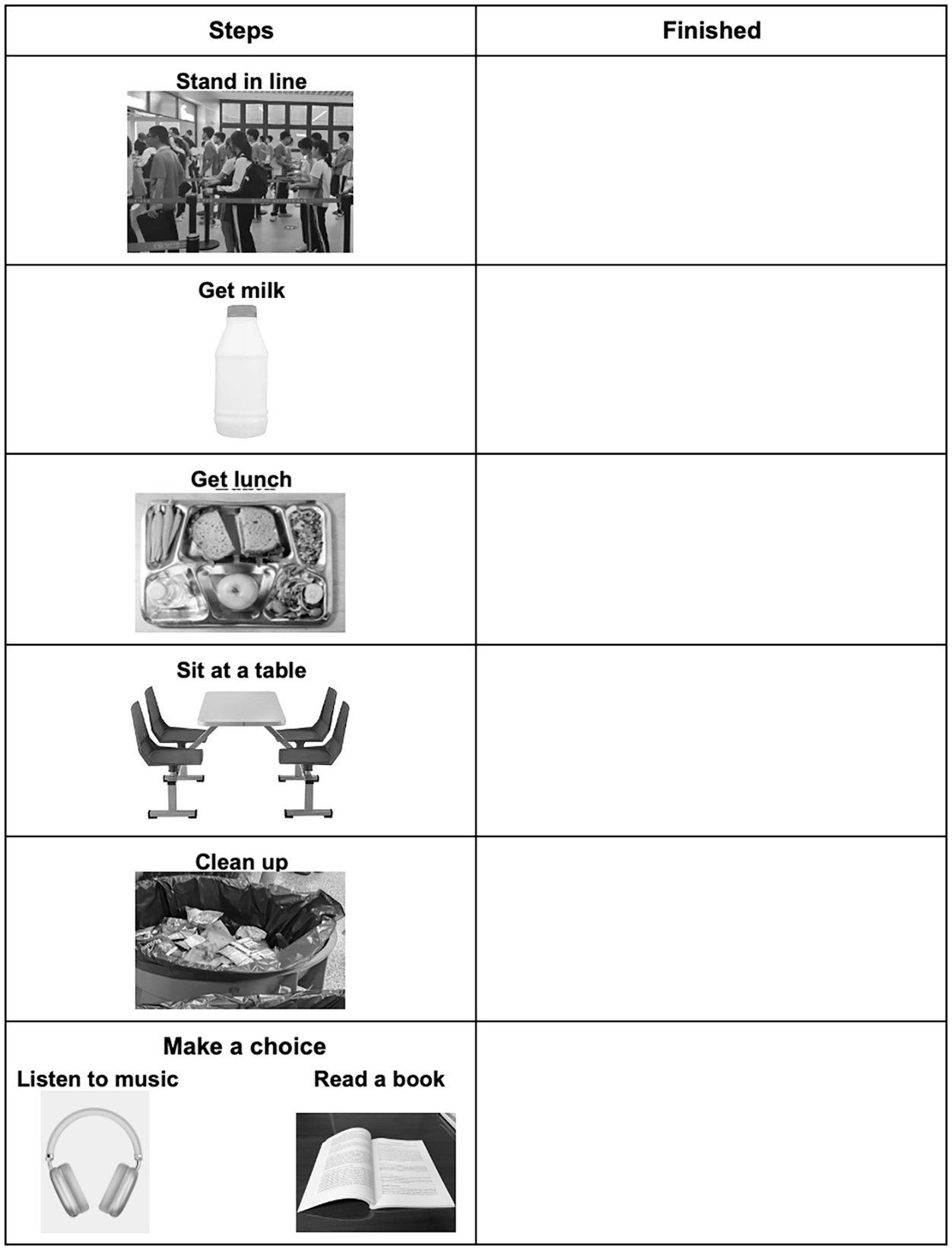
Visual Schedule for Lunchtime Routine.
Now that Ms. Smith has created a visual schedule for Sam, she can use the following steps of the CHECK strategy to teach Sam how to use his visual schedule to complete the lunchtime routine independently and monitor his progress.
Step 3: Engage the Learner Using Model, Guided Practice, and Independent Practice
As with any new skill, a model/guided practice/independent practice instructional sequence can be beneficial. It promotes active student engagement by requiring frequent and varied responses followed by appropriate affirmative and corrective feedback and assists long-term retention using purposeful practice strategies (Hughes & Riccomini, 2019; Morris et al., 2021).
Model (I Do)
The teacher demonstrates the new skill and describes what they are thinking/doing in simple, straightforward language. To model the use of a visual schedule, the teacher would introduce the visual schedule and demonstrate the use of the visual schedule (follow the steps you see). In addition, the teacher should also introduce and demonstrate how to access the reinforcer or make a choice.
A good model (1) is clear (words they know), consistent (keywords are used consistently and do not change as the lesson progresses), and concise (fewer words, the better); (2) includes several demonstrations, depending on the complexity of the skill being taught; and (3) involves learners with ASD (Archer & Hughes, 2011; Hughes et al., 2022). Teachers should include only the critical aspects of the process of using the visual schedule and make sure the description is clear and worded concisely and consistently. As for the number of demonstrations for learners with ASD, more than one model is typically needed unless the new skill is very simple or similar to previously mastered skills. Then, teachers should consider involving learners with ASD because many of them have difficulty listening passively for extended periods, so keeping them involved is imperative. After the first modeling of the visual schedule, teachers can ask learners with ASD to “help” during the demonstration, promoting increased attention and preparing for critical steps. Involving learners with ASD in this manner and at this point in the lesson provides the teacher with valuable information. If learners with ASD respond correctly, it verifies that they initially understand the key steps in using the visual schedule and completing the activity. If they respond incorrectly, the teacher can determine what steps or processes are causing difficulty and can address these problem areas before proceeding to guided practice. Guided practice should be initiated when learners with ASD demonstrate proficiency and responsibility for performing the skill.
Guided Practice (We Do)
The teacher and the learner with ASD follow the visual schedule and complete all the listed steps or activities (including access reinforcer or making a choice) together. Later, the teacher and the learner with ASD will take turns performing the skill. Over time, the teacher slowly fades support, and the learner with ASD becomes independent with the skill. In this stage, the teacher also supports the learner with ASD in accessing the reinforcer or making a choice and providing support if needed. During guided practice, the teacher provides support to help the learner with ASD use the visual schedule and gradually fades this support as the learner with ASD develops competence. In addition, guided practice should continue until the learner with ASD demonstrates successful independent completion of all steps at least once.
Guided practice usually includes systematic prompting procedures to teach the correct use of the materials (Bryan & Gast, 2000; Liang et al., 2024; Zimmerman et al., 2017). Among these procedures, graduated guidance has been used most often (Zimmerman et al., 2017). In this procedure, the teacher typically uses a physical prompt to guide the learner with ASD in making a correct response, making moment-by-moment decisions on the level of physical prompting needed to ensure the accurate response until the student can perform the desired behavior independently (Collins, 2022; Tekin-Iftar et al., 2024). That is, as the learner with ASD is responding (resistance, nonresistance, or errors), the instructor decides to provide or withhold physical prompting needed to maintain the correct response (Collins, 2022; Tekin-Iftar et al., 2024). Intrusiveness may vary according to the location of support (e.g., wrist, elbow, or shoulder) or intensity of support (e.g., full or partial physical) and individual characteristics of a learner with ASD, such as being averse to physical prompting (Ivy et al., 2018). As there are no criteria for when or how to prompt a child using graduated guidance, teachers must consistently evaluate their learners with ASDs behavior to determine whether a prompt is needed and, if so, the level of prompt needed to assist them in correctly completing a task (Collins, 2022; Jimenez & Alamer, 2018; Wolery & Gast, 1984).
Independent Practice (You Do)
In the independent practice phase, the teacher does not provide any prompts or cues for the learners with ASD; they work independently. However, the teacher closely monitors their work and provides feedback as appropriate. During independent practice, the teacher should introduce the activity: “Your turn. Do what you See” and then monitor the learners with ASDs independent use of the visual schedule and provide positive feedback (if completed independently) or corrective feedback (if support is needed).
Ms. Smith introduced and demonstrated each step of the lunchtime routine on Sam’s visual schedule. Then she gave the instruction: “Let’s look at your schedule together. I’ll do the first one.” Then, she completed the first step. After that, Ms. Smith gave the instruction: “Your turn. Do what you see.” If Sam did not respond after 5 seconds, Ms. Smith utilized the graduated guidance procedures by providing full physical prompts by holding his hand to complete the second activity and then moving the cue card or picture to the “finished” column. As Sam worked on the remaining steps on his schedule, Ms. Smith evaluated if she should continue the full physical prompt or fade it to partial physical prompting by changing location on the arm (hand to wrist or shoulder). Ms. Smith continued to provide guided practices until Sam successfully completed all steps at least once. Ms. Smith gave the instruction: “Your turn. Do what you see,” and then monitored independent use by recording the data and providing appropriate feedback.
Step 4: Collaborate to Support Widespread Use
With increased expectations for inclusive models of K–12 education for learners with ASD, there has been an emphasis on effective collaboration among general and special education teachers (Da Fonte & Barton-Arwood, 2017). Effective collaboration ensures that students’ learning experiences are planned, taught, and enhanced to support positive student outcomes (McLeskey et al., 2019). In addition, collaboration could ensure that all adults working with learners with ASD are consistent with expectations, reinforcement, correction, and follow-through regarding visual schedules. To support the widespread use of visual schedules, teachers should meet with other team members to demonstrate the use of the visual schedules and share information on the learners with ASD’s expected use of visual schedules (share high expectations) across settings and activities.
Ms. Smith met with other team members to demonstrate how she used the visual schedule to support Sam in completing the lunchtime routines. Then, she shared information on Sam’s expected use of visual schedule across settings (consider home setting) and activities.
Step 5: Keep Data and Make Changes as Needed
Data-based decision-making consists of gathering data about how learners with ASD progress toward specific goals in academic or behavioral performance (Walker & Kearns, 2022). Collecting data is an important part of the educational process. Such procedures help educators, caregivers, and other essential stakeholders make data-based decisions to accelerate student progress. Collecting data has been associated with more frequent instructional changes to better meet learners with ASD’s needs, increased quality of individualized education program objectives, and increased academic and behavioral performance (Gischlar et al., 2009; Hojnoski et al., 2009). By collecting data, teachers can document the learners with ASD’s success (and be ready to set new goals) and learn when instruction changes may be needed.
Keep Data
Use a data-collection system that is simple and efficient but also supports instructional decision-making. Hojnoski et al. (2009) introduced multiple recording methods (see Hojnoski et al., 2009 for more details about how to create a data sheet and collect specific data), including:
Event recording (frequency): Each occurrence of the target behavior (short in duration and has a clear beginning and end) is recorded, and at the end of the observation, the total number of occurrences is calculated, yielding the number or frequency of behaviors.
Time sampling: Specific time intervals (e.g., 5 s, 1 min) are selected and used to observe and record the target behavior.
Duration: The elapsed time between onset and offset of the target behavior is recorded.
Latency: The elapsed time between the prompt or request for behavior and the performance of the target behavior is recorded.
Selecting a recording method that will best capture the target behavior is important.
In Sam’s case, Ms. Smith created the goal for Sam to complete the lunch routine independently. Each occurrence of the target behavior in the lunch routine is short-duration and has a clear beginning and end. Therefore, Ms. Smith decided on event recording to record Sam’s independent performance and the steps he requires prompt or support (i.e., performed incorrectly or not performed within 5 seconds, See Table 1).
Data Sheet Recording Sam’s Lunch Routine Performance.
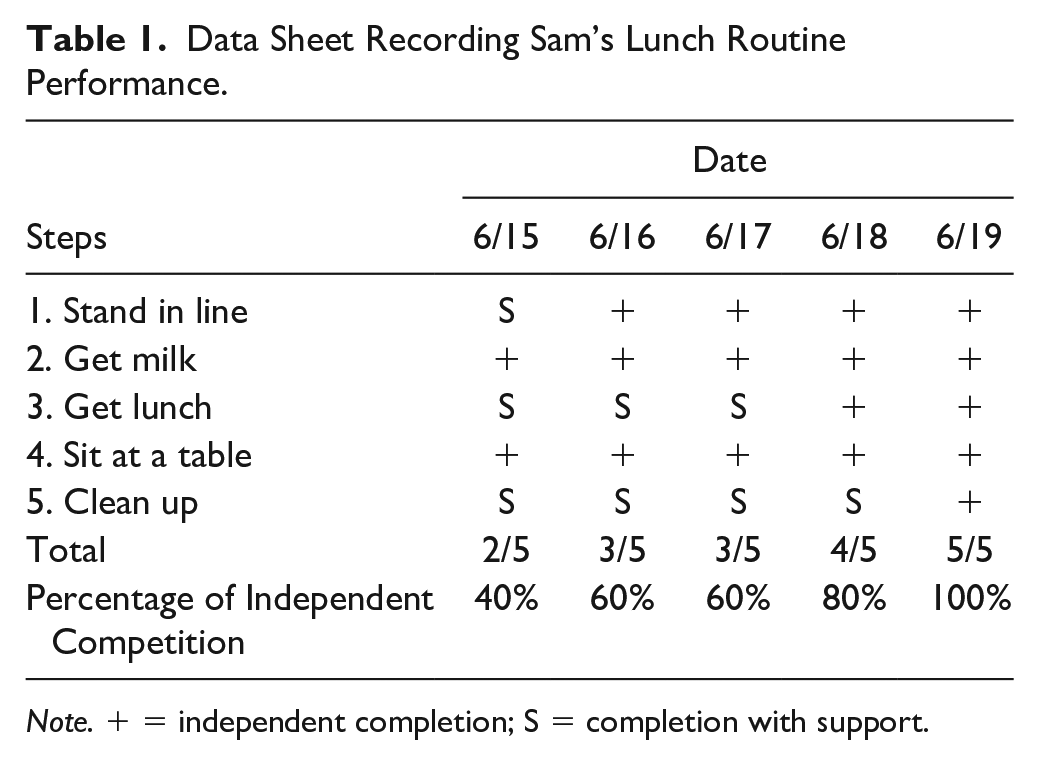
Note. + = independent completion; S = completion with support.
Ms. Smith used a simple data sheet to record Sam’s independent performance. Based on the target behavior, if he performed a step incorrectly (or did not perform the step within 5 seconds), Ms. Smith performed the step (so that Ms. Smith could keep the activity moving forward). Ms. Smith then allowed Sam to do the next step. Ms. Smith recorded the steps Sam performed correctly (and independently) within 5 seconds with a +. Ms. Smith recorded the steps for which Sam required support (i.e., performed incorrectly or not performed within 5 seconds) with an S.
Make Changes
If the learner with ASD is progressing, teachers should celebrate their success. If the learner is not making progress, then teachers should consider going back to prior steps (1) consider the steps, preferences, and/or choices; (2) help the learner with meaningful representations and layouts that support self-monitoring and (3) engage the learner using model/guided practice/independent practice when the learner with ASD was successful.
Ms. Smith identified that Sam has made progress by using the visual schedule. So, Ms. Smith offered reinforcers to Sam and considered using the visual schedules to support Sam in other activities further to achieve greater independence.
Conclusion
Visual schedules are an EBP for learners with ASD. They can be effectively used in different settings across age groups and a range of skills and behaviors. The CHECK strategy contains the key steps for making and using visual schedules. Special education and general education teachers or other professionals could use this strategy to increase the participation and independence of their learners with ASD.
Footnotes
Acknowledgements

Author’s Note
The vignette is a fictionalized account drawn from several authentic situations and combined to formulate an aggregated scenario.
Declaration of Conflicting Interests
The author(s) declared no potential conflicts of interest with respect to the research, authorship, and/or publication of this article.
Funding
The author(s) received no financial support for the research, authorship, and/or publication of this article.