







Abstract
Building positive relationships with students is one of the most powerful choices a teacher can make. Strong student–teacher relationships have been linked to improved social-emotional development, classroom behavior, and academic success. Yet, reactive and exclusionary discipline practices continue to undermine these relationships, diminishing trust and long-term behavioral growth. This article presents a responsive, relationship-based approach for classroom management that emphasizes connection over punishment. It highlights three research-based, easy-to-implement strategies: offering choice, precorrection/prompting, and behavior-specific praise. These strategies foster prosocial behaviors while maintaining a warm, supportive, and inclusive classroom environment for all learners.
Building Positive Student–Teacher Relationships While Managing Behavior
Cultivating a positive relationship with students is one of the most powerful teaching choices a teacher can make. Educational theorists have made compelling arguments that the relationship-oriented aspect of teaching is what makes learning possible (Freire, 1970; Noddings, 1992). Rapport between students and teachers is strongly associated with improved academic, social-emotional, and behavioral outcomes (McGrath & Van Bergen, 2015). Although teachers strive to make their classrooms hospitable places to learn, they may not be aware of the outsized impact their day-to-day interactions have on students. There are many definitions of a positive student–teacher relationship (STR), but it is commonly described as students believing their teacher cares for and respects them, as well as making them feel safe (Pianta, 1999).
This is especially important for students with learning disability, autism spectrum disorder, and emotional and behavioral difficulties as they face learning barriers that their peers do not encounter. In addition, these disabilities are characterized, in part, by behaviors teachers may perceive as challenging (Individuals with Disabilities Education Improvement Act of 2004). This makes the STR particularly consequential in the context of discipline, where teachers’ responses to student behavior can either strengthen or erode these relationships.
While there is an increased awareness of the detrimental effects of punitive discipline, it is still widely used to compel students to compliance (Welsh & Little, 2018). Common practices such as time-outs, harsh reprimands, response cost (e.g., taking away treats or activities students have already earned), and public shaming have a negative impact on students’ perceptions of schooling (Lewis et al., 2005) and contribute to a hostile school climate. Exclusionary practices such as suspension and expulsion decrease academic achievement and increase school dropout rates (Noltemeyer et al., 2015). While punitive measures may temporarily stop challenging behaviors and appear to be effective in the short term, they do not work in the long term. Students who are punished are less likely to conform to classroom norms and may increase their challenging behavior. When disciplinary practices emphasize punishment over understanding, students are more likely to perceive teachers as adversarial, undermining trust and weakening the relational foundation necessary for effective teaching and learning (Gregory & Ripski, 2008). Rather than viewing teachers as a source of support for learning, students may decrease engagement and become more resistant to feedback (Kennedy-Lewis & Murphy, 2016).
Moreover, students of color, those with disabilities, and LGBTQ+ students experience disproportionate exclusionary discipline relative to White students, further compounding any difficulties they encounter during their school years (Fabes et al., 2021; Skiba & Losen, 2015). A primary consideration in moving away from traditional discipline is to reduce those inequities (Welsh & Little, 2018). When schools and districts shift to positive behavior support systems, they improve student engagement while reducing the need for exclusionary discipline (Bradshaw et al., 2010).
High-quality STRs are characterized by warmth, support, affection, and low levels of discord (Gallo et al., 2022). Effective discipline is inherently relational, so when teachers use techniques that explicitly teach students how to change their behavior, they are enhancing STR and building a foundation for promoting prosocial behavior. A warm STR encourages students’ engagement because it communicates the teacher’s desire to be understanding or supportive rather than punitive. Responsive strategies also increase the number of positive interactions a teacher has with a student, reducing the discord that occurs when using punitive measures to address challenging behavior. This is a critical point because a higher number of negative interactions leads to more relational conflicts, resulting in poorer academic and behavioral outcomes (Gallo et al., 2022).
Ideally, a school-wide framework of interventions is used when adopting a responsive approach to discipline (Gregory et al., 2017). Equally important is determining the conceptual foundation of any proposed interventions to understand how they will work in the local context (e.g., culturally responsive practices; Welsh & Little, 2018). However, because teachers’ classroom decisions are both critical and immediate determinants of how school discipline is enacted, teachers preferring a responsive approach can adopt strategies that have been shown to reduce challenging behaviors, but also enhance STR.
In this article, we discuss three concrete strategies teachers can use to decrease challenging behavior and enhance prosocial behavior. Equally important, the use of these strategies contributes to a warm STR by facilitating productive and supportive interactions between teacher and student. Choice, precorrection/prompts, and behavior-specific praise (BSP) are grounded in educational theory and research, easy to use, and require little advance preparation. These strategies are particularly important for students with disabilities, who may experience difficulties with communication, self-regulation, executive functioning, or understanding behavioral expectations (Kestner et al., 2023; Lory et al., 2020). By providing opportunities for autonomy, clear communication, and constructive feedback, these practices support students’ access to participation and instruction (Aceves & Kennedy, 2024; Royer et al., 2019).
Choice
Choice is providing students with the opportunity to make their own decision by offering two or more options (Jolivette et al., 2002). When students are given meaningful opportunities to select between tasks, materials, or reinforcement preferences, they demonstrate higher levels of motivation, a stronger sense of autonomy, and fewer disruptive behaviors (Lane et al., 2015b; Shogren et al., 2004). Embedding choice into daily classroom routines and academic assignments also facilitates a culturally responsive environment. Teachers can create a learning environment that honors the students’ identities, values, and ways of learning by allowing for more than one way to participate or show understanding (Gay, 2010). When given choice in how they illustrate mastery of a subject, students can connect academic content to their cultural backgrounds, community experiences, or real-world contexts in ways that are meaningful and authentic to them. For example, they may choose to display their understanding of a topic through a demonstration or example drawn from their home or community rather than through a written test. Having choice not only promotes student agency and motivation but it also fosters a cooperative classroom climate that minimizes resistance and encourages prosocial behavior (Jolivette et al., 2002) while simultaneously creating space to validate students’ strengths and diverse cultural values.
The first step in providing choice is to intentionally build it into specific lessons when planning the week’s curriculum. Not every assignment must include choice, but activities that offer students a variety of ways to explore academic content or demonstrate their skills and knowledge can be incorporated strategically. The Universal Design for Learning (UDL) principles (CAST, 2024) provide a framework for incorporating choice into lesson planning. They are a rich resource for thinking about how to develop lessons that promote students’ engagement, sense of self-efficacy, and view of academic content as personally relevant. Universal Design for Learning emphasizes multiple means of engagement, representation, and action and expression when designing learning experiences. The CAST website offers in-depth resources for preparing lessons with options for students to choose which aspects of the content to focus on, the types of resources they prefer to use to explore the content, and the way students will present the knowledge or skills they have learned.
In addition to planning for choice in consequential academic tasks, routine opportunities for choice can be woven into the school day. For example, two versions of practice worksheets can be made available; students can work independently or within groups, or they can choose their own book during independent reading time. While these options are easily implemented, the effectiveness of choice-making interventions is contingent on the developmental appropriateness of the options provided, the consistency of implementation, and the degree to which choices are perceived as authentic to students.
The number of choices offered is also an important consideration. Too many choices can be overwhelming to students and difficult to manage in the classroom. Too few choices may seem inauthentic depending on the task. Students’ age, complexity of the assignment, amount of support needed, and allotted time for the activity or assignment can all affect the effectiveness of offering choices. Research suggests that offering two to four choices may be optimal (Patall et al., 2008).
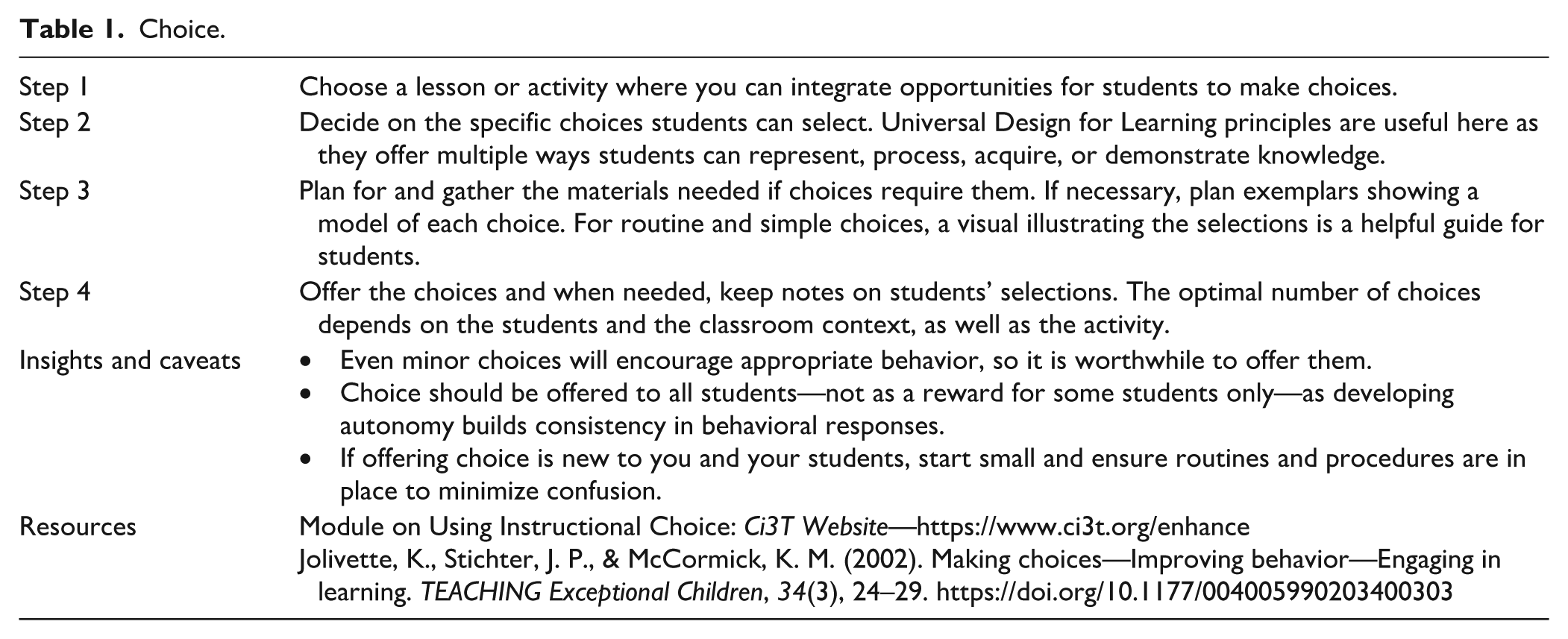
Providing students with choice facilitates and builds students’ sense of autonomy over school-related tasks. This minimizes conflict as students are less likely to resist when they have some control over their actions. Offering choice also connotes respect as it values students’ decisions. As teachers become familiar with the choices students make, they deepen their understanding of students’ preferences and interests, leading to more meaningful interactions with the students. Low levels of conflict, respect, and interest are all elements that build a strong STR. Choice is an effective strategy in reducing challenging behaviors while promoting greater participation in both academic and social activities (Jolivette et al., 2002; Lane et al., 2015b; Shogren et al., 2004) as well as having a positive effect on attitude and effort (Flowerday & Schraw, 2003). It is a strategy that simultaneously builds STR while reducing behavioral challenges. See Table 1 for suggestions on implementing choice (Lane et al., 2025).
Choice.
Precorrection and Prompting
Precorrection is an advance reminder of expected behavior. It is a key component of explicit instruction, which is recognized as a high-leverage practice in effective teaching (Aceves & Kennedy, 2024). Explicitly reminding students of how to behave in specific situations facilitates the academic and prosocial behaviors teachers expect. An academic precorrection helps students learn or perform an academic task, while behavioral precorrections facilitate students’ engagement in prosocial behavior. For example, a teacher might remind students how to proceed with independent practice after a math lesson: “When working on your assigned problem sets, don’t forget to use the model in your book as well as your problem-solving checklist.” A behavioral precorrection could also be offered at the beginning of independent practice to remind students how to clean up or what to do when they have completed their work: “Once you have finished your problem sets, place your work in the basket and then read independently.” Precorrection can be used to reiterate expectations for common routines, procedures, and transitions, such as getting ready for lunch or at the end of the school day.
Closely related to precorrection is prompting, but it occurs in the moment to guide a student in choosing the correct behavior. A teacher may have offered a precorrection at the beginning of a lesson, but some students will need additional support to focus on the expected behavior and then to engage in it. Prompts can be offered to the whole class or to individual students. Prompts are not reprimands; tone and affect are important, and remaining calm and helpful is more effective than communicating frustration or anger. It contributes to a warmer classroom environment when students are prompted in advance rather than reprimanded after an infraction.
Various types of prompts can be used to encourage appropriate participation in school tasks and engagement in activities. Effective instruction involves balancing opportunities for child-initiated activity with timely teacher guidance. Ideally, students are first encouraged to make independent choices. Teachers then provide sufficient wait time to allow students to process and respond. If a student still does not make a choice or is off task, the teacher may then use prompts to guide the student toward an appropriate action or decision. Prompts can range from minimal to more direct, forming what is commonly referred to as the prompt hierarchy (e.g., Leach & Helf, 2016).
At the least intrusive level are environmental prompts, in which the teacher sets up the physical environment to encourage independence and choice-making. For example, during a writing activity, a teacher might provide visual prompts with multiple writing topics clearly displayed. When environmental cues are embedded in the learning space, they allow students to exercise autonomy while still receiving support. If a student continues to have difficulty following directions, more focused prompting can be used. This could include verbal prompts (e.g., suggesting a topic or stating a specific reminder of expected behavior) or modeling, where the teacher demonstrates the desired response. For example, if a student shows no preference or engagement during a writing task, the teacher might suggest, “Since you really like basketball, maybe you can write about basketball?”, especially if the teacher knows the student is interested in the sport. The teacher could then model the task by writing a first sentence, such as “Basketball is my favorite sport because I like to play with my friends.” With an older student, the teacher could elicit ideas to help them get started. The goal is to assist students in overcoming their initial reluctance or to help them focus. Starting with a responsive action, a prompt, rather than a reprimand, increases the likelihood of engagement and decreases discord.
Similarly, if the teacher is addressing a challenging behavior, she can reiterate the expected behavior and offer a prompt by stating firmly, “Sam, when you walk through the hallway, remember to be quiet so you don’t disturb students still in class.” Gestures are also effective prompts. The teacher could catch Sam’s attention and then hold her finger to her lips to remind him to be quiet. When a student responds appropriately to a prompt, it is a good time to use a verbal reinforcer, such as BSP (introduced in the next section). By using a range of prompts, starting with the least intrusive and increasing as needed, teachers support autonomy while scaffolding learning in a responsive and developmentally appropriate manner.
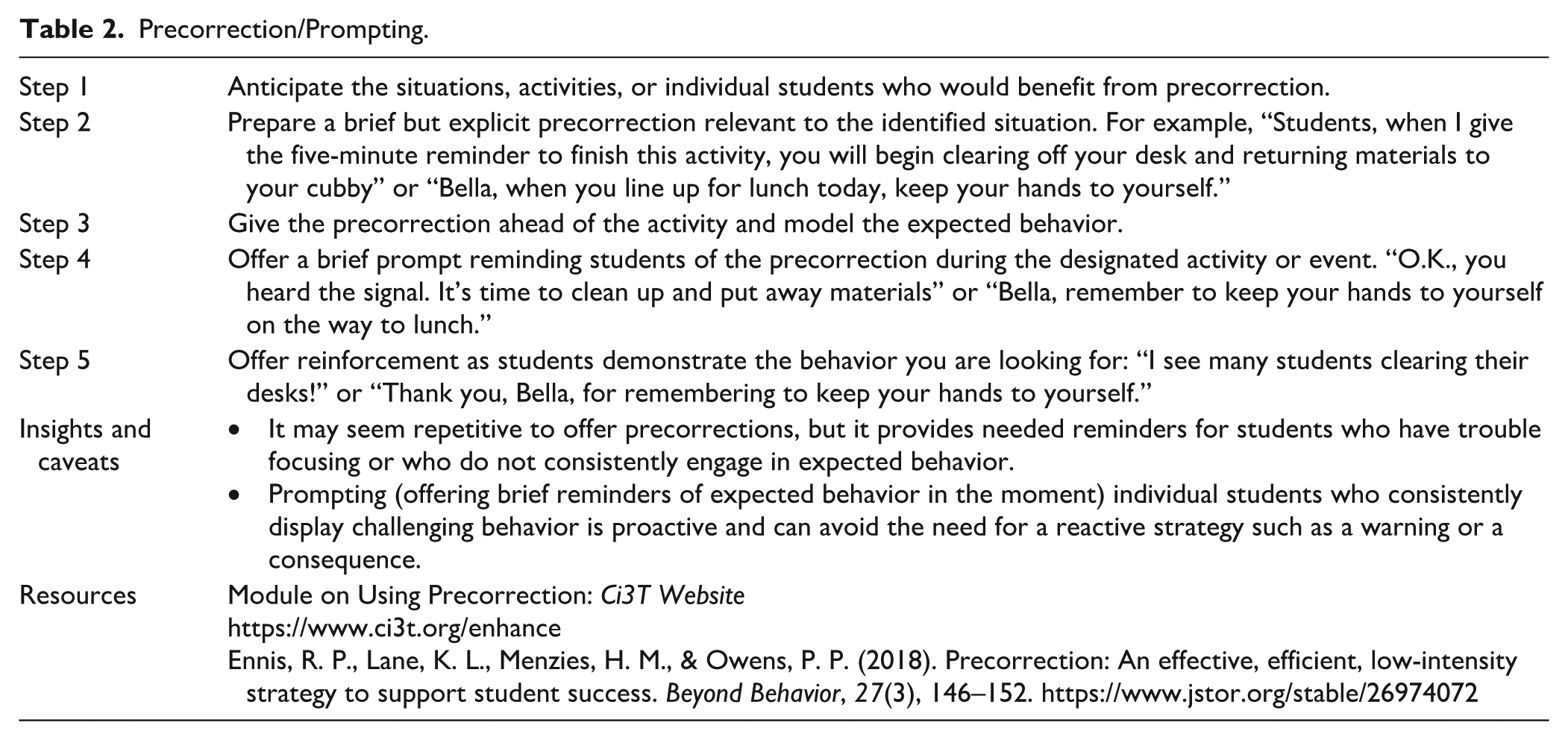
The goal of precorrection and prompting is to shape a student’s response to closer approximations of desired behavior until the individual can demonstrate it independetly. Some students need more time and support to learn and readily display appropriate classroom behavior, and prompts guide them to that goal. A prompt helps a student focus on the expected behavior to make the correct choice (Colvin, 2009). Because precorrection and prompting are instructive and proactive, they minimize the occurrence of misbehavior. In addition to reducing challenging behaviors, the strategy emphasizes an instructive rather than a punitive approach to shaping behavior, which enhances STR. Breaking a cycle of negative interactions is essential in establishing a warm relationship with students. Both teachers and students can feel demoralized by reactive discipline, whereas responsive strategies such as precorrection/prompting offer opportunities for connection rather than distance (Kennedy & Haydon, 2021). See Table 2 for suggestions on implementing precorrection/prompting (Lane et al., 2015a).
Precorrection/Prompting.
Behavior-Specific Praise
Behavior-specific praise is a technique for providing clear, explicit feedback when a student demonstrates a desired behavior. It is based on the premise that we are more likely to display behaviors we have been praised for; in other words, when the teacher notices and comments on a student’s effort, the student is motivated to repeat that behavior. Sometimes teachers are reluctant to use praise (Bear, 2013). It can conflict with their educational philosophy or training, or they believe it decreases intrinsic motivation, or that students do not need to be praised for what they should already be doing. However, behaviors can first be encouraged extrinsically when they are “prompted, modeled, or valued by significant others to whom they feel attached or related” (Ryan & Deci, 2000, p. 73). This is the power of a strong STR. Students are extrinsically motivated by their sense of connection to the teacher. The consistent and frequent feedback of BSP helps students become fluent in displaying prosocial behaviors, which, in time, become internalized (Guay, 2022). Despite being a simple strategy, studies show that BSP has been used successfully to reduce tardiness, decrease challenging behavior, and increase time on task (Royer et al., 2019).
Planning ahead on how to deliver BSP makes it easier to use. The first step is to consider opportunities where it will be effective by identifying the most important or frequent behaviors to address. If it improves classroom management to have students go to their designated centers quickly and begin working immediately, then delivering BSP at that time will be especially productive. An essential component of BSP is to make the feedback explicit. Instead of saying, “Good work at centers, Sam,” explicit BSP would be, “Sam, I see you walked quickly to your center and got started right away.” Without a high degree of specificity, a student may not understand exactly what the desired behavior is, which impedes the development of fluency. The praise should be both immediate and genuine. When it is immediate, students can easily make the connection between their actions and the praise. It is also more reinforcing not to have to wait for feedback. When students perceive the praise as sincere, it is more effective than when they think it is merely a pro forma comment by the teacher. Finally, the praise should not be an evaluation of the individual but should focus on their effort or actions (Chalk & Bizo, 2004).
It can be difficult to refrain from commenting on undesirable behavior, but ignoring minor infractions and finding opportunities to praise productive behavior is more powerful than reprimands (Justus et al., 2023). A 5 to 1 ratio of positive to negative comments is suggested when reinforcing desired behavior. Cook and colleagues (2017) demonstrated that when teachers attempted to reach or exceed a 5 to 1 ratio, they significantly increased student engagement and decreased disruptive behavior. When teachers reduce the attention they give to behaviors they want to eliminate and increase their responses to behaviors they want to see, they maximize the opportunity to support a strong STR.
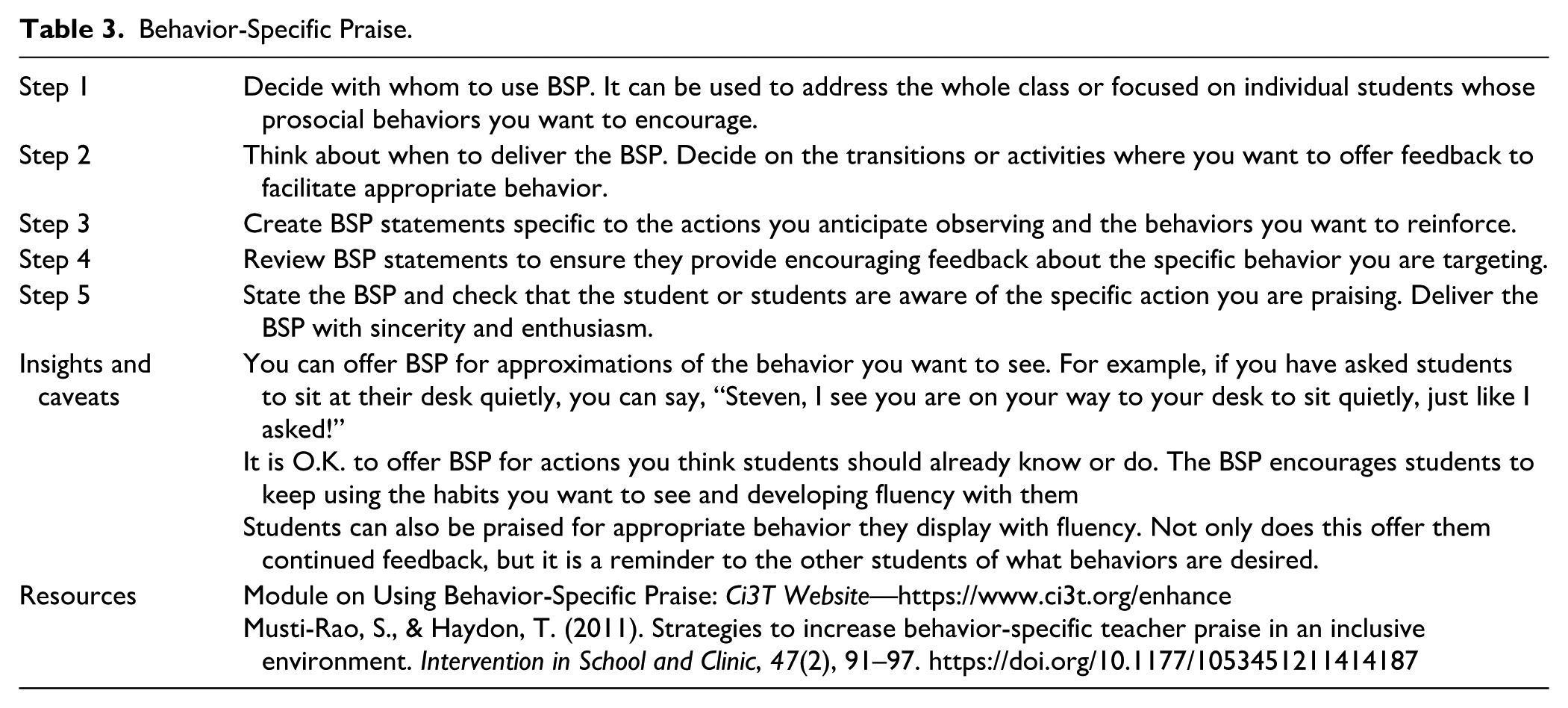
Behavior-specific praise is a strategy that reinforces the behavior the teacher would like to see. When teachers increase the frequency of positive feedback, off-task and disruptive behavior are reduced (Myers et al., 2011), alleviating the need to use reprimands and administer disciplinary action. In addition, it is a way to increase the number of positive interactions that support STR. The verbal feedback of BSP conveys interest instead of disapproval, building STR while clearly communicating expected behavior (Sutherland et al., 2019). See Table 3 for suggestions on implementing BSP (Lane et al., 2015a).
Behavior-Specific Praise.
Recommendations for Implementing the Strategies
Teaching requires an understanding of the complexity of interacting with a classroom of many students, each with their unique needs and strengths. It is not a simple question of using strategies, but of the teacher’s ability to communicate that they value their students while simultaneously teaching them appropriate classroom behavior. This task is further complicated by the long history of using punishment to curb behavior, so shifting to a responsive approach to help students in their acquisition and performance of prosocial behaviors is no easy task. Given this complexity, it is helpful to consider the following:
Expect student behavior to change over time rather than immediately. Using strategies consistently will have a greater impact.
Offering choice can be overwhelming at first, but there are many ways to get started. The focus could be academic, behavioral, with routine activities, or during play. Start small and build from there.
Some teachers may feel awkward using BSP or prompting, so planning statements in advance makes it easier to deliver the verbal praise or reminders.
Although the strategies themselves are straightforward, it is an entire shift in thinking to realize a responsive approach will reduce challenging behavior. Making this change takes practice and requires consistency.
Using the Strategies in Combination
Middle School Inclusion Class
Mr. Choi is an English Language Arts teacher at Jupiter Middle School. He has dual certification in general and special education. His school is adopting a school-wide approach to discipline and is using a Positive Behavioral Interventions and Support framework. He and his sixth-grade co-workers have decided to consistently use three proactive strategies in their classroom for a month and then plan to get together to discuss their thoughts on using them.
When students enter Mr. Choi’s inclusive classroom each day, they know to go straight to their desks and start writing in their journals. When they finish their entries, students put away their laptops or journals. Mr. Choi has always posted a journal starter on the board, but he decides to let students make the
As students enter the classroom, instead of sitting at his desk, Mr. Choi stands at the door and says hello. He also uses a
Once most students are seated, he offers a
At the end of 5 min, Mr. Choi reminds students they have two more minutes to finish their journal entry. As he moves around the class, he asks individual students if he can read their entries as he checks their work. He offers
Later in the day, Mr. Choi thinks about how easy it was to be both proactive and positive. Not only did he have more positive interactions with students, but it was easier to get students focused with prompts rather than reprimands after the fact. He could see that using choice, precorrection/prompts, and BSP had the potential to improve his classroom climate (see Note 1).
Preschool Special Education Class
It’s morning circle time in Ms. Rivera’s preschool classroom. The children are sitting together on the rug, preparing to choose a song for everyone to sing. Four-year-old Alex, a child with autism, is sitting nearby but fidgeting with the edge of his shirt and glancing toward the shelf where toy cars are stored. Alex typically has a hard time staying engaged in group activities for long periods of time and often prefers to play alone with his collection of toy cars.
Ms. Rivera begins by gathering the group’s attention. Noticing Alex’s gaze shifting away, she gently places a small toy car next to her as a visual support. Smiling, she offers
To keep him engaged, Ms. Rivera offers a
Ms. Rivera then waits to see if Alex will pick a song with the red car. On the rug are three picture cards representing class favorites: Wheels on the Bus, If You’re Happy and You Know It, and Old MacDonald. Alex sat quietly, pushing the red car back and forth in front of him. Ms. Rivera then
The whole class cheers, and Ms. Rivera reinforces Alex’s participation with
Conclusion
Traditional school discipline has relied on a punitive approach to addressing behavioral infractions; however, research shows that responsive strategies yield greater gains. Strategies such as choice, precorrection/prompting, and BSP are best practices for enhancing learning and promoting engagement (Newton et al., 2024; Sherod et al., 2023). Equally important, these strategies contribute to a positive STR by reducing conflict and fostering meaningful, rather than adversarial interactions between students and teachers. They are concrete ways to foster connection, responsiveness, and an instructive approach to changing unwanted behavior. Establishing a classroom where students are supported in using prosocial behaviors rather than punished for noncompliance not only provides a powerful model of social interaction but also offers students opportunities to practice those desired behaviors. A strong STR is based on the premise that students feel safe and cared for, as well as respected by their teacher. Choice, precorrection/prompts, and BSP are visible expressions of valuing and caring for students.
Shifting from a traditional mindset to focusing on behavior as a skill that requires instruction can improve outcomes for all students while providing targeted support for those who struggle due to their behavioral profile. There is strong evidence of the positive outcomes of this shift, including improved social-emotional functioning, academic engagement, prosocial behavior, and school climate, as well as reduced behavioral infractions (Elbanna, 2025). Finally, the strategies are feasible for teachers as they can be easily implemented with minimal advance planning, yet have the potential to offer a substantial return on their investment of time.
Footnotes

Funding
The authors received no financial support for the research, authorship, and/or publication of this article.
Declaration of Conflicting Interests
The authors declared no potential conflicts of interest with respect to the research, authorship, and/or publication of this article.