







Abstract
Multidisciplinary teams are responsible for developing legally compliant individualized education programs for transition-age students with disabilities. A critical component of this process is the use of age-appropriate transition assessments to inform postsecondary goals and transition services. However, the assessment process can become challenging when team members differ in their perspectives on the types or extent of evaluations needed to support transition planning. For example, a dispute may arise when a parent seeks to limit the scope of special education evaluations. In C.M.E. on behalf of W.P.B. v. Shoreline School District (2023), a decision from the U.S. Court of Appeals for the Ninth Circuit addressed whether parents may refuse components of an evaluation required under the Individuals with Disabilities Education Improvement Act of 2004. The court concluded that parents may refuse special education services but cannot dictate the assessments within an evaluation. Implications and strategies to support collaborative transition planning with families are discussed.
Keywords
Change never happens at the pace we think it should. It happens over time. — Judith Heumann
More than two decades after the last reauthorization of the Individuals with Disabilities Education Improvement Act of 2004 (2006 [IDEIA 2004]), educators, scholars, attorneys, and judges have sought to elaborate on and interpret what it means to provide a free and appropriate education (FAPE; 20 U.S.C. §1401(9)). Since 1975, when the Education for All Handicapped Children Act became federal law, educators have been tasked with providing educational access to students with disabilities and instructing them in academic and functional skills. District court to Supreme Court rulings provide a basis for the quality and quantity of the education provided under the IDEIA 2004. While the literature base in disability-related research has grown exponentially, the population of students who qualify for special education continues to grow, posing new challenges for educators and school districts in providing FAPE.
When a student qualifies for special education and related services, they are entitled to an individualized education program (IEP). A student’s IEP must include a statement of their present levels of academic achievement and functional performance, measurable annual goals (academic and functional), a description of how the student’s progress will be measured and reported to parents or legal caregivers, a statement of special education and related services, an explanation of the extent to which the student will be removed from the regular class, individual appropriate accommodations, the projected begin date of services, and the location, frequency, and duration of services (§ 300.320(a)). All of this must happen in the student’s least-restrictive environment (LRE), as determined by the IEP team (20 U.S.C. §1412(a)(5)(A); § 300.114). When a student reaches transition age, as determined by state law (but no later than 16 by federal law), the IEP must also include transition services (§ 300.320(b)) and the transfer of rights at the age of majority (§ 300.320(c)).
According to the National Center for Education Statistics (NCES, 2024), in the Fall of 2022, 95% of students with disabilities who received services under the IDEIA 2004 attended public schools. Of the remaining 5%, 2% were enrolled in separate schools (public or private) for students with disabilities; 2% were parentally placed in regular private schools; and the final 1% were homebound or placed in hospitals, separate residential facilities (public or private), or correctional facilities (NCES, 2024). Currently, the U.S. Department of Education does not provide data related to the number of students who are homeschooled, including those with disabilities. According to the National Special Education Advocacy Institute (NSEAI, n.d.), there are five million homeschoolers after COVID. Of these, nearly one million had disabilities, and another 600,000 were reported to be gifted. The most represented disabilities were learning disabilities, emotional or behavioral disorders, and twice exceptional learners (NSEAI, n.d.).
Legal Context: IDEA Requirements for Evaluation and Transition
When a parent, legal caregiver, or school personnel suspect a student has a disability, the parent/legal caregiver must provide consent for the initial evaluation (§ 300.300(a)). The public agency must provide notice of the need for evaluation and “reasonable efforts” to obtain informed consent before the evaluation can be conducted (§ 300.300(a)(1)(iii)). If the parent fails to consent to the evaluation, the education agency is obligated to evaluate the student in compliance with federal and state laws (§ 300.300(a)(3)(ii)). It should be noted that parental consent for evaluation is different from consent for special education and related services (§ 300.300(b)). It is also a parent’s right to revoke special education or related services at any time, so long as their request is in writing (§ 300.300(b)(4)). While parents and legal caregivers are involved in the evaluation process, the education agency is responsible for the process.
Once a student qualifies for special education, the services and supports are held to a standard of FAPE set by the IDEIA 2004 and, most recently, interpreted by the Supreme Court of the United States in Endrew F. v. Douglas County School District (2017; hereafter Endrew F.). In Endrew F., the Supreme Court set a threshold of appropriate within FAPE as more than minimal progress in meaningful academic and functional skills. This places great importance on the evaluation measures used to qualify students for special education services, as they establish a baseline for student progress toward goals.
Transition Assessment as a Statutory Requirement
The use of age-appropriate transition assessments is mandatory for developing an annual IEP when a student turns 16, or earlier, depending on state requirements (Suk et al., 2020). Transition assessments determine a student’s strengths, preferences, interests, and needs related to future employment, postsecondary education, and adult living. While these assessments are not considered high-stakes testing instruments, a variety of formal and informal transition assessments are available to support educators and IEP teams in developing compliant, high-quality IEPs. The assessment results facilitate the creation of the necessary components, including postsecondary goals, annual goals, transition services, and a course of study.
Experts in the field of secondary transition recommend the use of two or more transition assessments that gather input from more than one invested party (i.e., caregivers, general educators, related service providers, the student themselves), with at least one assessment having ample validity and reliability evidence to support its use in transition planning for students with disabilities (Prince et al., 2014; Pulos & Martin, 2018; Sinclair et al., 2024). These recommendations follow the rulings of district and circuit courts on transition assessments and a free appropriate public education provision (Prince et al., 2020; e.g., Carrie, I. v. Department of Education, State of Hawaii, 2012; Gibson v. Forest Hills School District Board of Education, 2013; K.C. v. Mansfield Independent School District, 2009; M.Z. v. New York City Board of Education, 2013). If educators or school districts fail to use age-appropriate transition assessments when developing required components of the IEP, including the transition plan, this procedural violation may rise to the level of a substantive violation resulting in a denial of FAPE.
Case Overview: C.M.E. v. Shoreline School District
In C.M.E. on behalf of W.P.B. v. Shoreline School District (2023, hereafter C.M.E. v. Shoreline), the U.S. Court of Appeals for the Ninth Circuit heard a case related to evaluation, parental consent for evaluation, and postsecondary transition. At the time of the dispute, W.P.B. received special education services from the Shoreline School District from elementary school through high school. While W.P.B.’s age and disability(ies) were not disclosed in the court case, the facts of the case indicated that he had already completed 4 years of high school. His most recent IEP, developed in January 2019, anticipated a transition to the district’s community-based transition program at a local community college. This proposed placement was based on independent evaluations and district observations indicating that W.P.B. was more successful in functional settings than in traditional academic environments.
W.P.B.’s mother, C.M.E., disagreed with this proposed transition placement and instead sought to maintain her son’s enrollment in a high school academic setting. The district declined to change the placement, concluding that continued enrollment in high school would not constitute the LRE. In February 2019, C.M.E. notified the school district that she would begin homeschooling W.P.B. on a part-time basis. According to court documents, she believed this decision gave her primary control over her son’s educational programming, including the authority to reject components of the IEP with which she disagreed. The district acknowledged the part-time homeschooling arrangement but clarified, through prior written notice, that homeschooling did not permit unilateral modification of an IEP or overriding of IDEIA 2004 procedures related to special education decision-making.
In June 2019, C.M.E. formally revoked consent for W.P.B. to receive special education services. The district again issued prior written notice confirming that, because of the revocation, W.P.B. would no longer be eligible for IDEIA services or protections and would revert to general education status. Approximately 3 weeks after revoking consent, C.M.E. requested that the district conduct a new evaluation to determine eligibility for special education services, acknowledging that the prior evaluation, which was completed 2 years prior, was outdated. The IEP team, of which the parent was a member, convened a planning meeting to propose an initial evaluation that included a review of existing data, academic assessments, and an age-appropriate transition assessment with a student interview. While the district accommodated several parent-requested limitations to the academic components of the evaluation, the parent continued to refuse consent for the transition assessment and interview. Specifically, C.M.E. said that her child experienced trauma during a previous interview. She also asserted that, because W.P.B. was homeschooled or dually enrolled, transition assessments were not required and that the district lacked authority to override her refusal.
Both the administrative law judge and the district court rejected this argument, concluding that when a parent seeks special education services from a public school district, regardless of homeschooling or part-time enrollment status, the student is subject to the IDEIA 2004’s evaluation requirements. The court specifically found that IDEIA does not recognize a distinct homeschool IEP and does not permit parents to selectively consent to only portions of an evaluation necessary for developing an appropriate IEP, particularly where transition services are legally required for students of age 16 or older. The district court further found that the district had made reasonable efforts to address the parent’s stated concerns, including seeking documentation and exploring potential alternatives to mitigate the student’s distress. The parent, however, did not respond to the district’s requests for medical documentation or propose alternative assessment methods.
On further appeal, the Ninth Circuit Court of Appeals upheld the district court’s decision, concluding that the proposed evaluation, including the age-appropriate transition assessment and interview, was lawful, reasonable, and necessary based on the IDEIA 2004’s requirements. In a concurring opinion, one of the three judges on the panel agreed with the outcome but raised a procedural concern, arguing that the case was moot. He reasoned that because W.P.B. had aged out of special education eligibility and no claim for compensatory education was before the court, there was no longer a case requiring judicial resolution.
Discussion
The findings from this case are significant both in their application and scope. First, the U. S. Court of Appeals for the Ninth Circuit (n.d.) is the largest of the 11 circuit courts, with jurisdiction over Alaska, Arizona, California, the Commonwealth of the Northern Mariana Islands, Guam, Hawaii, Idaho, Montana, Nevada, Oregon, and Washington. According to the U.S. Department of Education, Office of Special Education Programs (2023), this ruling applies to over 1.36 million students living in these nine states and two insular areas (i.e., inhabited territories). This means the ruling in this case will apply to all these students, whether they are transition-aged now or will be in the future.
Following the Supreme Court’s ruling in Endrew F. (2017), legal researchers have frequently used FAPE as a unit of analysis, anticipating a shift in court decisions in light of this case (Connolly & Wasserman, 2021; Moran, 2020). In C.M.E. v. Shoreline (20203), one judge acknowledged that there were no FAPE-related claims in this case that would have entitled the adult student to compensatory education if the case had been found in their favor. Therefore, this case is unique, both in its relation to legal requirements for evaluations, including transition assessments, and in its service provision for homeschooled students with disabilities.
Comprehensive Evaluation Obligations
The IDEIA 2004 requires that any child who is suspected of having a disability receive a comprehensive evaluation “in all areas related to the suspected disability, including, if appropriate, health, vision, hearing, social and emotional status, general intelligence, academic performance, communicative status, and motor abilities (§ 300.304(c)(4)).” Under the current evaluation requirements, parents can provide information that may assist in determining whether the child has a disability and the content of the child’s IEP (§ 300.304(b)(1); emphasis ours). Furthermore, the local education agency is tasked with conducting an evaluation using multiple valid, reliable, nondiscriminatory assessments to determine whether the student has a disability and to plan educational programming based on the child’s individual needs (§ 300.304).
Conditional Consent Is Not Legally Valid Consent
Parental consent is required for an initial special education evaluation (§ 300.201), which differs from consent for special education services. If the parent does not provide consent for the initial evaluation or fails to respond to a request to provide consent, the public agency is not required to pursue the initial evaluation (§ 300.300(a)(3)(i)). While parents or legal caregivers are members of the multidisciplinary team (§ 303.340), they are only one member and cannot dictate the nature of the federal-, state-, and district-mandated assessments, including transition assessments. In C.M.E. v. Shoreline (2023), the parent attempted to modify their approval for evaluation or service provision in a way that violated federal or state law; therefore, their conditional consent is invalid. When this happens, the IDEIA 2004 provides override procedures.
In C.M.E. v. Shoreline (2023), the Ninth Circuit upheld a June 2021 ruling by the Western District of Washington that allowed the district to conduct the proposed assessments, including a student interview, without the parent’s consent. Specifically, any IEP developed by the district for this student would need to include appropriate, measurable postsecondary goals and the transition services needed to help the student reach those goals. Acknowledging the IDEIA 2004’s requirements, the court ruled that “the [district] needed to use an age-appropriate transition assessment to help develop [the student’s] future IEPs if he was found eligible for special education services.” Although the student had a traumatic experience in a past interview, the district’s request to interview the student about his interests, strengths, preferences, and needs was reasonable and necessary. In addition, the parent did not respond to Shoreline’s request for additional information on how to assess W.P.B. without making him uncomfortable.
No Such Thing as a “Homeschool IEP”
According to the IDEIA 2004, state and local education agencies are obligated to identify students with disabilities residing in their communities (34 C.F.R. § 300.111 and § 300.201). This means that state departments of education are required to have procedures in place to evaluate and provide services to students with disabilities outside public schools, including in homeschooling settings. While a student with a disability who homeschools has the same rights to special education and related services, federal law does not require a different version of an IEP for this student. In this case, the Ninth Circuit Court of Appeals clearly ruled that dual enrollment did not alter the IDEIA 2004 obligations. This means that parents, as homeschool instructors, cannot make unilateral decisions regarding special education and related services. Despite W.P.B.’s dual enrollment, the provisions of the IEP remained under the school district’s authority. Therefore, there is no such thing as a “homeschool IEP.”
Implications for Practitioners
The IDEIA 2004 requires educators to administer transition assessments and use them to create transition plans for their students. Transition assessments are legally required and not an optional measure of performance. An important implication of this ruling in C.M.E. v. Shoreline School District (2023) is that transition assessments are required as part of the evaluation process for students of transition age, and parents cannot pick and choose which assessments are administered. Parents may refuse special education services, but they cannot dictate the scope of admission evaluations.
If parents have a limited understanding of the transition planning process, they may feel apprehensive about the inclusion of transition assessments during the evaluation and in subsequent years as the transition plan evolves. Research has consistently found that parents report limited understanding of, and dissatisfaction with, the IEP and transition planning processes (Choiseul-Praslin et al., 2022; Hetherington et al., 2010; Yeager et al., 2024; Young et al., 2016). By using a few strategies, educators can increase parental understanding and engagement in the IEP/transition planning process, thereby mitigating the risk of prolonged disputes. Examples of strategies to increase family involvement in transition planning are presented below.
Go Beyond Forwarding Information about Transition. Young et al. (2016) found that providing parents with in-person information through a training approach was significantly more effective at increasing parental knowledge of transition services than sending a transition planning brochure home. To go beyond sending written information home in backpacks, educators and school personnel should offer families and students other ways to share information following principles of universal design for learning (Scott & Bruno, 2018). A few examples of this could include in-person informational workshops on or off the school site, pre-recorded videos that explain the written information, and virtual office hours for parents to attend at different times during the day to ask questions.
Connect Families with Support Providers. Caregivers explain that the need for tangible action-related support and nurturing emotional support systems is particularly important when they have transition-age youth (Yeager et al., 2024). Educators can invite disability organizations, parent support groups, the Department of Rehabilitation, and family and student service organizations to community and family engagement nights. During these events, these organizations can showcase their tangible and emotional supports through hosting a booth and/or interactive presentations.
Parent and Family Training Opportunities. A variety of online training modules related to transition planning for family members is available (see Table 1). These modules are engaging and provide a variety of information-sharing strategies (audio, visual, textual, audio-visual). They also offer busy family members the flexibility to learn about transition planning on their own terms. Other options include providing family members with a list of local training opportunities or providing on-site school training once a semester on different transition topics.
Build and Repair Relationships With Parents and Caregivers. Choiseul-Praslin et al. (2022) found that some mothers of children with disabilities distrust IEP teams and are not satisfied with IEP development due to many factors, including power imbalances between school officials and themselves. They suggest taking steps to build and repair relationships with caregivers to improve trust and satisfaction with the IEP process. This can also reduce parental stress around the IEP process (Burke & Hodapp, 2014).
Online Transition Resources for Families.
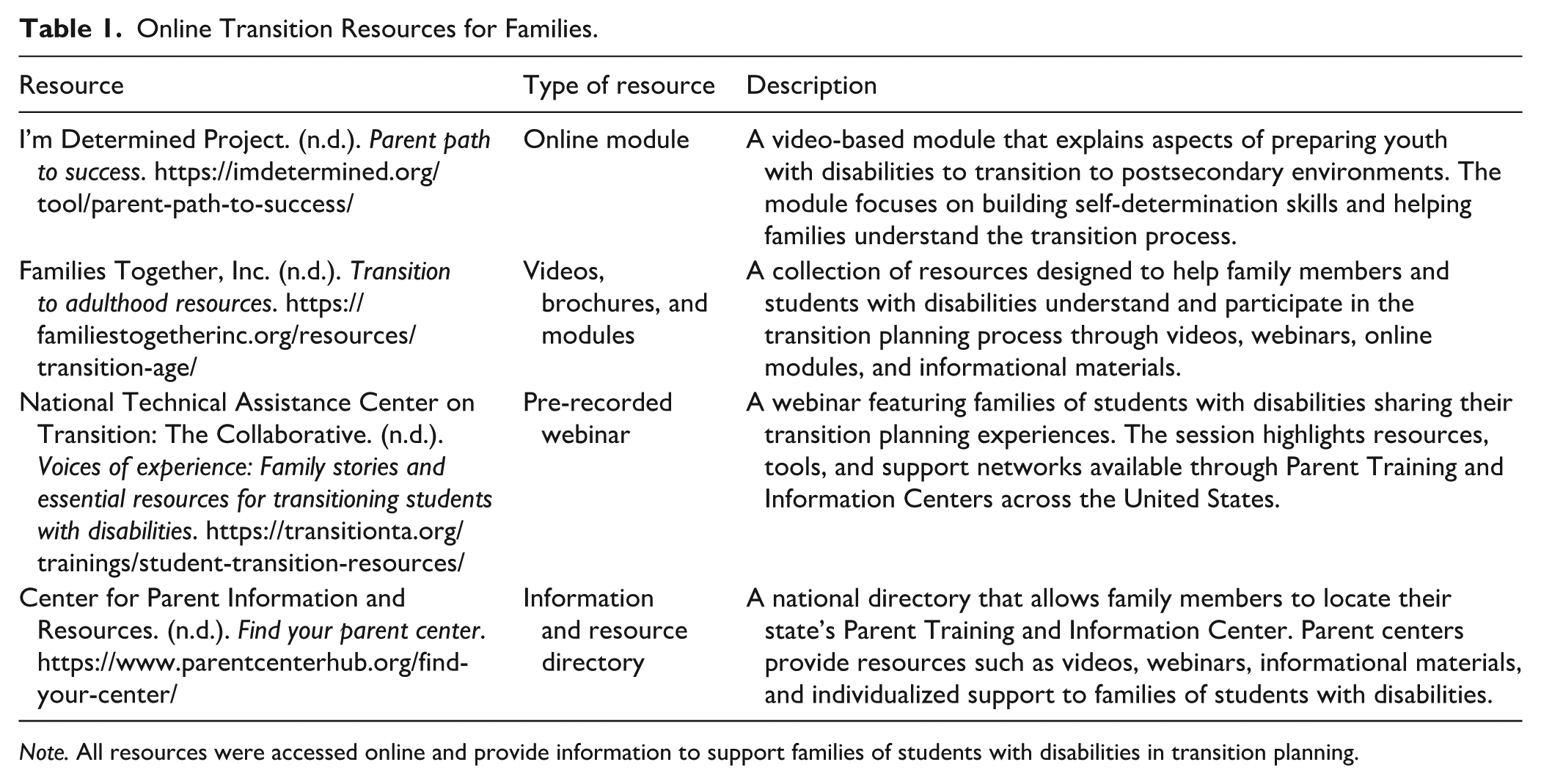
Note. All resources were accessed online and provide information to support families of students with disabilities in transition planning.
School personnel should actively involve caregivers in decision-making rather than simply asking questions during IEP meetings. For transition planning, educators can involve caregivers by asking them to complete family versions of assessments, seeking input on annual goals, or surveying via online avenues or response forms to determine their wants, needs, and hopes for their child, for consideration in postsecondary goal creation.
Conclusion
The decision in C.M.E. v. Shoreline School District (2023) reinforces a central principle of the IDEIA 2004: Evaluations used to determine eligibility and develop IEPs must be comprehensive and aligned with federal requirements. For transition-age students, this includes the use of age-appropriate transition assessments to develop postsecondary goals and provide transition services. As the courts in this case made clear, transition assessment is not an optional component of the evaluation process. When a student is of transition age and a district is considering eligibility or developing an IEP, the student’s strengths, preferences, interests, and needs related to postsecondary outcomes must be assessed.
For school-based practitioners, the ruling highlights several important considerations. First, while parents and caregivers play a critical role as members of the multidisciplinary team, they cannot unilaterally limit evaluations in ways that would prevent districts from meeting their legal obligations under the IDEIA 2004. Conditional consent that restricts required evaluation components may effectively function as a refusal of consent, triggering procedural options for districts to pursue an evaluation through due process. Second, the case clarifies that homeschooling or dual enrollment does not alter the IDEIA 2004’s evaluation requirements when parents seek special education services from a public school district. Regardless of the instructional setting, districts remain responsible for conducting evaluations that meet federal and state requirements and that provide sufficient information to develop an appropriate IEP.
At the same time, the decision underscores the importance of proactive communication and collaboration with families. Disputes over evaluation components often arise from misunderstandings about the purpose of assessments or concerns about how students will experience the process. Practitioners can reduce the likelihood of prolonged conflict by clearly explaining the role of transition assessments in developing legally compliant IEPs and by offering multiple opportunities for families and students to ask questions and share concerns. When families express apprehension about evaluation methods, educators should document their efforts to address those concerns and explore reasonable alternatives while still ensuring compliance with legal requirements. Ultimately, C.M.E. v. Shoreline School District (2023) serves as a reminder that transition planning must remain grounded in meaningful assessment and student-centered decision-making.
Footnotes
Acknowledgements
In loving memory of Malcolm Lorenzen, whose legacy of compassion and perseverance remains a source of strength.

Funding
The authors received no financial support for the research, authorship, and/or publication of this article.
Declaration of Conflicting Interests
The authors declared no potential conflicts of interest with respect to the research, authorship, and/or publication of this article.