







Abstract
Historically, educational systems have prioritized authoritative teaching and learning based on dominant norms, further excluding students with emotional and behavioral disorders (EBD). Thus, it is imperative for educators to make a philosophical and pedagogical shift toward a humanizing pedagogy, which centers students’ lived experiences, strengths, and autonomy. Humanistic educators uphold four key values: (a) teaching as a relationship, (b) space as a reflection of inclusion, (c) instructional strategies that embolden students, and (d) assessment as a tool for growth. This article provides an in-depth look at these values, along with actionable strategies for educators committed to this work. By reimagining education as a collaborative and liberatory process, educators can foster environments where students with EBD thrive academically, socially, and emotionally.
Introduction
For too long, traditional education systems have treated students as passive recipients of knowledge rather than active participants in their own learning (Artiles, 2019; Freire, 1970). This is particularly true for students with emotional and behavioral disorders (EBD), who historically have been marginalized, excluded, or subjected to rigid, one-size-fits-all approaches that prioritize compliance over critical engagement (Artiles, 2019; Haft et al., 2023; Kirby, 2017). Authoritative teaching styles require individuals to conform to dominant, able-bodied norms, which further exacerbate barriers to learning. These approaches not only limit student autonomy but also undermine their ability to develop critical thinking, self-advocacy, and a sense of belonging in the classroom (Deniz et al., 2024). To create truly inclusive spaces, educators must conceptualize education as a transformative, evolving process that prioritizes the humanity of every learner and acts as a practice of freedom (hooks, 1994). This shift to a humanizing pedagogy requires a shift in mindset, not just methods (Carter Andrews et al., 2019).
Across the past several decades, scholars have proposed different definitions of humanizing pedagogy. Some emphasize student dignity and respect (del Carmen Salazar, 2013), democracy and liberation (Freire, 1970), and student-centeredness (Nguyen & Schunn, 2024), while others affirm humanity (Carter Andrews et al., 2019; Rogers, 1969) and reject deficit-oriented thinking (Heumann & Joiner, 2020). Regardless of variation, all scholars have agreed that humanizing pedagogy centers around common themes: (a) honoring students as whole individuals, (b) co-constructing knowledge between students and teachers, (c) critical consciousness and empowerment to challenge oppressive systems, (d) renouncing deficit mindsets and focusing on student strengths, and (e) transformative learning environments that foster student agency and engagement. In alignment with these themes, humanistic learning theory emphasizes learners’ freedom and autonomy, connecting the ability to learn with the fulfillment of other needs (Ryan & Deci, 2017).
Characteristics of Humanistic Educators
Humanistic educators operate under the unwavering belief that education should nurture the whole learner—intellectually, socially, and emotionally—and view education as an evolutionary process that promotes holistic growth (Rogers, 1969; Ryan & Deci, 2017). This has led some scholars to define humanizing pedagogy as a process of becoming, focusing on the constant evolution of one’s own humanity (Carter Andrews et al., 2019). Thus, humanizing pedagogy is more than a teaching approach—it is a profound, ongoing commitment to education as an act of liberation. It is a philosophy that shapes every aspect of a teacher’s practice. At its core, it is a celebration of “the souls of students” (hooks, 1994, p. 13), affirming their humanity, their voices, and their right to be seen, heard, and valued.
Educators committed to humanizing pedagogy challenge the notion that education is something done to students and instead reframe it as something created with them. Rather than enforcing hierarchical teacher–student relationships, humanistic educators promote co-learning, where both educators and students contribute to the construction of knowledge (Bartolomé, 1994). Engaging in this reciprocal process supports educators to reject deficit-based views of disability and instead embrace the idea that all students hold valuable knowledge, acknowledging their strengths, lived experiences, and cultural wealth in all aspects of learning (del Carmen Salazar, 2013; Llopart & Esteban-Guitart, 2016; Moll et al., 1992). Humanizing pedagogy seeks to dismantle structural inequalities in education by valuing students’ voices, honoring their realities, and positioning them as agents of change. In doing so, it thereby creates an ethic of care (Noddings, 2013). Overarchingly, humanistic educators prioritize four key values: (a) teaching as a relationship, (b) space as a reflection of inclusion, (c) instructional strategies that embolden students, and (d) assessment as a tool for growth. When classrooms are built around these principles, students with EBD are no longer positioned as passive learners in need of remediation but as active collaborators in the construction of knowledge (Bartolomé, 1994).
Education as a Humanizing Process
When ensuring educational opportunity for students with EBD, it is critical to move beyond a narrow conceptualization of access; students must experience a meaningful, empowering, and humanizing learning process. A metaphor to consider: access as opening the door and inviting someone in; accommodations and modifications are what are done after access is offered. Access alone, without follow-up, is often an empty gesture (Heumann & Joiner, 2020). Humanistic educators underscore humanity as a core principle in creating accessible and inclusive learning environments, recognizing that access without humanization is incomplete. To design truly inclusive education experiences, humanization must define access, not merely accompany it. Traditional classroom structures, including classroom culture, physical layouts, instructional methods, and assessment practices, can either empower or inhibit student agency. By rethinking these structures through a humanizing lens, educators can create spaces in which students with EBD can thrive academically, socially, and emotionally.
Teaching as a Relationship
At the core of humanizing pedagogy is the belief that students are whole (Nguyen & Schunn, 2024; Rogers, 1969). However, this is not always the predominant attitude toward students with EBD (Haft et al., 2023; Kirby, 2017; Penketh, 2020), who are often considered inconsiderate, defiant, and annoying, and mistakenly viewed as having more conscious control over their behaviors than is realistically the case (French, 2019). This leads educators to hold deeply rooted values that frame students with EBD as lesser, focusing on deficits and stereotypes rather than their assets (Haft et al., 2023; Kirby, 2017). Educators who are humanists, however, challenge notions of deficiency in favor of potential. This requires a shift away from deficit thinking to asset-oriented perspectives, recognizing and honoring students as knowledge holders and knowledge sharers. In fact, authentic and humanizing relationships are critical to supporting students with EBD; calm, positive, and trusting interactions lay the foundation for learning prosocial behaviors such as empathy and self-control (French, 2019).
Reciprocal teaching and learning require intentional strategies that encourage students to question, reflect, and contribute their perspectives. As educators move away from teacher-centered, one-way instructional approaches and toward shared learning opportunities, they promote the classroom as a democratic space—affirming that diversity in learning is an asset, not a limitation. When educators foster spaces where students are not only included but feel valued for their unique insights, levels of engagement and academic performance increase (Conner et al., 2022). This also encourages students to recognize their inherent worth and contributions (Penketh, 2020; Stansberry Brusnahan, Harkins Monaco, et al., 2023).
Co-Creating Expectations
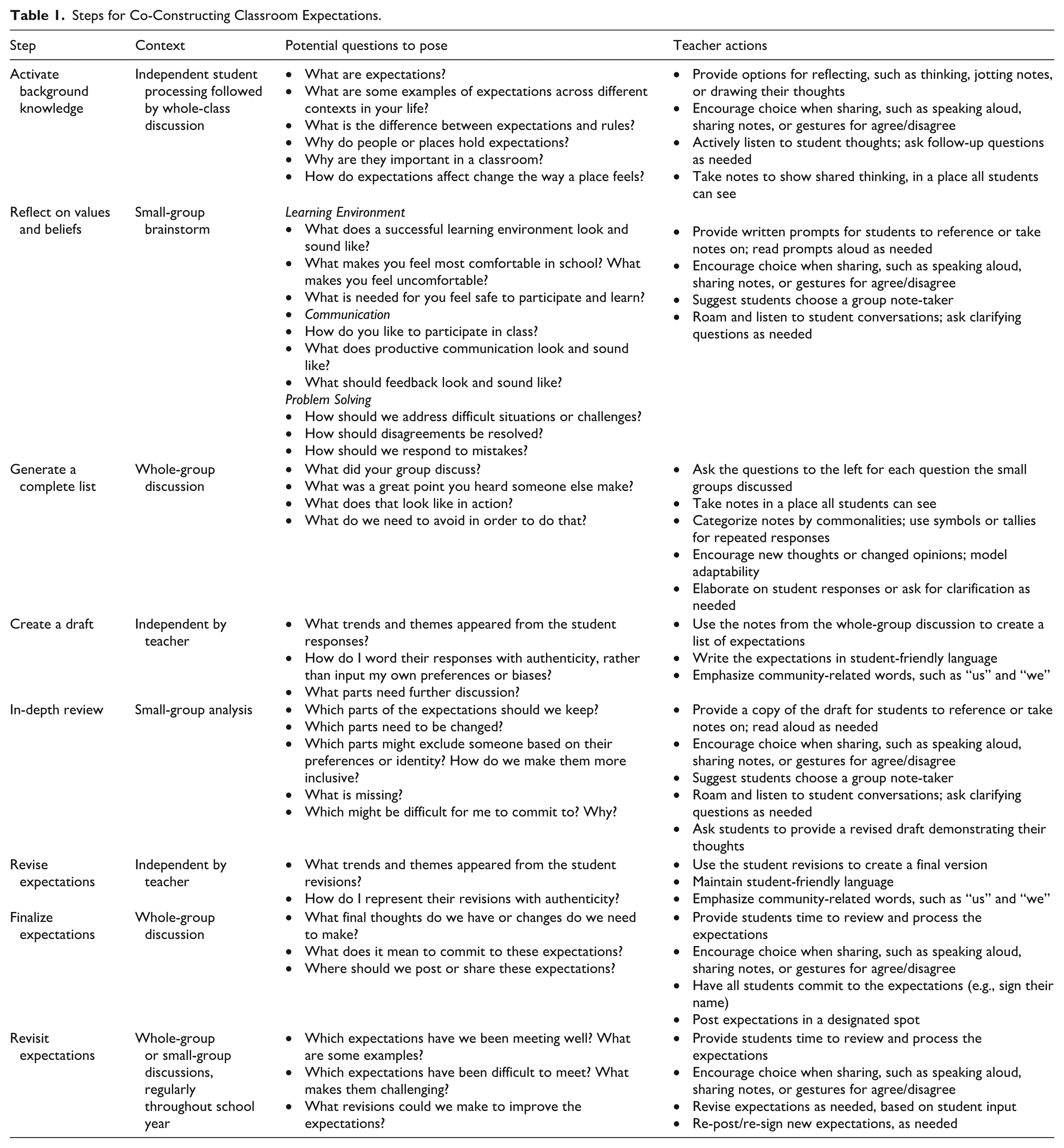
Humanistic educators celebrate students with EBD by engaging them as co-constructors of knowledge and by creating learning environments that center students’ lived experiences and perspectives. One way to do this is to co-create classroom expectations with students rather than for them, acknowledging that they are the experts on what they need to thrive. Co-creating classroom expectations not only demonstrates educators’ value for student voice and experience but also ensures that the class culture reflects students’ cultural and linguistic assets (Boyes-Watson & Pranis, 2015; Cohen & Lotan, 2014; Hilliard et al., 2025). To do this, educators start by activating students’ background knowledge, posing guiding questions such as “What are expectations?” and “How do they shape our environment?” Getting a sense of students’ perspectives in this way allows the educator to learn about their values, understand their prior experiences, and tailor the conversation to build on what students already know (Ma et al., 2025). Once a foundation is built, small-group and peer-to-peer discussions can encourage students to generate their own ideas, reflect on their values and beliefs, and problem-solve with others. These small-group interactions have proven more beneficial for students with EBD, as they encourage more personalization, engagement, and social interaction while attending to students’ specific needs (Hilliard et al., 2025). During this time, they can collaborate with peers to identify what helps them feel safe, included, regulated, and engaged in the classroom.
After small group work, educators can invite all students to share ideas and generate a comprehensive list of expectations. It is important to record these ideas where all students can see them and to help organize them into themes while encouraging new or evolving thoughts. Using these suggestions, the class can draft a list of expectations written in student-friendly and community-centered language (e.g., using “we” or “us”). They can then return to their small groups and review the draft. This student-centered review allows students to discuss what should be kept, revised, or added—and whether any expectations unintentionally exclude certain identities or perspectives. Educators can then gather this feedback and use it to update the list of expectations.
Before the expectations are put into place, students and educators should reflect on what it means to commit to them. Once they come to a final agreement, it is helpful to have everyone mark their approval with signatures, initials, symbols, or another agreed-upon method. Educators can then post the final document in a shared, accessible location in the classroom. It is important to note that this process should continue multiple times throughout the school year: the class should regularly revisit the expectations, reflect on how well they are working, make necessary updates, and recommit as a community. See Table 1 for more in-depth steps for co-constructing classroom expectations.
Steps for Co-Constructing Classroom Expectations.
Valuing Students’ Perspectives
A critical aspect of reciprocal learning spaces is being present. When educators are active listeners who seek to understand and learn from students, they can tailor their instruction to meet students’ needs better (Ladson-Billings, 1995, 2024). Therefore, humanistic educators design learning environments in which students are encouraged to question, reflect, and contribute rather than merely comply with predetermined expectations (Freire, 1970; Ladson-Billings, 2024). Activities that use structured dialogue protocols, such as Socratic seminars or collaborative inquiry circles, encourage students to critically engage with texts, ideas, and each other’s perspectives. These activities emphasize student participation and input, placing students with EBD at the forefront of the conversation as the educator steps back to observe and absorb. Similarly, student-led discussions and peer teaching provide opportunities for students to take ownership of their learning by sharing their current understandings, asking questions, and making connections to their own lives. By using dialogue to foster reciprocal learning, educators create spaces where students develop critical thinking skills, challenge assumptions, and engage in meaningful learning opportunities that value students’ insights (Hilliard et al., 2025).
While the restorative nature of these activities supports students in taking ownership of their learning, they also model for students how to learn with and from each other. The student-centered focus makes space for students with EBD to listen and learn, develop empathy, build a sense of belonging, and create a culture of mutual respect among peers (Hunter, 2020). Another way to foster this among students is to use flexible grouping during small-group activities. Grouping students with EBD based on their specific strengths and needs supports their engagement and confidence while increasing academic success (Barnes et al., 2023; Hilliard et al., 2025) and decreasing the fear and anxiety that can occur during whole-class instruction (Bledsoe & Baskin, 2014). Fostering this collaborative environment helps to address feelings of exclusion and isolation that students with EBD may be feeling across their school day. It also fosters learning through student voice and social interaction, cultivating a sense of belonging and community among students (Power et al., 2024).
Space as a Reflection of Inclusion
Inclusive learning environments begin with physical design. Educators committed to humanizing pedagogy consider students’ identities, needs, and preferences when setting up their classroom. Humans are expected to be flexible and adaptable; classroom environments must reflect that.
Employing Flexible Seating Structures
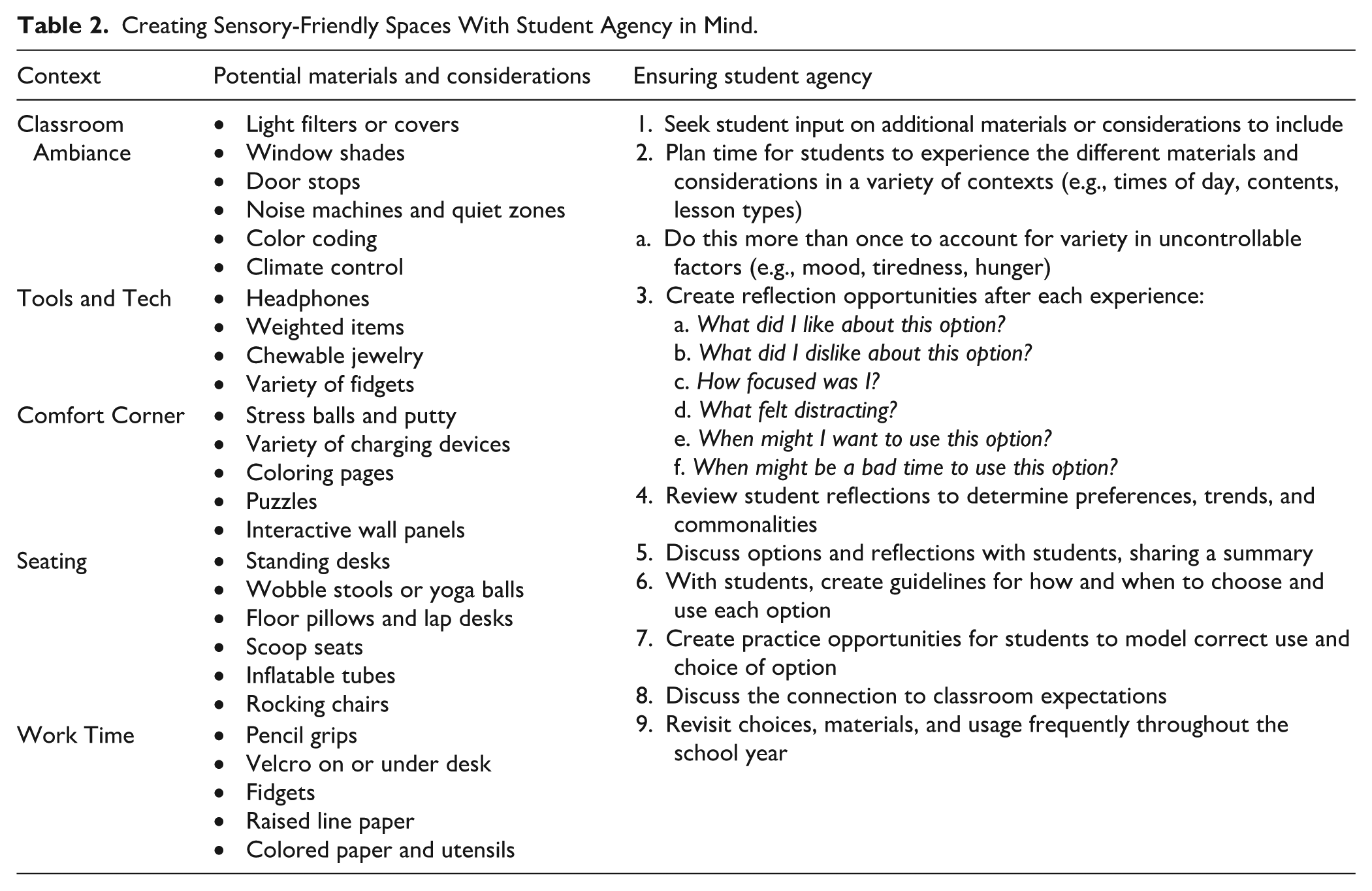
Educators can create flexible seating arrangements that ensure students with EBD have choice and voice over their learning contexts. Research suggests that alternative seating arrangements can improve in-seat and on-task behaviors (Bloom-Williams et al., 2023; Kaiser et al., 2020). This should go beyond options for seat type (e.g., camping chair, inflatable tube, yoga ball, standing desk, pillow) and also include additional variables, such as when to change seats, where the seat is situated, and what materials to use with each seating type. For example, students with EBD who fidget to regulate their emotions may feel comfortable bouncing on a yoga ball during a read-aloud but may prefer to stand at the desk when working on the comprehension worksheet that follows. Another student with EBD may prefer to stand near the front of the room during the read-aloud to hear better, then move to a low table in the back of the room, away from their peers, during independent work time. Requiring students to maintain the same seating type or location throughout an entire lesson or for extended periods strips them of their agency to learn in ways best suited to their needs.
Attending to Students’ Sensory Preferences
An important consideration for all physical spaces, especially those for students with EBD, is how sensory-friendly they are (or are not). Humanistic educators co-create the sensory experience of the learning environment with the students and adapt it as needed to support emotional regulation, focus, and mood. This may include turning off the lights, using only natural light, or shutting doors (Kaiser et al., 2020; Wan Yunus et al., 2015). Educators can also keep sensory tools, such as headphones, fidgets, putty, and weighted items (i.e., weighted stuffed animals, blankets, or vests) in the room, which often support students with EBD and their self-regulation (Kaiser et al., 2020; Wan Yunus et al., 2015). When planning for these decisions, educators can proactively seek student input and preferences while maintaining shared governance over the space (Fletcher et al., 2024). Teaching students how to select and advocate for options that meet their needs is also an important step in fostering autonomy. See Table 2 for designing sensory-friendly spaces with student agency in mind.
Creating Sensory-Friendly Spaces With Student Agency in Mind.
Prioritizing Authentic Representation
Students with EBD may also feel more valued when the classroom space demonstrates authentic representation (Artiles, 2019). Educators can integrate the voices of scholars, activists, and artists with disabilities from various cultures into the classroom design, allowing students to see themselves reflected in the space. Authentic, positive representation in this way helps disrupt problematic narratives of disability (Artiles, 2019; Kramarczuk Voulgarides et al., 2024; Stansberry Brusnahan, Harkins Monaco, et al., 2023). For example, ensuring sufficient space between furniture, using adjustable equipment, and avoiding cluttered areas demonstrate values for students with EBD who have additional mobility or ergonomic needs. This should include clear emergency protocols and evacuation plans with accessible routes for all students, not solely adjusting as needed. Additionally, providing and teaching all students to use assistive technologies and adaptive materials, rather than retrofitting them for one student, encourages student choice and autonomy in meeting their needs in well-informed ways that reflect true inclusion (Kaczorowski et al., 2023). When educators consider representation by design, they demonstrate how they value their students at their core and celebrate their uniqueness.
Instructional Strategies That Embolden Students
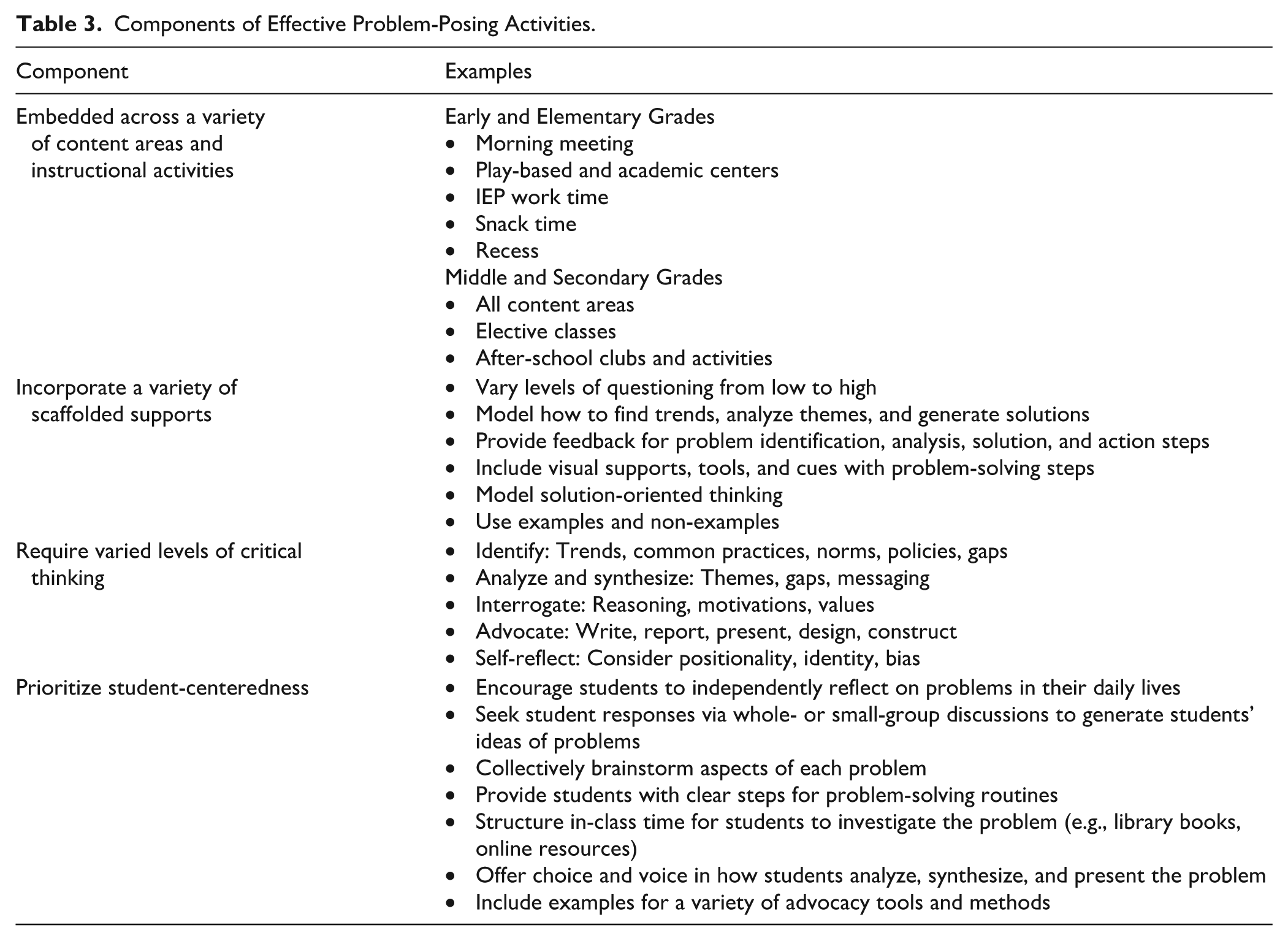
Honoring students cannot be limited to class culture and physical space; doing so without implementing humanizing instructional strategies creates a stark disconnect in values and messaging. For students with EBD, engaging and meaningful instructional strategies are critical in improving both academic and behavioral outcomes (French, 2019). Instructional approaches should both engage and embolden students by fostering critical thinking, agency, and active engagement in their learning (Diamond & Hsiao, 2019; Nguyen & Schunn, 2024). Rooted in the concept of problem-posing education (Freire, 1970), humanizing instructional approaches challenge the traditional model of education, which views students as empty vessels who quietly receive new information. Instead, problem-posing education encourages dialogue, inquiry, and reflection, positioning students as co-creators of knowledge (Diamond, 2018; Freire, 1970; hooks, 1994). Rather than being employed as one-off occurrences, problem-posing activities should be consistently embedded throughout the learning experience.
Educators committed to problem-posing education connect learning to broader experiences (e.g., current events, community concerns, and patterns of disparity in areas like education, healthcare, or employment) in four ways: (a) consistent implementation across a variety of learning opportunities, (b) use of intentional scaffolds to support student engagement, (c) design that elicits a range of critical thinking skills, and (d) incorporation of student voice, choice, and experience. By integrating real-world issues into the curriculum in this way, educators create space for students to analyze and question the world around them while critically reflecting on the systems and structures that impact their everyday lives. This leads students to develop a sense of social responsibility and the confidence to challenge injustices (Stansberry Brusnahan, Harkins Monaco, et al., 2023). As a result, students not only cultivate deeper understanding but also feel emboldened to become active participants in shaping their own futures (Ryan & Deci, 2017). See Table 3 for components of effective problem-posing activities.
Components of Effective Problem-Posing Activities.
Connecting Learning Opportunities to Lived Experiences
Problem-posing education must recognize and discuss how disability intersects with culture, language, and identity (Kramarczuk Voulgarides et al., 2024). Students with EBD not only need to understand their intersections of identity (Crenshaw, 1991; Stansberry Brusnahan, Harkins Monaco, et al., 2023) and funds of knowledge (Llopart & Esteban-Guitart, 2016; Moll et al., 1992) but also analyze societal actions and inequities related to them. For instance, an educator might include a unit exploring the contributions of historically underrepresented leaders in local and national movements. Using that framing, students can examine disciplinary data from their own school to identify and reflect on patterns of exclusion or disproportionality. Educators can structure small-group discussions in which students analyze data and connect historical content to current school realities. This not only fosters academic engagement but also promotes a deeper understanding of how students’ lived experiences intersect with broader systems.
As educators present real-world problems and encourage critical thinking, ableism and all related sub-components (e.g., linguistic ableism, institutional ableism, physical ableism) must be included (Kramarczuk Voulgarides et al., 2024; Stansberry Brusnahan, Maguire, et al., 2023). For example, students could engage in structured small-group conversations about disability-related language before completing opinion pieces, using their preferred terms and drawing on real-life examples and additional resources from disabled activists to support their arguments. Students with EBD need opportunities to discuss, interrogate, and reflect on the ways ableism can overlap with other forms of discrimination and affect their lived experiences. To do so, students might read a short story featuring a character with a disability navigating school life. After reading, educators can use guided discussions and journaling prompts to encourage students to reflect on the character’s experiences, draw connections to their own lives, and identify ways schools can be more supportive and inclusive. This not only deepens comprehension but also cultivates empathy and critical awareness.
Creating Accessible Pathways to Learning
Humanistic educators prioritize autonomy because true learning emboldens students to think critically, make decisions, and take ownership of their education (Deniz et al., 2024). For students with EBD, this means creating accessible pathways to success rather than removing challenges altogether, separating them from inclusive learning experiences, or creating dependent-rich environments (Kaczorowski et al., 2023). Support and dependency are fundamentally different—support provides students with the tools and strategies they need to navigate learning, whereas dependency undermines their ability to learn. In contrast, dependency limits their growth by leading them to assume they cannot meet high expectations. Using multiple methods to teach content—such as oral discussions, digital interaction, written explanations, and visual representations—ensures access while maintaining higher levels of thinking. Similarly, ensuring classroom activities offer students choice in how they demonstrate their knowledge—such as visual, oral, or written responses—also helps students explain their thinking. In these instances, the educator emphasizes student voice and experience while learning from and about their positionality (Stansberry Brusnahan, Harkins Monaco, et al., 2023; Stansberry Brusnahan, Maguire, et al., 2023). Doing so creates a learning environment where students with EBD develop confidence, problem-solving, and advocacy skills (Diamond & Hsiao, 2019; Nguyen & Schunn, 2024).
Using Technology to Free, Not Fix
Similarly, humanistic educators use instructional and assistive technologies as tools for accessibility and learning, not as a substitute for meaningful interaction. While technology often reduces barriers to learning, it can also cause exclusion and isolation (Kaczorowski et al., 2023). For example, an educator may assign an independent reading assignment to a student who uses a text-to-speech or screen reader device while their peers engage in collaborative reading activities. While it may not be intentional, this choice inherently excludes the student based on their needs. In this case, technology didn’t remove a barrier; it replaced a crucial support system and sense of belonging. Instead, technology should amplify students’ agency and connection to their learning opportunities and meaningful interaction with others. Intentionally planning for technology integration can support students with EBD in both academic and social domains (Hirsch et al., 2021). When considering academic progress, educators can inquire about students’ preferred modes of demonstrating their learning, then teach them to use audio- or video-recording platforms to share their knowledge. If the student wants to build relationships or increase social interactions, educators can incorporate technology-based activities with small groups of students or send clear communications, reminders, or check-ins (Hirsch et al., 2021). As such, humanizing pedagogy conceptualizes technology as a means of liberation rather than a fix or replacement for the multitude of ways students with EBD think, communicate, and learn.
Assessment as a Tool for Growth
Celebrating students with EBD as whole, unique beings means avoiding seeing them as numbers or scores. Thus, humanistic educators move beyond compliance-based assessments and focus on holistic learning and growth. While academic progress is included, a more inclusive and comprehensive view of learning encompasses developmental, social, and cultural growth. For example, educators who honor varied growth markers will celebrate a student’s use of self-regulation strategies after previously resorting to physical aggression (Ladson-Billings, 2024). Just as educators and students can co-create classroom expectations, supports, and learning opportunities, they can co-create the evaluation process as well, ensuring their progress is meaningful and comprehensive.
Incorporating Students
Making space for students with EBD to consistently engage in self-determination practices, such as self-reflection and goal setting (Ma et al., 2025; Ryan & Deci, 2017), lays the foundation for a student-oriented assessment cycle (Kirby, 2017; Stansberry Brusnahan, Harkins Monaco, et al., 2023). When students with EBD align their goals with their personal preferences and values, it not only enhances their sense of ownership but also supports their ability to think about self-improvement and ways to pursue intrinsically motivated goals (Ma et al., 2025). Therefore, educators should design assessments that allow students to express their knowledge in preferred modalities (Ladson-Billings, 2024; Stansberry Brusnahan, Harkins Monaco, et al., 2023; Stansberry Brusnahan, Maguire, et al., 2023). Choice should reflect student preference and can relate to format (e.g., written work, interactive experience, formal presentation, creative project), modality (e.g., oral, visual, digital, hands-on), or content (e.g., choice of topic). Assignment descriptions and evaluation tools should also reflect strengths-based expectations with clear language, examples, and timelines. Educators should not only share these with students in advance but also explicitly review and refine them based on student feedback.
Providing Asset-Oriented Feedback
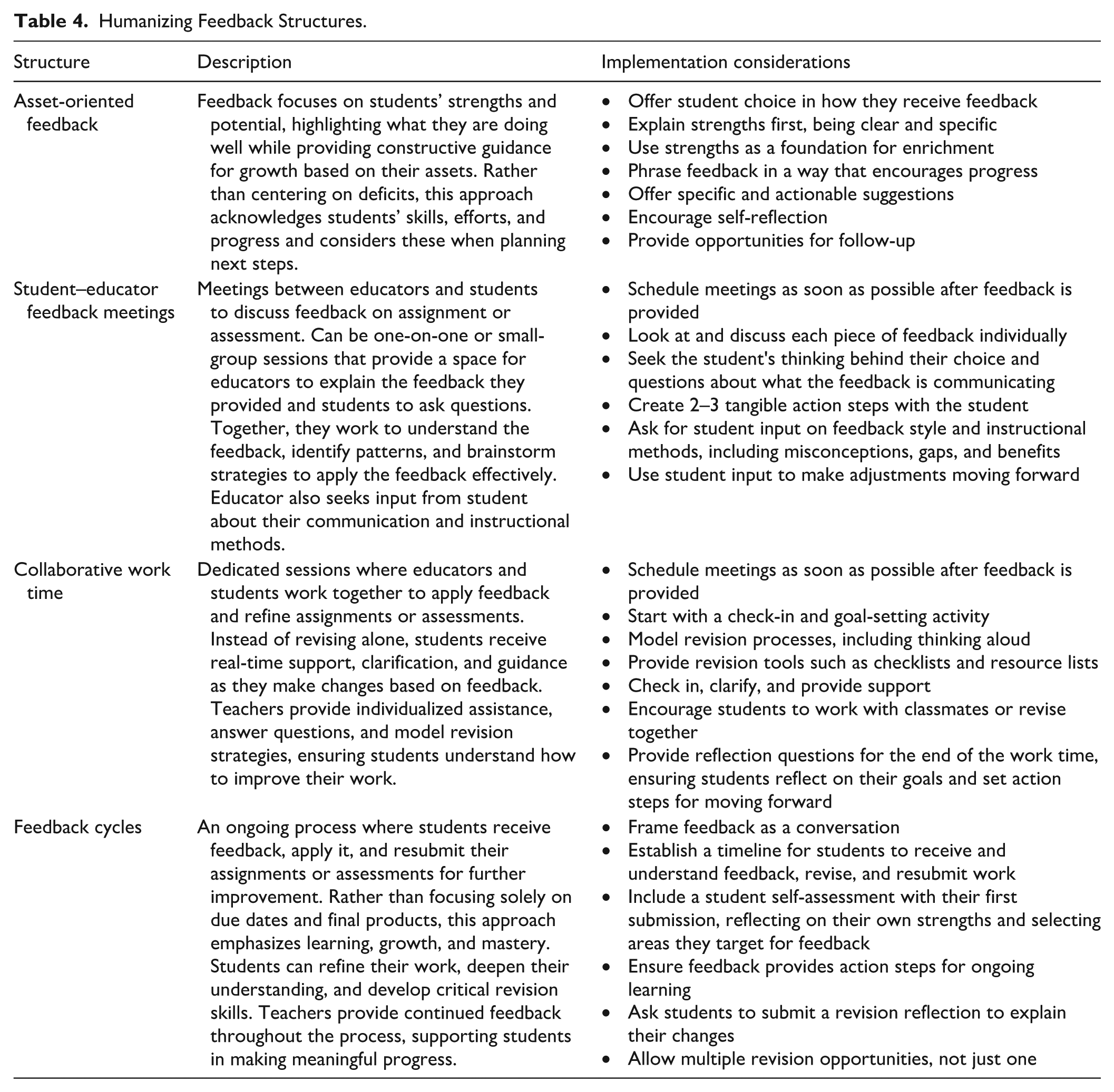
Educators should frame feedback to celebrate the student’s effort, creativity, and progress rather than focusing solely on accuracy or compliance. Using asset-oriented feedback further reinforces high expectations by focusing on what students with EBD can do and how they can grow, rather than emphasizing deficits (Llopart & Esteban-Guitart, 2016; Moll et al., 1992). Importantly, strengths-based feedback should not be limited to academic content; research shows the use of behavior-specific feedback improves behavioral skills of students with EBD (Meyer et al., 2021). Educators can also provide students with choice in how they receive feedback on desired behaviors or content revisions, offering it in verbal, visual, modeled, or rehearsed formats to ensure students know how to confidently apply it (Meyer et al., 2021; Power et al., 2024). As educators come to know their students, their values, and their experiences, incorporating students’ preferences into feedback and framing it in ways that are motivating to them can be especially helpful (Ma et al., 2025; Power et al., 2024). Table 4 presents suggestions for implementing humanizing feedback structures.
Humanizing Feedback Structures.
Embedding Growth-Centered Cycles
Unlike traditional assessment models, humanistic educators uphold assessment as a tool for growth, not as an endpoint. Learning is a fluid process; providing assessment results with no opportunity for improvement and practice inherently stops learning. Instead, educators should create a culture of continuous improvement. Self-assessment and self-reflection techniques, such as pre-unit goal setting, mid-unit self-assessment, and post-exam learning reflection, help students with EBD track their learning and better understand their progress (Ma et al., 2025). It is also critical to ensure students know how to receive feedback, understand it, and use it to guide them forward. For example, allowing students to revise an assessment based on feedback encourages them to analyze the feedback, make sense of it, and apply it in a supported, intentional manner. Opportunities for student–educator feedback meetings or collaborative work time can also encourage students to review their assessment results critically, then refine and apply them. When educators create these positive experiences for students with EBD, they model their belief in ongoing human development rather than maintaining harsh expectations rooted in perfectionism and deficit-oriented thinking.
Conclusion
Humanizing pedagogy redefines education for students with EBD by rejecting traditional, compliance-based models and implementing approaches that affirm the agency of the individual. Rather than reinforcing ableist narratives that limit a student’s potential, a humanizing approach ensures they are active collaborators who bring valuable perspectives to the learning process. This shift goes beyond mere access—it calls for a complete reimagining of classroom culture. By incorporating accessible and equitable teaching strategies, students with EBD develop confidence, self-advocacy skills, and a sense of belonging. Beyond the classroom, this means advocating for systemic change. Educators must amplify students with EBD’s voices to shape school policies, disrupt ableist biases in educational structures, and ensure inclusion is not just a policy but a lived reality. Education should not be something done to students with EBD, but something built with them. Humanistic educators envision a future in which students with EBD are honored as knowledge-holders, leaders, and vital contributors to their communities—ensuring education truly serves as a practice of freedom.
Footnotes

Funding
The author received no financial support for the research, authorship, and/or publication of this article.
Declaration of Conflicting Interests
The author declared no potential conflicts of interest with respect to the research, authorship, and/or publication of this article.