







Abstract

Free appropriate public education (FAPE) became available to children above the age of 5 and to youth with disabilities in the mid-1970s with the passage of PL 94-142. Infants, toddlers, and preschoolers with developmental delays and disabilities were not granted access to FAPE, except in rare instances in which states already required provision of services for younger children, until 1986 when PL 99-457 was passed. PL 99-457 mandated services for 3- through 5-year-olds with disabilities and included incentives for states to develop services for infants and toddlers. Amazingly, 2011 was the 25th anniversary of the passage of PL 99-457. Anniversaries, particularly of such important events, are worthy of celebration, reflection, and challenge.
To mark the 25th anniversary of PL 99-457, the editors of the Journal of Early Intervention (JEI) and Topics in Early Childhood Special Education (TECSE) decided to do something that to our knowledge has not been done in the world of academic publishing: simultaneously and collaboratively publish complementary issues on the same topic in two different and “competing” journals. Both JEI and TECSE began publishing in the early 1980s, JEI in 1979 and TECSE in 1981. The two journals have shared readers, authors, and editorial board members throughout their history. So, in the spirit of the collaboration and teamwork required to provide services to infants, toddlers, and preschoolers with disabilities, we set about to structure a celebration of the 25th anniversary of PL 99-457 in the two journals.
Through a series of conference calls, we made several decisions jointly about how to proceed with the simultaneous publication of the anniversary issue. We first identified topics to be included and invited authors who had made contributions to the field over the last 25 years to write essays in their areas of expertise. The essay format seemed appropriate because it gave researchers who had spent a quarter century or more working on specific issues an opportunity to report what was on their mind about the field’s past and current status. In keeping with the productive nature of the field, everyone who was invited agreed to provide an article. This was remarkable because the timelines were short and unyielding. The authors were free to invite others to assist them with their articles.
A general structure for the articles was suggested; however, authors produced articles that best fit their approach to their topics. We asked authors to limit their essays to 20 manuscript pages, although we understood the topics were deserving of much longer discussion. When the articles exceeded the page limits, we insisted that authors reduce their essays to meet the page limits, although this was often not easily accomplished. We appreciate the authors’ willingness to contribute to this project and to comply with the page limitations and to the requested revisions.
Had space allowed, we would have invited more essays. Clearly, some outstanding investigators whose work is critical to what is known and done in the field are not represented in the articles here. We apologize to those individuals. The topics included reflect our biases and opinions about the topics we thought were of interest to the readers. We hope this double issue will provide a context for further discussions of topics important to the future of early intervention.
The authors submitted their articles to the joint anniversary publication, rather than to either of the journals specifically. The editors reviewed each article and requested revisions. After revisions were received and accepted, articles were assigned to one of the two journals. In Table 1, a listing is provided of the authors, title of each article, and journal in which it appears. Reading these 17 articles has been a tremendous privilege and education. It was not as enjoyable as having a conversation with these authors about the content of their articles, but it has been a close second. The articles reflect the current thinking of authors who are knowledgeable about research and the issues the field has faced and still faces today. Many of the articles represent a lifetime of careful work and outline multiple lifetimes of future research and activity. Young investigators will be interested in the challenges posed and the directions offered for future research in these articles.
Listing of Authors, Title, and Journal of Included Essays
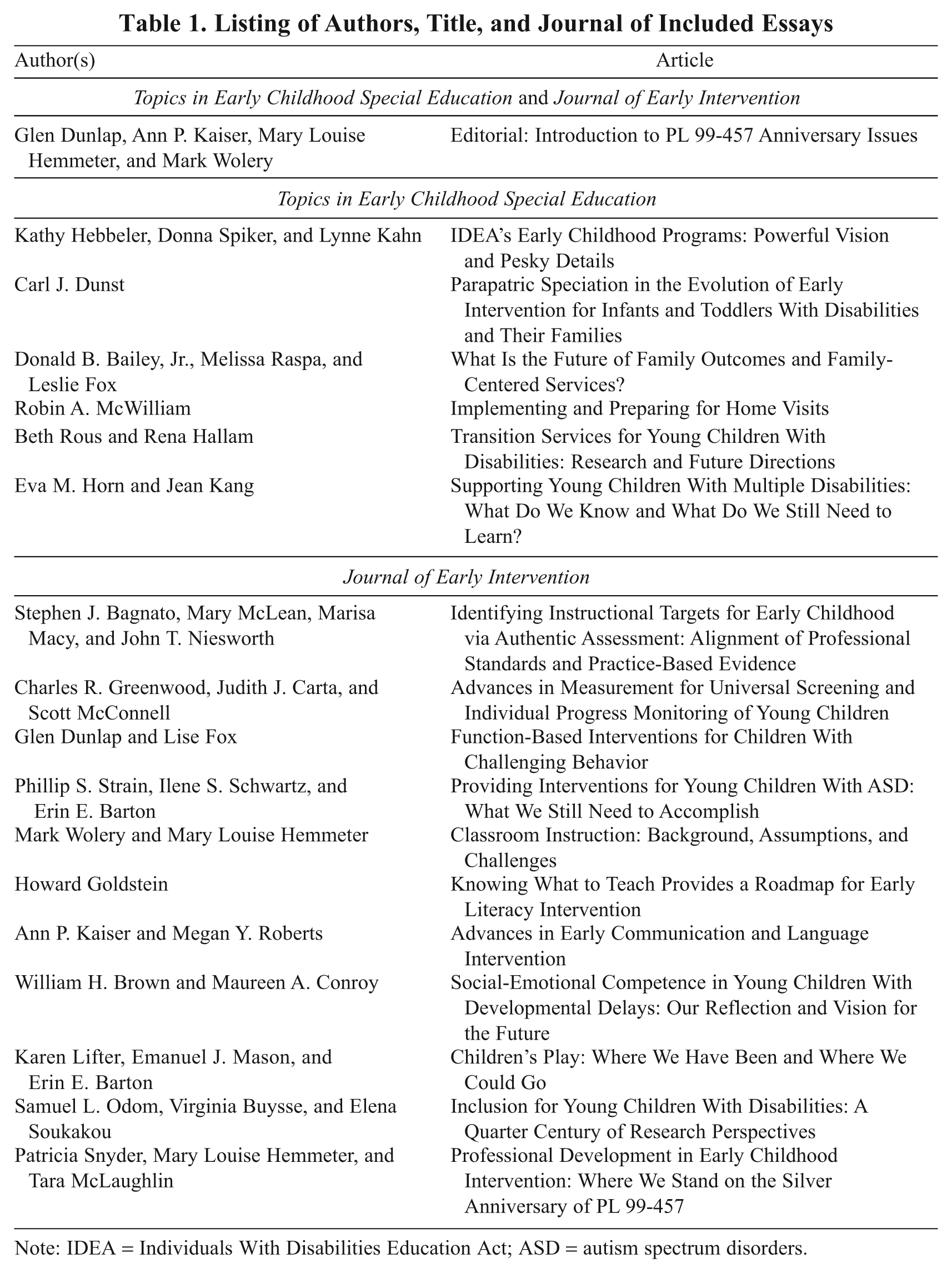
Note: IDEA = Individuals With Disabilities Education Act; ASD = autism spectrum disorders.
Two overriding conclusions are apparent from these articles. First, a great deal of knowledge has been generated over the relatively short life of the field of early intervention and early childhood special education. This knowledge spans the domains of development in young children, strategies and contexts for intervention, and the policies and research that shape practice, access to services, and research. Much, but not all, of this knowledge has been accumulated over the last 25 years. As a field, we can point with pride to the body of knowledge that has been built through systematic research and scholarship surrounding the development of recommended practices for children and families. It is reason for celebration.
Second, and not surprisingly, a gap exists between what is known by researchers and what is done in usual practice. The gap between what is possible and what is likely to be delivered is daunting. The word gap understates the magnitude of this critical issue; a chasm, a wide gulf, or an unbridged void may be a more accurate description of what exists. This occurs at nearly every level of conceptualization—at the policy level, in the personnel preparation arena, in the supports and assistance available to practitioners, in the conceptual approach to issues and problems, and in terms of resources available. This is cause for reflection. Although a gap can represent a rapidly advancing research base, it also can reflect the barriers to making changes in the field, and the lack of a systematic approach to translating research into policy and accessible practices. As a field, we have become skilled at conducting efficacy studies that include high-quality designs, measures of treatment implementation fidelity, and sound outcome measures. Most efficacy studies have been relatively small scale, and large trials that test the scaling up of early intervention models are notably absent. We have very little knowledge about the variables that control adoption, sustained implementation, and fidelity of evidence-based practices. It is essential that we work simultaneously to translate research to practice through policy, personnel preparation, professional development, and translational research. The field cannot be healthy when what is known from its research base is practiced so infrequently. We cannot continue the bifurcation between the worlds of research and practice; we must plan for and support interactions between researchers and practitioners to build effective services for young children and their families. Although we may advocate for policies that mandate evidence-based practice, for data-based accountability, and for funding to support the development of effective early intervention systems, such regulatory policies have not solved the research-to-practice gap in other areas of education. Without doubt, the challenge for the next 25 years is to cause usual practice to reflect more closely what is known.
In preparing this special issue, we were struck by the absence of discussions of culture, poverty, and the changing demographics of families and children in the articles describing progress in our field. We do not believe our field is unaware of these issues; we do note that little research has addressed these important factors influencing early intervention directly. The cultural and linguistic contexts of communities, classrooms, practitioners, and families must be addressed systematically in research to develop evidence-based practices appropriate for all communities and effective for families and children from the widening range of cultural, linguistic, and economic backgrounds.
Is there reason for optimism? We think so; not because we have multiple examples of where practice and research knowledge are aligned but because so much knowledge has been generated. Any field that has recruited a collection of incredibly innovative, bright, committed individuals of integrity to work on recalcitrant problems and issues over multiple decades is likely to be able to find solutions to the challenges posed in these articles. With nonidealistic eyes, we acknowledge it will not be easy, inexpensive, or straightforward; however, if it were, more pedestrian minds would suffice. We need to ensure that we recruit another cohort of similarly capable individuals to devote their lives to these issues over the next 25 years. If we do that, then what we know now to be the findings of research will become usual practice.
Footnotes
This editorial for the PL 99-457 Joint Anniversary issue is being published simultaneously in Journal of Early Intervention (2011, Volume 33, Number 4) and in Topics in Early Childhood Special Education (2011, Volume 31, Number 4).