







Abstract
A randomized control intervention study was conducted to evaluate the effects of the highly structured Heidelberg Parent-Based Language Intervention (HPLI). The outcomes of 43 children (n = 23 intervention, n = 20 control) who had been identified as late talkers during routine developmental check-ups carried out in pediatric practices at the age of 2 years were examined at 4 years 3 months of age. To address these results, we used standardized instruments to assess language and memory performance. At the age of 4 years, expressive language abilities did not differ as a function of the early language intervention. Results in language comprehension, phonological memory, and episodic buffer were significantly better in the intervention group than in the control group. These findings demonstrate the long-term effectiveness of the parent-based language intervention HPLI, and have practical implications for dealing with children with specific expressive language disorder (SELD).
Introduction
Language delay is one of the most common developmental problems among toddlers (Horwitz et al., 2003; Reilly et al., 2007; Zubrick, Taylor, Rice, & Slegers, 2007). According to the definition of late talkers, about 15% of children aged 24 to 29 months can be identified as having a language delay (Horwitz et al., 2003; Reilly et al., 2007). Rescorla (1989) defines late talkers as toddlers whose active vocabulary amounts to fewer than 50 words or who do not frame multiword combinations at 24 months of age. This language delay is by definition not a result of a cognitive delay, genetic syndromes, hearing disorders, or pervasive developmental disorders. Despite language abilities, late talkers are otherwise developmentally age appropriate. Similar to the figures reported by Rescorla, Mirak, and Singh (2000) of approximately 30% to 50% of late talkers who catch up spontaneously by the age of 3 years, 32% of children in Germany with a specific language delay catch up after 1 year as reported by Sachse and Suchodoletz (2009). The prognosis for further language development of late-talking toddlers depends on which components of language are affected. Two different forms of specific language delay can be distinguished: expressive language delay and receptive-expressive language delay. Although children with isolated deficits in expressive language have a relatively good prognosis compared with children with additional deficits in receptive language, a substantial proportion of these children show continued deficits in language abilities after the age of 3 (Dale, Price, Bishop, & Plomin, 2003; Paul, 1993; Rescorla, Dahlsgaard, & Roberts, 2000; Rescorla, Roberts, & Daalsgaard, 1997). Nevertheless, reliable predictors for language development of late talkers have not been identified yet. Prognostic indices like vocabulary, non-verbal cognitive ability, and maternal education have mixed results in the literature (Dale et al., 2003; Marschik, Einspieler, Garzarolli, & Prechtl, 2007).
Follow-up studies have examined the linguistic performance of former late talkers during preschool and early school age (Dale et al., 2003; Rescorla et al., 1997). At the age of 5, former late talkers differed from children with typical language development in comprehension of passive negative sentences and non-word repetition as a component of working memory (D’odorico, Assanelli, Franco, & Jakob, 2007). These abilities are crucial for acquisition of written language and achievement in school. Persisting deficits in language carry a risk of further cognitive and psycho-emotional development (Irwin, Carter, & Briggs-Gowan, 2002). In a study by Kühn and Suchodoletz (2009), 53% of the former late talkers showed deficient language abilities at the age of 5 years 10 months. Furthermore, the language abilities of even the late talkers without obvious language difficulties at the age of 5 years 10 months were significantly lower in comparison with the controls in active and passive vocabulary, in sentence comprehension, and in working memory. Despite late talkers’ risk of developing specific language impairments (SLIs), the “wait-and-see” approach is still widely chosen in many countries. A costly child-centered, one-to-one therapy is not yet indicated for late-talking toddlers because a relatively high proportion of children catch up without special intervention. Consequently, affordable early interventions such as parent instruction programs are needed to provide a daily language promotion.
Therefore, we started a randomized controlled intervention study in 2003. Mothers of children with specific expressive language disorder (SELD)—based on parent-reported screening conducted in general pediatric practices—took part in the Heidelberg Parent-Based Language Intervention (HPLI; Buschmann, 2011).
In our previous study, we found that by training parents of SELD children to apply the HPLI methods, children in the intervention group (IG) made developmental gains in expressive language over and above the maturational changes of the non-intervention control group (CG; Buschmann et al., 2009). Nine months after intervention, the two groups differed significantly in active vocabulary and grammar in favor of IG, but both scored within the typical range. At the age of 3 years, 18 children of the IG (75%) and 10 children of the CG (43.5%) had caught up and reached scores within typical range in a standardized language assessment (1 standard deviation [SD] below or above mean).
The long-term outcomes of these children are especially interesting because there are few parent-based intervention studies with follow-ups into preschool or school age. Girolametto, Wiigs, Smyth, Weitzman, and Pearce (2001) examined a group of 5-year-old children whose mothers had participated in a parent-based language intervention when the children were aged 2 to 3 years. Eighty-six percent of these children showed expressive language skills within a typical range at the age of 5 years. The findings were limited because a non-intervention CG with late-talking toddlers was not available.
Gaines and Missiuna (2006) re-examined 40 children between the age of 5 years 3 months and 6 years 8 months who took part in the group-based parent–child intervention “Toddlers Talk” when they were younger than 3 years 6 months. The 3-year follow-up showed that 28 children (70%) measured with standardized tests no longer had speech or language difficulties. These results were also limited by the lack of a comparison with a non-intervention CG.
The meta-analysis of Roberts and Kaiser (2011) revealed positive effects of various parent-based language interventions in different languages regarding receptive and expressive language of children aged between 18 and 60 months. The largest effects were reported for expressive morphosyntax (g = .82). Mean effect sizes for expressive vocabulary (g = .48) and receptive language (g = .35) were lower.
Working Memory
There is some evidence that there is a relation between language and working memory impairments (Archibald, Joanisse, & Edmunds, 2011; Montgomery, Magimairaj, & Finney, 2010). Children with SLI show significantly lower verbal working memory abilities relative to same-age peers (e.g., Gray, 2006). This deficit has been identified within the non-word repetition paradigm, in which the child has to repeat unfamiliar phonological forms (e.g., Conti-Ramsden, 2003). The ability of non-word repetition is closely related to language learning, especially to vocabulary acquisition. This association has been reported in various studies in which vocabulary acquisition in natural or foreign language was investigated (see Gathercole & Baddeley, 2009).
Although a number of studies have described an association between language acquisition and verbal working memory, no causal structure for this relationship could be found (Gathercole & Baddeley, 2009). Therefore, the purpose of this study was to compare language abilities and related memory skills of the children with SELD in the IG and the non-intervention CG at the age of 4 years. A first aim was to analyze whether the children with SELD whose mothers had participated in the parent-based language intervention HPLI showed improved expressive and receptive language abilities in comparison with the children with SELD in the CG at the age of 4 years. Second, we aimed to explore possible transfer effects of the rapid increase of vocabulary and grammatical skills with regard to the performance on components of working memory: phonological loop and episodic buffer.
In this study, we examined three main research questions:
Method
Study Design
This study was completed in the Department of Paediatric Neurology at the Children’s Hospital, University of Heidelberg. The randomized controlled trial (RCT) consisted of a pretest/posttest CG design with three follow-up examinations at 6, 12, and 24 months after pretest. Required sample size for single-sided t tests was estimated by setting α at .05 and β at .80 based on earlier studies (Girolametto, Pearce, & Weitzman, 1996; Whitehurst et al., 1988). For this analysis, 14 subjects per group were required, and it was decided to aim for a sample size of 20 subjects per group. After pretest, sequential randomization was used for gaining a stratified random sample. As a first step, we identified pairs of children similar in gender and maternal education. Second, a member of each pair was randomly assigned to the IG and CG to achieve parallel groups. This was necessary because earlier studies (Dale et al., 2003) indicated a correlation between language development at the age of 3 and 4 years and maternal education. Opaque sealed envelopes were used for conducting the randomization process.
Participants were identified during routine developmental check-ups using the Parent Report Screening Questionnaire for Early Identification of Children at Risk (ELFRA-2); adapted from the MacArthur Communicative Development Inventories (CDI; Fenson et al., 1993; Grimm & Doil, 2000). Children were given a pretest to provide information as to their early language skills. Those who did not reach the critical cutoff of 50 words in their expressive vocabulary measured with the ELFRA-2 were examined in an individual assessment using the Developmental Language Test for 2-Year-Old Children (SETK 2; Grimm, 2000). In this diagnostic examination, 61 children scored in at least one subtest measuring expressive language one SD below mean. They were identified as having a specific expressive language delay and took part in the RCT to evaluate the effectiveness of the HPLI. The IG mothers participated in the HPLI. The results of 47 children were analyzed at posttest and follow-up at 6 and 12 months after pretest (Buschmann et al., 2009). Following completion of the randomized controlled intervention study, all parents of children whose gains in language abilities continued to be slow at the age of 3 years, that is, results one SD below the mean in at least one subtest of the standardized and norm-referenced Developmental Language Test for 3- to 5-year-old children (SETK 3-5; Grimm, 2000), were recommended to start a direct-individual language therapy.
A further follow-up assessment was carried out when the children were 4 years old, 2 years after pretest assessments. Forty-three children participated. The examiners who carried out the follow-up diagnostic tests were not aware of the children’s previous results or to which group they were assigned in the study. The experimental protocol was explained to all parents, and their written, informed consent was obtained. The study received ethical approval from the Ethics Committee of the University of Heidelberg.
Intervention
The HPLI is a group program specially developed for parents of late talkers. In this study, six 2-hr sessions were conducted, which took place with an interval of 2 weeks. Six months later, a 3-hr session followed. It is designed for small groups of 5 to 10 people. Like the Hanen Parent Program (Girolametto, Greenberg, & Manolson, 1986), the HPLI strengthens parents’ roles as primary communication partners, and sensitizes them to the language-teaching potential of everyday situations. Parents are introduced to three main clusters of parental input techniques as defined by Tannock and Girolametto (1992): child-oriented techniques, interaction-promoting techniques, and language-modeling techniques. Sharing picture books with the child is a main method of the training, as it is an ideal time to initiate communication as well as being a prototypical situation for learning words at the age of 2 (e.g., Whitehurst et al., 1988). The HPLI focuses on the rapid expansion of vocabulary followed by the aim to facilitate the acquisition of grammar skills. It is a highly structured and interactive program using various didactic methods (e.g., videotapes, participative lectures, role plays, home practice, written information related to the contents of each session). The detailed contents of the curriculum structure of the HPLI are shown in Table 1. Compared with the established Hanen Parent Program, the HPLI offers a more structured approach in which no individual home visits are required. The analysis of video sequences takes place within a group structure format.
Contents of the HPLI.
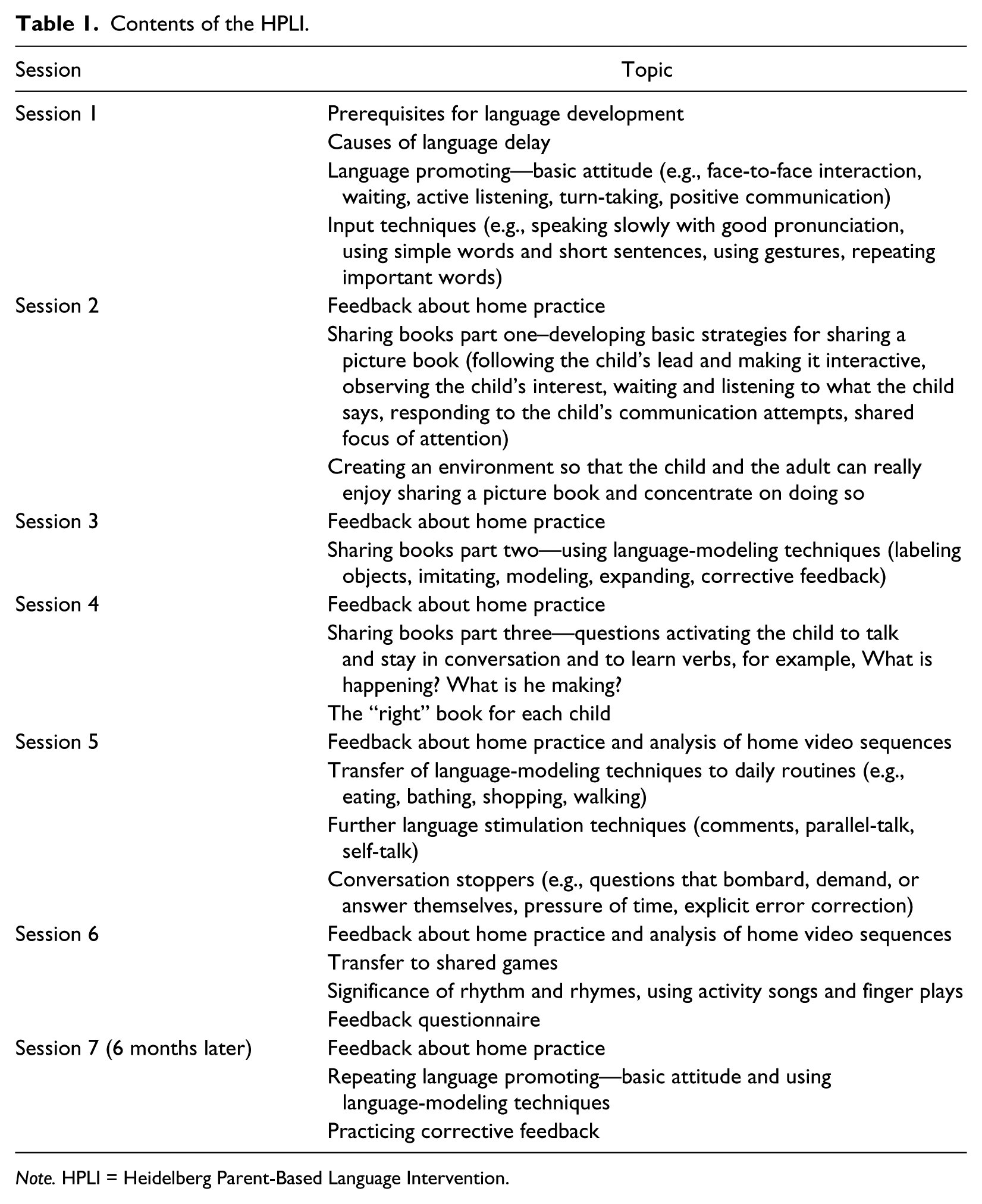
Note. HPLI = Heidelberg Parent-Based Language Intervention.
In this study, the intervention started when the children were between 24 and 27 months old. To achieve comparability, only mothers took part; group size was seven to eight mothers. All sessions took place at the Children’s Hospital at the University of Heidelberg.
Participants
Forty-three children who had an SELD at the age of 2 years, and who had also taken part in the randomized controlled language intervention study, were examined at 4 years 3 months of age between January 2007 and May 2008. According to the definition of late talkers, children at the single-word stage with a vocabulary below 50 words as measured by the parent-report screening questionnaire ELFRA-2 (Grimm & Doil, 2000) were included (ELFRA-2 mean IG: 16.6 words, CG: 14.3 words). IG contained 23 children, and CG contained 20 children. The flow of participants through the trial is described in Figure 1. All participants were monolingual German-speaking individuals without major sensory impairments, pervasive developmental disorders, or additional deficits in receptive language skills and/or cognitive abilities. Audiometric testing (otoscopic inspection of the tympanic membrane, impedance measurement, hearing threshold determination, play, or conventional audiometry) was scheduled for all children, and all were judged to have hearing within typical ranges. At the time of entry, children with Language Delay (LD) were between 24 and 27 months old (M = 24.7 months, SD = 0.9 months).
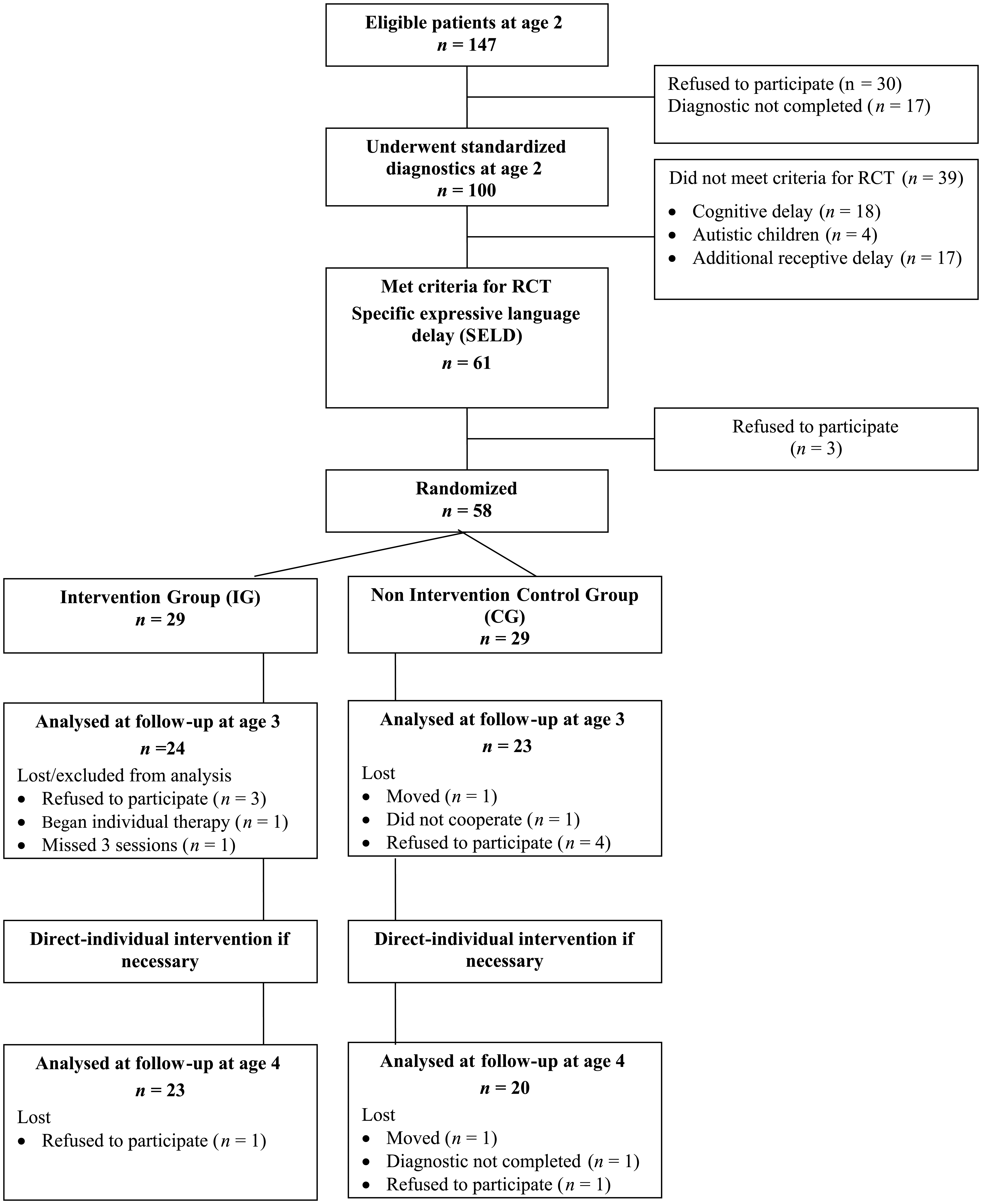
Flow of participants through the trial.
At pretest, the IGs and CGs did not differ significantly in any of their demographic, clinical data, language scores, or cognitive abilities (Tables 2 and 3). The LD children’s word and sentence comprehension was age appropriate (1 SD below or above mean, SETK-2). Their non-verbal cognitive abilities were also within the typical range.
Demographic and Clinical Data of Children in IG and CG.
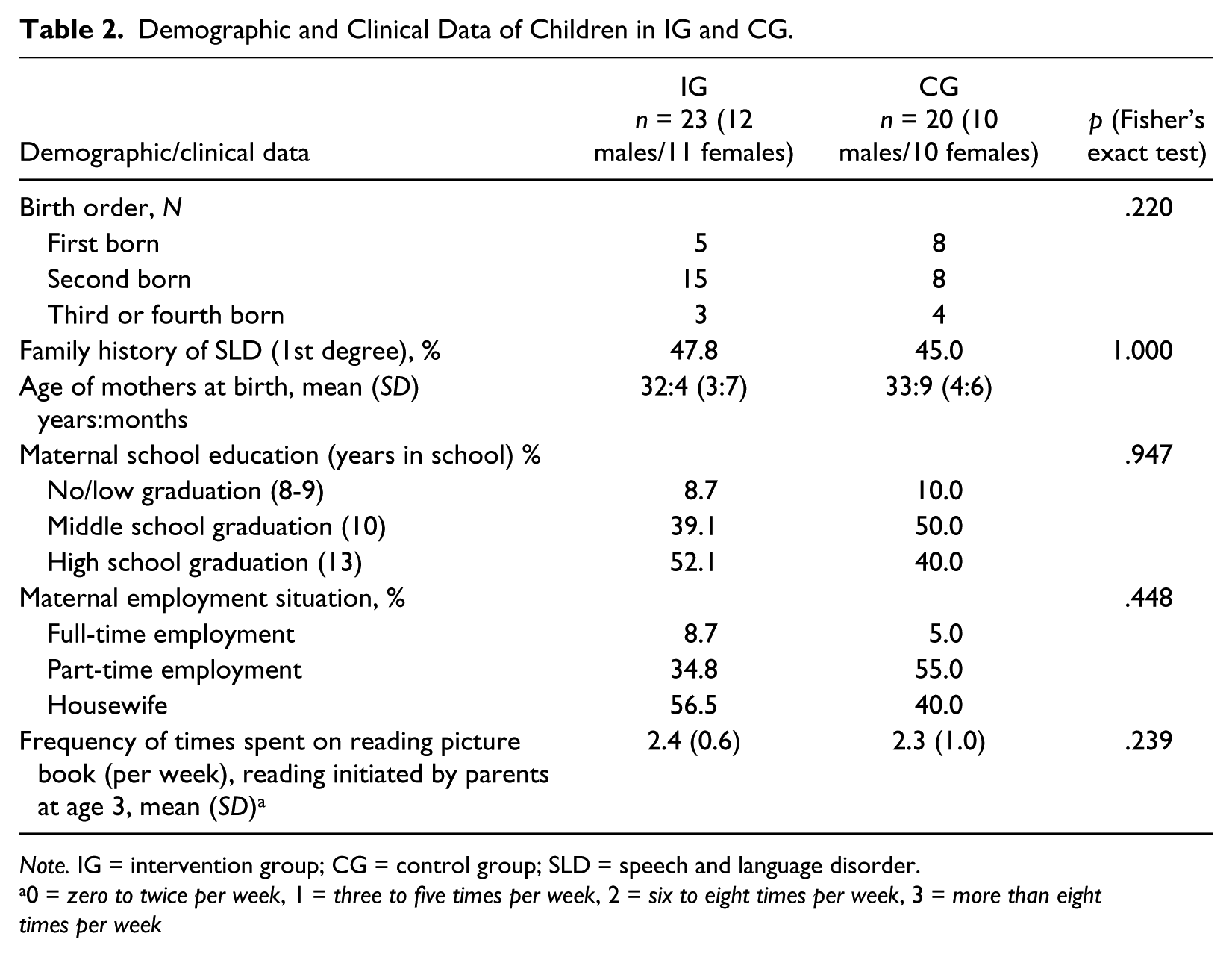
Note. IG = intervention group; CG = control group; SLD = speech and language disorder.
0 = zero to twice per week, 1 = three to five times per week, 2 = six to eight times per week, 3 = more than eight times per week
Pretest Comparisons on Subtests of the ELFRA-2, SETK-2, and BSID-II-NL.
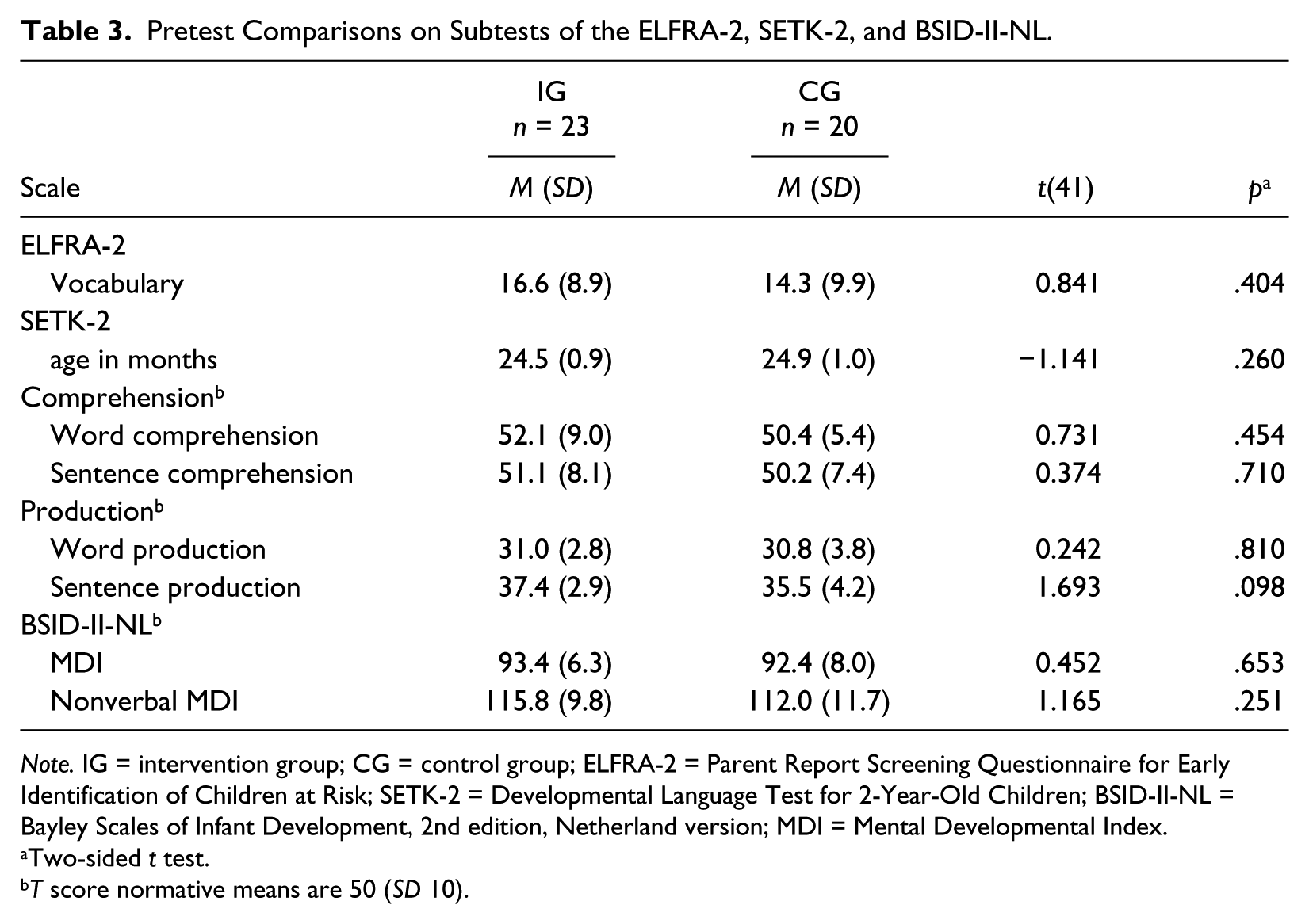
Note. IG = intervention group; CG = control group; ELFRA-2 = Parent Report Screening Questionnaire for Early Identification of Children at Risk; SETK-2 = Developmental Language Test for 2-Year-Old Children; BSID-II-NL = Bayley Scales of Infant Development, 2nd edition, Netherland version; MDI = Mental Developmental Index.
Two-sided t test.
T score normative means are 50 (SD 10).
Measures
Pretest
In addition to the ELFRA vocabulary score which defined the sample, language comprehension and language production were measured with the SETK-2, a standardized and norm-referenced developmental language test for 2-year-old German-speaking children (Grimm, 2000). Cognitive abilities were assessed with the Mental Scale of the Bayley Scales of Infant Development, 2nd edition, Netherland version (BSID-II-NL) translated in German (Van der Meulen, Ruiter, Spelberg, & Smrkovsky, 2002). Only children with a non-verbal Mental Developmental Index (MDI) >85 (M = 100, SD = 15) were included in the study.
Follow-up at the age of 4 years 3 months
Parents completed a questionnaire regarding the history of direct-individual language intervention. The following assessments were administered to all children to measure their expressive and receptive language as well as different components of working memory including phonological memory and episodic buffer.
Language performance
Expressive vocabulary was assessed with the Expressive Vocabulary Test for 3- to 5-Year-Old Children, Revision (AWST-R, reliability coefficient .86; Kiese-Himmel, 2005). The children have to name 51 pictures of objects (nouns) and 24 pictures of actions (verbs). A component of expressive grammatical ability was assessed with the subtest Plural Forming of the SETK 3-5 (reliability coefficients .78-.85; Grimm, 2001). In this assessment, children are shown pictures with objects and are asked to name the plural after the examiner has named the singular. A component of receptive grammatical abilities was measured through the subtest Sentence Comprehension of the SETK 3-5 (reliability coefficients .71-.82; Grimm, 2001). Within this subtest, children have to listen to a sentence and choose the appropriate scene out of a set of pictures.
Working memory
Phonological short-term memory
Four tasks were used to measure the phonological loop: the subtests Non-Word Repetition and Word Span of the SETK 3-5 and the subtests Number Recall and Word Order of the Kaufman Assessment Battery for Children (K-ABC), German version (Kaufman & Kaufman, 2004). The K-ABC is a standardized and internationally used test for assessing intelligence and achievement in children aged 2 years 6 months to 12 years 6 months. Non-Word Repetition consists of 18 non-words with two to five syllables (reliability coefficients .62-.81; Grimm, 2001). The items are presented using live voice with shielded lips to prevent lip-reading. In the Word Span, as well as in the Number Recall subtest (reliability coefficients .78−.88; Kaufman & Kaufman, 2004), the examiner reads a series of word/number sequences to the child (one per second). The child is required to repeat each sequence. During subtest Word Order, the examiner reads a series of words for common objects, and the child points at the picture of objects read by the examiner (reliability coefficients .70−.86; Kaufman & Kaufman, 2004). The subtests used for measuring phonological memory differ in regard to the information that has to be stored (numbers, words, and non-words) and in the way the tasks are answered (producing language, motoric reaction).
Episodic buffer
The subtest Sentence Repetition of the SETK 3-5 was included to measure the episodic buffer (reliability coefficients .88-.89; Grimm, 2001). The subtest consists of six semantically correct sentences and nine semantically incorrect sentences of increasing length and complexity. Each sentence is to be repeated verbatim immediately after presentation. Results within typical limits (1 SD below or above mean) in all standardized language scores constituted the criterion for catch up at the age of 4. SLI was defined by a score of more than 1.5 SD below the mean in at least one subtest of the SETK 3-5 or AWST-R.
Statistical analysis
Statistical analysis was performed on a personal computer system using PASW (Version 18.0, SPSS Inc., 2009). Software G-Power (Erdfelder, Faul, & Buchner, 1996) was used for power analyses. Prior to statistical analyses, assumption of normality was evaluated through Kolmogorov–Smirnov tests. Four variables were found to violate the assumption of normality: Plural Forming, Sentence Comprehension, Word Span, and Word Order. To receive reliable test statistics, the non-parametric Mann–Whitney U test was applied for these variables instead of independent t test.
Fisher’s Exact test and chi-square test were applied to test for frequency differences between groups concerning demographic and clinical data. Pretest comparisons were made using Fisher’s Exact tests and two-sided t tests. Single-sided t tests and Mann–Whitney U tests were administered to test for treatment effects. Cohen’s d was calculated for estimating effect size according to Field (2009) and was interpreted according to Cohen (1992): d = 0.20, small effect; d = 0.50, medium effect; d = 0.80, large effect. All hypotheses were directional and one-tailed probability level was set at .05.
Results
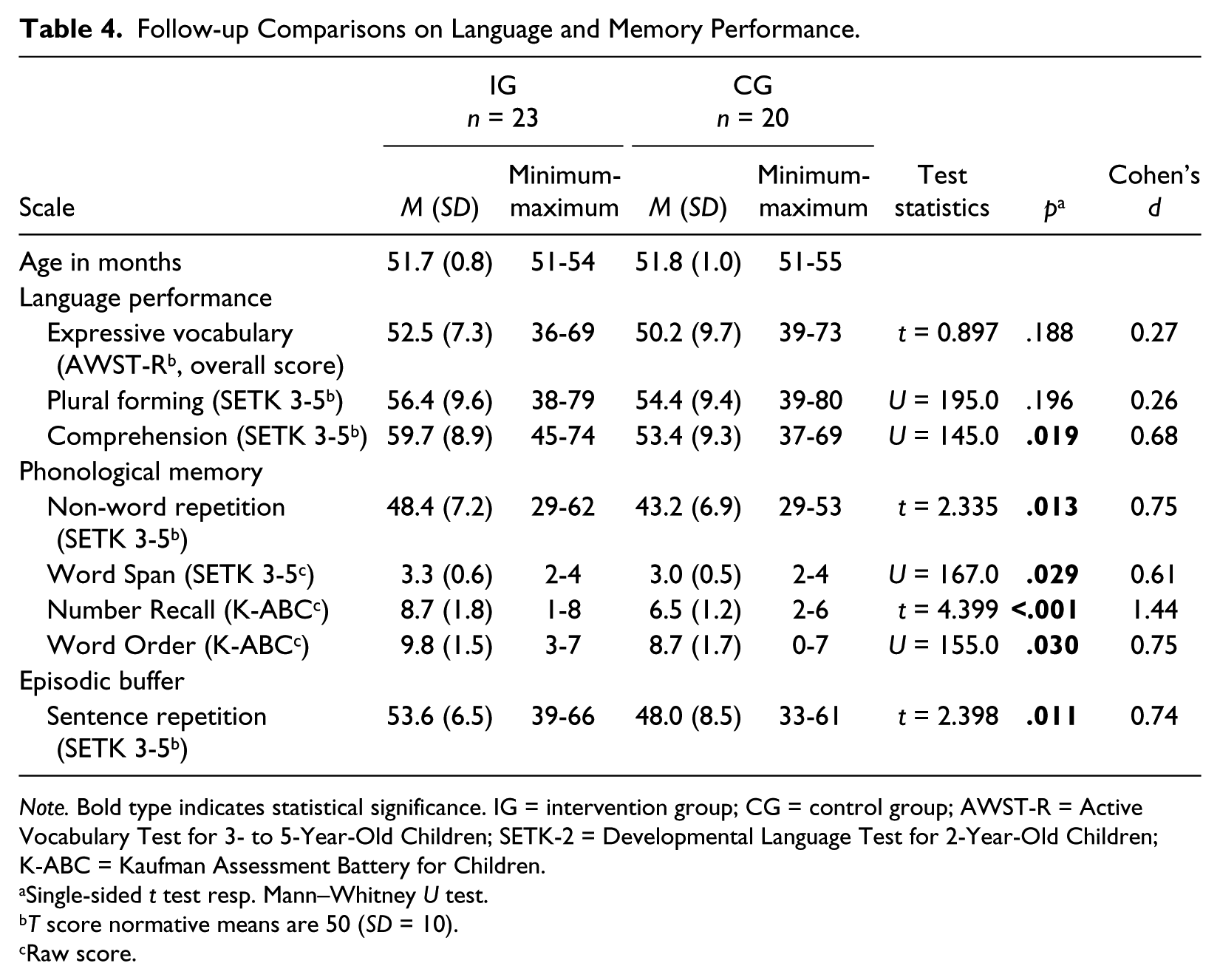
The results are presented in Table 4.
Follow-up Comparisons on Language and Memory Performance.
Note. Bold type indicates statistical significance. IG = intervention group; CG = control group; AWST-R = Active Vocabulary Test for 3- to 5-Year-Old Children; SETK-2 = Developmental Language Test for 2-Year-Old Children; K-ABC = Kaufman Assessment Battery for Children.
Single-sided t test resp. Mann–Whitney U test.
T score normative means are 50 (SD = 10).
Raw score.
Language Performance
In expressive vocabulary (AWST-R) [1] as well as in the subtest Plural Forming [2], both groups showed means within typical limits and did not differ significantly—[1]: t(41) = 0.897, p = .188; [2]: U = 195.0, z = −0.855, p = .196. In Expressive Vocabulary, 95.7% of IG and 95% of CG scored within typical range. Regarding Plural Forming, 95.7% of IG and 90% of CG reached a score within typical range—[1]: d = 0.27, 95% CI = [−0.33, 0.87]; [2]: d = 0.26, 95% CI = [−0.34, 0.86]. Regarding Sentence Comprehension, both groups also scored on average within the typical range, but the groups differed significantly (U = 145.0, z = −2.077, p = .019). Children of the IG outperformed the CG children. In IG, all children reached scores less than 0.5 SD below the mean; in CG, 95% scored less than 1 SD below the mean (d = 0.68, 95% CI = [0.06, 1.30]).
Memory Performance
Phonological memory
At the age of 4 years, children in the groups differed significantly on their scores for Non-Word Repetition, t(39) = 2.335, p = .013. In this subtest, the scores of the IG were higher than those of the CG. A score within typical range was reached by 95.5% of the IG children and 73.6% of the CG children (d = 0.75, 95% CI = [0.13, 1.37]). The Word Span scores differed depending on the group (U = 167.0, z = −1.884, p = .029). Children in the IG remembered more words than children in the CG (d = 0.61, 95% CI = [0.00, 1.22]). In the subtest Number Recall, IG children scored significantly higher than children in the CG, t(41) = 4.399, p < .001; d = 1.44, 95% CI = [0.77, 2.11]). Another significant group difference was found for the K-ABC subtest Word Order (U = 155.0, z = −1.884, p = .030). Children of the IG also outperformed the CG (d = 0.75, 95% CI = [0.13, 1.37]).
Episodic buffer
Analyses show a significant difference between the groups in the scores for Sentence Repetition, t(39) = 2.398, p = .011. The IG scored higher than the CG on this measure. A score within typical range was reached by 95.5% of the children in the IG and 84.2% of the children in the CG (d = 0.74, 95% CI = [0.12, 1.36]).
At the age of 4 years, children in the IG had received less speech therapy and fewer hours of treatment than children in the CG. 47.8% of IG and 65% of CG children had started therapy, χ2 (1, N = 43) = 1.279, p = .129. Children in the IG had received on average 28 hr of therapy, whereas children in the CG had received 34 hr, t(22) = −0.843, p = .204.
In the IG, two children (8.7%) met the diagnostic criteria of SLI (1.5 SD below mean) compared with five children (25%) in the CG. In the IG, 17 children (73.9%) compared with 10 children (50%) in the CG showed results within the typical limits in all scores on standardized tests of language performance (Figure 2). The children who caught up scored significantly better on two of three subtests measuring phonological loop compared with children who did not catch up: Non-Word Repetition, t(39) = −5.489, p < .001, Word Span, t(41) = −2.979, p = .005, Number Recall, t(41) = −1.502, p = .141. They also had higher scores on the subtest Sentence Repetition as a measure of episodic buffer, t(19.356) = −3.609, p = .002.
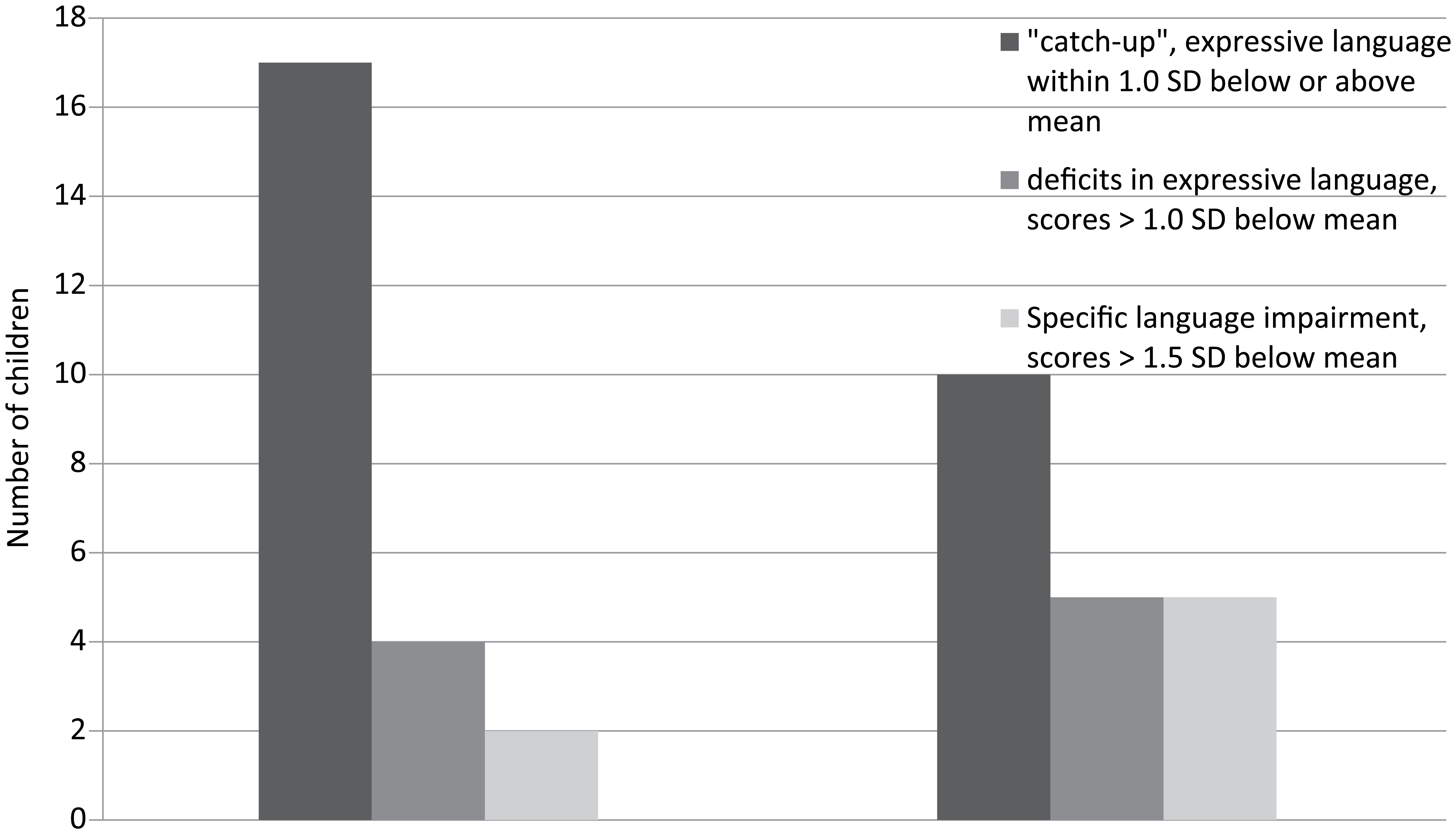
Comparison of language deficits in intervention and control group at follow-up at the age of 4.
Based on the odds ratio, the odds of “catching up” were 2.83 times higher if parents were trained than if they did not receive the intervention. However, there was no significant association between group and the number of children who “caught up” with their peers, χ2(1, N = 43) = 2.618, p = .096. There was no significant difference regarding gender [1] and maternal school education [2] between IG children who “caught up” in comparison with those who showed continuing impaired expressive language development at the age of 4[1]: χ2(1, N = 23) = 0.683, p = .640; [2]: Fisher’s Exact test = 1.551, p = .863. Similarly, there were no differences between children in the CG who resolved their language problems compared with children with persistent impaired expressive language—[1]: χ2(1, N = 20) = .80, p = .656; [2]: Fisher’s Exact test = 3.645, p = .243.
Discussion
The effectiveness of the HPLI was examined in a group of 2-year-old children with specific expressive language delay (late talkers), through a randomized controlled study. Long-term effects were investigated based on evidence for short-term and medium-term efficacy of HPLI (Buschmann et al., 2009) in the present study. Children with SELD were re-tested at the age of 4 years to measure long-term effects in receptive and expressive language abilities as well as memory skills 2 years after HPLI. Regarding the question as to whether an early parent-based language intervention could facilitate these abilities, the data show encouraging results.
Language Performance
At the age of 4 years, the children in the IG, as well as the children in the CG, scored on average within the typical range in expressive and receptive language performance on standardized tests. No group differences were obtained concerning expressive vocabulary and plural forming. In the follow-up study conducted when the children were 3 years of age, no treatment effects in plural forming were detected, although significant differences in expressive vocabulary were found (Buschmann et al., 2009). However this effect could not be replicated at the age of 4.
In the language comprehension task, there was a significant difference between the two groups in favor of the IG. This result seems surprising, because the measured expressive abilities were comparable in the two groups. However, one must take into account that vocabulary and plural forming may not be sensitive enough indicators with which to detect expressive language problems at the age of 4. It could be that testing of more complex grammar skills and narrative skills are needed to detect expressive deficits at this age.
Phonological Memory
Children of the IG outperformed children of the CG in all four subtests measuring phonological memory (Non-Word Repetition, Word Span, Number Recall, and Word Order). The strongest effects were obtained for the subtests Number Recall and Word Order. It has to be mentioned that these tests measure not only phonological working memory but also other important abilities, for instance, the recall and understanding of numbers and auditory discrimination. The subtest Word Order also requires visual motor short-term memory and sensomotoric integration. It is possible that some elements of the HPLI (e.g., picture book sharing and intensive linguistic attention) can affect the children’s ability to focus on such tasks; however, this was not measured specifically.
Episodic Buffer
The follow-up at the age of 4 showed that children of the IG could reproduce sentences significantly better compared with children of the CG. This result is important because better performance in reproducing sentences is also a reliable indicator of better understanding of grammatical structures. In addition, significant results in syntax and morphology development were found at the age of 2 years 6 months and 3 years in the IG (Buschmann et al., 2009). It can be assumed that topics of the HPLI such as facilitating children’s vocabulary growth and language support strategies (e.g., corrective feedback) contributed to these training effects.
Children who “caught up.”
Comparing the groups, about 74% of the 4-year-old children whose mothers took part in HPLI when the children were 2 years old showed receptive and expressive language abilities within the typical range compared with 50% of the CG. The odds of “catching up” were 2.83 times higher if parents were trained than if they did not receive the intervention. This effect suggests a long-term efficacy of the HPLI because the groups did not otherwise differ on any demographic, cognitive, or language data at the age of 2.
Considering the group differences on various components of language and memory, the effects of the HPLI go beyond the improvement of receptive language and also appear to affect high-level language abilities such as phonological memory. However, the data do not permit any inferences regarding the relationship between vocabulary and phonological working memory because no cross-lagged panel design was used. The underlying mechanisms of early language intervention require further research. Bourassa and Besner (1994) and Patterson, Graham, and Hodges (1994) have proposed associations between semantic and lexical representations and recall performance. It is possible that an increased vocabulary facilitates performance of auditory memory, especially for language-related memory tasks.
Nevertheless, no causal connection between the intervention and the gains in phonological working memory can be drawn. It has to be mentioned that our pretest measurements did not include testing of memory abilities and pretest group comparisons in working memory. Nevertheless, due to random sampling, group differences in phonological working memory at pretest appear unlikely. The fact that the performance in all four phonological loop tests and in episodic buffer was significantly better in the IG should not be ignored, because these abilities are essential prognostic factors for persistent language problems in preschool (Baddeley, 2003; Petruccelli, Bavin, & Bretherton, 2012). Our results are in line with the findings of Petruccelli et al. (2012) in which late talkers performed better than children with SLI concerning phonological loop and episodic buffer.
Limitations
Due to the focus of the study, the results are especially valid for 2-year-old children with isolated expressive language delay and can be generalized neither to children with deficits in receptive language or cognition nor for younger or older children. For enhancing external validity and establishing more generalizable results, replication to a community-based sample is necessary. The total number of participants in the study was small, and therefore, replication with a larger sample in future work is necessary. This is a restrictive factor for discovering significant effects because in some cases power fails to reach appropriate values (expressive vocabulary). Nevertheless, considering the time interval between examining the children, the dropout rate of 25.9% was rather low and comparable with other studies (Grossheinrich, Kademann, Bruder, Bartling, & Suchodoletz, 2010; Petruccelli et al., 2012).
Another limitation concerns the individual speech therapy some of the children received during the 1-year period between the follow-up at the age of 3 years and the current follow-up at the age of 4 years. This variable could not be controlled (due to ethical guidelines) and constitutes a possible confounding factor. Children of the CG tended to receive more individual speech therapy (n.s.), but they did not outperform children of the trained parents regarding the examined variables.
Our study contributes to the important task of investigating long-term effects of early parent-based language intervention as it provides support for the long-term effects of early parent-based language intervention in children with deficits in expressive language. In HPLI, parents learn to support their children in learning to speak. The methods used are not specific to the acquisition of the German language.
Finally, some questions remain to be addressed concerning early parent-based language intervention using the HPLI, for instance, how the HPLI affects the quantity and quality of child-directed talk that happens in the home. In our sample, the number of children who received speech therapy in addition to the HPLI is relatively high and not significantly lower than in the CG. Moreover, the HPLI effects on parents’ perception of their child’s language development were not measured in this study. It could be assumed that knowledge about or an awareness of the problem may facilitate the willingness to initiate speech and language therapy.
Further follow-up examinations of the children being studied regarding their language, cognitive, and social-emotional development up to school age are necessary to evaluate the long-term effectiveness of the HPLI.
Footnotes
Declaration of Conflicting Interests
The author(s) declared no potential conflicts of interest with respect to the research, authorship, and/or publication of this article.
Funding
The author(s) disclosed receipt of the following financial support for the research, authorship, and/or publication of this article: This study was supported by the Günter Reimann-Dubbers Foundation.