







Abstract
Math skills are critical for children’s future success in school, as school-entry math knowledge is the strongest predictor of later academic achievement. Although there is a recent increase of literature on math with young children, there is a scarcity of research related to young children with disabilities. This quasi-experimental study with 50 preschool aged children with disabilities examined the effects of an intervention that integrated mathematics and literature on early numeracy skills. The intervention was conducted 3 days per week for 6 weeks, and consisted of an interactive shared storybook reading including mathematical content through scripted questioning and discussions and story-related mathematical activities after the reading of the story. Children who received the intervention scored significantly higher than the comparison group in total math ability, quantity comparison, one-to-one correspondence counting, and oral counting as measured by scores on the Test of Early Mathematics Ability, Third Edition (TEMA-3) and the Individual Growth & Development Indicators Early Numeracy (IGDIS-EN).
Keywords
Introduction
School-entry mathematics knowledge, specifically the knowledge and understanding of numbers and ordinality, is the strongest predictor of later academic achievement (Claessens, Duncan, & Engel, 2009). Although early numeracy has not received the attention in the research literature that emergent literacy has, researchers have found that preschoolers are developmentally ready for mathematics (Arnold, Fisher, Doctoroff, & Dobbs, 2002; Balfanz, Ginsburg, & Greenes, 2003) and that there are key foundational skills that young children should master before understanding more complex mathematical skills (National Association for the Education of Young Children & National Council of Teachers of Mathematics [NCTM], 2002). One of these five broad content areas is that of Number and Operations, the focus of this research. The NCTM (2006) noted that the domain of number and operations for preschoolers includes the development of number sense and the understanding of whole numbers, concepts of correspondence, counting, cardinality, and comparison.
Although there is a recent increase of literature on math with young children, there is a scarcity of research related to young children with disabilities in the field of mathematics, particularly utilizing evidence-based interventions. Research on mathematics for young children with disabilities is critical as early mathematics skills are a predictor for later academic achievement (Claessens et al., 2009; Duncan et al., 2007; Melhuish et al., 2008). Furthermore, studies consistently show that children with disabilities who are behind in mathematics at a young age, make slower gains and experience less growth than their peers without identified disabilities (Lambert, Kim, & Burts, 2014; Morgan, Farkas, & Wu, 2011).
Most of the research on mathematics for young children with disabilities uses an explicit and direct instruction methodology (e.g., Daughtery, Grisham-Brown, & Hemmeter, 2001; Murphy, Bates, & Anderson, 1984). However, in early childhood special education, researchers agree that most children learn best with a combination of explicit instruction and naturalistic learning, particularly children who are at risk or have disabilities (Lonigan, Farver, Phillips, Clancy-Menchetti, 2011; Wolery & Hemmeter, 2011). Definitions of naturalistic instruction vary among the early childhood literature (Wolery & Hemmeter). For the purposes of the current investigation, naturalistic instruction was defined as providing learning opportunities during naturally occurring activities, and providing intentional and systematic instruction within activities (Snyder et al., 2015). One way to intervene using a more naturalistic approach is through the integration of mathematics and children’s literature.
Integrating Mathematics and Children’s Literature
In the integration of mathematics and children’s literature, the literature becomes the context, and mathematics can be taught and constructed naturally through questioning and experience (Van den Heuvel-Panhuizen & Van den Boogaard, 2008). Through such construction of knowledge, children can achieve a higher and deeper level of understanding by developing new mathematical ideas, structures, and schemas (Elia, Van den Heuvel-Panhuizen, & Georgiou, 2010). The research studies that use children’s literature to support the math skills of typically developing young children usually consist of a naturalistic and constructivist approach to learning (e.g., Anderson & Anderson, 1995; Hojnoski, Columba, & Polignano, 2014; Hong, 1996; Jennings, C. M., Jennings, J. E., Richey, & Dixon-Krauss, 1992; Skoumpourdi & Mpakopoulou, 2011; Van den Heuvel-Panhuizen & Iliada, 2011). Using children’s literature for teaching mathematics can provide children mathematical experiences based on problems and situations of interest to students (Haury, 2001), and allow opportunities for children to actively construct mathematical ideas and promote critical thinking by providing a forum for adults and students to ask questions, elicit discussion, and make personal connections (Anderson, Anderson, & Shapiro, 2004).
Empirical research supports the premise that mathematics can be effectively integrated within children’s literature shared storybook readings (Anderson & Anderson, 1995; Balfanz et al., 2003; Hojnoski et al., 2014; Hong, 1996; Jennings et al., 1992; Skoumpourdi & Mpakopoulou, 2011; Van den Heuvel-Panhuizen & Iliada, 2011). Shared storybook reading is a common practice in preschool classrooms (Dickinson, McCabe, & Anastasopoulos, 2003; Dynia & Justice, 2015). The positive effects of shared storybook readings are well-documented in the research literature. The majority of the research literature for children with disabilities focuses on children with mild to moderate language impairments (e.g., Colmar, 2011; Colmar, 2014; Ezell, Justice, & Parsons, 2000; Justice, Kaderavek, Bowles, & Grimm, 2005; Van Kleeck, Woude, & Hammett, 2006; Voelmle & Storkel, 2015). Shared storybook reading is effective in improving children’s expressive and receptive language skills, mean length of utterances (MLU), and literal and inferential language skills (Colmar, 2011; Colmar, 2014; Van Kleeck et al., 2006; Voelmle & Storkel, 2015). It is also effective in improving preliteracy skills, such as alphabet knowledge, concepts of print, alliteration, identification of initial sounds, name writing, and rhyming skills (Ezell et al., 2000; Justice et al., 2005; Justice, Logan, & Damschroder, 2015; Kaderavek & Justice, 2002; Pile, Girolametto, Johnson, Chen, & Cleave, 2010; Ziolkowski & Goldstein, 2008), as well as increased turn taking exchanges (Pile et al., 2010). Yet, even with strong evidence of shared storybook reading supporting the language skills of children with and without disabilities, Dynia and Justice (2015) found that early childhood special education (ECSE) teachers read less frequently to their class and read for shorter amounts of time than general education early childhood teachers.
Researchers have examined the successful integration of literature and mathematics as a vehicle for teaching mathematical concepts, such as introducing manipulatives (Anderson et al., 2004), counting (Anderson et al., 2004), measurement (Van den Heuvel-Panhuizen & Iliada, 2011), geometry (Anderson, Anderson, & Shapiro, 2005; Hong, 1996; Skoumpourdi & Mpakopoulou, 2011), mathematical vocabulary (Anderson et al.,2004, 2005; Hojnoski et al., 2014; Jennings et al., 1992), numeral identification (Young-Loveridge, 2004), number sequence (Young-Loveridge), and to increase mathematical discussion (Hojnoski et al., 2014).
There is much literature that supports the integration of mathematics, and children’s literature specific to young children in kindergarten classrooms with children who are at risk or typically developing (e.g., Hong, 1996; Jennings et al., 1992; Skoumpourdi & Mpakopoulou, 2011; Van den Heuvel-Panhuizen & Iliada, 2011). For example, Hong (1996) analyzed the effectiveness of using children’s literature with complementary mathematics activities during free play with 57 kindergarteners without identified disabilities. The students in the control group experienced a typical storytime with opportunities to play with mathematical materials unrelated to their story. Hong found that the children in the experimental group experienced higher qualitative achievement, as well as spent more time in the math corner and chose to play with the mathematics materials, than the children in the control group.
In another study, Young-Loveridge (2004) explored the effectiveness of an early numeracy program that employed authentic number books and games for 5-year-old children. The children were paired and pulled out of the room for 30 min each week day for 7 weeks for the math intervention, which incorporated the use of stories, rhymes, and games. The results of the program included significantly higher achievement by the intervention group with a very large effect size (1.99).
The integration of mathematics and children’s literature has also been successful in home environments for preschool children with and without identified disabilities (see Anderson, 1997; Anderson & Anderson, 1995; Anderson et al.,2004, 2005; Hojnoski et al., 2014; Skwarchuk, Sowinski, & LeFevre, 2013; Vandermaas-Peeler, Nelson, & Bumpass, 2007). For example, Hojnoski and colleagues (2014) examined the effects of a parent training series focusing on mathematical dialogue (e.g., math concepts and vocabulary) during shared storybook readings with their preschool children. Three of the six child participants were identified as having an individualized education plan (IEP). All dyads increased math talk and interaction, as measured by the mean frequency and total utterances; yet, the three dyads consisting of children without disabilities experienced greater effects than the dyads of children with disabilities. The authors stated that one dyad with a child with a disability dropped out of the study, as the storybook reading was creating problematic behaviors, and the other two dyads experienced little change in math talk. The authors considered that the intervention may require modification for children with disabilities. This finding, along with those of Dynia and Justice (2015), highlights the importance of investigating interventions for children with disabilities, as children with disabilities may acquire knowledge and perform tasks differently than their nondisabled peers.
The intervention of integrating mathematics and children’s literature allows teachers to meet the current instruction recommendations by the National Association for the Education of Young Children (NAEYC) and the NCTM while helping young children achieve mathematics proficiency. Yet, even with recent increases in research related to mathematics, much of the research is related to children without identified disabilities, children the age of 5 or older, or home-based interventions. Furthermore, there is a scarcity of research related to classroom interventions for preschoolers with disabilities. Mathematics instruction is especially critical for young children with disabilities as skills in this area are so critical to later development. Using a large sample of children who participated in the Early Childhood Longitudinal Study—Kindergarten Cohort, Morgan and colleagues (2011) found Matthew effects (i.e., the rich get richer and the poor get poorer) for kindergarteners with learning disabilities in mathematics growth over time. That is, children with learning disabilities who were behind nondisabled peers in math in kindergarten, continued to lag behind their nondisabled peers, and that achievement gap widened by fifth grade (Morgan et al., 2011). These findings emphasize the need for mathematics interventions for young children with disabilities.
The literature suggests that integrating math with storybook readings is a successful intervention for young children; further, children with disabilities benefit from math interventions in the early educational environment. The current study adds to the literature on mathematics interventions for young children with disabilities in classroom settings; specifically, supporting the use of teaching mathematics during shared storybook readings in the preschool classroom for children with disabilities. The purpose of this study was to examine the effects of an intervention that integrates mathematics and children’s literature on the early numeracy skills of preschoolers with disabilities. The specific research question was what is the difference in the math skills of preschoolers with disabilities who received a shared storybook reading intervention with related math activities and those of preschoolers with disabilities who received only a shared storybook reading? The current study addressed the following math areas: (a) total mathematical ability, (b) quantity comparison (QC), (c) one-to-one correspondence counting (OOCC, and (d) oral counting (OC).
Method
Participants and Setting
The participants in this quasi-experimental study included 50 children, ages 3 to 5 years old, with disabilities designated as developmentally delayed who participated in a self-contained classroom for preschoolers with special needs in one school district in a southeastern state. All 10 preschool classrooms for children with special needs in the district were used; each classroom was in a separate school building. Each classroom consisted of eight to 10 preschoolers with disabilities, one special education teacher, and one or two teacher assistants. The classrooms were comprised of children who ranged in age from 3 to 5 years. Based on a random assignment of classrooms, the students in half of the classrooms received the intervention (n = 24), whereas students in the other half received a typical small group storybook reading of the same literature books with no math elaborations (comparison group; n = 26). Sixty percent of the classrooms in the intervention group (n = 3) and 40% of the comparison group classrooms (n = 2) were housed in schools characterized by low socioeconomic status (i.e., Title 1 schools) as determined by state eligibility requirements.
Prior to implementation of the study, all teachers filled out descriptive information noting their class schedule, their class curriculum, and how many minutes per day were spent in each subject matter. Each classroom noted that they held one to two storybook readings per day, approximately 5 min on math instruction at circle time, and approximately 10 min per day on math instruction within small groups. The math instruction at circle time included rote instruction activities such as (a) counting the numbers of the calendar at circle time and (b) numeral identification on the calendar. At small group time (e.g., table work or a station at free play) math instruction included activities such as (a) sorting objects by color, size, or type; (b) matching objects to their respective numerals; and (c) matching shapes.
Parental permission forms were sent home by the classroom teachers for all 86 children who met the inclusionary criteria as follows: State eligibility for and participation in a classroom for preschool children with disabilities at least 3 hr per week, and English as the primary language. Children were not included who were deaf, had severe vision impairments, or had severe motor difficulties such that they were unable to communicate even with an adaptive or augmentative and alternative communication device. Forms were returned for 55 children (i.e., 64% return rate). Data points of three children in the comparison group were removed from the dataset due to absence rates of more than 50% of sessions; data points for two children in the intervention group were removed from the dataset due to refusal to participate in more than half of the sessions. Results are presented for the 50 participants who completed the study (see Table 1). Chi-square analyses revealed no significant differences between the intervention and comparison groups in age, gender, race, or pretest scores.
Table of Characteristics of Participants.
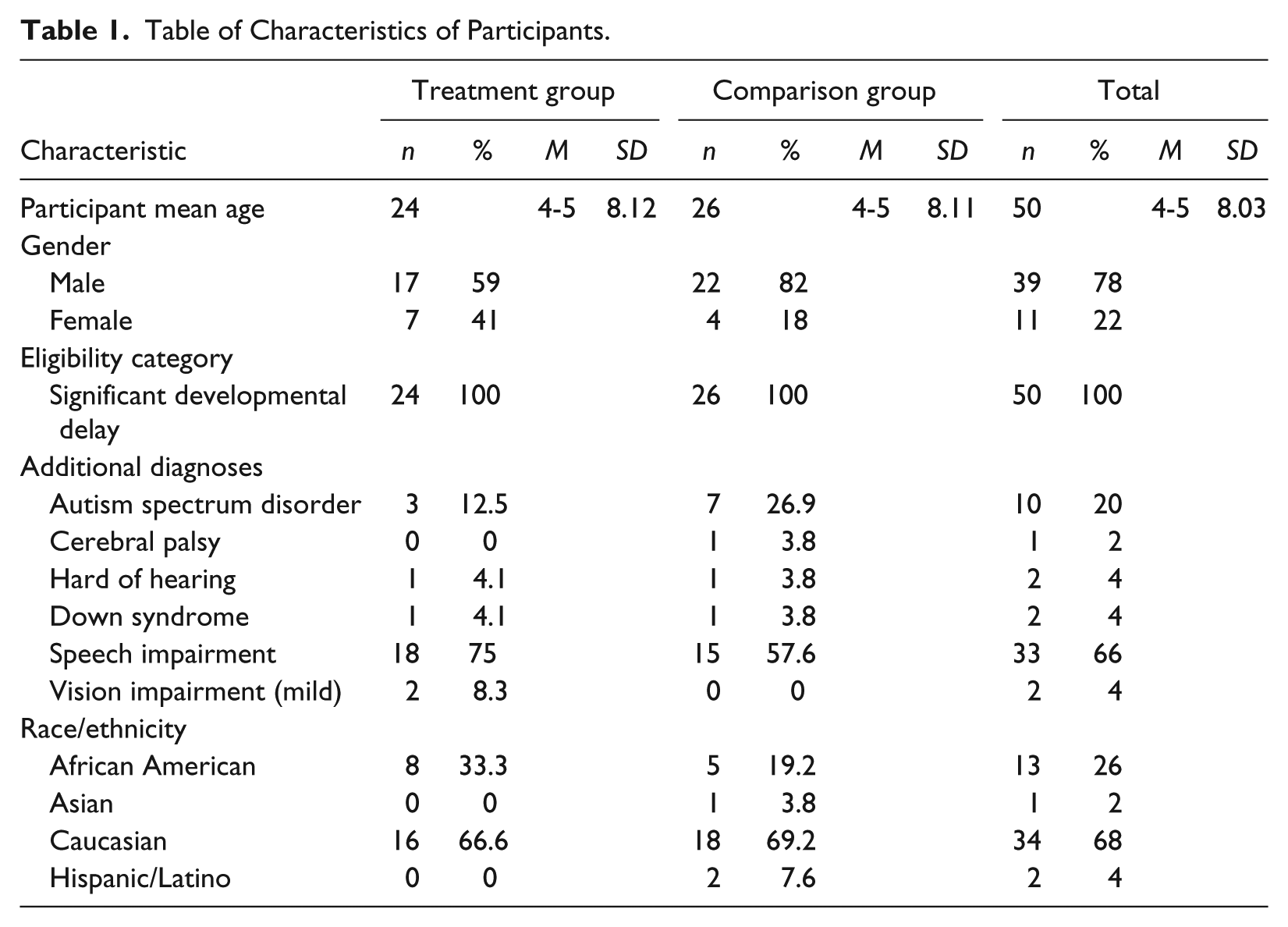
All participants had a school eligibility of developmental delay. In the state that this research project occurred, preschoolers are examined in five domain areas: self-help/adaptive, motor, communication, social/emotional/behavioral, and cognition. A child may qualify for developmental delay if his or her evaluation results in two standard deviations (SD) in one area below the mean or if two areas are 1.5 SD below the national norms according to the assessments used, and if this delay may cause negative effects in age-appropriate activities (Georgia Department of Education, 2012). The majority of participants in both groups also qualified for speech and language impairments. Other diagnoses of the participants included autism spectrum disorder, cerebral palsy, hard of hearing, Down syndrome, and mild vision impairments. The majority of participants of both groups is male and of the Caucasian race. Other races/ethnicities included African American, Hispanic, and Asian.
The mean standard scores of both the intervention and comparison groups were 1.5 SD below the mean on the Test of Early Mathematics Ability, Third Edition (TEMA-3; Ginsburg & Baroody, 2003). The mean pretest raw scores for both groups on the Individual Growth & Development Indicators Early Numeracy (IGDIS-EN; Hojnoski & Floyd, 2004) were within the Lower Cut scores for all subtests (see below for a description of the measures; see Table 2 for mean scores).
Means on TEMA and IGDIS-EN.
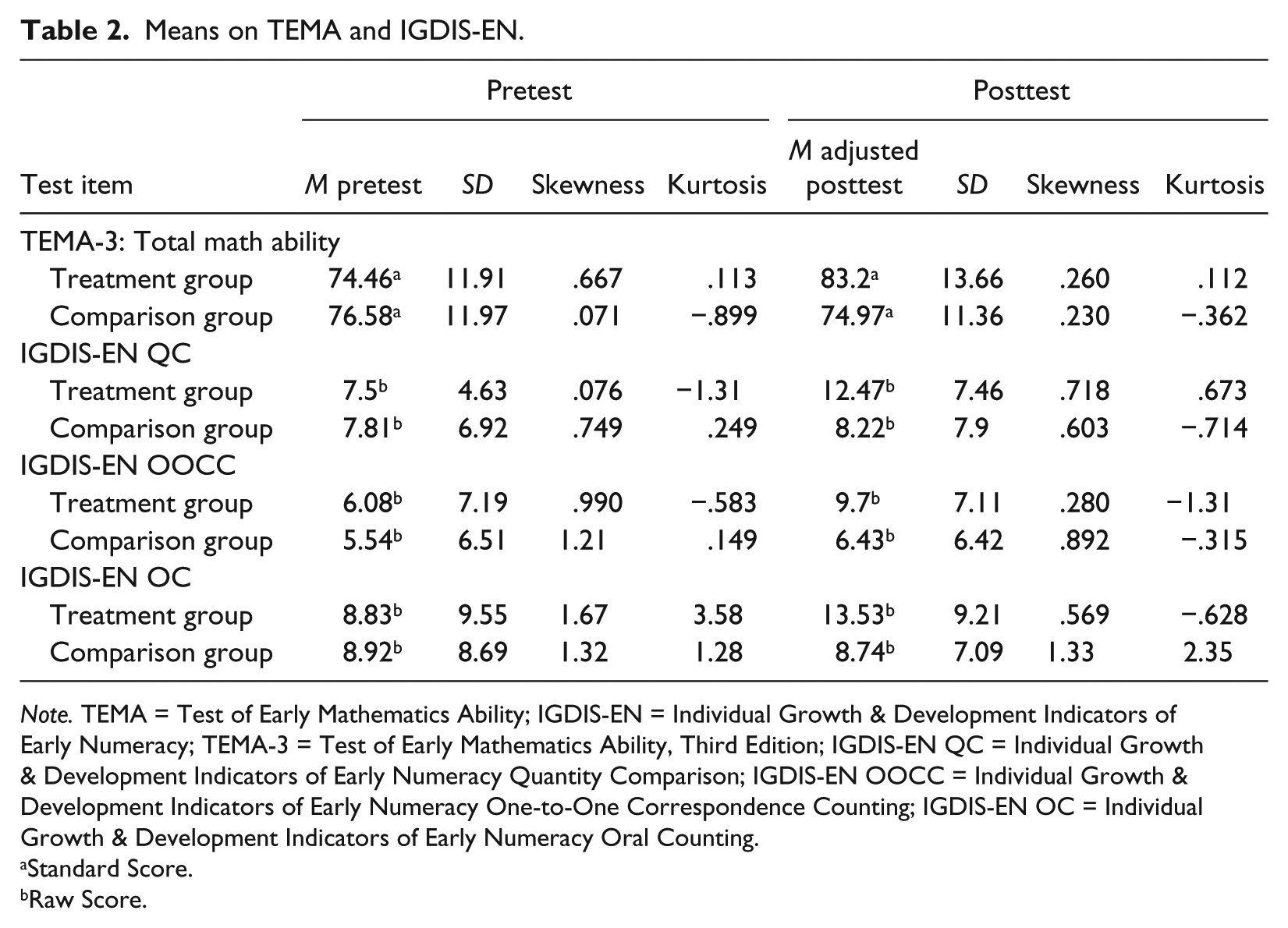
Note. TEMA = Test of Early Mathematics Ability; IGDIS-EN = Individual Growth & Development Indicators of Early Numeracy; TEMA-3 = Test of Early Mathematics Ability, Third Edition; IGDIS-EN QC = Individual Growth & Development Indicators of Early Numeracy Quantity Comparison; IGDIS-EN OOCC = Individual Growth & Development Indicators of Early Numeracy One-to-One Correspondence Counting; IGDIS-EN OC = Individual Growth & Development Indicators of Early Numeracy Oral Counting.
Standard Score.
Raw Score.
Measures
Two assessments were used to assess the children’s performance in early mathematics as pretest and posttest measures: (a) The TEMA-3 (Ginsburg & Baroody, 2003) and (b) The IGDIS-EN (Hojnoski & Floyd, 2004), formally known as the Preschool Numeracy Indicators (PNI; Floyd, Hojnoski, & Key, 2006). The TEMA-3 is a norm-referenced instrument designed to measure the mathematical knowledge of children ages 3 to 8 years old, whereas the IGDIS-EN is a curriculum-based measure used to assess young children’s number sense. The researchers used both measures to examine the effects of the intervention on children’s total math ability, as well as the specific number sense skills of OOCC, QC, and OC.
According to the test developers, the purposes of the TEMA-3 are to identify children who are behind typically developing peers in mathematics skills, identify strengths and weaknesses in mathematical thinking, suggest instructional practices for individual children, document children’s progress in learning arithmetic, and to serve as a measure for research projects (Ginsburg & Baroody, 2003). Skills assessed on the 21-item TEMA-3 range from questions relating to basic early numeracy skills, such as showing one finger and pointing to the page with more dots, to formal arithmetic and multiplication. The TEMA-3 reports scores in percentile ranks, standard scores, and age and grade equivalents. Skills assessed in the TEMA-3 for preschool children include early counting tasks (e.g., finger displays of numbers, one-to-one correspondence, rote counting, enumeration, the cardinality rule), nonverbal production of numbers, QC (i.e., more), early addition word problems, part-whole concepts, written expression and reading single-digit numerals, and number comparisons.
The TEMA-3 was normed on a sample of 1,228 children with and without disabilities from 15 states. Analysis of the use of the TEMA-3 has indicated evidence of reliability (i.e., coefficient α of .94). The TEMA-3 yields a total math ability score, and takes approximately 20 min to administer. Test-retest reliability (2-week interval) correlations ranged from .82 to .93 (Crehan, 2005). Criterion-related validity was compared with several subtests from other early numeracy assessments: KeyMath-Revised, Normative Update (NU) (Connolly, 1998); Woodcock-Johnson III (Woodcock, McGrew, & Mather, 2001); Diagnostic Achievement Battery-3 (Newcomer, 2001); and Young Children’s Achievement Test (Hresko, Peak, Herron, & Bridges, 2000) with a correlation median of .65, indicating that the TEMA-3 measures concepts similar to other related tests.
The IGDIS-EN (Hojnoski & Floyd, 2004) curriculum-based measurement (CBM) consists of four measures linked to components of number sense: (a) OOCC, (b) QC, (c) number naming, and (d) OC. For the purpose of this study, three of the four measures were used to measure math achievement. The QC task (QC IGDIS-EN) required that children choose which one of two sides of a page had more dots. The children were timed and the number correct within 60 s was the final score. The OOCC task (OOCC IGDIS-EN) required children to count objects while pointing to each dot on a page of 20 dots on the IGDIS-EN. The participants were given up to 30 s to complete the task. On the OC task (OC IGDIS-EN), participants were required to orally count to the highest number possible for 1min.
The IGDIS-EN reports scores in raw scores. The administrator manual provides age-based benchmarks and cut scores to determine whether children may be developmentally at risk. For purpose of the current study, cut scores were used to describe the participants: (a) Upper Cut: The child is considered Tier One (understands the task successfully), and (b) Lower Cut: Child is considered at risk.
Test-retest reliability varies by subtest from .71 to .88. Three of the four subtests of the IGDIS-EN were used for this study (i.e., OOCC, QC, and OC). Cronbach’s alpha was calculated to determine the internal consistency of the IGDIS-EN and TEMA-3 test items for the sample in the current study. Alpha values range from 0.00 to 1.00, with values of .9 and higher considered to represent high internal consistency (Portney & Watkins, 2009). Results from the Cronbach’s alpha show that the IGDIS-EN had acceptable internal consistency with the estimated alpha level of .71, and the TEMA-3 with good internal consistency with the estimated alpha level of .83.
Procedures
The intervention team consisted of the principal investigator (PI) and one intervention research assistant. The assessment team consisted of the intervention team with one research assistant. The PI and both research assistants were certified and experienced in teaching young children with disabilities. The PI was the interventionist for three of the intervention classrooms and two of the comparison classrooms. The intervention research assistant was the interventionist for two intervention classrooms and three comparison classrooms. At 2 weeks prior to the commencement of the study, the PI provided both research assistants 1 half-day training on the assessments. The PI also provided the intervention research assistant 1 half-day training on the intervention, shared storybook reading, and ways to implement the activities, including strategies for scaffolding and adapting the materials. Throughout training sessions, the PI and intervention research assistant practiced one lesson plan each to reach 90% fidelity on a fidelity checklist (described below).
All children who returned their parental permission forms were assessed on both the TEMA-3 and the IGDIS-EN. All children were assessed within a 10-day period by the assessment team. The intervention began the Monday following the completion of pretests. The intervention and comparison group activities were conducted by the PI and an intervention research assistant during the regular school day, either in the corner of the classroom or in a location just outside the classroom. The children were grouped by similar ability level by the classroom teacher into groups of two to four students.
One children’s storybook with related activities was introduced every 2 weeks for a total of 18 sessions (three storybooks, three times per week for 2 weeks per story) for children in the intervention group (described below). Children in the comparison group received three small group storytime sessions per week with the PI or the intervention research assistant for 6 weeks. The comparison group received the same storybooks in the same order as the intervention group, though there were no questions or elaborations provided during the session. The intervention group spent approximately 5 to 10 min on the storybook reading, and approximately 10 to 15 min in math instruction related to the storybook. Children in the comparison group received a 10-min storybook reading. Following the intervention, postassessment on children in both groups was conducted using the TEMA-3 and the IGDIS-EN.
Intervention
The intervention was a researcher-led storybook reading, followed by a mathematics activity based on the storybook. Researcher-created scripted questions and elaborations were used throughout the storybook (available upon request from first author). Planning the intervention first involved selecting high-quality picture books (described below) that visually and contextually supported the mathematical concepts chosen for study: OOCC, QC, and OC. Each book was carefully analyzed to identify where the text and illustrations supported one or all of the concepts. For example, one apple on one page and two pears on the next page were used to support quantity comparisons. Six activities were then developed to build off of the story in a three-step sequence of (a) teacher modeling, (b) student guided instruction, and (c) student independent practice (i.e., I do, we do, you do).
Questions were labeled on post-it notes throughout the books. Questions varied between comprehension of the story content and mathematics-related questions. Comprehension questions were included to enhance student understanding of the context of the book and encourage increased engagement in the mathematics activity. An example comprehension question for The Very Hungry Caterpillar (Carle, 1987) was how did the caterpillar feel after eating all the food items on Saturday? Whereas, an example mathematics-related question focused on the target skills was did the caterpillar eat more strawberries or more oranges? (QC skills). Comprehension and mathematical questions were generally balanced to encourage heightened engagement in the activity (through the story) and meet the desired mathematical learning goals.
One children’s storybook with related activities was introduced every 2 weeks for a total of 18 sessions (i.e., three storybooks, three times per week for 2 weeks per story). The children’s literature chosen had an implicit math focus with illustrations that would naturally lead to mathematical discourse (Anderson et al., 2005; Padula, 2004). The rationale for using a storybook with an implicit mathematical focus was to utilize high-quality children’s literature books that are commonly found in teachers’ classroom libraries and read to children during a typical storytime reading. Books used were The Snowy Day (Keats, 1962), Goldilocks and the Three Bears, and The Very Hungry Caterpillar (Carle, 1987). The researchers first selected books based on the quality of children’s literature. Next, the researchers narrowed down the selection to choose books that targeted particular mathematical skills. Although books were chosen for specific skills, all target skills were taught and modeled during each session. Three sessions per week for approximately 20 min per session, the intervention small groups were provided with (a) a review of math concepts from the prior session, (b) shared storybook reading by the PI or the intervention research assistant with guided math questions and elaborations, and (c) one small group math activity as directed on the lesson plans through an explicit and direct instruction model. Each session closed with a review of comprehension and math concepts from the story. Every 2 weeks the books and activities changed. To ensure that all children in the intervention group received the same type of storybook experience, questions, notes of interest, and main ideas were labeled throughout the storybook.
Storybook-themed math activities were also included as part of the intervention. All math activities were based off prior research interventions, programs, and curricula. Each activity focused on at least one of the target objectives. For example, The Three Bears has great potential for one-to-one correspondence, as each bear has his or her own bowl, spoon, chair, and bed. Example comprehension and math-related questions for The Three Bears included how many bears lived in the house? How many bowls of porridge did Mama Bear give each bear? Who entered the house when the three bears went on a walk in the forest? Example activities included (a) counting bears: Student draws a number card, identifies the number, and places the accurate number of small plastic counting bears on a five-frame card. The group then counts the bears together and discusses how many each student has. The students then compare who has more bears on their card; (b) table setting: Children set the table with the appropriate number of bowls, spoons, and napkins, as Mama Bear did in the story.
The Snowy Day was chosen for QC. For example, the main character made more snow angels than snowmen, and the amount of snow, snowballs, and snowflakes differed on particular pages. Example comprehension and math-related questions for The Snowy Day included what did Peter see when he looked out the window? Did Peter make more snow angels or snowmen? Example activities included (a) snowball toss: A student is handed a white Styrofoam ball (i.e., “snowball”) with 1 to 10 black dots drawn on the ball with a black marker. The student counts the number of dots, the group counts the number of dots together, then the student throws the ball in a bucket. The game continues with the next student. (b) Reenactment: The children physically reenacted all of Peter’s activities in the snow, while focusing on math talk as appropriate (e.g., Peter took 10 steps, let’s all take 10 steps and count each step as we walk).
The Very Hungry Caterpillar provides ample opportunities for counting skills. In the story, the hungry caterpillar eats a different number of food items per day. Example comprehension and math-related questions are as follows: How did the hungry caterpillar turn into a beautiful butterfly? How many apples did the hungry caterpillar eat? Did the hungry caterpillar eat through more apples or oranges? Example activities included (a) felt board story reenactment: The students place the number of felt fruits eaten by the caterpillar on a felt board while the story is being read. At the end of the story, the students are each called upon to count the number of fruits per day, and to decide which days the hungry caterpillar ate more fruit; (b) mystery box: While wearing a green sock puppet on their hand, the children will act as if they are the caterpillar. The children take turns grabbing a handful of colored snap cube manipulatives from the box as if they were the caterpillar eating through the fruit. The children will sort their cubes by color, count how many cubes they have of each color by pointing to each cube, snap their cubes together by color, and determine of which color they have the most cubes.
Fidelity
Fidelity checks were completed for 20% of intervention and comparison sessions, per each of the two researchers implementing the intervention. The PI performed the fidelity checks for the research assistant and vice versa. For the intervention group, fidelity was determined by (a) adherence to the determined storybook, (b) implementation of scripted questions throughout the storybooks, and (c) implementation of the target math activities. In the comparison group, fidelity checks were related to the researchers’ adherence to the reading of the storybook without additional questions or elaborations. Results of fidelity checks revealed high compliance in both intervention and comparison conditions (range: 95%-100%, with an average of 97% fidelity).
Data Analysis
An ANCOVA was used to determine differences between posttest scores for the comparison and intervention group on all measures. ANCOVAs were used to control for pretest scores, due to the variability of children’s ages and ability levels. SPSS version 21 for Windows was used as the statistical tool for the analyses. For all ANCOVAs, the pretest scores were held constant as the covariant. For all analyses, a test of homogeneity of regression was performed. A nonsignificant result of this analysis assures that the covariate (i.e., pretest scores) and the dependent variable (posttest scores) have similar slopes (i.e., no interaction effect). All analyses are reported with a nonsignificant test of homogeneity of regression. Effect sizes (Cohen’s d index) were calculated for each outcome variable (Cohen, 1992). Effects for each targeted early numeracy task were determined as small (.10), medium (.25), or large (.40; Cohen, 1992). Furthermore, Levene’s test of equality of variance was analyzed on each ANCOVA to meet the assumption that the variances between the samples were equal between the groups. Each analysis met this assumption as well.
Results
Intervention Effects on Total Mathematical Ability
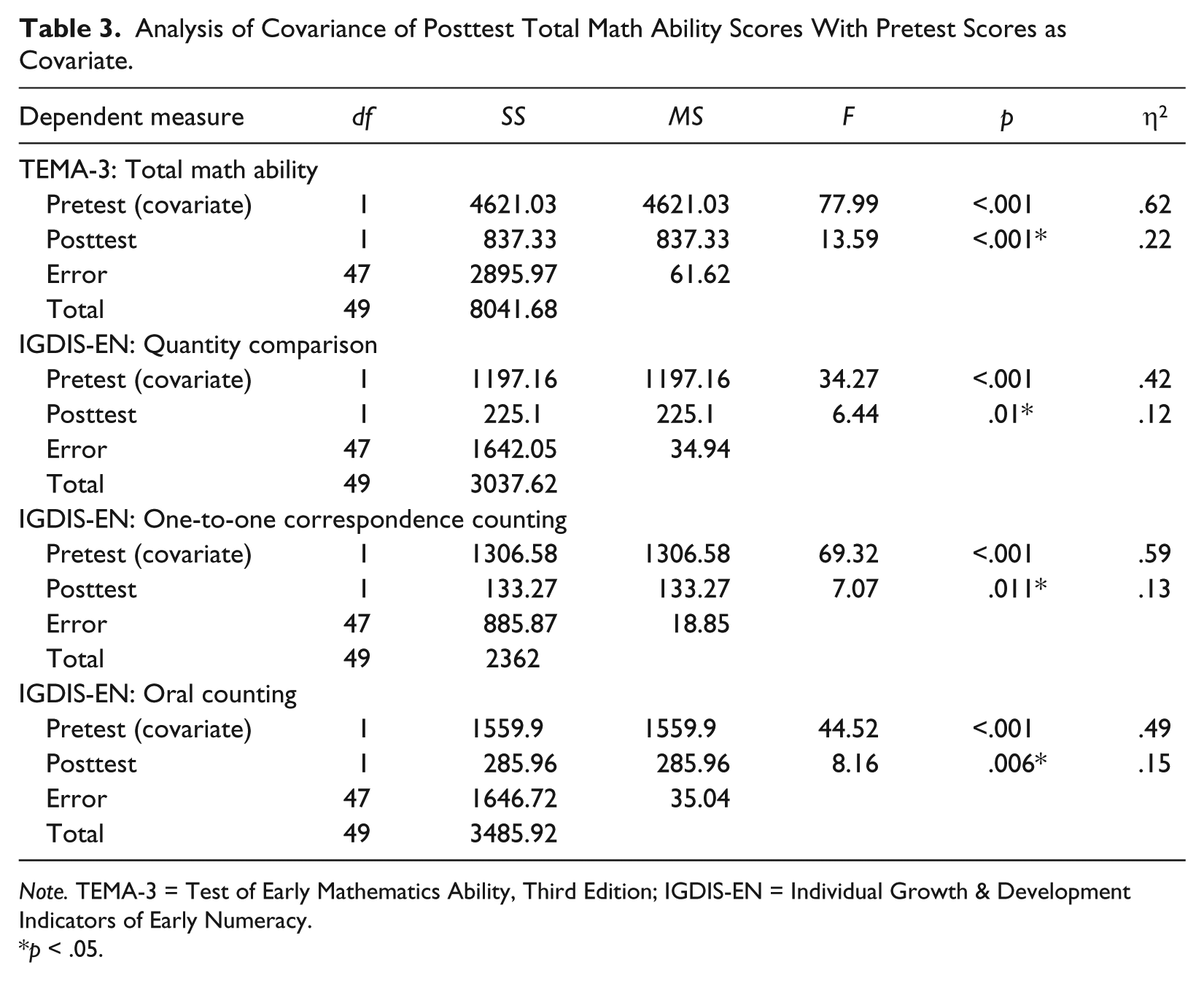
Significant differences were found between the two groups for total mathematical ability on the TEMA-3, with higher scores for the intervention group. The ANCOVA of the math ability scores was significant, F(1, 46) = 13.59, p = < .001, η2 = .22 (see Table 3). The strength of the relationship between the intervention and the dependent variable was assessed as medium on the dependent measure, holding constant the pretest math achievement scores. The intervention group had the lower pretest mean (M = 74.46, SD = 11.91), but the higher posttest mean (M = 82.29, SD = 13.66) and adjusted mean (M = 83.2). The comparison group had the higher pretest mean (M = 76.58, SD = 11.97), and the lower posttest mean (M = 75.81, SD = 11.36) and adjusted mean (M = 74.97; see Table 2). Follow-up tests were conducted to evaluate pairwise differences among the adjusted means. There were significant differences among the pairwise comparison of adjusted means between the two groups (p = < .001). Although the intervention group experienced total math ability gains, posttest scores were still more than 1 SD below the mean for both groups.
Analysis of Covariance of Posttest Total Math Ability Scores With Pretest Scores as Covariate.
Note. TEMA-3 = Test of Early Mathematics Ability, Third Edition; IGDIS-EN = Individual Growth & Development Indicators of Early Numeracy.
p < .05.
Intervention Effects on QC Skills
The ANCOVA for the QC task was significant, F(1, 46) = 6.44, p = .01, η2 = .12 (see Table 3). The strength of the effect size between the intervention and the dependent variable was assessed as small on the dependent measure, holding constant the pretest math achievement scores. Of the two groups, the intervention group had the lower pretest mean (M = 7.5, SD = 4.63), and the higher posttest mean (M = 12.33, SD = 7.46) and adjusted mean (M = 12.47). The comparison group had the higher pretest mean (M = 7.81, SD = 6.92), and lower posttest mean (M = 8.35, SD = 7.90) and adjusted mean (M = 8.22) (see Table 2). Follow-up tests were conducted to evaluate pairwise differences among the adjusted means. There were significant differences among the pairwise comparison of the adjusted means between the two groups (p = .016).
Intervention Effects on OOCC Skills
The ANCOVA was significant for the OOCC skill task, F(1, 46) = 7.07, p < .001, η2 = .13 (see Table 3). The strength of the effect size between the intervention and the dependent variable was assessed as small on the dependent measure, holding constant the pretest math achievement scores. Of the two groups, the intervention group had the higher pretest mean (M = 6.08, SD = 7.19), posttest mean (M = 9.92, SD = 7.11) and adjusted mean (M = 9.7), whereas the comparison group had the lower pretest mean (M = 5.54, SD = 6.51), posttest mean (M = 6.23, SD = 6.42), and adjusted posttest mean (M = 6.43; see Table 2). Follow-up tests were conducted to evaluate pairwise differences among the adjusted means. There were significant differences among the pairwise comparison of adjusted means between the two groups (p = .01).
Intervention Effects on OC
There were significant differences between groups on the OC IGDIS-EN subtest. The ANCOVA for this test item was significant, F(1, 46) = 8.16, p = .006, η2 = .15 (see Table 3). The strength of the effect size between the intervention and the dependent variable was assessed as small—medium on the dependent measure, holding constant the pretest math achievement scores. The intervention group had the lower pretest mean (M = 8.83, SD = 9.55), but the higher posttest mean (M = 13.50, SD = 9.21) and adjusted posttest mean (M = 13.53). The comparison group had slightly higher pretest mean (M = 8.92, SD = 8.69), but the lower posttest mean (M = 8.77, SD = 7.09) and adjusted posttest mean (M = 8.74; see Table 2). Follow-up tests were conducted to evaluate pairwise differences among the adjusted means. There were significant differences in the adjusted means between the two groups (p = .006).
In summary, the intervention group showed significant differences on the total math ability standard score on the TEMA-3, as well as the three subtests assessed on the IGDIS-EN, when compared with the comparison group. The areas with the highest effects included (a) total math ability on the TEMA-3, (b) OC, (c) OOCC, and (d) QC skills on the IGDIS-EN, respectfully.
Discussion
In prior studies, researchers found that when preschoolers without identified disabilities were provided with an intervention that integrated math activities and children’s literature, the children made significant progress in math skills (e.g., Arnold et al., 2002; Hong, 1996; Jennings et al., 1992). The current study extended former research studies in that the intervention of integrating mathematics and children’s literature increased mathematical skills for preschoolers with disabilities as well, specifically in QCs, OOCC, and OC. Even though the intervention targeted specific skill areas, the participants experienced gains in their overall mathematics ability as well. The results of this preliminary study are promising, especially as the intervention was relatively short and targeted only a few specific early math skills. Furthermore, this study extends existing mathematics literature on young children with disabilities, in that, given an intervention that is a combination of naturalistic and explicit methodologies, children with disabilities can make significant progress in mathematics in a short time frame.
Providing mathematics interventions for children with disabilities is of great importance, as researchers have found that children with disabilities who lag behind peers in math skills at an early age may experience less growth and slower gains than peers without identified disabilities (Lambert et al., 2014; Morgan et al., 2011). Furthermore, early math skills are a great predictor of later academic success (Claessens et al., 2009). Hojnoski and colleagues (2014) found that children with disabilities may require different interventions than children without identified disabilities. Furthermore, Dynia and Justice (2015) discovered that preschool instruction differs for classrooms for children with and without disabilities. The current study contributes to the small body of research investigating classroom-based mathematics interventions for young children with disabilities.
It is interesting to think about the different beginning skills of number sense targeted in this intervention. For instance, the children in the intervention group were noted to experience significant gains in the QC task. This skill of recognizing which of the two groups have “more” objects is one of the most fundamental and early developing numeracy skills (Baroody, 2000; Chu, vanMarle, & Geary, 2013), and as discovered through the intervention, a most natural concept to incorporate in math-implicit storybook readings. For example, two of the targeted storybooks had several pictures throughout the book that naturally allowed for discussion of which page or object had more. The Snowy Day had some pages with more snowballs or snowflakes than other pages. The caterpillar in The Very Hungry Caterpillar ate more fruits on different days of the week. Therefore, this skill was not only addressed in the activities, but also easily targeted during the storybook readings.
In addition, the early counting skills of one-to-one correspondence and OC improved for the children in the intervention group. Counting skills were intentionally modeled and encouraged throughout the intervention. For example, in The Very Hungry Caterpillar, the PI and research assistant pointed to each fruit after reading each page. The children were then also encouraged to count objects by touching each object when opportunities occurred during the instruction. Counting skills proved to be another easily integrated mathematics skill when reading all three target storybooks.
Integrating the mathematics instruction and children’s literature allowed interventionists in this study to not only provide a shared storybook reading to the children using quality children’s literature within a short time frame, but also within a limited budget. It should be acknowledged that the researcher interventionist had expertise in the area of mathematics with young children; however, the materials and training were specifically designed so that teachers may use the intervention in their own classrooms. The PI made it a priority to keep the cost of the materials and books to a minimum when developing this particular intervention, as typical classroom budgets are limited. The manipulatives used were materials that most teachers already have in their classrooms (i.e., counting/sorting bears, links, and snapping cubes), as were the books. In addition, all activities were created using inexpensive materials typically found in preschool classrooms such as plastic bowls, construction paper, crayons, magnets, and glue.
The researchers also found that it is important to be intentional and purposeful in selecting the storybooks, and to consider which books are best for teaching particular skills. For this study, early numeracy skills targeted for the intervention were taught with each storybook. Different books can produce differences in discourse, remarks, and the types of mathematics skills elicited (Anderson et al., 2005). There are differing opinions from researchers in how to choose children’s literature books for the integration of mathematics (e.g., Padula, 2004; Schiro, 1997; Wilburne, Keat, & Napoli, 2011). With the increasing popularity of the concept of integrating mathematics into children’s literature, publishers have added several mathematical trade books that allow for a variety of books for teachers to choose from.
Storybooks may have a mathematical focus that is implicit, explicit, or both (Padula, 2004). Whereas some researchers believe that the mathematics in literature should be visible in text and illustrations (Schiro, 1997), others have found that children as young as 5 years of age can identify mathematical concepts and ideas from children’s literature with an implicit focus (Van den Heuvel-Panhuizen & Van den Boogaard, 2008).
Wilburne et al. (2011) suggested three successful approaches teachers may use when selecting literature to integrate within mathematics. One approach includes reading through the storybook to find opportunities for mathematical questioning. Effective questioning should not simply ask for one word answers, such as how many pencils are in the box? or what is this shape?; rather, questions should evoke higher level thinking, such as why is the answer four? Another approach to selecting literature for mathematics is to consider the story elements, such as the plot, theme, setting, and characters to discover how mathematical questioning can be posed. For example, does the plot of the story consist of a logical sequence or order? Does the plot allow for prediction? Do the characters allow for problem-solving situations? The third approach requires the teacher to determine the mathematical standards to teach first, and then attempt to connect the standards within the story. Wilburne and colleagues (2011) suggested that teachers should read through the literature first to discover the mathematical connections, as many stories do not include explicitly presented mathematics. Once the storybook is chosen, the teacher may select characters and situations that the students can help solve.
The intervention of combined math activities and shared storybook readings with early numeracy elaborations makes it difficult to discern which element of the intervention was more effective than the other, or whether it was a combination of elements. Former studies that used a similar intervention of shared storybook readings and math activities with children without identified disabilities (e.g., Hong, 1996; Jennings et al., 1992; Young-Loveridge, 2004) found similar results as the current study, suggesting that it may be a combination of elements that influenced the change in math skills over the course of the study. It is important to note, however, that the mean total scores of both groups were below the norm at pretest, and although participants made progress in all areas examined, the group means continued to lag behind the norm at posttest.
Implications
Implications of this study for classroom teachers include the possibility of integrating the content areas of literature and mathematics for young children with disabilities. Within 20 min per intervention day, three times per week for 6 weeks, two content areas were targeted: Storybook reading and mathematics, with books and materials readily found within the preschool classrooms. Integrating the mathematics instruction and children’s literature allowed interventionists in this study to not only provide a shared storybook reading to the children using quality children’s literature, but also encouraged the construction of early numeracy concepts.
Implications for teacher preparation programs include focusing on the strategy of teaching early math skills through children’s literature. This intervention allows for teaching the key concepts defined by NCTM (2006). Preparers of preservice and in-service personnel may invite students to explore high-quality children’s literature and find the mathematical concepts within the storybooks as a class project. College faculty may emphasize the strength of this strategy not only to integrate two content areas, but also to teach key concepts and provide a common context for supporting student learning (Van den Heuvel-Panhuizen & Van den Boogaard, 2008).
Limitations
The investigation was a pilot study with many lessons learned throughout the process. There are several limitations to this study. For example, the length of the intervention and the representativeness and size of the sample. Although the intervention was implemented for 6 weeks, 3 days per week, for 20 min per session, the participants in this intervention may have benefitted even further if there had been a longer time frame. The length of intervention is consistent with other studies that have used storybook readings as a part of a mathematics intervention (Arnold et al., 2002; Young-Loveridge, 2004). However, some studies that used implicit storybook readings as their sole intervention used longer intervention timelines (e.g., Jennings et al., 1992; Van den Heuvel-Panhuizen & Iliada, 2011). Although the potential sample for this study included all preschoolers meeting the inclusionary criteria from one school district in the southeastern region of the United States, the sample is of course not representative of all preschoolers with disabilities. An even larger sample of preschoolers with disabilities may provide additional information regarding the effectiveness of this intervention. In addition, due to the nature of the intervention, it is difficult to discern whether the participant’s improvement in math skills were due to the storybook reading in conjunction with the math instruction or whether the participants would have made similar progress with the math instruction alone.
A further limitation to this preliminary investigation is the lack of independent assessors and objective fidelity data, which is a threat to internal validity. Two of the researchers who conducted the intervention also conducted the assessments and were thus not blind to the children’s conditions. They were not unaware of the study’s questions, which may have compromised internal validity. Furthermore, there may have been other factors, such as classroom or school differences, which contributed to the results, as objective classroom instructional data were not obtained. Those factors may have threatened internal validity, as well.
To reduce possible threats to internal validity, future studies should include interventionists blind to the study’s hypotheses, investigate objective classroom instruction, randomize the groups at the child level, use independent assessors, and include objective fidelity data.
Future Research Directions
The authors recognize that the results may vary if this intervention was conducted by the classroom teacher or within inclusive settings. Future studies may want to explore teacher implementation of the intervention or even family members in the home environment as significant adults highly influence the children’s mathematical knowledge (Anders et al., 2012; Melhuish et al., 2008). Future studies might also target young children with specific disabilities such as autism spectrum disorder or Down syndrome to see whether differences occur in mathematical disabilities based on targeted interventions such as this. Interestingly, there was one participant in the Hojnoski and colleagues (2014) study and two participants in the current study who exhibited refusal or dropped out of the study due to behavior issues. Future research might investigate how challenging behaviors interfere with this particular intervention.
In addition, studies could examine whether this intervention promotes growth in emergent language and literacy skills, as well as changes in early mathematical abilities. It would be interesting to investigate the “active” ingredient in the intervention, comparing math instruction alone to math instruction with storybook reading. Finally, future research in this area could benefit from the inclusion of social validity measures and classroom observational data.
Conclusion
In summary, preschool children with disabilities increased their scores on assessments in math after an intervention integrating mathematics and children’s literature. This study adds to a sparse, but growing, body of intervention literature in mathematics research for young children with disabilities. Although it remains unclear exactly how emergent literacy, language, and early numeracy influence each other (Purpura, Hume, Sims, & Lonigan, 2011), this study adds to the literature that supports the integration of the content areas of literacy and mathematics. Results of this study demonstrate that children with disabilities can benefit from mathematics interventions, and underscore the potential of teaching and focusing on early numeracy for young children with disabilities.
Footnotes
Declaration of Conflicting Interests
The author(s) declared no potential conflicts of interest with respect to the research, authorship, and/or publication of this article.
Funding
The author(s) received no financial support for the research, authorship, and/or publication of this article.