






Abstract
Interventions to enhance interactions between children with disabilities (CWD) and typically developing children (TDC) in inclusive preschool classrooms are crucial for the development of young children. This systematic scoping literature review describes peer interaction interventions in inclusive preschool classrooms. Sixteen studies met the inclusion criteria and were categorized according to a peer interaction intervention framework. Explicit social skills interventions, such as peer-mediated interventions, were the most common type of intervention. Most interventions were delivered to 4-year-old White children with Autism. Studies generally focused on increasing language and social skills for CWD and positioned TDC as intervention agents. The results suggest that future research intending to support peer interactions in inclusive classrooms should (a) include CWD other than autism and improve the reporting of race and language background; (b) clearly report what supports were in place before individualized interventions were implemented and expand research on less-intensive, naturalistic, or class-wide approaches; and (c) broaden the types of dependent variables measured.
Keywords
Introduction
Peer interaction is critical to the development of young children. Such interactions provide opportunities for children to scaffold each other’s learning and development in many areas, including language (Erdemir & Brutt-Griffler, 2020) and cognitive and social-emotional development (Weiss et al., 2026). Moreover, positive peer interactions are central to the inclusion of children with disabilities (CWD) in general education classrooms because they facilitate children’s sense of belonging (Beneke et al., 2019). However, simply placing CWD in the same classroom as children without disabilities may not be sufficient to facilitate children’s interactions. Previous research has found that there may be limited interactions between children with and without disabilities in inclusive early education classrooms (Dott, 2026) and that CWD continue to experience social isolation disproportionately (Chen et al., 2020). For instance, Hong and colleagues (2020) found that typically developing children (TDC, i.e., children without disabilities) 1 interact with CWD for relatively small amounts of time throughout the school day in preschool classrooms. The CWD experience fewer peer interactions than the TDC and interact more frequently with other CWD as opposed to TDC in general education classrooms (Chen et al., 2019). Limited opportunities to interact with a broader range of peers may restrict children’s access to diverse social partners, communication opportunities, and classroom activities.
Limited peer interaction between TDC and CWD is often explained through a focus on the behavioral or developmental characteristics of CWD, such as differences in the joint attention, language, social, and play skills of CWD (e.g., Barber et al., 2016). However, importantly, a lack of peer interactions between CWD and TDC is not solely due to the abilities, behaviors, or disability status of CWD. For instance, researchers have found that teachers may not scaffold peer interactions between children with and without disabilities effectively (e.g., Hong et al., 2020). In addition, whether TDC includes CWD in play or classroom activities is correlated with their own abilities (i.e., theory of mind; Diamond & Hong, 2010) and attitudes or understanding about disability and CWD (e.g., Diamond et al., 2008; Hong et al., 2013; Yu et al., 2015). Finally, peer interactions between children with and without disabilities may depend on classroom contextual factors (e.g., classroom activity; Acar et al., 2017; Hong et al., 2020) and how TDC perceives the match between an activity and their understanding of the abilities of CWD (Diamond & Hong, 2010; Diamond & Tu, 2009).
Several interventions have been used to improve peer interactions between CWD and TDC in inclusive preschool classrooms. It’s important to discern key components of certain types of peer interaction interventions, including the characteristics of participating children, the specific strategies used to promote interaction, and the dependent variables targeted for each group (i.e., TDC and CWD). However, prior literature reviews focusing on peer interaction either did not include studies with preschool children (e.g., Huber & Carter, 2016) or analyzed preschool interventions in conjunction with elementary school-level interventions (e.g., Garrote et al., 2017). In addition, some reviews have focused on specific types of interventions or specific populations. For example, Zagona and Mastergeorge (2018) reviewed studies on peer-mediated interventions (PMI) for preschoolers. Therrien et al. (2016) also focused on preschoolers but only examined interventions that involved the use of augmentative and alternative communication (AAC) systems. Hansen and colleagues (2014) reviewed interventions conducted in inclusive preschools but focused only on children with autism spectrum disorder (ASD). Thus, no previous literature reviews have broadly examined peer interaction interventions implemented in inclusive preschool classrooms without restrictions on the type of intervention or child disability type. Importantly, there has also not been a review that examined peer interaction interventions descriptively, such as detailing the types of intervention procedures used or discussing power dynamics between CWD and TDC. A comprehensive descriptive review across intervention and disability types can capture patterns, overlaps, and gaps that may be overlooked in more narrowly focused reviews. The purpose of this review is to conduct a systematic scoping and descriptive synthesis of peer interaction interventions by narratively describing (a) the characteristics of participating children; (b) the intervention types, contexts, implementers, and strategies used; and (c) the dependent variables assessed for children with and without disabilities. This is critical for advancing equitable and inclusive practices that foster peer interactions in inclusive preschool classrooms. The research questions were:
Understanding participant characteristics helps illuminate who is being included or excluded from intervention research, which is critical for an understanding of who practices are evidence-based for (Cumming et al., 2023). Examining intervention types and strategies provides insight into the approaches most used to support peer interactions between CWD and TDC and how practices may differ for CWD and TDC. Finally, systematically analyzing the dependent variables measured for CWD and TDC helps understand which skills have been evaluated in the literature and, thus, what has been prioritized (Cumming et al., 2023).
Method
Conceptual Framework
We drew on sociocultural theory (Vygotsky, 1978) to frame the role of social interactions and active supports within children’s zone of proximal development (ZPD) and to characterize the potential mechanisms facilitating or impeding peer interactions that advance social inclusion for CWD. In addition, we utilized Brown and colleagues (2001) peer interaction intervention framework to analyze the types of peer interaction interventions applied. These framings informed the research questions, codebook development, and final analysis. Having a clear theoretical framing supports the coherence and transparency of systematic literature reviews (Cumming et al., 2023).
Vygotsky stated that children can exceed their current capacities and acquire new skills and perceptions through collective activities and interactions scaffolded by adults or “more capable” peers within their (ever-shifting) ZPD (Vygotsky, 1978). The purpose and process of such scaffolding, from a sociocultural perspective, is to facilitate children’s entrance, or inclusion, into their sociocultural context. That is, learning is an enculturation process by which adults and peers model and teach socially meaningful skills using society’s valued signs and tools (e.g., language and behavior; Vygotsky, 1978). Thus, how social interactions are supported (or not) can be viewed as one way that children learn what (and who) is valued in their society. Leonardo and Manning (2017) pointed out that applying a sociocultural lens helps explicate who is considered capable in society and what makes one capable. In the present literature review, applying a sociocultural lens helped us frame the importance of peer interactions and closely examine the social messages imbued in the ways peer interactions are conceptualized and supported (i.e., who and what are valued).
We used Brown and colleagues’ (2001) framework to categorize the intensity and type of peer interaction interventions in inclusive preschool classrooms (see Supplementary Materials—Figure 1). They assign various peer interaction interventions into four categories based on their purposes and level of intrusiveness (Tsao & Sung, 2014). Classroom-wide interventions are the least intrusive intervention type and include the use of developmentally appropriate practices to support social interactions, environmental arrangements (e.g., the availability of some types of social toys such as checkers), and affective interventions to improve the positive attitudes and perceptions of TDC toward CWD (e.g., using children’s books to talk about disability). Naturalistic interventions, the next most intrusive, include incidental teaching of social behaviors and friendship activities (Tsao & Sung, 2014). Incidental teaching is an individualized and contextualized intervention that uses naturally occurring opportunities during the routine of daily activities, such as outdoor play, snack time, or transitions, to prompt behavioral changes, such as appropriate social responses between interaction partners (Alai-Rosales et al., 2017). Friendship activities are teacher-planned activities (e.g., songs or games) intended to teach or embed prosocial behaviors, such as making friendly statements and sharing (Brown et al., 2001).
The next level of intervention in the hierarchy is social integration interventions. In social integration activities, interventionists can plan, arrange, and introduce the activity; assign roles; and monitor children’s interaction. However, they do not participate directly and gradually remove themselves from the activity. Finally, the most intense intervention is explicit social skills interventions. These interventions are adult-led and may involve children engaging in activities outside of typical classroom routines and activities or engaging in said activities in very different ways from what they naturally do. One common type of explicit social skills intervention is PMI, where a child without a disability is taught a particular behavioral chain to interact with a child with a disability in a very specific way (Milam et al., 2021). Brown and colleagues (2001) emphasized the need for less intrusive interventions (i.e., those located at the lower levels of the hierarchy) to reduce the research-to-practice gap. They also acknowledged that different types of interventions can be used together.
Article Search and Screening
Key terms that guided the article search and screening process are defined as follows. Peer interaction is the process of peers acting and influencing one another (e.g., initiation and responses, communicative turns, and play behaviors) through verbal or nonverbal means (Wu et al., 2021). “Inclusive preschool classroom” refers to classrooms where children aged 3 to 5 years with and without disabilities attend together. This definition was not attached to a particular teacher-child ratio or the ratio of children with and without disabilities. Peer interaction intervention means “a program, product, practice, or policy” aimed at improving peer interaction (What Works Clearinghouse, 2002).
In the original search, the first author did the electronic database search to identify articles from Education Research Complete, ERIC, and APA PsycInfo databases using the terms: (preschool* OR child* OR early childhood) AND (disab* OR special need* OR typically develop*) AND (peer interact* OR social interact* OR friend*) AND (interven* OR strateg* OR development). The first author also restricted the search to peer-reviewed articles written in English and published in academic journals between January 1, 2013, and February 1, 2023. To be included, articles had to meet the following criteria: (a) an intervention was conducted to increase peer interaction between children with and without disabilities, (b) the intervention occurred in inclusive preschool settings, (c) the interaction of children with and without disabilities between the ages of 3 to 5 was the primary dependent variable of the intervention, and (d) the study used experimental or quasi-experimental group design or single-case design. See the four-phase flow diagram for the article identification, screening, eligibility, and inclusion processes in Figure 1, adapted from the Preferred Reporting Items for Systematic Reviews and Meta-Analyses (PRISMA) flow (Moher et al., 2009).
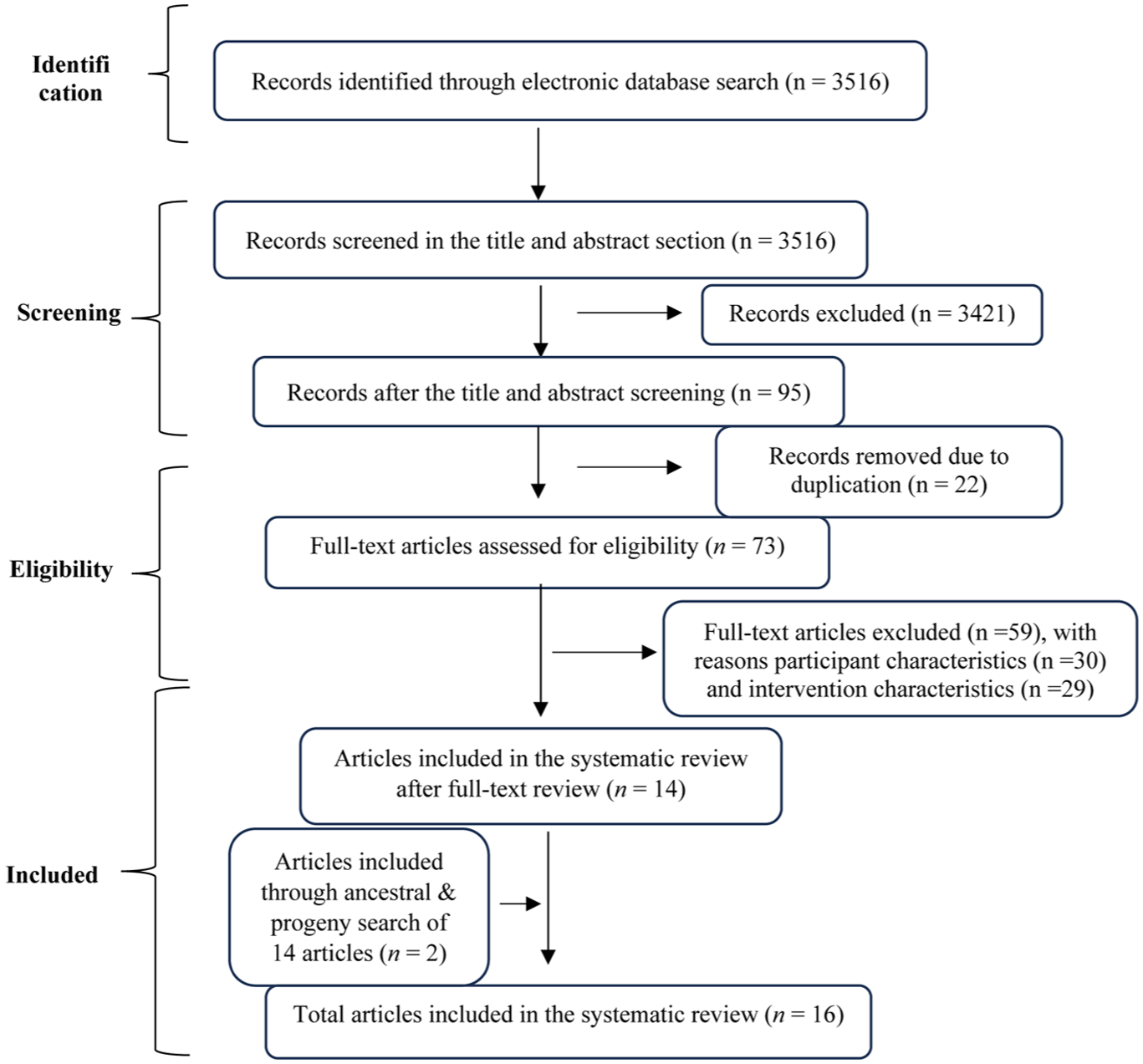
Systematic Review Flow Diagram.
The unit of analysis for screening was the published manuscript (i.e., article), meaning that the entire article had to meet the inclusion criteria, rather than individual research designs or participants within the study. The first author identified a total of 3,516 studies across all three databases and excluded 3,421 of these articles because they did not include an intervention focusing on increasing or improving peer interactions according to their titles and abstracts. After eliminating duplicates (n = 22), 73 studies remained. The first author then reviewed the full text of those studies and excluded 59 articles. Thirty of these fifty-nine articles were excluded due to their participants’ features. For example, the first author excluded articles that included children older than 5 years old (n = 22; e.g., Watkins et al., 2019), younger than 3 years old (n = 3; e.g., Martinez Cueto et al., 2022), and children considered to be “at-risk” but without disabilities (n = 5; e.g., Lemmon & Green, 2015). Also, the first author excluded 29 studies due to the interventions’ features (n = 29), such as interventions not being conducted in inclusive preschool settings (e.g., conducted in special education classrooms; n = 14; Bauminger-Zviely et al., 2020). This process resulted in the inclusion of 14 articles. Then, the first author conducted ancestral searches and a forward search of these articles, which resulted in and included two additional studies (Dueñas, D’Agostino, & Plavnick, 2021; Dueñas, Plavnick, & Goldstein, 2021).
The first author then replicated the original electronic database search using the same search terms and databases, covering publications from February 1, 2023, to June 1, 2025, to include the most current literature. As in the initial review, the unit of analysis for this screening was the published manuscript (i.e., article). This updated search yielded a total of 905 studies. After title and abstract screening, the first author excluded 872 articles for not including an intervention specifically targeting peer interactions. Following the removal of duplicates (n = 14), 19 articles remained for full-text review. Eight of these 19 articles were excluded due to their participants’ features, including children older than 5 years old (n = 7; e.g., Fedewa, Watkins, Carden, & Grbac, 2024) and children who do not have a diagnosed disability (n = 1, Foster et al., 2024). Eleven studies were excluded because the intervention did not focus specifically on peer interaction (n = 4; e.g., researchers intervened on CWD’s involvement in play activities and learning; Lundqvist, 2024). Studies were also excluded if they did not use an experimental, quasi-experimental, or single-case design (n = 4; e.g., Fedewa, Watkins, Barber, & Baggett, 2024). Finally, studies were excluded that were not conducted in inclusive preschool settings (n = 3; e.g., Edgar et al., 2024). Ultimately, no additional studies were identified for inclusion in the current review. The first author also reviewed the articles included in previous systematic reviews (Garrote et al., 2017; Huber & Carter, 2016; Therrien et al., 2016; Zagona & Mastergeorge, 2018), and after screening those articles against the inclusion criteria, she found that none qualified for inclusion in the current review.
Coding
We used a deductive coding process (Fereday & Muir-Cochrane, 2006) guided by a predefined codebook developed for this review. Coding consisted of extracting descriptive excerpts from each article, based on our research questions and purpose (Cumming et al., 2023). Although several manuscripts contained multiple single-case designs, we treated each study as the unit of analysis rather than each design. This decision aligns with the descriptive purpose of this review and with CEC (2014) guidance on assessing the quality of single-case designs. Importantly, for all studies that included more than one design, the designs used the same intervention category, type, and dependent variables; multiple designs served primarily to replicate effects rather than to test substantively different interventions. Therefore, treating the study as the analytic unit prevented overweighting studies with more replications without altering the interpretation of the review’s key findings. We used Microsoft Excel to code.
The articles were coded according to (a) descriptive information about the articles (e.g., title and publication date), (b) study method(s), and (c) participant characteristics for TDC and CWD separately (i.e., number, age, disability type, gender, race, home language, whether their home language is the same as the intervention language, and children’s inclusion criteria [requirements for participation] and developmental characteristics, as described in the articles [if the general inclusion criteria were reported for all participating children, it was listed; however, if there were no general inclusion criteria, the patterns among children’s development characteristics were summarized]; RQ1). In addition, the articles were coded for (d) intervention category according to Brown et al. (2001), which were classroom-wide, naturalistic, social integration, and explicit social skill interventions (RQ2), (e) intervention type and content (i.e., the name of the intervention as stated in the article and the content of the intervention for TDC and CWD; RQ2), (f) intervention context (i.e., the type of activity or routine in which the intervention was implemented; RQ2), (g) intervention agents (i.e., the individuals who implemented the intervention with the target child(ren) or trained the child(ren) to carry out the intervention steps; RQ2), and (h) dependent variables measured in the studies (i.e., participants about whom data was collected and the skills for which data was collected; RQ3). See the codebook in the Supplementary Materials. Although only single-case design studies were included in the final sample, the coding system was designed to accommodate single-case and group design studies.
Study quality was coded based on the Council for Exceptional Children’s (CEC; 2014) quality indicators for single-case design (SCD) research, as these standards are specifically designed to evaluate intervention studies targeting child outcomes in special education. The CEC standards include eight domains (i.e., context and setting, participants, intervention agent, description of practice, implementation fidelity, internal validity, outcome measures, and data analysis) encompassing 22 indicators specific to SCD studies. Each indicator was coded as “met” or “not met.” For each study, the number of indicators met was divided by the total number of applicable indicators (22) and multiplied by 100 to calculate the percentage of indicators met. The average percentage of indicators met was 89.57%, with a range from 72.72% (Hughett et al., 2013) to 100% (Driscoll & Carter, 2018; Dueñas, D’Agostino, & Plavnick, 2021). However, a full rigor analysis was beyond the scope of this review, given its descriptive purpose. This review also did not include a secondary visual or quantitative analysis of outcomes. Rather than independently evaluating the effectiveness of interventions, we coded the types of dependent variables assessed and the participant groups (CWD, TDC, or both) for whom data were collected.
Interrater Agreement and Consensus Procedures
The first author coded all included articles. After the first author coded the articles, she selected the six articles (37.5%) that were the most difficult to code due to factors such as ambiguous language, complex findings, or challenges in applying the existing coding framework, and the second author also coded those articles. The first two authors discussed discrepancies to come to a consensus on the codes and code definitions. For reliability purposes, the third author was then assigned one randomly selected article to complete the training process. She independently coded this article using the codebook. After achieving 100% agreement with the first author on this training article, the third author independently coded five additional randomly selected articles (31.25% of all included studies). To calculate interrater agreement (IRR), agreements were defined as both coders identifying or describing the same information for each code. The IRR was calculated by dividing the number of agreements by the total number of agreements plus disagreements and multiplying by 100. The IRR scores were computed both by article and by coding variable. The IRR by article averaged 95%, ranging from 91.30% to 100%. The IRR by coding variable also averaged 95%, with individual code-level agreement ranging from 60% (e.g., dependent variables for CWD) to 100%. Due to the small number of double-coded articles (n = 5), IRR percentages for individual codes should be interpreted with caution, as single disagreements can substantially affect the percentage. The overall IRR across all articles and codes was 95%.
Finally, following Shamseer and colleagues (2015), the first and third authors discussed all remaining discrepancies and reached a consensus on the final codes. In combination with documenting initial IRR based on independent coding, reaching consensus through discussion supports the trustworthiness and validity of the findings (Corr et al., 2020). For all the IRR and consensus procedures, the first and third authors met three times for 1 hour each meeting.
Final Analysis
Following Rodgers et al. (2022), we used a descriptive analysis approach for final analyses to identify patterns in the coded excerpts, enabling us to answer our research questions and provide a holistic picture of the studies’ methods and intervention practices. Data (i.e., coded excerpts) were organized separately for CWD and TDC to identify patterns in participant characteristics (RQ1), intervention content and context (RQ2), and dependent variables (RQ3). We then looked at patterns within and across these groups of participants.
Results
The 16 included articles used a single-case research design: multiple-probe design across participants (n = 4), multiple baseline design across participants (n = 3), alternating treatments design (n = 3), multitreatment design (n = 2), multiple baseline design across groups (n = 2), ABAB (Baseline, Intervention, Baseline [withdrawal], and Intervention) withdrawal design (n = 1), multiple-probe design across dyads (n = 1), and multiple-probe design across settings (n = 1). Severini et al. (2019) used a withdrawal design first and then expanded to a multitreatment design to compare the effects of two different versions of the Stay-Play-Talk (SPT) intervention.
Participant Characteristics
See Supplementary Materials—Table 1 for a summary of participant characteristics.
Children With Disabilities
In total, 44 CWD were included in these studies. Twenty-five CWD (56.81%) were 4 years old, ten (22.72%) were 3 years old, and nine children (20.45%) were 5 years old. Twenty-eight children (63.64%) had an ASD diagnosis. Other disability labels were developmental delay (n = 5; 11.36%), Down syndrome (n = 3; 6.82%), social-communication delay (n = 3; 6.82%), speech delay (n = 2; 4.55%), intellectual disability (n = 2; 4.55%), language delay (n = 2; 4.55%), Prader Willi (n = 1; 2.27%), and 22q deletion (n = 1; 2.27%). Thirty-three (75%) participating CWD were male, and 11 (25%) were female. Nine studies (56.25%), reflecting 24 CWD, provided information about the children’s race. Among these studies, 4 children were Black (16.67%), 18 children were White (75%), 1 was Asian (4.17%), and 1 was Asian/Pacific Islander (4.17%). Four studies (25%; e.g., Oh-Young et al., 2018) reported the home languages of participants: three reported that participants’ home language was English and one (Lee & Lee, 2015) reported that their home language was Chinese. However, none of the studies described the intervention language; therefore, it was not possible to analyze whether there was a match between children’s home language and the intervention language.
Researchers in 10 studies specified inclusion criteria for study participation. In 6 of 10 studies, researchers expected CWD to show certain abilities related to attention, motor movements, language, or other areas (e.g., Lee et al., 2022; Oh-Young et al., 2018). For example, Oh-Young and colleagues (2018, p. 271) stated that, to be included in the study, participating CWD “demonstrated an ability to watch a 5-min video on a tablet device, imitated a minimum of 10 motor movements, communicated using a minimum of three to four phrases, and followed simple directions.” Also, CWD were commonly described as being selected for the study because of challenges in peer interaction and social skills (n = 8; e.g., Dueñas, D’Agostino, & Plavnick, 2021; Mancil et al., 2016). For instance, Dueñas, D’Agostino, and colleagues (2021) mentioned that “Participants with ASD were selected for inclusion in the present study because the researchers observed that the children did not respond to peer initiations and did not initiate interactions with peers.” (p. 203). Also, three studies included CWD based on their language and communication difficulties (e.g., Stanton-Chapman & Brown, 2015; Therrien & Light, 2016). For example, Therrien and Light (2016) included children “for whom speech was not sufficient to meet communication needs” (p. 165). No studies reported that CWD had to display an interest in peer interactions or demonstrate certain types of peer interactions to participate.
In studies that did not explicitly list inclusion criteria (n = 6), participating CWD were commonly described based on perceived challenges in social interaction, play, and communication. The CWD were generally characterized as having limited social skills and few or no peer and social interactions (n = 4). For example, CWD were described as “lacking appropriate social skills” (Lee et al., 2022, p. 238) and “rarely interact[ing] with peers” (Osborne et al., 2019, p. 7). Some studies also reported that CWD had difficulties playing with peers, little interest in interacting with peers, and/or engaged mostly in solitary play (n = 3). For example, Hughett and colleagues (2013) reported that, “most of Whalen’s play was solitary, and he typically avoided activities that involved cooperative play with peers.” (p. 248). Researchers in several studies also described CWD as having limited verbal language (n = 3). For instance, Coogle and colleagues (2019, p. 118) stated that “Kai used vocalizations, single words, and two-word phrases to communicate in the classroom; however, he did not use his language to initiate communication or exchange information.”
Typically Developing Children
Sixty-one TDC were included across the 14 studies, and two studies did not specify the number of TDC (Driscoll & Carter, 2018; Lee et al., 2022). Of the 10 studies that reported the age of the TDC, 20 out of the 35 children (57.1%) were 4 years old, 9 (25.7%) were 3, and the remaining 6 children (17.1%) were 5. The other six studies only reported the age range (e.g., 3–5 years old) but not the specific age of TDC. Of the 11 studies that reported the gender of the TDC, 25 out of 45 children (55.6%) were female. Of the six studies that provided information regarding TDC’s race, 18 out of 20 children were White (90%), 1 was Asian (5%), and 1 was mixed-race (5%). Two studies (Therrien & Light, 2016; Thiemann-Bourque et al., 2017) specified the home languages of the TDC, which were English.
Out of eight studies that reported specific inclusionary criteria for TDC, in contrast to CWD, TDC were selected for inclusion in the studies solely based on their strengths. For example, researchers in four studies included children based on what they characterized as age-appropriate or high rates of social, language, or interaction skills (e.g., Severini et al., 2019; Thiemann-Bourque et al., 2017). For instance, Severini and colleagues (2019) reported that to be considered for study inclusion, TDC must be “engaged in high rates of peer social interaction” (p. 221). Also, researchers in four studies included TDC if they complied with the teacher (e.g., Dueñas et al., 2019; Oh-Young et al., 2018), and researchers in two studies named being liked by peers as a criterion for TDC (e.g., Dueñas et al., 2019). Researchers rarely described TDC as having any challenges or support needs, including needs related to interacting with their peers with disabilities. Only one study included TDC who were referred to as being “at risk for language delays, problem behavior, or poor social skills” (Stanton-Chapman & Brown, 2015, p. 6).
Five studies did not describe explicit inclusionary criteria for TDC but listed children’s developmental characteristics. All of these studies described children based on their age-appropriate, typical, or high rates of social, language, play, or interaction skills. For example, Hughett and colleagues (2013) reported that TDC “exhibited age-appropriate social and play skills” (p. 248). Also, two studies (Coogle et al., 2019; Katz & Girolametto, 2013) specifically reported that the participating TDC showed interest in interacting with the CWD who were participating in the study. For example, Coogle and colleagues (2019, p. 248) described a TDC in the study as a child who “inquired about where Kai [the participating child with a disability] was when absent, and demonstrated curiosity when he became upset.” Two other studies reported that the participating TDC showed compliant behavior, although this was not specified as an inclusion criterion (Lee & Lee, 2015; Osborne et al., 2019). Three studies did not report any inclusionary criteria or characteristics for participating TDC (e.g., Lee et al., 2022).
Intervention Category, Type, and Content
We first present intervention categories based on Brown and colleagues’ (2001) framework, as previously described: classroom-wide, naturalistic, social integration, and explicit social skill interventions. Then, we report intervention type and content for each group of children (TDC and CWD), including intervention agent and context. Table 1 presents the results.
Intervention Characteristics.
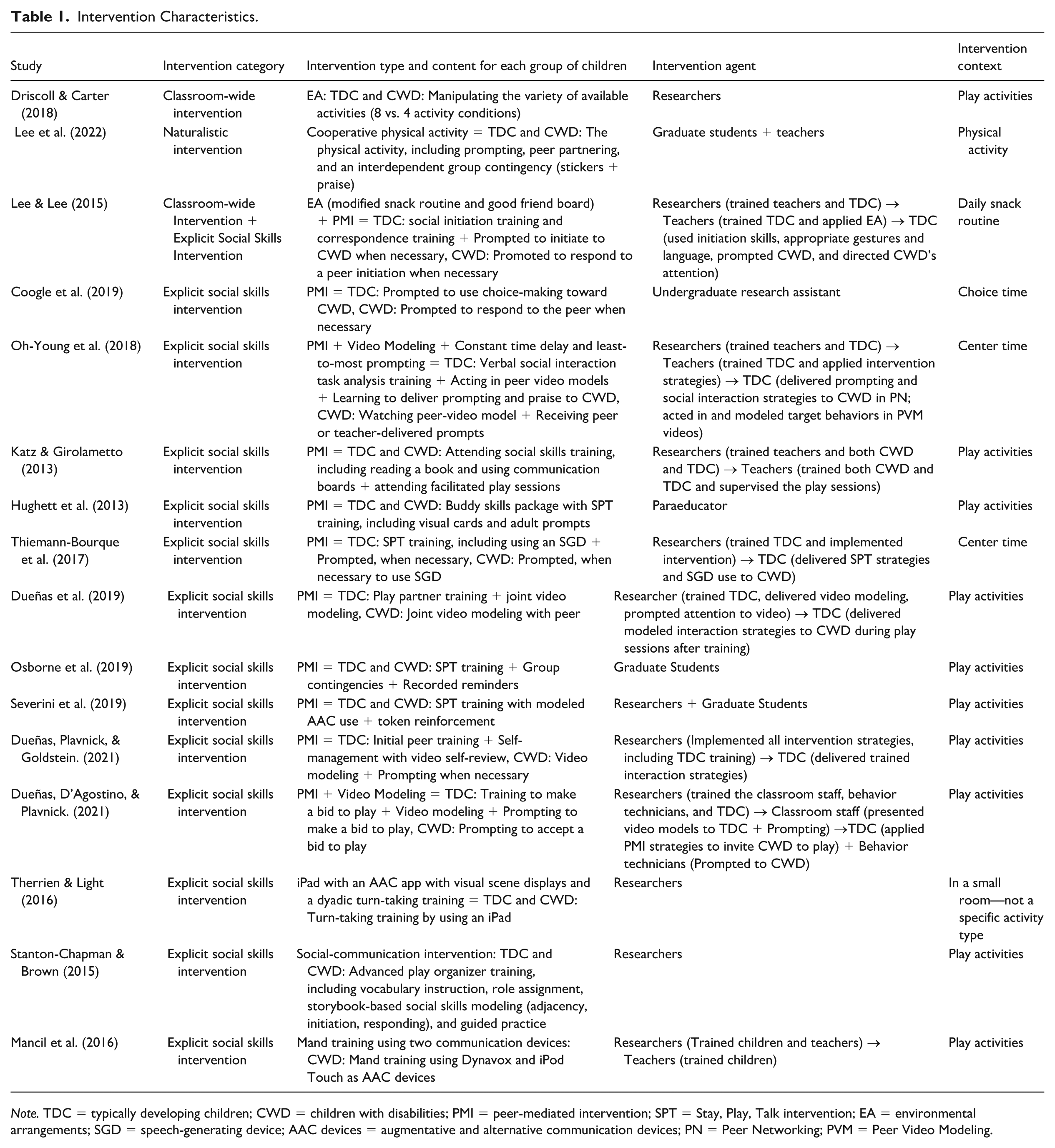
Note. TDC = typically developing children; CWD = children with disabilities; PMI = peer-mediated intervention; SPT = Stay, Play, Talk intervention; EA = environmental arrangements; SGD = speech-generating device; AAC devices = augmentative and alternative communication devices; PN = Peer Networking; PVM = Peer Video Modeling.
Intervention Category
Among the included studies, the majority (n = 13; 81.25%) employed explicit social skills interventions (e.g., Katz & Girolametto, 2013; Hughett et al., 2013), which involve directly teaching specific social behaviors to children. Only one study (Driscoll & Carter, 2018) implemented a classroom-wide intervention, the least intensive category, characterized by structured classroom environments with well-designed materials and learning centers. Another study (Lee et al., 2022) applied a naturalistic intervention categorized as a friendship activity. The researchers implemented a cooperative physical activity and embedded prompts for children to engage in prosocial behaviors (i.e., selecting a partner, practicing the activity with the partner, and completing group tasks together). One additional study (Lee & Lee, 2015) combined two intervention categories, classroom-wide and explicit social skills interventions.
Intervention Type and Content
Out of the 14 studies that used explicit social skills intervention, 11 studies used PMI. Out of the 11 studies that used PMI, 6 studies provided instruction to TDC separately from CWD to teach them to support their peers with disabilities in structured and intentional ways. In these interventions, TDC were typically taught to initiate interactions, provide prompts, use specific communication strategies, and reinforce positive social behaviors. For example, TDC received instruction in delivering verbal prompts and praise (Oh-Young et al., 2018), SPT behaviors using speech-generating devices (Thiemann-Bourque et al., 2017), and play partner behaviors (Dueñas et al., 2019). In these studies, CWD were generally prompted during the interaction to respond to the initiations (e.g., Lee & Lee, 2015) or accept a bid to play (e.g., Dueñas, D’Agostino, & Plavnick, 2021) from TDC. In four of the 11 PMI interventions, both TDC and CWD participated together in the same social skills training sessions, including joint participation in structured activities such as book reading, use of communication boards, visual supports, SPT training, and AAC-based training (e.g., Katz & Girolametto, 2013; Osborne et al., 2019). Uniquely, Coogle et al. (2019) provided prompting to TDC and CWD during peer interactions but did not deliver any prior instruction or structured training sessions. This approach differs from other PMIs, as the authors examined whether real-time adult support alone could facilitate peer interaction without prior skill instruction, relying only on in-situ prompts.
Three studies implemented explicit social skills interventions without a PMI framework (Mancil et al., 2016; Stanton-Chapman & Brown, 2015; Therrien & Light, 2016). These interventions involved adult-facilitated or technology-assisted instruction. For example, Therrien and Light (2016) used iPads with AAC apps featuring visual scene displays to support dyadic turn-taking training, with both CWD and TDC participating in shared practice. Mancil et al. (2016) focused exclusively on CWD by teaching mand behaviors using Dynavox and iPod Touch AAC devices, with no involvement of TDC in the training process.
The studies that did not use an explicit skills intervention focused on adjusting classroom physical arrangements and activity structures. Driscoll and Carter (2018), the only study to use a classroom-wide intervention, used an environmental arrangement intervention in which both CWD and TDC participated in settings with varying numbers of available activity choices (i.e., 8 vs. 4 activities). Lee et al. (2022) implemented a naturalistic cooperative physical activity intervention, incorporating peer partnering, adult prompting, and an interdependent group-contingency system. In both studies, the same strategies were applied to TDC and CWD, and the interventions emphasized naturally occurring social opportunities.
Intervention Agent
Across the 16 included studies, intervention agents varied in role and involvement, with most interventions involving multiple layers of implementation and more than one intervention agent. In five studies, researchers trained teachers who then served as the intervention agent by applying environmental arrangement strategies, prompting interactions, or conducting peer training (e.g., Mancil et al., 2016; Oh-Young et al., 2018). Three of the five studies provided information about teachers’ training, which ranged from a 2-year college diploma to bachelor’s and master’s degrees. In two studies, other school personnel, paraeducators (Hughett et al., 2013) or classroom staff (Dueñas, D’Agostino, & Plavnick, 2021), were trained by researchers and implemented aspects of the intervention.
In six studies, TDC were taught by teachers or researchers to act as intervention agents who use specific strategies with CWD. For example, in one study, researchers and teachers taught TDC to use specific gestures and language as prompts for CWD and to direct CWD’s attention (Lee & Lee, 2015). In another study, TDC were taught to deliver prompting and social interaction strategies to CWD and model target behaviors in videos (Oh-Young et al., 2018).
Intervention Context
Across the 16 included studies, the most common context in which peer interaction interventions were implemented was play activities (n = 11). These included both structured and unstructured play sessions. Other intervention contexts included center time (n = 2), choice time (n = 1), daily snack routine (n = 1), and physical activity (Lee et al., 2022). One study conducted the sessions in a small room, but the specific activity type was not clearly described (Therrien & Light, 2016).
Intervention Outcome
Table 2 in the Supplementary Materials provides an overview of dependent variables. Of the 16 included studies, 10 reported data for both TDC and CWD (e.g., Coogle et al., 2019), 5 reported data only for CWD (e.g., Driscoll & Carter, 2018), and one reported data only for TDC (Mancil et al., 2016).
Among the 10 studies that reported data for both TDC and CWD, three of them measured the same dependent variables for both TDC and CWD, such as reciprocal social interactions (Lee & Lee, 2015) or turns in extended interactions (Katz & Girolametto, 2013). In the other seven studies, researchers used different measures to assess each group’s participation in peer interactions. For TDC, dependent variables commonly captured their use of the practices they were taught to prompt interaction with CWD, similar to fidelity checks. For example, researchers assessed how many times TDC provided choices to CWD (Coogle et al., 2019), the percentage of stay, play, and talk behaviors (Severini et al., 2019), and the number of invitations extended to CWD (Dueñas, D’Agostino, & Plavnick, 2021). Dependent variables reported for CWD tended to focus on their responsiveness to peer prompts and participation in reciprocal interaction, such as weighted communication, gestures, and vocalizations (Coogle et al., 2019), acceptance of play invitations (Dueñas, D’Agostino, & Plavnick, 2021), and the duration and frequency of cooperative play (Hughett et al., 2013).
Among the five studies that reported data regarding dependent variables exclusively for CWD, researchers assessed their use of specific skills. Two studies assessed the frequency and/or percentage of verbal and nonverbal social interactions (e.g., Lee et al., 2022), while another measured both scripted and unscripted verbalizations alongside play actions (Dueñas et al., 2019). Three studies examined various aspects of play behaviors, including parallel play (Stanton-Chapman & Brown, 2015) and social-cognitive play (Driscoll & Carter, 2018). In sum, dependent variables for CWD primarily focused on language and play skills as indicators of their peer interactions.
Discussion
We reviewed 16 intervention studies conducted to improve peer interaction between children with and without disabilities. We extend the findings of prior reviews by descriptively examining all types of peer interaction interventions, not limiting studies based on disability labels, and focusing on preschool-age children within general education settings. Below, we discuss the findings and their potential implications for future research.
Representation of Child Participants
The majority of CWD in the reviewed studies had an ASD disability label. This finding aligns with other literature reviews on peer interaction interventions that included older children (e.g., Garrote et al., 2017). Although children with ASD may experience challenges with social skills and social isolation, children with other disability labels, such as intellectual disabilities, physical disabilities, visual impairments, and hearing impairments, may also face exclusion or limited peer interactions (e.g., Chen et al., 2019). Therefore, future research on peer interaction interventions should be intentional about including children with other disability labels, abilities, and support needs.
Most studies did not provide information about children’s race or language. For the studies that did provide information about children’s race, most children were White. This is consistent with other peer interaction intervention reviews on PMI (Huber & Carter, 2016). In addition, the few studies that reported children’s home language generally reported it to be English. Considering the increasing number of bilingual learners (National Center for Education Statistics, 2022) and the possible effect of cultural and linguistic differences on peer interaction (e.g., Lalvani & Bacon, 2019), researchers should more comprehensively report children’s demographics, including race and language. In addition, since no study reported the intervention language, the match between children’s home language and intervention language was not analyzed. While we can assume interventions were provided in English, this reporting gap limits our understanding of how language may shape children’s experiences and outcomes in peer interaction interventions. More diverse linguistic representation and reporting both home and intervention language can help the field understand for whom peer interaction interventions are effective and the adjustments that may need to be made to serve a diverse group of children.
Prevalence of PMI
Our review found that explicit social skills interventions, particularly PMI, were the most common type of peer interaction intervention. PMI is considered an evidence-based practice to support peer interactions (Brock & Huber, 2017). Because PMI has most widely been studied with elementary and secondary students, researchers have called for more research on its use with preschool-age children (Zagona & Mastergeorge, 2018), and this review describes the ways PMI has been implemented with preschool children in the studies we identified.
It is important to note that PMI in the studies included in the present review were conducted to increase a narrow set of dependent variables, particularly the use of certain types of peer prompts for TDC and language and play skill development for CWD. While such skill development can support peer interactions, as prior research has pointed out, the skills of CWD are not the only factor that impacts peer interactions (e.g., Diamond & Tu, 2009; Hong et al., 2020). Therefore, to more robustly support peer interactions, researchers should consider and assess what PMI may need to be supplemented with to support outcomes that influence peer interactions beyond those identified in the current review. They may particularly take into account the understanding and attitudes of TDC toward CWD (Diamond et al., 2008; Hong et al., 2013; Yu et al., 2015) and broader environmental supports, including classroom climate and routine, and teacher facilitation strategies (Acar et al., 2017; Hong et al., 2020).
Intrusiveness of Interventions
Most of the included studies were explicit social skills interventions that required direct teaching of social skills and behaviors, the most intensive type of peer interaction intervention. Although they might be effective at improving the measured dependent variables, because these interventions involve directly teaching social behavior to TDC or CWD (Milam et al., 2021), they can be demanding and time-intensive and interrupt typical classroom activities and routines (Brown et al., 2008). The PMI, specifically, requires considerable adult prompting and intensive specialized training for interventionists (Tsao & Sung, 2014). Perhaps because of this, the studies in the present review relied heavily on researchers to administer interventions.
Based on the studies included in this review, it is difficult to determine whether less-intensive or classroom-wide supports were already in place before individualized interventions (i.e., explicit social skills interventions) were introduced, as this information was not reported. Future research should therefore clearly describe the practices occurring prior to intervention implementation, including during baseline, to help readers understand whether individualized interventions were built upon existing classroom-wide supports. Also, while we recognize the importance of being responsive to children’s individual support needs and implementing explicit social skills interventions when necessary, more research is needed about less-intensive interventions (i.e., naturalistic and classroom-wide interventions). In the current review, few studies examined naturalistic or class-wide interventions to support peer interaction. Although such approaches are often preferred by teachers (Hugh et al., 2022) and have been shown to be effective for child outcomes when implemented by teachers in inclusive classrooms (Hemmeter et al., 2021), only a small subset of the studies in this review evaluated their impact.
The Role of Teachers, TDC, and CWD in Peer Interaction Interventions
Teachers are key facilitators of peer interactions in inclusive classrooms (e.g., Acar et al., 2017). However, few studies have involved teachers implementing peer interaction interventions or providing such support. This is consistent with findings from previous literature reviews on peer interaction interventions (e.g., Therrien et al., 2016). With little information about how teachers and other classroom staff can be supported to promote peer interactions, more research is needed that focuses on improving teachers’ awareness, the effective implementation of peer interaction interventions, and their training experiences. Previous literature suggests that classroom staff can be trained to implement interventions effectively. For instance, Camargo and colleagues (2016) compared the effect sizes of studies in which researchers implemented behaviorally based social interaction interventions versus those in which teachers implemented the intervention. The authors found no differences between the two groups. Future research should incorporate more naturalistic intervention agents, particularly teachers and paraprofessionals, and investigate how to best support teachers’ skills in this area.
Meanwhile, some studies in this literature review, especially studies of PMI, positioned TDC as intervention agents expected to deliver intervention strategies to their peers with disabilities. This set-up can inadvertently perpetuate a kind of “helper-recipient of the help” relationship that can reify inequality in children’s friendships (Therrien et al., 2016). This may be particularly troubling given the previously described deficit perceptions TDC may hold toward their peers with disabilities (e.g., Yu et al., 2015). Scholars have long called for researchers and practitioners to attend to TDC’s understanding of disability, equity, and fairness to further improve peer interactions and friendships between children with and without disabilities (e.g., Diamond & Tu, 2009; Diamond & Hong, 2010). Yet, in the current literature set, such dispositions and skills were not addressed in the intervention procedures or dependent variables measured. Little, if any, attention was paid to the perspectives of the TDC toward disability or their peers with disabilities. Moreover, TDC were often taught separately from CWD and taught to interact with them in largely scripted ways to solicit specific behaviors from the CWD. Future research could expand the dependent variables supported and measured in peer interaction interventions to include perceptions and additional skills for TDC.
The differential positioning of children with and without disabilities was also evident in the participant descriptions of the groups included in the interventions. The CWD were largely included and described based on perceived deficits in peer interaction, social skills, language, and communication. We did not identify any studies that included CWD based on their interests or strengths in peer interactions, though researchers in six studies expected CWD to show certain skills related to attention, motor movements, and language to participate in the study. In contrast, TDC were generally included in the study if they showed social, language, or interaction strengths, and, with the exception of one study, they were described based on their strengths and interests in interacting with their peers. Thus, TDC were fairly explicitly positioned as the “more capable peer” in terms of Vygotsky’s ZPD, and while their interests regarding peer interactions were routinely referred to, those of CWD were not. While it can be assumed that CWD were selected for these studies because they had few peer interactions and/or support needs in related skills, that does not preclude the development and assessment of interventions grounded in their existing abilities and interests related to peer interactions. Indeed, these findings point to the need for more research that bases peer interaction intervention on the strengths, social interaction preferences, and agency of CWD; this can support more strengths-based and inclusive practice. To that end, our findings raise an important question that researchers should ask as they consider the next steps for this literature base: Is the purpose of peer interaction interventions only to improve skills for CWD or to create an inclusive classroom that promotes the full membership of all children? If we shift focus to the latter, we must reconsider the ways CWD are understood, described, and supported in both research and practice.
Finally, the perceived role of CWD in peer interactions is further evident in the fact that dependent variables were more often measured for CWD than for TDC. In almost all reviewed studies, the skills or behaviors of CWD were assessed, whereas five studies did not collect data on TDC. It is not inherently problematic for the outcomes of a population to be measured that did not directly receive intervention (e.g., Hemmeter et al., 2021). However, it is important to recognize that CWD were always expected to show changes in behavior and skills, while TDC were not consistently assessed to ensure they displayed the skills taught to support peer interactions. Thus, CWD were more often held responsible for the status of their peer interactions and whether peer interactions increased in frequency, length, or certain features.
A sociocultural analysis of these findings calls us to question who is being valued as capable in these scenarios (primarily TDC) based on whose cultural tools are being employed and upheld (nondisabled ways of being and communicating). Accordingly, to further support peer interactions, researchers should consider what explicit skill instruction could be supplemented with to build on the skills and desires of CWD, promote equal-status relationships (Therrien & Light, 2016), and break the pattern of social exclusion that research continues to document for CWD (e.g., Chen et al., 2020). In combination with other literature that has revealed the dispositions and skills TDC need to support peer interactions with CWD (e.g., theory of mind, understanding of disability and equity; Diamond & Hong, 2010; Lalvani & Bacon, 2019), the current analysis indicates the need for researchers to (re)consider (a) who is in need of skill development to support peer interactions; (b) what skills need to be supported (beyond the social and communication skills of CWD, and even beyond the communication initiation skills of TDC); and (c) what outcomes are targeted and measured for interventions intended to support peer interactions. By expanding how peer interaction interventions are conceptualized and implemented, researchers can support all children’s abilities while ensuring more equitable interactions between children with and without disabilities.
Limitations of the Current Systematic Scoping Review
This literature review has several limitations. The major limitation of this review is that all screening decisions at both the title/abstract and full-text levels were conducted by a single reviewer. We acknowledge that the absence of a secondary screener might limit the ability to assess the reliability of the screening process and may increase the risk of selection bias. Also, we only included studies where the primary purpose was to improve peer interaction. It is possible that other studies also examined peer interaction outcomes, but because those outcomes were secondary, they did not meet the inclusionary criteria of the current review. We also acknowledge the potential risk of biases across studies, including publication bias and selective reporting within studies (Moher et al., 2009). In relation to participant characteristics, we excluded the studies that focused on children considered “at-risk” for disabilities but without formal diagnoses. This criterion may have excluded interventions that support the peer interactions of children with emerging developmental concerns. As a result, this review may underestimate the existing body of work addressing peer interaction supports for children who have not yet received a formal diagnosis. In addition, this review did not include gray literature, such as dissertations, conference papers, or unpublished reports, which may have resulted in missing relevant studies (Paez, 2017). Finally, although we conducted a quality appraisal to contextualize the included studies, we did not code rigor in a way that would allow us to relate study quality to intervention effectiveness, given our research questions.
Conclusion
A central goal of inclusive education is to support a sense of belonging for CWD and to combat ableism, or the devaluation of disability (Beneke et al., 2019). Peer interaction is a key component of that goal, and researchers should continue to examine how to support it in effective, less-intrusive ways. At the same time, we must attend to the potential unintended consequences of peer interaction intervention. That is, we must ensure we combat deficit-based views of CWD and position them as equals to their peers without disabilities. Researchers must holistically consider what influences peer interactions and develop multifaceted approaches to support them that are responsive to all children’s preferences and support needs.
Supplemental Material
sj-docx-1-jei-10.1177_10538151261448160 – Supplemental material for Interventions to Improve Peer Interaction in Inclusive Preschool Classrooms: A Systematic Scoping Review
Supplemental material, sj-docx-1-jei-10.1177_10538151261448160 for Interventions to Improve Peer Interaction in Inclusive Preschool Classrooms: A Systematic Scoping Review by Emine Kilincci, Hailey R. Love and Zhe Gigi An in Journal of Early Intervention
Footnotes

Funding
The authors disclosed receipt of the following financial support for the research, authorship, and/or publication of this article: This study was conducted as part of Emine Kilincci’s Ph.D. education, which is funded by the Republic of Türkiye.
Declaration of Conflicting Interests
The authors declared no potential conflicts of interest with respect to the research, authorship, and/or publication of this article.
Supplemental Material
Supplemental material for this article is available online.
Notes
References
Supplementary Material
Please find the following supplemental material available below.
For Open Access articles published under a Creative Commons License, all supplemental material carries the same license as the article it is associated with.
For non-Open Access articles published, all supplemental material carries a non-exclusive license, and permission requests for re-use of supplemental material or any part of supplemental material shall be sent directly to the copyright owner as specified in the copyright notice associated with the article.
