






Abstract
The Individuals with Disabilities Education Act (IDEA) governs the Early Intervention (EI) system for families of children aged birth to three with or at risk for developmental delays and disabilities. In EI, families have a key point of contact who manages their evaluations and services, the service coordinator (SC). In Illinois, counties are grouped into 25 Child and Family Connection (CFC) regional offices to serve EI families. SCs in each CFC are overseen by an SC supervisor. There is limited research on the supervision of SCs. The purpose of this qualitative study was to offer an in-depth look at the barriers SC supervisors face and the supervisory characteristics that affect their work. During semistructured interviews, seven participants discussed the traits, motivation, and communication skills influencing their effectiveness, the systemic barriers they face, and the emotional strain these challenges place on SC supervisors. Implications for research and practice are discussed.
Keywords
Introduction
Each state operates an Early Intervention (EI) system as outlined in Part C of the Individuals with Disabilities Education Act (IDEA, 2004). EI services include developmental, occupational, and physical therapies, as well as hearing, vision, and speech-language services, provided to eligible children with or at risk for disabilities or developmental delays. The key contact for each family within the system is the EI service coordinator (SC), who oversees the coordination of all services. Once a child’s needs are identified, they may begin receiving EI services from a range of providers. The SC facilitates this process by coordinating with relevant professionals (e.g., speech-language pathologists, physical therapists). The SC and providers collaborate with the family to create an Individualized Family Service Plan (IFSP) that addresses outcomes targeted for the child and family. Although this process is meant to comply with IDEA Part C, families may encounter waitlists for high-demand services like speech-language therapy (Bruder, 2005; Dunst & Bruder, 2006).
Service Delivery in Illinois
In Illinois, once a family is identified for EI, an SC from their local Child and Family Connections (CFC) office initiates contact to schedule an initial evaluation (Betz, 2023). This evaluation determines eligibility under IDEA Part C and identifies the types of services the child may need (IDEA, 2004). The assessment focuses on five developmental areas: cognitive, physical (including hearing and vision), communication, social-emotional, and adaptive development (Illinois Early Intervention Clearinghouse, 2023; Nolan et al., 2005). Federal guidance states that to be eligible for EI, a child must be between birth and 3 years old, experiencing delays in one or more areas of development, or have a diagnosed condition that has a high probability of resulting in developmental delay (IDEA, 2004). Notably, states have autonomy within this federal guidance and eligibility qualifications vary by state. For example, to qualify for EI in Illinois, a child must be under age 3 and demonstrate a 30% or greater delay in at least one area, have a condition known to cause developmental issues, or be at high risk for a significant delay (Fowler & Illinois Early Intervention Clearinghouse, 2016).
Illinois has 25 regional CFC offices (Gilkerson & Kopel, 2005; University of Illinois, 2021), each covering a defined geographic area. A typical CFC includes a manager, several SCs, a local interagency coordinator, and one or more parent liaisons (Gilkerson & Kopel, 2005). Staffing levels vary by region. The CFC manager oversees staff and reports performance metrics such as service delays and transition timelines to the Illinois Bureau of Early Intervention (IDHS, 2016). The responsibility for training and supervising SCs is delegated to the manager, assistant manager, or a lead SC. For this study, anyone who holds such supervisory responsibilities is referred to as an SC supervisor.
Service coordination is the only EI service mandated by IDEA; however, states have autonomy in how they set up their EI system, including how SCs function within their system. SCs are an essential component of EI, yet little is known about how supervisors train and monitor SCs in this varying landscape. This is concerning as SCs have numerous responsibilities: educating families, arranging evaluations, coordinating resources, drafting IFSPs, maintaining communication with all relevant parties, monitoring outcomes, and planning transitions (Fulton et al., 2024; Nolan et al., 2005; Romer & Umbreit, 1998). An SC’s effectiveness can significantly affect a child’s outcomes in EI. Poor organizational skills, inconsistent communication, or a lack of accountability can result in missed services or delayed support (Fulton et al., 2024; Minotra, 2012; Sherf et al., 2018). Supervisors must ensure that SCs meet deadlines, engage families, and use recommended practices.
Drawing on Bronfenbrenner’s (1992) Ecological Systems Theory, this work is grounded in the idea that to understand a child’s progress through the EI system, we must first understand the larger systems surrounding that child such as their family, EI professionals (i.e., SCs, SC supervisors), the legal systems (i.e., IDEA Part C), and time (i.e., EI is only from birth to 3 years). For this study, we specifically focus on the systems surrounding EI professionals. Through an examination of SC supervision, we can identify supervision characteristics that are successful, and barriers to mitigate, to improve the information and support that can be provided to SCs, their supervisors, and children and their families.
Given the lack of research examining SC supervisors and the numerous systemic issues that impact EI (i.e., funding, system-level inefficiencies, inflexible timelines; Childress et al., 2019; Johnson et al., 2012), there is a critical need to understand the instrumental skills SC supervisors use to support SCs and the barriers they encounter in their supervisory role. To address this gap, we chose to employ a phenomenological approach (Creswell & Poth, 2018) in which we used constant comparative analysis (Glaser, 1965, 2008) and an emergent coding process (Patton, 2002). The purpose of this study was to identify characteristics of an effective supervisor, barriers they encounter when supporting EI SCs, and how the identified barriers impact their supervision. The following research questions (RQs) guided this study:
Method
The University of Illinois Urbana-Champaign Institutional Review Board (IRB) approved this study on February 7, 2024. We used semistructured interviews to explore possible impacts on SC supervisors, as these allowed for flexibility and were conducted to better understand SC supervision. All interviews were audio and video recorded using Zoom. The lead author, who served as the interviewer, had her camera on during all seven interviews.
Positionality and Research Team
Our research team was comprised of four former early childhood special education practitioners. Our familiarity with the experiences of children in EI was a strength in conducting this study because we had background knowledge about EI to help contextualize the findings. However, each team member also brought their own lived experiences and perceptions to the study. For example, all of the researchers work closely with the EI system, and the first author is the parent of a child who received EI services and personally encountered barriers throughout their experience. At the beginning of each interview, the interviewer told participants that they had a background in EI to help build trust and acceptance; this type of rapport building is known to help gather richer data (Adler & Adler, 1987; Talbot, 1999). While our team’s background provided valuable context, we engaged in reflective discussions during analysis, continually examining how our positionalities might shape our interpretations of the findings.
Recruitment
Potential participants were recruited through email. First, the lead author retrieved the email addresses of potential participants (i.e., CFC managers, assistant managers, and lead SCs) from the websites of the 25 CFCs located across the state (N = 33). Then, she emailed a recruitment flyer to them; it contained study, eligibility, and compensation information. It also contained a link to sign up for an interview time via Zoom, a consent form to review, and a demographic questionnaire to complete. Supervisors were sent three recruitment emails, one every 2 weeks. The final email let them know that this was their last opportunity to register to participate. The reminder recruitment emails were only sent to CFCs that had not yet participated, as we hoped to recruit one participant from each CFC to obtain diverse perspectives from across the state. For this study, we relied heavily on two dimensions of information power (Malterud et al., 2015): the quality of the dialogue and the analysis strategy. The quality of the dialogue was judged by the quality of the transcript and the member check process (i.e., overall length, depth of discussion, and variety of topics covered). In addition, to ensure the strength of our analysis and for geographic representation, only one supervisor from each CFC was eligible to participate in the study; participants were selected on a first-come basis. The response rate for the study was 21%, and of those respondents, 28% of the local CFCs were represented. Of the 33 recruitment emails sent to eligible participants, n = 24 did not reply, one participant canceled their interview and did not reschedule, and one potential participant was from a CFC where we had already recruited an SC supervisor and therefore was not able to participate in the study.
Participants
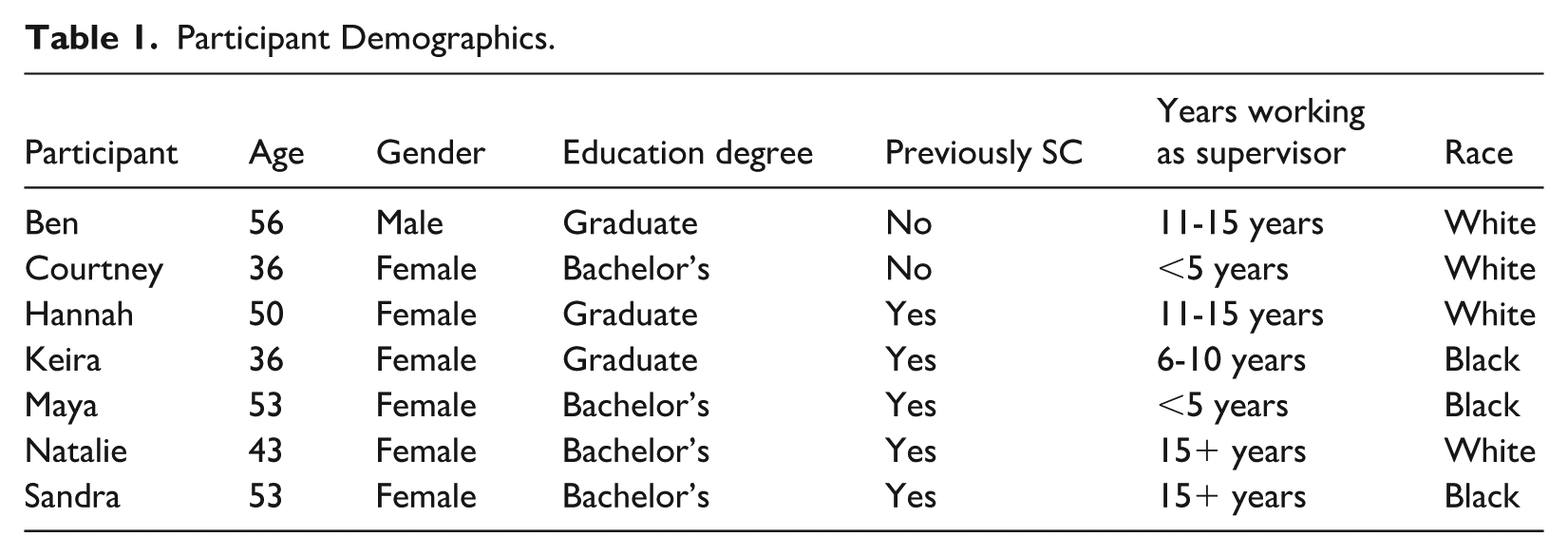
Seven supervisors in Illinois’ EI system consented to participate in this study. Most participants were the program manager for their CFC (n = 5, 71%). On average, they had 7.3 years of experience in their role as SC supervisors (range = 2–20 years). The participants also represented different geographic regions: northern Illinois (n = 3, 43%), central Illinois (n = 3, 43%), and southern Illinois (n = 1, 14%). See Table 1 for additional participant demographics.
Participant Demographics.
Interview Protocol
The interview protocol was developed based on extant literature about EI (Cheung et al., 2022) and SCs (Fulton et al., 2024; Nolan et al., 2005). From the protocol, 12 questions address RQ1, such as “What are the positive aspects of being a CFC supervisor?” and “How do you support EI service coordinators?” Ten questions address RQ2 such as “What barriers do you face when supporting service coordinators in a CFC?” and “Looking back, is there anything that you wish you had been trained on or felt you were unprepared for before beginning in this role?” Some interview questions addressed both RQs. Prior to the study, the protocol was reviewed by two experts in early childhood special education and one EI developmental therapist. In addition, the interview protocol was piloted with a former SC supervisor in the target state. Based on this feedback, minor changes were made for clarity and functionality. See Supplemental Appendix A for the full interview protocol.
Procedures
Prior to the interview date, each participant reviewed the consent form, signed up for an interview time, and answered 10 demographic questions focused on topics such as their age, race, and educational background. All interviews were scheduled at a time and date preferred by participants. Before an interview began, the interviewer ensured she had each participant’s consent to record the interview, participants were given the option to have their camera on or off (all participants chose to keep their camera on for the entirety of their interview), and confirmed the participant’s eligibility to participate in the study by verifying their CFC location and current employment status. The interviewer then explained the purpose of the study, the approximate length of time that the interview would take, and assured each participant that they could skip any questions they did not feel comfortable answering. In addition, the interviewer described the member check process and compensation.
After each interview, the first author used memoing to record her thoughts and feelings about the interview. The interviews averaged 77 min (range = 45-125 min). At the end of each interview, as a first-level member check (Brantlinger et al., 2005), the researcher emailed a one-page summary of the interview responses to each participant. At that point, the participant had the option to revise any of their answers or add additional information. Each participant received a $15 gift card following their interview. They were eligible to receive an additional $10 gift card following both steps of the member check process (i.e., replying to both the interview summary and findings emails). Following the first member check, four participants responded (57%). Two participants had no additional comments, while two respondents added information to their summary. For instance, one participant clarified that Cornerstone—the data system used in EI—posed a barrier to supervision, stating, “Cornerstone is a barrier due to it freezing and glitching and often working improperly or slowly.”
Following data analysis, participants were emailed an additional member check, which included a summary of the findings across all seven interviews. Participants were asked to return the summary member check within a week with any corrections or concerns. They were sent one reminder prompt. Following the second member check, five participants responded (71%). Four participants had no additional comments, while one added information. This participant shared her appreciation for having the opportunity to participate and stated, “I am actually stepping down from my management position in 30 days due to all that was mentioned in this report [member check document]. I am going back to work as a developmental therapist.” Four participants received an additional $10 gift card for responding to both member checks.
Data Preparation
The interviews were transcribed verbatim using the Zoom transcription feature. The first author listened to each recording to correct any inaccuracies in the transcriptions. To be mindful of potential bias and strengthen the credibility of the findings, two researchers coded and analyzed the data. The data were separated by interview and, within each interview, by interview question. Using a chunking approach, the first author chunked the data within each interview into manageable chunks. The two researchers coded all text related to the RQs to develop big-picture codes in sections of the text (Vears & Gillam, 2022).
Analysis
We followed the four steps of the constant comparative analysis approach (Glaser, 1965, 2008), using an emergent coding process (Patton, 2002) to analyze the interview transcripts. First, the initial four interviews were read multiple times to familiarize ourselves with the data (Tesch, 1990). Using MAXQDA, we independently coded the interviews one at a time and met after coding each interview. The coding process consisted of the first and fourth authors each highlighting key words and phrases within each interview to generate codes. We used an iterative process of refining, comparing, merging, and adding codes throughout the analysis.
After analyzing the first four interviews, we created a codebook and then used the codebook to independently code the remaining three interviews, with one researcher coding two interviews and the other researcher coding the final one. Throughout the coding process, constant comparative analysis was used in which each piece of coded data was highlighted and annotated with a phrase that summarized the key points and compared with the other existing codes to be merged with existing data or used to create new codes (i.e., incident comparison). We then listed the codes in the codebook and arranged them into groups to categorize codes and identify patterns (Creswell, 2003; Glaser, 1965). We met weekly to discuss emerging themes, compare codes, resolve differences, discuss bias, and reach consensus. When there was a disagreement, we each shared our rationale for the codes we used and discussed, until consensus was reached.
The codes were grouped into categories within MAXQDA. The categories and codes were placed into an Excel spreadsheet, and then the categories were integrated and organized into themes delimited by the RQs (i.e., constant comparative method writing phase; see Table 2 for a summary of themes, categories, and quotes organized by RQ). For example, when sharing the positive aspects of their job, we openly coded participants’ responses. Some example responses were: “The work that we do in general, I think it’s so rewarding as a supervisor,” “I think it’s an honor to get to go through that journey with a family,” “This is a job you do because you care about families and children,” and “Definitely a positive knowing that I have [made an] impact.” We assigned the codes: “rewarding,” “helping families,” and “mentoring others” to these responses. We then grouped the codes to create the category “fulfilling.” This category was integrated with other similar categories such as “salary increase” and “relationships” to create the theme “motivational factors to be a supervisor.”
Categories, Themes, and Example Quotes.
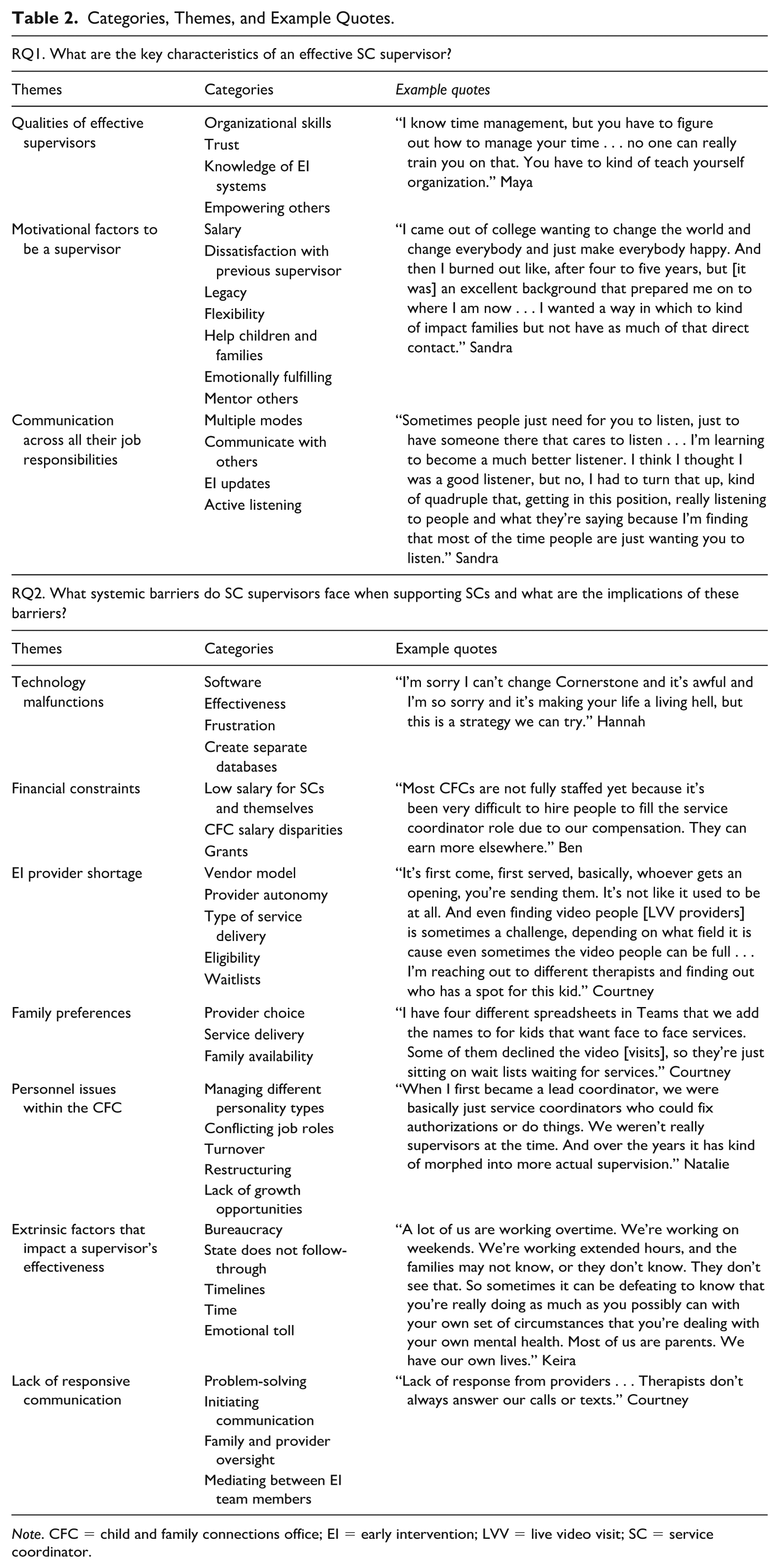
Note. CFC = child and family connections office; EI = early intervention; LVV = live video visit; SC = service coordinator.
Findings
The purpose of this research study was to offer an in-depth look at the key characteristics, and barriers that SC supervisors face, that impact their ability to support SCs. Consistent with Bronfenbrenner’s Ecological Systems Theory, the findings reflect influences across multiple system levels, with some themes representing interpersonal supervisory processes and others highlighting broader systemic and structural conditions shaping supervision. The findings are presented by RQ, with the first section focusing on the characteristics of an effective supervisor, followed by findings related to the barriers faced by SC supervisors.
RQ1. Characteristics of an Effective Supervisor
Three main themes were generated about the components of supervision: (1) qualities of effective supervisors, (2) motivational factors to be a supervisor, and (3) communication across all their job responsibilities.
Qualities of Effective Supervisors
Participants shared that certain personality traits can help or hinder the supervision process. They felt that to be an effective supervisor, an individual must have strong organizational skills including time management and an ability to prioritize tasks. They also must have a good understanding of the EI system to support their supervisees and a family’s advocacy skills. Hannah discussed the importance of supervisors knowing about the EI system when she shared, “You have to have good understanding of our system first and . . . things are in place for a reason, because those are what guide us to ensure that we are providing appropriate services to our children.” Supervisors also must build trust with their SCs. Courtney explained how she must trust her SCs and how that trust is earned:
They [SCs] like the hybrid method . . . work from home, work at the office, a little bit of both. I have some that actually are completely home-based right now. They’re my higher performers and the ones that I can trust to do their job . . . It’s earned based on how their performance is.
Participants had different definitions of supervision and how hands-on they need or want to be, with some sharing that service coordination is independent work. For example, Maya shared that she does not micromanage her supervisees because of her own workload:
When you’re given this job as a service coordinator, it’s your responsibility. That is our word for the last few years—it’s accountability. I am not micromanaging anyone. My expectation is that when I meet with them monthly, I’m saying, “hey, this is what you need to do.” And the expectation is for them to do it. Not for me to micromanage you.
Overall, participants emphasized that effective supervision depends on a blend of trust, strong communication skills, knowledge of the EI system, and the ability to empower others to take ownership of their responsibilities.
Motivational Factors to Be an SC Supervisor
Participants reported factors that are both intrinsically and extrinsically motivating are also facilitators to effective supervision. Extrinsic factors included salary increases, dissatisfaction with their own supervisor, and streamlining SC processes that were problems for them when they were SCs. Two participants had a personal connection to EI that motivated them to be a supervisor. For example, Sandra shared how she is motivated to improve CFC processes for future supervisors:
I think one of the other things is really setting foundations in place that will help facilitate and make this program more operational . . . for someone to come in here and be able to pick up what I have kind of began to build and start off. It shouldn’t be as difficult as what I had. I don’t want anyone to have that experience. What I had was not a good experience. I felt so overwhelmed and so stressed.
Supervisors also reported enjoying the flexibility afforded in their job. Natalie stated:
I love the fact that this is not a desk job, 9:00 to 5:00, and just sitting in front of a computer all day. You get to interact with people . . . doing that [hybrid work] really I think helps us even meet families more readily where they’re at and when they need it.
Overall, these findings suggest that motivational factors like workplace conditions play an important role in supporting effective supervision.
Compared to extrinsic factors, intrinsic factors were more prevalent in comments made by participants. All participants shared that they wanted to help children and their families. Ben reflected on how he enjoyed seeing children in EI develop. “It’s easy to get very passionate about this job and when you do see the successes, those successes are huge.” Likewise, Hannah described the rewarding parts of her job in the following quote:
No matter what age of a human being I’m working with, whether it’s the infant and toddler or preschool or an adult, it is kind of fun to get to be that teacher, that mentor, that facilitator of knowledge and see them grow and learn.
Participants also shared that having relationships with families was encouraging, they had enthusiasm for their job, and that it was fulfilling to work as a supervisor. Maya stated:
Everybody’s not excited about this work, but [I’m] excited about it . . . We’re not in the trenches, but we’re standing on the outside directing things. So, I think that’s the positive part, just to help other service coordinators and I feel like I’ve helped other people find their way, away from this. If it wasn’t for them just to help them figure out where they should go and where they should land. Is service coordination right for them or is it not? Because I think I’ve helped other people figure that “this isn’t for me.” But I understand that, and I respect that.
Participants from northern regions reported that working in EI and as a supervisor was part of their calling. Maya shared, “I really enjoy being able to help people. If you ask my husband, he would tell you that’s my ministry. Children are your ministry, so it just allows me to do my ministry.” Participants also said they were motivated to be supervisors because they like to mentor others and want to leave behind a legacy. Keira reported how empowering parents has been very rewarding for her:
Watching parents learn how to advocate for their child or children, that has been the most rewarding part . . . them [parents] coming into the program maybe not even knowing what early intervention is and having the girl come straight from the hospital and by the time a year passes or even when the child is turning 3 and transitioning into the school district, they’re almost like mini advocates. I can’t tell you how many times I’ve had parents go on to be parent advocates for the program, or referral sources for a number of parents that they know or come across, who are also struggling with some of the things they were struggling with.
Supervisors were driven by both external motivators and personal core values, with many of them seeing their role as a meaningful way to support families, guide SCs, and contribute to lasting change. Their passion, flexibility, and desire to make a difference were central to their continued commitment to EI leadership.
Communication Across All Their Job Responsibilities
Communication is an essential part of SC supervision and is both a facilitator and barrier to being an effective supervisor. First, as a facilitator, supervisors reported that they use a variety of modes of communication, which make them easy to access and facilitate communication and supervision. Participants said that they can be contacted through email (often having several email accounts), text, phone, mail, or in person and that communication skills are important in their relationships with staff, families, and community members. Sandra shared how she communicates with community agencies:
As far as CFC functionality, it’s communicating even though we do have LIC (Local Interagency Council) coordinators and [a] parent liaison, I’m kind of like the mouthpiece for the CFC . . . all the phone calls, they’re coming to me from our reception crew up front. So, I’m having to sort that out, talk to various agencies and entities.
Maya explained her CFC’s process for communicating with providers to pick up cases:
I call them [SCs] or tell my team that, hey, if you’re looking for a provider in a certain area and you can’t locate one, let’s try to brainstorm ‘cause I feel like I’ve been doing this for a long time. I have two phones with people’s phones numbers in them, so I’m kind of that extra resource we also have . . . it’s a combination of things and that waitlist is going out monthly to any provider that we have to see if they’re available to pick up . . . It’s not the smoothest system, but we’re trying to make sure families get services.
Keira discussed how active listening was an important skill when supporting her SCs:
Sometimes we’re dealing with some personal things that are coming up that we take time out of our days to maybe just comfort them [SCs] . . . Maybe not always be able to solve their problem, but be a listening ear, which tends to help them out a lot, to be able to be more efficient in the role.
Supervisors also encourage SCs to communicate with families and providers. Natalie explained how she directed her SCs to stay in touch with the families on their caseload who are waiting for available services:
Continue to communicate what we have too. We are often, we’re just reminding coordinators even though you don’t have good news, to say, “Hey, I haven’t found somebody for you at the time slot that you wanted.” Just making sure that the families know that we’re still working on it. We’re still looking. We haven’t forgotten about them.
Supervisors also communicate state EI updates to their staff and providers. Hannah explained how she informs her SCs about bureau updates:
You need to have the information available to you for you to be able to do your job. And so that’s my job, to ensure that they have what they need. So, my emails every day [are] guiding them on something or asking them for something back or putting out training information and having staff meetings.
Effective communication (through multiple modes, active listening, and consistent updates) is a key component of successful supervision. Participants from all geographic regions of the state stressed the importance of communication and how they utilize it in their role. Supervisors rely on strong communication skills to support their teams, coordinate services, and maintain trust and relationships with families and providers.
RQ2. Systemic Barriers SC Supervisors Face and Their Implications
From the interview data, seven themes were generated about barriers SCs experience: (1) technology malfunctions, (2) financial constraints, (3) EI provider shortage, (4) family preferences, (5) personnel issues within the CFC, (6) extrinsic factors that impact a supervisor’s effectiveness, and (7) lack of responsive communication.
Technology Malfunctions
Participants shared numerous barriers that impact their ability to do their job at the level that they would like to do it. Technology was one barrier, and comments often focused on the software system (Cornerstone) that they use to input data. All seven participants mentioned their frustration with Cornerstone and how it impacts their work; for example, Maya shared:
Our computer system, Cornerstone, is outdated and slow and difficult to use . . . we need something better because it really some days you can’t get in it, it shuts down and it’s one of the biggest frustrations around service coordination . . . You [EI system] told me I got to do a million things and now I don’t have access to the thing that those million things are on so I got all of these little . . . I’s to dot and T’s to cross, but I can’t access the system.
Ben explained how his CFC has addressed this issue,
A lot of us as CFCs have created a separate database that gets the information that we want easily, rather than relying on what Cornerstone can do . . . But that takes a lot of time, and you have to have somebody that really knows how to [do it].
Financial Constraints
Financial barriers related to supervision were also highlighted by participants. Low salary wages resulted in issues with hiring employees. One participant shared that due to her low salary, her family relied on her spouse’s salary,
I’m fortunate enough to have had a husband that has a good income that was mainly supporting my family because this didn’t support our family at all. Over the years, when I started this, it did not support our family.
On a related topic, Maya discussed salary disparities across CFCs:
Salary should not be different in different CFCs because they are. They’re different. We might start them at one thing, and another CFC is starting at $5,000 more. There is a disparity in the salaries of service coordinators and that needs to change.
Each CFC manager must write grants to secure funding and then decide how funding is dispersed among their employees. Courtney reported that there is no part of the grant funding that is set aside for supervisors so they must take their salary from the SCs and other sections of the grant to pay themselves:
To fund everything and to pay the staff the amount that they needed to be paid to accept the position we had to find ways to save money because the grant only goes so far. There’s no pay for the manager in the grant . . . the way it’s broken down is really outdated and needs to be revised and changed . . . you’re funding service coordination, you’re funding [a] parent liaison, you’re funding [an] LIC coordinator, but you’re not funding the manager like you. So, our, my pay comes out of the coordinator pay. In turn [this] lowers their pay.
Participants emphasized that these outdated funding structures and inadequate salaries create significant challenges in staffing, retention, and engaging in effective supervision across CFCs.
EI Provider Shortage
Another common barrier to SC supervision that participants shared was provider shortages. Because Illinois uses a vendor model, providers’ preferences create barriers. Vendor models may contribute to provider shortages by enabling providers to choose when, where, and how they deliver services. Providers can choose what areas they are willing to serve, which creates location barriers if they are not willing or able to go to certain places due to issues with the length of travel time from their home. Providers also can choose the number of families on their caseload and if they are available for in-person or live video visits (LVVs). Supervisors are left to manage the repercussions of provider availability, which may cause delayed services for families, and increased stress on supervisors and SCs. Natalie explained:
Providers are able to say “I’m going to serve two kids or five kids or 50 kids and I’m only going to drive two minutes from my home or I’m going to drive two hours from my home” and there’s nobody that changes that. Whereas at the CFC if I have a referral, I assign referrals . . . I can say, “We have to take this referral and so you [SC] are going. This might not be your normal area, but you’re going there.” But for providers, we don’t have that. We don’t have any control over people to say, “We need you to go here now.”
Extended summer services, an EI policy, has also created provider shortages. In the summer months, new families want to join EI, but they are unable to because providers are working with children who continue to receive EI services, past age 3, until school starts. Ben explained, “We’re keeping kids longer. We have no more providers, but we’re keeping them longer.” Similarly, some children are eligible for EI because of a medical diagnosis; however, they have no delays in any developmental domains, or they need medical services and not developmental services. However, because they are eligible, they enter the EI system, but no providers are appropriate or available to provide services. Natalie reported on this issue:
Getting the family to understand if you were in a hospital setting doing feeding therapy, if something, God forbid, were to go wrong, you’re in a hospital and they have the equipment and tools and everything to be able to intervene immediately. But in your home . . . those kinds of things, that is not at all what we’re here to do.
When no provider is available, families are placed on waitlists. Ben explained, “We have a waitlist. We have two actually. There’s the main one that we keep with the state of Illinois and then we also have others by [county] . . . so we know who’s waiting and most of it is speech.” Provider shortages, such as those created by the flexibility of the vendor model, have resulted in significant delays and inequities in accessing services, something which supervisors, regardless of the CFC region they operate in, must constantly navigate to meet families’ needs.
Family Preferences
While providers’ preferences are a barrier, this issue is compounded by family preferences. Family provider choice was cited as a barrier where families get to select which providers they want to work with their family. While autonomy for families is important, it impacts SC supervisors as they must help families understand that a provider may not be available or be the best match for their child’s developmental needs. Keira explained,
It’s always a parent choice as well. If they have a provider, for instance, maybe there’s a provider who works in a daycare center that their child attends that maybe we’re not familiar with. And the parent requests that provider, as long as they’re credentialed and able to take the case, we’re able to go with the parent requests.
Families also have service delivery preferences as to whether they would like to receive their services in person or remotely with LVV. These preferences cause delays in services when different types of service provision are not available. Supervisors must work with SCs to mitigate these delays, when possible, by helping them explain to families the benefits of LVV. A family’s availability also can be a barrier when their schedules do not align with the provider who is available in their area. Natalie shared an example of this scenario:
Asking the family if they are able to open up their availability anymore, because sometimes it’s [that] they give us one day at one time, which then paired with the provider issues makes it even more difficult . . . where’s the child during the other times of day? Can we go there? Can we try and find somebody for that location instead?
While family choice is a core value of EI, it can inadvertently contribute to delays in services when families have preferences for specific providers, service delivery models, or limited availability, which supervisors must help SCs navigate.
Personnel Issues Within the CFC
Supervisors also shared personnel barriers that impact their work life. They discussed the challenges of managing a variety of personality types. Keira explained how her inexperience made this difficult:
It would have been nice to come into this role with a little bit more support. If there were more training for supervisors in this role that were available to just teach you how to, if you’ve never been over a team of individuals before, with different personalities and all of the different sorts that come along with that, it can be a bit of a shocker to come out of the phase of wanting to be the almost the perfect match for each individual personality that you’re working with.
Supervisors also struggled with having conflicting job roles such as being an SC while also serving as the supervisor of the other SCs. Sandra commented on this barrier:
Sometimes having people who are your peers. You were peers, but now you’re their supervisor . . . finding really creative ways in which to maneuver personalities, but yet at the same time not overstepping boundaries, still being professional about things, still addressing items, but yet again being very cognizant of people and how they function as individuals.
Within their individual CFCs, participants spoke of restructuring positions due to turnover and how the types of positions change as well as the expectations of each position. Participants also shared that as an SC, there is a limited opportunity for growth, which motivated them to become a supervisor. Maya reported that she has experienced that new SCs do not care about the importance of their job,
People taking this job and not understanding the importance of it, that would be my negative because I’ve had supervisees I’ve come in contact with, and they just don’t care. And I’m like, come on, you’re talking about somebody’s child.
Supervisors face a complex set of personnel-related challenges, including evolving roles, limited training, and varying levels of SC engagement, all of which require strong leadership skills, adaptability, and emotional awareness to navigate effectively.
Extrinsic Factors That Impact Supervisors’ Effectiveness
There are outside factors that can create barriers toward effective supervision. Supervisors reported that they often have bureaucratic hoops that they must jump through, as Hannah noted:
It’s really hard when I feel like my hands are tied by system challenges . . . I’m not able to help . . . I know how hard the job is. It’s hard for me when I see them struggling. I’ve not seen service coordinators so unhappy in years because our system is really challenged.
Courtney shared, “You can’t make change. You’re just stuck implementing whatever the state tells you [that] you have to do. They don’t always take into consideration our concerns.” Participants also reported frustration with the state’s lack of follow-through. For example, Maya discussed the state’s repeated promise to replace Cornerstone:
I don’t have any confidence in it [the state] and that’s so sad. They said this before. “We’re going to get a new system.” OK, after the first time, I’m like, what happened with the new system? It just disappeared and then now they’re doing it again . . . It’s stagnated. It’s just kind of stopped. And that’s unfortunate for us, mainly for the people doing the work. It’s unfortunate.
Another outside factor that was mentioned as a barrier was the fact that EI is riddled with timelines that must be followed. Ben explained how he monitors SC timelines:
I get reports on when different meetings are due and so I can go into our computer system and be like, OK, they’ve not even scheduled this, and the six month is due, or they haven’t started the transition process. So, reports are a lot of what I rely on besides case notes.
Supervisors also shared that while there are many timelines that need to be kept, they do not have enough time in the day to meet all their work responsibilities. Keira shared how she wishes she could meet with her SCs monthly but cannot, due to time constraints:
There’s no time. We used to [meet monthly], and we used to do it with that social emotional specialist. That was a requirement, but we just have not been able to have the capacity to do it . . . I’ve never seen service coordinators so overwhelmed and struggling with their own mental health like they are right now.
Systemic inefficiencies, rigid timelines, and a lack of responsive state support significantly hinder supervisors’ ability across the state to lead effectively, placing additional stress on both their professional roles and personal well-being.
Emotional Toll
The emotional toll resulting from their jobs caused participants to feel frustrated and burnt out and created issues with SC turnover and being understaffed at their CFC. Supervisors shared that their feelings paralleled the feelings of the SCs they supervised. Keira explained that burnout happens because SCs and supervisors are often not a priority:
If we are giving families all that they’re asking for, which is a great thing, and we are giving providers what they need in order for them to do the work, which is a great thing. The people who are literally, I don’t want to say the heart of it, but the ones who are really holding the work—if they’re not happy, if they’re dissatisfied, if there’s a high turnover, if there is burnout, if there’s all these things being added to their plates from these two sides to make the program run smoothly . . . then you’re missing the equation or the part of the equation that says that these people need support, and work in order to support these two sides. To me, that’s where the ball is dropped.
One participant, Sandra, reported that she also struggles emotionally when a child passes away:
We do have some children that are very medically involved and that do pass away. So, we’ve had that. That’s a very sad part I’ve had actually, people that became my friends and then their children passed away. So those types of stories are . . . kind of difficult to process and swallow.
As a result of all these barriers, SC supervisors are stressed and overwhelmed in their jobs. Hannah shared, “[Supervision] is really incredibly stressful. There’s a lot of pressure . . . it’s the weight of the world, right, the EI world.” Supervisors also shared that they and SCs both feel unappreciated, as Sandra explained in the following quote:
One of the things that’s kind of difficult as well is people not really understanding what you do . . . you may feel like you have gone above and beyond to explain things, and they still just don’t understand it, or they don’t see the benefit of how you’ve helped them. It’s not that you’re wanting constant praise or whatever, but when you have worked so hard to really facilitate things and people, they just don’t get it. They just are not very appreciative of your efforts; that’s kind of hurtful.
The emotional burden of supervision and service coordination, compounded by lack of recognition, high stress, and staff shortages, leaves many SC supervisors feeling unsupported, exhausted, and undervalued in their essential roles.
Lack of Responsive Communication
Supervisors from each region of the state reported that there are often communication breakdowns that impact their ability to adequately do their job. Supervisors noted they must spend time problem-solving and reaching out to individuals when there is poor communication such as that involving SCs. Maya recalled a time when she had to intervene due to communication problems:
A mom called and she was upset about the communication between her and the service coordinator. She felt that he was a little short, just not attentive to her. And at that time, I think the service coordinator had a lot of cases, so most of the time I’m leading with apologies to families. “I’m sorry that that happened. I’m sorry that you have not been communicated with well . . . What is it that you need and how can I help you?” That’s my next step. And then if there’s something that I can do, then I do that and then I’ll go back to the service coordinator, and we’ll have a talk about it.
Participants also noted that communication issues arise because of oversights by providers and family members. Courtney described a lack of communication from families:
We have a lot of no shows and a lot of parents that are hard to get a hold of. They don’t respond, we end up doing a lot of “unable to contact” letters and we end up having to close a lot of families in this area . . . because we can’t get the families to communicate.
These communication challenges involving SCs, providers, and families create additional work for supervisors and can negatively impact the quality and continuity of services.
Discussion
The purpose of this study was to offer an in-depth look at the barriers SC supervisors face as they support SCs and the characteristics of an effective supervisor. By exploring how SCs are supported, guided, and overseen by their supervisors in upholding the legal requirements of IDEA (e.g., monitoring services, educating families of their rights, coordinating assessments, identifying resources, developing IFSPs, and communicating with providers and families; Fulton et al., 2024; Nolan et al., 2005; Romer & Umbreit, 1998), steps can be taken to identify strategies to strengthen supervisory practices and ultimately enhance the quality of EI services provided to families. By situating these findings within broader organizational and system contexts and framing them through Bronfenbrenner’s (1992) Ecological Systems Theory, the challenges described by participants can be understood not as individual shortcomings but as indicators of system-level challenges, policy factors, and interactions across system levels. In this study, we explored the experiences of seven CFC SC supervisors, with three important takeaways. First, many variables create EI provider and SC shortages, which directly impact SC supervisors. Second, effective SC supervision requires specific personality characteristics that influence how supervisors lead. Third, an SC supervisor’s work can take an emotional toll on them. Together, these themes reflect interrelated workforce sustainability and implementation challenges that shape how EI systems function.
First, several systemic factors contribute to ongoing EI provider and SC shortages, which directly impact SC supervision. Financial constraints significantly hinder the recruitment and retention of both SCs and their supervisors. Not surprisingly, low wages, variable compensation across agencies, and limited opportunities for advancement undermine the long-term stability of the EI workforce and result in burnout and turnover (Bromer et al., 2018; Whitebook et al., 2014). The disparity in salaries across CFC offices intensifies these challenges, leading to staffing inequities, high turnover, and inconsistent supervision support. Compounding this issue, grant structures often fail to delineate funding for supervisory positions. As a result, SC supervisors are forced to stretch limited resources, sometimes diverting funds from direct service roles to cover supervision needs. Moving funding from these roles to supervisors creates low salaries for providers, thereby increasing the provider shortage as they are not adequately compensated for the work they do. Unfortunately, an underinvestment in leadership and administrative infrastructure is a common issue in human service systems that rely on broken or outdated funding mechanisms (Childress et al., 2019; Cole et al., 2011). The lack of dedicated funding for supervision reflects broader, national issues in EI, such as variations in eligibility criteria, service delivery models, and personnel qualification requirements (Cole et al., 2011).
The financial limitations identified in this study align with findings by Childress and colleagues (2019), who also reported that both SCs and EI professionals highlight the need for improved compensation to better reflect the complexity of SC roles and to attract and retain qualified personnel. The findings of this study also align with workforce sustainability theory, which highlights how inadequate compensation and overwhelming responsibilities create cyclical issues in which staff shortages increase workload demands, accelerate burnout, and further destabilize the workforce (Johnson et al., 2012). As found in the current study, low salaries not only deter professionals from entering or remaining in the field but also burden supervisors who must oversee teams that are frequently understaffed and under-supported. Supervisors are left to manage the repercussions of systemic underfunding including limited provider availability, delayed services for families and increased stress on current SCs. In addition, policy initiatives like extended summer services, while well-intentioned, can prolong a child’s time in EI without expanding provider capacity. This can further restrict access for new families and increase supervisors’ workload. Ultimately, these challenges reveal a need for targeted funding and policy reforms that recognize the critical role SC supervisors play in ensuring the provision of equitable, timely, and high-quality EI services.
The second important issue that participants emphasized is that effective SC supervision requires certain personality traits that influence how supervisors lead. Consistent with previous research, our findings also demonstrate that strong organizational skills, including time management and the ability to prioritize competing demands, were viewed as essential, yet often self-taught, qualities (Minotra, 2012; Sherf et al., 2018). This finding is aligned with previous research in which families of children in EI reported the importance of SCs having strong organizational skills to meet all the EI timelines (Fulton et al., 2024). However, when systems rely on individual skill development without providing standardized training, coaching, and supports, variability in practice is inevitable (Fixsen et al., 2005). Supervisors need these essential supports to be able to help foster these vital SC skills and ensure that SCs meet deadlines, engage families, and use recommended practices. Equally important were interpersonal traits, such as being an active listener, fostering trust with SCs, and strong communication skills. Several participants acknowledged that being an active listener and building trusting relationships were developed over time with experience. Active listening is vital to fostering meaningful relationships, which creates a safe and supportive environment for others to share their thoughts and feelings; this can then result in the development of trust and can build others’ self-esteem (Jahromi et al., 2016; Tustonja et al., 2024). These vital relational skills can be cultivated through reflective supervision, leadership training, and mentorship (Gilkerson & Kopel, 2005; Heffron & Murch, 2010), which can be developed and facilitated by EI policy and leadership from decision-makers.
The third takeaway is that SC supervisors’ experience working in EI can take an emotional toll. Participants described a significant emotional burden tied to their and SCs’ roles, often stemming from systemic challenges and overwhelming demands frequently caused by working within a vendor model. SC supervisors are responsible for ensuring compliance with IDEA timelines, yet they cannot necessarily require providers to accept referrals or travel to underserved areas, leaving them accountable for outcomes they cannot fully control. This can then increase their workload, heighten stress, and create ongoing problems as SC supervisors navigate inequities that arise from provider preferences and geographic limitations. Provider shortages and scheduling conflicts also generate tension among families, SCs, and providers, increasing the conflict-resolution demands placed on supervisors who often do not have formal training on how to manage these disputes. Many participants reported feeling helpless as they watched SCs struggle within a bureaucratic system that is under-resourced and slow to change. Supervisors felt unseen and unappreciated, and they witnessed the same feelings reflected in the SCs they support. The emotional strain is compounded by high turnover, lack of state follow-through, and emotionally taxing events. These factors contribute to stress, exhaustion, and feeling invisible, representing a misalignment between policy expectations (e.g., timely services, fidelity to IDEA requirements) and the practical supports available to those responsible for implementation (Damschroder et al., 2009). Our findings suggest SC supervisors could benefit from more intentional relationship-based emotional support and a reexamination of the vendor model. It appears that this model amplifies supervisors’ workload, limits their ability to ensure timely service delivery, and reduces the time they can devote to essential tasks such as mentoring, training, and staff development. Without adequate systemic support, the weight of supervising in the EI system can feel isolating and unsustainable. States should carefully evaluate the EI structures they use, such as how the vendor model impacts supervisor workloads and the EI families served, to address issues such as employee burnout and families being waitlisted for services. Such data might help states better implement effective EI service delivery systems and decrease SC supervisors’ workloads.
EI providers can benefit greatly from a high-quality support network that offers consistent guidance, reflective supervision, and opportunities for professional growth (Champine et al., 2019; Gilkerson & Kopel, 2005). This is contingent upon the quality of EI supervision and supervisors because regular supervision can help providers navigate complex family needs, strengthen their practice, maintain alignment with evidence-based practices, and comply with system policies. If our goal is to deliver responsive and effective EI services that enhance outcomes for young children and their families, it is essential to reconsider the structures and supports available for SCs and SC supervisors.
Limitations
Although this study was an important launching point for SC supervision research, there are two limitations to address. First, some of the CFC servers bounced emails back (n = 2) that were sent during recruitment, thereby impacting the pool of potential participants. Additional emails to other accounts were sent to those two CFCs; however, if a CFC did not have their email bounce back, but it was never received, those SC supervisors may not have received a request to participate. Second, this study was conducted in one state, and although many regions of the state were represented, future research should focus on broader representation, including an examination of trends in rural, suburban, and urban settings to ensure that findings are relevant across diverse populations and geographic contexts. Future studies also should examine EI SC supervision across the United States to identify effective EI infrastructures, as well as effective supervision practices that all SC supervisors might be trained to use.
Implications for Future Research
Given that there are no published studies specifically examining systemic issues SC supervisors encounter across the United States, research is needed to broadly examine how SC supervisor barriers impact SCs to ensure that all families receive high-quality equitable EI services. Future research can be conducted to gather a more comprehensive picture of SC supervision and to better understand what SCs experience in the field. For instance, it is important to better understand how provider shortages and large caseloads impact SCs’ ability to provide high-quality services to families. The need for future research focusing on Part C service coordination services, providers, and supervisors is essential to providing fair and supportive workplace conditions for EI staff and equitable services to EI families.
Implications for Practice
States should evaluate the software used by EI agencies and ensure that their data entry system is user-friendly. Such software needs to be evaluated by practitioners to test its effectiveness and ease of use to support SCs and help them do their jobs effectively and efficiently. The intention of data collection software is to streamline the data collection and submission process, not to be a barrier to it. This streamlined process would help mitigate unnecessary tasks that supervisors currently have to manage such as delays in their ability to enter necessary data. In addition, states that use a vendor model should examine if this model is impacting provider shortages. Vendor models may contribute to such shortages by granting providers autonomy over when, where, and how they deliver services. Supervisors lack the authority to assign or require providers to serve certain families, resulting in gaps in coverage, prolonged waitlists, and additional work for supervisors. Finally, SC supervisors need additional training in communication skills. Across the systemic systems that supervisors must manage, there is a need to have strong communication skills to be effective in their jobs. Training should include orientation, continuing education, and role-specific expectations aligned with current IDEA guidance and recommended practices.
Conclusion
Service coordination is a vital component of EI and is widely regarded as the most critical support for families as they navigate the complexities of the EI system (Dunst & Bruder, 2006; Harbin et al., 2004). Managing and supporting these SCs are their SC supervisors who ensure that the tenants of IDEA (2004) service coordination are followed. The findings from this study extend the literature on SC supervision and lay the groundwork for future research, which can drive meaningful improvements in the EI system and ensure the highest-quality EI services for young children and their families.
Supplemental Material
sj-docx-1-jei-10.1177_10538151261460969 – Supplemental material for Supervising Early Intervention Service Coordinators: Key Components and Systemic Barriers
Supplemental material, sj-docx-1-jei-10.1177_10538151261460969 for Supervising Early Intervention Service Coordinators: Key Components and Systemic Barriers by Kelly Fulton-Armer, Catherine Corr, Michaelene M. Ostrosky and Abby Hardy in Journal of Early Intervention
Footnotes

Funding
The authors disclosed receipt of the following financial support for the research, authorship, and/or publication of this article: This project was supported by funding from the Office of Special Education Programs through the Project IMPACT (Individualization, Mobility, Poverty, Adversity, Culture and Trauma) Grant.
Declaration of Conflicting Interests
The authors declared no potential conflicts of interest with respect to the research, authorship, and/or publication of this article.
Supplemental Material
Supplemental material for this article is available online.
References
Supplementary Material
Please find the following supplemental material available below.
For Open Access articles published under a Creative Commons License, all supplemental material carries the same license as the article it is associated with.
For non-Open Access articles published, all supplemental material carries a non-exclusive license, and permission requests for re-use of supplemental material or any part of supplemental material shall be sent directly to the copyright owner as specified in the copyright notice associated with the article.
