







Abstract
This study compares outdoor adventure-based leader development programs with a traditional non-outdoor program to test predictions about differential effects on leader development outcomes. Participants were drawn from the population of U.S. Naval Academy midshipmen involved in experiential leader development programs as a component of their training and education. Three concurrent experiential leader development programs were compared in terms of their impact on leader development outcomes, including leader identity, leader efficacy, and organizational cynicism. Two programs were outdoor, adventure-based experiences; one was a conventional, non-outdoor experience. We found that outdoor adventure-based programs varied in their effects on leader development outcomes, whereas the non-outdoor program had no significant effects on outcomes. Implications of these varied effects on leader development are discussed in terms of the implementation of theory-driven leadership development experiences.
Keywords
This study uses a novel research setting to test theoretical predictions about how outdoor adventure leader development programs compare with each other and to an experiential leader development program that is not outdoor-based, in terms of their effects on leader developmental outcome variables. The research setting is a set of distinct summer programs executed nearly simultaneously as leader training experiences for U.S. Naval Academy (USNA) midshipmen, where leader development is a stated institutional goal. Theoretical models of outdoor adventure-based programs lead to predictions of how these settings make the developmental experience different from non-outdoor/adventure-based programs. Because participants are drawn from a largely homogeneous population, the research design facilitates a test of these predictions. The authors begin with a review of the theory of experiential leadership development, and how it animates summer training at USNA, followed by a review of the rationale and literature on the chosen developmental outcome variables. The article closes with a discussion of findings and implications for experiential leader development program design.
Theoretical models of outdoor adventure-based programs lead to predictions of how these settings make the developmental experience different from non-outdoor/adventure-based programs. Walsh and Golins’ (1976) adventure education theory model and McKenzie’s (2003) extension of this model contrast the unique contributions of outdoor education programs with non-outdoor programs. These models are based on motivated learners, unique physical environments, small social groups led by instructors providing feedback and mentoring, ill-structured tasks demanding synthesis of multiple knowledge domains that allow for transference, environment of risk, mastery of skills, and an ability to make new meaning through reflection of the outdoor experience. The USNA outdoor experiential leader development programs are closely aligned with Walsh and Golins’ and McKenzie’s models and provide a direct comparison with a traditional non-outdoor experiential leader development program.
Experiential Leader Development at the U.S. Naval Academy
In his classic work on the connection between education and experience, John Dewey (1938) claimed that intellectual growth and development happens especially well when the learning environment is purposefully designed to be “educative.” The role of experience in leadership education and development has long been emphasized (DeRue & Wellman, 2009; Kolb, 1984; Shooter, Paisley, & Sibthorp, 2010). The learning environment for leader development provided by outdoor adventure education programs may well be paradigmatic of the educative experience Dewey had in mind (McKenzie, 2000; Wojcikiewicz & Mural, 2010). Well-designed outdoor adventure-based leader development programs demand that students deal adequately with uncertainty, risk, failure, and interpersonal conflict. These are elements of the experience that make them powerful, and are precisely the elements that must be negotiated by the developing leader and set the conditions for an educative experience (McCall, 2010). It is then a matter of providing the right guidance from experienced guides, coaches, and mentors to help students make meaning of the experience. The best experiential leader development programs provide expert guided reflection and feedback, and hold students accountable for applying the lessons of unfolding experience in future experience (Eich, 2008).
The U.S. Naval Academy is a 4-year undergraduate institution charged with educating and training U.S. Navy and Marine Corps officers. The engineering-based curriculum includes an immersion in leadership education and training for undergraduates (midshipmen). Leader development is of central importance to the institution; leadership and leader development animates the undergraduate culture at USNA—midshipmen are evaluated as leaders nearly continuously by staff officers, faculty, and peers in all phases of midshipman life.
At developmentally appropriate places, midshipmen assume leadership roles designed to provide experience to complement classroom instruction. All midshipmen participate in one or more experiential leader development programs during summer training; some serve as crew members or crew leaders on a 44-foot sailboat during a 3-week open ocean sail; some crew on a miniature destroyer on a 3-week cruise; others indoctrinate incoming freshmen through a 6-week crucible training experience similar to a “boot camp.” About 10% of midshipmen use personal funds to participate in a specialized 3-week wilderness leadership course run by the National Outdoor Leadership School (NOLS). These developmental programs vary in the context in which leadership is practiced, but share a common purpose—to set the conditions that apprentice leaders immerse themselves in the leadership milieu characterized by uncertainty, physical and/or psychological risk, interpersonal conflict, and failure, during unfolding experience, and under the watchful eyes of experienced observers and educators.
These programs are also a unique setting for research. Naval Academy experiential leadership programs draw from a homogeneous student population, are similar in length, and are executed nearly simultaneously. The authors designed a pre–post outcome study comparing the effects of programs on participants’ self-perceptions based on developmental outcomes. As with most youth and undergraduate leader development programs, the assessed programs focus on personal growth outcomes and not on leader effectiveness per se. The design is a novel comparison of programs that are packaged as leader development enterprises, run over the course of the same summer, and drawing participants with similar experiences, backgrounds, and orientations toward leadership. The design controls for both the demand characteristic of the research setting and selection effects for the participants, and offers insight into program differences.
Developmental Outcomes: Leader Efficacy, Leader Identity, and Organizational Cynicism
Meaningful developmental experiences in outdoor settings tend to enhance the learner’s self-concept (McKenzie, 2000; Nadler, 1993). Walsh and Golins’ (1976) outdoor education theoretical model remains foundational (Sibthorp, 2003); it identifies self-awareness, self-esteem, and self-efficacy as key learning outcomes, the “reorganization of the meaning and direction of the experience” (p. 16). Based on this model, the authors operationalized leader development as dependent variables using self-concept constructs: leader self-efficacy and leader self-identity. Organizational cynicism is a new construct not previously measured in Walsh and Golin’s model and was selected to examine differences in students’ trust and commitment based on idealized and realized expectations of leader development programs. The authors hypothesized increases in self-concept measures (leader identity and efficacy) and decreases in organizational cynicism as a product of program completion.
Leader Self-Efficacy
Bandura (1997) defines self-efficacy as a belief in self’s capacity for effective performance in a domain-specific endeavor. Leader development scholars have focused on the construct as a way to measure a developing leader’s response to developmental interventions (Anderson, Krajewski, Goffin, & Jackson, 2008; Hannah, Avolio, Luthans, & Harms, 2008). To the extent the leader emerges from a developmental experience with greater domain-specific efficacy, the program can claim a level of effectiveness (Sibthorp, 2003), even when no absolute measure of leader development is available.
While self-efficacy is a construct with wide empirical application and utility, the authors acknowledge that belief in one’s ability does not necessarily correlate with actual ability. However, in this design, whether participants emerged from these developmental experiences with greater ability as leaders is less important than differences in the way their beliefs in their own leader ability evolved during the programs. What matters empirically in this design is that gains in efficacy differ in predictable ways across programs.
Anderson and colleagues (2008) developed a taxonomy of leader domain-specific efficacy items, from which the authors derived a scale of leader efficacy—see “Methods” section for a detailed scale explanation. The authors expect experiential leader development programs to increase participant’s domain-specific (leadership) efficacy.
Descriptive Leader Identity and Leader Identity Importance
The leader identity construct is well developed in the psychology literature (see Hiller, 2005). Leaders take on leader identity as they progress developmentally, thinking of themselves increasingly as leaders and describing themselves to others as leaders as their leader identities take root in their self-concepts. The evidence suggests leaders with strong leader self-schemas will seek opportunities to perform as leaders and have higher self-efficacy as leaders (Markus, 1977; Markus, Cross, & Wurf, 1990), though the relationship between leader identity and leader performance remains untested (Hiller, 2005). Still, it follows that developmental programs should target an increase in participant leader self-schemas, and that outdoor-based programs might achieve a larger effect on identity shifts than non-outdoor programs. This study used a leader identity measure developed by Hiller (2005) to measure the adoption of leader identity among participants, in two dimensions of identity: descriptive leader identity and importance of leader identity. The first dimension addresses the extent a person self-identifies as a leader during interaction with others; the second relates to how important the leader identity is to the person, relative to other identities in the self-schema.
Organizational Cynicism
Lastly, this study takes the original step of measuring organizational cynicism as a leader development programs outcome. Organizational cynicism is an emerging construct in organizational literature, though its effect on organizational functioning remains understudied (Neves, 2012). In essence, organizational cynicism is the set of negative attitudes one feels toward the organization in which one is embedded. Cynicism has three dimensions: a belief among organizational actors that the organization lacks integrity, negative affect among actors toward the organization, and tendencies for actors to “badmouth” and discredit the organization (Dean, Brandes, & Dharwadkar, 1998). This study makes an original theoretical and empirical contribution on the relationship between organizational cynicism and leader development. The authors reasoned that developing leaders engaged in a meaningful experience provided by their host institution would emerge from the experience feeling more positive about themselves as leaders, with spillover effects on the institution. This spillover should be especially prevalent in the study population, in which leadership is so highly valued.
Method
Participants
Participants in this study consisted of midshipmen who completed summer training experiences from May to August, 2011. Data were obtained from 255 midshipmen with an average age of 20.2 years. There were 59 women and 196 men included in the sample that was 83% Caucasian with the remaining 17% of the sample including Asian, Native American, Hawaiian/Pacific Islander, and African American participants.
This study compared three leader development programs at USNA. The first is a 3-week sailing expedition in which participants perform as members of a 10-person crew on a 44-foot sailboat; the program is called the Off-Shore Sail Training Squadron (OSTS). Each boat was crewed by 8 midshipmen, and led by a captain and executive officer who were experienced sailors. The program consisted of basic sailing training in the Chesapeake Bay and culminated in an ocean voyage from Annapolis, MD, to various locations on the Eastern seaboard. The second training experience was a 3-week wilderness adventure and leadership course operated by the NOLS; wilderness settings include sea kayaking in Prince William Sound, mountaineering in Alaska, hiking in Wyoming and Washington state, and canoeing in the Yukon of Canada. The third training experience was the non-outdoor/adventure program—a 3-week orientation program led by senior students for incoming freshmen at USNA known as Plebe Summer; the seniors, as the leader development program participants, served in leadership roles in the Plebe Detail ranging from squad leader, responsible for the training and performance of 12 plebes, to regimental commander, responsible for the overall training and performance of the 1,200-person plebe regiment.
As experiential settings, there are important differences between the Plebe Detail experience and the two “outdoor adventure” experiences. First, the physical setting for Plebe Detail is more familiar, less novel, and more straightforward than the outdoor settings, and therefore lacking in the features of the environment that Walsh and Golins (1976) highlight as key enablers of learning in outdoor education. Second, Plebe Detail participants lacked the persistent instructor observation and intervention present in both NOLS and OSTS settings, another important outdoor education element (Sibthorp, 2003). Plebe Detail student leaders were supervised mostly by their peers who (rather arbitrarily) occupied more senior roles in the hierarchy—active-duty officer instructors with more experience and ability to lend the right meaning to experience were less available—the ratio of student leaders to instructors was almost 20 to 1, whereas the ratio in a typical NOLS and OSTS setting is 4 or 5 to 1. Finally, the task nature in outdoor settings demands a wholesale engagement by students—participants in these programs must engage in the activity or face real danger and/or social sanctions (McKenzie, 2000; Sibthorp, 2003), not so for the Plebe Detail participants, whose social loafing or lower personal investment in tasks can be more transparent. Because of these differences, and because participants themselves in all three programs were similar on their prescores, the authors expected greater similarity in outcome metrics between outdoor/adventure-based programs (NOLS and OSTS) than between either of them and the non-outdoor/adventure-based program (Plebe Detail).
Instruments
Leadership self-efficacy
Self-efficacy for leadership was assessed with a 17-item scale based on the leadership self-efficacy taxonomy developed by Anderson et al. (2008). The scale included items such as “In general, to what extent do you believe in your ability to achieve your goals as a leader?” or “In general, to what extent do you believe in your ability to undertake reasonable risk to realize your goals as a leader?” Each of the items were rated on a 5-point scale anchored at one end with “1” indicating “not at all” and at the other end with “5” indicating “completely.” Cronbach’s alpha for the Leadership Self-Efficacy scale was r = .97 for the predata and r = .95 for the postdata.
Descriptiveness of leader identity
The Descriptive Leader Identity scale consisted of a 4-item scale developed on the basis of the work of Hiller (2005). The scale included items such as “I see myself as a leader” and “If I had to describe myself to others, I would include the word, ‘leader.’” Participants rated their responses on a 5-point scale anchored at one end with “1” indicating “not at all” and at the other end with “5” indicating “completely.” Cronbach’s alpha for the Descriptive Leader Identity scale for the pretest was r = .91 and for the posttest r = .88.
Importance of leader identity
Importance of Leader Identity was assessed with the same four items and rating scale as the Descriptiveness of Leader Identity scale, except the participants were asked to rate the intrinsic importance of each item; for example, “How important is it to you that you see yourself as a leader?” Cronbach’s alpha for the Importance of Leader Identity scale for the pretest was r = .89 and for the posttest r = .91.
Organizational cynicism
Organizational Cynicism was assessed with an 8-item scale using a 5-item scale ranging from “1” indicating “strongly disagree” to “5” indicating “strongly agree.” The scale items were designed specifically for this sample. Examples are “I am cynical about the Naval Academy,” “What the Naval Academy administration does is different from what they say they’re going to do,” and “Naval Academy administrators ask for student input, but then do nothing with it.” Cronbach’s alpha for the Organizational Cynicism scale at pretest was r = .94 and posttest r = .76.
Procedure
After giving informed consent at the beginning of the summer training experience, participants completed an on-line survey that included information about the intended summer experience as well as the measures described above. All information was then electronically conveyed to the office of Institutional Assessment where it was translated into an Excel data file after being assigned a random digit identifier to insure information was not traceable to an individual participant. The data were not released to the investigators until after posttraining data were fully obtained. Immediately after completion of the summer training experience, participants again completed an on-line survey containing the measures described above as well as specific information about the training experience. After data collection, transcription, and randomization, the data set was forwarded to the investigators for analyses.
Data Analytic Strategy
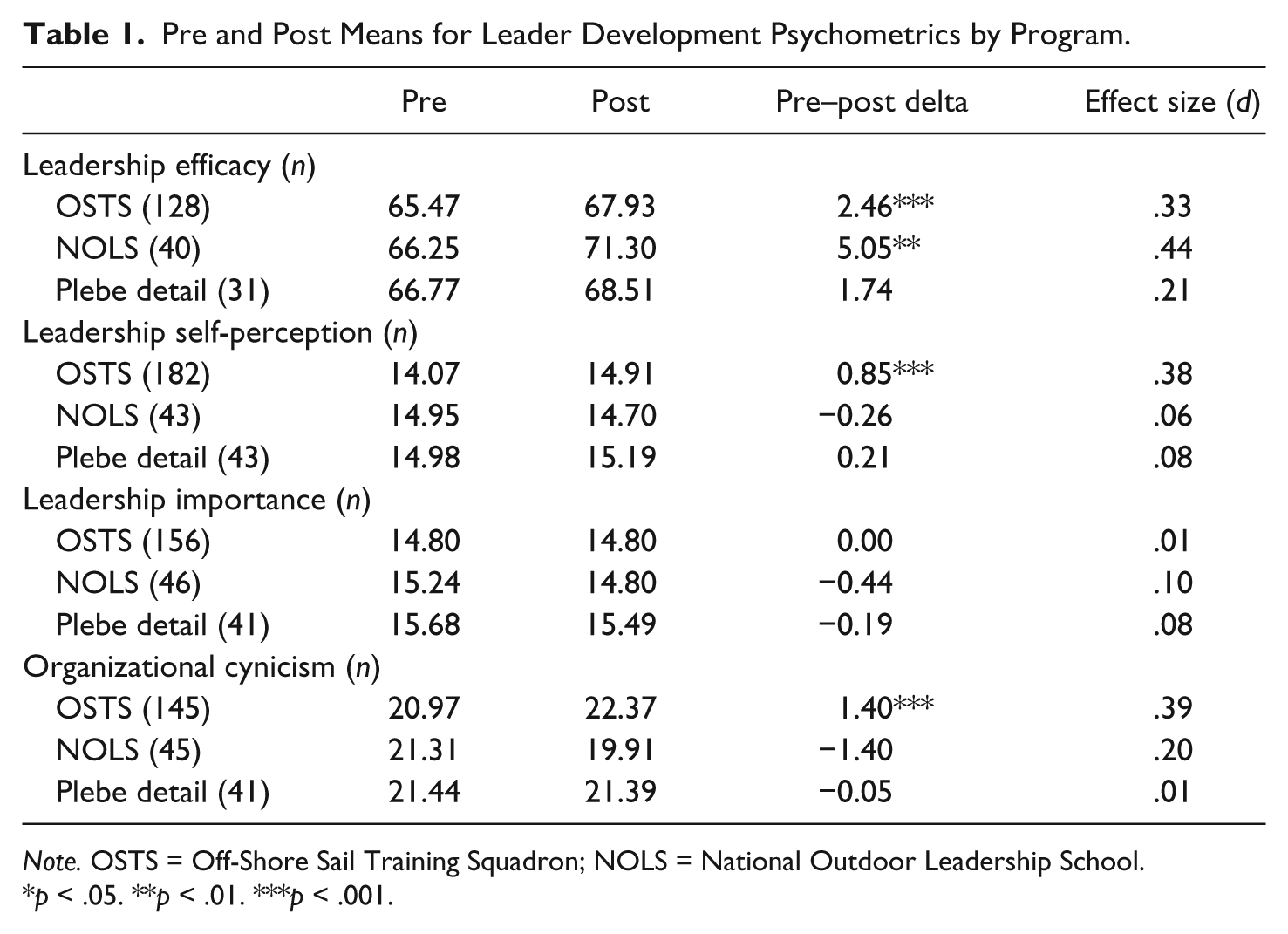
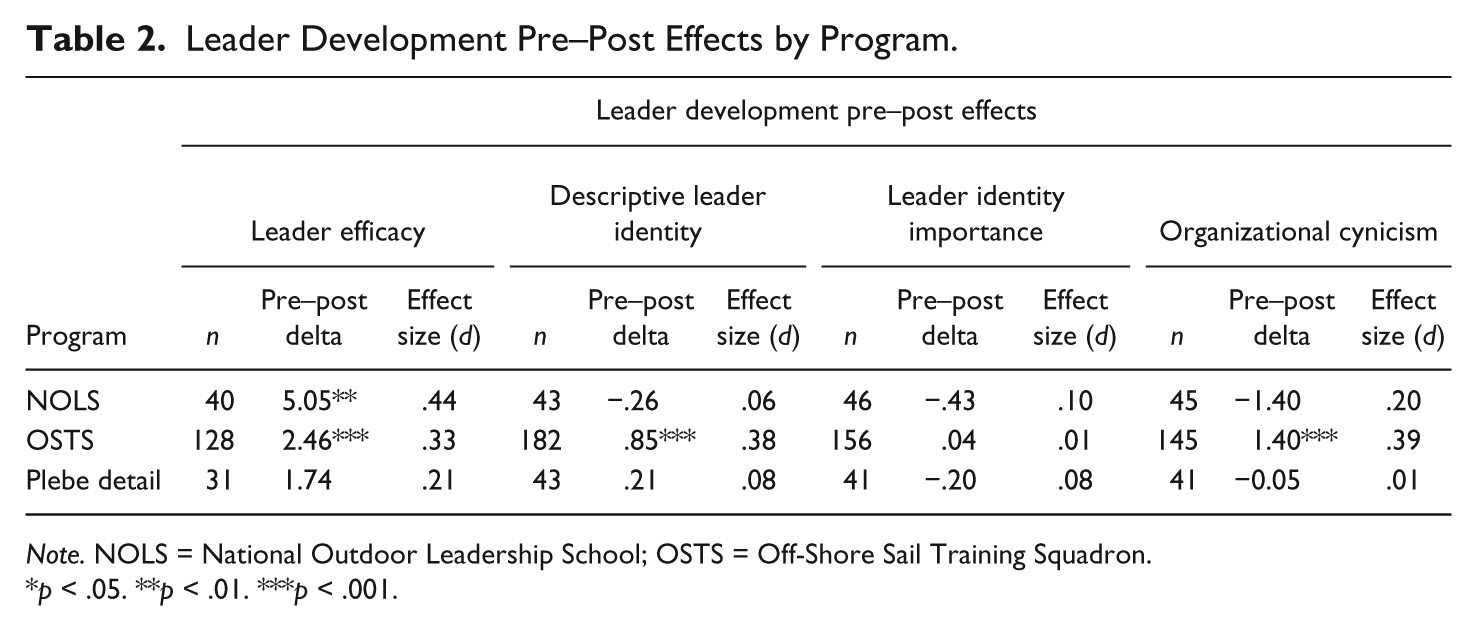
All data analyses were conducted using the Statistical Package for Social Sciences, SPSS v.20. An initial analysis was conducted to ensure there were no between-groups differences in social desirable responding. As we hypothesized each group would experience pre–post changes on each dependent variable, in accord with procedures outlined by Pedhazur and Schmelkin (1991) we conducted hypothesis-specific pre–post evaluations for each variable to assess the magnitude of change for each group. We recognized there were three analytic strategies (pre–post change scores, two-level within factor analyses of variance, and analyses of covariance) that could assess between-groups differences for each of the dependent measures. To capture the relative differences between programs and best represent the outcomes, pre–post change scores were calculated for each leadership variable and between-groups (three level) analyses of variance (ANOVA) were conducted. Post hoc follow-up comparisons used the Bonferroni test. Alpha level was set at p < .05. Results are presented in Tables 1 and 2.
Pre and Post Means for Leader Development Psychometrics by Program.
Note. OSTS = Off-Shore Sail Training Squadron; NOLS = National Outdoor Leadership School.
p < .05. **p < .01. ***p < .001.
Leader Development Pre–Post Effects by Program.
Note. NOLS = National Outdoor Leadership School; OSTS = Off-Shore Sail Training Squadron.
p < .05. **p < .01. ***p < .001.
Results
Leadership Self-Efficacy
Pre–post assessments for each experimental group indicated significant changes for the OSTS group, preX = 65.47 and postX = 67.93, t(127) = 3.75, p < .001, effect size d = 0.33, and for the NOLS group, preX = 66.25 and postX = 71.30, t(39) = −2.79, p < .01, effect size d = 0.44, but not for the Plebe Detail group, preX = 66.77 and postX = 68.51, t(31) = −1.15, p < .26, effect size d = 0.21. A three-way ANOVA was conducted to determine whether there were any differences in changes in Leadership Self-Efficacy among the three groups. The results indicated that there were no differences in Leadership Self-Efficacy among the three groups, F(2, 196) = 1.72, p < .18, with mean change scores of +2.46 for the OSTS group, +1.74 for the Plebe Detail group, and +5.05 for the NOLS group.
Leader Self-Perception
Pre–post assessments of leadership perception for each experimental group indicated significant changes for the OSTS group, preX = 14.07 and postX = 14.91, t(181) = 5.12, p < .001, effect size d = 0.38, but not for the NOLS group, preX = 14.95 and postX = 14.70, t(42) = −0.41, p < .68, effect size d = 0.06, or for the Plebe Detail group, preX = 14.98 and postX = 15.19, t(42) = 0.54, p < .59, effect size d = 0.08. A three-way ANOVA was conducted to determine whether there were any differences in changes in Leadership Perception among the three groups. The results indicated that there were differences in Leadership Perception for the three groups, F(2, 265) = 3.47, p < .03, with mean change scores of +0.85 for the OSTS group, +0.21 for the Plebe Detail group, and −0.26 for the NOLS group. Post hoc comparisons indicated the OSTS group was significantly different from the NOLS group whereas the OSTS group and the Plebe Detail group means were not different from one another. Furthermore, the Plebe Detail mean change in Leadership Perception was not different from the NOLS mean change in Leadership Perception.
Leader Importance
Pre–post assessments of leadership importance for each experimental group indicated no significant changes for the OSTS group, preX = 14.8 and postX = 14.8, t(155) = 0.17, p < .87, effect size d = 0.01; NOLS group, preX = 15.24 and postX = 14.80, t(45) = −0.68, p < .50, effect size d = 0.10; or for the Plebe Detail group, preX = 15.68 and postX = 15.49, t(40) = −0.53, p < .60, effect size d = 0.08. A three-way ANOVA was conducted to determine whether there were any differences in changes in Leadership Importance among the three groups. The results indicated there were no differences in Leadership Importance among the three groups, F(2, 240) = 0.43, p < .65, with mean change scores of +0.04 for the OSTS group, −0.20 for the Plebe Detail group, and −0.44 for the NOLS group.
Organizational Cynicism
Pre–post assessments on organizational cynicism for each experimental group indicated significant changes for the OSTS group, preX = 20.97 and postX = 22.37, t(144) = −4.29, p < .001, effect size d = 0.39, but not for the NOLS group, preX = 21.31 and postX = 19.91, t(45) = 1.36, p < .18, effect size d = 0.20, nor for the Plebe Detail group, preX = 21.44 and postX = 21.39, t(40) = 0.09, p < .93, effect size d = 0.01. A three-way ANOVA was conducted to determine whether there were any differences overall in changes in Organizational Cynicism among the three groups. The results indicated there were differences for changes in Organizational Cynicism among the three groups, F(2, 228) = 7.53, p < .001, with mean change scores of +1.40 for the OSTS group, −1.40 for the NOLS group, and −0.05 for the Plebe Detail group. Post hoc comparisons indicated the increase in Organizational Cynicism reported by the OSTS group was significantly different from the decreases experienced by both the NOLS and Plebe Detail groups. There was no significant difference between mean decreases reported by the NOLS and the Plebe Detail groups.
Discussion
Hypothesis 1A, midshipmen will experience increases in “total” leader efficacy from pretest to posttest in each of the three programs, is partially supported. In the NOLS and OSTS programs, participants emerged from the experience with greater leader efficacy than when they began, across a range of leader competencies and skills, such as managing teams, managing risk, delegating responsibility, and maintaining composure.
Hypothesis 1B, predicting self-efficacy gains in outdoor-based programs would exceed gains in non-outdoor-based programs, is supported. We found no difference in leader efficacy for Plebe Detail participants, though the mean shift is in the expected direction.
A number of explanations are plausible for efficacy gains in NOLS and OSTS versus Plebe Detail. First, Plebe Detail participants were highest among the three groups in their pretest scores for efficacy, and so were perhaps less developmentally primed for increases in efficacy than participants in other programs. Moreover, they are also the more experienced of the three groups. Another explanation relates to differences in the presence, persistence, and expertise of leadership instruction across the programs. NOLS participants were under nearly constant observation by qualified instructors specially trained as outdoor educators and leadership guides. Plebe Detail participants were not as closely supervised and likely experienced less critical feedback than their NOLS peers. OSTS participants experienced the same presence and persistence of observation, and even though OSTS instructors are not trained as outdoor educators, nor are they specially trained as leadership guides, they have considerable experience and expertise in sailing. It is reasonable that the higher quality and quantity of leadership instruction and personal interactions with instructors received by NOLS and OSTS participants resulted in higher efficacy gains relative to the Plebe Detail. One way to test this explanation indirectly is to check whether gains made by NOLS and OSTS participants persist; one would expect higher quality instruction to result in greater latency of efficacy gains. Research designs in the future should conduct a third wave of evaluations to assess the durability of efficacy gains.
There is minimal support for Hypothesis 2A, and no support for Hypothesis 2B. Midshipmen experienced increases in descriptive leader identity, but only in the OSTS program. There was no difference between outdoor-based programs from the non-outdoor-based program in terms of changes in descriptive leader identity.
There was no support for Hypotheses 2C and 2D. Participants experienced no change in the importance of leader identity in any of the three programs.
The most likely explanation for the significance of the OSTS descriptive leader identity is participant developmental differences. OSTS participants had completed their first year of education and training at the Naval Academy, whereas NOLS and Plebe Detail program participants ranged from 1 to 3 years of experience as midshipmen. OSTS participants may have been primed for gains in leader identity as a result. Overall, there were not significant mean differences within groups or across groups for the importance of leadership identity; this could be attributed to relatively high pretest scores as midshipmen are immersed in a 4-year learning environment focused on leader development. It may be that leader identity increases are relatively small in these programs and need to be assessed for durability over time.
Hypothesis 3A—midshipmen will experience decreases in organizational cynicism from pretest to posttest—was not supported, and in fact findings for OSTS showed the opposite result; participants emerged from OSTS more cynical toward the Naval Academy, despite other findings that suggest they had a meaningful leadership experience during the program. Hypothesis 3B—that outdoor-based programs would result in a greater decrease in organizational cynicism than non-outdoor-based program—was not supported.
One plausible explanation for the difference in cynicism changes across programs involves differences in the sensitivity of participants to the presence of institutional leaders across programs. Organizational cynicism is an attitudinal reaction to external factors, particularly negative or “poor practice” factors such as ineffective role modeling and incongruence between policy and deed (Ostroff, Fulmer, Huey, Chontosh, & Smith, 2012). Of the three experiential programs measured for organizational cynicism, OSTS involves the greatest proximity to the institution and its leadership. NOLS is completely removed from association with the Naval Academy in the minds of midshipmen. NOLS instructors are typically civilian, socially liberal, generally pacifistic; Naval Academy instructors are typically military, socially conservative, tradition-bound. As for the Plebe Detail, the plebe summer experience effectively gives control of the institution to the Midshipman Detailers. As feelings of personal ownership are high, cynicism remains correspondingly low. OSTS typically employs Naval Officers, active and retired, to shape and lead the developmental experience, which is organizationally similar (hierarchical with midshipmen at the bottom) to the majority of a Midshipman’s experience at USNA. As such, midshipmen participating in OSTS are particularly attuned to factors normally associated with organizational cynicism—a gap between stated values and practiced values, micromanagement, poor modeling, incompetence, unfairness, and negativity (Ostroff et al., 2012). Although institutional leaders in OSTS are no more prone to these problems than other individuals, midshipmen in OSTS are likely more sensitive to their presence than in NOLS or Plebe Detail. More research is required to better understand the relationship between leader experience and organizational cynicism.
Limitations
The study is limited by the small sample size for NOLS and Plebe Detail participants. The small sample likely contributed to the lack of statistical significance in some of the dependent measures for these two groups. Also, the participants involved in this study were, in general, more oriented to leadership development than might be the case for other populations, selected as they are for demonstrated leadership in settings prior to college (e.g., high school, preparatory school, enlisted military). It should not be inferred that other populations of similar aged students will respond the same to leader development interventions such as those presented in this study. Lastly, the study does not account conceptually or empirically for the fact that among the three programs, only NOLS participants paid for the experience from their own (or their parents’) pockets; Plebe Detail and OSTS programs are government funded. Two potential implications of this limitation could be that participants who pay for their experience may be more likely to report increases in learning outcomes to justify their expense; and that participants who are able to pay for this type of experience are demographically and/or developmentally different from students who cannot or will not pay for the experience.
Conclusion
The efficacy of the developmental experience for leaders in outdoor education programs is revealed in this study. For USNA midshipmen training to be leaders, outdoor education programs such as NOLS and OSTS deliver measurable gains in leader self-efficacy relative to midshipmen in Plebe Detail, a non-outdoor developmental program of identical duration and timing. The effect is particularly pronounced in NOLS, where the quality and persistence of leader instruction and feedback is highest. OSTS midshipmen experience further gains in descriptive leader identity relative to their older and more developmentally advanced peers in NOLS and Plebe Detail. It appears that the importance of leader identity is unaffected by any of the three programs, perhaps an artifact of the selection effect for Naval Academy students, who are recruited in large part for making leader roles a priority in their lives.
Results for organizational cynicism reveal a more complex relationship with leader development. Although the within-subject decline in cynicism for NOLS participants is not significant, the delta is significantly different from the increase in cynicism experienced by OSTS participants (p < .001). Interestingly, during the same experience in OSTS that made participants feel more efficacious and self-described as leaders, participants became more cynical toward the institution that made the experience possible. Yet it appears NOLS participants emerged from an equally efficacious leader experience with less cynical attitudes toward the institution. It is clear there are other unmeasured factors that mediate the relationship between leader development and organizational cynicism; possible mediating factors include developmental stage, quality and persistence of leadership instruction, and whether participants paid for the experience. Future research should attempt to replicate these findings and explicate the factors that influence the development of cynicism.
Because we are comparing effects on participants from the same population in programs that all purport to develop leadership ability, the lack of findings for Plebe Detail on any of the outcome variables is important to note. The fact that the study reveals pre–post effects in OSTS and NOLS across all of the developmental variables, but no effect (and relatively small effect sizes) in the Plebe Detail, says something important about the developmental quality of the Plebe Detail. Findings suggest Plebe Detail participants are not constructing the same meaning of their leader experience as are NOLS and OSTS participants, which begs the question of why.
This study’s research design allows us to explore this question. There are three clear differences in experiential context between NOLS/OSTS and Plebe Detail, which have been mentioned but bear repeating. The first is the novelty of the educational environment. Plebe Detail is conducted in the same location and under similar environmental conditions as normal routine for midshipmen. Both OSTS and NOLS occur in vastly different environmental conditions, increasing the power of the educational experience (Sibthorp, 2003). The second difference between NOLS/OSTS and Plebe Detail is the developmental stage of participants. Plebe Detail participants were, on average, older and more experienced than participants in NOLS and OSTS, and may have been less primed for a developmental experience. The last difference between NOLS/OSTS and Plebe Detail, and the one best positioned for an intervention by USNA staff, is the presence and persistence of observation and feedback from experienced instructors during the experience, who according to Dewey (1938) provide that crucial interaction to extract the right meaning from the experience, and to make the experience “educative.” Relative to NOLS and OSTS, Plebe Detail participants likely experience fewer observations and critique from experienced instructors, and when feedback was provided, it typically came from other midshipmen, themselves relatively inexperienced as leaders. Using theories of reflection in managerial learning outlined by Seibert and Daudelin (1999), the authors intend to conduct a field experiment next summer testing the hypothesis that active reflection leads to gains in developmental outcomes for Plebe Detail participants.
This study makes a methodological contribution to the existing research on experiential learning, particularly as it relates to leader development. By comparing effects of distinct experiential programs on participants drawn from the same population, researchers can more precisely ascribe differences between programs to program characteristics; in other designs those ascriptions are confounded by demand characteristics of the research setting and selection effects of participants.
Footnotes
Acknowledgements
The authors thank Dr. Jim Sibthorp, Dr. Rob Ribbe, and two anonymous reviewers for their thoughtful comments on earlier drafts.
Declaration of Conflicting Interests
The author(s) declared no potential conflicts of interest with respect to the research, authorship, and/or publication of this article.
Funding
The author(s) received no financial support for the research, authorship, and/or publication of this article.