







Abstract
Integrating service-learning and other experiential approaches into higher education offers the potential for enhancing student growth and learning (Kiely, 2005). However, the inclusion of such practices themselves does not guarantee learning. Although past studies of service-learning have focused on assessing student growth and addressing ways to support students in writing critical reflections, less attention has been focused on how to support students in doing the work of “theorizing,” one common component of critical reflections and service-learning projects, especially within the social sciences (i.e., Molee, Henry, Sessa, & McKinney-Prupis, 2010; P. J. Pedersen, Meyer, & Hargrave, 2015; Rinehart, 1999).
When teaching theory application within and outside service-learning contexts, undergraduate students often anxiously inquire, “Which theory or concept is the correct one? Which should I use?” In fact, anxiety is a common student reaction to theory application (Lowney, 1998). Past scholars have proposed the perceived abstractness and distance of theory from students’ lived experiences as contributing factors to students’ struggles (Holtzman, 2005; Lowney, 1998; D. E. Pedersen, 2010; Pelton, 2013). While asking students to apply a particular theory to experiential activities, such as service-learning projects or internships, can help address some of these barriers, the added component of the messiness of real life can also increase student confusion and anxiety about the process (Holtzman, 2005; Silver & Perez, 1998). Undergraduate students are left to master theory within a service-learning context that in many cases already pushes their comfort levels. Moreover, the task of selecting from several seemingly plausible options and making a case for a particular selection requires a level of comfort with ambiguity that William Perry’s research shows is not prominent in all learners at all stages of their development (1998). Yet, scholars have not fully addressed how to scaffold classroom activities to support students in theory application, particularly as it relates to selecting and integrating theory with data from service-learning experiences (Pelton, 2013; Rinehart, 1999).
To assist faculty in guiding students through the process of applying theory to their experiential learning projects, I present a model for framing the application of theory and scaffolding class activities that integrates past scholar’s work on service-learning and teaching theory in undergraduate courses. The model addresses two underdeveloped areas in the theory and service-learning pedagogy literature: supporting students in the selection phase of theory application and factoring in students’ perceptions of knowledge in the scaffolding of class activities. Based on addressing key barriers to theory application, such as the abstractness and perceived unrelatability of theory, the model is designed around an analogy that students can easily relate to and practice in their daily lives, that is, finding-the-right-fit as it relates to fashion. The model extends Kathleen Lowney’s (1998) findings about the use of analogies in teaching theory and offers a pedagogical approach that helps students work through the dualistic orientation in which the instructor is expected to identify for students the one correct theory or concept and the multiplicity phase, where multiple viable options are recognized but not necessarily evaluated critically (Moore, 2002). Based on a case study of an upper-division anthropology identity theory course with a service-learning component, I highlight how this analogy combined with scaffolded activities can assist students across disciplines in bridging that critical gap between understanding theory and selecting and applying theory to service-learning experiences.
Review of Literature: Uncovering the Scaffolding to Apply Theory
In applying theory to any context, including service-learning, there are several key steps, including understanding the theories, selecting an appropriate theory from a series of options based on the data and the objectives, and connecting the theory to the data to provide a deeper understanding or to illuminate a process. Past pedagogical research has focused on the former and the latter, but does not directly address how to help students actually decide what theory to use for a given data set. For example, many pedagogical studies on teaching theory have focused on identifying particular activities, such as collaborative projects (Orum, 1980), simulations (Holtzman, 2005), and current event case studies (Ormrod, 2011), that help increase students’ understanding of theory. Yet, these studies do not address how instructors prepare students to select and apply a theory. In each case, students are either given the task of explaining a theory or are given a specific theory that they then apply to a pre-defined case study. While identifying particular in-class activities that can help students understand theory is important, for students to continue to use the theories and grow as scholars, they also need to be able to match theory to real-world situations on their own.
Similarly, those studies that have focused on how to order different activities over the course of the semester to assist with theory application tend to match theory to data sets without addressing the selection process. Within non-service-learning contexts, Jane Rinehart and Julie Pelton examined how to structure various activities to help students move from approaching theory as a “thing” to be memorized to what (Lemert, 1999) calls “theorizing,” that is, theory as an action to engage in (as cited in Rinehart, 1999, pp. 221-222). Rinehart asks students to list in small groups their personal assessment of particular topics that sociologists study, individually answer and discuss in small groups a set of questions for each theorist, relate a specified theory to films or newspapers featured in class, and to conduct a formal group presentation focused on a particular theorist. Building on Rinehart and other scholars’ work, Julie Pelton (2013) proposes and assesses the effectiveness of a series of scaffolded activities to help students apply theory to familiar case studies. Using popular film, Pelton (2013) combines a series of low-stake writing assignments, which include individual reading guides and a 2-day workshop that leads students through the process of doing a film analysis, with high-stake papers that integrate each major theory by asking students to apply a specific theory to a given film. Her data reveals that the act of writing helps empower students in the process and the use of film reduces their anxiety (Pelton, 2013). However, Pelton does not specifically address the selection process and indicates the theory to apply to a particular film with the exception of two out of seven film paper options, which students could potentially not select.
Within service-learning contexts, the pedagogical literature focuses more on how instructors can help students go deeper into critical reflection, but does not directly address how to structure classroom exercises to guide students through theorizing (i.e., Ash & Clayton, 2009; Silver & Perez, 1998). For example, based on their work with students in internships, Silver and Perez recommend some questions instructors can use as comments on students’ reflections. Furthermore, Ash and Clayton’s DEAL model provides a detailed step-by-step for instructors to walk students through the process of identifying a link between their course material and service-learning experiences and explaining the connection fully, but they do not focus on how to help students select the best fit from a series of competing frameworks.
Mastering each step in theory application, including the selection phase, is critical to avoid some common problems in service-learning, particularly the reinforcement of stereotypes and ethnocentric or non-holistic perspectives on global challenges that overlook structural and other cultural influences (Cooper, 2014; Hyatt, 2001; Marullo, 1998). Similar to the central role that critical reflection plays in service-learning, knowing how to select and apply a relevant social science theory or concept to experiential case studies is a key factor in helping students to recognize cultural or societal influences, such as structural inequalities, and to avoid using stereotypes. Without training in the selection phase, the risk remains that student learning will be reduced by their frustrations over a myriad of options or that students will select whatever social theory is closest to their viewpoint regardless of its fit for the social issue that is central to their service-learning experience.
When designing a series of scaffolded activities to support students through all steps of theorizing, it is also important to keep in mind that students are not just bringing into their service-learning experiences a specific cultural viewpoint of how the world operates, but also their specific perspective on learning and how knowledge is created and transmitted. In terms of theory application, individuals’ perceptions of knowledge will influence the types of explanations that are needed in the classroom for students to successfully understand how to apply theory. To take on the role of theorizing, it is key that students move away from what Perry refers to as a dualistic worldview with the instructor as the expert with the correct answer. In dualism, which encompasses Positions 1 and 2 on Perry’s Scheme of Intellectual and Ethical Development, individuals tend to approach learning in terms of binaries, dividing knowledge into accurate versus inaccurate (Moore, 2002). Frustration can arise when students begin to make a list of possible concepts or theories that relate, only to find that there are multiple options.
The shift from dualism into the next phase of multiplicity brings with it the challenge of helping students to assess a particular theory’s fit and its explanatory/framing power in relation to a similar theory. It is this area of knowledge ownership that can pose major barriers to undergraduates. During multiplicity, which encompasses Positions 3 and 4 on Perry’s Scheme of Intellectual and Ethical Development, individuals recognize that there are gray areas of knowledge that are still to be determined and begin to embrace this ambiguity. In addition, there is a growing “sense of idea ownership” when it comes to knowledge (Moore, 2002, p. 20). As individuals’ viewpoints become closer to Position 4, they increasingly take on a more absolute relativistic perspective, where any person’s opinion is as good as the next (Moore, 2002). According to Moore, what distinguishes contextual relativism (Position 5) from multiplicity (Position 4) “is the self-consciousness of being an active maker of meaning” (p. 21) who is taking and defending their position in relation to others. According to Perry (1985), individuals can cycle back and forth between the different phases as their approach to learning and knowledge progresses (as cited in Moore, 2002). Understanding these general phases can help instructors anticipate and plan for key areas of trouble.
This article’s framing analogy and associated scaffolded activities take into consideration what other approaches have not explicitly addressed, that is, students’ perceptions of knowledge as it relates to Perry’s research and the task of selecting a theory. Although Perry’s research has been applied to other areas of service-learning, such as transformative learning (i.e., Cunningham & Grossman, 2009), intercultural engagement and learning (i.e., Fitch, 2004), potential student reactions (McEwen, 1996), and student approaches to social issues (i.e., Eyler & Giles, 1999), it is underrepresented in the pedagogical literature on designing scaffolded activities to support students’ application of theory. In the following sections, I illustrate how I approached scaffolding class activities and framed theorizing using a familiar analogy that incorporates Perry’s research on knowledge perspectives to help students work through the barriers innate within multiplicity and dualistic worldviews to deal with the anxiety and struggles of applying theory to service-learning.
Methodology: A Model for Scaffolding Theory Application
The proposed model is based on teaching at Midwestern universities the same set of theories in an upper-division ethnic and national identity course in Anthropology for four semesters with one semester having a significant service-learning component. In the course, students read two to three ethnographies and a series of articles, and they conduct participant observation at one ethnic event to analyze how different ethnic groups (indigenous, diasporic, and refugee populations) negotiate their identities. Students also write response papers to the readings, complete a midterm and final, and participate in numerous in-class activities to prepare them for analyzing data and applying theory. The focal point for the first half of the semester is the theories, and the second half centers on case studies. The course focuses on five different theoretical approaches to studying ethnic, national, diasporic, and transnational identity. While other approaches are discussed, the main theories concentrate on analyzing identity construction and identifying the strategies that various groups throughout the world use to negotiate their identity.
The service-learning partnership for this course was initially created to give students more experience using ethnographic data to understand how local communities navigate ethnic and national identities while also assisting a local non-governmental organization (NGO) in achieving their goals, which involve helping newly arrived refugees resettle in the United States and preparing immigrants for the U.S. citizenship exam. The NGO community partner organizes citizenship, English-language, and acculturation classes for refugees and other immigrants. From a list provided by the NGO, students selected the type of class, the location, and times they would attend and volunteered at least 6 to 8 hours in the classes. Students kept field notes/reflections which were graded. Their work culminated in a paper for which students selected a theory from class and applied it to the experiences of one refugee or immigrant group they were working with to explain how this group negotiates their ethnic, national, transnational, or diasporic identity.
In general, students’ ability to apply theory is an important step in critically constructing meaning out of their observations and experiences at a service-learning site. For this course, I used an analogy that many students can easily relate to, that of finding-the-right-fit in terms of fashion, to frame the key step of selecting a theory from a set of seemingly viable options. I explained to students,
Imagine the various theorists are each a different style or size of pants in a store. You may try on one, and it fits your waist but is too short. Then, there are pants that technically fit but the cut does not really work with your body shape. Lastly there are those pants that you cannot even fit into. Theory is the same way. Just like there are pants that sort of fit, there are theories that somewhat fit a given case study so it seems on the surface that there are many plausible options. However, you would not show up in attire that does not fit the context, like sweats at a job interview. Thus, you want to select the theory that fits the context and data the best and provides you deeper insight into what is happening. When all you can find is close enough, i.e. slacks that need the hem taken in, you settle for it and go to a tailor or adjust it yourself. This is what researchers do when they use theory. This is where critique and theory development enter in.
As Pelton (2013) found in the case of using film, centering a teaching approach on something familiar can help address the abstractness of theory which past scholars have found to be a source of student anxiety. Pelton reports that
creating connections between difficult subject matter and students’ experiences has been shown to be highly effective for the learning of abstract sociological concepts (Calwallader and Scarboro 1982; Hudd and Bronson 2007; Roberts 1993) because it enables the student to integrate new information into his or her existing cognitive structure more easily (Cadwallader & Scarboro, 1982 as cited in Pelton, 2013 p. 108). In this case, it is not an object, like film, but rather a familiar decision-making process that the fashion analogy appeals to.
In addition to a framing analogy, instructional design as it relates to the order and selection of readings, and not just class exercises, plays an important role in building a firm foundation for students to apply theory. Aside from a few recommendations for theory textbooks or field note and ethnography how-to’s (i.e., Silver & Perez, 1998), generally the scholarly literature on theory in the social sciences does not address how to scaffold readings, particularly case studies, to help students grow into the role of theorizer. I paired readings that demonstrate the progression of theory construction and application with a sequential set of individual and collaborative activities to support students in transitioning among dualism, multiplicity, and contextual relativism phases. Table 1 illustrates the pedagogical model and rationale for scaffolding readings and in-class activities to assist students through the process.
Pedagogical Model and Rationale.
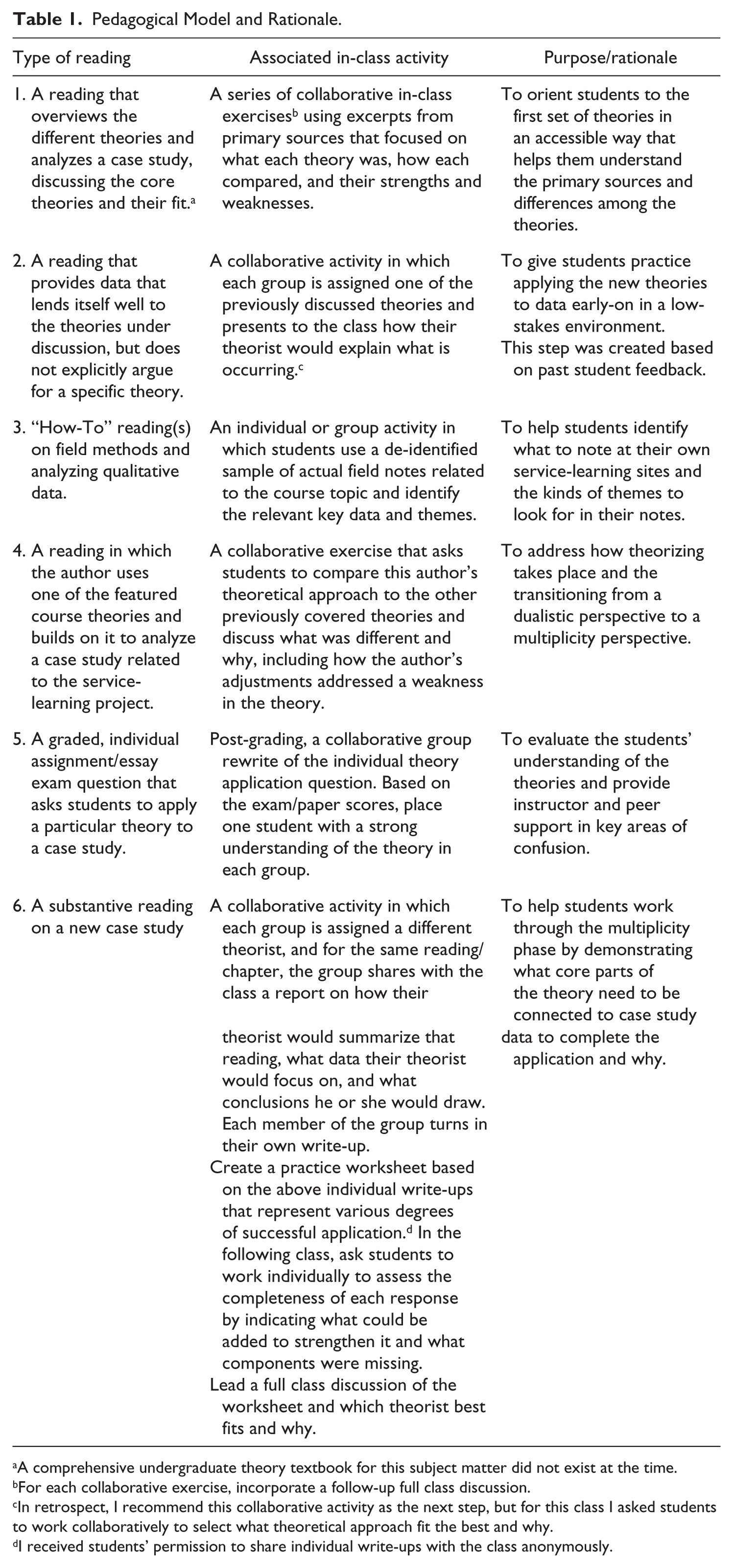
A comprehensive undergraduate theory textbook for this subject matter did not exist at the time.
For each collaborative exercise, incorporate a follow-up full class discussion.
In retrospect, I recommend this collaborative activity as the next step, but for this class I asked students to work collaboratively to select what theoretical approach fit the best and why.
I received students’ permission to share individual write-ups with the class anonymously.
In addition to structuring the in-class activities and readings, I asked students to submit their field notes midway and at the end of the semester. The submission midway served as a check-in point on how well students were translating what they were learning in class to their service-learning experiences, that is, taking notes of pertinent data. My comments directed students to what additional data they should look for and questions to ask. I also provided a space for peer feedback via an in-class peer review of the service-learning paper. Such feedback complements the in-class activities of connecting theory to data.
I conducted an institutional review board (IRB)-approved research study to see how the analogy, the sequential readings, and class activities assisted students in applying theory to their service-learning experiences. The course included 14 students from different majors, including many non-majors from the liberal arts and sciences, and consisted mostly of seniors. Various ethnic and racial groups were represented in the class. Nine females and three males participated in the research study. At the first exam and later at the final, students completed the Learning Environment Preferences (LEP) survey which is a tested measure for assessing individuals’ positioning along Perry’s Scheme of Intellectual and Ethical Development (Moore, 1989). (Not every student completed both the pre- and post-survey measure.) At the end of the semester, students filled out a survey about the usefulness of the different resources when completing the service-learning paper. Students also wrote a critical reflection at the end of the semester about what they had learned from the service-learning experience. I assessed students’ growth in theory application by comparing each students’ performance on the first exam’s theory application essay question, the applying theory worksheet, and the final’s theory application essay question. In addition, I emailed out a call for a follow-up interview about the framing analogy 1 year later to those students who wanted to continue in the research study. I performed a content analysis on their reflections and interview responses, coding for key features such as anxiety, selecting theory, applying theory, and what helped them.
Results and Analysis: Trying Out the Fit
Of the 14 students enrolled in the course, nine completed the LEP survey around the first exam:
One student was in transition between dualism and multiplicity (Position 2/3).
Three students were in Position 3 of the multiplicity phase, holding a viewpoint that multiple viable opinions exist about a given subject or issue.
Two students were in transition from Position 3 to 4.
Three students were either in Position 4 of the multiplicity phase or in transition from this phase to the contextual relativism phase, holding a viewpoint that there are multiple perspectives from which to analyze issues and realizing to varying degrees the need to integrate the preferred perspective with data to illustrate its validity (Moore, 2002).
Six out of the nine students who completed the LEP survey were working within the early phase of the multiplicity perspective. From Perry’s research, it would be expected that they would struggle with the selection and application of theory to their service-learning data, and all but one student in these categories did. In fact, a common issue in the midterm essays was either summarizing the theory then summarizing the data with variable degrees of explanation of how the two connected or the absence of a core part of the theory in the application. In addition, it was during the second half of the semester that one student raised her hand and asked, “Just tell me, out of all the theorists we have looked at this semester, which one is correct?” Her statement reflected the anxiety that several of her peers shared about the service-learning paper. In response to her question, I introduced the finding-the-right-fit analogy.
Students’ comments in their end-of-the-semester critical reflection papers illustrate that the analogy, finding-the-right-fit, in combination with the scaffolded in-class activities and assignments were instrumental in reducing anxieties and assisting students in learning how to apply theory. For example, after I initially shared the analogy with the class, one student told me that the analogy really helped him grasp what he needed to do for the paper. This student fell within the multiplicity Position 3 phase at the end of the semester (he did not completely fill out his midterm LEP so it could not be scored). He wrote in his critical reflection that
During these classes, and especially when writing my field notes I was able to piece together different theories in class and see which best fit the [service-learning]. I argued Barth and Cohen often and both fit. For the Barth theory and on this paper, they negotiated via ethnic boundary markers in language, and for Cohen I could have argued that they work as interest groups by attending these classes, keeping the diaspora, and working together to gain their citizenship in the United States.
His comments show that he went from not knowing how to select a framework from multiple options for his service-learning project to being able to do so and explain the “why” of his position. In fact, he had begun his critical reflection with the following statement,
Working for the [NGO] opened my eyes a bit in understanding what exactly it takes to become an American citizen through taking the citizenship tests. On first thought, I thought that it [the service-learning project] was a stupid idea and that I would not gain any insight through this fieldwork, but I was wrong.
His comments overall reveal that the combination of the analogy and in-class activities enabled him to both apply theory better and, more importantly, make deeper meaning out of his service-learning experience.
Later in the semester without prompting, another student used the finding-the-right-fit analogy in a class discussion to explain to other students how and why a particular theory fit the new case we were discussing. At the end of the semester, her score on the LEP survey was a 3/4. Her comments in the critical reflection reiterate the role that the analogy and the scaffolded activities played in her learning. She reflected that
This paper was out of my comfort zone so I found myself putting it off because I was anxious to start because I wasn’t confident in it. . . . I learned that apply[ing] theory in general is not an easy task. I found out that applying ethnic identity theory and nationalism theory was difficult but not impossible. At first, it was a totally daunting task and then the week before it was due, sitting down and hashing out all the logistics and really diving into the theory I was using really helped relieve a lot of the stress. In class, we discussed so many different theories and trying to remember who goes with what was a little overwhelming at first. . . . However, by reading and applying them consistently in class with different activities and case studies they continued to become more clear.
Both her comments in class and in her critical reflection paper show that the analogy and scaffolded activities helped her work through the anxiety and stress that is often associated with doing theory.
Compared to other analogies, the fashion analogy locates students more centrally in the decision-making process, giving them an active role that better captures the idea of theorizing. Although Kathleen Lowney (1998) uses jigsaw puzzles as an analogy for working with theory, the puzzle analogy’s focus is more on helping students understand the relationship between theory and data and transferring confidence. According to Lowney’s (1998) analogy, the border pieces which frame the puzzle represent theory and the interior pieces the data. She uses this as a basis to pose questions to students about what theory best frames the data (Lowney, 1998). However, the puzzle analogy does not capture as well the multiplicity in options that exist within theory as there is only one frame that will work for a puzzle, and completing the puzzle is about discovering what that one frame is. Unlike puzzles, individuals can select a different style or adjust the fit of the clothes to frame their bodies, much like individuals can adjust theory to better fit reality. The finding-the-right-fit analogy allows for such agency, but certain components, such as the type of clothing referenced, should be adjusted to the students’ cultural background. Similar framing analogies that embrace notions of flexibility and tailoring to contexts may also work as well. From the first exam to the final, most students showed improvement in their ability to integrate key parts of the theories. Take, for example, the work of another student, who scored a 3/4 on the first LEP survey. On the first exam this student defined the theory well and then went into a discussion of the case study that implicitly but not explicitly showed application of the key parts of the theory. On the final, the same student wove the theorist’s main points explicitly into the case study data.
In a follow-up interview with this student 1 year after the course, she explained how the analogy had helped her not only for that class but for other classes as well.
It [The analogy] solidified that there is never a right answer but what fits the best. It helped clarify but also muddle. The whole time in school we are taught that there is a right and wrong answer and when we switch to theory, it’s different. [The analogy] helped because it’s different, you choose a theory then have data to support. We saw from our readings that people disagree. We have been programmed from elementary school and now we have to choose theory.
Her comments highlight that students in fact struggle with theory application because of a dualistic perspective on learning, which may be reinforced in K-12 if students are not gradually introduced to more multiplicity-type case studies. Moreover, the transition from dualism to multiplicity can create frustrations as it challenges and complicates previous understandings of the world (Kloss, 1994). This illustrates that understanding a student’s perspective on knowledge is key and may be one contributing factor to the anxiety that surrounds theory and service-learning. When I asked the student if she thought the analogy was necessary, she replied, “Necessary. It would not have been easier if it wasn’t used. It helped clarify more. The clothes analogy helped alleviate some of the stress of figuring out which was the best.” Later when I asked about whether she had found the analogy useful in other classes, the student replied,
Yes with my . . . class because there is so many approaches. So many different ways you can implement strategies and people are going about it a different way. It depends on what you are looking for, depends on what theory or campaign because you are going to get a different product. It has definitely helped me do more analytical thinking to look at what fits best for what situations.
Overall, each of the 11 students who completed the survey agreed that the discussions and in-class activities helped them with the service-learning project. Some students indicated that they wanted more practice, which illustrates the benefit of using theory application exercises repeatedly in-class. All confirmed as well that the applying theory worksheet was helpful, but only three indicated they had used it in preparing to write the service-learning paper. One student noted that she tried to use it but wished her notes had been better. All indicated they had read through the instructor’s comments on their field notes in preparation for writing the paper. The fact that 8 of 10 student responses on the survey indicated previous experience working with theory in another class suggests that theory pedagogy could benefit from this missing component.
Data from the critical reflections also revealed that students’ enhanced ability to select and apply theory to their service-learning experiences helped the community partner and those they serve beyond their immediate goals. The community partner strives to assist immigrant and refugee groups to become active members in society without losing their cultural identity. Providing their clients with knowledge about English and U.S. customs as well as U.S. government and history for the citizenship exam is one part of the process, which students assisted with as tutors. The other part relies on the general public to understand the clients’ efforts to continue their ethnic identity while becoming members of U.S. society. The combination of theory with service-learning assisted in achieving this other part of societal understanding. For example, several students pointed out how the theory component of the service-learning project assisted them in rethinking how they viewed refugees and immigrants. The student who had talked about applying Barth and Cohen reported that
My perceptions of immigration in the United States from Mexico has not changed much, . . . , but what has changed is how I perceive their language. Before I would tend to get annoyed when people would be speaking in Spanish and English back and forth, but now I understand that it has a purpose. Many people get nervous when Mexicans speak Spanish near them because they cannot understand what they are talking about and think that they could possibly be talking about them. I learned through this experience that that is not always the case, this is just how they negotiate their ethnic identity in a foreign land to preserve their culture and identity.
Another student commented,
I had never interacted with Hispanic and Latino immigrants dealing with specific immigration issues before this class. . . . I did not realize before this class how many different issues accumulate into larger stresses on everyday life, such as passing an oral test in a foreign language taught by people who do not know your language. . . . This allowed me to place theories from class into the context of individual lives, and how the social systems affected their lives instead of their lives defining the social systems.
The above comments illustrate how enhancing students’ ability to select and apply theory helped them gain a better recognition of how people communicate their belonging in society while retaining their ethnic heritage and the challenges involved. Simply interacting across ethnic or racial groups does not correct stereotypical ideas about groups nor does it highlight the larger structural issues at work (Cooper, 2014; Hyatt, 2001; Marullo, 1998); however, this data suggests that enhancing students’ ability to select and apply theory can.
Conclusion
It is common in upper-division social science courses for instructors to expect students to be able to apply concepts and theories to case studies and real-life experiences or events. In fact, application and evaluation are key features of critical reflections for service-learning and other experiential pedagogies in higher education. Yet, not every student, especially undergraduates, may have a contextual relativism perspective on knowledge nor is it common for students to progress from dualism to contextualize relativism in one semester. My goal is not to propose a series of activities to “force” this progression but to give students what Robert Kloss (1994) calls “nudges” via the scaffolded activities and the finding-the-right-fit analogy to help students continually develop their worldview on learning and knowledge. Although expecting a full and permanent transition in one semester may be lofty, avoiding the application of theory or concepts to data does a disservice to students’ advancement as scholars and citizens. As the above student’s comments suggest, postponing students’ experiences of working through multiplicity and toward contextual relativism only increases anxieties as they progress through their coursework.
So how do we bridge that gap? I argue that the use of a familiar analogy, such as finding-the-right-fit in terms of fashion, combined with specific scaffolded activities, is needed to increase students’ awareness of knowledge construction. When scaffolding class activities and readings, one important factor to keep in mind is Perry’s Scheme of Intellectual and Ethical Development to help anticipate the “what” and the “why” of some students’ struggles. In the process, this pedagogical support can reduce the anxieties and abstractness surrounding theorizing. For future implications of the above model for teaching theory, I recommend that instructors introduce the finding-the-right-fit analogy during the first or second week of class. Similar to what Lowney (1998) found, the implementation of analogies marks a turning point for student understanding. For courses with a fieldwork, volunteer, or internship experience, I recommend that students submit their field notes/critical reflections for instructor comment after each visit. In a subsequent service-learning course for first-year students, such submission increased the quality and level of application of key concepts.
It is not enough just to incorporate a service-learning project to improve students’ understanding of theory. The way instructors construct the support framework, that is, the types of readings, in-class activities, and framing analogy, is also important. Although past research has worked to identify individual activities, such as collaborative projects (Orum, 1980), simulations (Holtzman, 2005), and participant observation (Silver & Perez, 1998), to examine the structuring of such activities (Pelton, 2013; Rinehart, 1999), and to show the benefit of including familiar items, such as puzzles or films (Lowney, 1998; Pelton, 2013), as a means to increase students’ theory comprehension, this article’s proposed model brings this research together to support students in their service-learning. It extends these findings with the analogy of finding-the-right-fit in terms of fashion to more centrally locate students in the process and directly addresses the overlooked step of selecting theory in the teaching of theorizing. At the same time that this analogy helps students find-the-right-fit in terms of theory and their experiential learning, it can also assist faculty in finding the right fit for teaching their disciplines’ service-learning projects and supporting community partners in attaining their goals.
Footnotes
Declaration of Conflicting Interests
The author(s) declared no potential conflicts of interest with respect to the research, authorship, and/or publication of this article.
Funding
The author(s) received no financial support for the research, authorship, and/or publication of this article.