







Abstract
Talent shortages in Latin America hit different professions, from medicine to business management and computer science and engineering, among others (DeCarvalho, 2019). Companies in the region, furthermore, have identified emotional intelligence (EI), communication skills, and critical thinking as among the top soft skills lacking among the extant employee pool. These deficits were mentioned more frequently than information technology (IT) abilities and financial expertise (Flores & Melguizo, 2018). On a global scale, EI was also identified among the emerging and more in demand skills during the period from 2018 to 2022 (World Economic Forum, 2018).
Students in Latin America and abroad also need to develop teamwork skills; however, characteristics like organizational centralization and hierarchy seem to hinder the development of such skills (Elvira & Davila, 2005). Furthermore, Colombian companies do not have a clear understanding of teamwork (Ardila Soto & Gómez Chiñas, 2005).
Today, demand for EI and teamwork skills among engineering graduates indeed transcends regional constraints. Engineering schools worldwide are compelled to provide opportunities for interpersonal skills development. This is due to the fact that the conception of engineering as a profession has changed. Engineers must be team players instead of isolated professionals. Oftentimes, they are members of multidisciplinary and diverse teams (Boyatzis et al., 2017). In fact, Boyatzis and colleagues (2017) recently found that emotional and social intelligence positively affected engineer reputational effectiveness.
In some regions, however, the need for rethinking undergraduate programs toward skills development is particularly urgent. Latin American institutions may not be delivering skilled graduates capable of facing workplace challenges (DeCarvalho, 2019). Nonetheless, some universities in Latin America are trying to transform learning practices to focus on soft skills development (Roman-Calderon et al., 2018). The authors of this article have developed a program that provides undergraduates from all disciplines with the opportunity to participate in complex student engineering competitions. Student competitions are said to leverage multiple skills deemed necessary in the workplace (Lovelace et al., 2016). Among the challenges of this program have been to select the right students to participate in those competitions and to identify ways to expand the potential benefits to all students. To some extent, this is the same challenge Latin American companies face when hiring their staff. Furthermore, given the broader skill shortage in the region, it is likely that companies may implement selection processes aimed at identifying the more skilled candidates. There is a growing awareness of the need to incorporate EI into recruitment processes (Miao et al., 2017). Hence, new graduates should be prepared not only in terms of skills development but also to deal with these types of selection processes.
Bearing in mind the challenges mentioned thus far (i.e., the need to upskill Colombian graduates and establish practices for selecting the more skilled students for international competitions), the researchers selected a team activity that consisted of building a creative weighing machine. The activity was conceived as a part of a process aimed at selecting the students to participate in an international engineering challenge. The students were distributed in teams and were instructed to use raw materials to create a weighting machine. As the international challenge implied social interactions, the processing of emotional information, and the use of cognitive skills, the activity was also a part of the preparation of the students.
In terms of research, the initial aim of this activity was to measure participants’ EI levels and task performance. This information would be joined with data collected in other situations to select the more skilled students for future student competitions. In terms of testing a theory, the study aimed at assessing whether student EI helped improve contributions to teams in engineering simulations. Considering prior contradictory findings regarding the relationship between EI and performance, the results of the study contribute to EI theory development. Theoretical development can be furthered by conducting research aimed at resolving and explaining confusions in the literature (Sandberg & Alvesson, 2011). Notably, the results presented in this article were obtained in the context of an experiential learning program and by using procedural remedies against common methodological biases. In this vein, the study also contributes to the experiential learning field, where there is also confusion with regard to the relationship between student EI and student performance in teams. From a more practical perspective, and in view of the fact that EI has been identified as a skill lacking in Latin America, the authors wanted to test whether EI does in fact predict individual task performance in teams in a sample of students from that region.
Literature Review
EI was first coined by Salovey and Mayer (1990) by drawing on Sternberg and Detterman’s (1986) integrative theoretical framework on the multiple loci of intelligence. Highlighting the importance of emotions, given their requirement of mental processes for elicitation and regulation of response, they defined EI as a “subset of social intelligence that involves the ability to monitor one’s own and others’ feelings and emotions, to discriminate among them and to use this information to guide one’s thinking and actions” (Salovey & Mayer, 1990, p. 189).
The ability model approach to EI focuses on the ability to process emotional information and the interactions between emotional competencies and cognitive abilities; as such, it can be developed and perfected (Harms & Credé, 2010; Mayer & Salovey, 1997). In addition, this approach considers it a tool for comprehending and regulating emotions and understanding and integrating this into cognition (Harms & Credé, 2010).
The ability model divides EI into four hierarchical branches, each ranging from basic to more advanced psychological processes (Kerr et al., 2006). The first two branches are qualified as experiential EI (identifying emotions and using emotions to facilitate thought), and the last two are strategic (understanding emotions and managing emotions; Batool, 2013; Mayer & Salovey, 1997). This classification is congruent with the studies of EI within workgroups wherein several authors have claimed that, in this context, EI comprises four dimensions: awareness of one’s own emotions, management of own emotions, awareness of others’ emotions, and management of others’ emotions (Jordan et al., 2009; Jordan & Lawrence, 2009).
Previous studies have shown that both emotional awareness and emotional management abilities have important effects on performance within teams (Jordan & Lawrence, 2009). Also, emotional management and awareness abilities complement the attainment of hard and soft employability skills, which allow individuals to achieve and perform better in their professions (Rasiah et al., 2019).
There is growing interest among researchers and within organizations to understand the effects of EI in the workplace (Ashkanasy & Daus, 2002) and on task performance (Batool, 2013). The uses of EI include possibilities for detecting emotional nuances in others and capabilities for reading social situations and adjusting behaviors in particular contexts (Antonakis, 2003). In addition, EI allows people to develop collective goals, to generate positive attitudes at work, to stimulate flexibility in decision-making, and to establish organizational identity (George, 2000). In general, these competencies are “the underlying characteristics of a person that lead to or cause effective and outstanding performance” (Boyatzis, 1982, pp. 20–21).
Researchers in the social sciences continue to make efforts to understand the many different variables associated with individuals and organizational realities. In their desire to explain a large field of issues, academics and the practitioners have articulated diverse approaches to the question. Such discussions have in turn led to the theoretical development of EI and team performance and the testing of potential links between these two important constructs in organizational behavior and management education. However, extant literature and research in experiential education do not provide conclusive results regarding this relationship. Contradictory results indeed call for new research (Sandberg & Alvesson, 2011). Put differently, this situation provides an opportunity to develop and validate theoretical models on a topic with a seemingly unlimited spectrum. This article contributes to the literature on experiential learning by presenting a study validating the relationship between EI and individual task performance in teams in an experiential learning context.
Task performance is measured based on individuals’ accomplishment of the tasks and objectives given to them. It refers to the job a person was assigned to do and is formally specified and mandated by the job or task description; it is furthermore related to the organization’s technical core or the activities that directly transform inputs into outputs (Borman & Motowidlo, 1993).
Previous studies have revealed that EI has an effect on task performance in different contexts, including work teams and organizations. In these studies, authors have shown that EI competencies in group work made positive contributions to overall collaboration (Hobbs & Smyth, 2012) and that people with higher EI levels performed better on facets such as teamwork (Clarke, 2010). In addition, comprehensive meta-analyses showed that all measures of EI had predictive ability regarding job performance (Boyatzis et al., 2017) and that EI predicts individual performance, team efficacy, and leadership effectiveness (Lopez-Zafra et al., 2012).
Abilities related to emotions have indeed been proven to have important consequences for performance within teams, for establishing appropriate relationships with other team mates (Jordan & Troth, 2004), and for facilitating a culture of collaboration, conflict resolution, decision-making, and trust. Moreover, studies indicate that a single person with a low EI can lower the collective EI of an entire group (Cooper & Sawaf, 1997).
There are many claims regarding the positive impact of EI on job performance and, as noted, previous studies have shown significant and positive relationships between the EI construct and team performance (Jordan & Troth, 2004). Conversely, studies examining the relationship between EI and individual-level performance show that the potential benefits of using EI in the workplace may be absent (Naseer et al., 2011). In sum, the relationship between EI and job performance seems to be inconsistent (Joseph & Newman, 2010). Such inconsistency suggests that additional research should be conducted to resolve and explain the identified confusion in the literature. Helping to disentanlge confusion is a means toward theory development (Sandberg & Alvesson, 2011). Hence, more research is needed to explain the relationship between EI and job performance.
It is becoming more evident that to obtain effective task performance in today’s educational evironment, cognitive intelligence falls short—that it is a necessary but insufficient condition—and the engineering field is certainly no exception (Boyatzis et al., 2017; Riemer, 2003). The engineer’s work context is relational, comprising both internal team structures and external engagement with different stakeholders; as such, EI is expected to predict effectiveness over and above cognitive intelligence (Boyatzis et al., 2017).
Professional bodies and research studies affirm that engineering students require many skills and a great deal of knowledge when entering the workforce (Riemer, 2003), especially when they have to work with people from different backgrounds and roles within an organization. Consequently, university education needs to devise strategies that provide students not just with technical fundamentals, but also with actual on-the-job skills, including capabilities related to EI (Goleman, 1999). In this sense, EI ought to be considered an enhancer of work skills and employment opportunities rather than a substitute for intellect (Riemer, 2003). As pointed out by Gibbs (1995), in industry, IQ gets you hired but EI gets you promoted.
Moreover, Goleman (1998) has observed that EI abilities were more important than IQ in determining professional success, even for those with scientific backgrounds. This scenario poses big challenges for universities in terms of methodologies aimed at enhancing the development of EI abilities as traditional teaching only focuses on technical education (Riemer, 2003). In this regard, experiential learning may constitute an effective teaching strategy as EI by nature implies an experiential approach (Riemer, 2003).
Based on this theoretical background and taking into account the self-evident need for students well prepared for success in the workplace, the educational institution under study in this article has created a strategy to develop employability skills among its participants. Specifically, EI is an important skill to measure during the program’s recruiting process. In this learning measurement effort, the following hypothesis is presented:
Method
Participants and Procedures
This study was approved by the institutional review board (IRB) at Universidad EAFIT. Data were collected on February 23, 2019. Overall, 182 undergraduate students voluntarily participated in the activity. A total of 32.9% were women and the mean age was 19.53 years (SD = 2.18). Seventy percent were enrolled in the School of Engineering and 30% in the Schools of Management and Humanities. The students responded to a call for participants in an institutional experiential learning program focused on the design and manufacture of engineering devices and the participation in international competitions. After attending informative meetings planned by the instructors, and as part of the recruiting process, students were told that their continued participation in this program depended partially on their performance during a team activity. Respondents self-reported their Work Group EI, using a tested instrument described in the next section, before the beginning of the team activity. The activity was selected by six professors out of a series of team activities developed by Stuart (2017). Two of these professors were responsible for guiding the students during the student competitions. The activity’s instructions were back-translated following the process suggested by Schaffer and Riordan (2003).
The activity selected by the professors consisted of building a weighing machine (Stuart, 2017). The participants were randomly assigned to 16 teams, always assuring the presence of students from different majors. This was a recruitment activity aimed at gathering information to further select students for international competitions. Although the design implied that the students had little familiarity with their team colleagues (which could have effects on the results of the study as discussed in the last section of this article), the authors assumed this risk as they preferred to simulate common real-life short-time-frame recruitment activities. In those real-life scenarios, candidates are likely to have little familiarity when participating in group interviews and, as previously mentioned, end up working in multidisciplinary teams.
As a result of the random distribution of the participants, the average team size was 11 students. Counterproductive behaviors such as social loafing may emerge in teams of that size. Procedural remedies to reduce this kind of behavior within the teams were implemented. The students were told beforehand that they were going to be assessed individually by the research team and that the experience was a recruitment activity. Noteworthy, both indicating that individual work is identifiable (Jassawalla et al., 2009) and observing individual efforts (Simms & Nichols, 2014) are ways of coping with social loafing. In fact, the dependent variable of the study was an individual task performance measure encompassing the individual effort and is considered an effective way to assess student work (Levi & Cadiz, 1998).
Instructions were printed and handed out to each of the teams and also explained by the instructors at the beginning of the activity. Basic building materials were given to the teams, each of which had an hour to build a machine without consulting external sources. The machine was assessed by engineering professors at the end of the activity. Independent observers rated the degree to which each student fulfilled the functions assigned to them by the team.
Measures
This study employed different types of measures (i.e., self-reported and externally observed assessment) to control endogeneity issues such as common method biases (Podsakoff et al., 2003). Task performance was measured by a third party, whereas EI was a self-reported measure.
To assess Work Group EI, the authors chose the Spanish version of the Work Group Emotional Intelligence Profile–Short version (WEIP-S; Lopez-Zafra et al., 2012). The WEIP-S is intended to measure abilities regarding one’s own and others’ emotions. The Spanish version exhibited the same factorial structure as the WEIP-S developed by Jordan and Lawrence (2009). The WEIP-S consists of 16 items that measure four correlated dimensions: awareness of own emotions, management of own emotions, awareness of others’ emotions, and management of others’ emotions. In this study, the items were ordered as in both the original and Spanish versions of the instrument (Jordan & Lawrence, 2009; Lopez-Zafra et al., 2012). In the Spanish validation, the dimensions obtained good reliability with Cronbach’s alphas from .71 to .91, and composite reliability indexes above .73. The respondents manifested their agreement with items using a 7-point Likert-type scale. Options ranged from 1 (strongly disagree) to 7 (strongly agree).
As 16 external raters were simultaneously assessing the individual task performance throughout the activity, the researchers selected a measure allowing an agile rating of all team members’ task performance. Hence, individual task performance was measured using an ad hoc single-item measure, in line with Leung and Xu’s (2013) study, indicating that single-item measures are meaningful and useful in social sciences and work practice when simple, direct, and short instruments are useful and/or necessary. Single-item measures are also appropriate when used as peripheral measures, as general but not specific measures, and when they are meant to be compared across different groups. The item in this study stated, “X accomplishes the tasks assigned by the team” and was measured over a 5-point Likert-type scale. This item was developed in this fashion because measuring the completion of a specific part of a project is deemed a clearer way of evaluating student work (Levi & Cadiz, 1998).
Observers were randomly assigned to a single team and they rated individual task performance with which individuals accomplished the tasks assigned by the team. Each time a team member volunteered for a task or was assigned one by the other members of the team, the external raters observed and noted whether it was accomplished. At the end of the activity, the raters assigned a final score using a 5-point Likert-type scale. The scale ranged from 1 (never) to 5 (every time). This is a behavioral measure and such assessments are considered accurate to evaluate student work in projects (Levi & Cadiz, 1998).
Previous studies have shown good content validity of single-item measures because of their simple and direct nature (Leung & Xu, 2013) and past results have reported acceptable test–retest reliability, such as the .7 shown by Wanous and Hudy (2001) and several other related articles, and the .87 indicated by de Boer et al. (2004).
Analysis
The Mplus statistical package Version 8 was used to analyze the data (Muthén & Muthén, 2017). As the hypothesized model comprised both latent and observed variables, the authors selected the structural equation modeling (SEM) technique. As the EI measure, to the best of the authors’ knowledge, has not been previously used in the studied population, they employed an exploratory SEM (ESEM) instead of a confirmatory approach. Specifically, two ESEM models were tested: the hypothesized model, where the four EI dimensions exerted an influence on individual task performance in teams, and a model with one general Work Group EI factor (hereinafter, the competing model). Testing the competing model is recommended when validating SEM models (Kline, 2011). The robust maximum likelihood (MLR) estimator was used to cope with small deviations from the normal distribution. The CF-Varimax oblique rotation was selected to validate the EI four dimensions model. The fit of both ESEM models was assessed using the following coefficients and cutoff values as suggested by Hu and Bentler (1999): nonsignificant chi-square, comparative fit index (CFI) >.95, root mean square error of approximation (RMSEA) <.06, and standardized root mean square residual (SRMR) <.08. The critical value adopted in this study regarding factor loading was 0.4 (Hair et al., 2010). Items with factor loadings equal to or greater than that value in their corresponding theoretical construct are to be retained. After retaining the ESEM model with better fit indices, the authors controlled for age and sex (although a previous study found that among different demographic variables only sex was related to EI; Harrod & Scheer, 2005). Finally, the internal consistency of the EI dimensions was assessed using the Cronbach’s alpha coefficient. Although the generally accepted rule of thumb for this is >.07, in exploratory studies the coefficient can drop as far as .60 (Hair et al., 2010).
Results
Table 1 displays the results relative to the goodness of fit of the two ESEM models tested in this study. Whereas the hypothesized ESEM model where four independent Work Group EI dimensions affected individual task performance in teams adequately fit the data, the competing one Work Group EI factor model yielded poor fit coefficients. Consequently, the four Work Group EI factor model was retained over the competing model.
Goodness-of-Fit ESEM Models: One and Four EI Factors.
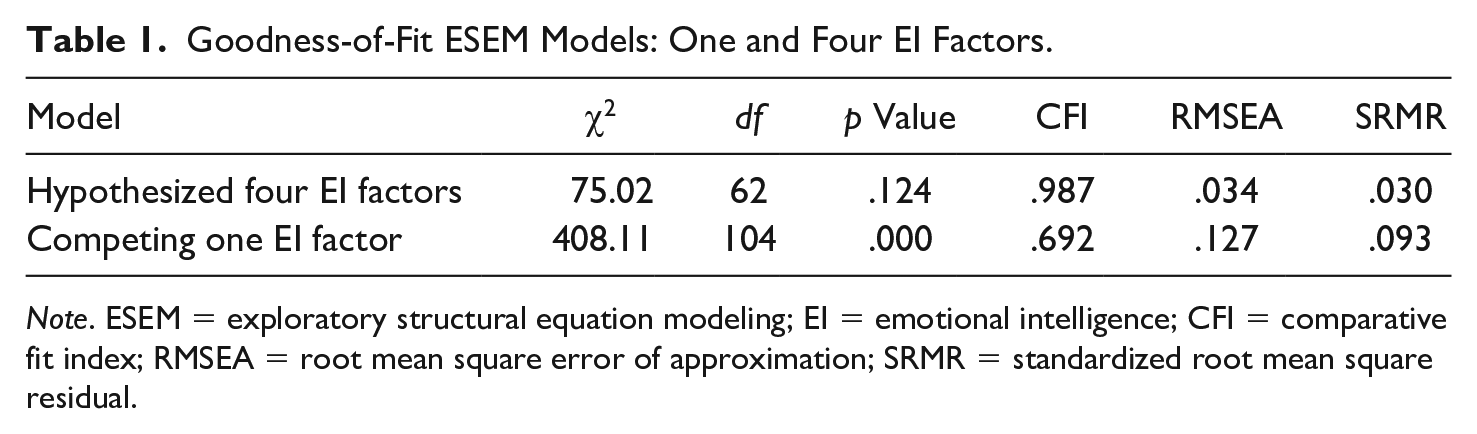
Note. ESEM = exploratory structural equation modeling; EI = emotional intelligence; CFI = comparative fit index; RMSEA = root mean square error of approximation; SRMR = standardized root mean square residual.
Table 2 shows the correlations between four factors of the hypothesized four EI factors model and the corresponding MacDonald’s omega reliability coefficients.
Correlation Matrix and Reliability of the Four EI Factors.
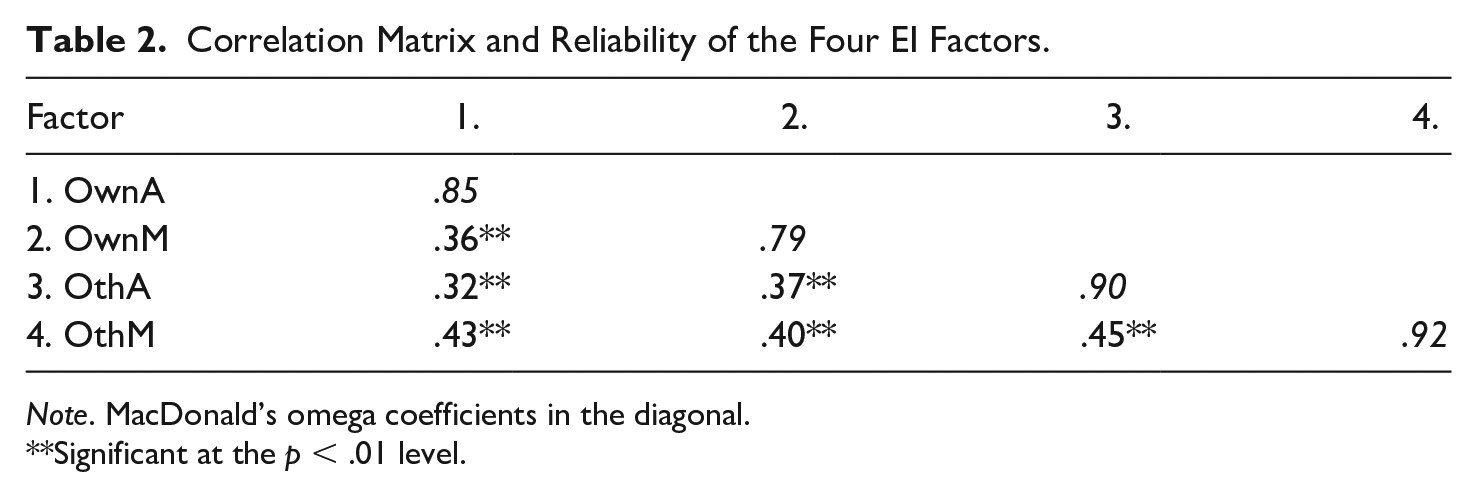
Note. MacDonald’s omega coefficients in the diagonal.
Significant at the p < .01 level.
Figure 1 displays the specific results of the retained model. Except for the case of Item ei4, all loadings in the corresponding theoretical dimensions surpassed the critical value. Hence, Item ei4 was eliminated from the analysis. No cross loadings greater than .04 were found in the retained model. Apart from Item ei1, all residual variances were significant. However, the researchers examined the explained variance of Item ei1 by the OwnA factor and found that the estimate was significant (R2 = .96, p < .01). As the estimated residual variance was positive and the fit of the model was satisfactory, and in the interest of retaining at least three indicators per factor (Kenny, 2016), Item ei1 was retained. Moreover, “practically speaking, if a causal-formative indicator has negligible measurement error, then directly linking it to the focal latent variable is probably doing little harm” (Bollen & Diamantopoulos, 2017, p. 590). Note, however, that the other two indicators on the OwnA scale had significant residual variances and the tested model included measurement errors for all the Work Group EI items.
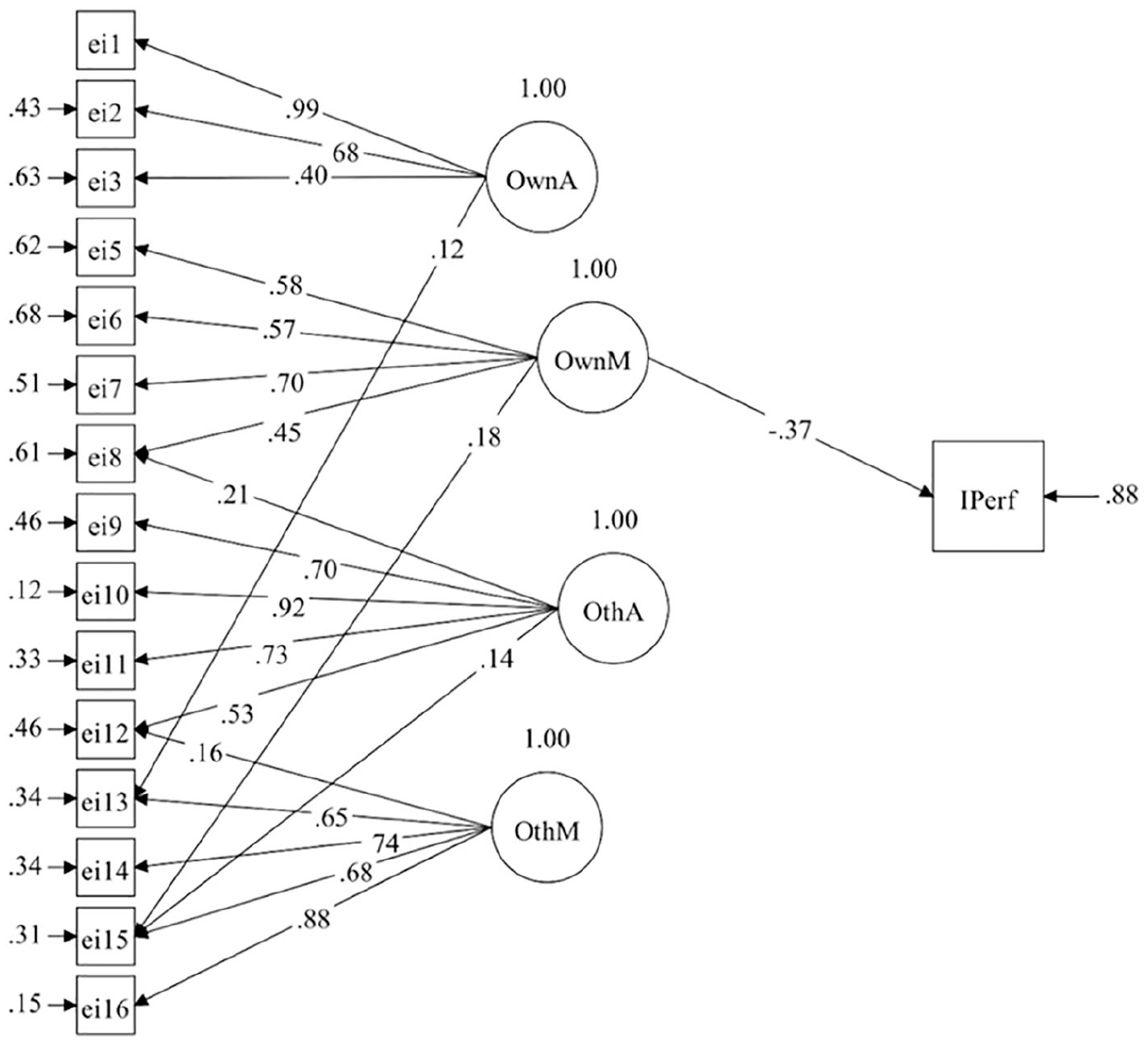
ESEM four work group EI factors and effects on individual performance in teams.
As expected, the four Work Group EI factors were positively correlated. Correlations between the dimensions were below .85, indicating discriminant validity between the four factors (Kenny, 2016). Taking into account the exploratory nature of this study, the four Work Group EI dimensions showed good internal consistency. The values of Cronbach’s alphas ranged from .68 to .90.
With regard to the hypothesis of the study, the results show that only one Work Group EI dimension exerted an influence on individual performance in teams. Notably, the effect of management of own emotions (OwnM) on the latter variable was negative. Previous research results show that only the OwnM dimension is related to behavioral outcomes. Lopez-Zafra and colleagues (2012) found that, out of the four Work Group EI dimensions, only OwnM was negatively correlated with ability to act or acting.
Discussion
Generally speaking, the Spanish version of the WEIP-S exhibited good psychometric properties in a sample of Colombian undergraduates. Except for Items 1 and 4, all indicators measure the corresponding theoretical work group EI dimensions. Although the study reported in this article is not psychometric in nature, future studies focusing exclusively on validating the WEIP-S in experiential education studies may confirm the findings presented above. Such studies should employ larger sample sizes and adopt designs that help test criterion validity for the instrument.
A limitation of the study is that the reliability of internal consistency of the single-item measure of individual task performance is not tested. The main reasons for this were the technical difficulties related to having to register students’ responses twice when the activity was applied in a single time point and also due to the fact that matching individual names to data pre- and posttest would endanger respondents’ privacy. The use of an individual team performance single-item measure was a trade-off. The authors wanted to avoid using only self-reported measures by gathering data in situ by means of external raters. Under these two conditions, the use of multiple-item measures was difficult. Nonetheless, future studies should employ strategies to facilitate the use of multiple-item measures capable of grasping more aspects of individual team performance.
The absence of common method biases arising from the use of common sources (i.e., one self-reported scale and external raters for task performance measurement) and raters (i.e., each team was observed by a different rater) may explain that, unlike other studies where all measures were self-reported (Boyatzis et al., 2017; Clarke, 2010), the hypothesis was only partially supported. Although this finding is apparently discouraging, strategies to reduce common method biases are highly recommended and future studies on the effects of Work Group EI should continue such practices to reduce Type I errors.
In a study conducted in a similar cultural setting, Lopez-Zafra and colleagues (2012) found that the only Work Group EI dimension that significantly correlated with variables such as ability to act or acting was OwnM. Furthermore, the resulting relationship was negative. Although Lopez-Zafra and colleagues (2012) used a sample of employees working in different organizations and different industrial sectors and used two self-reported measures, their study obtained similar results. However, they did not provide a developed explanation for their results, merely mentioning that EI may interact with other variables. As noted above, the results of this study showed that OwnM was the only dimension exerting an effect on individual performance in teams.
The design of the study helps explain why OwnM was the only Work Group EI dimension affecting individual task performance in teams, whereas other EI dimensions were not related to performance. This could be attributable to the lack of knowledge of team members, who were assigned to their teams almost immediately after being called upon and recruited for an experiential learning program. Furthermore, the participants of this study were randomly distributed in different teams to increase the rigor of the study/selection process. Under these conditions, students may not be able to use all the dimensions of EI. This explanation is in line with Jordan and Troth’s (2004) findings. According to these authors, the only way to gain performance benefits from EI in a team in short performance tasks with limited completion time is to manage one’s own emotions. They argue that there is not sufficient time in a short task to build up relationships that may activate the other EI skills. Jordan and Troth (2004) also suggested that cognitive tasks may require skills different from emotional tasks at work. For instance, a selection interview process may engage emotions, whereas a team task may not fully require emotions.
Another explanation of the fact that only OwnM affected individual task performance in teams is related to the fact that EI abilities build up in a sequential manner with the management of emotions, one’s own and others’ being the final factor in this sequence. This is based on the cascading model of EI shown by Joseph and Newman (2010), so perhaps the influence of this dimension was evident in the study by being the factor englobing the rest.
Previous research has demonstrated that EI is directly linked to variables such as the establishment of appropriate relationships with other team mates (Jordan & Troth, 2004) and the facilitation of a culture of collaboration, conflict resolution, decision-making, trust, and empathy (Boyatzis, 2009; Fernández-Abascal & Martín-Díaz, 2019; Jordan & Troth, 2004). Hence, it is possible that the effect of Work Group EI on task performance, as the findings show, is indirect, and that these variables act as mediators of its influence. This is aligned with Mooney et al. (2007) who argued that emotional interaction is essential to enhance relationships in groups. Other authors have reinforced these claims by arguing that the emotional management and perception of others, relationship skills, social competence, and trait empathy are key components of EI (Petrides & Furnham, 2007). Following Mayer and Salovey (1997), emotionally intelligent people may not only better perceive and understand emotions, but also engage in more psychologically advanced processes. These include the management of their own emotions (Kerr et al., 2006) and extrapolating these abilities to the emotions of others (Fernández-Abascal & Martín-Díaz, 2019). In this regard, Austin et al. (2007) pointed out that empathy (the ability to be aware of and understand another’s feelings) overlaps with interpersonal EI.
On the contrary, previous research offers an explanation for the negative effect of OwnM on task performance found in the present study. In their integrative meta-analysis, Joseph and Newman (2010) found that ability-based EI has a negative effect on performance in low emotional labor jobs. This may be the case of undergraduate students who still have not entered the labor market.
Meanwhile, Weiss and Cropanzano (1996) observed that short time frames for task performance evoke emotions that need controlling and being dealt with. The weighing machine was an activity of this nature and this, together with the fact that team members did not know each other, could explain the negative effect upon individual task performance of the EI dimension of management of one’s own emotions.
Task performance was evaluated by using a single-item measure “X accomplishes the tasks assigned by the team.” This single-item scale may encompass the effort of each team member to thoroughly follow the instructions given and to play their part within the team, either by choice or by being told to by a spontaneous leader. To prevent aspects such as effort being measured with task performance scales, future studies should employ effort scales and test whether individual task performance in teams differs from effort. It is important that effort is isolated when studying the effects of EI on individual task performance in teams. Students with high EI might also be aware of their true contribution to the team task and decide to withdraw effort to avoid disruption to the overall mission or to let others contribute.
This study inquired into the effect of work group EI on individuals’ task performances among a group of mostly engineering students within a team activity. As suggested by scholars studying EI in team settings, future studies should adopt a multilevel perspective (Lopez-Zafra et al., 2012). Such a perspective will help test whether and to what extent team members’ work group EI contributes to overall team performance. Such studies would require larger sample sizes both in terms of individuals and number of teams, and also longer time frames. The authors of this article found it very difficult to collect these kind of data during a single activity (the construction of a weighing machine) among students willing to participate in international competitions. Nonetheless, efforts should be made to test the relationship between work group EI and team-level variables in the context of this study.
Although previous research has shown that the effects of EI appear to be independent from the influence of personality (Gannon & Ranzijn, 2005), future studies inspired by this research should control for the latter as there is a strong relationship between these two variables.
Selection of students for international competitions, and efforts in general to extend the benefits of experiential learning in developing EI to all students through team activities, must consider the necessity of the socialization process and the consequent trust and collaboration climate to trigger team member potential (e.g., EI) and performance. In this vein, future studies on the effects of Work Group EI should inquire into the mediating effect of trust, among other variables. upon task performance in workgroups.
Supplemental Material
JExEddata – Supplemental material for The Effect of Student Work Group Emotional Intelligence on Individual Task Performance in Teams
Supplemental material, JExEddata for The Effect of Student Work Group Emotional Intelligence on Individual Task Performance in Teams by Juan Pablo Román-Calderón, Sara Aguilar-Barrientos, Juan Esteban Escalante, Jaime Barbosa and Alejandro Arias Salazar in Journal of Experiential Education
Footnotes
Declaration of Conflicting Interests
The author(s) declared no potential conflicts of interest with respect to the research, authorship, and/or publication of this article.
Funding
The author(s) received no financial support for the research, authorship, and/or publication of this article.

Author Biographies
References
Supplementary Material
Please find the following supplemental material available below.
For Open Access articles published under a Creative Commons License, all supplemental material carries the same license as the article it is associated with.
For non-Open Access articles published, all supplemental material carries a non-exclusive license, and permission requests for re-use of supplemental material or any part of supplemental material shall be sent directly to the copyright owner as specified in the copyright notice associated with the article.
