







Abstract
Keywords
Every year, approximately 11,000 summer camp programs across the United States host over 14 million campers and 1.5 million counselors (Browne et al., 2019; Richmond et al., 2019; Whittington et al., 2017). Nearly 60% of those campers are girls (American Camp Association [ACA], 2017), while women represent about 50% of all outdoor experiential education (OEE) professionals (Mitten et al., 2018). And yet, the consensus among OEE researchers is that, despite a lack of specific data on this distribution, women are disproportionately underrepresented in leadership roles throughout camp and adventure learning contexts (Gray et al., 2017; Henderson, 1996; Warren et al., 2018). For decades, feminist scholars have called attention to the lack of space for, and representation of, women and those identifying outside of the gender binary in OEE leadership (Browne et al., 2019; Henderson, 1992, 1996; Kennedy & Russell, 2021; Mitten et al., 2018; Warren et al., 2014). Women's praxis and research contributions to OEE are significant, but those achievements are often and persistently overlooked (Mitten et al., 2018).
Women face numerous challenges that contribute to their lack of representation as leaders; sexism, gendered stereotypes and role expectations, and historically masculine hegemony within OEE severely restrict women's access and ability to thrive in leadership (Cousineau & Roth, 2012; Henderson, 1996; Kennedy & Russell, 2021; Warren, 2002; Warren & Loeffler, 2006). Gender bias pervades OEE professional culture and creates an environment wherein women are constrained by prescriptive, stereotyped gender norms (Warren et al., 2018). Such biases are antithetical to the stated intention of many OEE communities – to raise and socialize strong leaders into communities where their skills are valued (Browne et al., 2019), and must be remedied.
Despite feminist scholars’ efforts to call attention to gender discrimination in OEE, the inherent variability of OEE learning contexts, and particularly that of summer programming, makes it difficult for scholars to explore gender discrimination in contexts that can be easily generalized across OEE programs. Historically, researchers have explored issues related to gender and leadership in adventure education (i.e., trip-based), sleepaway camps, and higher education-based OEE learning programs (Cousineau & Roth, 2012; Davies et al., 2019; Gray et al., 2020; Loeffler, 1996b; Mackenzie & Raymond, 2021; Roberts & Henderson, 1997; Warren et al., 2018). Collectively, these studies suggest a need for continued dialogue and systemic improvements related to discriminatory organizational norms and their impact on women's leadership experiences at summer camp throughout OEE contexts. Summer day camp programs are largely absent from empirical studies about gender and leadership in OEE.
The current study, a single-case study at a rural day camp in southern New England, is an effort to address this gap. Specifically, we explored the following research questions:
To what degree do gender stereotypes influence the construction of professional leadership in a New England summer camp? How does this construction influence women's ability to access and effectively implement camp leadership roles?
As context for this study, we next review the problematic relationship between gender and OEE, and how constructions of leadership shape the interactions therein. We then discuss gender discrimination within outdoor learning spaces and the contribution of the current study.
Literature Review
Gender in OEE
In the late 1800s, summer camps began as spaces where boys from White, affluent families could spend time engaging in activities to “address the strain of transition from boy culture to the world of men,” (Maynard, 1999, p. 6). Activities included outdoor sports such as swimming, boating, baseball, and hiking. The popularity of summer camps soared, and soon institutions like the Boy Scouts, the Camp Fire Girls, the Young Men's Hebrew Association (YMHA), and the Young Men's Christian Association (YMCA) created summer camps to provide children from middle-class and wealthy families with an escape from “the moral and physical degradations of urban life,” (Slyck, 2006, p. xix). By the late 1930s, girls’ attendance at summer camps was almost as high as boys’, although co-ed camps were not popularized until the 1940s (Paris, 2001). While some girls’ camps hired men as counselors or leaders, women leaders often worked solely within girls-only camps (Paris, 2001).
Although the number of camps has grown considerably over the last century (Browne et al., 2019), campers of color and those from low-income backgrounds remain underrepresented–just under one-third of the camper population compared to 55% of the national population identified as students of color in 2023 (National Center for Education Statistics [NCES], 2023). These racial and economic disparities reflect what Warren et al. (2014) coined “the invisible knapsack of White [and class] privilege: the unearned and often unseen advantages White [and wealthy] people experience in outdoor adventure,” (p. 93).
Scholars also acknowledge how sexism affects camp enrollment and employment (Browne et al., 2019; Mitten et al., 2018; Rogers & Rose, 2019; Warren et al., 2014). Transgender, nonbinary, and gender-nonconforming campers face difficulty finding inclusive spaces within camps that often divide campers based on the gender binary (ACA, 2017; Gillard et al., 2014). Additionally, despite representing approximately half of the OEE professional population (Mitten et al., 2018), women are disproportionately underrepresented in leadership roles and experience sexism, implicit prejudice, disregard, and harassment as leaders (Mitten et al., 2018; Rogers & Rose, 2019; Warren, 2016: Warren, Risinger & Loeffler, 2018). Gender role stereotypes and expectations shape how female leaders are seen within the field and limit women's access to leadership opportunities (Warren et al., 2018; Warren et al., 2019).
Gender and Leadership in OEE
As practitioners, women in OEE lead students in environments originally designed for and by mostly White, able-bodied, male leaders who were perceived as rugged and charismatic, and thus competent (Warren et al., 2018). Evidence suggests that while collaboration and connection are key to OEE program success (Cooley et al., 2015), focusing on leaders’ “physical and technical skills over social, emotional, and communication skills” (Warren et al., 2019, p. 144) prioritizes men for leadership roles and relegates women to playing “second fiddle” (p. 144) in supporting roles in their programs.
Within OEE work environments, gender expectations and stereotypes create unspoken rules about if and how women should and should not lead (Pinch, 2007; Warren et al., 2018). Even campers’ implicit biases shape expectations for women in leadership by favoring male leaders for instruction about skill development (Cousineau & Roth 2012). These biases are internalized from the time campers attend their first summer programs, and continue to shape individuals’ perceptions of who should lead, and how. When camps function as socializing institutions (Browne et al., 2019) and aim to build future leaders, but fail to attend to gendered biases in their organizational culture, campers adopt similar biases. Without intervention, when the new generation of counselors assume leadership positions, they may unwittingly incorporate bias into their practice.
However, even as they feel the sting of discrimination, women in OEE have fought back. For example, in their work on removing the “invisibility cloak” around women in OEE leadership, Mitten et al. (2018) recognize women have been internationally “championing” (p. 318) women's issues in OEE for decades. Simultaneously, feminist scholars have exerted considerable effort to acknowledge women's contributions to the field (Loeffler, 1996a; Warren, 2016; Warren et al., 2018; Warren et al., 2008). For example, Loeffler (1996a) outlines ten strategies organizations can use to improve women's representation in OEE leadership, including reformed recruitment and staff training, professional development, and networking opportunities designed for women leaders. Yet, while this effort has pushed the needle within OEE, such efforts have not fully rectified male-centered narratives that exclude women's contributions and diminish the perceived significance of women's abilities as leaders in the field (Mitten et al., 2018). As recently as 2016, only men appeared in major web searches for “outdoor education significant people,” (Mitten et al., 2018, p. 320). Moreover, since 1974, women received only 33% of the last 180 prestigious honors awarded by the North American Association of Environmental Education (NAAEE) and the Association for Experiential Education for scholarship and service. There is a need to not only continue demonstrating women's professional significance through research, but to also identify ways OEE institutions can support women in leadership and challenge discriminatory systems that bind them.
As previously mentioned, framing gendered role expectations as major influences on women's access to OEE leadership may help shed light on how gender discrimination and gatekeeping manifest within the field, and hence the current study.
Theoretical Framework
To study the impact of gender discrimination on women's leadership experiences in summer camps, it is necessary to understand how gendered roles and expectations prescribe specific, and different, behaviors to men and women. One must also understand how those gender stereotypes are reflected in how leaders are “supposed to” behave; as society expects leaders to act aligned with stereotyped male behaviors, there is limited space for women to lead without breaking the boundaries of being a “good” woman or a “good” leader. Eagly and Karau's (2002) name this paradox role congruity theory.
Gender roles, or “consensual beliefs about the attributes of men and women,” (Eagly & Karau, 2002, p. 574), are social constructs that focus on perceived stereotyped behaviors that members of a particular gender exhibit (i.e., descriptive norms), and/or those that they should exhibit (i.e., injunctive norms). Descriptive norms stereotype women as communally-oriented individuals who exhibit nurturing behaviors and prioritize others’ welfare (e.g., “helpful, kind, sympathetic, sensitive,”) (Eagly & Karau, 2002, p. 574). Conversely, descriptive norms ascribe agentic behaviors to men, stereotyping them as, “assertive, controlling, and confident” (Eagly & Karau, 2002, p. 574). Men and women who violate their stereotyped roles are seen as problematic (Eagly & Karau, 2002).
Eagly and Karau (2002) also argue that leadership is imbued with stereotyped male norms. We conceive effective leaders as those showing agentic traits; they are ambitious, confident, self-sufficient, and dominant. Furthermore, because women (according to stereotypes) demonstrate communal behaviors and leaders demonstrate agentic behaviors, there is incongruity between what leaders and women “are” and should be. This incongruity creates competing ideals between stereotyped views of women and those of leaders. This dissonance traps women in what Weiner and Burton (2016) name the “double bind,” wherein women may adhere to the stereotyped female role but violate the agentic construction of leadership, thus being perceived as too soft, too sensitive, and/or too weak to be in charge. Alternatively, women can engage in ascribed behaviors of “good” leaders (be strong, bold, aggressive) but violate female gender norms and be perceived as too pushy, loud, or bossy. Weiner and Burton (2016) acknowledge this paradox creates a “vicious cycle” (p. 360) for women leaders, wherein some may ultimately opt out of leadership due to feeling disenfranchised and unsupported by their organizations. Outdoor experiential education is no exception to this phenomenon.
Within OEE, agentic behaviors are historically seen as preferred for leadership. Layers of hegemonic masculinity within outdoor education contribute to environments that value agentic leadership traits and create broad-spread biases favoring male leaders (Cousineau & Roth, 2012; Kennedy & Russell, 2021; Warren, 2016). Considering the ways gender stereotypes create societal biases against women in OEE leadership, our study explores how these gender biases function within a day camp context.
Methods
We employed a qualitative, single-case design (Yin, 2018) and interviewed participants within one camp setting. Outdoor experiential education researchers have used case studies to understand a variety of phenomena in camps. For example, Browne et al. (2019) conducted three informal case studies to explore how camps can address issues of social justice and access within their settings. Warner et al. (2021) employed an instrumental case study to understand the influence of summer camp employment on counselors’ work values. As there are myriad variations across summer camp programming (e.g., day/overnight camp, geographic location, demographics), case studies offer unique opportunities for researchers to capture individual camps’ norms and values while simultaneously sharing potential applications for others. This case study was limited to interviewing current leaders; however, future studies could consider reviewing programs’ hiring, promotion, and marketing materials as sources for data triangulation.
Site
The case camp is a rural, non-profit outdoor center in southern New England that hosts two co-ed day camps and two gender-segregated sleepaway camps every summer. We focused on this camp's day program because of its long history as a high-quality summer program, the center's two established co-ed day programs, and its tenured female executive director. The camp is situated within 700 wooded acres and hosts campers ages 4–14 and 5–13; respectively, one day camp focuses on traditional camp activities (e.g., swimming, arts and crafts, sports) while the other focuses on wilderness, survival, and nature education. Together, the programs host approximately 1,050 campers annually, with about 80% of these identifying as White. Approximately 25% of day camp participants receive tuition assistance. The staff at both camps are also predominantly White.
Sample
We used purposive sampling to recruit the camp's executive director, and then asked her to identify four director-level camp leaders with substantial knowledge of the camp to participate in the study. Acknowledging this sampling technique likely shaped influenced participants’ orientations (e.g., those more likely to have positive relationships with leadership), we chose this approach for two reasons. First, it allowed us to capitalize on the leader's knowledge of the leadership team and interview participants from across the organization who were deeply knowledgeable about camp culture including the presence of gender stereotypes. Second, we felt the invitation from a trusted colleague would be more likely to yield participation than reaching out directly. Thus, and given the study was focused on the overarching culture rather than the leader's performance, we felt the tradeoffs of this approach to be appropriate.
The final sample included one executive director, one camp director, and three program directors. Of the five participants, three identified as White women, one identified as a Black man, and one identified as a White man. All work at camp throughout the year and had worked there for at least 7 years with approximately 14 years being the average duration of employment. Table 1 provides additional participant demographics.
Sample Demographics.
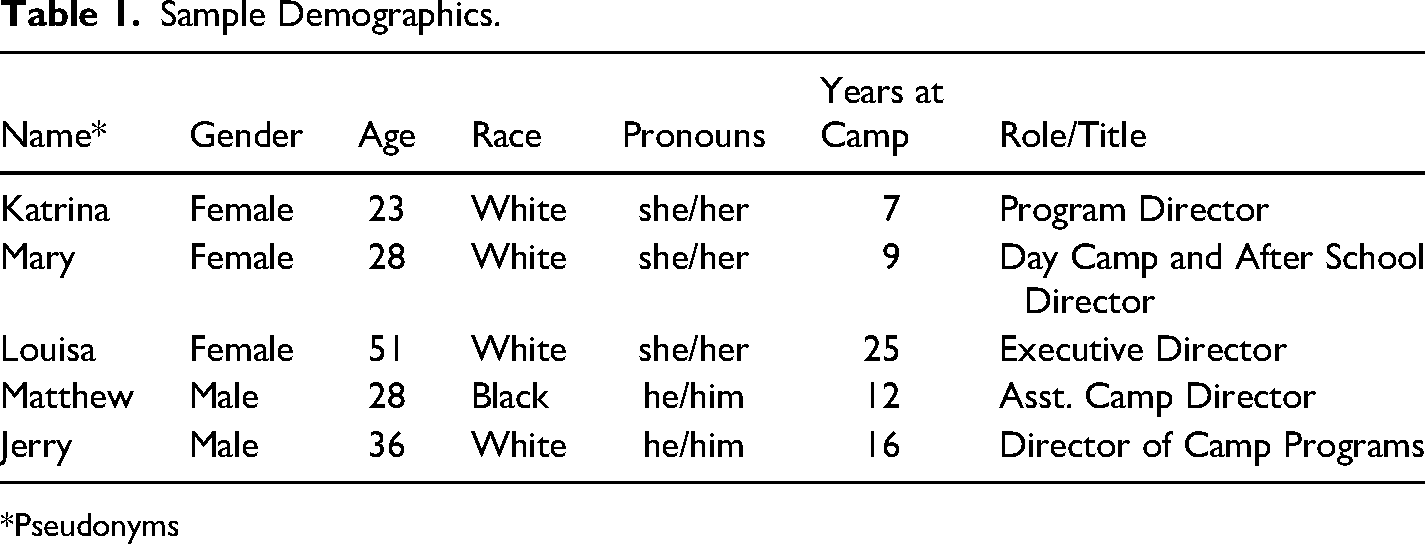
Pseudonyms
Data Collection
To build rapport and provide participants a platform to deeply consider their experiences, we followed Seidman's (2006) three-interview process. Each participant was interviewed three times for 60 min. The first interview focused on participants’ personal histories within the camp and constructions of leadership. The second interview asked participants about societal stereotypes about men and women as leaders and whether and to what degree they impacted their camp experiences. The final interview built on those prior and asked participants to consider how gender could impact women's access to, and success in, camp leadership roles. This study was approved by the IRB at the University of Connecticut. Each participant provided written informed consent prior to the first interview.
Data Analysis
We used coding software to transcribe the interview recordings, and coded data thematically using inductive and deductive approaches. We developed a preliminary collection of deductive codes using the theoretical framework and prior research about women in OEE leadership. Some of the initial deductive codes included agentic and communal leadership behaviors, challenges women face as leaders, and camp practices regarding leadership identification. During deductive coding, we wrote analytic memos and made adjustments as necessary (Saldaña, 2016). As novel themes emerged, we created inductive codes to describe those experiences. For example, a common theme was that men were seen as exceptional for demonstrating communal behaviors, whereas these behaviors were expected from (and thus not rewarded when demonstrated by) women. We created the subtheme “kindness seen as exceptional” under the category “stereotypes about men who lead” to capture this trend. One author completed the full coding process, followed by a review of codes and corroboration of findings by the second author.
We facilitated member checking (Creswell & Creswell, 2017) by presenting preliminary findings to the camp leaders. One leader affirmed our early findings saying they “sound about right” while another thought the findings, “hit the nail on the head” regarding the challenges women face as camp leaders. We also began each second and third interview by having participants reiterate their thoughts from previous interviews to confirm our conversations accurately captured their feelings and experiences. This review also provided participants with opportunities to shift their views if needed.
Positionality
We, the researchers, identify as cis-gendered, White women and acknowledge the affordances our Whiteness and status as researchers provide us. The second author has specific expertise in gender discrimination and gendered racism and was involved in conceptualizing the study and analysis but did not participate in data collection. The first author is a former camp professional with two decades of experience in the summer camp arena. This author's experiences with camp practices, and her time as a camp leader, give her background knowledge shaping her understanding of gender and camp leadership. As such, we employed strategies such as member checking, multiple coding processes, and consulting with scholars across interdisciplinary fields (e.g., education and outdoor recreation) to mitigate our subjectivities shaping the process.
Limitations
This study was not without limitations. The research focuses on participant self-reports rather than multiple perspectives or observations. Of the participants, only one was a person of color, and none identified outside the gender binary. While reflecting larger problematic and disproportionate racial demographics in OEE, future studies should aim to further diversify the voices represented in camp research (Mitten et al., 2018). Similarly, the role congruity framework (Eagly & Karau, 2002) fails to consider how intersecting marginalized identities (e.g., gender, socio-economic status) contribute to prejudices against women in leadership. Thus, while this case study helps initiate comparative case studies, repeated studies with more diverse participants, data collection methods, and settings would support more transferable findings across camp contexts.
Findings
Our analyses confirmed (1) a double standard in leadership expectations based on gender and (2) inequitable access to crucial aspects of the leadership access pipeline including representation, mentorship, and non-biased hiring practices. These obstacles created an organizational system wherein hiring practices upheld gender discrimination rather than dismantling it.
Double Standard in Leadership Expectations
Caretaking
When asked to consider how gender stereotypes inform role expectations at camp, participants described how women were expected to fulfill more caretaking roles than men. Mary explained, The expectation is that a good woman leader is like a mom…they are very emotionally invested in their staff, and that's not the case for men leaders…I don’t think there's much of an expectation for them to develop personal relationships as there are for women.”
These responsibilities for caretaking and emotional labor came from inside the camp (e.g., other leaders and staff) and outside (e.g., parents). For example, Katrina described how the expectation that she was more responsible for staff and campers’ emotional well-being than the men in leadership made her feel more like a therapist than a camp director: Obviously, I would drop anything if a kid was in need…I wasn't just, like, twiddling my thumbs waiting for someone to be sad. I reached the [camper's social-emotional] goal where I wasn't needed. But I think that [within the camp] it was very much viewed as, if I wasn't being ‘Therapist Katrina,’ I wasn't doing a good job…I don't think that expectation existed at all for [the men on staff]. From the consumers’ standpoint…who's gonna take the best care of my child? The mom type? Or, could that be a dad that has his kid on his shoulders as campers are driving in? I think people still sway towards moms. She was incredible with children, and I got promoted over her, which I thought was strange. But then afterwards [the hiring director asked me], ‘Well, do you think she could have handled not being with the children all the time? Do you think she could have handled having to discipline staff and stuff?’
In contrast, men who were caring and attentive were seen as exceptionally sensitive and successful leaders. Mary explained, [One specific male director] will always be my successful leader that I go to in my head, and I’ve talked about him already. I don’t even know how to, like–he has this air about him. He's cool, calm, and collected even when he is not, even when you look at him and you’re like, ‘you’re really stressed right now,’ he somehow doesn’t let that come across to everybody. I think he treats people well…I think that goes a long way too. You know, treating people well and making sure they know they're doing a good job…He is just so creative, and crazy organized, down to every last nook and so he doesn't feel the need to be the front man…He doesn't bitch and complain. No, no. He takes it in stride. And I think his ability to kind of weather the storm and also not emote is an incredible strength…would a woman be able to do that too? It depends on who the woman is, right?
Permission to Lead
Women at the camp described feeling that they needed permission to lead in ways they knew were correct, whereas the men did not. Male colleagues, too, elevated these differences. At two different points, Matthew explained how “feminine-presenting leaders ask for more permission than masculine-presenting leaders;” “the girls play by the rules a lot more than the boys do.”
The feeling of being required to abide by a set of unequal rules, Katrina shared, came from repeated instances wherein women were punished for asserting their authority as leaders and men were not. For example, she described a situation where she was repeatedly denied permission to prepare a unit for her staff, but her male co-director completed the same task without once asking for permission. I was very anxious to [go shopping for supplies] after being told no the first couple times, so I’d already budgeted and looked on the website for what I needed and said I’d be back in three seconds. [But] the guy, he's been gone for an hour already and just messaged me to say he has the [camp credit] card.
Even the physical layout of the camp facility was such that the men had easier access to activities for which women needed to plan ahead. Katrina explained that, within this sex-segregated camp, the girls’ swimming area was farther away from the water sports equipment than the boys’ area. This required her to plan ahead and receive permission for planning fun water activities in a way the men on leadership staff did not need to consider. If the girls want to use a trampoline or the cliff or some sort of special activity, I’ll book it out and do all this stuff and the guys [are on a beach with more access to the fun activities] so instead of doing swim lessons, they’ll just be able to see [the trampoline] is empty so they swim out…we can’t make that last-minute decision, so we have to be very calculated in planning, but the guys just kind of can do it on a whim.
Inequitable Pipeline Access
Participants described a leadership pipeline where campers worked toward becoming counselors, and counselors worked toward joining the leadership staff. Gender representation and access to informal mentorship played significant roles at the organizational level in determining who was considered for leadership. Women said they experienced inequitable access to these resources, which disadvantaged them in pursuing leadership. These disadvantages manifested as organizational hiring biases that favored those in close proximity to Whiteness and masculinity.
Representation: Seeing and Being Seen
For most leadership-aspirant staff, their journey toward leadership began with navigating representation. The feeling that one's identity was represented within the veteran leadership staff played a large role in how participants saw themselves as potential leaders. For example, Mary shared, When you see something [happening right in front of you], it's more accepted. And [it's] not just that seeing [yourself represented] makes it accepted, but seeing that makes you feel like you can do it. So, it's been kind of difficult not having female leaders in the past because it does feel like it stunts your mindset.
Another important part of the leadership identification process was whether those who were interested in leading could be “seen” as potential leaders during their training program. Being “seen”, or the ability to positively stand out from the crowd, increased access to leadership. However, as Matthew highlighted, the privilege of being “seen” and feeling safe to stand out was not afforded to all individuals equitably. He explained, I'm sure you've seen the stereotypical camp director…with the flannel and the vest and the beanie hat, the carabiner with all the keys on it for the camp. Right? Of course. So that person you've seen on TV alone. But have you ever seen a [young, Black] person who looks like me on TV as a camp leader? Probably not. Or in movies? No. Like you look at [the movie] The Parent Trap, you know what I'm talking about. She's got the clipboard; she's got the flannel. Her whistle around her neck, with the visor… but you've definitely not seen someone who looks like me.
The privilege to take up space and see yourself represented in a room full of leaders, participants explained, was a critical piece of pursuing leadership at their camp. Mary explained when women didn’t see themselves represented in leadership spaces, they felt they had to work harder to prove themselves, and were scrutinized more than those in the majority group. [As a woman] …you are constantly having to seek that approval and prove that you are better than everybody else at your job, especially if you’re one woman in a group of men. I think that can be extremely difficult, because they could treat you differently without even realizing it.
Mentorships
For many participants, mentorships served as foundational opportunities to form relationships with veteran leaders, gain insight about what leaders do, and learn about the nuances of their camp's culture. As Matthew explained, mentorships were “the place for learning.” Louisa explained that mentorships are often seen as equally valuable, or potentially more valuable than, formal education or training about the camp world. She shared, Someone that grew up in the organization has access to, you know, mentorships and relationships that don't necessarily translate to paper the same way as a master's degree does…but are also valuable.
However, because access to mentorship was largely dependent on whether individuals could “see” themselves represented in camp leadership, those with less representation experienced more difficulty creating these experiences. For example, participants’ access to mentors who shared their racial identities impacted their perceptions of themselves as leaders. Matthew explained how seeing a Black woman lead in camp gave him a sense of direction for himself. He shared, “[My camp role model] is a Black woman, one of the very few Black women leaders we’ve had at this camp. I try and role model a lot of parts of myself off her.”
Within the context of gender, the disproportionate number of men in camp leadership made it difficult for women to identify and create relationships with veteran women leaders. None of the women we interviewed named other women as mentors. Two were named men, and one did not name anyone. While the lack of same-gender mentors did not prevent these women from achieving leadership positions, it impacted their perception of leadership's accessibility. For example, Mary shared, I just didn’t think [leadership] was very achievable for me. Had I seen more [women leading], I would’ve been like ‘oh, I can do that…,’ but I didn’t see that, unfortunately…Even now, yes, I’m the leader, but I still don’t see myself as the ultimate leader.
Not only did access to informal mentorships (and lack thereof) influence how individuals saw their potential as leaders, it also impacted how they were identified as potential leaders from an organizational perspective. The pipeline favored those who had created informal mentorships throughout their journey and had been “seen” as potential leaders by those responsible for hiring and promotion.
Hiring Biases
Participants described hiring practices which, while labeled gender-blind, favored individuals who shared racial and gender identities with veteran leadership staff. These individuals received opportunities to “practice” camp leadership before assuming their roles, which provided them with greater access to leadership once roles became available. For example, Jerry, a White man, shared his experience of moving into his current leadership position as “informal,” explaining, “I never had to jump through those [formal interview] hoops because I'd been doing the role without the title for, for a few months at that point.” Jerry described his ascension to his leadership role as a “natural fit” explaining, I [gained] experience on what the job actually required [before being promoted], and so when it came to pass that he was ready to retire…at that point, I was the longest serving and the oldest, it just became a natural fit.
For example, Mary noted how one of her leadership-aspirant counselors “really stepped up to the plate” and took on extra responsibilities to show their leadership skills. Mary explained, “we had [a counselor in the past] who we wanted for a position…so we told him, ‘You’re gonna do it for the day while [the current director] is with you, so that you can have the practice.’” This practice offered opportunities to work with a close mentor, ask questions about leading, and demonstrate his leadership skills prior to interviewing for the position.
However, not all counselors were equally able to share those skills with their directors. Katrina shared, “I feel like it's more common that men will ask for leadership roles or be more upfront that they want those roles.” Matthew explained that this phenomenon might be because, The closer that somebody is to Whiteness and masculinity, the more they're perceived as an effective leader. And the further they are in any direction from that pinpoint, they're gonna work harder to gain respect; they have to work harder; they have to prove themselves…Every person of color, at a certain age, they get the speech: You are going to have to work twice as hard in any setting that you're in to get the same as someone who is White. Point blank.
Still, some participants pointed to gender-blind hiring practices as evidence that gender discrimination and inequitable access were not issues at the camp. For example, Mary believed the camp's ability to identify and hire diverse leadership staff was most influenced by the applicant pool. She shared, It's all about timing. Who's available, when…so when people started leaving and there were [women] that were there to promote, [directors] promoted them. It was very situational that there were so many men just by chance. And there's a lot of women now, and that will change over time… The good thing about how we hire is that we never have a lack of candidates…we’re not hiring someone who's worse because they tick a gender box. It never comes down to, ‘okay, well they’re that gender, so we’re gonna hire them'. [If a woman is] closer to Whiteness, that's a step in a more respected direction in the camp community. [And] if women are presenting with more masculine energy, you know? But as women get further away from the idea of that burly, beanie-hat, White dude, they're working harder…if a woman is of color, or if a woman is feminine-presenting, or if a woman is queer, there are more barriers for her to break down before she can have access to the same level of respect that a White man would have.
Discussion
In this study, we aimed to identify whether gender stereotypes influenced constructions of leadership at a summer day camp and, if so, how this influence occurred. We also sought to understand whether and how those gendered constructions impacted women's access to, and experiences within, leadership. The lens of role congruity theory (Eagly & Karau, 2002) highlighted how societal biases against women manifested as discriminatory practices in OEE leadership. Specifically, the construction of leadership within this camp rewarded men's agentic behaviors and punished women who led similarly. These findings echo those of Rogers and Rose (2019), who highlighted the negative feedback women receive when they lead in ways socially perceived as too communal or agentic. Beyond benefiting from hegemonic masculinity in OEE (Kennedy & Russell, 2021), men who showed communally-oriented leadership traits were recognized as exceptional leaders, while women lost promotions and were reprimanded for behaving similarly. This gendered construction of leadership manifested as women having inequitable access to leadership development pipelines compared to men, especially concerning representation, informal mentoring, and promotion.
Additionally, this study demonstrated that women experienced pushback whether they asserted expertise and commanded respect agentically or led communally. The double standard these women faced is consistent with Weiner and Burton's (2016) description of the double bind, wherein women are permitted to lead neither agentically nor communally without facing consequences for behaving outside of what is socially permitted.
Moreover, our findings regarding the gendered construction of leadership at this camp created a backdrop for understanding how gender stereotypes impacted women's journeys throughout the leadership pipeline. Access to same-gender representation and mentorship, or lack thereof, played crucial roles in their self-perceptions as potential leaders and in their access to equitable hiring practices.
Representation, or being able to see oneself within existing leadership and the privilege of being seen as a potential leader, advantaged those whose identities aligned most closely to Whiteness and maleness. Feeling represented allowed individuals to take risks within the bounds of socially permitted behaviors. Those without equitable representation (e.g., women, people of color) already existed outside the mold of what a stereotypical leader looked like, and so they were considerably limited in how much space they were allowed to assume while pursuing leadership. The lack of representation participants described echoes what feminist scholars across the OEE field note: women are under-represented in camp leadership (Gray et al., 2017; Henderson, 1996; Warren et al., 2018).
Without representation, women experienced challenges establishing informal mentorships with veteran leaders on staff. These mentorships were essential opportunities for staff to refine skills, gain insight, and form meaningful relationships with leadership staff. Several studies note the high potential for mentorships as a way to transfer skill sets and train upcoming generations of camp leaders (e.g., Riley, 2019; Shooter et al., 2009). However, when women experience inequitable access to these opportunities, their development as leaders is disadvantaged, and the systemic barriers they face in the leadership pipeline become more difficult to overcome.
Biased hiring policies presented an additional barrier in women's leadership pipeline. Despite arguments that the process was “gender-neutral,” homophilic hiring practices (Rivera & Owens, 2021) disproportionately favored those who aligned most closely with those making hiring decisions. Aspirant directors who saw themselves demographically represented by current leadership were more able to create meaningful relationships with veteran leaders and practice leadership skills before being promoted; women without access to the privilege of representation lacked these resources.
While these discriminatory hiring practices limited women's access to leadership roles, they did not diminish access entirely. However, women who were hired faced explicit discrimination from their colleagues as a result of leading in misalignment with gendered stereotypes. Reflective of Warren (2015), this discrimination was operationalized through colleagues questioning women's skills and competencies, reinforcing gender role expectations about caretaking and other communally-oriented behaviors, and hiring biases that favor men for leadership positions. Thus, inequitable access to the leadership pipeline prevails as camps continuously perpetuate systemic cycles of underrepresenting women, upholding hegemonic masculinity, and enforcing harmful double standards across camp generations.
Implications
In addition to our call for additional research focusing on the experiences of women in leadership across camp contexts and additional attention to intersectionality, our findings also provide practical implications. First, the persistence of gender discrimination in camps suggests a need for explicit training on gender biases and their impact on camps’ leadership expectations and organizational culture. For example, Wittmer (2001) suggests three ways leaders can recognize biased norms within their camps: identify leadership styles and internal biases; create awareness in colleagues of gender-role expectations; and mentor participants in becoming effective leaders (p. 175). Second, camps can promote gender equity by addressing harmful program policies related to hiring, promotion, and staff development. For example, Rogers and Rose (2019) recommend leaders to, “revisit hiring policies that may be exclusive, reallocate budgets around DEI efforts and recruitment, and reexamine training and curriculum materials through a DEI lens,” (p. 48) to promote equity at the systemic level. Bohnet (2016) offers concrete ways to shift hiring practices to make them less likely to reinforce gender bias. These include avoiding gendered language in postings and interview questions, focusing on concrete skills and knowledge rather than “fit” or “promise,” standardizing the process such that all candidates the same questions in the same order, and waiting until the end of the process before interviewers share opinions or notes. Heilman and Caleo (2018) expand these recommendations from an organizational perspective, suggesting programs can dismantle systemic gender biases through thoughtful promotion practices such as attending to group composition and “clustering” (p. 730) women leaders in stereotypically “masculine” spaces to avoid the activation of gender stereotypes and reduce gender tokenism. Finally, support can be provided to women to help them recognize and learn strategies to combat gender discrimination rather than internalize it (Weiner & Higgins, 2023). However, for real change to occur the focus needs to be on reforming discriminatory systems rather than those most harmed by them.
Conclusion
As harbors for positive youth development (Sibthorp et al., 2010), camps have a social responsibility to ensure their programs provide campers with equitable representation in their leadership staff. As participants reiterated throughout this study, when individuals can identify aspects of themselves in the roles they aspire to achieve, the “magic” of camp multiplies. Though gender-blind hiring policies and implicit expectations for leaders may support some, particularly those with racial and gender privileges, these systems inhibit women's pursuit of authentic leadership experiences. Considering these inequities, OEE institutions can address the root causes of gender discrimination by implementing the recommendations described above.
Footnotes
Declaration of Conflicting Interests
The authors declared no potential conflicts of interest with respect to the research, authorship, and/or publication of this article.
Funding
The authors received no financial support for the research, authorship, and/or publication of this article.
