







Abstract
Keywords
Introduction
Creative arts therapies (CATs) have been used with students in the K-12 school-setting for the past several decades to promote well-being (Beardall, 2011; Hannigan et al., 2019; Panagiotopoulou, 2018), address psychosocial challenges (Gold et al., 2017; McDonald et al., 2019; Ramirez et al., 2020), and, to a lesser extent, support academic learning (Johnson et al., 2021). As an emerging area of empirical investigation, school-based CAT interventions have demonstrated utility due to their focus on inter/intrapersonal functioning, capacity to integrate concrete and abstract concepts, and provision of short-term support (Frydman et al., 2022; Pitre et al., 2016).
While CAT presence in schools has undergone a surge in research activity focused on pre/secondary grades, what is less understood is the overarching role of CATs in the contemporary postsecondary setting. Notably, many recent studies on CATs in higher education have tended to explore these interventions for mental health purposes, as originally designed (Boldt & Paul, 2010; Price & Swan, 2020; Sonnone & Rochford, 2020), with less consideration for how CATs might be uniquely suited to meet broader postsecondary educational goals. This discrepancy also exists within K-12 research, indicating that the application of CATs purely for academic success has been underexplored across educational settings. Although art-based methods have been used extensively in the postsecondary classroom (D’Alessandro & Frager, 2014; Gair, 2012; Keller-Dupree & Perryman, 2013; McNichols & Witt, 2018; Reeves & Neilson, 2018), CATs possess the unique basis of emerging from a therapeutic frame. Such a foundation is centered in individualized experiential engagement, potentially placing a greater emphasis on the role of psychosocial domains to stimulate learning, such as through personal expression and/or leveraging group processes.
The following secondary analysis takes a step toward addressing this gap in the literature by preliminarily examining the contributions of CATs to achieve postsecondary academic success over the past decade.
Literature Review
Creative Arts Therapy
Creative arts therapy is a broad term that encompasses multiple arts-based approaches to working therapeutically and/or communally to improve the psychosocial and socioemotional well-being of participants (Shafir et al., 2020). According to the National Coalition of Creative Arts Therapies Association [NCCATA] (2021), the following modalities fall under the larger domain of CATs: art therapy, dance/movement therapy (DMT), drama therapy, music therapy, and poetry therapy. Chiang et al. (2019) note that CATs, through the use of their reference art form as a container of projective and affective material, can enhance the capacity for relational functioning, access nonverbal components of experience, and facilitate creative action to bolster mood, self-confidence, and cognition. Moreover, the therapeutically informed creative act supports a dynamic approach that can flexibly adapt to emerging needs, providing an ever-evolving connection between consumer, practitioner, and the setting (Shafir et al., 2020).
Research-based investigations into CAT effectiveness have recently begun to take shape leading to a collection of reviews focused on identifying and isolating the key elements across various CATs responsible for facilitating change (Berghs et al., 2022; de Witte et al., 2021; Moula et al. 2020). With this, a broader intention within CAT research communities is to align interventions and techniques with targeted outcomes; an approach that has stretched into setting-specific needs, such as in schools.
Creative Arts Therapies in Schools
To date, much of the CATs-in-schools literature has focused on interventions meant to improve the socioemotional functioning and well-being of K-12 students (Frydman & Mayor, 2023; Hannigan et al., 2019; Moula et al., 2022; McDonald et al., 2019). Typically, this has taken the form of two routes: the first, as embedded counseling support through formal educational procedures, such as Individualized Education Plans or 504s (Isis et al., 2010; Nelson, 2010), the second via providing services as an outside contractor brought in to address a variety of student mental health needs (Frydman & Mayor, 2021; Sajnani et al., 2019; Sutherland et al., 2010). Thus, the brunt of CATs-in-schools literature has been contextualized within K-12 mental health operations.
What has been less discussed is the utilization of CAT techniques to promote academic success. When investigated, studies have generally focused on addressing mental health challenges with a concurrent or adjunctive consideration of academic issues, suggesting that CATs may directly address underlying difficulties that prevent academic engagement (Anderson, 2015; Chong & Kim, 2010; Freilich & Schectman, 2010; Johnson et al., 2021). Researchers have offered that by utilizing CATs as a projective tool to engage socioemotional content, students are able to expand their focus and center their attention on other tasks, which can improve learning experiences (Anderson, 2015; Freilich & Schectman, 2010; Johnson et al., 2021). While there has been some literature dedicated to understanding how CATs may be directly or indirectly used to support academic achievement in K-12 systems, what has not been explored through a broad lens is how this has taken shape in later-stage schooling.
Postsecondary Academic Success
Academic success has been previously defined according to a series of factors reflective of postsecondary education. Kuh et al. (2010) provided a useful definition, noting that it is a multifactorial construct comprised of the following domains: “…academic achievement, participation in educationally purposeful activities, satisfaction, acquisition of desired knowledge, skills and competencies, persistence, attainment of educational outcomes, and post-college performance” (p. 5). A later critique of this conceptualization maintained core components of the model, but implicated academic achievement and satisfaction as proxies for attainment of skills and competencies as well as contextual factors of the learning environment, respectively (York et al., 2015), thereby devaluing their isolated contribution to the overall construct. Further calls in the literature have echoed this movement away from positioning grades as a prime indicator of academic success (Goegan & Daniels, 2021), suggesting that a more holistic understanding would more accurately reflect the complex dynamics of student experience in successfully navigating higher education (Strayhorn, 2018; Tinto, 2012). Overall, the concept of academic success is necessarily broad and features a range of considerations encompassing factors that students bring to a postsecondary setting, the ecology and structure of the setting itself, and how student and environmental factors lead to success (Astin, 1991).
The Present Review
The present secondary narrative review analyzes a subcollection of empirical articles initially aggregated for a systematic review centered on CATs in schools (Frydman et al., 2022). As inclusion criteria from the initial review set relevant literature in a K-12 setting, articles discovered through the search process discussing CATs in postsecondary education were previously excluded. Therefore, this is an exploratory review seeking to identify potential trends and themes from a collection of postsecondary studies that may give initial shape to an emerging practice within higher education. As of yet, a review of this kind, which overviews research with this particular student population, academic setting, and educational focus, has not yet been conducted. In isolating and considering the present articles, we offer a broad and preliminary understanding on how CATs have been used in the postsecondary setting to achieve academic success through empirical evaluation.
Empirical investigation establishes systematic assessment through direct or indirect experience or observation (Armstrong et al., 2019a). Since CATs have an extensive history of case study literature, an intentional focus on empirical inquiry promotes critical research factors such as replicability, transferability, and generalization (Cruz & Koch, 2015; Cruz & Tantia, 2017). Additionally, CAT researchers have increasingly focused on empirical approaches in understanding effectiveness (Armstrong et al., 2019b; Baker et al., 2018; Shafir et al., 2020), seeking to advance rigor and reduce bias.
Given the relative uniqueness of using CATs to achieve educational goals and the field's recent emphasis on empirical work, our research questions intend to probe a precursive framework and assess corresponding methodological approaches:
Given that a subcollection of empirical articles collected for a previous systematic review (i.e., Frydman et al., 2022) were excluded due to their specific focus on tertiary education, what can an examination of these select studies preliminarily suggest about the characteristics of CATs in the postsecondary setting? As the initial review set parameters from 2009 to 2019, in what ways have select CATs been used to achieve academic success in the postsecondary setting during the previous decade? To what extent have these educational interventions been empirically investigated to support transferability and/or generalization?
Methods
Approach to a Secondary Inquiry
As this was a secondary review of articles that did not meet inclusion criteria from an initial inquiry with a K-12 focus, a more thorough overview of the formative search strategy is provided in Frydman et al. (2022). Due to its secondary nature, an alternate methodological frame was adopted to distinguish the present research inquiry from the previous one in the form of a narrative review.
Comparison of Narrative and Systematic Reviews
While a systematic review takes a preset, structured approach to literature inquiry that is rooted in a strategically designed protocol, a narrative review affords researchers the ability to take an adaptive approach (Efron & Ravid, 2019; Ferrari, 2015; Sukhera, 2022). Resultantly, this less restrictive method does not require a standardized technique for investigating an area of interest. Instead, the narrative review offers a widened scope for inclusion of literature and seeks primarily to describe and appraise published literature as a broad overview (Green et al., 2006; Pae, 2015). Moreover, the structure of a narrative review is not as specified as a systematic review, which traditionally adopts PRISMA guidelines as a means of organization and structure (Page et al., 2021). Instead, the suggested model is intentionally broad to facilitate an author's preference for how to best represent literature findings according to a research question (Ferrari, 2015; Sukhera, 2022). Meaning that authors can organize results based on their conceptualizations of trends, links, and/or major implications in response to an emergent point of inquiry. A restrictive factor of narrative reviews is that details of the search design and implementation may not be provided, or done so in a limited way, reducing the chance for replicability and creating greater opportunity for researcher bias to influence the research procedure (Efron & Ravid, 2019). On the other hand, this pluralistic strategy supports an open-ended search process that can be added to and continuously built out in future reviews to bolster theories and/or research trajectories (Sukhera, 2022).
In adopting this flexible approach, the present intention is to begin identifying considerations and recommendations from a selection of the past decade's empirical research about the use of CATs to promote academic success in higher education.
Carryover Elements from the Initial Systematic Review
Due to the present narrative review emerging from a seminal systematic review, structural elements traditionally aligned with the latter are included to account for the observed limitations of the former and help answer the research questions. These elements increase the rigor of this review by contributing to a greater level of organization.
Establishing Inclusion/Exclusion Criteria
Inclusion and exclusion criteria for this review are outlined in Table 1 (first two columns). Alongside these criteria are the original criteria established by Frydman et al. (2022) (second two columns). Overall, foundational inclusion was predicated on the use of CATs, as defined by NCCATA (2021), as a primary intervention, the intervention taking place in a contemporary school setting at the time of initial search (i.e., between 2009 and 2019), and the application of an empirical frame. Empiricism was understood according to approaches previously adopted in CAT research including quantitative, qualitative, and arts-based methods (Armstrong et al., 2019a). Case studies were considered to be empirical if analyzed within an identified qualitative methodology or coding approach and/or featured multiple sources of data (Yin, 2009).
Inclusion/Exclusion Criteria: Comparison of Reviews.
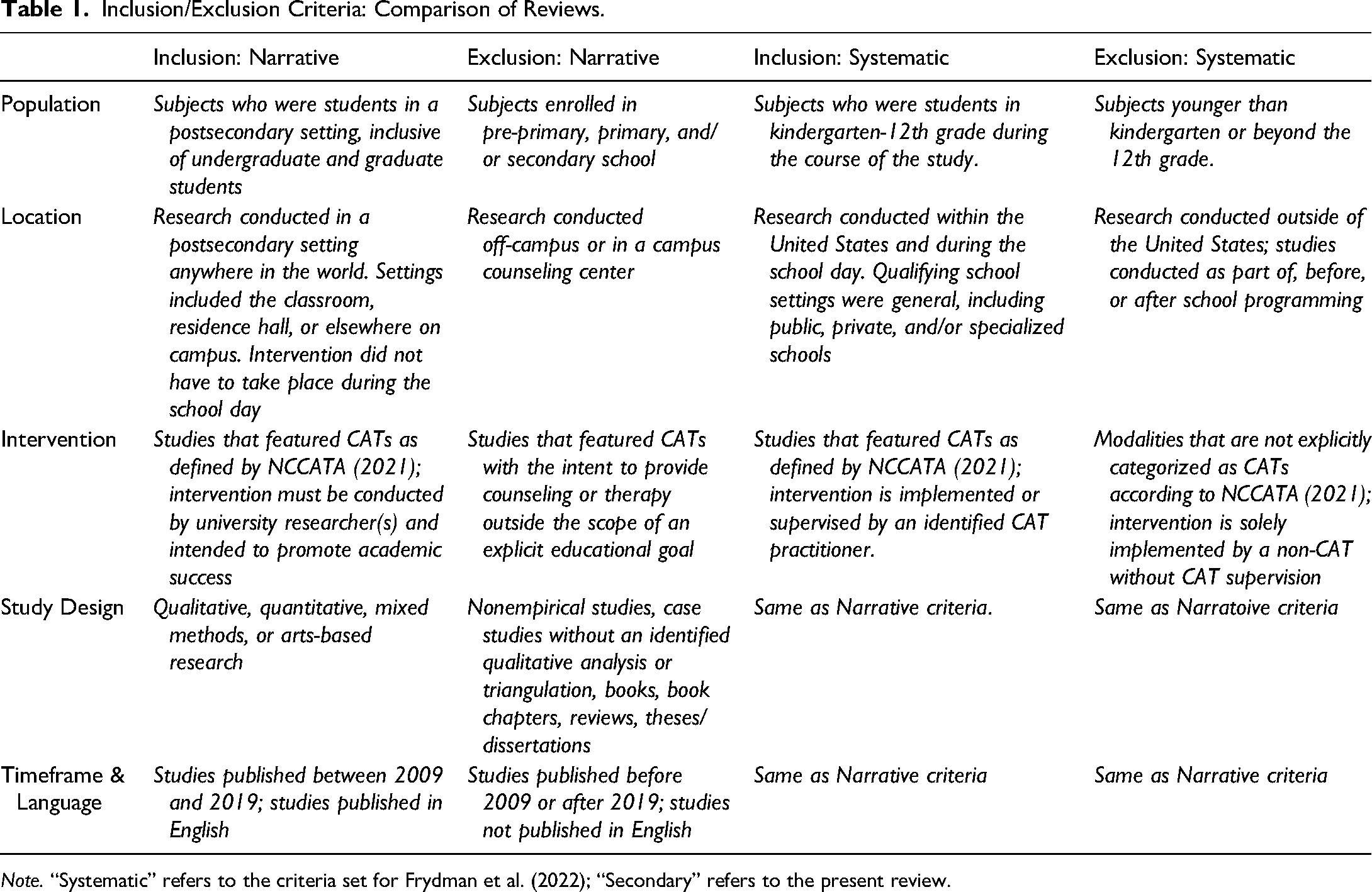
Note. “Systematic” refers to the criteria set for Frydman et al. (2022); “Secondary” refers to the present review.
Search terms used for the original article were specific to the previous research questions, which sought to determine the state of contemporary research on empirically evaluated K-12 school-based CAT interventions within the United States. A full accounting of the original search terms and search procedure is offered in Frydman et al. (2022). However, to provide clarity in this report on which terms were primary in the original search process, a replication of the root terms and categories is offered in Table 2. In sum, these terms were searched independently within each category, assessed for potential variants, aggregated into single categories, and then categorically cross-matched to generate results. Iterations of search strings across three major databases (PsychINFO, PubMed, Web of Science) categorically featured each CAT approach, type of empirical method, and school terms. For this last category, in addition to K-12 specific terms, two additional root terms were also included to widen possible returns: school setting and school intervention. These two terms are presumably the major vectors that generated the subcollection of the presently identified postsecondary articles.
Primary Search Terms by Category from Frydman et al. (2022).
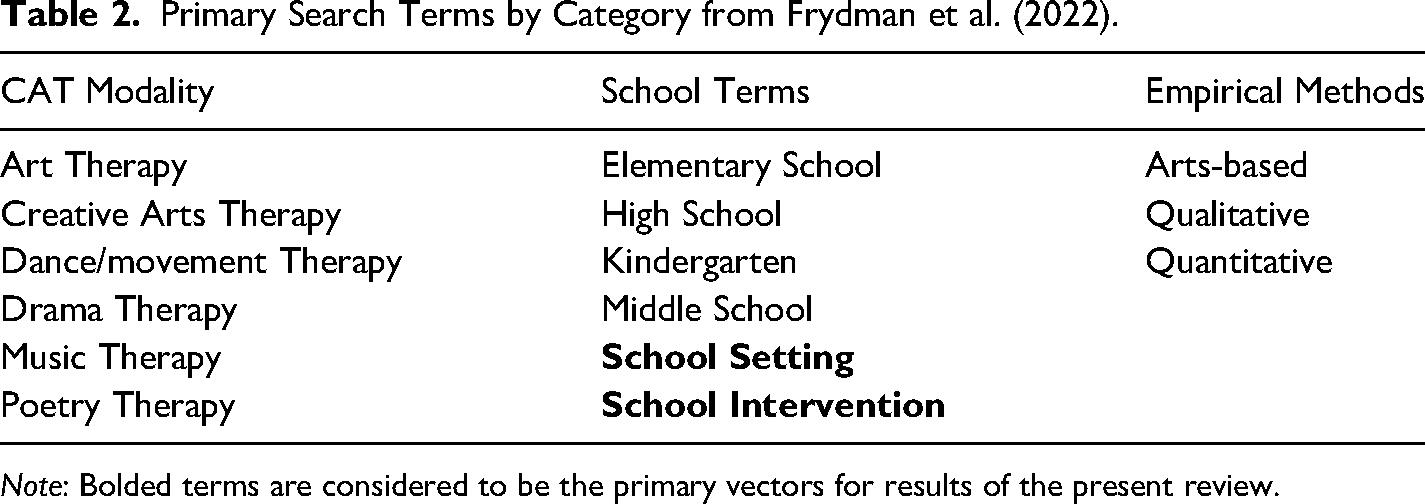
Note: Bolded terms are considered to be the primary vectors for results of the present review.
Following the articulation of the first and second research questions and a brief examination of the subcollection, major criterion differences for this review were set and included: (1) postsecondary students as the primary participants, (2) a postsecondary setting that was located anywhere in the world, (3) a focus on academic success via a CAT intervention, (4) conducted by a university-based researcher, and (5) took place outside of a university counseling center. This last criterion differentiated between typical college counseling practices and CAT use to address academic success.
Establishing eligibility occurred in three phases. First, all articles meeting face criteria from title and abstract were fully reviewed by the first and second authors to determine alignment with inclusion criteria. Any disagreements at this phase were resolved through a direct comparison of the article's face-level data and the established inclusion/exclusion criteria for this narrative review. Second, following individual read throughs, narrowed selections were compared for inclusion. Third, disagreements were resolved through discussion until consensus was achieved. When identified within the second and third steps, reasons for rejection were determined based on thorough analysis of each article and joint agreement on meeting preset exclusion criteria; specific reasons for removal are provided in Figure 1. As a final, organizing step, we applied the PICOS (participants, interventions, comparisons, outcomes, study design) framework (Saaiq & Ashraf, 2017) to better understand the scope of each major section per article.
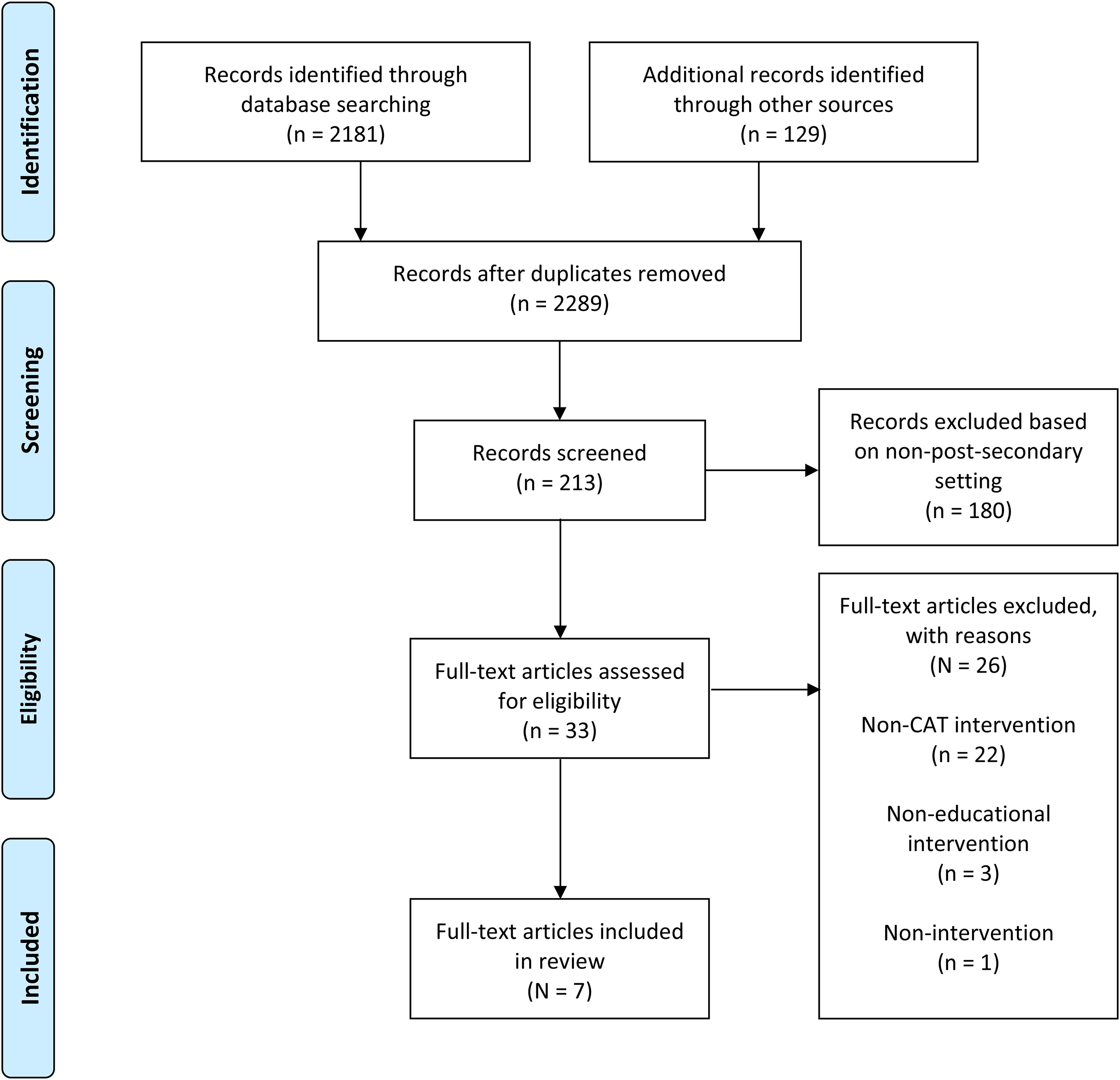
PRISMA 2009 flow diagram.
PRISMA Flow Diagram: Figure 1 provides a depiction of the literature search process, with the identification and screening (first component) sections reflecting the initial review and the subsequent screening (second component), eligibility, and included sections outlining the deviation taken for this review. PRISMA guidelines are intended for systematic reviews as a means of organization and structure (Page et al., 2021). Although a secondary narrative review, the diagram is included in this analysis due to the availability of the formative data and to highlight how eligibility was determined.
Risk of Bias Assessment: Assessing risk of bias (RoB) among included literature provides a clearer understanding of how, and to what extent, results should be considered replicable and/or generalizable, thereby assessing the strength of a body of evidence (Viswanathan et al., 2018). While this process has been positioned as the standard for assessing reliability of findings among rigorous methodological approaches, such as randomized control trials (Higgins et al., 2023), Hawker et al. (2002) developed RoB guidelines for literature featuring multiple methodologies.
In an effort to address our third research question, the first and second authors conducted an RoB assessment to evaluate the methodological strength of each article. Observations of transferability and/or generalization were identified and highlighted the rigor employed as well as areas for fortifying internal validity and/or credibility. Risk of bias domains assessed included: abstract and title, introduction and aims, methods and data, sampling, data analysis, ethics and bias, findings/results, transferability/generalizability, and implications/usefulness. Similar to the process adopted for determining article eligibility, and as conducted in the RoB assessment in Frydman et al. (2022), the procedure took place in three sequential steps: both assessors read through the full text of each qualifying article, scored articles according to the Hawker et al. (2002) criterion and compared scores for each domain, and resolved any disagreement via discussion to determine consensus. To specify this latter step, consensus was achieved through a process of fitting each researcher observation to the Hawker et al. (2002) criteria; the observations that fit the criteria most clearly via joint researcher judgment were used to finalize the categorization.
Results
Article Screening Process
The following stepwise procedure details the search process for the original study that is represented graphically in Figure 1. The final articles included for this narrative review were extracted from the eligibility screening stage in Frydman et al. (2022) with the specific reason being an ineligible population of postsecondary students. The two reviews share the following results in common: initial database searches resulted in 2,181 articles with an additional 129 articles added via a manual search of relevant journals, yielding a total of 2,310 articles. Twenty-one duplicates were removed, and time boundaries were applied (i.e., inclusion from 2009 to 2019) leaving 213 articles. At this point in the screening process, the two reviews diverged. For this review, of the remaining articles, abstracts were assessed for taking place in a postsecondary setting leading to the exclusion of 180 additional articles, resulting in 33 articles remaining. Figure 1 reports on the reason for the removal of an additional 26 articles as a final step before the final inclusion of seven articles.
Organization of Findings
The articles are presented in a manner that works conceptually through the research questions, which are intentionally broad to afford flexibility in conceptualization per a narrative review approach (Efron & Ravid, 2019; Green et al., 2006; Pae, 2015; Sukhera, 2022). To address the first research question, we begin with general characteristics of eligible studies including a breakdown of methodological frameworks, then, for our second and third research questions, we present major findings across studies and conclude with the RoB assessment results to determine rigor of inquiry.
General Characteristics of Eligible Studies
Primary elements of all included studies are featured in Table 3. Comparatively, researchers gathered data at universities predominantly in North America (Bailey, 2016; Butler, 2017; Mungas & Silverman, 2014; Schwantes & Rivera, 2017), followed by Europe (Butler, 2017; Satkova, 2019; Yucesan & Sendrurur, 2018), and Israel (Federman, 2011). Among the programs surveyed at these institutions, only a few featured at least partial data from graduate students (Butler, 2017; Federman, 2011; Mungas & Silverman, 2014), with the majority focused on undergraduate students (Bailey, 2016; Mungas & Silverman, 2014; Satkova, 2019; Schwantes & Rivera, 2017; Yucesan & Sendrurur, 2018).
Characteristics of Eligible Studies.
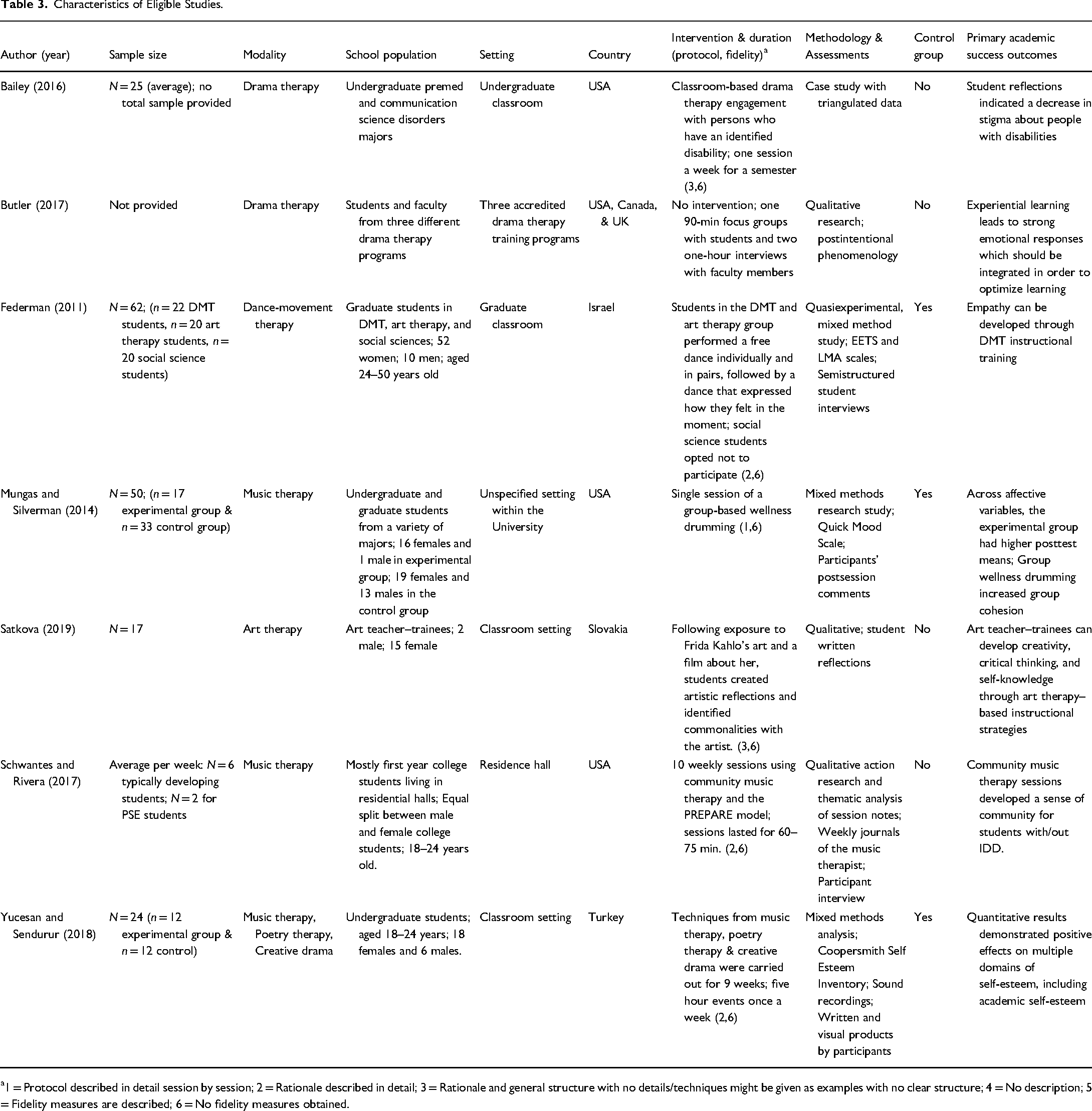
1 = Protocol described in detail session by session; 2 = Rationale described in detail; 3 = Rationale and general structure with no details/techniques might be given as examples with no clear structure; 4 = No description; 5 = Fidelity measures are described; 6 = No fidelity measures obtained.
All CAT modalities were represented, including art therapy (Satkova, 2019), DMT (Federman, 2011), drama therapy (Bailey, 2016; Butler, 2017), music therapy (Mungas & Silverman, 2014; Schwantes & Rivera, 2017; Yucesan & Sendurur, 2018), and poetry therapy (Yucesan & Sendurur, 2018). While the most studies focused on implementing techniques drawn from a single CAT modality, Yucesan and Sendrurur (2018) took a multimodal comparative approach.
Only two studies sampled CAT-trainees. Butler (2017) conducted interviews in three drama therapy graduate programs across North America and the U.K., and Federman (2011), in an effort to highlight benefits of utilizing DMT for teaching empathy, used art therapy and social science graduate students as comparison groups. In contrast, the majority of studies utilized CAT approaches to achieve academic success with non-CAT students. For example, Bailey (2016) used drama therapy techniques with undergraduate premedical and communication sciences majors to teach about and reduce stigma surrounding disability; Mungas and Silverman (2014) incorporated music therapy-based group wellness drumming to promote general well-being with undergraduate and graduate students from a variety of majors; Satkova (2019) highlighted the impact of an art therapy–inspired lesson with art teacher–trainees to advance their artistic education; Schwantes and Rivera (2017) promoted relationship-building among students with and without intellectual and developmental disabilities through community music therapy; Yucesan and Sendrurur (2018) demonstrated improvements in self-esteem, including academic self-esteem, among undergraduates.
The majority of studies took place in classroom settings. These interventions ranged in duration from a single session (Satkova, 2019; Mungas & Silverman, 2014) to weekly sessions over an extended period of time that spanned 9 weeks (Yucesan & Sendrurur, 2018), 10 weeks (Schwantes & Rivera, 2017), an entire semester (Bailey, 2016), or the course of an academic year (Federman, 2011).
Sample sizes were variable. The majority featured samples either at or below 25 participants across conditions (Bailey, 2016; Satkova, 2019; Schwantes & Rivera, 2017; Yucesan & Sendurur, 2018), while a single study did not report sample size (Butler, 2017). The two remaining studies had samples at or slightly above 50 participants (Federman, 2011; Mungas & Silverman, 2014).
Methodological Frameworks
As outlined in Table 3, researchers applied a qualitative framework (Bailey, 2016; Butler, 2017; Satkova, 2019; Schwantes & Rivera, 2017) more often than a mixed methods approach (Federman, 2011; Mungas & Silverman, 2014; Yucesan & Sendurur, 2018). Although there were no solely arts-based nor quantitative inquiries, of the studies that maintained a quantitative component all utilized a control group, with only Yucesan and Sendurur (2018) employing randomization in their design. Among the mixed methods designs, two featured quantitative–qualitative data (Federman, 2011; Mungas & Silverman, 2014), while the other (Yucesan & Sendurur, 2018), in addition to reporting on the quantitative–qualitative findings, also collected sound recordings, poems, and painted/drawn pictures as forms of arts-based data.
Qualitative Assessment: Bailey (2016) qualified for inclusion as an articulated case study approach in qualitatively analyzing student personal communications and course paper reflections on their experiences interacting with non-university community members who have a disability. This methodological outline was mirrored in Satkova's (2019) study, which was self-described as a qualitative content analysis of student reflections in response to Frida Kahlo's work as a means to better understand its effect on students’ critical thinking and creativity. Butler (2017) employed a postintentional phenomenological framework to analyze focus groups with drama therapy graduate students and parallel interviews with their faculty. Interview data were also utilized by Schwantes and Rivera (2017), in conjunction with individual session notes and researchers’ postsession journal reflections, who applied thematic analysis to better understand how community music therapy facilitates relationship building in an inclusive college setting.
Mixed-Methods Assessment: Federman (2011) utilized a quasi-experimental, pre–post control group design, quantitatively gathering scores on the Emotional Empathic Tendency Scale (Mehrabian & Epstein, 1972) and assessing movement using the Laban Movement Analysis scale (Laban, 1960), each given at the beginning and end of the academic year. Dance/movement therapy trainees were included as the experimental group alongside two control groups; participants in the experimental group took part in a retrospective, semi-structured interview. Mungas and Silverman (2014) used a two-group pre–posttest design to compare the effects of a single-session group wellness drumming on mood, utilizing the The Quick Mood Scale (Woodruffe-Peacock et al., 1998), between experimental and control conditions. Similar to Federman's (2011) interest in postintervention qualitative data, the researchers also collected written comments following the wellness drumming on what participants enjoyed most about the intervention and why. Lastly, as reported by the researchers, Yucesan and Sendurur (2018) adopted a random pre–posttest control group pattern design to determine changes across several self-esteem domains on the Coopersmith Self-Esteem Inventory (Coopersmith, 1981; Piskin, 1996). Qualitatively, the researchers collected a variety of arts-based data, including sound recordings of sessions as well as poems, pictures, and essays. In contrast to the other mixed-methods studies’ additional post-intervention data collection, these qualitative artifacts were gathered over the course of the 9-week study period.
Major Findings Across Studies
Table 3 denotes major academic success outcomes broken down by study. Generally, empirically derived findings across studies demonstrated the effective use of CATs in promoting academic success. Mungas and Silverman (2014) reported that following a group wellness drumming session, participants demonstrated positive trends in wakefulness, relaxation, clarity, sociability, and cheerfulness. These findings were coupled with overall self-reports of general comfort levels and positive enjoyment of the experience. In another description of a positive community-building outcome, Schwantes and Rivera (2017) suggested that students experienced greater community and group cohesion both within and outside of the music therapy sessions. Noted facilitative factors included music as a primary source of connection, a sense of “performing the group” (p. 9) in an effort to maintain this connection across settings, and an innate desire to develop friendships. Regarding self-esteem, Yucesan and Sendrurur (2018) observed that undergraduate students in the experimental group showed overall improvements in general and academic self-esteem and shared written responses to this effect.
Specific academic goals across studies, namely those linked to curriculum outcomes, focused primarily on leveraging affective student responses following experiential classroom processes to clarify and deepen targeted learning. In attempting to gain a more holistic view of drama therapy graduate training, Butler (2017) found that experiential learning evoked strong subjective emotional responses and played a major factor in supporting learning. Bailey (2016) also utilized common experiential practices to support destigmatization of those with disabilities among student–participants, such as learning about the other, contact, and ongoing positive interactions. Through a process of exposure, students reflected on their own preconceptions and subsequent shifts in mindset after joint drama activities with those who possess disabilities, reducing stigma and increasing empathy. Empathy was also the target focus of Federman (2011) who found that a year-long DMT training focused on increasing empathic skills was successful, although concurrently reported that pre–posttest empathy score differences were nonsignificant. However, it was noted that there was an observed correlation between kinesthetic echoing and empathy, with interviewees confirming that their ability to internalize and mirror the movement of another led to a greater relational engagement and increased ability to empathically feel another's condition through movement. Finally, Satkova (2019) also engaged reflective capacities among student–trainees in analyzing their responses to Frida Kahlo's work and its impact on their creativity and critical thinking. After exposure to the artwork and a relevant film, students’ reflections suggested both increased levels of self-knowledge, through insights made between their own lives and the artist's, and artistic expression, as demonstrated by comments and observed vibrancy of the response art.
Risk of Bias Assessment Results
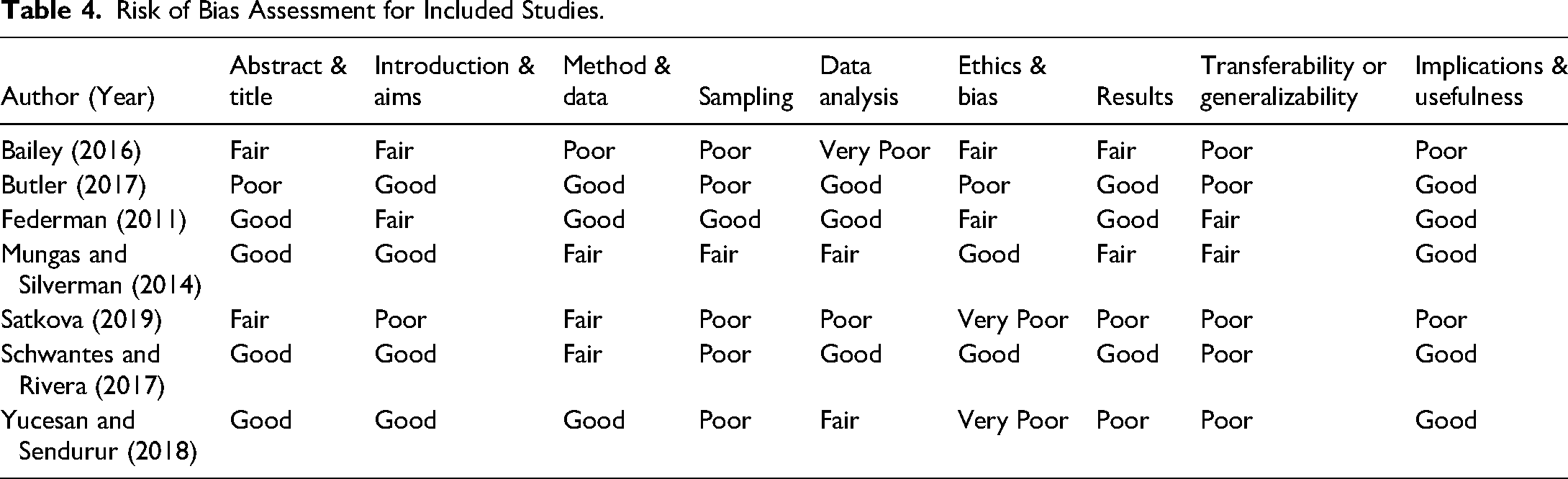
All the studies underwent a RoB assessment (Table 4) by the first and second authors and were evaluated based on criteria provided by Hawker et al. (2002). A few common themes emerged among the articles which led to similar ratings within the same criteria. The first related to inadequate description of the method used and data collected. The studies with lower ratings generally provided minimal or incomplete descriptions for their methodology and process of collecting data, either from the experimental or control condition. Secondly, in most studies, there was inadequate description of the sampling process and demographics such as age, gender, and race. This directly related to the poor ratings of transferability and generalizability. Thirdly, most of the articles did not mention ethics in an adequate capacity as, within those studies, there was no or minimal consideration of bias while designing, conducting, or analyzing the research. Fourth, in assessing the qualitative data, studies with a lower rating across relevant categories did not provide detailed description, analysis, and findings nor explicitly identified qualitative frameworks. Lastly, studies receiving a weaker score for implications and usefulness did not propose ideas for further research and articulate implications for policy and practice.
Risk of Bias Assessment for Included Studies.
Discussion
Contributions of CATs to Academic Success
Results of the present secondary narrative analysis preliminarily highlighted the use of CAT interventions to promote academic success, such as skill acquisition, participation in educationally purposeful activities, contextual factors of the setting (i.e., satisfaction within the learning environment), and attainment of educational outcomes (Kuh et al., 2010; York et al., 2015). These academic markers were seen through improved affective attunement, such as academic self-esteem (Yucesan & Sendrurur, 2018) and increased affective awareness to inform learning (Butler, 2017; Federman, 2011; Satkova, 2019), as well as community-building via engagement with peers to foster group cohesion (Bailey, 2016; Mungas & Silverman, 2014; Schwantes & Rivera, 2017). These factors have been targeted elsewhere as postsecondary educational foci (MacCann et al., 2020; Maguire et al., 2017; Respondek et al., 2017; Robbins et al., 2009; Wang et al., 2012) and represent content areas where CATs may be uniquely suited to advance academic success.
As CATs are informed by a therapeutic model, their capacity to access emotional content, and skillfully contain it in service of learning, is a unique instructional advantage. Coupling this with the inherent experiential nature of CATs helps to activate modes of learning that augment didactic methods and are attentive to affective material, such as empathy development. Experiential instructional techniques to build out mentalization capacity, primarily for therapists- or educators-in-training, harnesses subjective emotional experiences that can then be understood within the learning context to achieve academic goals. This was demonstrated through movement (Federman, 2011), dramatic activity (Bailey, 2016; Butler, 2017), or through art viewing and critical reflection (Satkova, 2019).
Outside of graduate training programs, a few studies in the present review sampled undergraduates and took place outside of the classroom setting with non-CAT students. Undergraduate students have previously reported that nonclassroom interaction with instructors has supported their engagement in learning (Hagenauer & Volet, 2014; Rivera Munoz et al., 2020); a factor which studies in this review leveraged. Moreover, the pedagogical merging of experiential learning theory in higher education, which promotes learning as a holistic process encompassing multiple aspects of both learner and environment (Kolb & Kolb, 2017), with nonclassroom instructional spaces, capitalizes on the strengths of each educational approach; students can interact with instructors in a unique environment while learning through experiential activity and benefit from holistically processing curriculum to enhance academic success.
Empirical Evaluation of CAT Educational Interventions
In contrast to the original systematic review where all included articles adopted a quantitative approach in some form, all studies in the present review featured qualitative approaches, reflecting a more site-specific, idiographic understanding on the use of CATs as educational tools in the postsecondary setting. Educational research scholars have outlined the unique strengths and limitations of using qualitative and quantitative approaches, suggesting that the method should fit the inquiry (Queirós et al., 2017). Perhaps then researchers positioned the use of CAT techniques to achieve academic success through a deeper and more illustrative understanding of the intervention, elevating this method of inquiry for CAT-informed educational activities. The use of qualitative research in education has been previously framed as a means to acknowledge the complexity of the educational setting (Eisner, 2017), a context that purely statistical observation may fall short of capturing. Therefore, it may be that the benefit of a qualitative research lens is that it offers the capacity to account for a dynamic environment and probe individual student experience in service of understanding the specific CAT application in each academic situation. On the contrary, the lack of quantitative research limits the ability to test emerging theories of educational effectiveness and replicate them, thereby reducing opportunities to generalize the potential of CATs to promote academic success across higher education.
Increasing Rigor of Study Design
Despite demonstrations that CATs were useful in supporting academic success, questions remain as to the general applicability of these findings due to the noted high potential for bias across several categories in the RoB assessment (see Table 4). Quality criteria is underscored by specific strategies that can be applied to enhance the impact of these criteria on trustworthiness within qualitative research (Korstjens & Moser, 2018; Lincoln & Guba, 1985) and validity and reliability within quantitative research (Cohen et al., 2017). Across this review, studies noted for higher potential of bias provided slim reports on their sample and sampling procedures and descriptions of methodology, compromising confirmability and transferability, as well as increasing threats to internal validity and generalizability (Torre & Picho, 2016). Dependability and reliability could have also been enhanced via a more rigorous outline of methods and analysis to ensure appropriate fit of the design with the research question. Notably, several studies employed a reflexive lens, wherein the researcher themselves self-situated, increasing the contextual understanding of interpretive findings (Jamieson et al., 2023; Korstjens & Moser, 2018; Walker et al., 2013).
Limitations
Due to the secondary nature of this research, several limitations exist. The sample of articles reviewed here were not systematically identified. Instead, these articles were extracted from the prior systematic review due to their being excluded as they took place in higher education and not in a K-12 setting. Therefore, the findings from this narrative review can solely be understood as preliminary. Further, the focus of the first review was centered on effectiveness research of psychosocial and behavioral interventions in K-12 settings, while the present narrative review considered academic success. Although the shift in focus was based on the central throughline in all articles featured in this review, this discrepancy further contextualizes the limited extension of these findings.
Studies that focused on psychodrama, sociodrama, expressive arts therapy, and sand tray therapy, interventions categorized as creative arts therapeutic modalities by the International Expressive Arts Therapy Association [IEATA] (2023), were not included because these forms are not explicitly recognized by NCCATA (2021). This is likely the reason why the majority of included studies are based in the United States, even though the inclusion criteria for this review did not presume any geographical limitations. Also, as a secondary analysis of previously collected findings, the data collection process may have been skewed by only including articles that peripherally related to the initial review's research question and search criteria. Lastly, the research study examined literature from 2009 to 2019, excluding previous and the most recent research on this topic.
Future Directions
A more specified and targeted search process is recommended. While the databases could remain the same as in Frydman et al. (2022) due to their reach within the social sciences, hand searches should differ regarding the non-CAT journals. Since the initial review was focused on the K-12 setting, school mental health journals that primarily focus on this age/grade range were examined. For a more systematic follow up to this narrative review, peer-reviewed journals focused on the postsecondary setting that consider psychological, social, developmental, and academic success should be investigated. Potential search terms to include in any future literature reviews should be relevant to such an educational context, including postsecondary education, higher education, undergraduate education, college, university, graduate studies, graduate school, and graduate training and combined with the expanded IEATA inclusion of CAT approaches. Such a broadening beyond the NCCATA classifications would also open the research to an international context which could add to the present review's findings.
Thematically, several domains identified in this review could benefit from further consideration in future research on the use of CATs in the postsecondary setting. Suggestions include investigating academically-oriented CAT techniques that invite affective attunement and connections to course material, examining the role of CATs in promoting group cohesion as a contributing factor to academic success, exploring the integration of CAT approaches into nontraditional learning environments, and, in an effort to increase rigor in research design, more fully consider the unique and mixed utility of quantitative and qualitative approaches as investigative frameworks.
This narrative review solely focused on academic success in higher education, but it is important to note that postsecondary students fulfill several roles beyond that of a student (Chu et al., 2021; Creed et al., 2023; Reed & Kennett, 2017); they are part-time or full-time employees, and/or navigate family and school responsibilities (Sallee, 2015). Future studies could take these factors into account and focus on how CATs may play a concurrent and dual role of supporting learning and increasing understanding of self-as-student, an approach supported by Butler (2017). As many of the studies included in this review took place in various settings across campus, it may be of value to explore how each institutional site (i.e., residence hall, classroom, community space) may uniquely contribute to support academic success. As a standout example, the virtual space has taken on a major role in university life and is an emerging, or perhaps solidified, platform for engaging students (Castro & Tumibay, 2021; Govindarajan & Srivastava, 2020). Therefore, it may be incumbent upon researchers to stretch into this new space to understand whether, or in what ways, virtual education can be further supported by CAT-informed educational approaches (LeFeber et al., 2023; Sajnani et al., 2020; Wood et al., 2020).
Conclusion
Demonstrably, CAT modalities have been used in the postsecondary setting to promote academic success. This is exemplified in their focus on encouraging affective intuition to strengthen skill development and ability to foster group cohesion in service of enhancing school belonging, specific factors of academic success (Kuh et al., 2010; York et al., 2015). The present review sought to establish CATs as viable and flexible contributors to educational interventions and may offer very preliminary considerations for where CATs may be useful in supporting higher education outside of traditional mental health practice. Further work may seek to scaffold these findings by designing research strategies where bias can be reduced and more directly isolate potential mechanisms for academic change. Ultimately, this review forwards the finding that CATs may be most efficiently used for their ability to facilitate engagement with academic topics that can best be integrated through experiential teaching practices. Specifically, by centering self/other attunement and interpersonal engagement in the postsecondary setting through creative action, CATs may possess the ability to deepen understanding and provide experiential pathways for nondidactic learning and community integration in service of academic success.
Footnotes
Declaration of Conflicting Interests
The author(s) declared no potential conflicts of interest with respect to the research, authorship, and/or publication of this article.
Funding
The author(s) received no financial support for the research, authorship, and/or publication of this article.
