







Abstract
Keywords
The benefits of experiential education for student depth of learning and career readiness are well-documented (Dewey, 1938; Lewis & Williams, 1994; see Kolb, 1984). While much has been published about the theory of experiential learning (EL), little has explained how to implement and assess EL programs across disciplines at the tertiary level. This article fills two critical gaps in the existent EL literature: First, we explain how EL can be conceptualized and evaluated across academic colleges at a university and, second, we present quantitative results for student learning outcomes, including inter-rater reliability.
Experiential Learning
While definitions of EL can vary widely (Illeris, 2007), in general, EL is a transformation in learning based upon specific experiences (Kolb, 1984). Tenets of EL frequently include: (1) connections to and interaction with the real-world environment, (2) application of prior learning and experience to the new experience; (3) learner control in the experience; and (4) learner growth and development during and after the experience (Boud, 1989; Bradberry & De Maio, 2018; Dewey, 1938; Lewis & Williams, 1994; Weil & McGill, 1989). An EL experience can be individual-centered, group-centered, or project-centered (Boud, 1989) across a broad range of educational settings (Illeris, 2007). The overall aim in EL is that “new impressions are connected with the results of prior learning in a way that influences both” (Illeris, 2007, p. 87).
Kolb (1984) provided a four-part cycle in his EL definition that includes learner engagement in a concrete experience, reflection on that experience, abstract conceptualization of that experience with relation to theory and practice, and active experimentation to effect change (Kolb & Kolb, 2009; Lewis & Williams, 1994). The phases occur in order, and the learner can enter the cycle at any point (Sharlanova, 2004). The teacher facilitates student learning, as opposed to directing it, through creation of suitable learning experiences; posing problems, questions, and boundaries; supporting students as they navigate new environmental interactions; facilitating the learning process; and serving as a mentor (Bartle, 2015; Bradberry & De Maio, 2018; Kolb & Kolb, 2009; Williams & Sembiante, 2022). Engagement in this cycle leads to learning at more sophisticated levels (Bartle, 2015; Lewis & Williams, 1994). “When a concrete experience is enriched by reflection, given meaning by thinking, and transformed by action, the new experience created becomes richer, broader, and deeper” (Kolb & Kolb, 2009, p. 309). Advantages of EL include direct application of learning, connections between course content and theory and practice, learner reflection, application across disciplines, and long-term benefits of increased confidence and goal attainment (Austin & Rust, 2015; Bradberry & De Maio, 2018; Kolb & Kolb, 2009; Lewis & Williams, 1994; Purdie et al., 2013; Sharlanova, 2004). EL provides opportunities for students to learn from natural consequences, mistakes, and successes (Bradberry & De Maio, 2018).
EL and Higher Education
Learner participation in EL experiences in higher education leads to increased student recruitment, retention, graduation, and enrollment in postgraduate studies, as well as higher student confidence related to goal setting and attainment (Austin & Rust, 2015; Bradberry & De Maio, 2018; Cantor, 1997; Purdie et al., 2013; Williams & Sembiante, 2022). Therefore, universities increasingly approach EL as a mandatory requirement to satisfy graduation requirements (Williams & Sembiante, 2022). EL has been implemented in higher education through field-based experiences such as internships, practicums, and service learning, during which learners divide their time between formal classroom instruction and authentic field-based settings (Bartle, 2015; Lewis & Williams, 1994; Williams & Sembiante, 2022). However, current research lags in terms of assessing and evaluating quantitative student learning gains through EL. In 1994, Lewis and Williams noted most published EL articles provide descriptive accounts without evidence that “learners actually acquire target skills” (p. 14), a sentiment echoed more recently by Williams and Sembiante (2022). Additionally, specifics on how EL is implemented across disciplines in higher education remain a gap in publications.
In one exception, Austin and Rust (2015) reviewed how their large public university in the southeastern U.S. developed and implemented EL university-wide across a 5-year implementation period to institutionalization. EL began as an initiative of their Quality Enhancement Plan (QEP), required for Southern Association of Colleges and Schools accreditation. They defined student learning outcomes, identified EL activities, established application forms and assessment rubrics, and provided student and faculty recognition. Challenges during the EL development and implementation process included measurement of student learning outcomes, development and consistent scoring of assessment rubrics, and building both faculty and student participation (Austin & Rust, 2015). However, they did not include specific examples of EL activities within university courses or inter-rater agreement for their assessment measures.
Context for the Present Study
We provide an overview of the EL process at one university to set the context for the present study. The present university serves approximately 12,000 students in face-to-face, hybrid, and online undergraduate and graduate courses across six colleges with about 500 faculty. Similar to Austin and Rust (2015), the EL implementation process was embedded within the university's QEP and focused on undergraduate courses (see Price & Savoie, 2024, for a review). The QEP's strategic plan called for all students to benefit from EL opportunities within the core curriculum and academic programs after a 5-year period from implementation. To implement the EL process, the university established an EL Committee composed of the QEP Coordinator, leadership from Academic and Student Affairs units, and five EL Faculty Ambassadors selected by the EL Committee.
The EL Faculty Ambassadors served 1-year terms as university-wide peer mentors. In Years 1 and 2, Ambassadors created and delivered presentations open to all faculty on how to implement EL activities within courses using Kolb's four stages with examples from university courses across each stage; these were also recorded for wide dissemination. In Years 3 through 5, Ambassadors assisted in developing the EL course endorsement process. They also scored a sub-sample of student reflections on learning outcomes within a few EL-endorsed courses for inter-rater reliability.
Courses designated as EL-endorsed were recognized across the 23 universities within the state university system and viewed as recruiting opportunities. In 2022–2023, the present university had 60 EL-endorsed courses across 81 sections with 1,440 student participants. In 2024–2025, the university had 150 EL-endorsed courses across 156 sections with 2,349 student participants. The application process for EL course endorsement was faculty-driven using an online application form, and applications were reviewed by the EL Advisory Committee. Once the EL application was approved, the faculty member could teach the course as EL endorsed in any of their course sections and in subsequent semesters.
Assessment of student learning first occurred at the instructor level. The faculty member was responsible for providing pretests, posttests, and reflective prompts to students, as well as assessing these prompts for students’ depth of learning on a 1–5 scale. The students addressed how they: (1) developed knowledge, skills, and values; (2) took initiative, made decisions, and were held accountable; and (3) grew and developed intellectually, creatively, emotionally, and socially. Faculty evaluated students’ reflections across these learning outcomes with a rubric that provided five levels of impact, including little or no impact, moderate, high, higher, and highest. Faculty also submitted their own reflection on the success of their EL activity and their pedagogy.
There were two limitations to the university's EL endorsement model. Because the university applied a faculty-driven application process, applications from specific colleges and degree programs were underrepresented, even when it was clear that EL happened in these programs. For example, only 6% of EL course endorsements were from the College of Nursing and Health Sciences, while 32% were from the College of Humanities and Social Sciences. These numbers do not reflect the reality of EL incorporation across the college's courses and programs, but rather faculty “buy in” to the EL model and process. Second, because the endorsement only applied to each section of the course taught by the faculty member, if the faculty member did not teach the course, the course endorsement did not apply, and therefore, the EL-endorsed course was “lost.”
Faculty of EL-endorsed courses also could apply for an EL Seed Grant to assist with any associated costs required of the EL experience, such as mileage reimbursement for fieldwork or site visits, laboratory equipment, video-recording equipment, software, and so forth. The seed grant funds provided an opportunity to test an innovation and were non-recurring, meaning that a faculty member could receive an EL seed grant for an EL activity only once. The EL Committee also reviewed the seed grant applications.
While EL has recently increased in higher education, how EL is implemented across disciplines and reliability for assessment of learner outcomes is missing in available publications. To address these gaps in university EL implementation, we investigated how EL was implemented and assessed within EL-endorsed courses across six academic colleges (Arts, Business, Education and Human Services, Humanities and Social Sciences, Nursing and Health Sciences, Science and Math) within one university in the Southeast U.S. We asked:
How are EL activities within EL-endorsed university courses implemented specific to Kolb's four stages of EL? What are specific successes and challenges of university EL implementation? What are the effects of EL activities on specific student learning outcomes? How reliable are measures of student learning outcomes?
Methods
Author Positionality
The first author is a white woman who taught P-12 deaf students across educational settings, teaches and supervises pre- and in-service teachers, served as an EL Ambassador, and investigates evidence-based instructional strategies across educational levels. The second author a white woman who is the EL coordinator at a regional university in the southeast and a sociologist by training. She is committed to the theory and practice of mentoring undergraduate students in research and EL.
Ethics Approval Statements
The university Institutional Review Board approved our interviews (Approval: 04566-2024) on December 6, 2024.
Consent to Participate
Respondents gave written consent for review and signature before starting interviews.
Consent for Publication
Consent for publication was not applicable to our study.
Participants
Both authors were the researchers in the present study. Inclusionary criteria for this study included faculty at the present university who implemented an EL activity in an EL-endorsed course at the university during the 5-year implementation period. We identified faculty candidates for this study through publicly available articles and the QEP Coordinator and contacted them via university email with requests to interview them for additional information on their EL activities. We interviewed 10 faculty members across 9 EL-endorsed activities and across 10 courses (two courses collaborated on one EL activity).
Design and Materials
To address how EL activities were implemented and related successes and challenges, we interviewed participants using a list of 13 interview questions (see Appendix). Interviews permitted the collection of qualitative data to address how EL was implemented and document successes and challenges via direct participant report. To examine student learning outcomes and inter-rater reliability, we collected student reflections from the analyzed courses that directly addressed the three EL learning outcomes and instructor ratings of those reflections from the QEP Coordinator. The EL learning outcomes included how each student achieved the following as a result of participation in the EL activity: (1) Developed knowledge, skills, and values; (2) Took initiative, made decisions, and was held accountable; and (3) Grew and developed intellectually, creatively, emotionally, socially, or physically.
Procedures
We conducted three participant interviews face-to-face, two via online video conferencing, one via phone, and four via emailed faculty responses. For the face-to-face and phone interviews, we used automatic transcription via Word to accurately capture interviewee responses. The emailed responses captured interviewee responses in print. We summarized, and in some cases pulled direct quotes from, interviewee responses related to the 13 questions.
To conduct inter-rater reliability for ratings of student learning outcomes, both authors independently rated student reflections using the same rubric used by the instructors. Each author independently read and rated each student's reflection on the three learning outcomes across five levels of performance. Both authors had previous experience rating student EL reflections using this rubric. Of the seven EL-endorsed activities included in this study, instructor ratings of student reflections and the reflections themselves were available for five. This resulted in three ratings (Instructor, Author 1, and Author 2) across four courses and two ratings (Instructor, Author 1) for one course, as Author 2 was the instructor.
Analytic Strategy
We analyzed interview responses by each prompt and presented responses across college, course, goal of the EL activity, concrete experience, reflective observation, abstract conceptualization, and active experimentation. We also present instructors’ responses related to student outcomes, including knowledge, skills, values, initiative, decisions, accountability, and how students engaged intellectually, creatively, emotionally, and socially.
Comparison of means or correlational trends are a recognized practical approach to examine interrater agreement and reliability (Tinsley & Weiss, 2000). We conducted one-way analysis of variance (ANOVA) within SPSS as a statistical test for significant differences in mean scores for each prompt across the three raters with Tukey post-hoc tests when needed. In the case where there were only two raters, we used t-tests to compare means for each of the three prompts. This resulted in 12 ANOVA tests and three t-tests, for 15 tests in total. Below, we present our findings.
Results
We asked how EL was implemented and assessed within EL-endorsed courses across disciplines within one university. We review each of the university EL activities based on the college, class, number of students that participated, EL goals, funding, and the four phases of Kolb's (1984) cycle (see Table 1). We also review student factors, including their knowledge, skills, values, initiative, decision-making, accountability, engagement, challenges, and successes, as reported by faculty.
Overview of Experiential Learning (EL) Activities Within University Courses Across Colleges.
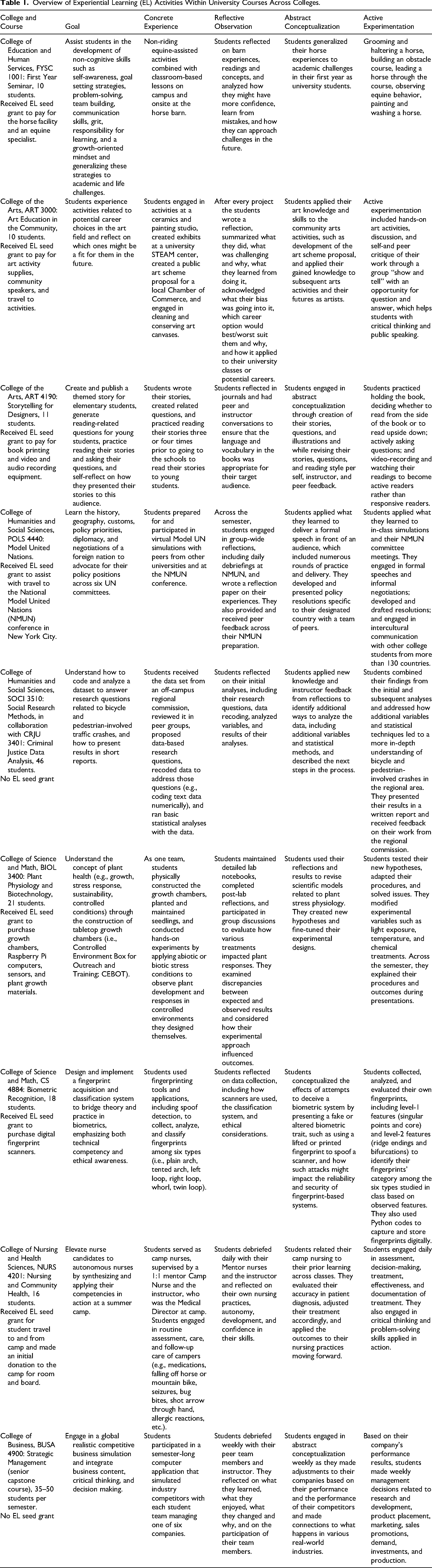
EL activities occurred across six colleges and nine courses. The activities ranged from non-riding activities at a horse facility, creation of themed books to share with elementary students via read-aloud, participating in various arts activities within the community, conducting business simulations, participating in Model United Nations, serving as camp nurses, fingerprinting analysis, growing plants in controlled conditions, and analyzing pedestrian safety.
Challenges
Instructors commented on students’ challenges as well as their personal challenges across the EL activities. Student challenges included motivation, engagement, and challenges with understanding technology and software. One instructor noted: “It's difficult when there's a steep learning curve to get them to stay engaged for the duration, so sustaining engagement was a real challenge.” Scanner compatibility and fingerprint image quality posed logistical difficulties, in addition to environmental consistency within the plant chambers and understanding image analysis software.
Instructor challenges included balancing course structure with student independence and having tough conversations when students underperformed. One stated: “Balancing structure and independence was challenging—especially in guiding students who struggled with unfamiliar tools.” Other challenges were coordinating schedules with community-based EL partners, transportation to off-campus activities, including the cost, as well as the limitation of EL seed funding to only one occurrence of an EL activity, forcing instructors to find subsequent funding elsewhere. Many instructors noted that the EL endorsement process is time-intensive, including the application process and the reflection and assessment processes at the end of the semester, when instructors are focused on grading coursework. Finally, some instructors noted a lack of faculty benefit to balance the time commitment, stating it was easier to continue the EL activities without the burdensome process of EL endorsement and assessment. One instructor called the EL process “cumbersome,” and another stated: “We just said look, this is too much, so we still do the stuff in class … it's just not an [official] EL activity.”
Successes
Instructors commented on student successes as well as their personal successes related to EL activities. One instructor noted that students were able to coordinate their nursing skills through application in a unique weeklong environment versus a few hours in a clinic. Another said student interest was captured when they saw the direct connection between their EL activity and their career readiness. An instructor commented on the opportunity for students to engage in leadership roles and how students who struggled with confidence and giving speeches thrived when they participated in the Model UN experience. One instructor stated: “This was the first time I implemented an EL model in this course, and it had a transformative impact on both student learning and my teaching approach. It showed how real-world projects can deepen understanding, spark curiosity, and prepare students for future professional challenges.” Another commented that the EL activities helped students understand how they learn, what they learn, and in some cases, why they did not learn. Finally, one stated: “This experience is so much more than I thought it would be.”
Below, we present student factors related to EL-endorsed activity participation as reported by faculty.
Students’ Knowledge, Skills, and Values
Across EL activities, students gained knowledge, skills, and values related both to course content and application of that content to the profession and the real world. They learned profession-specific skills, such as data analysis, fingerprint scanning and identification, and curating an art collection, as well as general life skills. Increased student communication, collaboration, critical thinking, decision-making, data analysis, confidence, and application of these skills to future professions and life in general were themes across EL activity outcomes.
Related to values, students gained ethical knowledge as well as knowledge about how one's actions affect others. One instructor noted: “Exposure to biometric ethics, such as privacy and spoofing, reinforced professional values and responsible computing.” Similarly, one student said: “I found out about research morals and how we should be mindful so as to safeguard [the] character of people” while analyzing data. Another instructor stated: “Importantly, they [students] learned to value evidence-based reasoning and ethical responsibility in reporting data.” A third reported: “If we extrapolate [values] to kind of habits of mind in business, they [students] develop a competitive nature and they also develop a realization that results matter.” Finally, a student noted: “I felt that I had to rewire my brain and think as a kid, while at the same time keeping the main subject (autism) clear for everybody who interacts with the book no matter the age.”
Students’ Initiative, Decisions, Accountability
Across EL activities, instructors shared examples of student initiative, decisions, and accountability from their own assessments and student responses to learning outcomes. Many students worked in collaborative groups and were responsible to each other (and to horses and plants) for taking initiative, making decisions, and how the consequences of those decisions related to the outcomes of their activities. When developing their storybooks, some students took the initiative to test their book language and questions with elementary-aged family members at home. Related to community art, students decided which canvases to restore and how, which ideas to include in a community art proposal, how to meet the proposal deadline, and how to spend a budget. One student stated: “I have learned how to be a better decision maker and how to make decisions [about] what information is more important than others.”
When growing environmentally controlled plants, students were accountable for every aspect of the project, including maintaining plant health, documenting changes, analyzing results, and explaining outcomes during presentations. When analyzing fingerprints, students were accountable for operating the fingerprint scanner, which included software and hardware challenges, and classifying fingerprints. Similarly, students were accountable for initial assessment of maladies, diagnosis, treatment, effectiveness, re-evaluation if necessary, and follow-up treatment with child campers.
Students’ Engagement
Intellectually
Instructors also shared examples of students’ engagement intellectually, creatively, emotionally, and socially, as well as comments from students related to these prompts. Intellectually, students applied theories discussed in class to real-world horse interactions, fingerprint systems, scientific experiments, business simulations, pedestrian safety, and so forth. One student noted: “I gained more knowledge on how to do research using real-world data,” while another mentioned the EL activity “helped me grow” by seeing how collected data and missing data are crucial to determine predictors of pedestrian accidents. Another student participating in Model UN noted, “I definitely gained a greater understanding of not only MUN, but also proper communication, cooperation, negotiation, and leadership skills … I believe I learned much more than I would in a traditional lecture class.”
Creatively
Creatively, students designed, problem-solved, and proposed solutions. One student commented: “I grew creatively when attempting to find connections between variables, such as between road and weather conditions as an explanation for high crash rates. Despite not finding a strong connection we brainstormed together and found other potential explanations.” A student in the book creation course wrote, “I had to … understand the creativity of a child and also be able to switch from writing for audiences on the collegiate level to an audience much younger.” Within business simulations, one instructor noted: “Creatively there's no one right answer. There’re many ways you can do this … it's not necessarily linear.” Across activities, students embedded creativity within their EL.
Emotionally and Socially
Students were emotionally and socially invested in the outcomes of their EL activities. A few instructors noted that students grew from uncomfortable situations, such as sharing personal space when carpooling or addressing peers who did not contribute to group work. Teamwork fostered communication and collaboration, resulting in troubleshooting, decision-making, and successful outcomes. One instructor stated: “Because it's experiential, we have that camaraderie and bond that makes learning so much more than just learning. I think it does cross the emotional [and] social boundaries more than any other course.”
One student reflected on her emotional growth, noting, “Seeing how many individuals have died in vehicle accidents in my neighborhood has caused me to grow emotionally as well … this investigation has opened my eyes.” Some students also mentioned social growth. One student said, “I am not a social person and this allowed me to interact with my peers that I have not met before. It also let me have a voice in this class and with this report.” Another student noted increased social awareness of problems facing the community: “It also helped me be more socially aware of the road and crash problems we have in my hometown.” An instructor added: “The horses sought connection to us and the students could extrapolate that sometimes when your energy comes down other beings will come in if you make this space for them.”
Students’ Natural Consequences, Mistakes, and Successes
In many instances, students responded that they experienced university course content and its real-world application “come together” during their EL activities. One instructor reported that student camp nurses frequently said: “Everything has come together. I understand the totality of what it means to be a nurse. I understand how to care for the whole person.” One art instructor noted: “They're [students] realizing that if I'm going to be any kind of artist, especially one that is community focused or community facing, I need to employ a lot of other skills and not just be talented with painting.” Another stated: “They [students] identified personally which profession they would want to go into or absolutely not go into. This gave them more information about the variety of careers and how to attain that job.” Related to Model U.N., the instructor stated: “One of our students advocated for the development of a new International Climate Crimes treaty that would supplement the International Criminal Court's ability to prosecute climate crimes against humanity, which is an outstanding and novel solution to this topic of which I have not heard before.” Another instructor noted: “Marketing majors learn about price product promotion and placement, those kinds of things, and so we’re kind of tying it all together.”
From student perspectives, one student noted that her horse was so forgiving and patient, and if that horse could do that, then she was capable of examining relationships in her life that were painful. Another student noted that she “experienced this growth by looking at real-world data … being able to interpret factual and raw findings that were not drawn from a textbook or professor.” Relatedly, another student stated that after data analysis related to pedestrian safety: “I know the problems with wrecks and what major roads have problems. When it is time for city council meetings where citizens can voice their opinions, I will inform them that some roads need some improvement to help protect our citizens.”
Across EL activities, students repeatedly expressed that they both enjoyed and found it challenging to work with real-world data, such as provided data sets, plant variables, and business decisions, that were not from a textbook or carefully curated by the instructor. Relatedly, students evaluated their internal processes and how those processes translated to the external processes required of the EL activities. An instructor stated: “Students have to figure out their sense of agency within the confines of what we’ve given them to do and that's an example of how you show up.” Related to the Model UN conference, the instructor noted: As I navigated the conference throughout the day and met our students, they often self-disclose the successes they had and tell me about the mistakes that occurred. We brainstorm why one strategy was successful and how to improve when things go poorly. They often have the solutions at hand and just want to share them with me, which further demonstrates the continuous self-reflective nature.
Specific to consequences, an instructor noted: “Many times students made choices or products that didn't work. For instance, they tried to clean the canvases with dish soap, and it pulled up the paint, so they instantly learned from their decisions.” Another noted that “Students confronted real consequences like plant leaf necrosis (signs of cell death) due to inconsistent lighting or wilting due to insufficient watering. These outcomes taught them to problem-solve, adjust protocols, and reflect critically. Conversely, successful experiments reinforced good practices and deepened their understanding of experimental design.” During fingerprinting, “Students encountered failures such as poor print quality and misclassification. These experiences required troubleshooting and refinement, teaching the value of iteration and resilience.”
Inter-Rater Agreement
Of the 15 statistical analyses, 13 were significantly different among raters (see Table 2). Author 1 scored reflections statistically lower than instructors 6 times across the three prompts. Author 2 rated student reflections significantly higher than one instructor on prompt 1 and significantly lower than one instructor on prompt 3. Author 1 rated six instructors significantly lower than Author 2. Notably, Author 1 rated Author 2's student reflections similarly to Author 2. Next, we discuss the implications of our findings.
Inter-Rater Reliability for Instructors and Authors for Student Reflections Across Three Learning Outcomes.
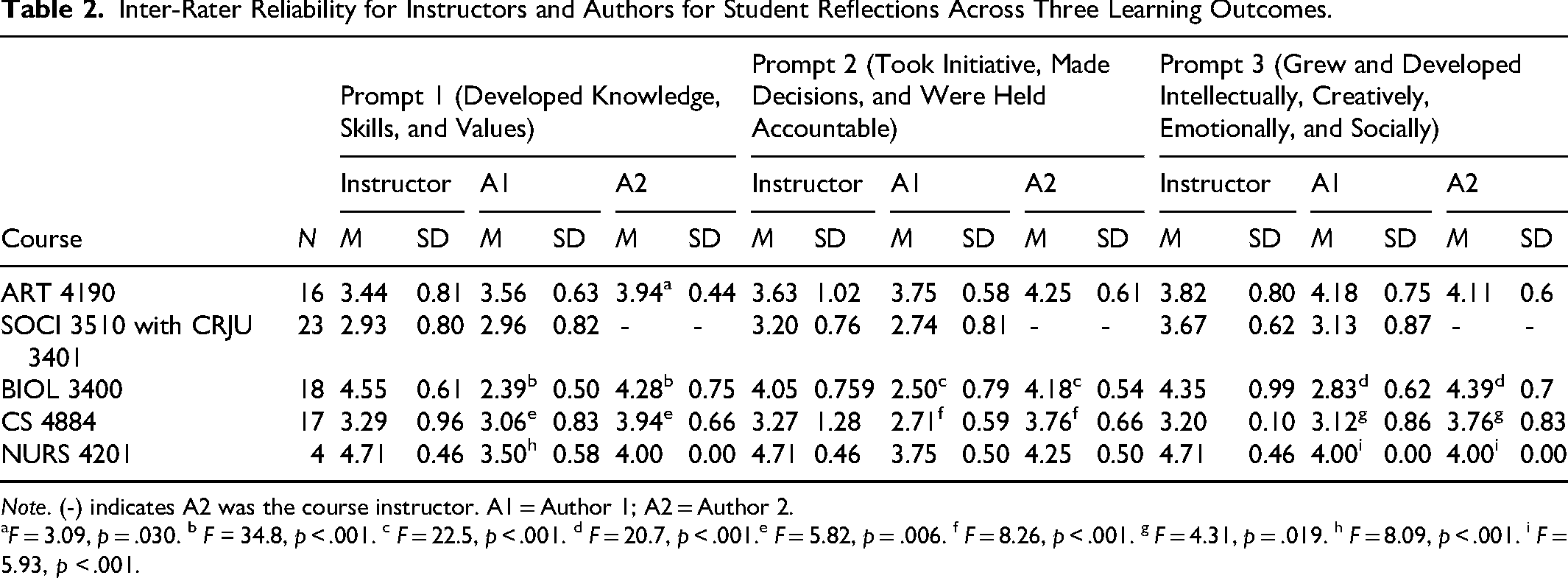
Note. (-) indicates A2 was the course instructor. A1 = Author 1; A2 = Author 2.
F = 3.09, p = .030. b F = 34.8, p < .001. c F = 22.5, p < .001. d F = 20.7, p < .001.e F = 5.82, p = .006. f F = 8.26, p < .001. g F = 4.31, p = .019. h F = 8.09, p < .001. i F = 5.93, p < .001.
Discussion
We investigated how university instructors embedded and assessed the effects of EL activities within their EL-endorsed courses. These examples add to the how-to component of EL in higher education across disciplines, beyond only teacher preparation programs (Williams & Sembiante, 2022) and specific internships (Bradberry & De Maio, 2018). Student and instructor reflections across learning objectives overwhelmingly pointed to the benefits and successes of EL activities for undergraduate students, ranging from confidence and collaboration to connections to university courses and professional responsibilities, similar to previous findings (Bradberry & De Maio, 2018; Purdie et al., 2013; Williams & Sembiante, 2022).
However, students and instructors also experienced challenges within the EL process. Student challenges tended to align with motivation and acquisition of activity-specific skills and were addressed across the course. To address student motivation to enroll in EL-endorsed courses, the EL Committee discussed designation of EL-endorsed credit hours, for which students can earn certificates, medallions, and graduation stoles based on the number of completed EL-endorsed hours, similar to Austin and Rust (2015). Recognition of an outstanding EL student at an awards ceremony, EL certification on students’ transcripts, and EL course prefixes brought visibility to Austin and Rust's (2015) EL program.
Instructor challenges were more difficult to remediate. Student transportation to off-campus events and funding for EL-related expenses were two challenges. Transportation to local off-campus activities could be addressed by university graduate assistants who are trained and certified to transport students in university vans. Because the EL seed grant provides funding for only the initial occurrence of an EL activity, faculty must find other funding to replicate their endorsed EL activities. This is a challenge in times of university frugality (Williams & Sembiante, 2022). One solution is a dedicated annual funding source specific to EL-endorsed activities that is not premised on a seed grant model, similar to Bradberry and De Maio (2018).
Another challenge with the university's EL endorsement model is that the process is dichotomous: Courses are either endorsed as EL or they are not, and the endorsement applies only to sections of the course taught by the instructor who received the course endorsement. What are the implications for the course sections not taught by the endorsed instructor and if instructors do not want to adopt the EL activity? How does this affect the quality of instruction for students in these sections? Perhaps EL endorsement of the course and all sections, in place of individual instructors, can remedy this issue. This also will maintain the course as EL-endorsed across time, providing funding is available to accommodate the EL activities within courses.
A resounding challenge from interviewed instructors was the time intensiveness of the EL endorsement application and endorsement process across the semester without faculty benefit (i.e., a pay stipend) or recognition of their (voluntary) time investment, similar to other EL experiences (Bradberry & De Maio, 2018). This is likely related to another challenge observed by the authors-the low percentage of faculty who applied for EL-endorsement, similar to Austin and Rust (2015). Despite presentations on the EL process by Faculty Ambassadors and online EL modules offered by the university, only 14% of faculty engaged in the EL endorsement application process. To address these time investment concerns and increase participation, the EL Committee proposed a tiered model of EL endorsement. A Tier 1 EL endorsement (1 hour of EL credit) includes introduction to inquiry-based learning and metacognition/reflection (e.g., analysis of secondary data). A Tier 2 EL endorsement (2 hours of EL credit) includes inquiry-based learning, metacognition/reflection, project-based learning, case-based learning, or cooperative community-based learning (e.g., simulations, analysis of real-world data, applied assignments). A Tier 3 EL endorsement (3 hours of EL credit) combines an extended concrete experience and metacognition/reflection (including study abroad/away, internships, clinicals, or student teaching). In this tiered model, deans and department heads would set standards for the three tiers within their courses in consultation with the EL Committee. Faculty across the university teaching a Tier 1, 2, or 3 EL credit course would be required to include the designated components. These EL-endorsed courses would then be assessed on a 3-year rotating basis, where faculty teaching Tier 1 courses would submit the pretests and posttests, as well as faculty ratings of student reflections on the three learning outcomes once every 3 years, similar to Austin and Rust (2015). In the following year, Tier 2 courses would submit assessments, with Tier 3 submitting the third year. This would drastically reduce instructor time spent on assessment of the students’ learning related to the EL learning outcomes.
The tier system also allows for instructors to benefit from peer learning and collaborative work. In the faculty application system developed under the QEP, individual faculty submitted an EL activity for a particular course. Now, a department could decide to adopt that practice for an entire course, across all sections. In this way, the benefits for students and faculty are shared. The tiered system makes the EL course endorsement process transparent and collective, rather than individualistic. A faculty member who did not have the time or resources to design an EL activity themselves may now teach a course in which the activity is embedded.
Along with the tiered system, faculty reinforcement could also increase instructor buy-in. Austin and Rust (2015) noted their university provided non-seed EL grants, so faculty could receive funding once every year for EL-related resources and supplies, partnerships, and conference travel (J. Austin, personal communication, 5.30.2025; https://www.mtsu.edu/exl/op_forfaculty/). They also recognized outstanding EL faculty through awards. Dedicated funding for EL grants with the option to receive them annually and faculty recognition could create a positive culture of faculty investment in EL.
Relatedly, when instructors do adopt an EL-endorsed course, it is unclear how accountability for completing designated EL activities as designed across course sections is addressed (i.e., validity). Will faculty who did not design the EL activity effectively complete it with students? Some interviewees struggled in recalling the abstract conceptualization and active experimentation portions of their EL activities. It is possible they knew the parts but not the specific labels, or perhaps they did not internalize these two components of the process. The four stages of Kolb's model in the present EL program differ from previous programs, such as Bradberry and De Maio's (2018) three components of concrete experience, reflection, and application, terms which may be less abstract than the present model.
Another challenge of the current design is that faculty who apply for a course to be endorsed do not always complete all the assessment requirements. Since the EL endorsement process has been entirely elective rather than mandated, the model is based on voluntary faculty participation. This has made it hard to move beyond the willing “early adopters” and presents little leverage for the QEP coordinator when assessment materials are not provided.
Implications for Education
A key implication of our study is that the EL program ambition must be balanced with long-term sustainability. Universities developing EL programs should give particular attention to building faculty buy-in and scalability and be ready to oversee an evolving program. A program that begins with a rigorous review of applications and multi-component assessment may then provide the data necessary to justify increased investment in the program (i.e., staffing, funding) and to motivate student and faculty participants. As the program evolves and becomes embedded at institutions, assessment may be needed less frequently, reducing participant burden.
Additionally, we addressed the effects of EL activities on student learning outcomes through independent inter-rater agreement completed by course instructors and authors, which addresses a previous gap in published studies (Lewis & Williams, 1994; Williams & Sembiante, 2022). We found that the authors had significant variation compared to each other and/or the instructors in 60% of cases, despite using the same rubric. In discussion, variability arose when it came to classifying student depth of accountability and initiative in the EL experience. Author 1 noted hesitancy to score students highly if accountability and initiative were strongly guided by the instructor, while Author 2 and the instructors tended to give students credit for initiative and accountability even when both were more external than intrinsic (e.g., student reflection noted accountability based on desires to achieve strong grades and meet established deadlines).
Limitations of the Present Study
It is possible that author ratings were lower than instructor ratings for several reasons. First, instructor ratings may be higher because of their in-class interaction with and knowledge of student performance across the EL activity (i.e., subjectivity). Instructors read only the reflections of their own students for comparison, while the two authors read reflections across seven different courses. Second, the element of comparison to other course experiences within prompt one on the rubric was not a part of the student learning outcome prompts, so rating of this prompt may have been interpreted differently by raters. Third, the number of examples students provided, and the depth of their responses, varied by student and course, likely affecting ratings.
While instructors were provided with the three EL learning outcome prompts for student reflections, they were permitted to modify these prompts to their EL activities. Some modifications seemed to increase the quality and depth of student responses, such as provision of a one-sentence summary of the EL activity or asking students to create a summary before answering the reflection prompts. However, some instructors changed the reflection prompts to the point that the data were not comparable. Additionally, some instructors did not submit both student reflections and instructor assessment of those reflections, which was a limitation to conducting inter-rater reliability on student learning outcomes.
Future Research
Future directions might address faculty incentive to complete the entire EL process, including assessment of student learning outcomes, as well as how to refine rubric indicators and levels of performance for increased rater reliability. Finally, future researchers might investigate student reflections on learning outcomes based on demographic factors such as gender, race, first-generation college student, and so forth, to determine if different EL activities produce different learner outcome effects to tailor EL activities to students’ specific needs and preferences and to increase student motivation to participate in EL. In conclusion, we provide various ways in which EL activities were embedded across university courses, as well as inter-rater reliability for learner outcomes.
Significance of the Research
Based on interviews with university faculty across colleges, as well as student reflection and inter-rater reliability data, engagement in EL provides benefits for undergraduate students, ranging from confidence and collaboration to connections to university courses. EL also presents both successes and challenges for university faculty that guide future research.
Footnotes

Ethics Approval Statements
The university Institutional Review Board approved our interviews (Approval: 04566-2024) on December 6, 2024.
Consent to Participate
Respondents gave written consent for review and signature before starting interviews.
Consent for Publication
Consent for publication was not applicable for our study.
Funding
The authors received no financial support for the research, authorship, and/or publication of this article.
Declaration of Conflicting Interests
The authors declared no potential conflicts of interest with respect to the research, authorship, and/or publication of this article.
Data Availability Statement
Data from this study are unavailable for sharing.