






Abstract
Background
Generation Z (Gen Z) is diverse, connected, and tech-centric, making their needs in the postsecondary classroom different from those of prior generations. For Gen Z, teacher education coursework needs to be designed to match their affinity for digital experiences and demonstrate clear connections to their future work as teachers.
Purpose
The goal of this qualitative study was to investigate two assignments, grounded in experiential education that employed practice-based professional learning experiences in digital learning spaces to support Gen Z teacher candidates.
Method
The study investigated teacher candidates’ engagement and experiences with
these assignments. Assignment artifacts from 28 teacher candidates were analyzed using descriptive statistics to investigate frequency counts and a Grounded Theory approach using open coding was used to notice themes across candidates’ responses.
Findings
Data support that both practice-based professional learning experience assignments utilizing digital learning spaces opened connections to professional communities and were enjoyed by students.
Implications
Experiential education through practice-based professional learning experiences provides a pedagogical bridge between generational learning needs and professional preparation. Assignments that are flexible to the ever-evolving social media spaces and include recommendations for getting started are promising ways to support Gen Z teacher candidates.
Significance of Research
The study investigated Gen Z teacher candidates’ engagement and experiences with practice-based professional learning experiences in digital learning spaces. These experiential learning opportunities enable participation in authentic professional contexts and opportunities for consideration of future professional learning practices via digital learning spaces. Data support that the practice-based assignments support Gen Z teacher candidates by opening connections to professional communities and modeling the experience of continued professional learning.
Higher education coursework is intended to build both general and specific skills in students, supporting continuous learning and preparation for the world of work (Duchatelet et al., 2023). Teacher education, specifically university-based teacher preparation, is particularly focused on preparation for the world of work, as its goal is to prepare its students for their future work as teachers. This preparation requires that teacher candidates learn theories of education and practical skills for teaching, as well as have opportunities for induction into the profession. Teacher candidates’ experiences as students are important. The way that students are taught influences the ways that they will later teach (Lortie, 1975; Strauss & Howe, 1991). As such, it is important to consider the generational cohort – of both the student and the teacher – in the design and development of educational experiences. Seemiller and Grace (2017) posit that “generational research can provide institutions with valuable information to design effective policies, programs, and practices” (p. 21).
Lyons and Kuron (2014) assert that “from a social perspective, a generation can be defined as a group of individuals born within the same historical and socio-cultural context, who experience the same formative experiences and develop unifying commonalities as a result” (p. 140). Generation Z (Gen Z), most often defined as those born within the date range of 1997–2012 (Dimock, 2019), is more racially diverse, educated, and socially aware than any prior generation in the United States (Twenge, 2018). They represent a significant generational shift because of their tech-focused childhoods and their ability to be constantly connected to anyone in the world, making them the first global generation. They are pragmatic and forward focused, often looking for direct connections between their education and their future work (Seemiller & Grace, 2017). In the United States, Gen Z were K-12 students in the midst of a standards movement, the No Child Left Behind Act of 2001 (U.S. Department of Education, 2002), and standardized testing – their experience in the college classroom, as well as in their future work as teachers, is shaped by these formative experiences (Marin, 2023; Seemiller & Grace, 2016). Concurrently, as Gen Z was coming of age in the early 2000s, digital technology and online communities were rapidly expanding and changing the ways the world was interacting, communicating, and learning. For Gen Z students, this means they learn and interact in the classroom differently than preceding generations and are less engaged by traditional teaching methods (Cillers, 2017; Mohr & Mohr, 2017; Seemiller & Grace, 2016).
Gen Z comes to the workforce, and for the interest of this research – to the teacher workforce, with the least amount of work experience of any generation (Morisi, 2017). According to Schroth (2019), in 1979, 60% of teens held a job, but that number has dropped dramatically in the twenty-first century with 34% of teens having held a job in 2015, and only 19% of 15–17 year-olds reported having a job in 2018 (Schroth, 2019). This decline has obvious impacts on working environments, but also on the educational experiences intended to prepare students for those working environments. Schroth (2019) asserts that Work, especially entry-level jobs, helps teens learn what is expected in the workplace and how to interact effectively with others. Without this early work experience new entrants can often have unrealistic expectations of work, which in turn fosters lower levels of commitment and higher turnover (p. 6).
As such, institutes of higher education employ high-impact teaching practices in order to help undergraduates develop real-world skills through hands-on, applied learning experiences (Association of American Colleges & Universities, 2008). This has led to shifts in focus in higher education, specifically toward professional competencies, which include generic learning outcomes as well as domain-specific knowledge (Duchatelet et al., 2023). Experiential learning environments, which introduce real-world scenarios into the classroom in a variety of ways – can be used to provide students with authentic learning experiences that support the development of both domain-specific and general learning outcomes (Duchatelet et al., 2023). Experiential education is rooted in John Dewey's valuing of experience in the educational process and is often viewed in one of two ways: 1) a learning process with distinct steps or 2) a direct experience occurring outside the classroom in a real-world setting. In order for learning experiences to be impactful, they must include an element of reflection (Wurdinger & Carlson, 2010).
While experiential education has great potential to be transformative, “how it gets taken up in schools and classrooms at the K-12 and teacher education levels is often lackluster” (Glazier et al., 2021, p. 4). In order for students (both in K-12 and teacher education) to engage in experiential learning that is transformative, Glazier and colleagues (2021) argue that the experiences need to serve as a way to both surface and center the voices of teachers, students, and community members. These kinds of experiences offer opportunities for community-based learning, which can lead to impactful student outcomes and serve as “public exemplars of the educational mission while providing good public relations with local, state, and regional stakeholders” while also helping institutions stand out in the competitive landscape of higher education (Roberts, 2018, p. 3).
Because Gen Z generally lacks work experience, they need modeling and guided introductions to professional experiences, which can potentially be provided in community-based and/or experiential experiences, in order to orient them to the teaching profession. Given their technocentric upbringing, they have a preference for digital experiences and online communities. As such, we intentionally chose to use Dalsgaard and Ryberg's (2023) Theoretical Framework for Digital Learning Spaces to consider assignments that meet Gen Z's unique learning needs and investigate students’ engagement and experiences. In this article, we explore practice-based professional learning experience assignments that utilize digital learning spaces as a way to engage Gen Z teacher candidates in the United States with communities beyond their teacher education program and to introduce additional voices and perspectives (Glazier et al., 2021), thus better preparing them for their future work as teachers in the world beyond their teacher education program and institution of higher education.
This study explores the experiences of pre-service teachers in the United States who are categorized into the generational cohort referred to as Gen Z because of their birth years (1997–2012) (Dimock, 2019). Generalizations about the experiences of a generational cohort are contextual and subject to intersectionality, therefore the lived experiences of a cohort in one geographical location may or may not be similar to those in another. For this reason, the authors wish to explicitly situate this work in the context of the United States and recognize that there are limitations in its generalizability to other geographic locations. Additionally, similar studies should be conducted in different cultural contexts, given that Generation Z is a global phenomenon.
Theoretical Framework
The characteristics of Gen Z, specifically their tech-centric childhoods and lack of work experience, shape teacher candidates’ expectations of teacher education and illustrate a need for tech-based opportunities for induction into the teaching profession in the design and development of learning experiences. In this research, the impact of two such assignments is analyzed through the lens of Dalsgaard and Ryberg's (2023) theoretical framework for digital learning spaces. A central goal of this work was to establish assignments that match the needs and preferred experiences of Gen Z and consider the ways in which those assignments introduce teacher candidates to and engage them with digital learning experiences with the goal of supporting their induction into the workforce and modeling ways to engage in career-long professional learning.
Theoretical Framework for Digital Learning Spaces
In the 2020s, digital technology plays a central role in teaching and learning in post-secondary education in the United States. As Gen Z navigates higher education, specifically teacher education, faculty are forced to consider the needs of this generational cohort and support them in the digital learning spaces that have become ubiquitous. Dalsgaard and Ryberg (2023) propose a theoretical framework for digital learning spaces that is rooted in the belief that “digital technologies change the ways we can act and learn” (para. 6). Grounded in social learning theories (Dewey, 1916; Engeström, 2015; Lave & Wenger, 1991; Wenger, 1998) and built on research, the framework makes explicit connections between three key dimensions of modern learning spaces: digital technologies, learning activities, and social forms. Specifically, digital learning spaces refer to “the unfolding of activities made possible by the involvement of digital technologies” (Dalsgaard & Ryberg, 2023, para. 7), and the framework addresses four specific spaces: individual space, working group, community of interest, and open connections. For each learning space, the framework identifies three main learning activities based on social forms (i.e., inquiry, construction, and communication), digital technology roles, and ways that technology expands learning.
Individual Spaces
Individual Spaces are digital learning spaces that focus on individual actions or learning experiences that are self-guided such as “the learner's abilities to act, produce, create, express oneself, etc.” (Dalsgaard & Ryberg, 2023, Expanding learning through technology section, para 2). Digital tools in this space act as cognitive partners (Salomon et al., 1991), where the individual uses the technology to complete the task. An example of this would be an independent study project in which a student engages in: inquiry by selecting a topic of interest to study and manages the searches to find information about their topic; construction of knowledge by digesting the information they gather through note-taking and developing a paper or presentation about their topic; and communication, as they disseminate or present their work to classmates.
Working Groups
Working groups engage students in collaborative or cooperative learning. In working group spaces, technology can be used as a collaborative tool and extend learning by enabling students to develop collaborative knowledge. An example of this might be a collaborative project where students are working in a shared digital space to complete a project. While working on the project, students learn through inquiry as they dialogue about the project, share readings, and flush out ideas. Next, they construct the project (e.g., presentation, video) about the content. Finally, communicating their work to others by publishing their project on a class website or presenting it to the class.
Community of Interest
In digital learning spaces, a community of interest exists in a place where a large number of individuals who are interested in the same topic engage in collective activity (e.g., in a Facebook group dedicated to improving mathematics teaching). In this space, technology is used for sharing tools that would be of interest to the entire community. Learning is extended in this space through transparency, as the community utilizes open communication that makes resources available and accessible to everyone. “Inquiry within a community of interest is a matter of being informed about what takes place within the community” (Learning in communities of interest section, para. 1). Since individuals are linked by a common interest, “the community is an obvious place to seek out inspiration” (Learning in communities of interest section, para. 1). Students might engage in inquiry by posting a question to the community of interest or just by searching the group discussions for keywords for new resources and knowledge from the community. The community provides feedback, both directly to questions or indirectly through the ongoing community discussions, that influence the students’ own work and beliefs (construction). Dalsgaard and Ryberg (2023) compare this to apprenticeship learning “where the apprentice learns from being within a practice and watching the work of the experienced” (Learning in communities of interest section, para. 3). Students can choose to actively participate (e.g., posting questions or comments) or passively participate (e.g., read others’ posts and comments and observe group activities) in these communities. Lastly, communication in the communities of interest is often asynchronous; creating an open culture of sharing that gives access to everyone.
Open Connections
Open connections refer to spaces in which there is stigmergic production – “where the learner builds, contributes to and activates online social networks” (Learning in different social forms section, para. 5). Stimergic production refers to “structures that emerge on their own with no central and determining operator” (Learning in different social forms section, para. 5). The technology allows for the connections to occur by enabling others to like, share, and comment on the learner's idea without the involvement of the learner. An example would be an Instagram post for which the student has no control over who likes, comments on, reposts, or shares the ideas with others online. Learning in an open connections digital space may occur through inquiry, where individuals consult or ask questions to the network, as well as stumble upon information as they follow their network. Construction occurs through the development of a user profile that will connect to others. Lastly, “A prerequisite for making use of open connections is to establish connections to other people and by that building networks” (Dalsgaard & Ryberg, 2023, Learning in open connections section, para. 5).
Individual spaces and working groups are common in higher education, with independent and group projects. However, assignments that encourage students to learn and connect with communities of interest and that align with program goals and career choices are fewer, and often require technology for access. We hypothesize that by supporting students to enter into communities of interest as learners, they may be more empowered to engage in open connection digital spaces on their own. This is particularly necessary for teacher candidates who are part of Generation Z, as their cohort has specific characteristics, preferences, and needs as learners.
Characteristics of Gen Z Learners
Research indicates that Gen Z views vocational training and work differently than the generations before them and therefore will require a different approach to training and transition to the workforce (Chand et al., 2022; Seemiller & Grace, 2016). Gen Z would prefer a career that enacts change rather than one that simply makes them money, which makes Gen Z well-suited for careers in education (Carter, 2018, p. 2). Because “generational research can provide institutions with valuable information to design effective policies, programs, and practices” (Seemiller & Grace, 2017, p. 21), teacher education programs need to consider the characteristics of teacher candidates who are part of Gen Z in order to best support their preparation as teachers. Teacher educators need to understand Gen Z and support their preparation and induction into the field with research-informed practices (Marin, 2023).
Gen Z are techcentric learners who have a preference for personalized, digital engagement but, somewhat surprisingly, generally lack tech savviness for professional productivity (Cillers, 2017; Marin & White, 2023; Mohr & Mohr, 2017; Seemiller & Grace, 2016; Twenge, 2018). They tend to prefer digital engagement with academic content because it enables quick decision-making, high online connectivity, and they often find success with interactive media in bite-sized chunks (Cillers, 2017; Mohr & Mohr, 2017; Zilka, 2023). However, they can struggle to use technology for educational purposes and can be overwhelmed by and have trouble discerning amongst the vast amounts of information available online. Gen Z learners need intentional instruction in order to effectively use technology for academic tasks and may require support with synthesizing and evaluating online information (Mohr & Mohr, 2017). The use of electronic learning materials (e.g., digital textbooks, multimedia) can support Gen Z by providing interactive engagement opportunities with material in manageable portions (Mohr & Mohr, 2017).
Gen Z values individuality and desires personalization, expecting choice in all aspects of their lives, from their lunch order to their learning experiences, where they prefer personalizable options (Twenge, 2018). Coming of age in the midst of several significant events and social movements (e.g., the marriage equality movement; climate change; the black lives matter movement), Gen Z also expects learning to be related to the realities and complexities of their world, despite their limited work experience prior to college (Schroth, 2019). Understanding these characteristics of Gen Z can be an asset to teacher educators as they develop syllabi and course assignments that support teacher candidates and best prepare them for their work as teachers by developing needed professional skills and modeling ongoing professional learning and development (Chand et al., 2022).
In this study, we investigate two assignments that have been guided in design by the characteristics of Gen Z learners and provide opportunities for teacher candidates to engage in digital learning spaces consistent with the definition of “communities of interest” (Dalsgaard & Ryberg, 2023). These experiential learning activities are intentionally designed technology-mediated experiences that introduce teacher candidates to communities of interest by requiring them to explore various social media outlets, listen to podcasts, and engage in a virtual conference experience. Reflection is embedded in both assignments and serves as a mechanism through which experience is transformed into learning. Data analysis will examine the ways in which these practice-based professional learning experience assignments provide opportunities for inquiry, construction and communication in communities of interest and opportunities for career-long professional learning.
Practice-Based Professional Learning Experiences
This manuscript highlights practice-based, professional, digital learning experiences designed to support Gen Z teacher candidates. These experiences enable teacher candidates to discover and experience professional learning opportunities by engaging in authentic practices of professional development and with resources and communities in digital spaces that are relevant to their future careers. Specifically, practice-based refers to the authentic work of teaching, and professional learning refers to experiences that establish life-long learner orientation and an introduction to networks that can support ongoing professional learning (e.g., engaging with professional organizations). In the following sections, we share two course assignments that fit this description of practice-based professional learning experiences: the Math Community Assignments and the Virtual Conference Assignment (Marin & Dyess, 2022). These assignments engage teacher candidates in authentic experiences within communities of interest in the broader mathematics education community via digital learning spaces, introduce them to professional learning opportunities, and provide opportunities for them to see themselves as part of something bigger than themselves (Marin, 2023).
The following sections provide a description of each assignment, connections to communities of interest, and how the assignment meets Gen Z teacher candidates’ learning needs.
Math Community Assignments
Description
Social media provides avenues for teacher candidates to discover, engage in, and learn with others in professional communities and networks, – often beyond their own school – after joining the teacher workforce. The Math Community Assignments were implemented in secondary mathematics methods courses as a way to support candidates to find and engage with professional communities of interest through social media. Specifically, candidates completed two assignments exploring different types of communities – the first exploring podcasts and the second exploring social networking sites.
Connecting to Communities of Interest
Podcasts and social media sites provide opportunities for connection to a community of interest. Podcasts often provide multimedia experiences with content – offering an audio recording, show notes, links to resources, and, in some cases, video. Some podcasts also have a social media presence and invite listeners to be a part of an online community that is more interactive. Teachers and teacher candidates may choose to listen to podcasts in order to: learn new teaching ideas, hear diverse voices and perspectives, explore ways others are dealing with situations that might also be occurring in their classrooms, and engage passively in community with others in the field.
Social networking sites, such as Facebook, Instagram, and X (formerly Twitter), are digital platforms where communities of interest form. There are many communities of interest related to the teaching and learning of mathematics across the diverse social media platforms available. These communities provide opportunities to connect with other educators and learn about research, instructional strategies, mathematical problems or content, local conferences, and even online learning experiences. Engagement is dependent upon the participant and therefore individuals can decide whether to be a passive observer in these communities or an active participant.
For these assignments, teacher candidates were required to explore podcasts and social media sites of interest to K-12 teachers of mathematics, engage with a minimum of four of each, and document the list. To conclude, candidates composed reflections about their explorations. After exploring and listening to each podcast episode, candidates reflected on three things learned, two interesting things, and one question or opinion. After interacting with social networking sites, candidates explained which social networking site was their favorite or least favorite and reflected on whether or not they see themselves engaging in these math communities via social media in the future and why. The assignments provided opportunities to explore communities of interest, engage with them (passively or actively), and reflect on the experience with a view towards future engagement.
Assignment Supports for Gen Z Teacher Candidates
As learners who grew up in the digital age, social media platforms are a tool Gen Z teacher candidates are familiar with and comfortable using, making this an accessible technology tool for connecting to professional organizations. However, Gen Z often lacks the technological skills necessary for professional tasks – they are tech dependent but not always tech savvy. Furthermore, Gen Z prefers the bite-sized chunks of information and real-time delivery that social media can offer, and since it is constantly updating, this “text” is timely, and teacher candidates view it as having immediate connections to the real-world and their future career. Additionally, instructors recommended podcasts and social media outlets in order to support candidates who may have been less familiar with the platforms or outlets. Social media and podcasts provide ways to meet Gen Z teacher candidates where they are – offering opportunities to engage professionally in the same spaces where they are connected socially, broaden their technological skills for professional tasks, and connect them to relevant communities of interest.
The Virtual Conference Assignment
Description
The Virtual Conference Assignment (Marin & Dyess, 2022) was created to provide elementary and secondary mathematics teacher candidates with the opportunity to engage in professional learning and make connections to professional networks. The assignment simulates attendance at a local, state, or national conference, and provides candidates with the opportunity to hear from experts in the field, learn something new about mathematics teaching, and develop an understanding of what conferences offer and how they are structured. The Virtual Conference Assignment has been implemented in mathematics content and methods courses and has been used as a stand-alone assignment or as an alternative to attending an in-person conference.
Connecting to Communities of Interest
The Virtual Conference Assignment requires teacher candidates to select “sessions” to attend from a conference program that utilizes recorded video and audio from a variety of sources including recordings of professional organization conference sessions (e.g., National Council of Teachers of Mathematics [NCTM]), and professional development webinars (e.g., NCTM, Kentucky Center for Mathematics, Desmos). Sessions for the program are purposefully selected to expand professional learning opportunities for teacher candidates, build on course content, present new ideas or content not covered in a course, highlight issues of equity and access in mathematics education from diverse perspectives, and introduce teacher candidates to professional organizations and other communities of interest in which they may consider future participation. Candidates select sessions from the menu of choices in the program and after “attending” a session, create a slide summarizing the content presented, their personal takeaways, and future implications for their teaching practice (See Figure 1 for an example of a candidate's slide). After completing the required number of sessions, candidates complete a conclusion slide reflecting on the big ideas across all of the sessions they attended and their overall conference experience (See Figure 2 for an example of a candidate's conclusion slide). Lastly, candidates share their slide decks and engage in conversations similar to the way teachers might disseminate information to their colleagues after attending an in-person conference.
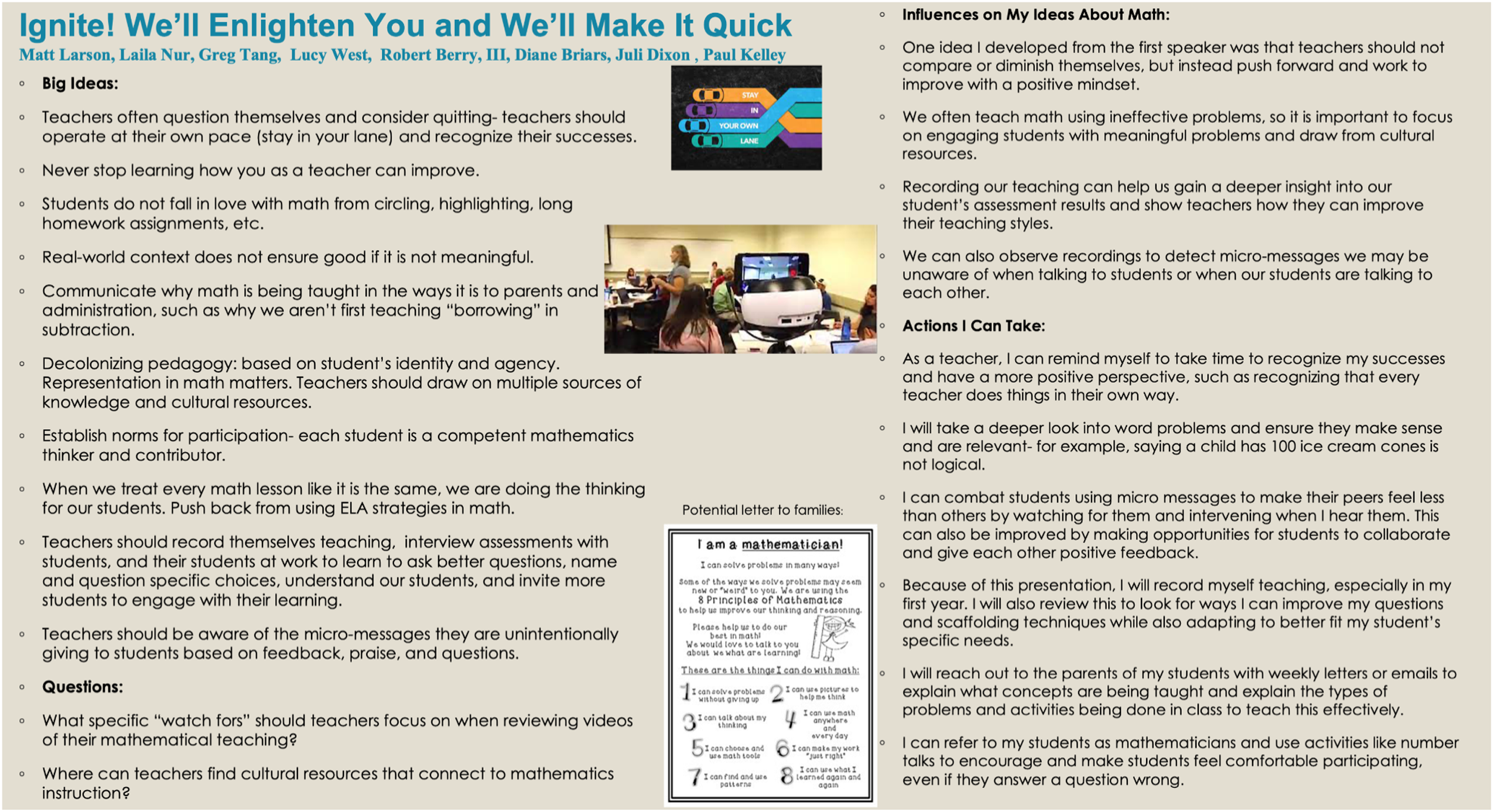
An example of a candidate's slide summarizing one session.
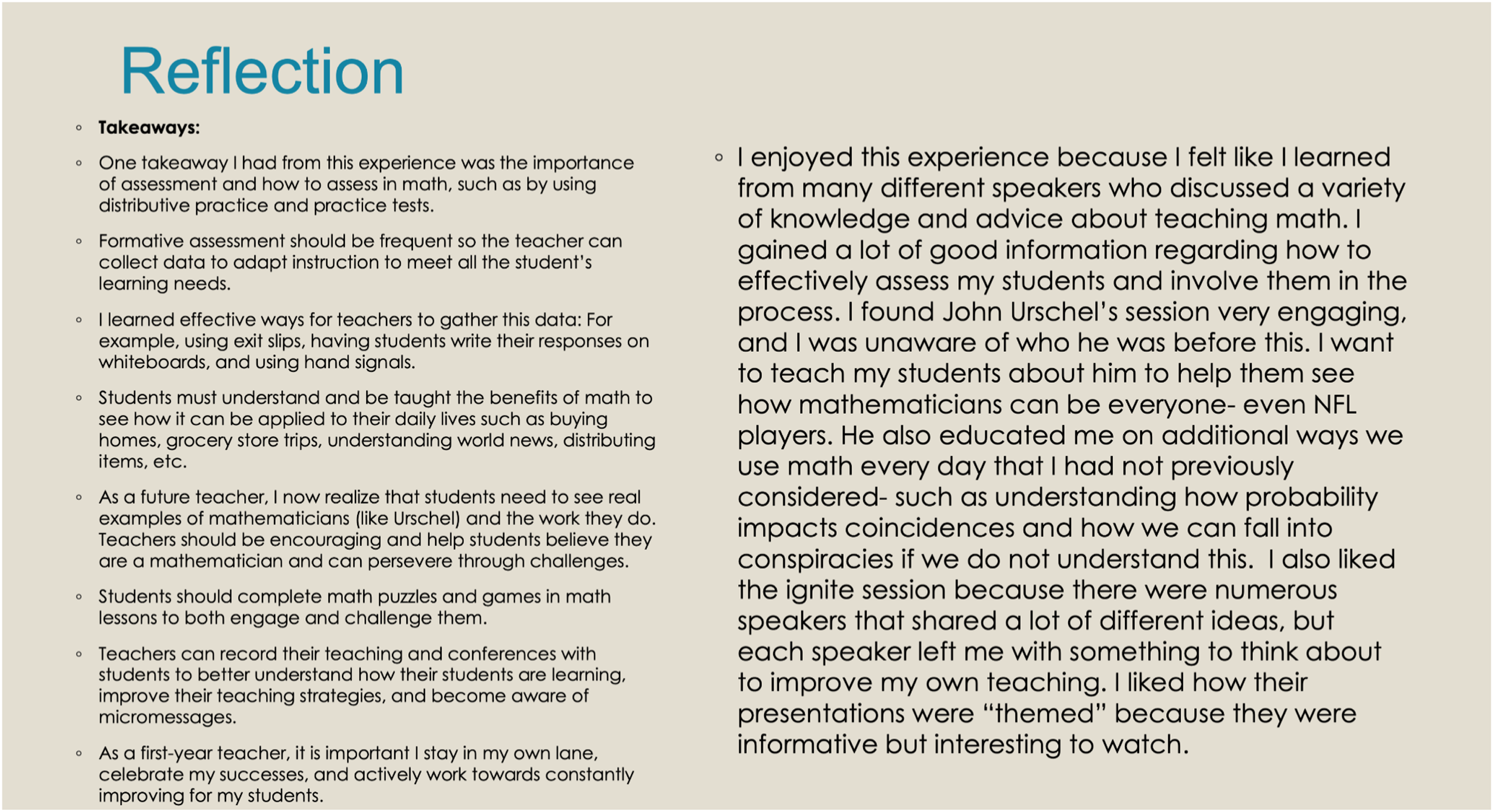
An example of a candidate's conclusion slide.
Assignment Supports for Gen Z Teacher Candidates
This assignment employs the use of video in order to provide Gen Z teacher candidates with an opportunity to engage in the same kinds of professional learning as in-service teachers. The assignment addresses Gen Z's preference for choice and personalization in their learning by offering options on a variety of different topics and in varied presentation styles (e.g., traditional workshop, Ignite sessions) during the conference experience. Clear directions are provided along with website links for each video, making this digital assignment easy to navigate – scaffolding the technology use required for Gen Z teacher candidates who lack tech savvy. Since Gen Z tends to be averse to collaborative learning (Mohr & Mohr, 2017), the conference experience offers them a chance to enter a digital learning space in order to observe what professional conference spaces tend to look and feel like without having to engage with others in hopes that they might feel comfortable joining the space in the future. Some sessions selected for the conference assignment were chosen to draw upon Gen Z's need to “be part of something bigger” and focus on topics of equity in mathematics education.
Method
Research Design
The goal of this qualitative study was to investigate two assignments that employed practice-based professional learning experiences in digital learning spaces to support Gen Z teacher candidates. The study investigated teacher candidates’ engagement and experiences with these assignments. The study was guided by the following research questions:
For the Math Community Assignments, what social media websites and podcasts did teacher candidates choose to connect with? What do teacher candidates report about the Math Community Assignment experience? How do teacher candidates describe their Virtual Conference Assignment experience?
The study was conducted in accordance with the Declaration of Helsinki and approved by the Institutional Review Boards at each author's university. Informed consent was obtained from all subjects involved in the study.
Data Collection
Data collection for this qualitative study took place in the United States at two different institutions, one for each assignment gathered. The Math Community Assignment #1 and #2 (see Appendix A for assignments) was implemented in a secondary mathematics methods course that was offered annually between 2021 and 2024 at a small public university. The Virtual Conference Assignment (see Marin & Dyess, 2022) was implemented in an elementary mathematics methods course that occurred annually between 2021 and 2024 at a large public university. Teacher candidates in all methods courses had birth years after 1997.
Following the completion of each methods course, teacher candidates were invited to participate in the study by providing consent to use their submitted course assignment artifact(s). Eight teacher candidates consented to having both of their Math Community Assignments (i.e., #1 and #2) used in the study (n = 8; 5 male and 3 female), and 20 teacher candidates consented to having their Virtual Conference Assignment used in the study (n = 20; all female).
Data Analysis
We utilized descriptive statistics to investigate frequency counts for the first research question, and employed a Grounded Theory (Glaser, 1978) approach using open coding to notice themes across teacher candidates’ responses for research questions two and three.
To address research question 1, a list of the social media websites and podcasts teacher candidates visited for the Math Community Assignments was compiled and each was classified based on its platform. Descriptive statistics were used to provide frequency counts of the social media websites and podcasts.
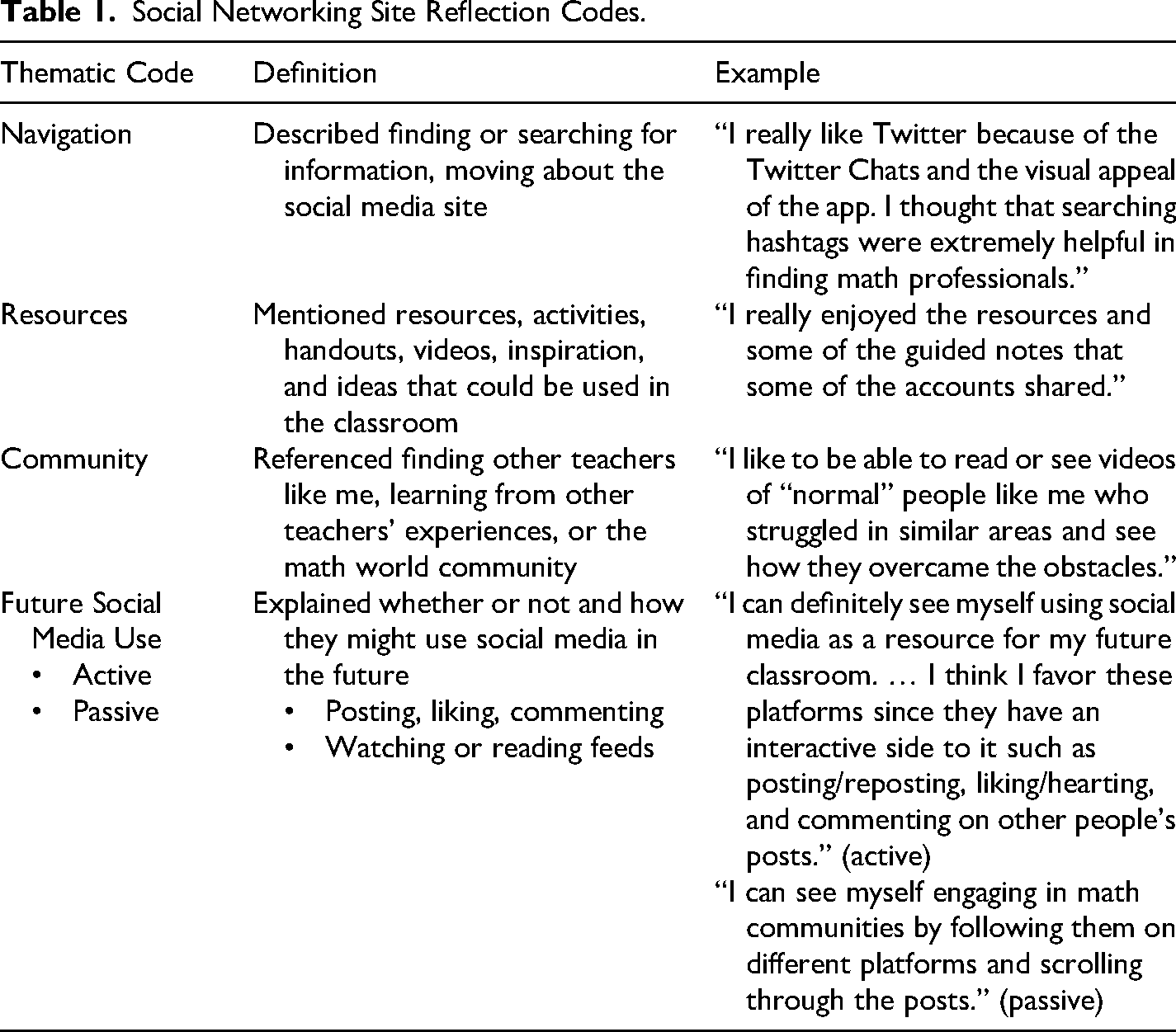
To address research question 2, student responses to the reflective response question on Math Community Assignment #2 which asks, “Based on your exploration can you see yourself engaging in math communities via social media? Why or why not? What was your biggest takeaway(s) from this experience?” were gathered to create a data set. Both authors, who are also the researchers, open-coded the data set. Based on this work, a set of themes were defined (Table 1) that both researchers used to independently recode the data. Full consensus of codes was reached through collaborative discussion and reconciliation.
Social Networking Site Reflection Codes.
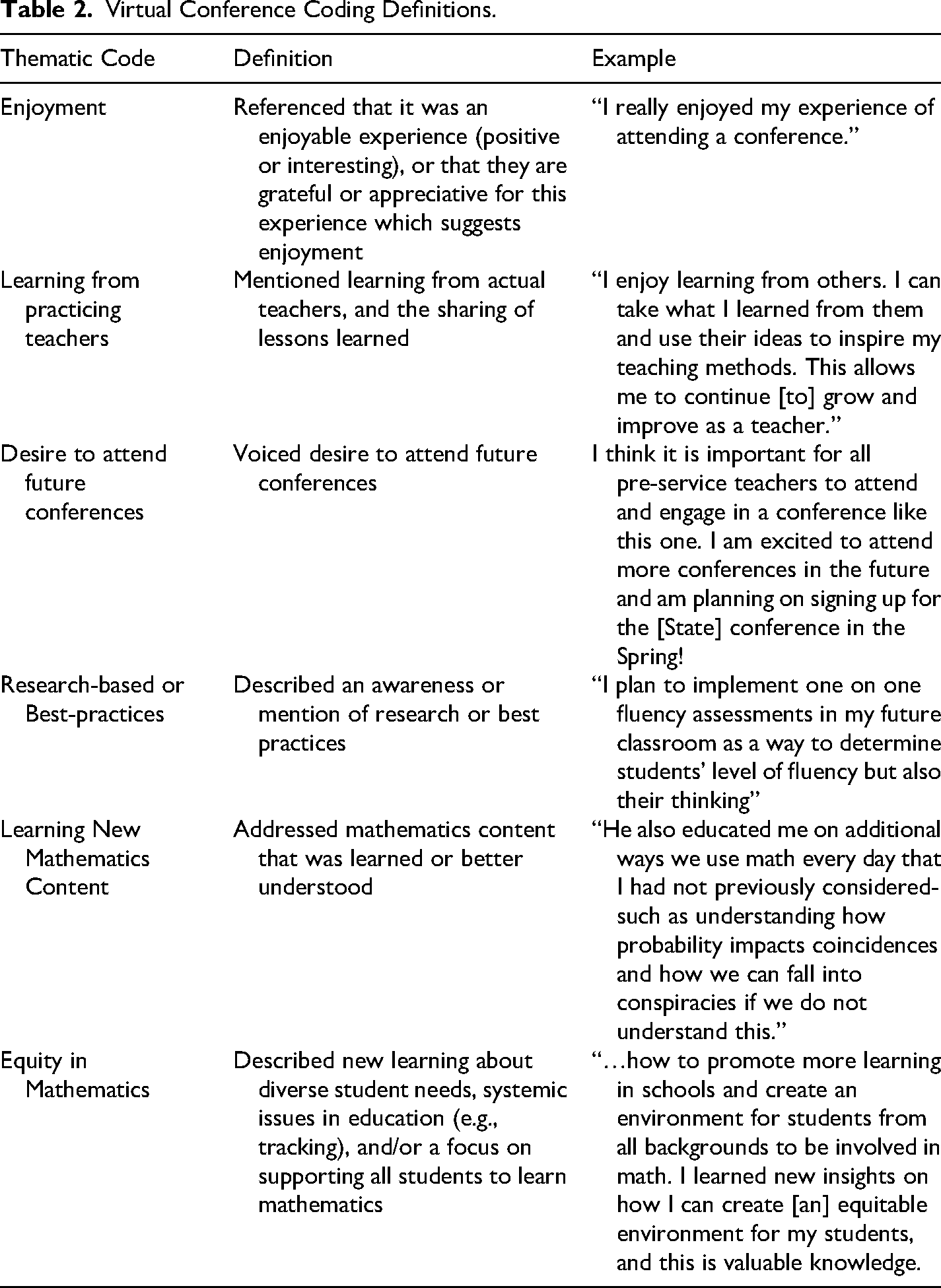
To address research question 3, the paragraph on the conclusion slide of each student's virtual conference experience was compiled into a list, and both researchers used open coding to notice patterns and trends across teacher candidates’ experiences. Based on this initial coding work, a set of themes were defined, which are displayed in Table 2. Both researchers then re-coded the data using this set of coding definitions, reconciled differences, and 100% agreement was reached.
Virtual Conference Coding Definitions.
Results
Math Community Assignment
Math Community Assignment #1 had teacher candidates explore podcasts as a way to connect with the mathematics teaching community via a digital learning space. The assignment required, in part, teacher candidates to find four different podcasts and provide a description and link to each one. The authors compiled a list of all of the podcasts (n = 32) teacher candidates identified in their assignment. Overall, 19 unique podcasts were identified. The podcast hosts ranged from professional organizations to edu-celebrities (popular speakers and/or researchers) to classroom teachers. Of the 19 podcasts identified, eight had been informally recommended on a slide introducing the assignment, while the remaining 11 were found independently by the teacher candidates. Of the 32 podcasts that were explored for the assignment, 56% (18 out 32) were introduced by the assignment directions. Thus, suggesting teacher candidates relied on recommendations from instructors more often than they found podcasts via their own research.
Math Community Assignment #2 had teacher candidates explore social networking sites, such as Facebook, Instagram, and Twitter/X 1 , where math communities exist in digital learning spaces. The assignment required them to find four different social networking pages/groups/people/etc. and provide a description and link to each one. The authors compiled a list of all of the social networking sites (n = 32) teacher candidates identified in their assignment. Again, the list ranged from professional organizations to edu-celebrities (popular speakers and/or researchers) to classroom teachers on various social media platforms. Figure 3 displays the frequency count of social media platforms. We identified that teacher candidates used six platforms (e.g., YouTube, Twitter/X, Facebook, Instagram, and TikTok), and that the most frequently chosen platforms were Twitter/X (n = 10) and Instagram (n = 9).
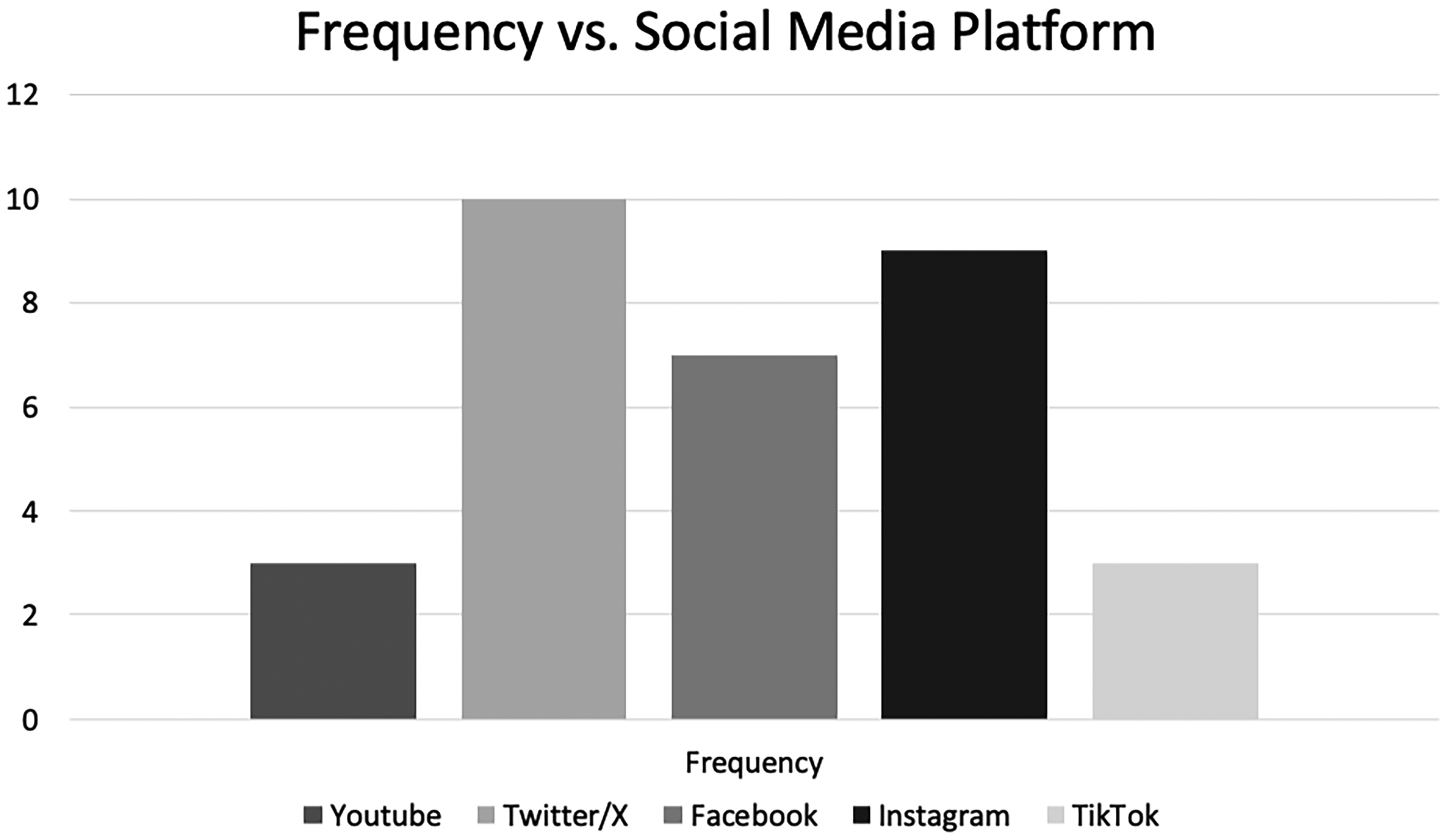
Frequency vs. social media platform.
The authors then wondered if organizing the social media selections based on the year would provide any further insights, particularly because social media sites are constantly changing in popularity and rebranding (e.g., Twitter/X). The percentage of responses from each social media platform is displayed in Figure 4. Twitter/X was utilized for 67% of the social media sites in 2021 but declined to 8% in 2024. Conversely, Instagram was used for 8% of the social media sites in 2021 and gradually increased use to 42% in 2024. This demonstrates an ebb and flow of interest in social media platforms and shifts over time among the teacher candidate population.
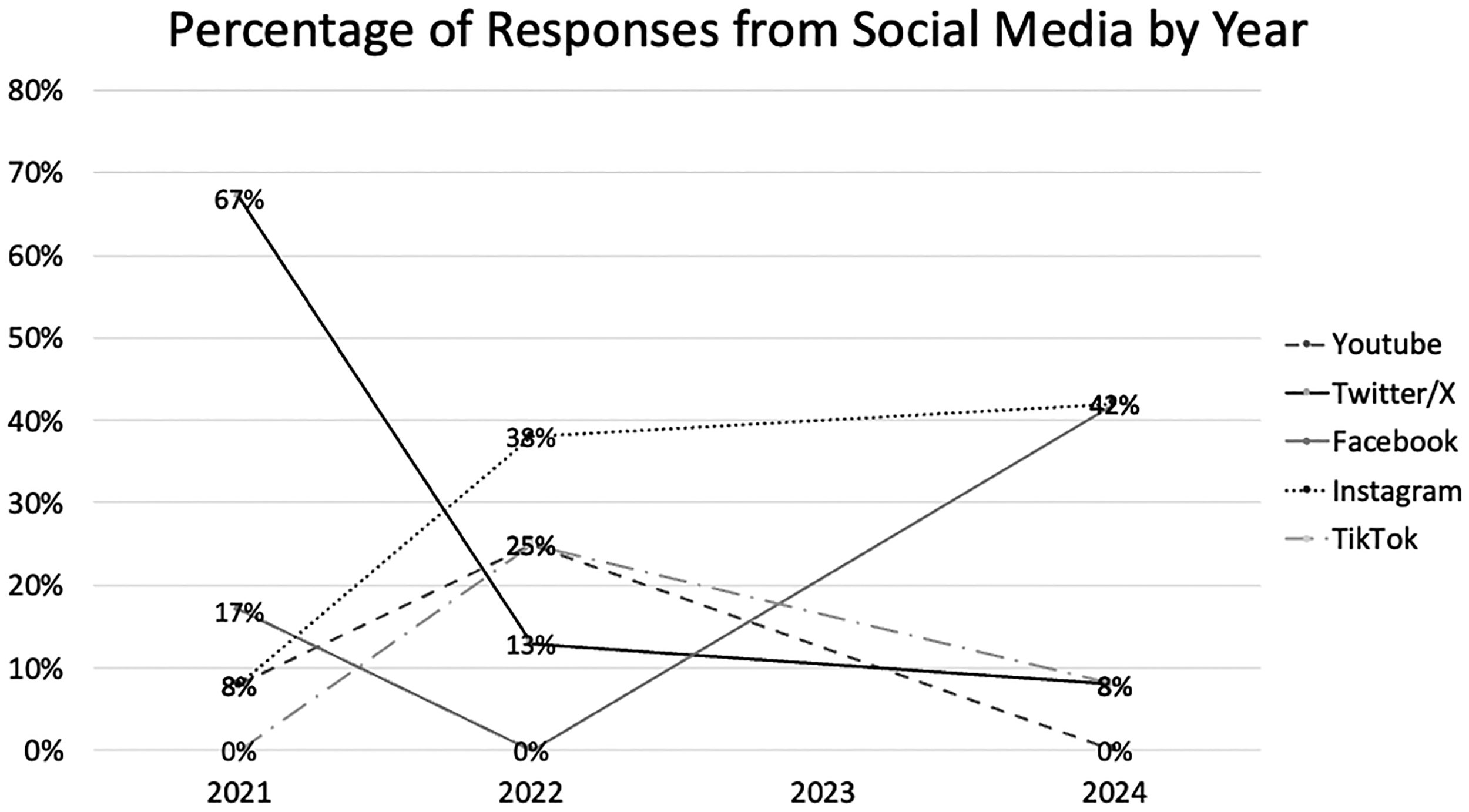
Percentage of responses from social media by year.
The second research question was addressed by analyzing the Math Community Assignment #2 reflective response question – “Based on your exploration can you see yourself engaging in math communities via social media? Why or why not? What was your biggest takeaway(s) from this experience?” Open coding of the student responses (n = 8) produced the following themes: Navigation, Resources, Community, and Future Social Media Use (Active or Passive). Table 3 displays the number of statements coded for each theme in the first column (i.e., overall frequency counts), and then the second column displays the percentage of teacher candidates’ responses that contained that code.
Frequency of Social Networking Site Reflection Codes.
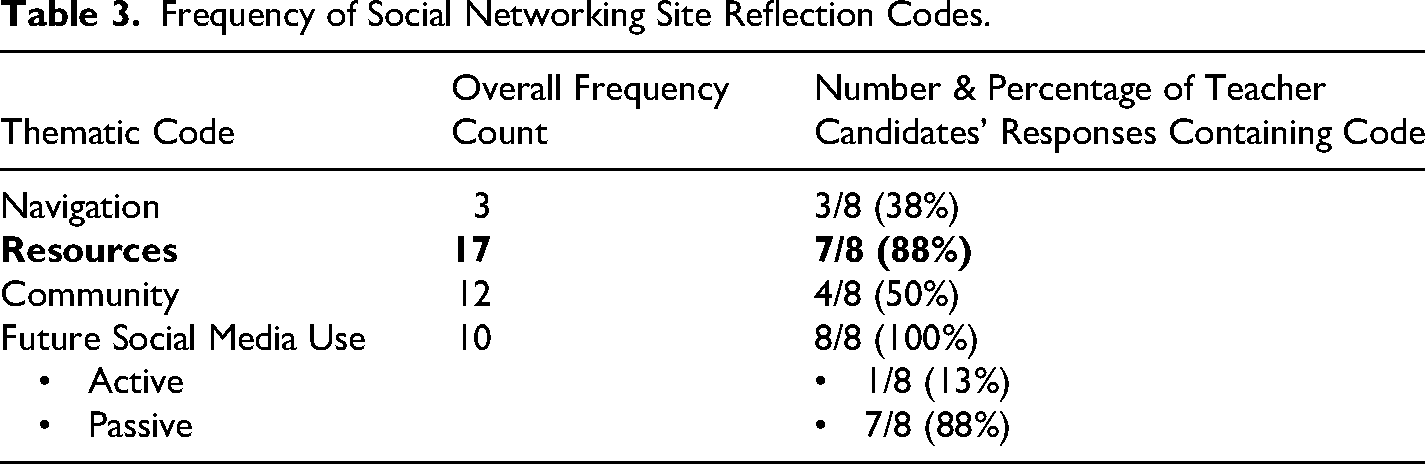
The most frequently coded category was Resources, which was mentioned 17 times. Teacher candidates demonstrated a preference for “lots” of resources over specific resources. They also spoke to a perceived need for generic resources, in other words, nothing specific to curriculum, course, grade level, or standards. For example, one candidate said, “I can see the benefit of having access to resources that can directly help me” and another wrote, “I really enjoyed the resources and some of the guided notes that some of the accounts shared.” This appreciation for resources was shared by 88% of the teacher candidates, and demonstrates Gen Z's interest in materials that will support their future work as teachers.
Another commonly coded category was community and highlighted when teacher candidates referenced finding other “teachers like me,” learning from other teachers’ experiences, or connections with the global mathematics community. Four teacher candidates (50%) referenced the teaching community they found in social media networking sites. They noted the ease of connecting with other teachers in these platforms, the opportunity for less experienced teachers to learn from posted questions and conversations from more experienced teachers and overall being able to relate to the experiences of the group. For example, one candidate summarized their biggest takeaway as “realizing the importance of community in the math world. We are all working towards the same goal and need one another to overcome any obstacles.” Community, as a theme, also aligns with Gen Z learners need to see themselves as part of something bigger than themselves (Marin, 2023).
Navigation was a less frequently coded category, occurring three times in the work of three different candidates. While not the most frequently occurring code, when navigation was mentioned, it was in reference to whether or not a site had what you were looking for, and the ease with which one could find that information. Navigation as a theme aligns with the trend of Gen Z learners being tech dependent, but not necessarily tech savvy, and how they appreciate modeling or scaffolded experiential spaces.
Lastly, and not surprisingly, as it was explicitly asked for in the assignment prompt, 100% of the teacher candidates addressed future social media use. The majority of them (7 out of 8) reported that they planned to engage passively with teacher communities on social media in the future; indicating that they wanted to read and watch the feed of information as an observer and not as an active contributor. They viewed the benefit of engaging in social networking communities as being able to go look for resources or scroll through resources and conversations more passively. Only one candidate mentioned active engagement in these spaces, stating, “I think I favor these platforms since they have an interactive side to it such as posting/reposting, liking/hearting, and commenting on other people's posts.” The positive tone in teacher candidates’ comments suggests they view this as a space to engage with others in the teaching profession, both learning passively and actively from them, and allowing for a connection to the professional world.
Virtual Conference Assignment
Six themes were produced from the open coding of the reflection slides about teacher candidates’ virtual conference experience and provided insight into the patterns and trends across their experiences. The six themes are displayed in Table 4. Overall, teacher candidates described their Virtual Conference Assignment experience as positive. They indicated it was: an experience they enjoyed or were thankful to attend (17); an experience that promoted learning from practicing teachers (19); and an experience that created the desire to attend future conferences (14). These three takeaways were highlighted by over fifty percent of the teacher candidates completing this assignment (see Table 4).
Frequency of Virtual Conference Codes.
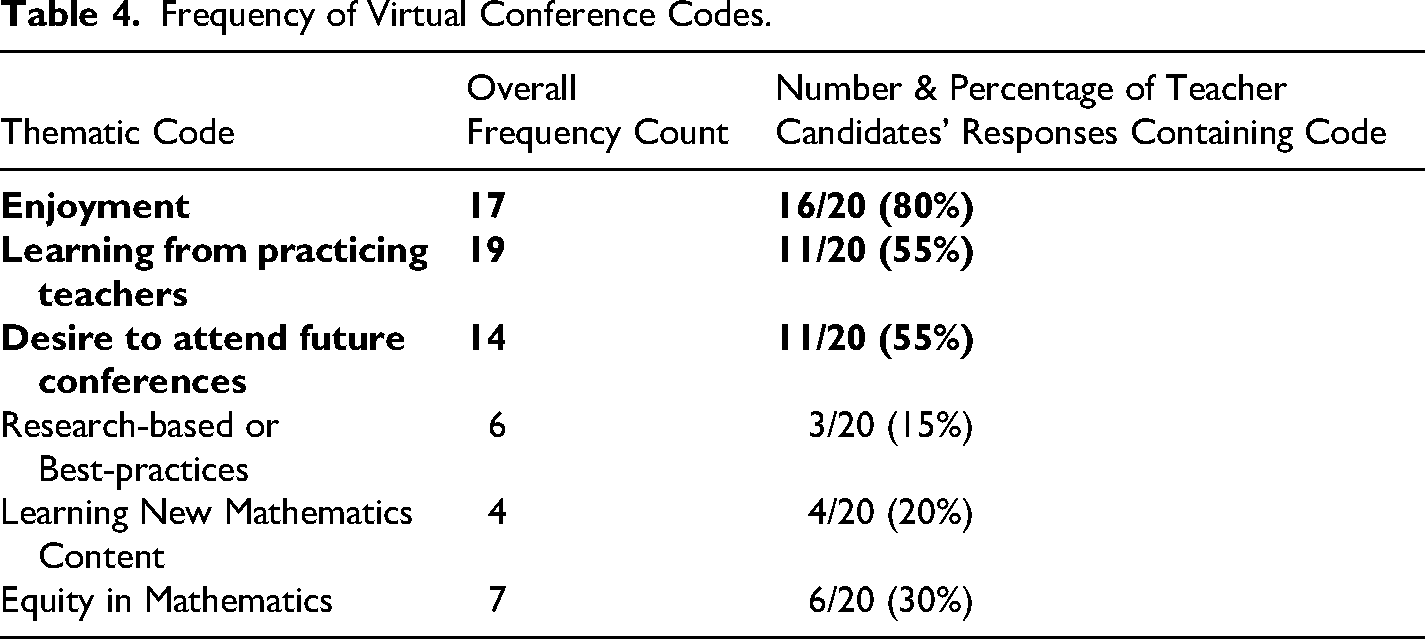
The most frequently coded category was learning from practicing teachers, which was mentioned 19 times and appeared in 55% of the candidates’ slides. Teacher candidates valued the variety of perspectives and ideas that were shared by practicing teachers in the virtual conference, and how these new ideas informed their own learning. For example, “I enjoy learning from others. I can take what I learned from them and use their ideas to inspire my teaching methods. This allows me to continue [to] grow and improve as a teacher.” and “I am always grateful to learn more about in-classroom experience to better prepare myself for my first year of teaching.” When asked about their conference experience, the majority of teacher candidates (80%) shared that they enjoyed the assignment. One student admitted, “When I first read this assignment, I didn’t want to do this at all. I thought the conference would be about boring new ways to do math problems but that was not the case at all, and I ended up really liking it.” Another candidate noted, “I enjoyed this conference experience because I have never gotten to do something like this as an educator” demonstrating this additional connection to the practice of a “real” teacher and Gen Z's need for experiential learning that aligned with the work of professional teachers.
As a result of this assignment, 11 out of 20 teacher candidates demonstrated a desire to attend a future conference and continue their learning. While one candidate acknowledged the benefit of this virtual conference experience, there were also comments that demonstrated a preference toward attending a conference in person (e.g., “I would rather go to conferences in person, instead of listening to them online.”). One candidate highlighted both the importance of the assignment and future intentions of attending a professional conference in person when they said, “I think it is important for all pre-service teachers to attend and engage in a conference like this one. I am excited to attend more conferences in the future and am planning on signing up for the [State] conference in the Spring!” Another candidate spoke to the professional learning that conferences support when they said, “I look forward to attending more conferences, gaining perspectives, taking notes, and understanding different ways people look at the mathematical world.” This reflective thinking and motivation to engage in future professional learning through in-person conferences, suggests the assignment provided Gen Z candidates an introductory experience that they felt would be beneficial to their future careers and ongoing professional development.
The most frequently occurring themes were all about teacher candidates’ conference experience and less about their learning (e.g., coding themes: research-based practices or best-practices, learning new mathematics content, and equity in mathematics). These most frequent themes reflect the goal of the assignment – to introduce teacher candidates to professional conferences in a way that might create interest and motivation to attend another professional conference in the future.
Discussion
Experiential education emphasizes the intentional design of authentic experiences that engage learners in professional practices and support learning through experience and reflection on action (Dewey, 1938; Itin, 1999). In digital context, Dalsgaard and Ryberg's (2023) framework extends experiential education by conceptualizing learning as distributed across individual, collaborative, community, and open networked spaces. Professional learning assignments that engage learners in virtual conferences and social media connected to professional organizations and teacher leaders provide opportunities to observe, evaluate, and learn from real professional development environments, a need for Gen Z teachers who generally come to their undergraduate experiences with little to no work experience (Schroth, 2019). Through these experiences, learners develop knowledge of professional learning opportunities, gain insights into the structure and value of disciplinary communities, and consider the relevance of continued participation in such spaces for their own professional growth – elements of needed induction into their chosen profession.
Results of this study were interpreted and will be discussed through the lens of Dalsgaard and Ryberg's (2023) theoretical framework for digital learning spaces with consideration of the characteristics and learning needs of Gen Z. The Math Community Assignments and the Virtual Conference Assignment intentionally utilized digital learning spaces that opened connections to professional communities and allowed teacher candidates to interact with communities of interest as they explored various social media websites, podcasts, or recorded conference sessions as passive observers. These assignments allowed teacher candidates to “establish connections” and decide if they wanted to continue to follow or be engaged in the networks they explored. In addition, they modeled formats for ongoing professional learning that could be utilized throughout their professional careers. The data suggests that these assignments were successful in this work, since 100% of the teacher candidates who completed the Math Community Assignment said they would use social media sites in the future, even if it was mostly in a passive way (e.g., following, observing posts), and 80% of the teacher candidates said they enjoyed the virtual conference experience and 55% expressed a desire to attend a future professional teaching conference. While Gen Z learners appreciate choice, we also noticed in the data that the teacher candidates took recommendations from the instructor for which podcasts to explore, which could be a function of their inexperience in professional spaces and a need for induction into and modeling of professional development.
Engagement in Social Forms
Dalsgaard and Ryberg (2023) identify three social forms within communities of interest – inquiry, construction, and communication. Considering these social forms, we noticed evidence in our data to suggest the Gen Z teacher candidates were taking up these forms of engagement in their work across assignments. In particular, the themes produced from the open-coding display evidence of the social forms. Those themes and evidence are discussed below.
Inquiry
A community of interest is a space where an individual may engage in inquiry – asking questions or searching the group discussions for keywords – to advance their knowledge. In the Math Community Assignment data, the theme of resources (e.g., resources, activities, handouts, videos, inspiration, and ideas that could be used in the classroom) was referenced in nearly all assignments. This meant Gen Z teacher candidates were engaged in inquiry of looking for ideas for their future classroom, and that ideas in the communities were available and accessible for everyone.
Analysis of student reflections on the Virtual Conference Assignment also produced evidence of inquiry. Themes produced from the analysis of student reflections – research-based/best practices and learning new mathematics content – indicate that teacher candidates were finding new resources and learning mathematics that would support their future work of teaching. Thus, through their participation in virtual conference sessions, they learned about research-based and/or best practices for teaching, along with important mathematics content, to which they were introduced and indicated its potential impact on their future work as a teacher. The majority of the Gen Z teacher candidates also indicated a desire to attend future conferences, evidence that they have a desire to continue to engage in inquiry and seek ideas and support for their work as well as newfound experience in professional development spaces.
Construction
Dalsgaard and Ryberg (2023) discuss the power of feedback on student learning as a form of knowledge construction in communities of interest. In data collected from Math Community Assignment, the identified theme of “community” displayed some ideas of construction through the lens of apprenticeship learning, by watching and learning from others like me or those that are more experienced. Candidates specifically noted that these social media sites provided opportunities to easily connect with other teachers and for novice teachers to post questions and learn from more experienced colleagues via active or passive engagement in the group. In other words, helping them construct their ideas about the work of teaching mathematics, as well as discover solutions to teaching challenges via participation in the community of interest.
A similar trend appeared in the Virtual Conference Assignment, where the theme of “learning from practicing teachers” was produced. Evidence from this assignment indicated candidates’ interest in learning from practicing teachers and the sharing of lessons learned. This suggests the Gen Z teacher candidates were again engaged in a model similar to apprenticeship – learning from more experienced others – which supports their knowledge construction and may contribute to their understanding of what is important to the mathematics teacher community.
Communication
A key element of communication in communities of interest is accessibility and sharing (Dalsgaard & Ryberg, 2023). Digital technologies are an effective and supportive tool in the facilitation of these elements of communication. While candidates were required to access pre-existing communities for the assignments discussed in this study, they also had opportunities to share ideas and access resources from their classmates in the dissemination of their learning as an element of the assignments. In these ways, communication – specifically the opportunities to access and share ideas and resources and ask questions – were available via the at-large communities found on social media and within the candidates’ own classrooms at their universities.
In the Math Community Assignment data, we see evidence of the ways that the Gen Z teacher candidates discovered the accessibility of communities of interest beyond their university networks – a first step in establishing communication. Access to external communities of interest is a necessary step in engagement. Within the data, the theme of future social media use provides evidence of candidates’ discovery of the accessibility of outside networks and provides insight into how candidates planned to engage in professional social media networks in the future — leveraging their comfort in tech spaces traditionally used for personal connections to build professional ones. Most candidates mentioned passively following specific communities, whereas only one candidate expressed interest in actively participating (e.g., posting, liking, etc.) in the future. However, this initial act of following a community and learning from others may support a candidate's confidence to later engage or develop their own profiles and networks in the future and establish open communication in communities of interest.
Data from the Virtual Conference Assignment shows evidence of both elements of communication – accessibility and sharing. Over half of the candidates reported a desire to attend future conferences, which points to the theme “desire to attend future conferences” that was produced from the student work sample provides evidence that candidates now see future conferences (and the communities they provide) as accessible and that they would like to actively participate in those communities of interest, specifically by attending a professional conference. This suggests that allowing the Gen Z teacher candidates to be passive observers in a virtual conference served as a model of professional development spaces and was one way to support them in feeling comfortable or in wanting to take the next step towards engaging and communicating with fellow teacher networks. In addition, teacher candidates were required to share their learning with others in their own smaller community – the university classroom – a second key element of communication. While data was not collected about the experience of disseminating their learning to others, the requirement that candidates engage in this practice provides a needed opportunity to model and rehearse it for later participation in professional communities. In this way, the assignment provided experience that teacher candidates from older generations may have been more likely to have gained in their prior work experience.
Overall, evidence from teacher candidates’ assignment submissions suggests that social media websites, podcasts, and virtual conference experiences leverage familiar, meaningful, and impactful tech platforms as professional learning experiences for Gen Z teacher candidates suggesting that these assignments met the needs of this generation of future teachers and also successfully provided a meaningful digital learning space for them to explore other professional communities. For teacher candidates who rely on technology for communication, social media creates a community that teachers may not have access to in their physicality. But via podcasts and social media, even through passive engagement, they can be a part of a community that supports their work and enhances their professional learning.
Implications for Teacher Education
As teachers, we may be inclined to teach in ways that reflect our own experiences (Lortie, 1975). However, the teacher candidates in teacher preparation programs are most often from different generations than their instructors and therefore require us to adapt our teaching to meet the needs of, in this case, Gen Z teacher candidates. While the skills of a profession may not change drastically, the way teacher educators deliver content needs to change over time to meet the strengths, satisfy the needs, and leverage the motivational factors of each generation. Practice-based professional learning experiences are one way we have found to effectively support Gen Z teacher candidates and potentially provide examples of what transformative experiential education can look like in teacher education These assignments offer a response to the concern raised by Glazier et al. (2021) that “there are too few examples of what transformative experiential education looks like when centered in K-12 classrooms and the preparation of teachers” (p. 4). Through assignments like the Virtual Conference Assignment, for example, pre-service teachers can be connected to and engaged with communities beyond their institutions of higher education (e.g., professional organizations), be introduced to diverse voices (e.g., the voices of teachers and students), and see models of the ways in which they might use their own voices to amplify their work and their ideas as they grow into the profession of teaching. Additionally, while the assignments in this paper were grounded in mathematics education, the assignment structure of exploring social media outlets or utilizing virtual conferences could be used widely across discipline fields within teacher education.
Teacher Educators Recommendations Matter
One important takeaway from this study is that teacher educators’ recommendations matter for Gen Z. As noted earlier, over half of the podcasts explored by teacher candidates had been recommended on the assignment slide. This finding is compatible with the literature describing Gen Z as lacking autonomy as a result of their upbringing in a culture of safety where overparenting stunted growth (Schroth, 2019) and underscores the influence of instructor suggestions and the importance of intentionally curating high-quality examples. This suggests that Gen Z teacher candidates, while appreciating choice, also use recommendations to begin and/or complete assignments. This means teacher educators should be intentional about what they model or show as examples, because candidates are fairly likely to try those out. By recommending high-quality podcasts (or other sites), we can support candidates with a more positive and intentional experience.
Using Digital Learning Spaces Means Assignments Have to Be Flexible
Social media is ever evolving and what is popular today could change tomorrow. This means experiential education assignments that use digital learning spaces must also evolve or be flexible to adapt to the ever-changing social networking site landscapes. The Math Community Assignments demonstrate this kind of flexibility as the social media sites teacher candidates selected increased and decreased over the years but still offered a similar experience of introducing networks and opening connections through digital learning spaces (Dalsgaard & Ryberg, 2023). Overall, teacher candidates utilized various social media platforms, but it seems some were more or less popular based on the year of the assignment. Therefore, teacher educators need to be flexible and willing to adapt to new social media networking sites as the field changes, too. Additionally, teacher educators should be open to experiential preference suggestions by candidates with regards to social media sites, podcasts, and sources for assignments like the Math Community Assignments in order to stay current with platforms that Gen Z teacher candidates use rather than are forced to use for an assignment.
Limitations of the Present Study
According to Sherin et al. (2011), attending refers to what a teacher does or does not pay attention to in the classroom, but this idea can also be applied to what teachers notice and focus on during practice-based professional learning experiences. Roller (2019) recommends providing teachers with mathematics teaching frameworks as lenses for focusing noticing during observations. In a similar way in this study, the reflection prompts acted as lenses, shaping what teacher candidates attended to during their assignments. For instance candidates were explicitly asked to reflect on their experiences with social media (e.g., if they would engage in math communities via social media) and virtual conferences (e.g., reflect on their conference experience and if they would attend a future conference) and whether they would use these platforms in the future. As a result, candidates’ reflections were more often coded for experiential themes—such as enjoyment, ease of use, or willingness to continue engaging—rather than for content-based takeaways, such as learning new mathematical concepts, equity considerations, or research-based practices. This suggests that the assignment structure influenced what candidates noticed and emphasized in their reflections.
In addition, as instructors of record, the authors acknowledge the potential for social desirability bias in student responses to graded assignments, as well as the limited sample size. Given that the assignment expectations were reflective, they were not evaluated for accuracy against a subjective scale. As such, teacher candidates were given full credit for depth of response regardless of its tone. In other semesters, candidates have freely expressed negative feelings about the assignment and were not penalized. Additionally, this study relied on the literature to identify the needs and characteristics of Gen Z learners, rather than collecting primary data directly from participants. While the literature offers a helpful theoretical foundation, it may not fully capture the specific preferences or learning needs of the teacher candidates involved in this study. Future research could more directly investigate participants’ needs and values by using primary data collection methods such as surveys or interviews. Doing so would provide more tailored insights and allow for a more accurate analysis of how assignments meet Gen Z learners’ needs.
Another limitation is the small sample size (n = 28) and the study's limited geographic and institutional context (two teacher preparation programs in the United States). As noted by Zilka (2023), the geographical context of a generation's experiences matters. These factors constrain the generalizability of the findings. For these reasons, the findings are framed as exploratory rather than representative of broader populations. While the study offers promising insights, future research would benefit from larger, more diverse samples, including comparative data across different groups of students, regions, or international contexts.
Conclusions
This study explored the experiences of Gen Z teacher candidates in mathematics methods courses. While the small sample size and United States context limit generalizability of findings, the study offers insights and raises important questions to guide future research. The findings contribute to the work of teacher educators, within and beyond mathematics teacher education, by informing the design of coursework that supports teacher candidates. Although educators must tailor instruction to their local context and the needs of their particular students, the exploration of generationally responsive teacher education practices has broader relevance to the field. Future research could build on this work by examining what is learned through specific assignments.
Gen Z enjoys digital engagement and personalization, and they are well-suited for careers that aim to enact positive change, such as teaching. However, they have limited work experience and need support as they transition into the professional world. This study provides preliminary evidence that practice-based professional learning experiences using digital tools can effectively support Gen Z teacher candidates in making early connections to professional communities. Candidates described these assignments as enjoyable and expressed interest in continuing such activities on their own — such as attending future conferences or engaging with educator communities on social media — to support their professional growth as a teacher.
Teacher educators are encouraged to remain conscious of the generational divide that often exists in teacher preparation programs between teacher educators and candidates, and to make thoughtful adjustments to better meet the needs of today's learners. Practice-based professional learning experience assignments, particularly those that are flexible to the ever-changing, relevant social media spaces and that provide intentional recommendations for getting started, offer a promising approach to designing and adapting teacher education coursework for Gen Z candidates that prepares them for the workforce.
Footnotes
Author Note
Katherine Ariemma Marin, Department of Elementary, Middle & Secondary Teacher Education, University of Louisville, ORCID iD: 0000-0001-7565-4955; Sarah Roller Dyess, Department of Curriculum and Instruction, The University of Alabama in Huntsville, ORCID iD:  .
.
Ethical Approval Statement
The study was conducted in accordance with the Declaration of Helsinki and approved by the Institutional Review Boards at The University of Alabama in Huntsville (reference number EE202495) and at University of Louisville (reference number 10.0528).
Informed Consent Statement
Informed consent was obtained from all subjects involved in the study.
Funding
The authors received no financial support for the research, authorship, and/or publication of this article.
Declaration of Conflicting Interests
The authors declared no potential conflicts of interest with respect to the research, authorship, and/or publication of this article.
Data Availability Statement
The data is contained within this article.