






Abstract
Background
Experiential learning is widely considered to be a high-impact practice in higher education. Yet, it is less understood how and why these experiences contribute to positive student outcomes.
Purpose
This study investigated the impact of an experiential learning opportunity at the Ritz-Carlton Hotel on leadership development among university students.
Method
Drawing upon experiential learning theory and exemplary leadership theory, the researchers analyzed student and external stakeholder reflective data to determine the extent to which the program aligned with tenets posited in experiential learning and exemplary leadership theories.
Findings
Three themes (1) Experiencing Exemplary Leadership in Action, (2) Forming Connections Through Reflective Observations, and (3) The Humanized Experience revealed insight into how and why the Leadership Excellence Apprentice Program experience facilitated student learning through experiential learning cycles aligned with key principles of exemplary leadership.
Implications
The study identified areas for improvement in the design and delivery of experiential learning opportunities to enhance student outcomes. Key insights from this research can inform and guide the development of effective experiential learning programs across various academic disciplines and institutions.
Significance of Research Statement
This study contributes to experiential education scholarship by demonstrating how an intentionally designed, theory-informed experiential learning partnership facilitates undergraduate leadership development. By theoretically examining a university–industry collaboration, this research offers practical insight for educators seeking to design high-impact experiential learning programs that bridge leadership theory and practice.
As a high-impact learning practice, experiential learning has become increasingly more prevalent in institutions of higher education (Slavich & Zimbardo, 2012). For instance, Selingo (2017) estimated that nearly 80% of college graduates participate in some form of experiential learning. Experiential or service learning is embedded into some college coursework to help students gain practical knowledge related to their desired profession. Experiential learning, a pedagogical approach, is often embedded into larger experiential education environments. According to Garlick (2014), experiential education is about linking real-life to learning through the process of reflection. Benefits of experiential educational learning environments are well studied and include positive learning outcomes such as personal growth, cultural engagement, and social capital development, to name a few (García & Longo, 2013). Selingo (2017) suggested that engaging in quality experiential learning during college is essential to establishing successful careers after graduation. Indeed, practical skills gleaned through experiential learning have the potential to positively impact students and community partners in a variety of ways. While few may refute the benefits of experiential learning in higher education settings, more research is needed to better understand how various experiential learning opportunities positively impact students (Kong, 2021). Further, several have noted that more research is warranted addressing how to design and implement effective experiential learning opportunities (Garlick, 2014; Venske, 2018).
This study utilized an a priori coding theoretical approach to examine how a collegiate experiential educational setting and experiential learning partnership with the well-known Ritz-Carlton hotel chain impacts leadership development for undergraduate leadership students. The following research question guided this inquiry: How does the Leadership Excellence Apprentice Program (LEAP), an experiential educational opportunity, facilitate student leadership development?
According to Kayes (2002), learning is most powerful when knowledge develops within a context of personal and environmental demands. Reported benefits of experiential-based learning include enhanced sense of self-engagement, cultural engagement, civic-mindedness, personal growth, awareness of social justice, social capital development, and other positive outcomes (Dewey, 1938; García & Longo, 2013; Kayes, 2002). Experiential learning has been studied both embedded within and outside of the classroom. Trolian and Jach (2019) noted that both curricular and co-curricular experiential learning is beneficial to student learning. Similarly, Azar et al. (2020) described experiential learning as “a useful educational tool for transforming the learning experience to extend beyond the traditional classroom” (p. 296). With the understanding that experiential learning can be highly impactful, educators across disciplines have sought to infuse the pedagogical tool into the curriculum, or design co-curricular and complementary to classroom experiential learning opportunities (Mittal & Bansal, 2024).
A few studies have examined characteristics of successful experiential learning opportunities. McLaughlin et al. (2018) assessed field course experiential learning through short-term study abroad experiences. Their model integrates experiential learning theories, emphasizing active engagement, reflection, and application of knowledge in real-world contexts. A key component of McLaughlin et al. 's model is structured reflection, which aligns with Schö'’s (1983) concept of the reflective practitioner. Through guided reflection, students created meaningful connections between their experiences and academic content. They posit that this approach will result in enhanced learning outcomes.
Wright's (2000) findings corroborated this research, suggesting that short-term experiential learning opportunities were more impactful than long-term programs. While these studies provide insight into the design of successful experiential learning opportunities, several scholars have noted that a better understanding of the elements that make experiential learning high-impact, and guidance on implementation of experiential learning both in and outside of the classroom is necessary (Garlick, 2014; Venske, 2018).
Additional studies provide examples of how experiential learning can be applied across various disciplinary backgrounds. Cock (2024) articulated the important role of business student reflections in experiential learning practice. Rossetti (2023) studied implementation of a curricular experiential learning program for event management students, finding that elements such as a link to employability and relevant teaching content were important to student outcomes. Additionally, in interior design, Ebbini (2022) found that experiential learning helped students foster creativity and application of concepts.
Some research has focused on the connection between experiential learning and specific student learning outcomes such as leadership. Several studies provide empirical context demonstrating the link between experiential learning and leadership development (Dugan & Komives, 2007; Trolian & Jach, 2019). In a more recent study, Balleisen and colleagues (2024) conducted research using a matched counterfactual group of undergraduate students participating in an experiential learning program at Duke University. Their study demonstrated several positive development outcomes present for the experiential learning group, including increased critical thinking and collaborative skills, stronger peer-to-peer and faculty connections, and career disposition developments.
Despite the abundance of literature confirming the benefits of experiential learning, Sabry Mohamed Salam (2019) noted that some faculty members are reluctant to engage in the work. They suggested that designing courses with experiential components embedded within can require time, money, and enhanced effort in building the assignment. Sabry Mohamed Salam (2019) revealed that faculty are more likely to engage in experiential learning at higher education institutes where experiential learning is prioritized by the university, evidenced by presence in institutional goals and strategic plans and resources that are allocated accordingly.
Experiential learning theory (Kolb, 1984) and exemplary leadership theory (Kouzes & Posner, 2017) frame the perspectives in this study. More specifically, these theories were used to examine the students’ experiential learning opportunities and unpack ways the students learned by participating (Kolb, 1984). Then we explore how participation in the experience shapes students’ perspectives on leadership. The combination of these theories allows for a robust understanding of an exemplary experiential leadership experience for students, as the conceptual approach described here provides a frame to examine how students understand and make meaning of leadership (e.g., exemplary leadership theory) in practice (e.g., experiential learning theory).
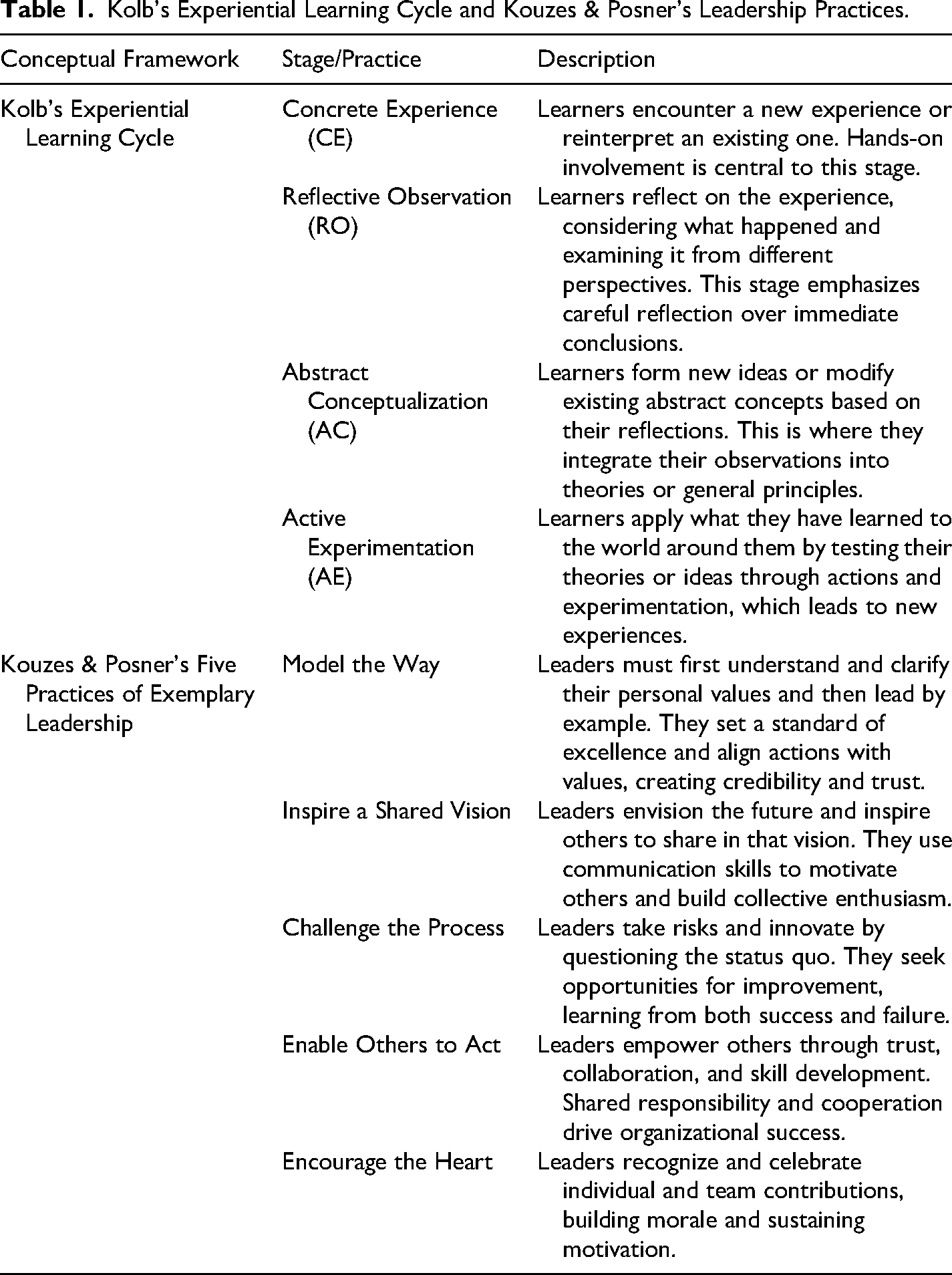
Kolb's (1984) experiential learning theory is based on the idea that learning is a continuous process grounded in experience. Kolb (1984) integrated the works and ideas of earlier theorists to propose a holistic model of learning that includes experience, perception, cognition, and behavior. The theory emphasizes how individuals can enhance their learning by using experiences to actively engage with the world. The four stages of the learning cycle are:
Concrete Experience (CE): This stage is characterized by learners encountering a new experience or reinterpreting an existing one, with active engagement serving as a central feature. Reflective Observation (RO): Learners reflect on the experience, considering what happened and examining it from different perspectives. This stage emphasizes careful reflection over immediate conclusions. Abstract Conceptualization (AC): Learners form new ideas or modify existing abstract concepts based on their reflections. This is where they integrate their observations into theories or general principles. Active Experimentation (AE): Learners apply what they have learned to the world around them by testing their theories or ideas through actions and experimentation, which leads to new experiences.
One of Kolb's key contributions is the assertion that different people have differing learning preferences, often depending on where they feel most comfortable within the learning cycle. Kolb described these preferences as:
Converging (AC + AE): Focuses on practical applications and problem-solving. Diverging (CE + RO): Prioritizes gathering information and exploring possibilities. Assimilating (AC + RO): Emphasizes logical reasoning and understanding theories. Accommodating (CE + AE): Relies on direct experiences and intuition.
The flexibility and adaptability of experiential learning theory make it useful in leadership development and organizational training contexts. Leaders, for instance, can benefit from rotating through these stages to enhance their ability to learn from experience, adapt their behavior, and improve decision-making. Although many experiential education programs begin with concrete experience (CE), Kolb suggested that individuals may engage the cycle in various learning stages. In LEAP, students are provided with some training before the concrete experience of engaging with guests. Kolb's framework provides a structured approach for systematically assessing student learning outcomes within LEAP. With this approach, educators can evaluate students’ ability to critically reflect, synthesize knowledge, and apply their learning in meaningful ways.
The exemplary leadership theory stems from over 30 years of research conducted by James Kouzes and Barry Posner (2017). It is a behavioral approach to leadership that highlights specific actions and practices exemplary leaders engage in, derived from extensive analysis of leadership behaviors across industries and organizations. Kouzes's and Posner's five practices of exemplary leadership provide a roadmap for leadership effectiveness:
Model the Way: Leaders must first understand and clarify their personal values and then lead by example. They must set a standard of excellence and align their actions with their values, creating credibility and trust among followers. Leaders build commitment by demonstrating how behaviors align with their stated values. Inspire a Shared Vision: This practice emphasizes the importance of envisioning the future and inspiring others to share in that vision. Leaders foster excitement and enthusiasm, rallying others to work toward common goals—which requires communication skills that motivate and engage others to buy into a collective vision. Challenge the Process: Leadership often requires taking risks and innovating. This practice involves searching for opportunities to grow, improve, and innovate by questioning the status quo. Leaders encourage experimentation and learning from mistakes, positioning challenges as opportunities for learning and growth. Enable Others to Act: Kouzes and Posner emphasized that leaders must empower others by building trust, fostering collaboration, and strengthening the abilities of those around them. Encouraging shared responsibility and facilitating cooperation helps organizations achieve greater outcomes. Encourage the Heart: Leaders recognize and celebrate contributions from team members. By recognizing individuals and teams for their contributions, leaders foster a sense of community and appreciation, helping to sustain motivation and morale.
Kouzes and Posner's (2017) research emphasizes that leadership is not about personality but about observable behaviors that can be learned and developed. Their work focuses on the human elements of leadership, stressing how exemplary leaders bring out the best in others by creating environments that foster mutual respect, trust, and collaboration. Table 1 summarizes both Kolb's and Kouzes and Posner's theories.
Kolb's Experiential Learning Cycle and Kouzes & Posner's Leadership Practices.
The Leadership Practices Inventory (LPI), developed alongside this theory, is a widely used tool for assessing how frequently individuals exhibit these leadership practices. Organizations and leadership development programs often use the LPI to help leaders reflect on their behaviors and identify areas for improvement.
Method
Participants
East State University, a pseudonym for a mid-sized public institution, classified as Research II under the Carnegie Classification System, served as the institutional site of the study. The university places a high emphasis on experiential learning opportunities for students and is home to a leadership minor available to all undergraduate students, regardless of academic major. Participants for LEAP were selected through a structured application and interview process. Eligible students applied to the program, demonstrating their interest in experiential learning. Applicants were then interviewed to assess their motivations, leadership potential, and readiness for an immersive field course experience. The final selection of 11 students was based on a combination of application responses, interview performance, and alignment with the program's objectives. All selected students were pursuing a leadership minor at East State University and were in their third or fourth year of study. They represented a range of academic disciplines including business, psychology, political science, education, computer science, nursing, and health administration.
Design
This study was a theory-driven qualitative inquiry into an experiential learning opportunity. It explored the phenomenon of experiential learning and its impact on student learning and leadership perspectives. More specifically, we, researchers, theoretically unpacked the elements of the selected experiential learning opportunities to better understand how the design aspects of such experiences could translate to student learning and influence students’ perspectives on and meaning making of leadership. Krauss (2005) described meaning making in relation to personal experience. Specifically, Krauss asserted that “a person draws meanings from, or gives meanings to, events and experiences. That is, experiencing starts to make sense as the person performs his or her psychological functioning of translating it into how he or she thinks and feels” (p. 762). The following research question was addressed: How does the Leadership Excellence Apprentice Program (LEAP), an experiential educational opportunity, facilitate student leadership development? Theoretical analysis was utilized in this study. Methodologists have long debated the appropriate use of theory in research (Anfara & Mertz, 2015). This study aligns with perspectives posited by Merriam (1998), who purported that research in its essence is “theory-laden” (p. 48). In this study, we used theory to systematically examine students’ experiences of the LEAP program. We leaned on the theoretical tenets to explain and make sense of patterns and outcomes reported by student participants. We sought to better understand how or why the LEAP program produces positive learning and developmental outcomes. Student and external stakeholder reflections were used as the main data sources to better understand the process of leadership development. Qualitative theoretical analysis is well-suited to understand how processes develop over time. Use of theory to analyze reflective data could provide valuable insights into the meaning-making processes for students and stakeholders (Creswell, 2013).
Author Positionality
We acknowledge the value of author positionality statements in the interpretation of analytic work, such as the present study. Three of the four authors are faculty members in a department that houses leadership programs. One of these faculty members also serves as the director of a leadership institute responsible for the leadership minor at the University. The fourth author is a doctoral student and serves as assistant director within the leadership institute. All four authors have taught leadership courses at the university, and all purport to be invested in understanding student leadership development. They bring their experience in the realm of college student leadership development to their interpretations of the student and external stakeholder reflections. The authors’ professional roles position them as institutional insiders with direct relationships to the leadership programs examined in this study. This status simultaneously adds to the study by allowing researchers deep contextual knowledge of the institution, program, and curriculum, while also introducing power dynamics that may shape interactions with student participants and external stakeholders. We authors acknowledge these realities, which we recognize in some cases may encourage students and stakeholders to limit critical analysis of the program. We offer this disclosure to readers to increase transparency and strengthen the trustworthiness of, rather than undermine, the study.
The authors also wish to highlight the co-constructed nature of the findings in this study. We purport that we bring with us our own assumptions, contexts, and lens to interpretation of the theories and their application to the student experiences. We maintain that thematic co-construction among participants, stakeholders, and researchers generates insight into the characteristics of the LEAP program and the student experience.
Design and Description of the LEAP
LEAP was a collaborative initiative involving East State University, The Ritz-Carlton, and Franklin Covey that distinguished itself through its unique, immersive pedagogical approach. LEAP was designed to provide students opportunities to experience exemplary leadership in real-life contexts by integrating the established methodologies of Franklin Covey and the operational excellence of The Ritz-Carlton, fostering a dynamic, experiential learning paradigm. Students selected to participate in LEAP were paired with a member of the Ritz-Carlton leadership team, who served as their mentor over the course of the semester-long apprentice program.
LEAP consisted of two parts: the primer and the on-site. To prime for the on-site experience, students completed the Franklin Covey LeaderU leadership training certification. The certification consisted of an eight-module leadership training that follows the principles outlined in the celebrated and best-selling book, The 7 Habits of Highly Effective People (Covey, 2020). The on-site portion of the project was in partnership with luxury hotel chain, The Ritz-Carlton. The Ritz-Carlton's philosophy, rooted in their credo and gold standards, emphasizes a culture of excellence, continuous improvement, and personalized service. Furthermore, The Ritz-Carlton's rigorous training and development programs utilize Covey principles. Opportunities to align students’ experiential learning priming with on-site practical applications via the Covey framework made the Ritz-Carlton an ideal selection for industry partners.
After completing the Franklin Covey LeaderU leadership training and having earned the leadership credential, students participated in monthly on-site visits at The Ritz-Carlton with their leadership team mentor. In total, each student completed four on-site visits, each ranging from 3–5 h in duration. Additional informal communication between students and mentors (e.g., virtual meetings, emails) occurred throughout the semester. During the on-site visits students connected with their mentors via activities including (a) an etiquette luncheon where students learned essential skills for networking, socializing, and communicating in the business world, (b) observation of and participation in a Ritz-Carlton leadership team meeting where students were invited to engage with leadership to examine the resort's operations, and (c) a typical day shadowing experience where they were invited to observe their mentors and engage with guests, employees, and coworkers. At the conclusion of the experience, students were expected to be able to (a) articulate instances where they observed Covey leadership principles in action at the Ritz-Carlton, (b) identify development of core professional competencies, (c) synthesize structured leadership training with experiential learning, (d) expand their professional network, and (e) demonstrate enhanced career readiness and more-developed leadership acumen.
Procedural Data Collection and Analytic Strategy
Following each of their on-site visits, students were asked to reflect on their experiences, detailing their personal takeaways regarding leadership gleaned from their experiential learning opportunities. These reflections were uploaded into an online repository. The following prompt was used to guide student reflections: “Reflect on your recent on-site visit at the Ritz-Carlton. What were your key takeaways, and how did this experience impact your understanding of leadership or your personal and professional development?” These reflections varied in length from 1–3 pages per student experience. Data points from the observational stakeholders were integrated into the analysis. For example, one of the University athletic academic advisors attended one of the on-site visits to observe her student-athletes who participated in the experience. The Ritz-Carlton is located approximately 30 min from campus. Specifically, the athletic advisor was invited to attend the luncheon so that she could be a part of the experience and observe in a naturally social environment. Following her observations, she provided additional perspective and feedback regarding her perceptions of the experience and student learning. Feedback from stakeholder observations of the luncheon was collected using Qualtrics, an online survey tool. External stakeholders were prompted to provide feedback in an open-ended questionnaire. Feedback from the external stakeholders was solicited to better understand the programmatic effectiveness. Athletic advisors, for instance, have an interest in ensuring student athletes optimize their time engaging in extracurricular activities that are beneficial to their development. Including their feedback in the analysis of the Ritz-Carlton experiential learning opportunities provided a well-rounded perspective of the learning process for students involved in the Ritz-Carlton experience. Other external stakeholders included faculty who regularly teach in courses for the leadership minor on campus, and community business leaders who had served in a mentorship capacity for leadership minor students. External stakeholders were selected because of their interest and affiliation with the leadership institute that houses the leadership minor to attend, observe, and provide feedback about their perceptions of the student experience of the etiquette luncheon.
Qualitative rigor is characterized by critical examination to ensure validity of the research (Creswell & Poth, 2018). Several strategies of validity described by Creswell and Poth (2018) were employed in this study. These included triangulation of multiple data sources, including student reflections, stakeholder feedback, and documents related to the experiential learning project (e.g., Covey LeaderU training materials). The researchers also participated in researcher triangulation, where multiple researchers individually coded reflections from a priori codes and then came together to discuss and synthesize coder interpretations of data and theory alignment. Finally, use of theory (e.g., experiential learning theory and exemplary leadership theory) as guiding frameworks that are integrated into the data analysis procedure introduces an element of qualitative rigor (Anfara & Mertz, 2015).
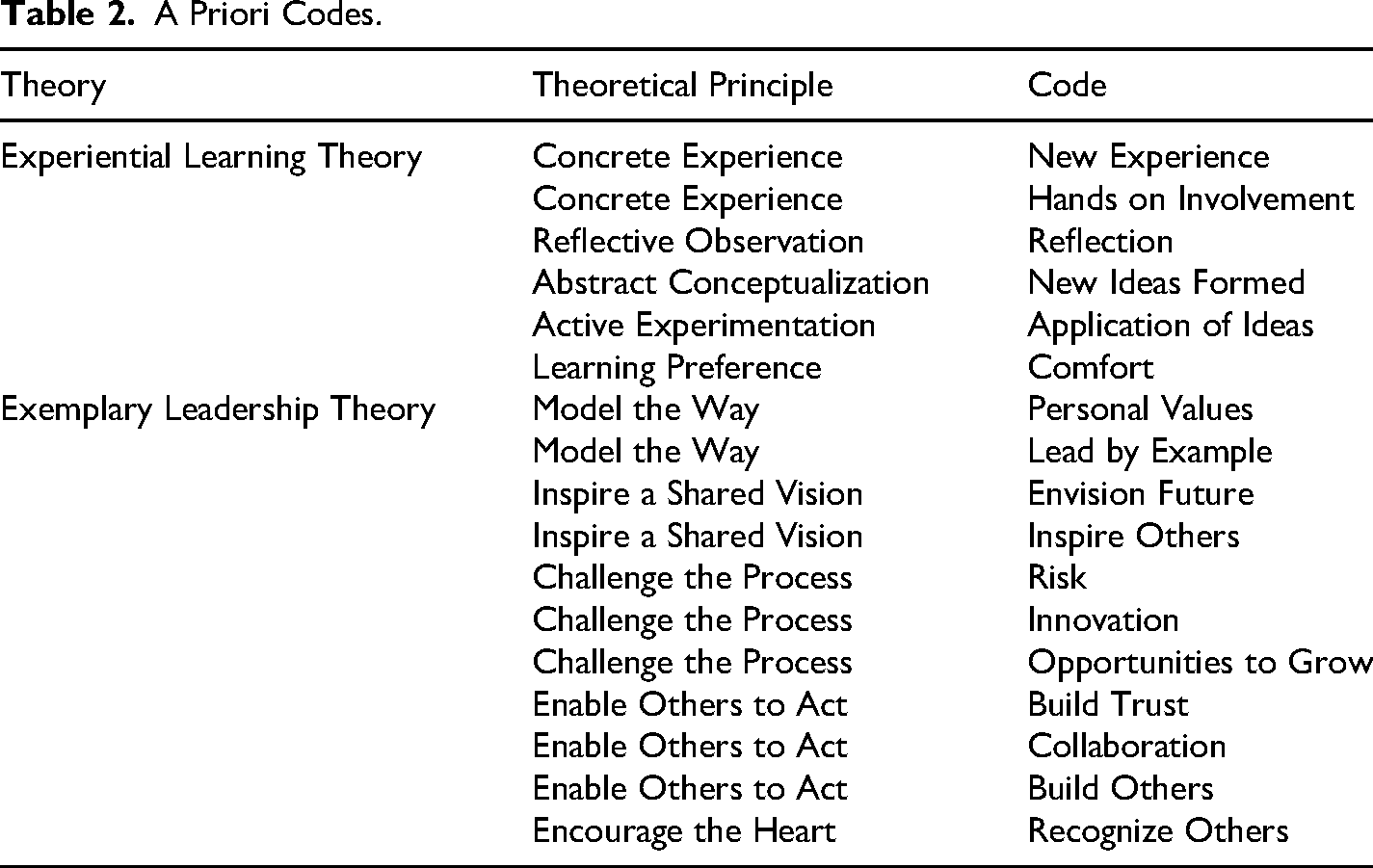
To achieve the stated objective of the study, that is, to understand how a collegiate experiential learning opportunity impacts student learning and perspectives on leadership, data analysis proceeded in three steps. First, the theoretical theories, experiential learning theory (Kolb, 1984), and exemplary leadership theory (Kouzes & Posner, 2017) were reviewed in depth, and a priori codes were derived from the tenets of the theories. This deductive approach was methodologically appropriate given the aim to understand experiential learning opportunities from a theoretical perspective (Bingham & Witkowsky, 2021). Taken together, these theories conceptually described an empirically based approach to experiential learning leadership opportunities. To understand how the Ritz-Carlton mentoring project impacted student learning and perspectives on leadership, we used an a priori coding approach to theoretically unpack observations and reflections of the experience. Table 2 shows the theoretically derived a priori codes.
A Priori Codes.
After a priori codes were established, the researchers read and re-read the data (Patton, 2014) to identify in what ways the participants’ and observers’ experiences aligned, or did not align, with the identified codes. Patton (2014) described this process of analyzing a priori codes in qualitative inquiry to be particularly appropriate for applied research. In step three, the coding framework was applied to the dataset and analyzed for themes or patterns related to the impact on student learning and perspectives on leadership (Saldaña, 2015). Figure 1 shows a diagram of data sources and analysis.
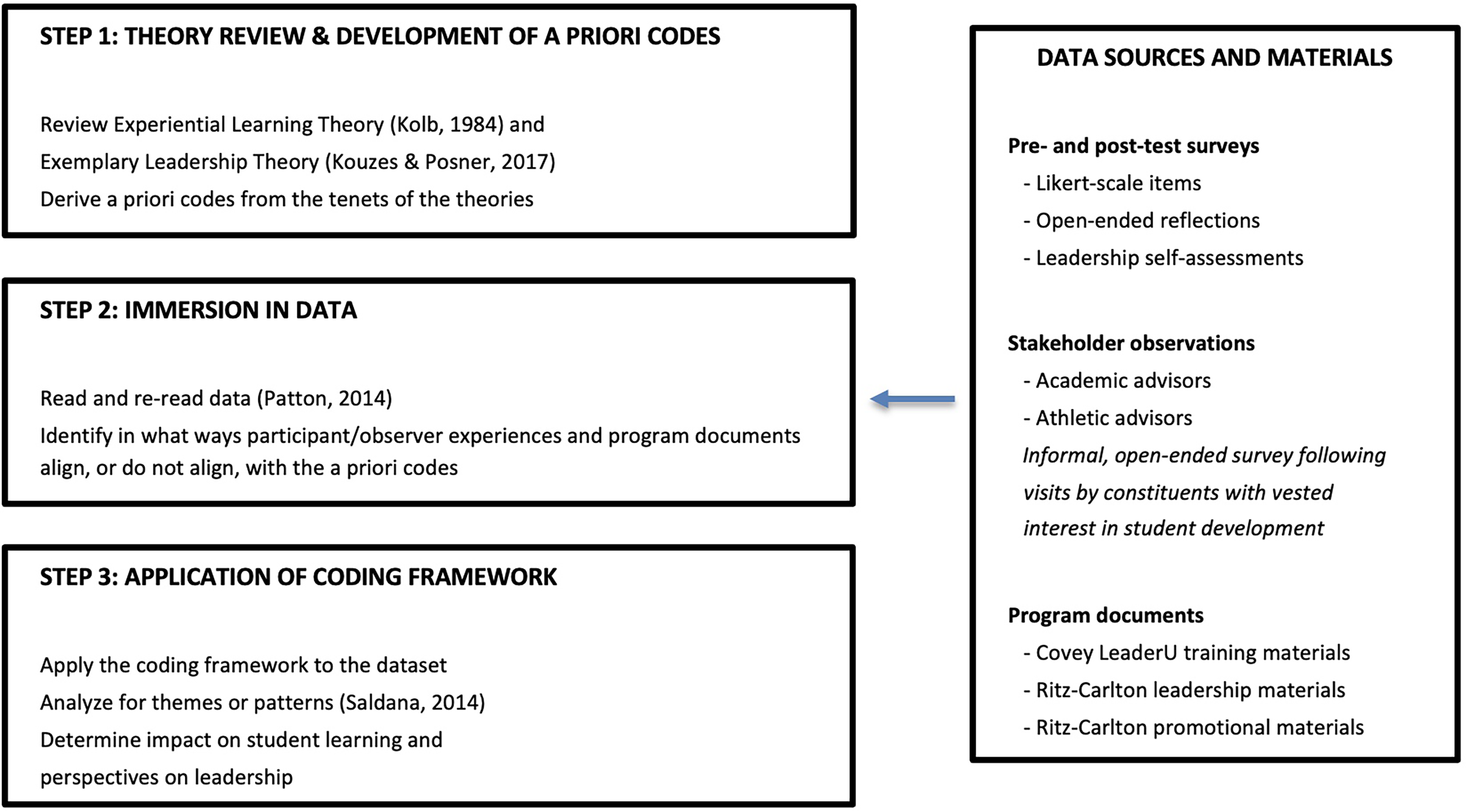
Data source and analysis diagram.
Data Sources and Materials
The Institutional Review Board (IRB) at East State University approved the study of leadership programs within the leadership institute. The primary materials used in this study included pre- and post-test surveys designed to measure changes in participants’ perceptions of leadership and professionalism throughout the program. The surveys consisted of a mix of Likert-scale questions, open-ended reflections, and self-assessments evaluating students’ confidence in leadership skills, adaptability, problem-solving, and professional communication. Additional data points from observational constituents (e.g., academic advisors, student athletic advisors), who had a vested interest in student development, but who were not the class instructor, nor the experiential learning mentors, were included in the dataset. These observation points were collected informally in an open-ended survey following their visit. Finally, documents such as the Covey leadership training materials utilized by both the Ritz-Carlton leadership and the student mentees, as well as the Ritz-Carlton promotional materials, were used to better understand the student experience.
Results
Data analysis revealed several ways in which the students and observers of the experiential learning opportunities at the Ritz-Carlton reported alignment with tenets of both experiential learning and exemplary leadership theories. Opportunities for strengthening the learning experience were also identified through theoretical analysis. Three themes emerged from the data analysis process. These themes (a) experiencing exemplary leadership in action, (b) forming connections through reflective observations, and (c) the humanized experience are explored here.
Theme I. Experiencing Exemplary Leadership in Action
Several students discussed how they learned about leadership through direct observation of the Ritz-Carlton leadership team. One student reflected, “I loved the managers meeting and getting to see how the leaders deal with negative feedback or statistics because they always turned it into an opportunity for growth.” Another student shared that they, “really enjoyed sitting in on the leaders meeting and hearing how they handle issues in a positive manner.”
A third student described experiencing exemplary leadership through observing seasoned professionals, they “loved how unique this program was in the sense that we learned about leadership from those who already have some experience and wisdom.”
The students were actively engaged in observing and learning from seasoned professionals. The firsthand exposure of what they do and how their meetings run provided valuable insight into what it takes to run a team and a successful enterprise. An observer shared, “from understanding the importance of customer satisfaction to mastering effective leadership, students were fully immersed in the environment.” These perspectives, triangulated with student data, further confirm how tenets of the theories described were exemplified through the students’ Ritz-Carlton experience. The next theme, forming connections through reflective observations, describes how the experiential learning opportunity created space for students to reflect on their observations while also allowing opportunities to draw connections.
Theme II. Forming Connections Through Reflective Observations
Through their reflective processes, students were able to draw connections between the best practices introduced through the Covey training and observing those principles in action at the Ritz-Carlton. Reflecting the concrete experience and abstract conceptualization aspects of experiential learning theory, as well as the exemplary leadership practice of challenging the process, one student remarked, “having done the 7 Habits trainings prior to the experience was beneficial because I could hear the ways that the Ritz-Carlton leadership was referencing certain practices from the 7 Habits.” Another student described similar connections between leadership behaviors and theory, “I feel like the leadership makes good connections with certain behaviors from the 7 Habits and shows how specific actions align with the habits.” These reflections demonstrate how students drew connections between classroom-based leadership learning and their experiential learning opportunities at the Ritz-Carlton.
In addition, a career services external stakeholder who observed the LEAP experience described the program as developing the principles of attentiveness and ardent service that could be applied to any career path to enhance professional success. From a professional perspective, this insight confirmed the intention for LEAP to create space for students to foster connections and make meaning from their experiential learning beyond the experience itself. However, further exploration of this theme through the theoretical lens revealed that while students felt they were provided with ample opportunities to reflect on their observations, they lacked opportunities to engage in reflective dialogue with the Ritz-Carlton leadership team. One student shared a recommendation for strengthening the experience, noting, “go over takeaways with the Ritz-Carlton leadership at the end of each session to reflect on what was learned.”
This observation is supported by the exemplary leadership practice of challenging the process (Kouzes & Posner, 2017) as well as the experiential learning processes of reflective observation and active experimentation (Kolb, 1984). The third theme explores how students reflected on the humanized aspects of their Ritz-Carlton and Covey experiential learning process.
Theme III. Humanized Experience
The third theme reflects students’ understanding of leadership as a humanized experience. Several students described how their experiential learning shaped meaning-making around leadership as relational and people-centered. One student shared how community was conveyed through everyday interactions, “even just walking through the halls, people would greet us or smile, which might not seem significant, but it shows the overall environment that is created there.” Another student highlighted how leadership was demonstrated through diverse styles and intentional practices, they said, “I also enjoyed being able to see how different people who spoke demonstrated different styles of leadership and how the meetings ran with a purpose.” These reflections illustrate students’ recognition that there is no single correct way to demonstrate leadership, but rather that leadership is enacted through human interaction and relational practices. This understanding reflects the exemplary leadership tenets of enabling others to act and encouraging the heart (Kouzes & Posner, 2017).
Additional students emphasized the importance of interpersonal relationships within the organizational culture. One student shared, “seeing how employees interact with one another stood out to me.” Another student explained, “the highlight of my experience was seeing the community that is created with everyone who works at the resort.” Students’ reflections on community building and human connection provide evidence of leadership learning that occurred through the Ritz-Carlton experiential learning opportunity. One student remarked on feeling valued and empowered within the organization, they said, “watching all areas of the hotel feel empowered showed me that people matter, that they are valued and heard.”
Beyond observations of culture and leadership practice, students also described a sense of belonging that developed over time. One student stated, “I loved how positive the environment was between faculty, students, and Ritz-Carlton employees. We got closer over the visits, and by the end it felt like family.” Feeling part of the organizational community reflects personalized involvement aligned with the concrete experience phase of experiential learning theory and exemplifies trust-building and collaboration consistent with enabling others to act. These interpretations were triangulated through external stakeholder observations. One advisor stated, “Feedback from students highlights attention to detail, a positive work culture, and a strong belief that leadership is a people-centered practice.”
Discussion
Experiential learning is widely considered to be a high-impact practice in higher education settings (Slavich & Zimbardo, 2012). However, it is not always understood how and why certain experiential learning experiences translate to desirable student learning outcomes. This paper examined LEAP, a high-impact experiential learning opportunity experience to gain insight into this question. Utilizing two theories, experiential learning theory (Kolb, 1984) and exemplary leadership theory (Kouzes & Posner, 2017) as tools, we analyzed student and outside stakeholder reflections to better understand elements of successful experiential learning opportunities. From this analysis, three themes emerged: (a) experiencing leadership in action, (b) forming connections through reflective observations, and (c) the humanized experience. Relying on the theories to establish an a priori coding schema allowed for examination of these data to better understand the essence of the experiential learning and student meaning-making process.
Implications for Education
Several implications and recommendations can be drawn from this study's findings. First, this study has theoretical implications. The reciprocal nature of the student and stakeholder reflections and their alignment to the propositions posited in both experiential learning theory and exemplary leadership theory strengthen the connections between the theoretical tenets and practical application of the theory. As students experienced and reflected on their experiences, their words confirmed theoretical tenets. For example, the third theme, the humanized experience, supported by student descriptions of observing the interplay of relationships built within staff and with customers as the optimization of the Ritz-Carlton experience, and subsequently feeling encapsulated by the culture built through positive relationships aligns with the ideas articulated by Kouzes and Posner (2017) in exemplary leadership theory. This alignment with the theories is one element that makes the LEAP experience impactful.
On the other hand, utilization of the theories proved to be helpful in unpacking areas for strengthening the LEAP experience. For instance, one of the major tenets of Kouzes and Posner's (2017) exemplary leadership theory, “challenge the process,” together with Kolb's (1984) experiential learning theory, might suggest that for students to fully engage in the experiential process may require space to raise questions and think critically and constructively about their experience with the Ritz-Carlton and the Ritz-Carlton processes. From the data, there was no evidence of such opportunities presented. Allowing students the opportunity and space to think about and reflect and challenge processes may be one way to strengthen this and other experiential opportunities. Theoretical analysis allowed for this insight to emerge. To this end, it is recommended that administrators and faculty responsible for designing and curating student success be intentional about utilizing theory in the creation and implementation of experiential learning opportunities, and to utilize theory in the evaluative aspects of experiential learning events.
A second point was observed through the “experiencing exemplary leadership in action” theme. This theme speaks to the design of the Ritz-Carlton and Covey LEAP experience. As confirmed by several student and stakeholder reflections, we posit that priming the students with a shared leadership language, in this instance, the Covey leadership training, was essential to maximizing the experiential part of the learning experience on-site at the Ritz-Carlton. Encouraging students to participate in the Ritz-Carlton experience and equipping them with the language and leadership approaches utilized by the Ritz-Carlton leadership provided the space for students to draw deeper meanings and connections during their experiential learning process than they may have been able to conjure otherwise. This finding is consistent with previous literature that speaks to the link between experiential learning and leadership development (e.g., Dugan & Komives, 2007) and extends this understanding into contemporary contexts. Based on this finding, we contend that administrators and faculty who design and facilitate experiential learning opportunities should consider ways to allow students to quickly adapt to allow them opportunities to share in the culture-building of their experiential learning site. A preemptive and intentional engagement with leadership training principles utilized by the experiential community partner may be one strategy to facilitate student meaning-making and connections.
This paper contributes to the academic literature on experiential learning in several ways. First, the theoretical approach utilized in this paper bridges the theory-to-practice gap in higher education experiential learning. Second, this research provides further insight into the how and why elements of high-impact experiential learning. These practical insights may be utilized across institutional settings. Lastly, this study confirms findings regarding the cross-disciplinary benefits of experiential learning as well as the important role of reflection for optimal student development (e.g., Garlick, 2014) and extends our knowledge into contemporary contexts.
Limitations of the Present Study
While this paper has several important contributions, there are some limitations that should be acknowledged. First, this study is a single institution within a specific context. Given the availability of partnerships with the Ritz-Carlton and Franklin-Covey may not be readily available to other institutions, this limits the transferability of this approach to other educational settings. Second, the LEAP program data collection and analysis were limited to one semester, and the time constraints of both the Ritz-Carlton leadership mentors and the student mentees. Additional time and other resources could have allowed for more and differentiated data sources.
Future Research
Future research may extend the findings of this study to collect direct evidence of student outcomes, such as career readiness, retention, or leadership self-efficacy, or leadership acumen. Additional studies might consider a longitudinal approach to uncover how the LEAP program or other experiential learning programs aid in student development over time. Examining student learning outcomes with another premier brand may extend the generalizability of this scholarship. Further, studying student learning outcomes in different regions is also recommended.
Conclusion
In conclusion, this paper utilized two theories, experiential learning theory (Kolb, 1984) and exemplary leadership theory (Kouzes & Posner, 2017) to examine an exemplary leadership experience for leadership students at the Ritz-Carlton Hotel. Analyzing the student and external stakeholder reflections of the experience through the theoretical lens of experiential learning and exemplary leadership revealed ways in which the design of the Ritz-Carlton and Covey LEAP experience contributed to the students’ learning and highlighted areas to strengthen this and other experiential learning opportunities. Two key insights emerge from this research. First, experiential learning is impactful when it is intentionally grounded in theory, particularly when opportunities for reflection are built in to challenge the process. Second, intentional priming with a shared leadership language prior to the experience enhances the student's ability to make meaning in the situation. Together, these insights suggest that experiential learning is enhanced by the combination of theory-informed design, pre-experience preparation, and structured reflection to allow students to translate lived experiences into enduring leadership learning. Key insights from this study can inform and enhance experiential learning for students across colleges and universities.
Footnotes

Ethical Approval
IRB approval for this work was obtained at the University of North Florida.
Funding
The authors received no financial support for the research, authorship, and/or publication of this article.
Declaration of Conflicting Interests
The authors declared no potential conflicts of interest with respect to the research, authorship, and/or publication of this article.