






Abstract
Hospice and palliative care is based on a biopsychosocial–spiritual model, yet there are very few studies or evaluations of programing designed to improve emotional well-being in terminally ill clients. This article reports on a program evaluation describing the Gift of a Day program offered by Crossroads Hospice. The Gift of a Day program seeks to celebrate life with each individual client by providing a customized client-centered event that encompasses activities that are enjoyable and important to them. Results suggest that participating in activities that are pleasurable and personally meaningful may improve clients’ emotional well-being at the end of life.
The basis of hospice and palliative care is for clients with a terminal diagnosis to live life pain free to the very end of life. Hospice agencies provide direct services and support to clients and families based on the biopsychosocial–spiritual model (Candy, Holman, Leurent, Davis, & Jones, 2011; Carpenter, 2014). Although the alleviation of pain and suffering is a part of hospice care, it is not its only emphasis. Meeting the psychosocial aspect of biopsychosocial–spiritual care is done by an interdisciplinary hospice team (McInnis-Dittrich, 2014). A benefit of hospice and palliative care is that with pain and illness symptoms under control, clients and families are able to embrace life and enjoy the time that they have together (Herbst, 2004; Zalenski & Raspa, 2006).
Clients in hospice care may be in a fragile emotional state related to change and uncertainty at end of life. Dealing with end-of-life issues can cause a dying person to feel fearful, anxious, angry, conciliatory, hopeful, reflective, and have intense spiritual despair or growth (Bern-Klug, Gessert, & Forbes, 2001). Psychological distress can affect a client’s quality of life, including physical health. Hospice and palliative care can offer relief to many of the fears that people have involving dying, such as fear of abandonment, fear of being a burden, fear of social isolation, fear of pain, fear of depression, and the loss of hope (Bretscher et al., 1999). Yet, notwithstanding these physical and psychological challenges, many clients experience growth toward self-actualization at end of life, inspiring those around them in the process (Herbst, 2004; Zalenski & Raspa, 2006).
Literature Review
Hospice care is client centered; thus, interdisciplinary health-care providers, administrators, and program planners are interested in providing services that meet the needs and preferences of individual hospice clients. End-of-life care studies have focused largely on the management of physical symptoms with medical interventions; however, clients’ quality of life is enhanced when care providers give attention to the client’s biopsychosocial–spiritual needs as end-of-life approaches (Waldrop, 2008). How can a social worker meet the emotional and psychological needs of an older adult who is dying? What are some ways that the hospice team might work together to improve clients’ emotional well-being?
Most of the literature do not include information about the emotional well-being of hospice clients or the “emotional” quality-of-life experiences of the hospice client (Prost, 2014). Likewise, emotional support interventions with hospice clients have not been widely researched or written about in the literature (Candy et al., 2011; Prost, 2014; Reese & Raymer, 2004). The literature review that follows documents that (a) self-reported quality of life of clients in hospice and palliative care was perceived to be stable or to improve under hospice care, (b) hospice clients were satisfied with the care they received, and (c) clients attending a palliative day care program reported higher levels of emotional well-being than the comparison group.
Prost’s (2014) recent review summarizes the impact of hospice and palliative end-of-life care on self-assessed quality of life in terminally ill persons. While there were no negative outcomes for clients using hospice care, because of the studies limitations, Prost was unable to point to the efficacy of palliative end-of-life care as the cause of clients’ quality of life being maintained or improved. Additionally, the studies reviewed included minimal descriptions of the quality-of-life intervention which makes replication research impossible (Prost, 2014).
Bretscher et al. (1999) discovered that the person dying does not always perceive their quality of life negatively. Clients admitted to hospice and receiving palliative care completed questionnaires measuring multiple dimensions of quality of life every 2 weeks until death. Results revealed that clients’ self-rated quality-of-life scores were similar to community norms and remained stable over time (Bretscher et al., 1999). This study corroborates Prost’s (2014) review that found hospice care maintained clients’ quality of life.
The results of a cross-sectional survey conducted with 330 patient cases in 66 hospices (Reese & Raymer, 2004) and the results of a randomized controlled trial with 297 patient cases comparing the outcome of patients receiving hospice care versus patients receiving generalist usual care (Brumley et al., 2007) both reported a higher level of family and patient satisfaction with hospice care. Reese and Raymer (2004) identify social work involvement on the interdisciplinary team as being significant to patient satisfaction. As social work education emphasizes competency in advocating for client self-determination, a social worker on the interdisciplinary team would actively champion the client’s active participation in his or her own care. Brumley et al. (2007) explain that the significantly higher level of satisfaction with care by the clients receiving the palliative care intervention may be because care was clearly guided by the client’s care preferences.
In countries such as the United Kingdom, palliative day care is offered to clients with life-limiting conditions. Palliative day care is defined as “a service, which enhances the independence and quality of life of patients through rehabilitation, occupational therapy, physiotherapy, the management and monitoring of symptoms and provision of psychosocial support” (Bradley, Frizelle, & Johnson, 2010a, p. 1211). Palliative day care offers social, recreational, and therapeutic activities that allow clients to focus on life rather than their illness (Bradley, Frizelle, & Johnson, 2010b). Clients attending palliative day care identified that participating in “activities” increased their feelings of well-being and confidence as well as promoting a positive attitude (Bradley et al., 2010b). Palliative day care services have been found to contribute to perceived improvement in clients’ quality of life such as an increase in confidence and self-esteem, feelings of well-being, reduction in social isolation, and having a new outlook as a result of the care and support provided (Low, Perry, &Wilkinson, 2005).
A study from Sweden (Svidén, Fürst, von Koch, & Borell, 2009) compared two groups of cancer patients receiving palliative care to see if attending a palliative day care program had an effect on health-related quality of life and emotional well-being. The focus of the palliative day care program was to offer patients opportunities to participate in creative and social activities to enhance their well-being and quality of life. While no differences were found between the groups on physical symptoms and functioning, the palliative day care group reported higher levels of emotional well-being than the comparison group. The results of this study suggest that interventions designed to enhance client well-being and quality of life implemented by an interdisciplinary team can contribute to a more positive emotional state for patients in spite of their deteriorating health (Svidén et al., 2009).
While hospice services are highly valued by patients and their families, there is minimal research on outcomes relating to hospice clients’ emotional well-being. This is disconcerting because the interdisciplinary hospice team provides emotional support as part of palliative care, but these services may be undocumented and unmeasured.
Psychosocial Preferences
Hospice care combines a dying individual’s personal care preferences with meeting their physical, psychosocial, and spiritual needs (Waldrop, 2008). It is important to know if there are areas in which client preferences are organized in order to plan programing to meet those physical, psychosocial, and spiritual needs. Research that set out to document the psychosocial care preferences of older adults noted the importance of continued growth, self-improvement, and enrichment for older adults. Older adults value activities and ventures that are pleasurable and personally meaningful to their lives (Carpenter, Van Haitsma, Ruckdeschel, & Lawton, 2000). The crucial component for an activity to be deemed beneficial is that it conforms to the older person’s individual wishes.
Research by Carpenter et al. (2000) also established the importance of personal choice and the desire to remain in control over one’s life. Following an individual’s expressed preferences gives the older adult control over their life (Carpenter et al., 2000). Likewise, providing opportunities for older adults to exert control may have a profound and positive effect on their physical and emotional health, through feelings of efficacy and agency. A comprehensive assessment can help social workers evaluate client preferences in order to individualize care (Carpenter et al., 2000).
Role of Hospice Social Workers
Social workers are recognized as integral members of the hospice team due to their specialized training in assessing and enhancing psychosocial functioning in individuals and families using the systems perspective (Crunkilton & Rubins, 2009; McInnis-Dittrich, 2014). They are also committed to promoting self-determination and preserving the dignity of the individual by working as client advocates (Reese & Raymer, 2004). Social workers have “skills in values clarification, emotional assessment, crisis intervention, goal setting, decision making, active listening, bereavement counseling, advocacy, and interpersonal communication” that can be helpful in working with hospice clients and families (Bern-Klug et al., 2001, pp. 43–44).
Social work involvement with hospice cases has been found to be associated with improved client satisfaction (Reese & Raymer, 2004). Reese and Raymer (2004) conclude that true interdisciplinary care with full involvement of social workers is important in the delivery of effective end-of-life care. Unfortunately, there is dearth of empirically based literature on interventions aimed at measuring or improving the emotional state of hospice clients (Reese & Raymer, 2004). In fact, hospice and palliative care social workers themselves have identified the need for continuing education curricula that addresses the psychological and social needs of patients and families and psychosocial interventions that can ameliorate distress (Weisenfluh & Csikai, 2013).
Many scholars and professionals have noted that conducting research with the hospice population is challenging owing to problems of (a) high patient attrition, (b) the deteriorating health of clients, and (c) the lack of uniformity in definition of the constructs measured surrounding the client’s end-of-life experience (Candy et al., 2011; Crunkilton & Rubins, 2009; Venkateswaran, Kumar, Thekkumpurath, & Bennett, 2008). The National Hospice and Palliative Care Organization (2013) report that in 2012 more than 35% of hospice clients died within 7 days of admission, and the median length of stay was 18.7 days. Nevertheless, the authors believe that the lack of literature on hospice clients’ emotional well-being is an impetus to disclose the results of a program evaluation implemented by an interdisciplinary team that included hospice social workers.
Program Evaluation
Crossroads Hospice Agency
Hospice care is a comprehensive set of services coordinated by an interdisciplinary group to provide for the physical, psychosocial, spiritual, and emotional needs of a terminally ill patient and family members (Centers for Medicare and Medicaid Services, 2014). Core hospice services include nursing services, medical social work, and bereavement counseling. Hospice must conduct a patient-specific comprehensive assessment that identifies the patient’s need for hospice care related to the palliation and management of the terminal illness in order to promote the hospice patient’s well-being, comfort, and dignity throughout the dying process (Centers for Medicare and Medicaid Services, 2014). Hospice is a philosophy of care that involves an interdisciplinary team approach in supporting the goals of patients and families during the last phase of life (Herbst, 2004).
Crossroads Hospice offers Medicare-mandated services to its patients with palliative care that focuses on the support and comfort of its patients during the final stage of life. Although hospice is guided by Medicare regulations, each organization has room to offer more than the minimum standard of care. Since its inception in 1995, the primary focus of Crossroads Hospice has been to provide programing and services that go above and beyond typical hospice care. “The mission of Crossroads Hospice is to provide highly unique, comprehensive, and compassionate hospice services to persons experiencing a life-limiting illness and to their caregivers” (Crossroads Hospice, 2014b, para. 8). While Crossroads Hospice works diligently to practice quality pain management and symptom care for clients through palliative treatment, they distinguish themselves through various special programs and services that the company offers. The Gift of a Day program is one of the extra services that Crossroads Hospice offers to clients to provide them with comfort and emotional support. The findings of this program evaluation may be used to inform other hospice social workers about current customized client-centered programing being offered.
Program Description
The Gift of a Day is a signature program offered by all Crossroads Hospices. The Gift of a Day was inspired by Jim Stovall’s (2001) novel The Ultimate Gift. The book shares a story of discovering 12 simple and profound life lessons (called gifts). The 12 gifts culminate with the ultimate gift: well-being. Readers of The Ultimate Gift are reminded that the true meaning of life is found in gifts: of work, learning, family, friends, giving, gratitude, and more. Crossroads Hospice has translated Stovall’s (2001) teachings into the Ultimate Gifts Program which includes Gift of a Day, Gift to the Community (a grief recovery outreach program), and Gift of Blessings and Gratitude (life journals; Crossroads Hospice, 2014d). The message that guides the Ultimate Gifts Program is to embrace life and approach each day with gratitude. This programing is designed to lift the spirits of hospice clients and their families and to help them live their lives to the fullest.
Every client at Crossroads Hospice is offered the opportunity to participate in the Gift of a Day program. Upon admission, clients are invited to imagine and describe a “perfect day” that they would enjoy. Then the interdisciplinary staff, social workers, nurses, volunteer coordinators, work together to create the perfect day and gift it to the client. Sometimes the perfect day is filled with simple things that are personally meaningful to a client such as dinner at their favorite restaurant or going to the ball game of a favorite team. The goal of the Gift of a Day program is to give clients extra attention to help enhance their emotional quality of life.
For example, one hospice clients’ Gift of a Day involved going back to school. This client was a former elementary school teacher who had a “zest for teaching and love for children” and “never stopped thinking about her days in the classroom” (Crossroads Hospice, 2014a, para. 3). The hospice team was able to arrange to bring the client into a bubbly class of kindergarteners where her face glowed with pure happiness and joy as she was able to be a teacher once again (Crossroads Hospice, 2014a).
Another Gift of a Day example entailed a client desiring to attend his own Irish wake! A client whose Irish heritage was very important to him wanted a genuine Irish wake as his Gift of a Day event. The hospice team was able to make it happen, from decorating a party room to arranging for professional bagpipers to perform. For more than 6 hours, the client partied and danced with his family and close friends. Heartfelt toasts were made to the client throughout the event (Crossroads Hospice, 2014c).
Planning and facilitating a Gift of a Day event is a team effort that includes participation of volunteers, if appropriate. Unless the client requests a private event, all members of the interdisciplinary team attend the event. A member of the hospice team takes photos of the event (if they have a signed photo release form), and upon completion, any photos taken during the Gift of a Day are printed and put into a small photo album for the family and delivered by the social worker within 2 weeks of the event. The Gift of a Day program is an opportunity for hospice workers, clients, and families to celebrate life. Hospice clients have a limited life expectancy, and this program makes their journey as enjoyable and comfortable as possible (Waton, 2010). The Gift of a Day event is designed to celebrate the clients’ life, to take the focus off their illness, and to give clients something great to anticipate (Waton, 2010).
Participants
During the time of this evaluation, 60 clients who were receiving hospice services from Crossroads Hospice in a mid-south region from January 2013 to July 2013 were offered the Gift of a Day program. Of these 60 terminally ill clients, only 30 clients participated, and 13 (8 women, 5 men) completed a survey about their experience.
Measure
An evaluation survey was created to measure satisfaction with achieving the Gift of a Day program objectives and to improve service delivery for future clients. The self-report measure included nine Likert-scale questions. The questions included a 5-point Likert scale with higher scores indicating a more positive response.
One question solicited the client’s emotional state before being offered the option of a Gift of a Day, and one question inquired about the client’s emotional state after the offer of the Gift of a Day (1 = Very Poor, 2 = Poor, 3 = Fair, 4 = Good, 5 = Very Good). One question asked the client about their level of anticipation as their Gift of a Day event approached (1 = None to 5 = High). Two questions inquired about how satisfying the event was and whether the event was worth the client’s time (1 = Not at All to 5 = Very Much).
Results of Gift of a Day Evaluation Survey.
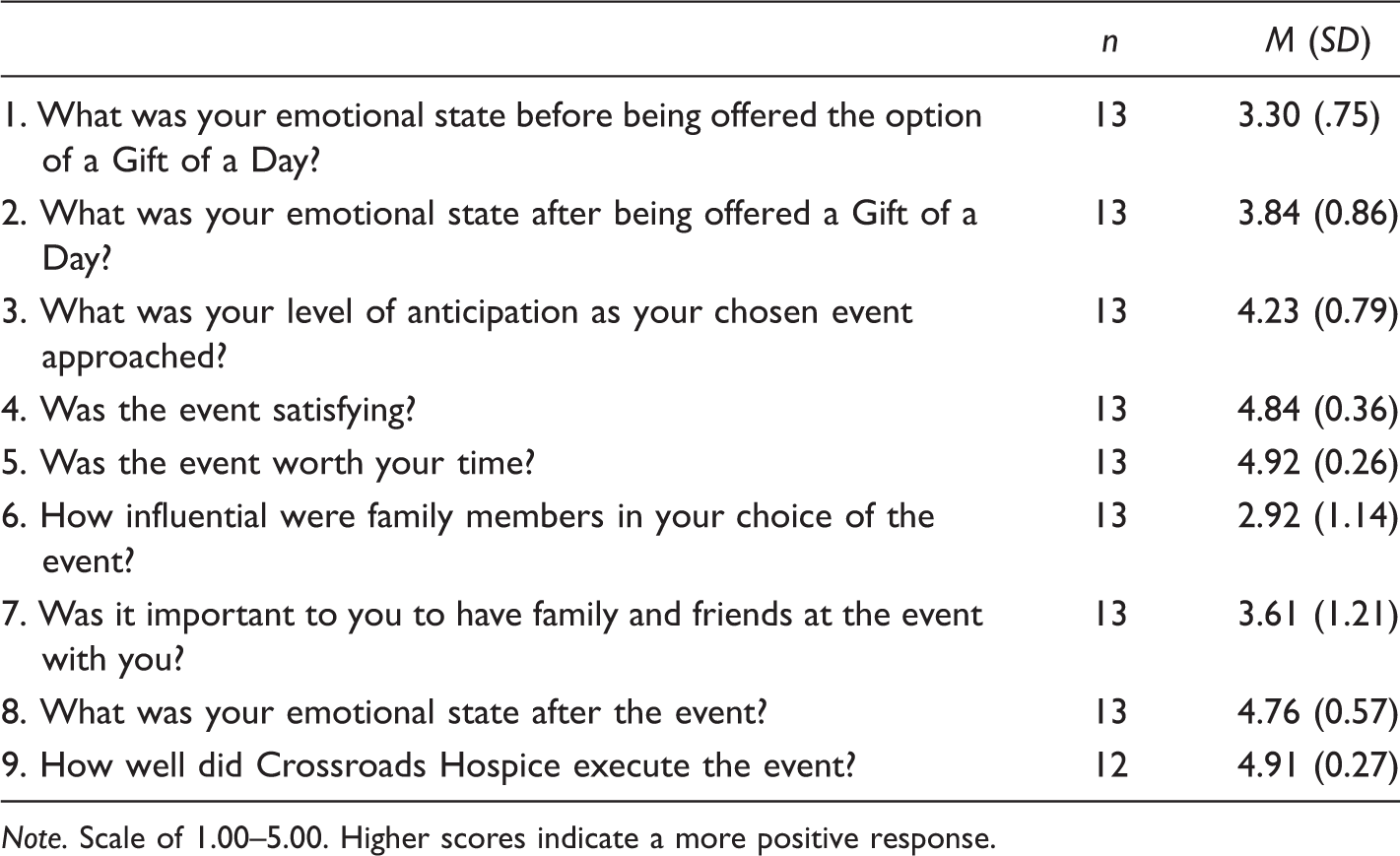
Note. Scale of 1.00–5.00. Higher scores indicate a more positive response.
Procedures
Clients who participated in this self-report evaluation did so because they had participated in the Gift of a Day program. Following each client’s Gift of a Day event, they were interviewed via phone by a social work intern using the aforementioned survey. There were some clients who died before the survey could be administered; therefore, their information was not obtained. This program evaluation is based on the results of 13 surveys. Survey scores were combined, and descriptive statistics are reported.
Results
The mean score measuring the clients’ emotional state prior to being offered the Gift of a Day program (Question 1) was 3.30 on a 5.0 scale which was understood to represent the prevailing mood was slightly greater than “fair.” Once the offer of the Gift of a Day program was extended (Question 2) to the clients, their emotional state rose slightly to an average of 3.84, approaching “good.” Anticipation of their Gift of a Day event (Question 3) increased to a mean of 4.23 on a 5.0 scale.
After the event, the clients rated their emotional state (Question 8) as an average of 4.76, an increase of 1.46 points over their preevent emotional state. A paired-samples t test was conducted to compare the clients’ self-rated emotional state prior to being offered the Gift of a Day program (Question 1; M = 3.30, SD = .75), and the clients’ self-rated emotional state after the Gift of a Day event occurred (Question 8; M = 4.76, SD = .59). There was a significant difference in the scores; t(12) = −7.98, p = .000.
Results of Questions 4 and 5 reveal high satisfaction with and worth of the event in terms of time as shown by the clients mean ratings of 4.84 and 4.92, respectively. Question 5 was rated the highest of the nine questions indicating the hospice clients very much agreed that the Gift of a Day program was worth their time.
Question 6 was, in aggregate, rated the lowest of the nine questions at 2.92 on a 5.0 scale. This question asked clients to rate how influential their family members were in the selection of the Gift of a Day event. Importance of having family and friends at the event (Question 7) was rated by clients as an average of 3.61. Most clients strongly agreed, 4.91 on a 5.0 scale, that the hospice staff executed the Gift of a Day event very well (Question 9). See Table 1 for results of the Gift of a Day evaluation survey.
Discussion
A systematic review of current research on hospice care found few evaluations on outcomes relating to clients’ emotional well-being (Candy et al., 2011). This program evaluation collected data on clients’ self-reported emotional state before and after their participation in the Gift of a Day program. Although the sample size was small, results showing a significant improvement of the clients’ self-rated emotional state after the Gift of a Day event (t(12) = −7.98, p = .000) suggest that potential emotional support is provided through a customized client-centered event that may improve clients’ emotional well-being at the end of life.
Research highlights the value that older adults have for activities that are pleasurable and personally meaningful (Carpenter et al., 2000). This seems to be the case as the results from Question 5 (M = 4.92, SD = .26) indicate that nearly all participants surveyed rated the Gift of a Day event very much worth their time. Activities that bring meaning to life can maintain an individual’s sense of purpose and worth (Carpenter et al., 2000). Hospice staff ensures that all ideas for the perfect day come from the client, based on their interests and experiences. This makes each experience a unique, one of a kind, positive event that has the potential to improve or maintain the client’s emotional state and quality of life.
The importance of personal choice and autonomy at end of life may be the basis of the scores for Question 6 (M = 2.92, SD = 1.14) indicating that family influence was not a major consideration in participants’ choice of event. The Gift of a Day program may offer hospice clients the ability to exercise agency in their lives and situation by deciding on activities that are enjoyable and important to them (Carpenter et al., 2000). Having their personal choices valued may bring emotional benefits such as increased feelings of self-worth (Bradley et al., 2010b).
From the results of Question 9 (M = 4.91, SD = .27), clients seemed to be very satisfied with how well the hospice team put their wishes for the perfect day into action. Defining and following the client’s care preferences seems to positively impact the client’s level of satisfaction (Brumley et al., 2007).
Recommendations
Programs and interventions that address client emotional needs at end of life are vitally important. From the authors’ review of the literature and evaluation of the Gift of the Day program, the following recommendations are offered.
Assess the clients’ emotional state. Psychosocial–spiritual distress at the end of life is understandable, and each client needs to be asked about their level of emotional distress (Carpenter, 2014). Assessing and monitoring emotional well-being (i.e., depression, anxiety, stress) can be as straightforward as asking one question. Social workers can utilize a single-item linear analog self-assessment question: How would you rate your emotional well-being over the past week on a scale of 0 to 10, where 0 = as bad as it can be and 10 = as good as it can be (Locke et al., 2007)? Provide emotional support. Emotional support of the client is an important aspect of hospice programing and a fundamental piece of biopsychosocial–spiritual care (Bradley et al., 2010b). Hospice clients are coping with the challenges of terminal illness, loss, and uncertainty. Social workers address each client’s unique stressors at end of life and offer emotional support and therapeutic interventions (McInnis-Dittrich, 2014). Individualize end-of-life care. Clients have unique desires about the care they would like to receive as they become more dependent on others. Tailor end-of-life interventions using the clients’ values and goals in decision making to provide individualized care that may bring emotional benefits (Carpenter et al., 2000). Include clients in their care plans. Hospice clients need to maintain a sense of mastery and control over their lives for as long as possible. This can be accomplished by including them in end-of-life treatment choices. Allow clients to exercise control in their environment and in integrating personal preferences into their care to increase their satisfaction and quality of life (Carpenter et al., 2000). Make use of unique customized client-centered services. Finally, providing clients and families the “extra” service of the Gift of a Day program requires greater staff time commitment to plan, implement, and evaluate. Yet, it has been a “gift” that is appreciated by both the clients and the interdisciplinary team. It offers clients the opportunity to have a meaningful experience that adds a breadth and depth to their hospice experience.
Limitations
Limitations of this program evaluation include that it was conducted at one hospice agency located in the mid-south using a small convenience sample of clients. Conclusions drawn from this program evaluation are not generalizable beyond this group. Another limitation is that 50% of the clients invited to participate in the Gift of a Day program declined, and of the 30 clients who did participate, only 13 surveys were completed. Due to the time sensitive nature of working with terminally ill clients, some of the participants died before feedback on the evaluation survey was obtained.
The survey was created for the purpose of evaluating the Gift of a Day program, and there was no validity or reliability data developed on the survey. Additionally, the survey was a self-report measure. With all self-report measures, there is the potential social desirability effect. It is possible that participants provided socially desirable responses.
Conclusion
There are very few studies or evaluations of programing designed to improve emotional well-being in terminally ill clients. This article reports on a program evaluation describing the Gift of a Day program offered by Crossroads Hospice. The Gift of a Day program seeks to celebrate life with each individual client by providing a customized client-centered event that encompasses activities that are enjoyable and important to them. Results suggest that participating in activities that are pleasurable and personally meaningful may improve clients’ emotional well-being at the end of life.
Footnotes
Declaration of Conflicting Interests
The authors declared no potential conflicts of interest with respect to the research, authorship, and/or publication of this article.
Funding
The authors received no financial support for the research, authorship, and/or publication of this article.