






Abstract
To understand the role of culture on the use of the meaning-making coping among people who have been struck by cancer, qualitative and quantitative studies have been conducted in several countries like Sweden, China, Japan, South Korea, Malaysia, Philippines, and Turkey. This article reports on a quantitative study carried out in Turkey. The aim of the study has been to answer the following question: “Which meaning-making coping method (even nonreligious or spiritual coping methods) is used by informants?” The sample consists of 95 persons, 18+ who had been struck by cancer. The questionnaire was distributed to former/current cancer patients via a web address as an electronic survey through the media page of Cancer Survivors Association. The results of the study show that the most important coping methods used by cancer patients in Turkey are the religious coping (RCOPE) methods, particularly spiritual connection, active religious surrender, passive religious deferral, and pleading for direct intercession. Several RCOPE methods such as spiritual discontent, seeking support from clergy or members, punishing God reappraisal, and demonic reappraisal or self-directing religious coping are not used by the Turkish informants. Nor are non-RCOPE methods highly prevalent among informants.
Within the framework of an international project aimed at understanding the influence of culture on the use of the meaning-making coping among people who have been struck by cancer, qualitative and quantitative studies have been conducted in several countries like Sweden, China, Japan, South Korea, Malaysia, Philippines, and Turkey. The present article reports on a quantitative study carried out in Turkey.
The aim of the project has been to answer the following questions: “What is the role of meaning-making coping methods (even nonreligious or spiritual coping methods) in life-threatening crises?” and “What is the role of culture in the selection of these methods?”.
The term “meaning-making coping” is used to describe coping methods that are related to existential questions, that is, the whole spectrum of religious, spiritual (both religious spiritual and nonreligious spiritual), and existential coping methods.
The project builds on two previous studies: (1) a qualitative study on “Religious and spiritual coping methods among cancer sufferers in Sweden” (2000–2006) and (2) a quantitative survey on “Religious and spiritual coping methods among cancer sufferers in Sweden” (2010–2012; Ahmadi et al., 2017; Ahmadi et al., 2016; Ahmadi et al., 2016; Ahmadi, & Ahmadi, 2015; Ahmadi, 2015; Ahmadi, & Ahmadi, 2013).
Focusing on the role of culture in coping, the two abovementioned studies gained a considerable amount of international attention among researchers working to create new instruments and theoretical models to develop coping methods related to existential questions. As a result of this international attention, we began an international project to study meaning-making coping in a variety of countries. One of these countries is Turkey. After carrying out a qualitative interview study among cancer patients in this country (Ahmadi, 2006; Ahmadi et al., 2016), we conducted a quantitative study, the results of which will be presented here.
Objective
The aim of the conducted survey was to deepen the knowledge obtained through the qualitative study and to identify the main meaning-making coping methods, using a cultural perspective when analyzing the results.
Theoretical Framework
Coping, spirituality, and religion
In the present project, the definition of religion and spirituality suggested by Ahmadi (2006) is applied: Religiousness is a search for significance that unfolds within a traditional sacred context. It is then related to an organized system of belief and practice relating to a sacred source that includes individual and institutional expressions, serves a variety of purposes, and may play potentially helpful and/or harmful roles in people’s lives. (p. 72).
We have used the following working definition of religion as our starting point: A search for connectedness with a sacred source that is related or not related to God or any religious holy sources. Spirituality involves efforts to consider metaphysical or transcendent aspects of everyday life as they relate to forces, transcendent and otherwise. (Ahmadi, 2006, pp. 71–72).
Hence, “spirituality encompasses religion as well as many beliefs and practices from outside the normally defined religious sphere” (Jenkins & Pargament, 1995, pp. 52–53).
Meaning-Making Coping
Coping can be defined as a process through which individuals attempt to understand and deal with important demands in their lives (Ganzevoort, 1998, p. 260) or as the search for meaning in times of stress (Pargament, 1997, p. 90). Coping is seen as a multilayered contextual phenomenon that involves a number of basic skills (Lazarus & Folkman, 1984, p. 148; Pargament, 1997, p. 89). Coping involves a meeting between the individual and the situation; it is multidimensional, multilayered, and contextual. It involves opportunities and choices and is diverse. Another dimension of coping is that it is a process that develops and changes over time (Pargament, 1997, p. 89).
The results of previous research (Ahmadi, 2006; Ahmadi, & Ahmadi, 2015), carried out among people who had been struck by cancer and who lived in predominantly nonreligious contexts, indicate that other coping strategies that hardly can be regarded as religious or spiritual are frequently employed in these contexts. Among these strategies, spiritual connection with oneself, spiritual sanctification of nature, positive solitude, empathy/altruism, search for meaning, visualization, healing therapy, spiritual music, and meditation can be mentioned. When analyzing these methods, it was clear that they had much more to do with connectedness to nature, to self, and to others than with something transcendent (God or any spiritual power; Ahmadi, 2006).
To avoid confining our discussion to either the religious or secular nature of existential coping methods, we use the term “meaning-making coping” hereafter, thus addressing the whole spectrum of religious, spiritual, and existential coping.
Method
Data Collection
Starting from the results of the qualitative study, a quantitative study was conducted. Due to the nature of the population and the possibilities at hand, we did not attempt to secure a quota or use random sampling. Instead, using a convenience sampling method, the questionnaire was distributed to former/current cancer patients via a web address as an electronic survey through the media page of Cancer Survivors Association (95 informants). The advantages of an Internet survey are that respondents may feel more comfortable completing the questionnaire online, as this gives them a higher level of anonymity and that it eliminates the burden of returning the questionnaire by post. However, we are aware that Internet users are a biased sample of the population, in that they tend to be better educated and wealthier, which is also shown in our results by the high level of education. The fieldwork started on September 1, 2016, and was completed at the end of October. In total, the data collection took 8 weeks to complete. The questionnaires were translated to Turkish and backtranslated by two of our researchers, and possible differences were discussed until the agreement has reached a satisfactory level.
We performed crosstabulations with χ 2 test analyses, using age (<45 and >45), gender (women and men), education (high school or lower and university or higher), and area of residence while growing up (big city and small city).
Target Group and Sampling
The target group for this study is people 18+ who had be struck by cancer. Net sample size is 95 respondents. The sample is not weighted against the actual population it is representative of.
Description of the Sample
The sample is described by several sociodemographic variables.
Age
More than 8 of the 10 are between 31 and 65 years of age (15%). The largest group is the lower middle age range between 31 and 50 years (59%); 23% are between 51 and 65 years and only 3& 65+.
Gender
There are more women than men in the sample (77% women and 23% men).
Education
The sample is well educated: 59% have a university degree (10% master’s and PhD) and 30% have a high school degree, while only 7% have a secondary and 4% a primary school degree.
Marital status
It is more common for respondents to live in a relationship than to live alone: 55% are married, 19% single, 15% divorced, 6% living separately, 3% widows/widowers, and 2% in a relationship.
Area of residence while growing up
A clear majority (77%) has grown up in a big city.
Margin of Error
In this study, the margin of error for the total sample for a result of 50% is +/− 10 percentage points. Results around 10% or 90% have a margin of error of about +/− 6 percentage points.
Ethical Considerations
An application for ethical approval was sent to the Regional Ethical Board in Uppsala, Sweden, and as the study was conducted outside Sweden, the board did not have any objections to the Swedish-led part of the study (Reg. no. 2015/126). The four general requirements for research were taken into careful consideration. These are the information requirement, the requirement of consent, confidentiality requirements, and usage requirements. All researchers have rich experience of conducting research among vulnerable people and are aware that, in studies dealing with sensitive information, particular consideration should be given to ethical rules.
Result and Analysis
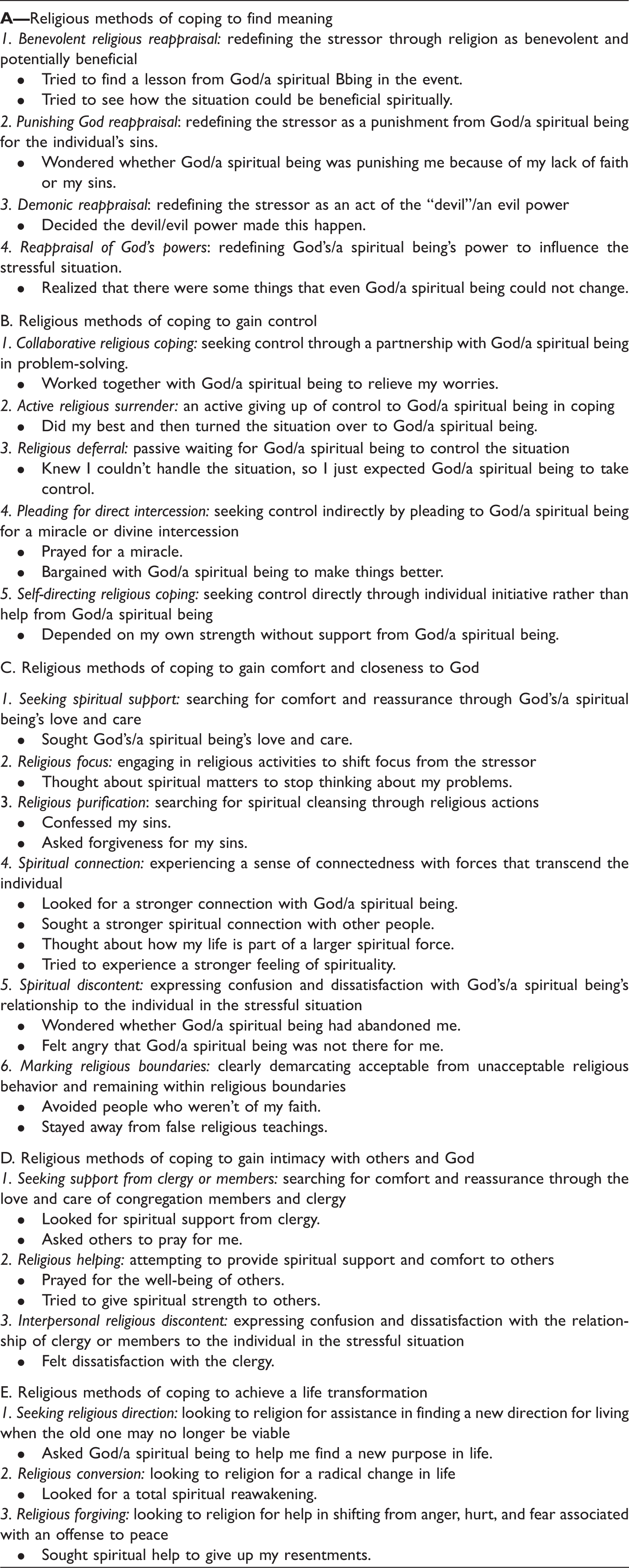
In this section, some of the most interesting results of the study are presented. Proceeding from the study aim, we have divided the results into two parts: those concerning the religious coping (RCOPE) methods (see Appendix 1) and those not concerning the RCOPE methods, but touching on existential questions.
RCOPE Methods
One of the RCOPE methods focused on in the present study is spiritual connection, which refers to having a sense of a stronger connection with God.
The question “Have you ever felt a strong connection with God?” is posed to informants to test the prevalence of this method. The majority of informants (56%) feel a strong connection to God. Only 14% say they have never felt this.
Another RCOPE method tested in the present study is active religious surrender: an active giving up of control to God, where the person has realized that she or he has done her or his best and then turned the situation over to God.
In this regard, the following question was asked: “Do/did you think you have done your best and now there is only God?” A majority (68%) think they often have done their best and now there is only God. Moreover, 31% say they have always done so.
The third method taken into consideration in the present study is passive religious deferral. Here, the person is passively waiting for God to control the situation.
Crosstabulation for Gender and Did You Ask God to Make Things Better?.
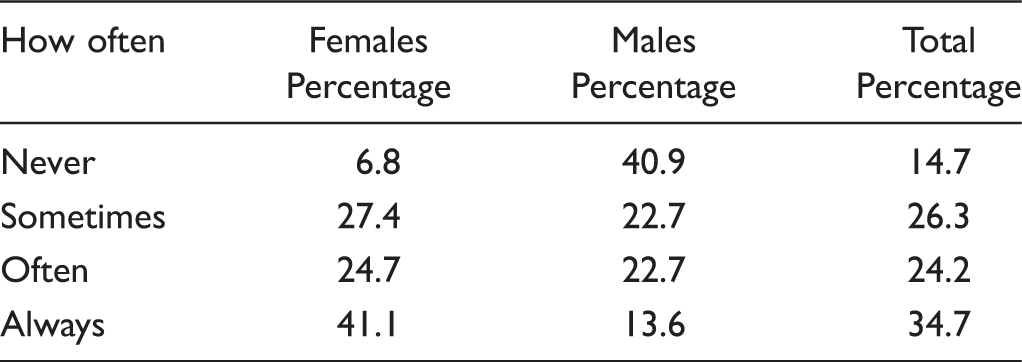
Note. n = 95. χ2 = 17.14.
*p < .001.
One RCOPE method tested in the present study is spiritual discontent, which focuses on expressing confusion and dissatisfaction with God’s relationship to the individual in the stressful situation. Here, the individual may wonder whether God has abandoned her or him or feel angry that God was not there for her or him. The vast majority do not blame God. Sixty-five percent have never wondered whether God has abandoned them or become angry because God was not there to help them. Only 8% did so always, 8% often, and 18% sometimes.
Crosstabulation for Gender and What Do/Did You Do to Feel Better During/After the Illness When You Feel/Felt Stressed, Sad, or Depressed?
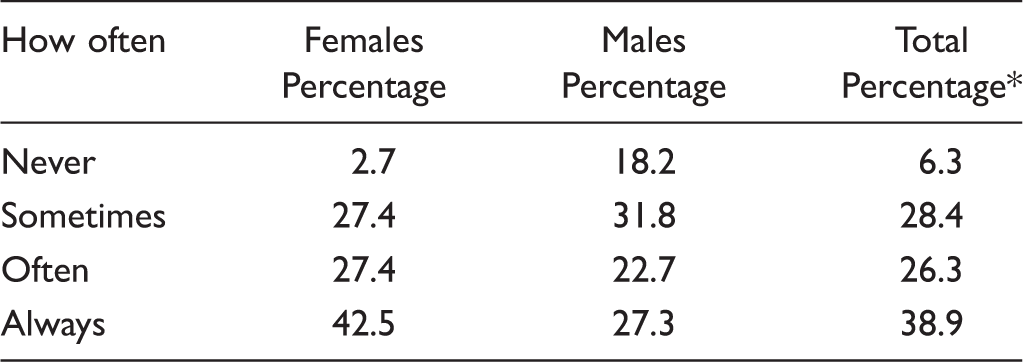
Note. χ2 = 7.64.
*p < .05.
The answers to the abovementioned questions concerning the RCOPE methods spiritual connection, active religious surrender, passive religious deferral, spiritual discontent, and pleading for direct intercession show clearly that these coping methods have been very important to the informants. The results strongly confirm the conclusion arrived in the qualitative study, which stressed the importance of religious coping in Turkey (see Ahmadi et al., 2016). What we are witnessing here is the strong impact of the idea of subordination to and acceptance of God’s will. Illness may be seen as the result of God’s will. As some researchers have mentioned (Gotay, 1985; Linn, Linn, & Stein, 1982), religion can function by removing the responsibility from the ailing person and lessening self-blame, which may lead to a better psychological outcome. According to Aflakseir and Coleman (2011, p. 46), the ideas of testing (Ekhtebar) and being tolerant/patient (Sabr) are quite strong among Muslims, including Muslims living in Turkey.
One important feature of Islamic teaching is the idea of being tolerant/patient (Sabr), which concerns how one faces difficulties. Religious teachings state that negative events have a purpose, and they require people to be patient; this patience, in turn, allows people to achieve spiritual growth. Sabr encompasses many characteristics. It means not only having patience but also having perseverance, self-constancy, endurance, restraint, and forbearance. At the core of the definition of Sabr is the notion that people should restrain themselves from surrendering to evil, obey Allah’s edicts by keeping their hearts strong, and refrain from complaining when bad things happen to them. Sabr enables people to fulfill their purpose in life. In Islam, patience is attained through effort. This effort, however, is not automatic; it requires considerable concentration and control of one’s inner self (Turfe, 1996).
Another idea that can help us to understand the results of the present study is Kader, which means “fate” or “predestination.” Kader is the concept of divine destiny in Islamic thought. According to this idea, God has dictated everything that happens in the world (cosmos) on the basis of His prior knowledge and the states of His wisdom (Ahmadi et al., 2016b).
One of the RCOPE methods considered in the present study is seeking support from clergy or congregation Mmmbers. This method refers to the search for comfort and reassurance through the love and care of congregation members and clergy. The question “Have you sought spiritual help from a religious leader?” is posed to informants in this regard.
Crosstabulation for Gender and Have You Sought Spiritual Help From a Religious Leader?
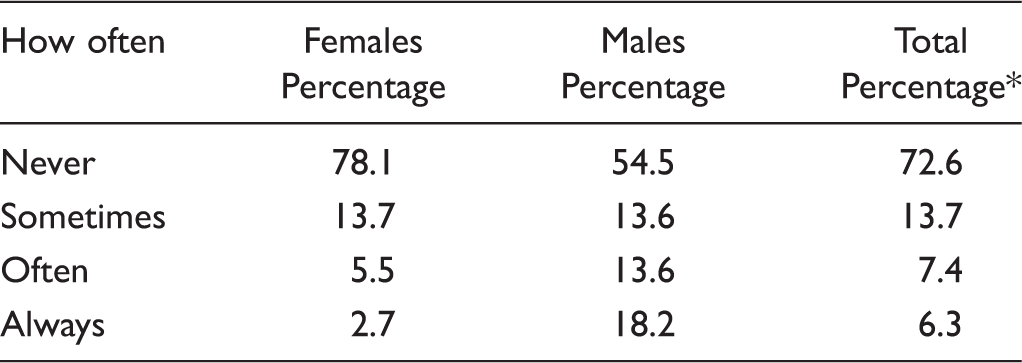
Note. n = 95. χ2 = 8.30.
*p < .05.
There is a significant gender difference in Turkish society concerning the place of Muslim women in Islamic space. According to the World Values Survey (Wave 6, 2010–2014), only 11.8% of females respond that they visit a mosque once a week or more than once a week, while males give this response at a much higher rate, 54%. Despite the fact that Turkey has in recent years made several strides aimed at greater inclusion and gender equality in its religious spaces, as Zein (2015) mentions, disregard for women is still widespread. Many women are intentionally excluded from mosques, and they seldom have contact with imams.
Crosstabulation for Education and Have You Sought Spiritual Help From a Religious Leader?
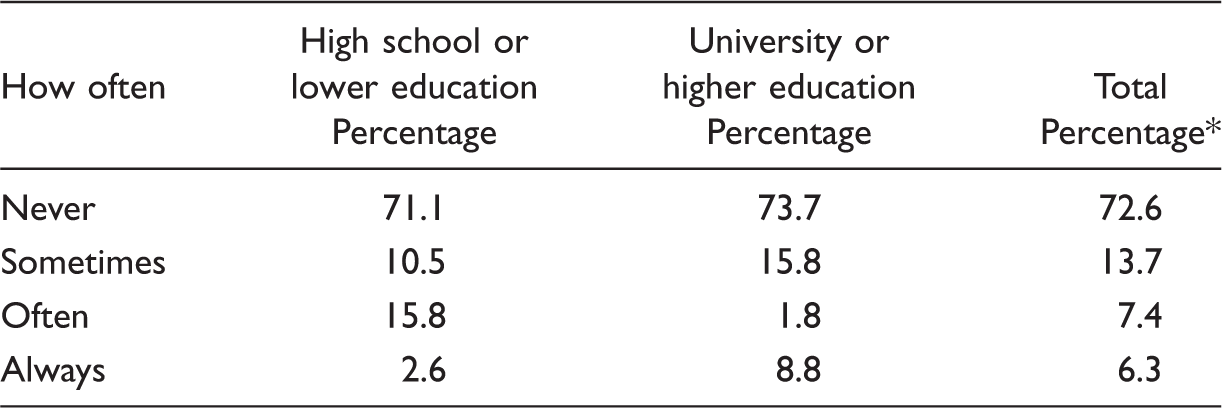
Note. n = 95. χ2 = 8.30.
*p < .05.
Crosstabulation for Age-Group and Have You Sought Spiritual Help From a Religious Leader?
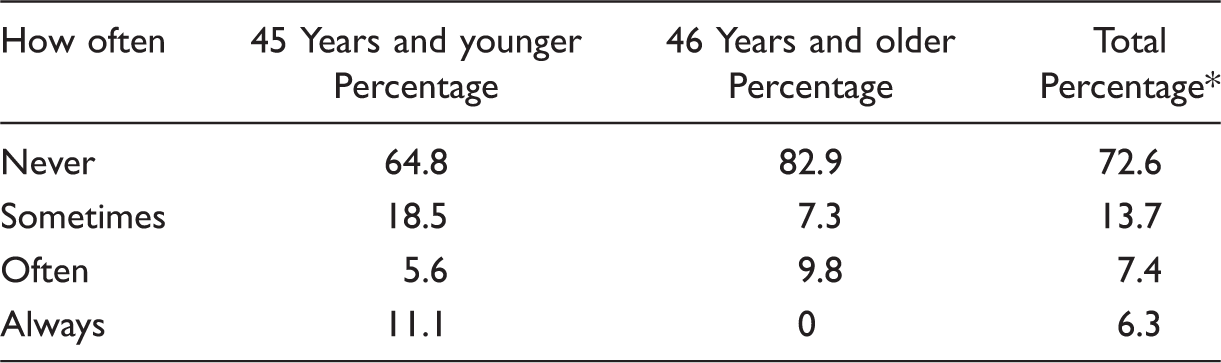
Note. n = 95. χ2 = 8.30.
*p < .05.
Yet a reason can be that, in Turkey, the religious leaders, like the imams, mainly give mundane advice (lead Islamic worship services, serve as community leaders, and provide religious guidance), not spiritual help. According to Sunni scholars, the imam (or caliph, as they prefer to say) can either be elected, nominated by the preceding caliph, or selected by a committee. Accordingly, there is no great expectation that an imam, besides giving mundane advice, will help people with spiritual issues. This is not true of Islamic mystics, however, who consider their religious leaders to be highly spiritual.
It should be mentioned that this does not negate the fact that, in several Islamic countries like Egypt, Morocco, Jordan, and Pakistan, there are many Sunni imams and scholars who do give spiritual advice to the seriously ill. The case of Turkey is special because Ataturk eliminated the class of “ulama” and then created a government controlled school to train a new class of imams who are in a sense government employees. But certainly, even in Turkey, there are some imams who are not just government employees and who do provide spiritual advice to the needy, especially those who are devoted to Sufism (Islamic mysticism) and are members of various Sufi orders.
Punishing God reappraisal, one of the RCOPE methods focused on in the present study, is regarded as a negative coping method. This method refers to redefinition of the stressor as a punishment from God for the individual’s sins. The individual wonders whether God was punishing her or him because of her or his lack of faith or sins.
Crosstabulation for Gender and Have You Ever Thought That God Has Caused Your Cancer Because of Your Actions or Because You Have Not Been a Strong Enough Believer?
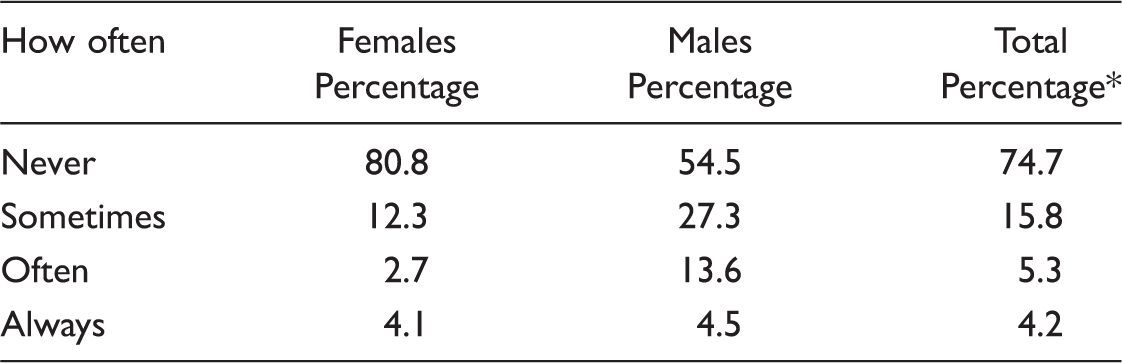
Note. n = 95. χ2 = 8.74.
*p = .07.
Demonic reappraisal—which refers to redefining the stressor as an act of the “devil”/an evil power—is another coping method in this group. In this regard, the question “Do/did you think your illness was caused by an evil power?” was posed to informants. The results indicate that the majority (70%) reported never having had such thoughts. Only 7% reported that they always or often have thought that the illness was caused by an evil power.
Responses to the above two questions show that the idea that one’s illness is a punishment issued by God or is caused by an evil power is not very strong among informants, despite the prevalence of the idea of the “evil eye” in the Turkish culture. One possible explanation can be found in the view on suffering and the place of evil in Islam.
Applying punishing God reappraisal as a coping method requires a view of punishing that is based on the idea of free will. Here, it must be mentioned that there have been many different conceptions of the problems of predestination and free will among Muslim thinkers, but the problem of theodicy as it appears in Christianity is neither as dominant nor as important among Muslims, as it is among Christians. The problem of theodicy, that is, the contradiction between the existence of human suffering and God’s goodness—something that, as Turner mentions, brings about the idea of reconstructing the world—is one of the central theological controversies in Christianity. The main contradiction in Islam, however, focuses “on God’s omnipotence and human free will.” In this connection, discussing the absence of a comprehensive confessional apparatus in Islam, Gilsenan (1973) affirms that Certainly, the sense of sin, of the fall from grace, of spiritual guilt and the whole theodicy of suffering are virtually absent from Islam by comparison with most of the Christian churches. (p. 70)
According to Taylor (1985), in the Christian evolution of the idea of Satan, matters take a different turn [than Judaism]. Christianity took over the apocalyptic worldview, which was basically dualistic. Thus Satan came to mean all that was opposed to God. He was Prince of this world, and all the kingdoms of the world were under his control. (p. 35)
Thus, a Muslim who strongly believes in an omnipotent God and does not regard Satan as possessing the power to change the course of events, in contrast to God’s will, can hardly redefine her or his stressor as an act of an evil power; everything is in the hand of God, not Satan.
There is, however, the idea of the evil eye in Turkish culture, but it is more a superstition than a theological belief in the power of Evil that we see in Christianity. So for some Muslim cancer patients, the evil eye may explain the cause of their illness, but they can hardly use this as a way to deal with their stressor. Accepting passively that they have been defeated by an evil power means accepting that God has no power to help them and that they should consider their illness to be the act of an enemy of God. Such acceptance is totally in conflict with the belief in a supreme, omnipotent God among people (here Muslims) who do not have a strong theological belief in the power of the Devil, as found in parts of Christianity.
Another factor that has probably impacted the results concerning the the punishing God reappraisal and demonic reappraisal is the education level of the informants. Although a χ 2 test did not indicate a significant association, as mentioned above, the majority of our informants are well educated (60% of respondents have at least a university degree). Opinions among researchers differ drastically as regards the impact of education in determining superstitious ideas. Following this study, we are planning to conduct another survey study among cancer patients in Turkey who belong to lower educational and socioeconomic strata. It will be interesting to see what the results of this new study will reveal about the prevalence of the abovementioned coping methods.
Summing up the results on the RCOPE methods, we see the strong position of religion in coping with cancer among our informants.
Nonreligious Meaning-Making Coping
The study in Turkey shows that the nonreligious meaning-making coping methods are not particularly strong among informants. Approaches such as meditation and visualization, which are connected to holistic health, are among such methods.
Our project shows that some informants, especially in Sweden, South Korea, and Japan, perceived health as “sacred” and gave it special significance (Ahmadi, 2006; Ahmadi, 2015; Ahmadi et al., 2016). For this reason, some informants in these countries turned to different coping methods connected to holistic therapy. It was in regard to this background that we focused on these methods in our study in Turkey as well.
In holistic health, it is assumed that each person is a unified whole, with both mind and spirit playing important roles in healing the body. Holistic or “wholistic” health claims to approach all parts of the individual, not just the physical body where manifested illnesses are often most apparent. The methods that have been focused on in the present study are meditation and visualization.
Considering holistic health, the following question is posed in this study: “Have you used any form of holistic health in relation to your cancer problem?” The results show, it is not particularly common to use any form of holistic health as a coping method among informants in Turkey. Only 12% say that they have used it always or often. A majority (55%) report never having used this method.
Crosstabulation for Education and Have You Regularly Meditated as a Way to Deal With Your Illness?
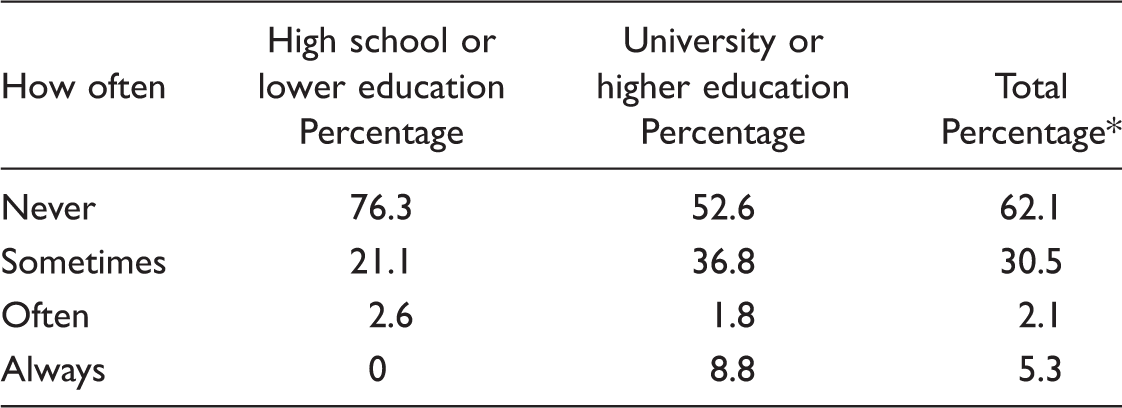
Note. n = 95. χ2 = 7.34.
*p = .06.
Crosstabulation for Place of Growing Up and Have You Used Visualization to Deal With Your Illness?
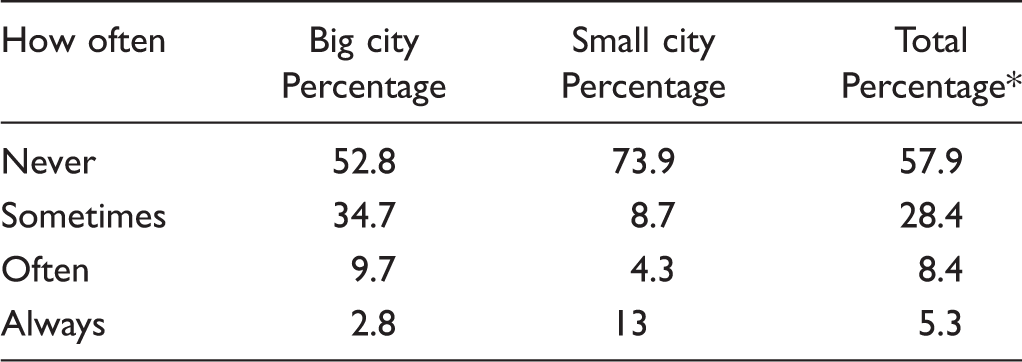
Note. n = 95. χ2 = 9.59.
*p < .05.
Besides the abovementioned nonreligious coping strategies, there is a method that, according to Pargament, belongs to RCOPE methods, but that we have not classified as RCOPE in the present study. In the RCOPE measurement instrument, this method is called self-directing religious coping. The self-directed religious style can be defined as seeking control directly through one’s individual initiative rather than through God’s help. Although self-directing is regarded (Pargament, 1997, pp. 181–182) as one of the religious styles, we see no reason to consider a self-directing style a religious coping strategy. If a person does not lean on God, but instead gains control through her or his own initiative, it is difficult to accept that such an initiative should be categorized as religious (for more discussion, please see Ahmadi, 2006, pp. 34–38).
A question posed to informants regarding this method was: “Are/were you trying to get control of your situation directly without the help of God?” As many as 54% report never having tried to control the situation directly without the help of God. Another 34% have done so only sometimes. As mentioned earlier, this method indicates that the individual seeks control without any intervening help from God or religion in coping and tries to gain control through her or his own initiative. As the results show, this kind of will to cope without the help of God is not particularly prevalent among informants; they prefer to lean to God instead. Only 6% respond always and 6% often, as regards relying on themselves instead of God.
Here, again we see the strong impact of religion in coping with cancer among our informants in Turkey. Considering the fact that the majority of our informants belong to the high-educated group (60% of the respondents have at least a university degree; only 7% have a secondary and 4% a primary school degree) and that the majority live in big cities (77%), we can maintain that the strong impact of religion on coping can be generalized to the entire population. This is because people with a lower education level or those who live in villages in nondeveloped countries are usually more religious than people with a high education and those who live in big cities.
Conclusions
The results of the study in Turkey indicate that several RCOPE methods that are prevalent in other countries—such as spiritual discontent, seeking support from clergy or members, punishing God reappraisal, and demonic reappraisal or selfdirecting religious coping—are not applied by the Turkish informants. Nor are non-RCOPE methods highly prevalent among informants.
The most important coping methods used by cancer patients in Turkey are the RCOPE methods, particularly spiritual connection, active religious surrender, passive religious deferral, and pleading for direct intercession.
This might be explained by referring to the prominent position of religion in the ways of thinking of people in Turkey.
Although Turkey is constitutionally a secular country, religion plays a tremendously important role in the everyday life of the majority of people (World Values Survey, Wave 6, 2010–2014). Because religion appears to be an immediate means of coping among individuals for whom religion constitutes a major part of their orientation system 3 , it is convenient to maintain that the reason people turn to religion in times of crisis is that it is more accessible in their sociocultural context than other resources are. However, religion is not the only available resource in the individual’s orientation system; other sources of support may also be understood as accessible. In societies with large nonreligious resources and where religion does not comprise a major part of individuals’ everyday life, its role in the coping process will be less extensive. In our project, Sweden, China, and South Korea provide some examples of this. Choosing to “turn to religion in coping” is primarily a question of religion’s position in the culture in which the individual has been socialized. When religion does not acquire a prominent role in the orientation system and is therefore less relevant to life experiences, it plays a minor role in coping (Ahmadi, 2006; Ellison, 1991; Ferraro & Koch, 1994; Kesselring, Dodd, Lindsey, & Strauss, 1986; Neighbors, Jackson, Bowman, & Gurin, 1983; Wicks, 1990).
The place of religion as well as the availability of nonreligious resources differs significantly between Turkey and the abovementioned countries. As shown by the World Values Survey (Wave 6, 2010–2014), religion is an important aspect of life for the great majority of Turks (92.7% report that religion is very or rather important in life), as is prayer (80.1% report praying several times a week/once a day/several times a day). The same study also shows that, in Turkey, most people (74%) believe that the meaning of religion is to make sense of life after death. Turkish culture is greatly influenced by religion, particularly Islam. Praying, reading religious texts, and especially visiting religious places are all integrated aspects of the Turkish people’s everyday life. Mosques are common elements of the urban landscape, and people take time to pray during the day. Moreover, as the World Values Survey results indicate, attitudes and values related to religion are also very strong.
Appendix
List of the Definitions and Items of Religious Coping Methods Used in This Study.
Footnotes
Authors’ Note
In this article, we have listed authors in order of their degree of involvement in the work, with the most active contributors listed first.
Acknowledgments
We wish to express our gratitude to our interviewees, whose responses are the foundation of our research. We also thank the Department of Social Work and Psychology, University of Gävle, for funding the research discussed in the present article. We are grateful to Riksbankens Jubileumsfond (The Swedish Foundation for Humanities and Social Sciences), which funded our collaboration with the research group in Istanbul and analysis of the results there. We extend our gratitude to the Swedish Research Institute in Istanbul for providing facilities in which we could carry out our work in Turkey.
Declaration of Conflicting Interests
The authors declared no potential conflicts of interest with respect to the research, authorship, and/or publication of this article.
Funding
The authors disclosed receipt of the following financial support for the research, authorship, and/or publication of this article: This research has been funded by Department of Social Work and Psychology, University of Gävle, and Riksbankens Jubileumsfond (The Swedish Foundation for Humanities and Social Sciences).