







Abstract
This study explored the incidence of grief and resulting effects experienced by graduate counseling students. A total of 157 students from three universities completed surveys about their grief experiences. The authors calculated descriptive statistics, as well as Kruskal–Wallis H tests and Spearman’s rank-order correlation coefficient, to identify relationships between variables. Results indicated that approximately 86% (n = 129) of students had experienced loss within their lifetime. Participants reported emotional, cognitive, physical, behavioral, interpersonal, and world assumption grief effects, with statistically significant relationships to both type of loss and reported closeness to the deceased. These findings provide new information on the specific and multidimensional grief effects these students experienced and offer practical insight into how grieving students can be best supported during their counseling training.
Bereavement, or the experience of losing a loved one to death, is a process most individuals must navigate at some point in their lifetime. For college students, bereavement often presents unique challenges that are important for helping professionals to understand. Approximately 30% to 40% of American undergraduate students have experienced bereavement within the previous 24 months (Balk, Walker, & Baker, 2010; Smyth, Hockemeyer, Heron, Wonderlich, & Pennebaker, 2008; Walker, Hathcoat, & Noppe, 2012) as well as approximately 25% of graduate students (Varga, 2015). These estimates indicate that at any given time, substantial numbers of postsecondary students are grieving the loss of a loved one. Although loss is universal, each individual experiences grief in a personally unique way. Grief, defined here as the “distress resulting from bereavement” (Center for the Advancement of Health, 2004, p. 498), manifests itself on a number of levels affecting human functioning, and those individuals impacted by grief during critical periods of transition or development, such as graduate and undergraduate college students, may be particularly vulnerable to its effects (Battle, Greer, Ortiz-Hernández, & Todd, 2013; Taub & Servaty-Seib, 2008). Postsecondary students, then, represent a population whose experiences of grief deserve specific recognition and attention.
A greater body of research describing the impact of grief on undergraduates currently exists than that focused on graduate student experiences. Balk’s Holistic Impact of Bereavement framework as applied to undergraduate students, for instance, illustrates the multidimensional effects grief has on this population (Balk, 2011). Through several years of research, Balk found that grief affects students physically, cognitively, behaviorally, interpersonally, emotionally, and spiritually and can manifest in various ways unique to each individual. Examples of these effects included feelings of sadness, anger, guilt, and regret (emotional); fatigue, illness, headaches, and insomnia (physical); difficulty concentrating, studying, and paying attention in class (cognitive); crying, smoking, drinking, sexual promiscuity, and irrational outbursts (behavioral); changes in thoughts regarding religion or spirituality and searches for life meaning (world assumptions); and relationship changes with others and feelings of isolation (interpersonal). Other researchers have found similar effects among students, primarily through online survey research using demographic questionnaires and researcher-constructed instruments designed to measure grief effects through categorical and Likert-type scale items (Neimeyer, Laurie, Mehta, Hardison, & Currier, 2008; Servaty-Seib & Hamilton, 2006; Varga, 2015; Walker et al., 2012).
In exploring the circumstances surrounding undergraduate student bereavement, students reported the deaths of family members and friends as both expected (e.g., terminal illness) and unexpected (e.g., accidental death; Balk et al., 2010; Walker et al., 2012). It is important to investigate both cause of death and undergraduates’ relations to the deceased, as specific characteristics may influence the development of grief-related disorders and complicate the grieving process (Balk et al., 2010). Although bereaved individuals can develop effective coping skills and resiliency, undergraduate students often face a number of challenges that compound their grief, including physical distance from natural support systems, a lack of peer support, the pressures of academic rigor, and environments filled with tempting coping mechanisms, such as drugs and alcohol (Bonanno, 2004; Janowiak, Mei-Tal, & Drapkin, 1995; Servaty-Seib & Taub, 2010). Given that grief manifests in ways varying by individual, it can be challenging for college student personnel to identify undergraduate students dealing with its effects (McClam & Varga, 2014).
Although studies focused on the grief experiences of undergraduate college students are plentiful, research about the grief experienced by graduate students is scarce. Graduate students in general have reported holistic grief effects similar to those reported by undergraduate students, with emotional effects (e.g., feelings of sadness, anger, guilt, regret, etc.) reported most frequently, as well as the loss of close loved ones, as opposed to acquaintances (Supiano & Vaughn-Cole, 2011; Varga, 2015). By responding to a questionnaire containing true/false and open-ended questions, as well as participating in a process group, graduate students training specifically in health or helping professions (i.e., nursing, social work, counseling, pastoral care, genetic counseling) described challenges in separating their grief experiences from those of their clients as well as experiencing apprehension when their own losses had occurred recently (Supiano & Vaughn-Cole, 2011). They also cited an increased ability to empathize with clients and a newfound interest in finding commonalities with and recognizing differences from those individuals with whom they worked as well as a process of growth in recalling their own personal grief experiences while helping clients to work through issues related to loss (Supiano & Vaughn-Cole, 2011).
While some research on graduate students in health or helping professions identified significant relationships between the personal losses experienced by counselors, empathy, and therapeutic termination (Boyer & Hoffman, 1993; Hayes, Yeh, & Eisenberg, 2007), not all current research is consistent. For example, one study focused specifically on the grief experiences of professional counselors revealed no significant correlation between students’ personal experiences with grief and self-reported aptitude on a survey of Grief Counseling Competencies (Ober, Granello, & Wheaton, 2012). Suggesting that it is critical for counselors to possess the ability to guide clients through processing grief, the researchers posited that many counselors are somewhat uncomfortable or inadequately trained to address issues of grief with clients. Establishing comfort may begin with addressing counseling graduate students’ abilities to introspect on how their own grief impacts their relationships with clients. Importantly, students reporting no personal grief experiences also described apprehension around addressing grief and an expectation that they would be unable to relate effectively to grieving clients (Supiano & Vaughn-Cole, 2011). The limited and somewhat conflicting research that currently exists on this topic suggests a gap in researchers’ current understanding of graduate student grief experiences, particularly of students in health or helping professions such as counseling.
For those students whose grief is left unreconciled, the risk for developing Prolonged Grief Disorder (PGD) also becomes a realistic concern. PGD was recently reconceptualized as Persistent Complex Bereavement Disorder (PCBD), a “condition for further study,” in the American Psychiatric Association’s (APA, 2013) Diagnostic and Statistical Manual of Mental Disorders (5th ed.; DSM-5) (Balk et al., 2010; Prigerson et al., 2009; M.A.V. Prigerson, personal communication, June 26, 2014). With a diagnosis of PGD, symptoms impact functioning in a number of ways, including the development of insomnia (Hardison, Neimeyer, & Lichstein, 2005), elevated rates of suicidal ideation (Prigerson et al., 1999), health impairments (Prigerson et al., 1997), and reduced quality of life (Prigerson et al., 1995). The DSM-5 (APA, 2013) describes additional symptoms for PCBD, including intense sorrow and emotional pain, aloneness, confusion, identity disruption, and impaired functioning in work and social environments. These concerns are particularly important with respect to graduate-level counselors-in-training, whose work with clients may compound personal grief experiences, and whose personal grief experiences may impede their work as students and continuing professionals. Only a small portion (0.5%) of grieving graduate students met the criteria for PGD in one study; however, those at risk for PGD also reported being diagnosed with another mental health issue, such as depression, eating disorders, insomnia, and posttraumatic stress disorder (PTSD; Varga, 2015). This underlines the potential significance of unreconciled grief for graduate-level counselors in training.
Grief experiences also have the potential to affect students in a number of functional dimensions, including physical, cognitive, behavioral, interpersonal, emotional, and spiritual (Balk, 2011; Neimeyer et al., 2008; Servaty-Seib & Hamilton, 2006; Walker et al., 2012). As such, it is critical for educators and college student personnel to identify those students struggling with grief-related issues, assess their needs, and make appropriate support referrals. Graduate-level counselors in training may specifically face unique challenges in managing grief and its resulting effects, given that much of their work may involve assisting clients in navigating their own parallel grieving processes. Therefore, those entering the counseling field are at a heightened risk for vulnerability in their professional lives, in addition to any personal issues of grief and loss that they may experience. Given the dearth of research related to grieving graduate students, specifically those in health or helping professions such as counseling, future clients, consumers, and patients may be at risk of iatrogenic harm from practitioners who lack an understanding of how their own grief impacts their work.
In order to address this critical need, this study’s objectives were to identify the incidence of grief due to death-related loss among graduate-level counseling students, explore the multidimensional effects of reported grief experiences as outlined in Balk’s (2011) Holistic Impact of Bereavement framework, and assess the risk of participants for developing PGD. The study aims to expand the research on graduate student grief and contribute to the ability of counselor educators to support students who may be struggling or impaired. Balk et al.’s (2010) study of college student bereavement and Varga’s (2015) study of graduate student grief served as methodological models because their aims were similar to those of the present study and both employed online survey research, adding the PG-13 to researcher-constructed instruments. Additionally, the use of Balk’s (2011) Holistic Impact of Bereavement framework allowed for more comprehensive and categorical exploration of the impact of grief on this lesser studied student population, particularly given its previous application to undergraduate students. Utilizing this already established lens for collecting data and reporting findings may also allow for valuable data comparisons both between and within student populations in the event of continued future research.
Method
Participants
The sites for this study included three universities in the eastern United States. Each university offered graduate counseling programs at master’s, specialist, and doctoral levels. Participants were asked to fill out a survey that collected demographic information as well as data pertaining to students’ experiences with grief; this tool is described further in the instrumentation section that follows. Of the 454 students invited to participate in the study, a total of 157 (35%) counseling graduate students completed the survey. The majority of participants were women (n = 133, 84.7%) between the ages of 22 and 26 (n = 72, 45.86%). Participants were predominantly white/Caucasian (n = 115, 73.2%) and identified as Christian (n = 90, 57.32%). Participants also identified primarily as full-time students (n = 126, 80.3%), enrolled in master’s-level (n = 120, 76.40%), specialist-level (n = 14, 8.9%), and doctoral-level counseling programs (n = 19, 12.10%). Some participants (n = 32, 20.9%) reported that they had been diagnosed with depression. A small number (n = 5, 3.3%) reported having been diagnosed with an eating disorder. Some participants also reported having been diagnosed with PTSD (n = 10, 6.5%).
Instrumentation
This study utilized an online survey to determine the incidence of grief among graduate counseling students, the effects of their grief, and an assessment of their risk for PGD. Because this study was conducted prior to the development of the Persistent Complex Bereavement Inventory (Lee, 2015), participants completed the Prolonged Grief Disorder Questionnaire (PG-13; Prigerson et al., 2009) to assess for risk of PGD. The survey consisted of a four-part questionnaire, including a participant demographic information section, a loss experiences section, a grief effects section, and the PG-13. Participants were also given the option to provide open-ended comments at the end of the survey. The survey was administered using the online survey tool Qualtrics® and took about 10 to 15 minutes to complete.
The demographic section solicited information on age, gender, race/ethnicity, religious affiliation, degree, and grade level. Most of these items were forced choice, but for some items, participants could choose “other” and describe their responses. This section also included questions regarding mental health. Participants were asked to disclose if they had been previously diagnosed with depression, an eating disorder, insomnia, or PTSD, given that prior research shows a link between these diagnoses and complicated grief symptoms (Boelen, van de Schoot, van den Hout, & de Keijser, 2010).
The second part of the survey contained questions pertaining specifically to loss, defined for the purposes of this study as the death of a person. Participants were asked if they had experienced a loss of this kind. Participants who answered “no” were directed to the end of the survey. Participants answering “yes” were asked to respond to specific questions about the loss, including the number of losses experienced, dates and causes of loss, and relationships and perceived closeness with the deceased. If students had experienced multiple losses, they were prompted to answer questions pertaining to the loss they considered the most difficult to have experienced.
Survey Questions for Holistic Impact of Bereavement Dimensions.
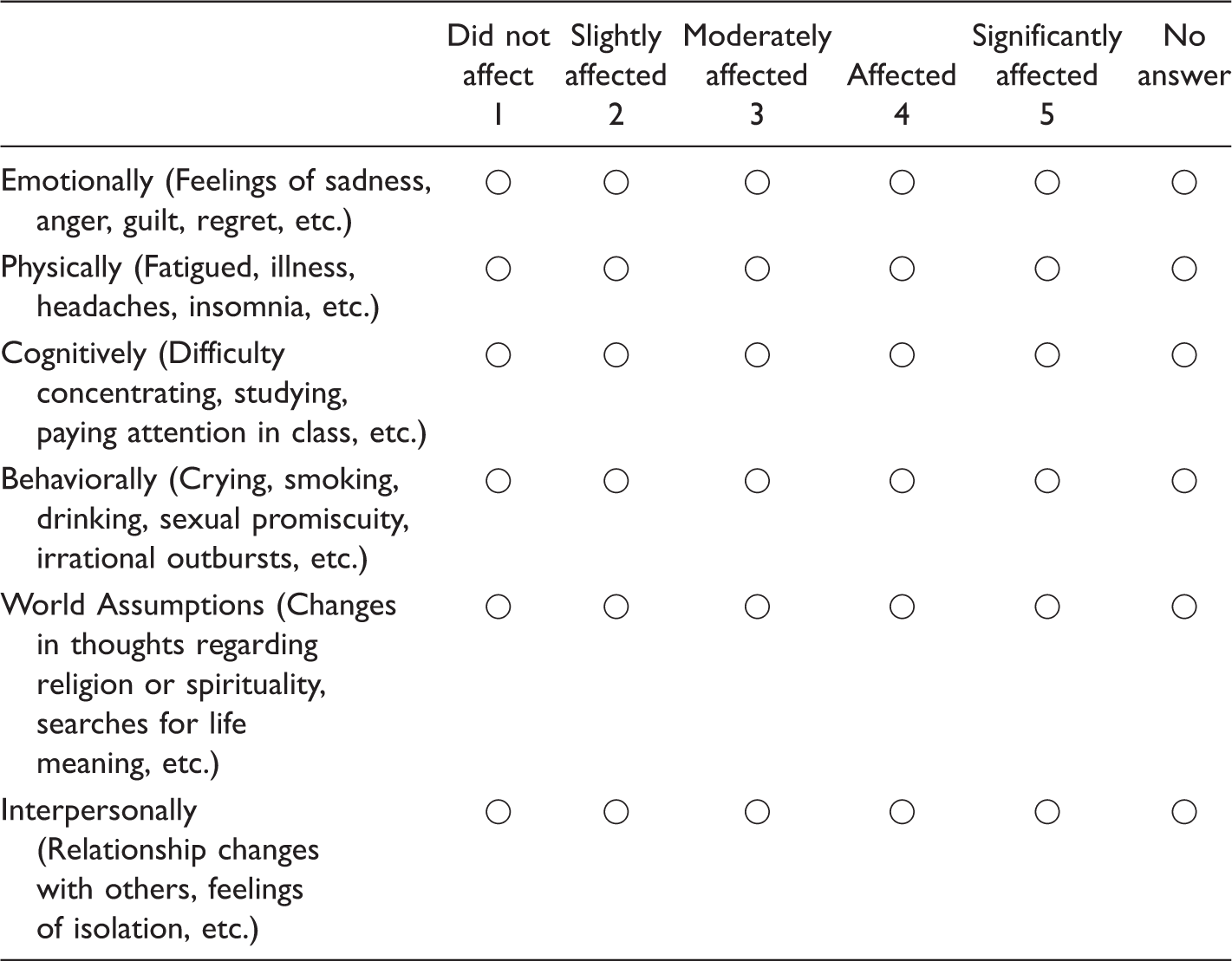
Note. Adapted from Balk (2011).
Participants selected each dimension that personal grief affected during their time as a graduate student, even if they experienced the loss prior to graduate school enrollment. Participants were also given the opportunity to share additional effects not encompassed by the six dimensions by responding to an open-ended question.
The PG-13, comprising the final 13 questions of the survey, gathered data from participants who helped to assess their risk levels for PGD (Prigerson et al., 2009). At the time of the study, the Persistent Complex Bereavement Inventory (2015) did not yet exist, and the PG-13 was the only instrument available to measure this risk. Item response theory and combinatoric analysis (computer analysis) conducted on the PG-13 determined the algorithm for the diagnosis of PGD (Prigerson et al., 2009). The formula incorporates specific symptoms of PGD, which include feelings, thoughts, and actions associated with significant functional impairment at 6 months postloss. These symptoms are measured in five categories: (a) event criterion; (b) separation distress; (c) duration criterion; (d) cognitive, emotional, and behavioral symptoms; and (e) impairment criterion on two different5-point Likert-type scales, as shown in Table 2. Individuals meet the criteria for PGD based on a unique combination of responses to each category.
The PG-13 has well-established reliability and validity (Boelen et al. 2010; Chen et al., 1999; Prigerson et al., 2009), concurrent validity with other scales (Boelen et al., 2010; Prigerson et al., 1995), and incremental validity (Dillen, Fontaine, & Verhofstadt-Deneve, 2009; Tolstikova, Fleming, & Chartier, 2005). Prigerson et al. (1995) reported a Cronbach’s α of .94 and significant concurrent validity with the Beck Depression Inventory (r = .67, p < .001), the Texas Revised Inventory of Grief (r = .87, p < .001), and the Grief Measurement Scale (r = .70, p < .001). Boelen et al. (2010) also found a Cronbach’s α of .94 and a retest temporal stability of .92.
Procedure
After receiving institutional review board approval from each university, an electronic survey was e-mailed to all counseling graduate students at each institution. The e-mail invitation contained an overview of the research study, the voluntary nature of participation, contact information for the researchers, and instructions for indicating consent to participate and begin the survey. Given the sensitive nature of the topic, participants also received contact information for university counseling services on each campus. They were then notified that proceeding to the survey implied their consent. Of the respect for the very personal information participants were asked to reveal, participation was anonymous and no identifying information was collected, including participant contact information or IP addresses. This component of the research design also served to eliminate the power differential and participants’ possible fears regarding impact on their progress as students, given the professional identities of three of the researchers as counselor educators. The researchers hoped to safeguard participants’ rights through these measures, in accordance with the American Counseling Association Code of Ethics (2014).
Results
The purpose of this study was to explore the incidence and effects of grief due to death-related loss among graduate counseling students as well as their risk for developing PGD. This section begins with a brief description of participants and the types of death losses they experienced and then describes the strength of effects of loss in each area of the Holistic Impact of Bereavement model. Next, it examines how time of loss may have influenced the effects of loss. Then, this section further explores how graduate counseling students’ relationship to the deceased impacted grief effects as well as how participants’ level of closeness to the deceased influenced the effects of the loss. Finally, it discusses participants’ risk factors for PGD as assessed by the PG-13.
Incidence of Death-Related Loss and Closeness to Deceased
When asked about loss experiences, most participants (n = 129, 86.0%) had experienced a death-related loss within their lifetime, with the majority of them taking place more than 36 months prior (n = 76, 60.3%). Other participants reported having experienced the loss 25 to 36 months ago (n = 14, 11.1%), 13 to 24 months ago (n = 19, 15.1%), 7 to 12 months ago (n = 6, 4.8%), or 0 to 6 months ago (n = 11, 8.7%). The average number of losses experienced was 3.67. The deceased included participants’ grandparents (n = 54, 42.9%), parents (n = 27, 21.4%), friends (n = 11, 8.7%), and those with whom participants reported “other” relationships (n = 12, 9.5%), including a friend’s father, a mother-in-law, and a mentor. The majority of participants indicated that they felt “very close” (n = 77, 61.1%) or “close” (n = 29, 23.0%) to the deceased, in contrast to others who felt “somewhat close” (n = 19, 15.1%) or “not close at all” (n = 1, 0.8%). The most frequent causes of death reported were illness (n = 63, 50.0%), followed by natural causes (n = 29, 23.0%) and accidents (n = 12, 9.5%). Other causes of death included suicide (n = 9, 7.1%), drug/alcohol use (n = 3, 2.4%), and murder (n = 2, 1.6%). A small number of participants reported “other” as the cause of death (n = 5, 4.0%) or were unsure of the cause (n = 3, 2.4%). The most common cause of death reported within the “other” category was heart attack. Overall, participants reported the losses as both unexpected (n = 68, 54.0%) and expected (n = 58, 46.0%).
Holistic Effects of Loss and Moderating Factors
Criteria for Diagnosing Prolonged Grief Disorder.
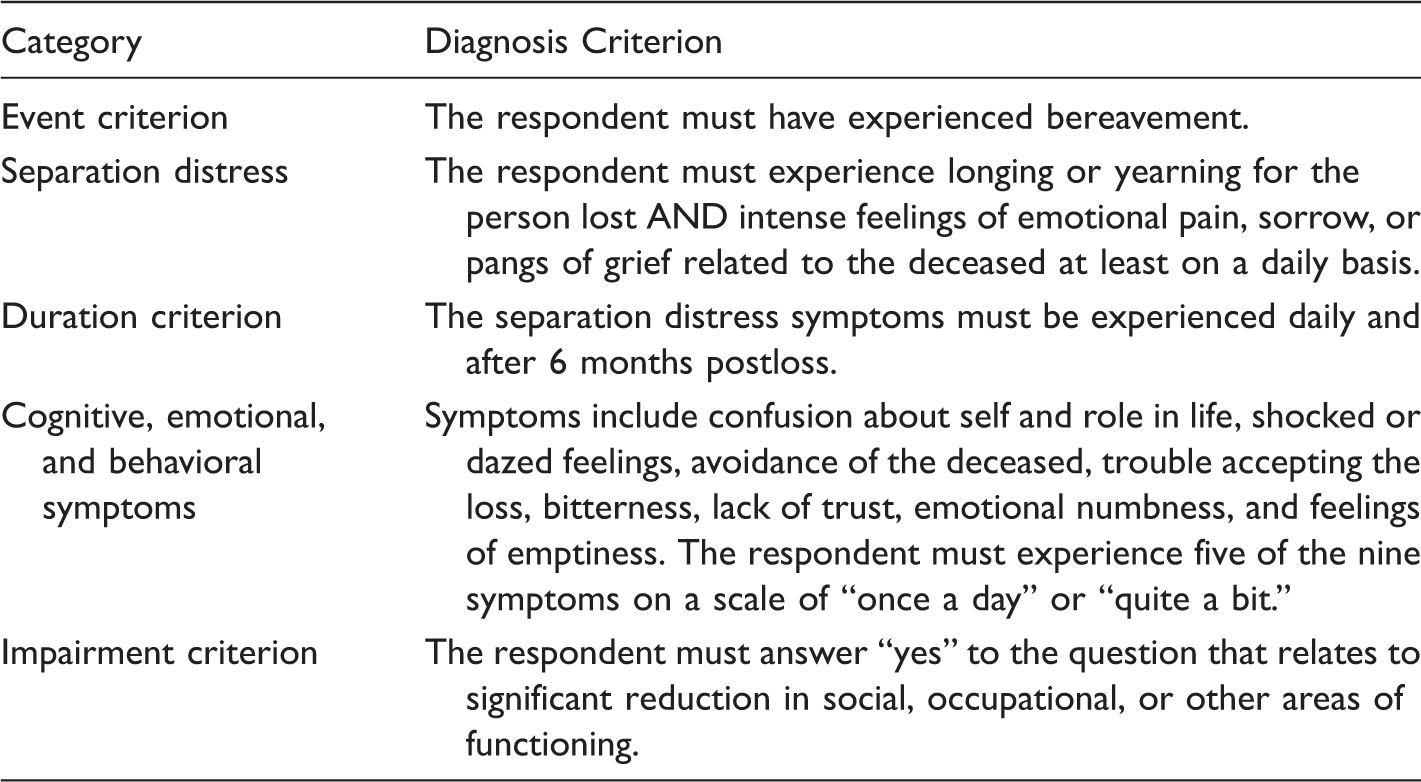
Note. Retrieved from Prigerson et al. (2009).
The authors also performed Kruskal–Wallis H tests to examine if the time of loss impacted grief effects. No statistically significant difference in grief effects existed based on the length of time since the loss had been experienced. Conducting a Mann–Whitney U test to explore the possibility of a statistically significant relationship between grief effects and the expected nature of the loss (expected or unexpected) revealed no statistically significant relationships.
Means of Grief Effects Experienced by Counseling Participants.
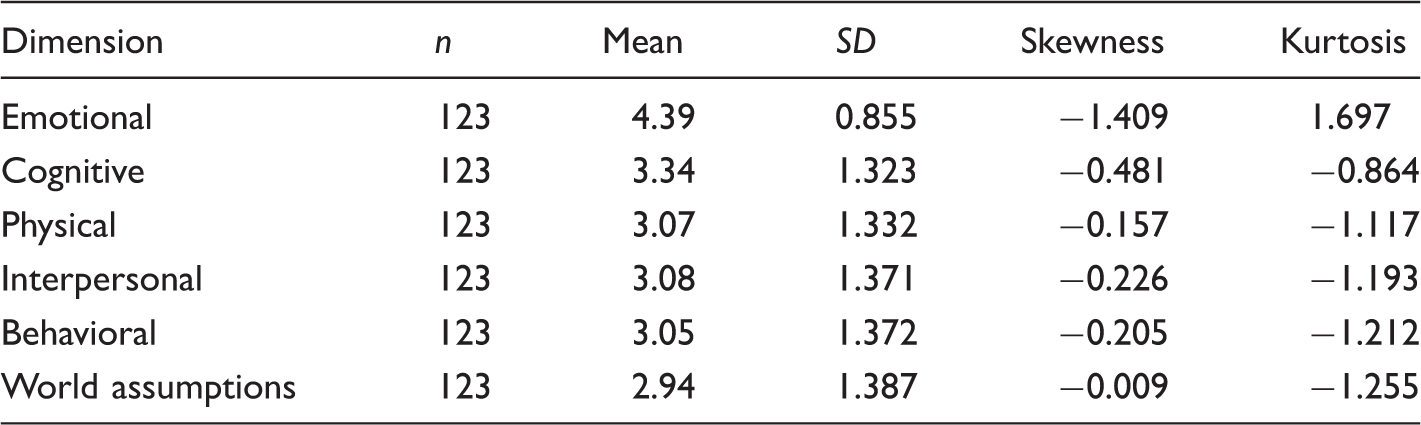
Note. 1 = not affected at all, 2 = slightly affected, 3 = moderately affected, 4 = affected, 5 = significantly affected.
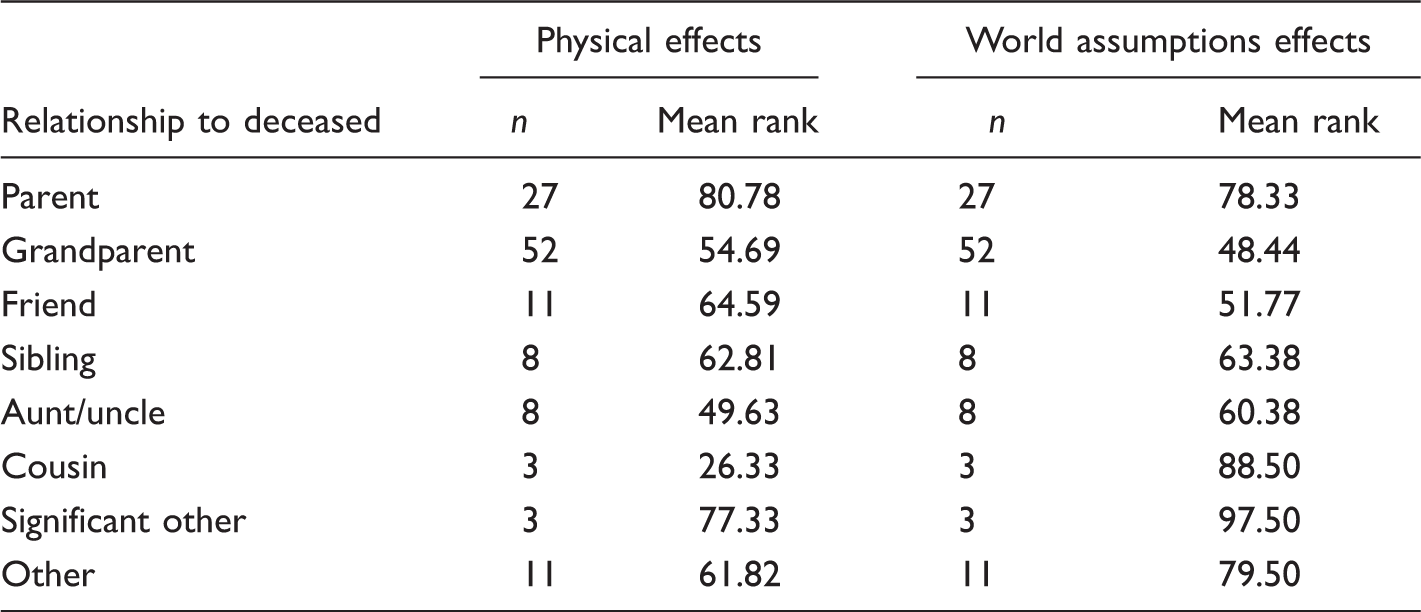
Mean Ranks of Physical and World Assumptions Grief Effects by Relationship to Deceased.
The level of closeness participants reported having to the deceased was examined between all holistic effects. Respondents indicated level of closeness using a 4-point Likert-type scale with the following choices: not close at all, somewhat close, close, or very close. The researchers calculated Spearman’s rank-order correlation coefficient to determine the relationship between level of closeness and effects of loss. Results revealed statistically significant positive relationships between level of closeness and each of the effects of loss: emotional (rs = .319, p < .000), physical (rs = .276, p = .002), cognitive (rs = .255, p = .004), spiritual (rs = .235, p = .009), interpersonal (rs = .234, p = .009), and behavioral (rs = .201, p = .026).
PG-13 Risk Assessment
Each participant who had experienced a loss more than 6 months prior was assessed for PGD using the PG-13 instrument. A diagnostic formula developed by Prigerson et al. (2009) is used to assess PGD. The formula incorporates specific symptoms of PGD, which include feelings, thoughts, and actions associated with significant functional impairment 6 months postloss. These symptoms are measured in five categories: (a) event criterion; (b) separation distress; (c) duration criterion; (d) cognitive, emotional, and behavioral symptoms; and (e) impairment criterion on two different 5-point Likert-type scales. Individuals meet the criteria for PGD based on a unique combination of responses to each category.
When responses were examined for each category, none of the participants who had reached 6 months postloss or longer met the criteria for being at risk of developing PGD. All participants provided self-report information indicating that their loss did not affect their daily functions in the present.
Discussion
Although researchers have begun to investigate the effects of grief on graduate students (Supiano & Vaughn-Cole, 2011; Varga, 2015), a specific focus on counseling graduate students is an area needing further attention. Given that future counselors are often and increasingly tasked with helping others navigate trauma and grief (Ober et al., 2012), it is important to understand the personal loss experiences of these specific students. Therefore, this study’s objectives were to investigate the incidence of grief related to death loss in this population, explore the multidimensional effects of participants’ grief, and assess their risk factors for PGD. The following discussion of key findings highlights each of these aims in turn.
Incidence of Grief
In support of existing literature that depicts grief as a pervasive experience for college students (Balk et al., 2010; Varga, 2015), approximately 83% of this study’s graduate participants had experienced a loss at some point in their lifetime. Although most participants reported losing grandparents as the result of illness, others reported losses ranging from additional family members to acquaintances acquired through various external means (e.g., teachers, family members of significant others, etc.). Participants primarily reported close or very close personal relationships with the deceased, indicating that the losses incurred constituted significant events in their lives. These are noteworthy findings with regard to the pervasiveness of grief among graduate participants and the significance of losses experienced either prior to or during active school enrollment. The statistical findings of the present study are consistent with those of previous research on college student grief, particularly with regard to incidence, relationship, and type of loss (Balk et al., 2010; Varga, 2015). This underscores the need to attend to, as well as understand, the significance and types of losses counseling graduate students experience. Results related to the effects of grief, however, prompt further discussion, particularly as they relate to graduate students in helping disciplines such as counseling.
Grief Effects and Moderating Influences
With regard to holistic grief effects experienced postloss, participants reported strong emotional effects; moderate to strong cognitive effects; and moderate physical, interpersonal, behavioral, and world assumption effects. When compared to the general graduate student population (Varga, 2015), counseling graduate students reported experiencing more grief effects in each holistic dimension—emotional, physical, cognitive, behavioral, world assumptions (spiritual), and interpersonal relationships. While it is difficult to draw a specific conclusion about this finding alone, it does point to the possibility that counseling students, because of the nature of their training, are more self-aware or more sensitive to their own internal responses to events (Council for the Accreditation of Counseling and Related Educational Programs, 2015). Although they may not literally experience greater effects, they may be more apt to notice them and accurately gauge their impact.
The most notable difference was in the reported emotional effect experienced postloss, with counseling graduate students reporting a higher mean average emotional effect (M = 4.39) than the general graduate student population (M = 3.76) in previously reported studies (Varga, 2015). Counselor educators and supervisors should help students to monitor the ways in which their emotional responses to significant loss impact their self-awareness as well as their empathic responses to clients. Particularly in cases of unreconciled grief, students may unwittingly avoid exploring their clients’ emotional responses to loss because of potential reminders of their own grief that could arise (Doughty Horn, Crews, & Harrawood, 2013). Conversely, students acutely experiencing their own grief may overidentify with grieving clients and inadvertently cause harm by way of inappropriate self-disclosure and countertransference. In these instances, supervision focused on helping students to recognize and attend to their grief-related emotional responses, so that they are more able to appropriately focus on their clients may be helpful.
Findings also showed that participants’ relationships to the deceased specifically impacted certain grief effects. Participants who lost parents reported experiencing more significant physical and spiritual effects of grief than those who lost grandparents. This is consistent with research that found that female students who experienced parental loss may be at a high risk for anorectic-related cognitions and behaviors as well as depression, hopelessness, and suicidal ideation (Beam, Servaty-Seib, & Mathews, 2004; Lawrence, Jeglic, Matthews, & Pepper, 2006). The interrelation of significant physical effects, cognitive clarity, and emotional stability may directly take a toll on a student’s ability to perform effectively in a clinical sense. Physical manifestations of grief may be one of the first visible signs that a student is struggling and should be directly attended to by observant counselor educators and supervisors.
These findings regarding spiritual effects also mirror findings of Schwartzberg and Janoff-Bulman (1991) who found that the intensity of grief experienced by college students was significantly correlated with parental overprotectiveness during childhood. Their results indicated that students who experience the loss of a parent are likely to experience a change in their assumptive worlds related to the death. Results also suggested that the more overprotective their parents were during childhood, the more intense grief symptoms students may experience, which may also directly impact their work with clients. Given the emphasis placed on self-care in both counseling training and practice, counselor educators are in an optimal position to engage students experiencing parental loss in dialogue about researched grief effects, their potential for impacting the therapeutic relationship, and options for maintaining holistic health postloss.
Finally, results of this study indicate a statistically significant correlation between closeness and grief effects in each holistic dimension. Participants who reported being closer to the deceased experienced more significant emotional, physical, cognitive, behavioral, world assumptions, and interpersonal effects of loss. This is important to note, as levels of closeness have also been connected to hardiness in college students (Mathews & Servaty-Seib, 2007). Regarding mental health outcomes, prior research indicated that females, in particular, who are high in closeness to the deceased are predicted to have greater negative mental health outcomes than males (Walker et al., 2012). This is an important consideration, given the high number of female students participating in this current study and enrolled in counselor preparation programs in general (Schweiger, Henderson, McCaskill, Clawson, & Collins, 2012).
Risk for Development of PGD
One notable nonsignificant finding of this study was that none of the 119 participants whose loss occurred at least 6 months prior met the criteria for PGD as measured by the PG-13. Although it is not yet known precisely how many bereaved people might meet these criteria in the general population, estimates range from roughly 7% to 10% (Kersting, Brähler, Glaesmer, & Wagner, 2011; Shear et al., 2011). The reasons for the lack of this study’s participants qualifying for PGD are uncertain. Students enrolled in graduate-level counselor training programs may possess increased self-awareness, access to relevant help and support, and lowered stigma associated with experiencing both typical grief responses and diagnostic symptoms. These students also participate in intensive clinical supervision during their training, and it may be that supervisors help them to identify and ameliorate problematic grief before it rises to the level of impairment. As with most self-report measures, there may additionally be an element of conscious or unconscious management of self-presentation among participants, even though responses could not be traced to individual participants. In any case, further study is warranted to determine whether there are internal or external protective factors at work amongst counselor trainees that may keep them from developing symptoms of PGD.
Overall, these specific findings are important for counselor educators to consider. Working with grieving individuals, families, or both is a near certainty for counselor trainees and counseling professionals with graduate degrees. The knowledge, skills, and abilities required for working with grieving populations are important and should prompt an examination of the inclusion and adequacy of academic preparation in grief and bereavement issues (Ober et al., 2012). This becomes especially critical for those graduate students who have no personal experience with loss and may be apprehensive about relating to others facing such issues (Supiano & Vaughn-Cole, 2011) as well as for those who have unresolved issues of grief in their own lives. For those who have personally experienced grief and loss, it may also be important to include opportunities for self-reflection in the training experience.
This study includes several limitations. First, the disciplinary and geographic restrictions under which participants were recruited resulted in a small sample size. Additionally, given that the majority of participants (n = 76; 58.5%) reported losses occurring more than 36 months prior to being surveyed, it is possible that the length of time postloss may have impacted their experience and reporting of relevant grief effects. Another limitation of this study involves its lack of data representing any potential differentiation between survey responders and nonresponders. Finally, the measurement of PGD, as opposed to the DSM-5’s (APA, 2013) newer description of PCBD, constitutes a limitation in accurately assessing participants for risk of the most up-to-date disorder classification.
While future studies should continue to focus on graduate students, researchers may consider extending recruitment efforts to health and helping disciplines beyond counseling as well as training programs in multiple geographic areas. Although all professionals may encounter grief in some capacity, health and helping professionals are particularly susceptible to encountering grief issues with the clients or students with whom they work. Investigating a more robust population would provide more generalizable insight into counseling student grief experiences. Additionally, conducting a mixed methods or qualitative study would provide a more in-depth understanding of how grief affects graduate counseling students, both during their academic training and as budding professionals. It would also provide an opportunity to understand more about the significant physical effects and world assumptions for counseling graduate students based on their relationships to the deceased. Additionally, because most participants reported on losses occurring more than 36 months prior to completing the survey, this study should be replicated with participants whose time since loss is between 6 and 36 months in order to determine whether the more recent time of loss may be a factor in the experience of grief for this population. Future studies should also identify and implement a measure for capturing potentially valuable data that may help to differentiate survey responders from nonresponders. Finally, future research should focus on studying students’ potential for PCBD as the diagnostic criteria and classification further develop. One suggestion for relevant new research would be to examine the common curriculum of existing graduate counseling programs and whether or not the inclusion of grief preparation courses affects graduate students’ own personal experiences with grief.
Conclusion
This study establishes a solid foundation for understanding how grief impacts graduate counseling students holistically, both as individuals and as future helping professionals who will encounter grieving clinical populations. It also highlights a need for continued investigation. Grief and loss are issues that affect all humans at some point during the life span and must be addressed in order to be fully reconciled. The grief experiences of students engaged in graduate-level studies, particularly in programs requiring the provision of helping services to external parties, must be considered at the curricular, clinical, and personal levels. Educators should maintain a particular awareness of the ways in which grief can impact graduate students in each of these domains. By encouraging graduate students to explore, address, reflect on, and process their own personal grief experiences, educators indirectly help those future grieving clients and students with whom counselors in training will undoubtedly work.
Footnotes
Declaration of Conflicting Interests
The authors declared no potential conflicts of interest with respect to the research, authorship, and/or publication of this article.
Funding
The authors received no financial support for the research, authorship, and/or publication of this article.